Feeds:
Posts
Comments

Archive for the ‘Jane Austen’s World’ Category

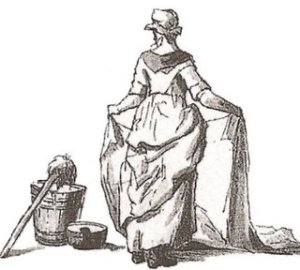
The general servant, or maid-of-all-work, is perhaps the only one of her class deserving of commiseration: her life is a solitary one, and in, some places, her work is never done. She is also subject to rougher treatment than either the house or kitchen-maid – Mrs. Isabella Beeton
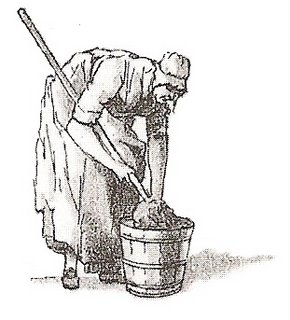
Maid of all work, W.H. Pyne

Maid of all work, W.H. Pyne

Gracie, the maid of all work in Anne Perry’s mystery novels, was lucky. Charlotte Pitt, the wife of Inspector Pitt, was a good and kind mistress who worked alongside her maid and gave gentle instructions. They quickly established a friendly relationship. Charlotte’s kindness did not make Gracie’s work life much easier, but she was luckier than most of her counterparts. In her Book of Household Management, Mrs. Beeton places a maid of all work lower than even a scullery maid. According to Mrs. Beeton, an ambitious scullery maid could learn skills from the kitchen maids and cook and move up the servant ranks, whereas a maid of all work was generally stuck in her position.

As with the scullery maid, the maid of all work was generally a very young girl. She could also be a mature woman so down on her luck that the only other choices open to her were life on the streets or finding shelter in a work house, which was to be avoided at all costs. In Mansfield Park Fanny’s family in Portsmouth is described as being poor, yet even they were able to hire a maid of all work, so you can just imagine what the work conditions were like for these poor women, who literally did everything from cooking, sweeping the floors, hauling water, carrying out slops, looking after the pets and children, laundering, changing the beds, and serving the family at mealtimes. Maids of all work were the first to rise and the last to go to bed. If the house was small, they were lucky to receive a pallet to sleep near the fire in the kitchen. As for time off to rest and recuperate, a maid of all work was at the mercy of her employer.

The following description of a maid of all work comes from ‘The Dictionary of Daily Wants’ – 1858-1859:

MAID OF ALL WORK. – A domestic servant, who undertakes the whole duties of a household without assistance; her duties comprising those of cook, housemaid, nurserymaid, and various other offices, acccording to the exigencies of the establishment. The situation is one which is usually regarded as the hardest worked and worst paid of any branch of domestic servitude; it is, therefore, usually filled by inexperienced servants, or females who are so circumstanced that they are only desirous of securing a home, and of earning sufficient to keep themselves decently clad. In many of these situations, a servant may be very comfortably circumstanced, especially if it be a limited family of regular habits, and where there is a disposition to treat the servant with kindness and consideration.

The duties of a maid of all work being multifarious, it is necessary that she should arise early in the morning; and six or half-past six o’clock is the latest period at which she should remain in bed. She should first light the kitchen fire, and set the kettle over to boil; then she should sweep, dust, and prepare the room in which breakfast is to be taken. Having served the breakfast, she should, while the family are engaged upon that meal, proceed to the various bedchambers, strip the beds, open the windows, &c. This done, she will obtain her own breakfast, and after washing and putting away the things, she will again go upstairs, and finish what remains to be done there.

W.H. Pyne, Microcosm of London

W.H. Pyne, Microcosm of London

As the family will in all probability dine early, she must now set about the preliminaries for the dinner, making up the fire, preparing the vegetables, &c. After the dinner is cleared away, and the things washed and put by in their places, she must clean the kitchen; and this done, she is at liberty to attend to her own personal appearance, to wash and dress herself, &c. By this time the preparation for tea will have to be thought of, and this being duly served and cleared away, she must employ herself in needlework in connection with the household, or should there happen to be none requiring to be done, she may embrace this opportunity to attend to her own personal necessities. Supper has then to be attended to; and this finished, the maid of all work should take the chamber candlesticks, hot water, &c., into the sitting-room, and retire to rest as soon as her mistress or the regulation of the establishment will permit her.

The duties here set down can only be regarded as an outline rather than a detail, the habits of every family varying, and thereby regulating the amount of labour demanded, and the order in which the duties are to be performed. As a rule, however, a maid of all work, if she wish to retain her situation, must be industrious, cleanly, and thoughtful; and not only able to work, but to plan.
Read Full Post »

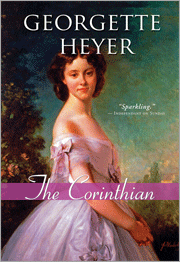
corinthianGentle Reader,

As you may have guessed from our reviews, SourceBooks has been reissuing a series of Georgette Heyer novels for summer reading, The Corinthian among them. I ‘ve spent many pleasant hours  journeying through Regency England from London to Bath to Sussex with Georgette’s scintillating characters, wishing I were as bright and witty in my repartee as her heroines, and that the men in my life were as dashingly romantic. If you’ve never tried a Georgette Heyer regency novel before, now is a good time to read one.

Pen Creed, the 17-year-old heroine of The Corinthian might be a tad young and naïve, but she is fearless in her dealings with the world and a most decidedly determined young lady. Rather than wait for her aunt to force her into an engagement with her fish-faced cousin, she has cropped her hair, put on boy’s clothes, and embarked on a journey to find Piers, her child hood friend. Having vowed to marry each other five year before, Pen is convinced that Piers will greet her with a great deal of pleasure and live up to his boyish promise.

Enter the Corinthian. At 29, Sir Richard Wyndham is a little drunk, bored beyond calculation, and feeling that he is the unluckiest dog alive. He is about to become betrothed to a woman so cold-blooded in nature that she could freeze the Arctic Ocean solid for two miles down. The night before he is to formally ask for her hand, Sir Richard encounters Pen dangling from knotted bed sheets several feet short of the pavement. Hearing her cries for help, he comes to her rescue and listens to her with aristocratic aplomb as she explains her convoluted reasons for running away in the middle of the night. Wanting to leave London to buy himself some time, he escorts Pen on a public coach to her destination.

Georgette’s heroine is much, much younger than the hero, which initially gave me a few misgivings, but both characters are so likeable that one can’t help cheering them on as they embark on their splendid adventure. While Pen resembles a fresh-faced urchin, Sir Richard is a resplendent example of the Regency dandy and sporting man. Georgette’s description of him could fit Beau Brummell to a tee:

He was a very notable Corinthian. From his Wind-swept hair (most difficult of all styles to achieve), to the toes of his gleaming Hessians, he might have posed as an advertisement for the Man of Fashion. His fine shoulders set off a coat of of superfine cloth to perfection; his cravat, which had excited George’s admiration, had been arranged by the hands of a master; his waistcoat was chosen with a nice eye; his biscuit-coloured pantaloons showed not one crease; and his Hessians with their jaunty gold tassels, had not only been made for him by Hoby, but were polished, George suspected with a blacking mixed with champagne. A quizzing-glass on a black ribbon hung round his neck; a fob at his waist; and in one hand he carried a Sevres snuff-box. His air proclaimed his unutterable boredom, but no tailoring, no amount of studied nonchalance, could conceal the muscle in his thighs, or the strength of his shoulders. Above the starched points of shirt-collar, a weary, handsome face showed its owner’s disillusionment.

Sir Richard is thrown into situations in which all of his ingenuity and influence are required. He must deal with a mystery regarding a stolen diamond necklace, a murder, things that go bump in the night, and Pen’s discovery that Piers has all but forgotten their childhood pledge. The young man has fallen madly in love with Lydia, a prettily plumb and silly female who, as she ages, will be prone to fits and vapors, and to whom he is secretly engaged. Unlike Pen, Sir Richard realizes at this point that he has compromised her and that they must marry. Not that he quails at the thought. Pen, who has fallen for her dashing and dependable escort, does not want to be his “obligation.” Instead, she concentrates her efforts on uniting Piers and Lydia, whose union is forbidden by their families. By the final pages, the plot and plottings have become so twisted that Sir Richard can only exclaim:

I am recalling my comfortable home, my ordered life, my hitherto stainless reputation, and wondering what I can ever have done to deserve being pitchforked into this shameless imbroglio!

3 regency fansRest assured that Sir Richard has never had so much fun in his life. At the end of the novel, his adventures with Pen lead to a romantic conclusion. To say that I enjoyed myself while reading this fast-paced romp is to state the obvious, and I give this delightful book 3 out of 3 regency fans.
Order The Corinthian here. Coming up next: My review of The Grand Sophy!

Other Heyer book reviews:

Read Full Post »


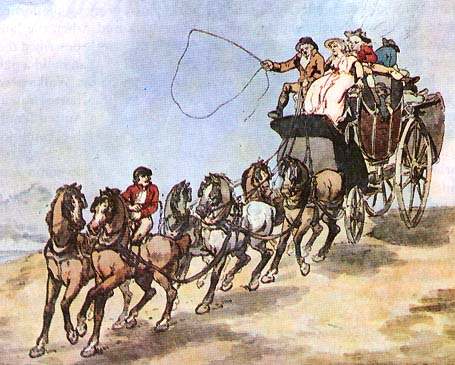
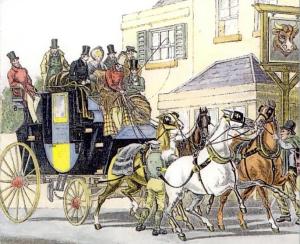
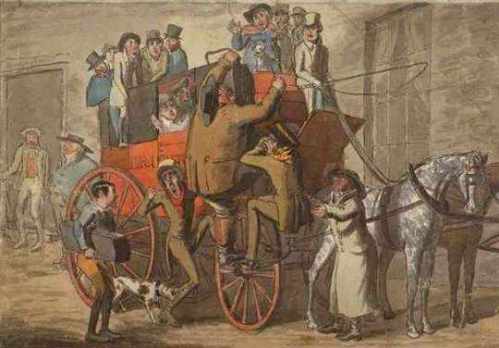
Stage coach travel. Notice the number of passengers laden on the coach and the number of horses.

Stage coach travel. Notice the number of passengers laden on the coach and the number of horses.

At the height of 19th century coaching days Northallerton in North Yorkshire had four inns that catered to travellers – the Black Bull, the King’s Head, the Old Golden Lion and, the largest, the Golden Lion. Horses that pulled the public coaches suffered mightily for the sake of speed. In a previous post I had already discussed that if forced to run at breakneck speed, coach horses did not last longer than three years. Recently I ran across this description:

The Highflyer changed horses at the King’s Head but the horses belonged to Mr Frank Hirst. This coach was driven by a coachman called Scott, a very big fellow of the Old Weller type who had to be hauled into his seat and nearly broke the coach down. The Express also stopped at the King’s Head but the horses that worked this coach stood at the Waggon and Horses and belonged to Mr Hall of Northallerton. The Wellington London and Newcastle coach changed horses at the Golden Lion and was horsed by Mr Frank Hirst. At one time it was driven by Ralph Soulsby, who was a terror to drive, and it is on record that once during a period when the Wellington was running in opposition he succeeded in killing three out of his four horses on the short stage seven miles from Great Smeaton to Northallerton. Opposition coaches were terribly hard on horseflesh; they used to gallop every inch of the road up hill and down dale, and Soulsby’s third horse dropped dead just opposite the church, and he finished his journey to the Golden Lion with but a single horse. When the railway began to supersede the road and coach after coach began to fall away, the Wellington still held on until it at last stood alone. One of the oldest and first coaches on the road, it had withstood the tide of opposition through all time until it remained the absolute last regular coach running on this section of the Great North Road. The old coaching days in Yorkshire By Tom Bradley

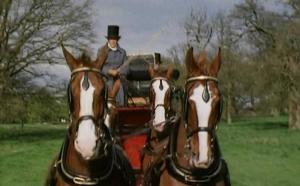
Coach and four

Coach and four

Horses were chattel and the general attitude towards beasts of burden during the Regency Era was one of exploitation. Fresh teams of horses were kept ready to replace an exhausted team that had just run the previous stage of a journey. These teams were contracted to stage lines or the Royal Mail. Other horses were available to be leased by individuals. Crack teams of hostlers prided themselves in changing mail coach teams in as little as three minutes. The combined refinements in coach design, and in road construction and maintenance allowed the heavy coach horses to be replaced by teams of faster half-bred or pure Thoroughbred horses. The luxurious coaches of the wealthy pulled by warmblooded horses or Thoroughbreds seemed to fly down the better roads at the unheard of speed of ten miles per hour. *

Coach leaving Brighton, 1840

Coach leaving Brighton, 1840

It wasn’t until 1821, that Colonel Richard Martin, MP for Galway in Ireland, introduced the Treatment of Horses bill. This piece of legislature was greeted by laughter in the House of Commons. The first known prosecution for cruelty to animals was brought in 1822 against two men found beating horses in London’s Smithfield Market, where livestock had been sold since the 10th century. They were fined 20 shillings each. Colonel Martin’s “Ill Treatment of Horses and Cattle Bill,” or “Martin’s Act”, as it became known, was finally passed in 1822 and became the world’s first major piece of animal protection legislation. Not much changed for working horses, however.  After a coaching horse’s usefulness ended, they were sold to labor for others**:

Mrs Mountain of the Saracen’s Head kept some 2,000 horses in her stables for the routes she served. Lord William Lennox sometime later estimated that it took some 2 pounds per week to keep coach horses. It is also estimated that the life of a coach horse was some three years. After that they were sold for they still had significant working life left. It was the nature of coaching with the strain of pulling a coach weighing more than 2 tons for an average of 10 miles at a speed of some 12 miles per hour 2 days out of 3.  Farm work seemed easy by comparison. – Coaching Inns

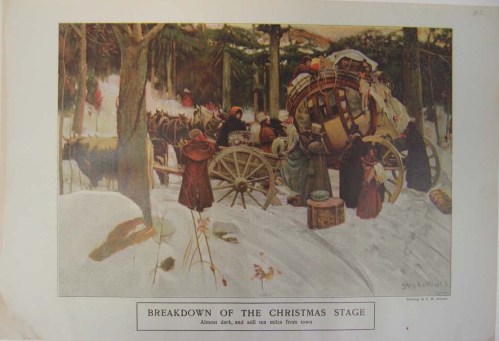
The Breakdown of the Christmas Stage shows how heavily laden the coaches were

The Breakdown of the Christmas Stage shows how heavily laden the coaches were

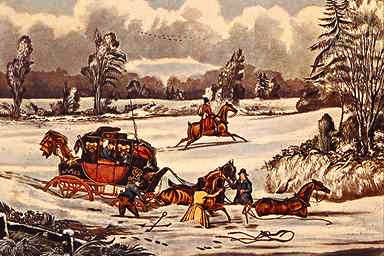
A society that lacked adequate social service systems to take care of the poor did not place a high priority on the ethical treatment of animals. Cockfighting, bear baiting, and dog fights were common”betting” sports prevalent during the Regency Period. A retired coach horse would have an easier life plowing a farmer’s field than pulling a coach. Accidents were frequent, but horses were seldom given a break, forced to struggle through blizzards and quagmire after passengers alighted and luggage was taken off to lighten the load. Not every horse led a harsh life. The following excerpt describes a private, more benevolent owner, the Rev. George Bennet, Jane Austen’s father, whose horses pulled heavy carriages over poor roads:

Coach stuck in snow

Coach stuck in snow

A carriage and a pair of horses were kept. This might imply a higher style of living in our days than it did in theirs. There were then no assessed taxes. The carriage, once bought, entailed little further expense; and the horses probably, like Mr. Bennet’s, were often employed on farm work. Moreover, it should be remembered that a pair of horses in those days were almost necessary, if ladies were to move about at all; for neither the condition of the roads nor the style of carriage-building admitted of any comfortable vehicle being drawn by a single horse. When one looks at the few specimens still remaining of coach-building in the last century, it strikes one that the chief object of the builders must have been to combine the greatest possible weight with the least possible amount of accommodation. – Memoir of Jane Austen by James Edward Austen-Leigh, Description of life at Steventon

Rowlandson, Coach Travel

Rowlandson, Coach Travel

Read Full Post »

Layout 1Gentle Readers, This Georgette Heyer book is reviewed by Lady Anne, a paragon of friendship and nonpareil of GH reviewers. She is someone who, to my way of thinking, is “without an equal.”  In celebration of all things Georgette Heyer and Jane Austen, my regency-loving friends and I will partake of pâté, whole wheat triscuits, grapes, and French wine tonight. Here then, for your summer reading pleasure, is Lady Anne’s review of The Nonesuch, another incomparable offering by Sourcebooks.
A ‘nonesuch’ is something unrivalled, a paragon, or something like nothing else. The hero in Georgette Heyer’s romance entitled The Nonesuch is indeed all of the above. Sir Waldo Hawkridge has been nicknamed Nonesuch by those of the Corinthian set, because he could do it all: drive, ride, shoot, fish, box, dress elegantly in an unobtrusive fashion suiting his splendid physique. The book begins as Sir Waldo has been named the heir to an elderly and eccentric cousin; others in the Family had attended the reading of the Will in vain hope, where we meet also the two younger cousins who have looked up to and been assisted by Waldo – one well, and one poorly –as they have grown from grubby schoolboys to young men about Town. And we discover another attribute of Sir Waldo’s that truly makes him a paragon.

Many of the heroes in Heyer’s frothy Regency romances are jaded with society and its predictable lifestyles. Over-burdened with family members wanting something from them, or chased by match-making mamas more interested in the money and pedigree attached to their names, knowing that they must marry for the sake of the family, they are bored with life as only idle rich can afford to be. Sir Waldo, however, has followed his parents’ examples and precepts: “My father and my grandfather before him,” he tells a character in the book, “were considerable philanthropists, and my mother was used to be very friendly with Lady Spencer – the one that died a couple of years ago, and was mad after educating the poor. So you may say that I grew up amongst charities! This was the one that seemed to me more worth the doing than any other: collecting as many of the homeless waifs you may find in any city as I could, and rearing them to become respectable citizens….”

Here for once is a wealthy man who is interested not only in his own amusements, but also actively considers his responsibilities and pursues good works: the epitome of noblesse oblige.
Waldo plans to house some 50 orphans in his new legacy, but before he has made the renovations to the house and made the contacts with the people in Leeds, he doesn’t want it widely known.

The Nonesuch takes place in Jane Austen’s England, with the village society, country house parties, and gossip. There is a broader range of society here than in London where they would stay stratified within the ton; some of the families here are definitely below the salt. It is another example of the changing times. But like any Austen neighborhood when a new bachelor finds his way there, parties abound. And romance flourishes.

The Nonesuch also tends to his philanthropic business, first by seeking out the vicar to get his assistance in getting his business done in Leeds. The town appears in the book as a nearby shopping mecca for the young ladies, but its interest to our hero is that it was one of the fast-growing factory towns that thrust England into the forefront of the world as the Industrial Revolution changed the way all the classes interacted. The Enclosure Acts of the late 18th and early 19th Century took away the wherewithal of many of the poorest classes to earn their living from the land by assigning the use of previous open land to the local lord. The poor flocked to the cities and the factories to sustain themselves, not always to the best effect for their health. Illness, malnutrition, and drunkenness took their toll, and the Nonesuch found plenty of the ‘brats’ under the auspices of the parish, for whom he could do a great deal.

Which is not to say that we actually see Sir Waldo meeting with the good people of Leeds; his work is alluded to obliquely in several different situations throughout the book, moving the plot along.

More to our immediate interest, Sir Waldo also finds in the neighborhood one Ancilla Trent, a young lady of impeccable breeding, currently working as a companion to a beautiful and amazingly spoiled young minx. Like Sir Waldo, Ancilla is serious-minded person. Not one to become a financial drain on her family, she gives up her chance in the Marriage Mart to work first as a teacher and then to keep the lovely and headstrong Tiffany Weld from destroying her own chances at a good marriage; Tiffany is wealthy, but she is mercantile rather than gentry, barely seeing the point of basic courtesy, and much too sure of her position as most beautiful heiress in the area. With all the young men of the neighborhood, Sir Waldo’s two young cousins, the young ladies of the neighborhood, as well as Tiffany, we have all the ingredients for plenty of delightful parties and outings, an abundance of amusing chatter, and one of the very best last scenes any book could ask for.

The Nonesuch looks like a typical Regency romance, but as Georgette Heyer always provides, there is much more between the covers.

Read Full Post »

Georgian town houses in Bath

Georgian town houses in Bath

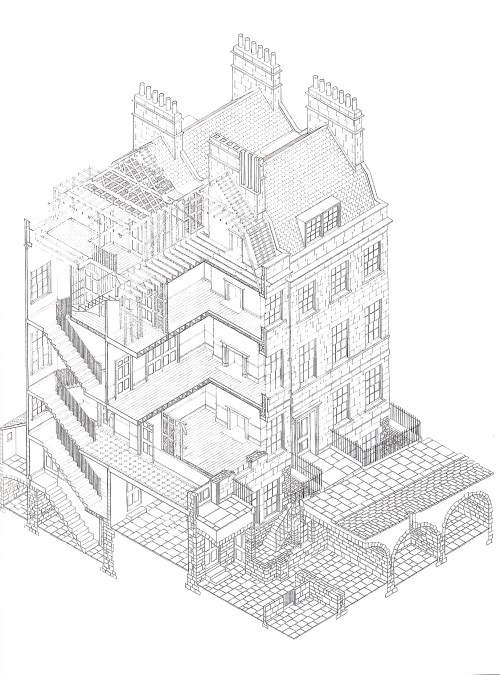
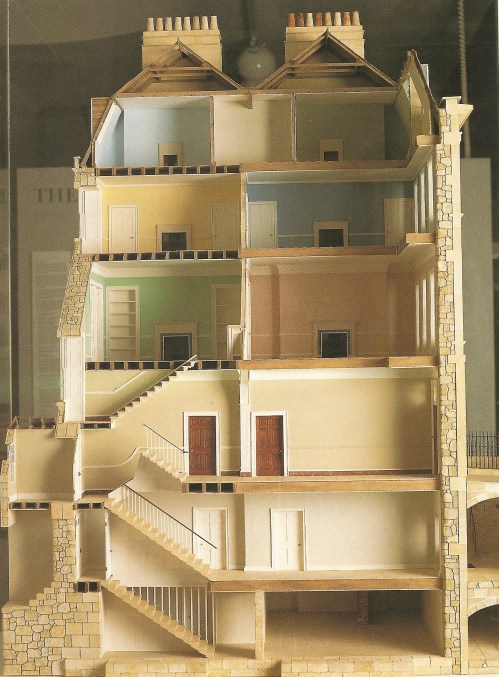
Cutaway of a Bath town house

Cutaway of a Bath town house

When we think of Regency architecture we think of the beautiful Georgian architecture so popular in Bath and Brighton. While there were subtle variations in design and detail, the basic plan for First Rate houses was similar to Fourth Rate houses*.

Bath Regency town house

Bath Regency town house

  1. The basement, or subterraneans section: All except the poorest houses had basements. They were occupied by the kitchens and other servant offices. The housekeeper and cook might be given rooms in this area away from the maids who slept in the attic.
  2. Ground floor: The drawing room was placed near the front door so that it was easily accessible. Drawing rooms were a place to greet visitors and where the women of the house could retreat. The humbler parlor was generally a private room where the family could retire. Furnishings in the drawing room were generally more feminine than those in the adjacent dining room. Double doors would lead to the dining room, which was more austere and masculine in nature. After dinner the men would remain there to enjoy conversation over port and cigars, while the women retreated to the drawing room. The closer the dining room was located to the kitchens, the warmer the food remained when it arrived at the table.
  3. The first floor: Featured a large room for entertaining on a grand scale, such as dancing, card playing, or other fashionable pastimes. This floor might also hold the principal bedrooms, which were generally placed in front of the house. The bedrooms would be decorated lavishly and in the latest style.
  4. The second floor: Featured bedrooms for children, or perhaps a lodger or guests.  Little expense went into decorating the nursery in comparison to the lower bedrooms. As the levels rose, the complexity of room decorations were simplified since fewer visitors bothered to climb the stairs to the upper levels. In general furnishings, mouldings, and decorations were modest on these floors.
  5. The attic: Reserved for the servants, whose beds were often like murphy beds and let down from the wall.  These rooms were cheaply painted and furnished.
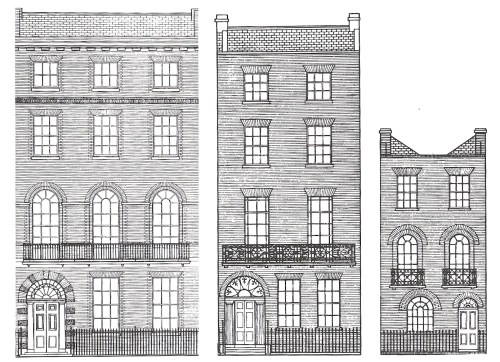
Georgian houses: first rate, second rate, and fourth rate

Georgian houses: first rate, second rate, and fourth rate

Throughout the 17th century, London houses had been susceptible to big fires that swept through narrow, twisting lanes in the city’s center and houses made of timber. A series of Rebuilding Acts specifying building construction followed the Great Fire of 1666 that destroyed over 14,000 houses. A rise in population generated demand for housing, encouraging land owner to develop large tracts of land. The Building Act of 1774 prescribed how houses were to be built. The act specified the use of stone or brick and determined the width of the street, the size of the houses, floor to ceiling heights, and the layout of the houses. It also defined the four types of houses that could be built in London. Each of these types were standardized and followed strict building guidelines:

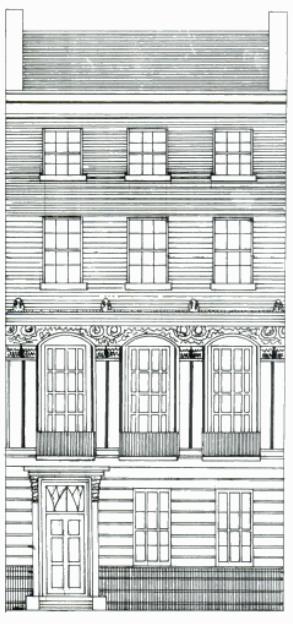
First Rate House: Worth over £850 per year in ground rent and occupied over 900 square feet of space. These houses faced streets and lanes.

First rate house

First rate house

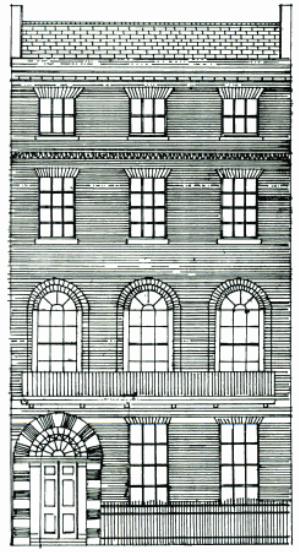
Second Rate Houses: Worth between £350 and £850 in ground rent and occupied 500-900 square feet of floor space. They faced streets, lanes of note, and the RiverThames.

Second rate house

Second rate house

Third Rate Houses: A smaller house worth around £150-£300 and occupied 350-500 square feet. They faced principal streets.

Fourth Rate House: Worth less than £150 per year in ground rent and occupied less then 350 square feet. These houses stood in their own ground.

About ground rent:
Land owners improved their land by laying out roads and services.  They then charged rent on this land. Housing developers (landlords) would build spec houses on the improved land and generate an income from leaseholders by collecting rent. Sometimes the land owner and the house landlord were the same person. These people were usually owners of great estates, which were better managed and the most sought after. Original leases were for as little as 33 years, but by the end of the Georgian era the length of time for many leases was increased to 99 years.

Curiously, the people who paid rent on large houses belonged to the nobility or gentry or prosperous merchants. While they did not own the houses they lived in, they received enormous incomes from their properties and businesses.

Read Full Post »

« Newer Posts - Older Posts »