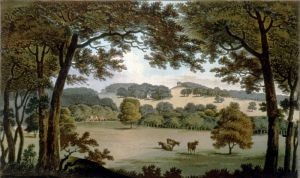
Wentworth Before, Humphry Repton
One of the biggest names in landscaping during the late 18th and early 19th centuries was Humpry Repton (1752-1818), a self-made man who transformed the formal landscapes around England’s great houses along more natural, fluid, and graceful lines. Repton, who saw the relationship between house and landscape as a picturesque whole, wrote:

Wentworth After, Humphry Repton
“In landscape gardening everything may be called a deception by which we endeavour to make our works appear to be the product of nature only. We plant a hill to make it appear higher than it really is, we open the banks of a natural river to make it appear wider, but whatever we do we must ensure that our finished work will look natural or it would fail to be agreeable.” Agreeable meant adding cattle or deer as focal points, and architectural structures that drew the eye. At times, entire villages were transported away from the great house and mature trees were transplanted so that the bucolic vision of manse and land could remain unspoiled and natural.

Transplanting trees, 1794, Hayes
In following his vision, Repton moved roads, created ponds, planted copses, and built architectural structures. An artist, he painted his vision of how the property would look in 50 years in a series of red books, many of which still survive. Stoneleigh Abbey, the ancestral home of Jane Austen’s mother’s family, was one of Repton’s most important commissions. Those who are planning to visit Stoneleigh Abbey will have an opportunity to view Repton’s red book for the Leighs, which took him a year to create and which will be on exhibit through 2009. Repton’s famous red books showed painted scenes of the landscape before and after his transformations. In Observations on the Theory and Practice of Landscape Gardening, he wrote:
“The perfection of landscape gardening consists in the four following requisites. First, it must display the natural beauties and hide the defects of every situation. Secondly, it should give the appearance of extent and freedom by carefully disguising or hiding the boundary. Thirdly, it must studiously conceal every interference of art. However expensive by which the natural scenery is improved; making the whole appear the production of nature only; and fourthly, all objects of mere convenience or comfort, if incapable of being made ornamental, or of becoming proper parts of the general scenery, must be removed or concealed”.
In 1796, following his own advice, Repton painted two watercolours for Whiton, the seat of Samuel Prime, esq., as seen below – (Images from Plants and Gardens Portrayed.)

Whiton, View from the Saloon Before, Humphry Repton, 1796

Whiton, View from the Saloon After, Humphry Repton, 1796
Jane Austen famously mentioned Repton and the vogue for landscape transformations in Mansfield Park:
“Mr. Rushworth,” said Lady Bertram, “If I were you, I would have a very pretty shrubbery. One likes to get out into a shrubbery in fine weather.”
Mr. Rushworth was eager to assure her ladyship of his acquiescence, and tried to make out something complimentary; but, between his submission to her taste, and his having always intended the same himself, with the superadded objects of professing attention to the comfort of ladies in general, and of insinuating that there was one only whom he was anxious to please, he grew puzzled, and Edmund was glad to put an end to his speech by a proposal of wine. Mr. Rushworth, however, though not usually a great talker, had still more to say on the subject next his heart. “Smith has not much above a hundred acres altogether in his grounds, which is little enough, and makes it more surprising that the place can have been so improved. Now, at Sotherton we have a good seven hundred, without reckoning the water meadows; so that I think, if so much could be done at Compton, we need not despair. There have been two or three fine old trees cut down, that grew too near the house, and it opens the prospect amazingly, which makes me think that Repton, or anybody of that sort, would certainly have the avenue at Sotherton down: the avenue that leads from the west front to the top of the hill, you know,” turning to Miss Bertram particularly as he spoke. But Miss Bertram thought it most becoming to reply—
“The avenue! Oh! I do not recollect it. I really know very little of Sotherton.”
Fanny, who was sitting on the other side of Edmund, exactly opposite Miss Crawford, and who had been attentively listening, now looked at him, and said in a low voice—
“Cut down an avenue! What a pity! Does it not make you think of Cowper? ‘Ye fallen avenues, once more I mourn your fate unmerited.’”
He smiled as he answered, “I am afraid the avenue stands a bad chance, Fanny.”
“I should like to see Sotherton before it is cut down, to see the place as it is now, in its old state; but I do not suppose I shall.”
“Have you never been there? No, you never can; and, unluckily, it is out of distance for a ride. I wish we could contrive it.”
“Oh! it does not signify. Whenever I do see it, you will tell me how it has been altered.”
“I collect,” said Miss Crawford, “that Sotherton is an old place, and a place of some grandeur. In any particular style of building?”
“The house was built in Elizabeth’s time, and is a large, regular, brick building; heavy, but respectable looking, and has many good rooms. It is ill placed. It stands in one of the lowest spots of the park; in that respect, unfavourable for improvement. But the woods are fine, and there is a stream, which, I dare say, might be made a good deal of. Mr. Rushworth is quite right, I think, in meaning to give it a modern dress, and I have no doubt that it will be all done extremely well.”
Miss Crawford listened with submission, and said to herself, “He is a well–bred man; he makes the best of it.”
“I do not wish to influence Mr. Rushworth,” he continued; “but, had I a place to new fashion, I should not put myself into the hands of an improver. I would rather have an inferior degree of beauty, of my own choice, and acquired progressively. I would rather abide by my own blunders than by his.”
“You would know what you were about, of course; but that would not suit me. I have no eye or ingenuity for such matters, but as they are before me; and had I a place of my own in the country, I should be most thankful to any Mr. Repton who would undertake it, and give me as much beauty as he could for my money; and I should never look at it till it was complete.”
“It would be delightful to me to see the progress of it all,” said Fanny.
“Ay, you have been brought up to it. It was no part of my education; and the only dose I ever had, being administered by not the first favourite in the world, has made me consider improvements in hand as the greatest of nuisances. Three years ago the Admiral, my honoured uncle, bought a cottage at Twickenham for us all to spend our summers in; and my aunt and I went down to it quite in raptures; but it being excessively pretty, it was soon found necessary to be improved, and for three months we were all dirt and confusion, without a gravel walk to step on, or a bench fit for use. I would have everything as complete as possible in the country, shrubberies and flower–gardens, and rustic seats innumerable: but it must all be done without my care. Henry is different; he loves to be doing.” – Mansfield Park, Chapter 6
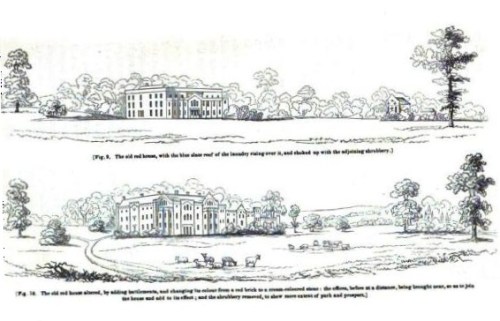
Repton's suggested improvements for house and landscape, p. 48, The Landscape Gardening and the Landscape Garden of the Late Humprhey Repton
Repton, who was prolific in his thirty year career, taking on over 400 commissions, believed in providing picturesque vistas that included focal points from certain stops along a circuitous path wending its way through the landscape. He wrote how he accomplished this:
First, by collecting the wood into larger masses and distinguishing the lawns in a broad masterly manner without the confused frittering of too many single trees;
Secondly, by the interesting line of road winding through the lawn;
Thirdly, by the introduction of cattle to enliven the scene; and
Lastly, by the appearance of a seat on the knoll and a part of the house with its proposed alterations displaying its turrets and pinnacles amongst the trees. – The Landscape Gardening and Landscape Architecture of the Late Humphrey Repton, Esq Being His Entire Works on These Subjects By Humphry Repton, John Claudius Loudon
Learn More About Humphry Repton by clicking on these links:
Hayes Image: Lasdun, Susan. The English Park, Royal, Private and Public. London. 1991, p 103. Print.
Read Full Post »
As 21st century guys, we can learn a lot from the attitudes and behaviors displayed in Jane Austen’s novels. While it would be possible to argue that Austen uses her novels to construct attributes of an ideal man (and this may be a very valid point), I believe the qualities that these men posses are worth striving for in our lives. Men today would do well to learn from their ability to be confident without being cocky, chivalrous without being demeaning; maintaining the honor and dignity of the women in our lives, observant and responsive to the needs of those around us, and models of integrity in how we spend our time and resources. It’s probably obvious that I believe masculinity today has been somewhat distorted. Reviving Austen’s ideals would do much to reinvigorate how we as men perceive ourselves, the world (and women) around us, and, in turn, how they perceive us as well. – Jane Austen and the 21st Century Man




 Philip Sheppard, who wrote Crystallized Beauty, a musical piece that was used to advertise the Jane Austen Season for ITV last year, has made his







 Jane Austen's World