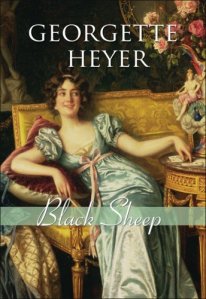
Inquiring readers, This Georgette Heyer novel, written in her mature years and recently reissued by Sourcebooks, will help you wile away the winter doldrums. Her scintillating dialogue is at its best in Black Sheep, as this snippet of conversation between Abigail Wendover and Miles Caverleigh reveals:
“Yes, that’s it. I’m his Uncle Miles.”
” Oh!” she uttered, staring at him in the liveliest astonishment. “You can’t mean that you are the one who …” She broke off in some confusion, and added hurriedly. “The one who went to India!”
He laughed. “Yes, I’m the black sheep of the family!”
She blushed, but said,”I wasn’t going to say that!”
“Weren’t you? Why not? You won’t hurt my feelings!”
“I wouldn’t be so uncivil! And if it comes to black sheep … !”
“Once you become entangled with Calverleighs, it’s bound to,” he said. “We came to England with the Conqueror, you know. It’s my belief that our ancestor was one of the thatch-gallows he brought with him.”
My thoughts about this novel are: Run, don’t walk to your nearest Sourcebooks online bookstore to purchase Black Sheep by Georgette Heyer. I’ve been raving about this book to friends who are interested in reading their first GH regency novel, and we have selected it for our next book club meeting (along with Lady of Quality). While GH uses all the usual convoluted plot elements and character types in this book that we have come to associate with her, there is a mature quality to the hero and heroine that I found especially attractive. At this point you might be muttering: Vic’s liked every Georgette Heyer novel she’s reviewed, so why should I believe her? To be fair there are GH novels that I don’t like as much as others, such as Friday’s Child, which was GH’s personal favorite, or The Convenient Marriage in which a 17 year old’s marriage to her 34 year-old husband is fraught with misunderstandings of her own naïve making.
In this book, Miles Caverleigh – the Black Sheep – returns from his exile to India several decades older and wiser, and, much, much richer. He feels so comfortable in his skin that the reader cannot help but admire his indifference to those for whom surface appearance matters. Miles dresses quite plainly and carelessly for a GH hero, and his social graces leave something to be desired, but his humor brings a warm twinkle to his eyes that Abigail, our heroine, cannot ignore. At the most inconvenient times, and much to her chagrin, he induces her to giggle. Even more, he appeals to Abby’s intellectual and practical side. Instead of wooing her with a flurry of pretty but empty compliments, he courts her with honest and well thought-out observations.
At 28, Abigail is a bit long in the tooth, but she is not without admirers. Pretty, stylish, and comfortably off, she feels no pressing need to marry. She lives with her older spinster sister in Bath, where the two are regarded as fixtures of Bath society. When Abigail is away on an extended family visit, a Fortune Hunter in the form of Miles’s nephew steps in to woo Abby’s 17 year old niece, Fanny. Rich, innocent, and not yet OUT, young Fanny is completely swept off her silly innocent feet by the debonair and handsome ne’er do well, Stacy Caverleigh. This cad is just days away from losing his ancestral lands and MUST marry an heiress to forestall foreclosure. An engagement announcement would keep him solvent until he gets his finely manicured hands on Fanny’s fortune. Abby returns to Bath to find this villain well entrenched in Fanny’s affections. Knowing she must tread carefully with her infatuated niece, she implores Miles to help her get rid of his nephew, but Miles refuses to interfere in an affair that is none of his business. Besides, he’s never met this nephew, who sounds like just the sort of person Miles despises.
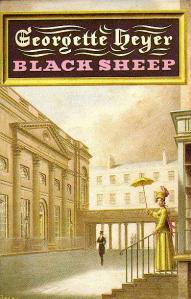
Barbosa cover of Black Sheep
The plot sways between Mile’s disinterest in his nephew’s actions and Abby’s determination to separate Fanny from the blackguard. Black Sheep’s characters are richly drawn and exhibit more depth than the usual GH regency romance. Even Fanny, young and immature as she is, operates in more than one dimension. Her first foray into romance is believable for one so young, and one feels that she will learn much from her puppy love experience to grow into a wiser, more mature woman. Like Marianne Dashwood in Sense and Sensibility, Fanny falls ill, causing her suitor to react in a most ungentlemanlike manner. His actions cause Fanny’s eyes to open to the WAYS of fortune hunters.
Georgette worked hard on perfecting her plots and it shows in this novel. Oh, there are some missteps. I found Abby’s sister Selina more irritating than interesting, even though her fashion sense is impeccable. Still, such a degree of silliness at her advanced age is a bit unbelievable. The older brother James is as self-important, selfish, and self-obsessed a prig as Robert Ferrars ever was, but given my overall enjoyment of this masterful book, my quibbles with these characters are minor.
The book’s ending provides a perfect solution to a choice Abigail is forced to make: She is so accustomed to assuming responsibility for those around her, that she’s forgotten what it’s like to have someone take a major decision out of her hands. Frankly, I never saw those last few pages of plot coming!
 Out of three regency fans, I give this book four. You may order it at Sourcebooks, a publishing company that features the Georgette Heyer books reviewed below. In addition, click on this link to look for new Georgette Heyer novels coming out in spring 2009.
My Other Georgette Heyer Reviews Sit Below
Read Full Post »
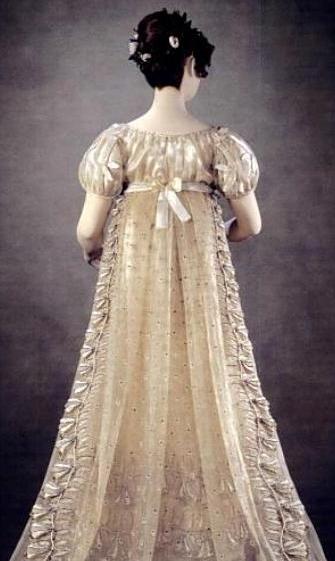
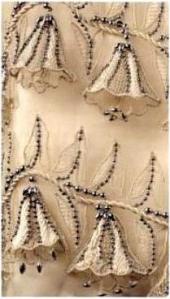 When I saw Princess Charlotte’s bellflower court dress (1814-16) at the Museum of London I remember being transfixed and standing in front of the glass case for a half hour. I could not get over the exquisite details and embroidery of this gossamer thin gown, and wondered at the hours it took to create it, the number of seamstresses that must have toiled over it, and its cost. It was so beautiful that I mistook it for a wedding dress. The train, which showed slight damage where some of the embroidered bells were missing, is similar to the one on Princess Charlotte’s silver net wedding gown. Tradition has it that this court dress was made for Princess Charlotte on her engagement in 1814. The bellflowers were fashioned from silk covered wire and net decorated with silver thread darning and the tiny beads were made from blown glass. (The London Look, p 22)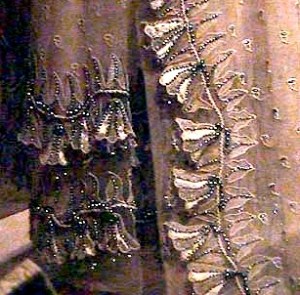
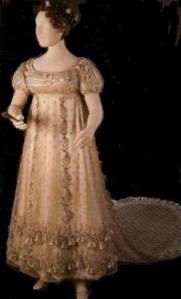 Front of gown, Museum of London
 In December 1859, Florence Nightingale wrote this letter of recommendation to Parthenope Verney:








 Jane Austen's World