Feeds:
Posts
Comments

Archive for the ‘Jane Austen’s World’ Category

Mutton

Gently stir and blow the fire,

Lay the mutton down to roast,

Dress it quickly, I desire,

In the dripping put a toast,

That I hunger may remove —

Mutton is the meat I love.

On the dresser see it lie;

Oh, the charming white and red;

Finer meat ne’er met the eye,

On the sweetest grass it fed:

Let the jack go swiftly round,

Let me have it nice and brown’d.

On the table spread the cloth,

Let the knives be sharp and clean,

Pickles get and salad both,

Let them each be fresh and green.

With small beer, good ale and wine,

Oh ye gods! how I shall dine.” — Jonathan Swift (1667 – 1745)

Inquiring readers: After reading  Jonathan Swift’s poem, Mutton, I was reminded of the importance of pleasurable dining and the immense satisfaction a good meal gives us. While I understand much of the poem, which still feels fresh, some phrases and customs prompted me to look up the differences between dining customs in the mid-18th century and today.  

While Jonathan Swift died 30 years before Jane Austen’s birth, his reputation as a writer, thinker and essayist must have been well known to her and her father, who most likely kept the author’s writings in his extensive library.

Annotations:

“Gently stir and blow the fire”

Stirring the hot coals while blowing the fire with bellows increases the temperature to the desired heat for cooking the meat.  
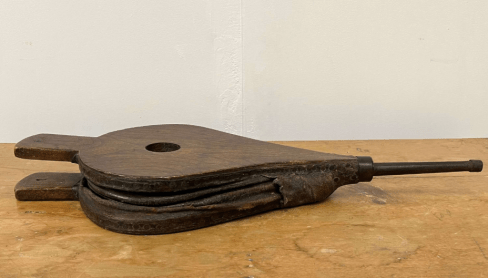
18th C Bellows

Image josephjenkinsantiques.co.uk

18th century elm and leather fireplace bellows

“Lay the mutton down to roast,

Dress it quickly, I desire,

In the dripping put a toast,

That I hunger may remove”

As the meat sizzles and browns, the drippings, or the fat rendered from roasting, are captured by a dish placed under the meat. The fat from beef is used to make yorkshire pudding: in this situation, mutton drippings are eaten with toast. 

“Mutton is the meat I love.

On the dresser see it lie;”

“Although they looked much more like what we would call a sideboard, the earliest use of the word dresser dates to 16th-century England. Used in the kitchen and dining areas, these early incarnations provided extra space for serving and “dressing” meats headed to the dining table and were essentially side tables with a single row of drawers that rested atop tall legs.” – Dressers, Rau Antiques

“Oh, the charming white and red;

Finer meat ne’er met the eye,”

Swift’s description of red and white meat is shown in this 1762 Schaak image of a tavern interior.
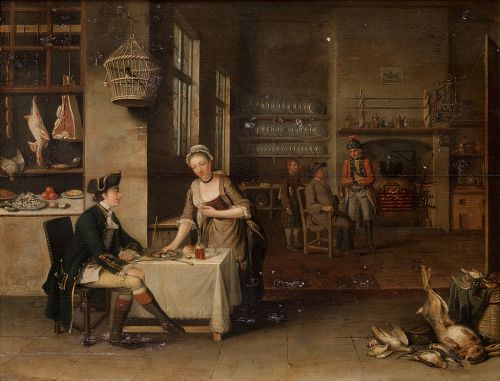
1024px-John_S_C_Schaak_Tavern_interior_1762

Tavern Interior, John Schaak, 1762, Wikimedia

“On the sweetest grass it fed”

Swift describes sheep that were fed in pastures with fresh green grass. We are all familiar with the bucolic engravings and paintings of that era of shepherds and sheep dogs or border collies looking after the flocks and bringing them to new pastures. — Glossary of sheep husbandry – Wikipedia

“Let the jack go swiftly round,

Let me have it nice and brown’d.”

“Roasting jacks (or spit jacks) were used in the kitchen to facilitate grilling meat or other dishes on a spit in an open fire by rotating (or turning) the spit.”  – Spit Jacks: See image in this link.

We have no way of knowing whether Jonathan Swift enjoyed his mutton at home or in a tavern, as in the Schaak image. The latter would have been quite common for a bachelor. Swift, however, was a successful man who could afford servants to cook and serve this meal at home or arrange for more private accommodations in an inn. 
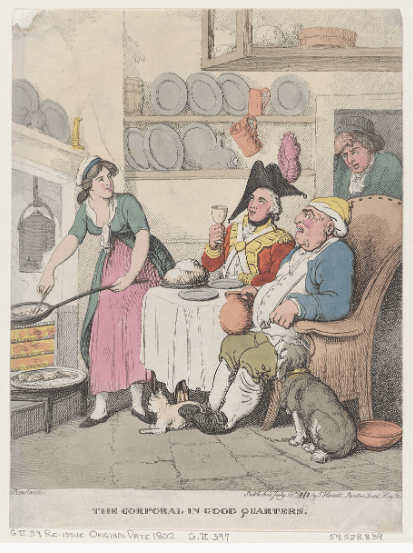
Screen Shot 2023-07-19 at 6.21.51 PM

The Corporal in Good Quarters, Thomas Rowlandson, Met Museum, Public Domain

“On the table spread the cloth,”

Swift might have dined in a more intimate setting instead of a busy tavern room. This 1802 cartoon by Thomas Rowlanson demonstrates the white table cloth and cozy setting. The Corporal in Good Quarters, Met Museum, Public Domain, 1802

“Let the knives be sharp and clean,”
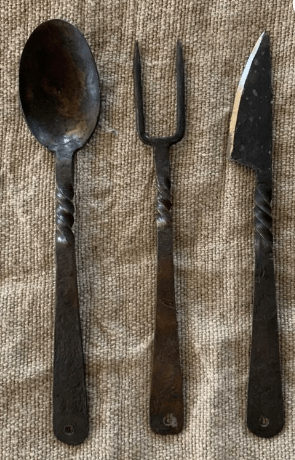
Screen Shot 2023-07-19 at 5.14.57 PM

Image: European Eating Utensils, 16th-18th Century – Tailor & Arms

Image: European Eating Utensils, 16th-18th Century – Tailor & Arms

Eating utensils, interestingly enough, didn’t change much for the poorer citizens from the medieval period to the industrialisation. This replica set of eating utensils is modeled from originals found in the UK and was used during the 18th century.

Vegetables:

“Pickles get and salad both, 

Let them each be fresh and green.”

Pickles:

“Pickles aren’t limited to the dill and cucumber variety. They can be sweet, sour, salty, hot or all of the above. Pickles can be made with cauliflower, radishes, onions, green beans, asparagus and a seemingly endless variety of other vegetables and fruits. When the English arrived in the New World, they brought their method for creating sweet pickles with vinegar, sugar and spiced syrup.” – History in a Jar: The Story of Pickles

Salad:

Salad during Swift’s time was known as salmagundi, a 17th-18th century form of a composed and layered salad that we know today as a chef’s salad. Components varied throughout the year according to the foods available. These salads were either made with fresh greens or with vegetables that were boiled. The links below lead to recipes used during this period.

Libations:

“With small beer, good ale and wine,”

Small Beer: 

Throughout the middle ages, drinking water was unpleasant and unsafe to consume and milk was far too expensive for most people. Instead, a mildly alcoholic drink known as ‘small beer’ was brewed and consumed for its hydrating and nutritional properties in households, workplaces and even schools across Britain. Typically brewed to around 2.8% ABV (alcohol by volume), small beer became a staple of British daily life and was even cited in Shakespeare’s works. – What is Small Beer & When Was it Brewed?.

Difference Between Beer and Ale:

According to Wikipedia, “Ale is a type of beer brewed using a warm fermentation method, resulting in a sweet, full-bodied and fruity taste. Historically, the term referred to a drink brewed without hops.” Beer or lager combined hops with other ingredients. 

“As hops began to pervade breweries … this distinction between beer and ale no longer applied. Brewers began to differentiate between beer and ale on the basis of where the yeast fermented in the cask: ale uses yeast that gathers on the top, and lager uses yeast that ferments on the bottom.” – What is the Difference Between Beer and Ale?
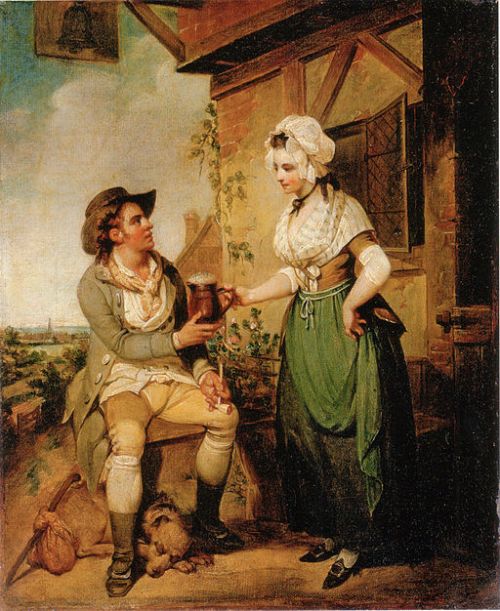
512px-Henry_Singleton_The_Ale-House_Door_c._1790

The Ale House Door, Henry Singleton, 1790, Wikimedia

The Ale House Door, Henry Singleton – Serving ale in a country setting, ca. 1790


At the start of the 18th century, increased taxes on malt and hops to finance war with France, induced brewers to move to brewing more beer. Their reasoning was simple: the tax on malt was more than that on hops. Ale used more of the former, beer more of the latter.” – Early 18th century British beer styles

The above article explains the difference between small beer and ale in both strength and color. Beer was made for immediate consumption, and ales were drunk as soon as they had “cleared” in three or four weeks. 

Wine

Poor people tended to drink beer or gin, but a wider range of alcoholic drinks was available to the rich. These included wines such as French claret; fortified wines such as sherry, port or Madeira; and spirits such as brandy and rum. – Jane Austen’s World,  Elder Wine, A Perfect Libation for a Regency Holiday
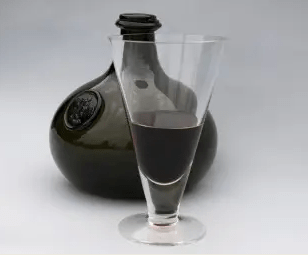
Madeira

Madeira image from the George Washington Presidential Library @ Madeira · George Washington’s Mount Vernon

Final line of the poem:

“Oh ye gods! how I shall dine.”

Conclusion:

In April, 1768, Pastor Woodforde described a get together at Lower House with Mrs Farr, presumably the hostess. His description of the dances and food served gives us an intimate view of ordinary get togethers only decades after Swift’s death. Notice the mention of a roasted shoulder of mutton, the paltry serving of vegetables, and alcoholic drinks: 

April 19. … We had some Country Dancing and Minuets at Lower House…We were very merry and no breaking up till 2 in morning. I gave Mrs. Farr a roasted Shoulder of Mutton and a plum Pudding for dinner — Veal Cutlets, Frill’d Potatoes, cold Tongue, Ham and cold roast Beef, and eggs in their shells. Punch, Wine, Beer and Cyder for drinking.” – The Diary of a Country Parson, the Reverend James Woodforde, full text Internet Archive

Food Poetry:

More links to this topic:

Screen Shot 2023-07-20 at 7.35.59 AM

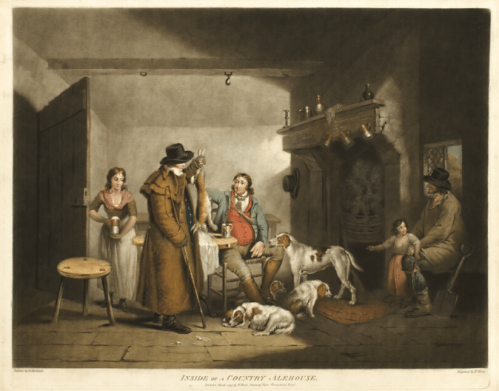
Inside of a Country AlehouseDate: published March 1, 1797, William Ward (English, 1766-1826) after George Morland (English, 1763-1804) Art Institute of Chicago

Read Full Post »

As we continue our investigation into Jane Austen’s irresistible romantic themes and plots, we now come to one of my favorite Austen novels, Persuasion.

In this series, we’ve looked at “Enemies to Lovers” in Pride and Prejudice, the “Slow Burn” Romance in Emma, and “Best Friends to Lovers” in Mansfield Park.

Now we turn our attention to the love story that many Austen fans love as much as (or more than) Pride and Prejudice. It’s the story of Anne Elliot and Captain Wentworth and the one that got away.

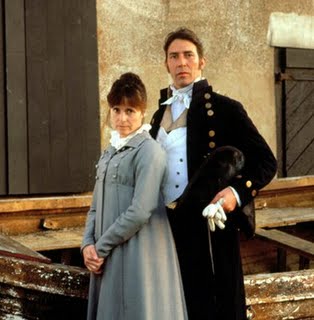
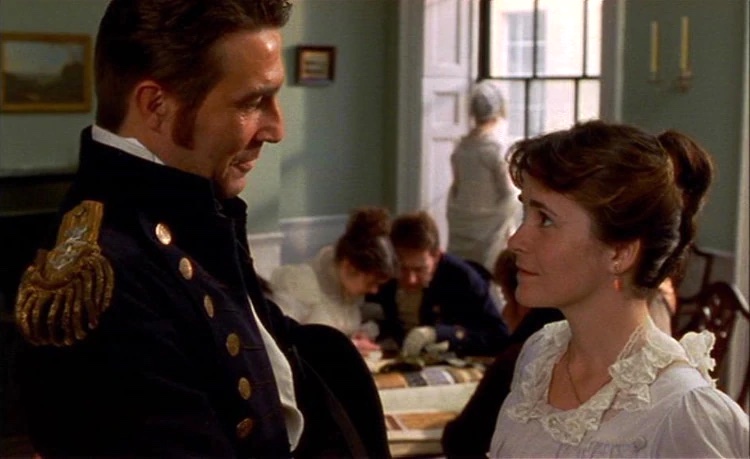
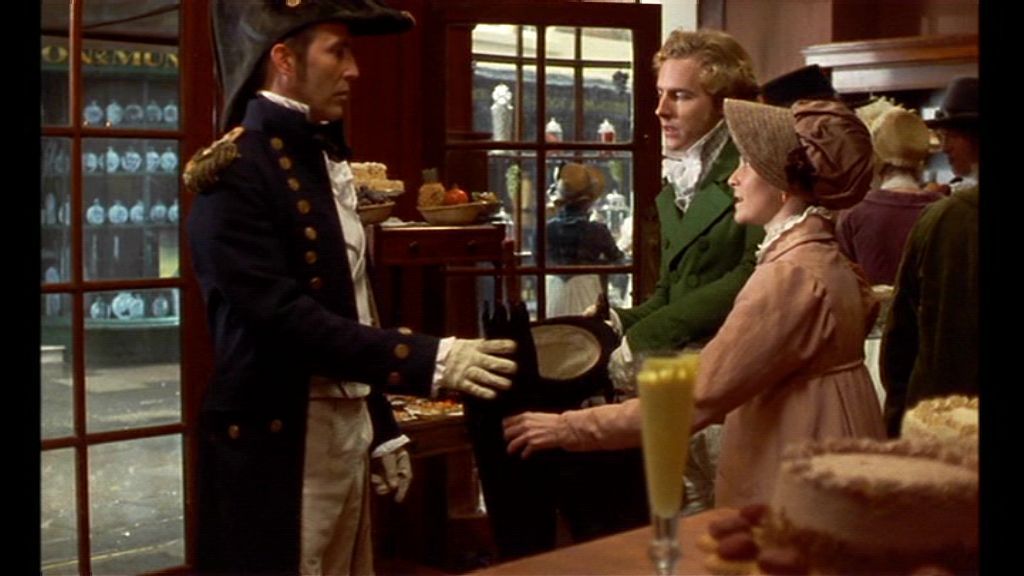
The 1995 film adaptation of Persuasion with Amanda Root and Ciaran Hinds.

Second-Chance Love

Persuasion is a second-chance story because Anne Elliot receives another chance at love with Captain Wentworth and another chance at living her own life and choosing her own happiness.

When the story opens, she’s somewhat of a faded, wilted flower:

A few years before, Anne Elliot had been a very pretty girl, but her bloom had vanished early; and as even in its height, her father had found little to admire in her, (so totally different were her delicate features and mild dark eyes from his own), there could be nothing in them, now that she was faded and thin, to excite his esteem.

Persuasion

However, her true beauty and worth go far beyond her exterior, and Captain Wentworth quickly notices that she’s still the same Anne:

She was looking remarkably well; her very regular, very pretty features, having the bloom and freshness of youth restored by the fine wind which had been blowing on her complexion, and by the animation of eye which it had also produced. It was evident that the gentleman . . . admired her exceedingly. Captain Wentworth looked round at her instantly in a way which shewed his noticing of it. He gave her a momentary glance, a glance of brightness, which seemed to say, ‘That man is struck with you, and even I, at this moment, see something like Anne Elliot again.’

Persuasion

The One That Got Away

Beyond a second chance at love, Persuasion is a picture-perfect model of “The One That Got Away” (or “Long-Lost Love”) romantic theme that has become so popular in romantic movies and books. Austen knew what she was doing when she created a storyline about passionate, young love; years of separation, heartache, and regret; and a long, drawn-out rekindling of a long-lost love that has only grown deeper and more mature with time.

But one of the reasons Persuasion is so intriguing is that Austen doesn’t instantly rekindle the relationship when Anne and Wentworth meet again. Instead, Austen builds a storyline that creates questions, heartache, and angst for Anne (and Austen’s readers).

While Anne never stopped pining for Wentworth, it seems as though he has moved on completely and has not forgiven Anne. There is no quick thrill, instant reignite, or swift rekindle. He acts almost as though they’ve never met.

Anne’s only recourse is to patiently, achingly watch the love of her life search for a wife, flirt with other women, and essentially ignore her (or so she thinks). She remains humble, quiet, and ever-patient, though each day brings fresh torture.

Forced Proximity

One romantic device Austen uses expertly in Persuasion (and in most of her novels) is what we now term “forced proximity.” This is when an author places two characters in a situation where they are forced to spend extra time together in close quarters. It might be a stalled elevator, a shared school or work project, a single bed in a hotel room, or a small car on a long road trip.

In Persuasion, Austen brings Wentworth right into Anne’s neighborhood, places him among the families she and her family socialize with, and even has them travel in the same group to Lyme. Austen also creates situations where Anne and Wentworth are even in close physical proximity:

They were actually on the same sofa, for Mrs Musgrove had most readily made room for him; they were divided only by Mrs Musgrove.

Persuasion

In another moment, however, she found herself in the state of being released from him; some one was taking him from her, though he had bent down her head so much, that his little sturdy hands were unfastened from around her neck, and he was resolutely borne away, before she knew that Captain Wentworth had done it. Her sensations on the discovery made her perfectly speechless.

Persuasion

In Bath, there are more opportunities for the two of them to cross paths, including the day when Wentworth overhears Anne’s conversation with Captain Harville and writes her his letter.

Love Stories Like Persuasion

Many popular romantic movies make use of these similar themes, such as The Notebook, Serendipity, The Princess Bride, Sweet Home Alabama, Before Sunset, 13 Going on 30, The Best of Me, The Parent Trap, Grosse Pointe Blank, Ticket to Paradise, Pearl Harbor, Love Actually, The Story of Us, Crazy, Stupid Love, When Harry Met Sally, and An Affair to Remember.

Television shows such as Friends (Ross Geller and Rachel Green) and As Time Goes By (Jean Pargetter and Lionel Hardcastle) also utilize the rekindled love or long-lost love theme.

Geoffrey Palmer and Judi Dench in As Time Goes By

Stories We Love

I’m sure you can add other books, shows, or movies to this list with similar themes. I personally think that many of us can relate to Anne Elliot and a desired second chance, whether it’s in love or some other passion or pursuit. Though none of these popular rom coms hold a candle to Jane Austen’s masterpiece, it’s clear that the themes she employed have stood the test of time.


RACHEL DODGE teaches college English classes, gives talks at libraries, teas, and book clubs, and writes for Jane Austen’s World blog. She is the bestselling author of The Little Women DevotionalThe Anne of Green Gables Devotional and Praying with Jane: 31 Days Through the Prayers of Jane Austen. Now Available: The Secret Garden Devotional! You can visit Rachel online at www.RachelDodge.com.
Read Full Post »

 Inquiring Readers,

This post examines the fortunes of the Austen family via the number of servants they employed for the students and family members who lived in Steventon Rectory, and the servants they took with them after Rev Austen’s retirement, and then after his death. The topic is fully described in Linda Robinson Walker’s 2005 Persuasions-Online article, Why Was Jane Austen Sent away to School at Seven: An Empirical Look at a Vexing Question. After reading this short summary of her remarkable essay, I encourage you to click on the link above.

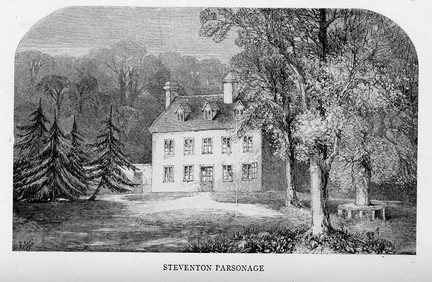
SteventonRectory-Wikipedia

Steventon Rectory, Public Domain, Wikipedia

Jane Austen scholars, readers, and fans know about her preoccupation with a single woman’s finances. She wove this topic masterfully into her novels. Women during her era (with very few exceptions) depended legally on their menfolk to see to their financial security. Many widows and spinsters, like Jane and her sister Cassandra, lived as total dependents, even though to our modern eyes some lived in the lap of luxury. Emotionally for Jane, this was not the case. A single woman’s financial security was never ensured. Witness Jane’s life before her father’s death and her quest for financial security afterward when she actively sought to earn some financial security through her writing. This was an uphill battle. Women in Jane’s social position who earned money through “work” were frowned upon, hence, during her lifetime, her novels were credited anonymously to “a lady.” 

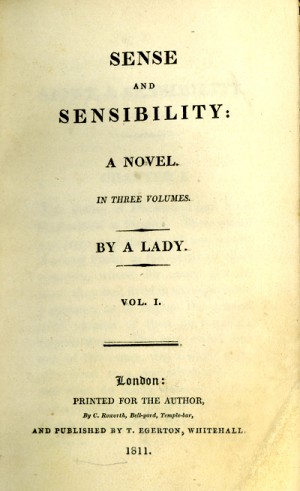
ss-title-page-first-edition

First Edition, 1811, public domain image

Despite her financial worries about her future as a spinster, Jane enjoyed a life of relative privilege due to her status as a gentlewoman and the people with whom she associated. The Austen family belonged to a landless class known as the pseudo-gentry. 

Cassandra Austen née Leigh

Jane’s mother, Cassandra Austen, was a distant relative of the Leighs of Stoneleigh Abbey. By the turn of the nineteenth century the Abbey was worth around £19,000. (In 1764, £19,000 was equivalent in purchasing power to about £4,433,593.38 today, an increase of £4,414,593.38 over 259 years. The pound had an average inflation rate of 2.13% per year between 1764 and today, producing a cumulative price increase of 23,234.70%.- CPI Inflation Calculator)

Cassandra Leigh’s distant relative was Sir Thomas Leigh, the Lord Mayor of London under Queen Elizabeth I. “For assisting the Royalists against Cromwell in the English Civil War, Leigh was created a baron in 1643.” – Regina Jeffers

Despite her impeccable lineage, Cassandra benefited very little financially from her family. Her father, Thomas Leigh, was the rector of Harpsden, near Henley-on-Thames in Oxfordshire, and his means were modest compared to his richer relations. Her brother, James Leigh, added Perrott to his name when he inherited the estate of his rich great uncle, Thomas Leigh. This uncle and his heir largely ignored Cassandra and her family (most notably Jane and her sister Cassandra) in their wills. More about Cassandra’s ancestry can be found in this genealogy link

George Austen, Rector

George Austen was a smart, ambitious, self-made, and enterprising man. His mother died in childbirth and his father died a year after marrying a new wife. The widow did not want the responsibility of taking care of George and his sister Philadelphia. When he was nine years old he was separated from her, and taken in by an aunt in Tonbridge. He then earned a Fellowship to study at St. John’s. His impressive education was quite unusual for an orphaned boy with modest means, but he had an important connection – his uncle Francis Austen II, who lived in Sevenoaks, Kent. With his uncle’s support and influence, George received three degrees at Oxford: Bachelor of Arts, Master of Arts, and Bachelor of Divinity. (Discovering the Young Jane Austen in West Kent, England — Sheila Johnson.com.) 

Thomas Leigh died just a few months before the wedding of Cassandra and George … In the strictly snobbish sense, George was marrying above himself, and Thomas may have doubted whether George was good enough for his daughter. – Maggie Lane, p 52

Through his education and his influential connection, George became a cleric of the Church of England and rector of Deane and Steventon in Hampshire. As a rector, his Anglican clerical position was higher-ranking than a vicar’s (think of Mr Elton in Emma, who was desperate to marry a woman of means). And so George earned a respectable position that gave him the opportunity to finance his burgeoning responsibilities. Thankfully, he had a supportive and hard-working wife.


The Austens support of their burgeoning family, and students and servants

The position of rector made George far from a wealthy man. To stay out of debt, he farmed an allotment of land that came with the parishes of Steventon and Deane. He also rented Cheesedown Farm from his Uncle Francis, where he grew food to feed his family, and sold the surplus for profit. George also started a boarding school for boys. With the income from his lands, the tithes, and tuition from male students, the Austens supported their growing family of eight children, as well as the servants required to help with household and farming duties. According to Robinson Walker:

“In 1781 and 1782 the Austen household was bursting with as many as twelve young people – which included the Austen children and pupils. In the four years between 1779 and 1782, as many as sixteen to twenty-two people made their home in the rectory.”

Then, in 1783,  Edward was adopted by the Leighs, and Cassandra and Jane were sent to boarding school. This alleviated the burden of feeding so many mouths. Robinson Walker surmises that these two events opened spaces for 4-8 additional students inside the rectory, attracting much needed income. One can only imagine the emotional effect on Jane at the tender age of nine when she left her beloved home to follow her sister to a boarding school, if even for only a year.

Number of Servants

The increase in students necessitated a change in servant numbers. 

The servants employed at the time Jane was sent away to school in 1783 were enough to fill the attics. With the attics filled by the servants, the rest of the household occupied seven bedrooms. Robinson Walker Provides an idea of the number of people at Christmas in 1786:


“One hint of the number that could squeeze into the rectory, albeit for a brief period, is given by Mrs. Austen when she enumerated the thirteen present for Christmas celebrations in 1786:  herself and Rev. Austen; five of their children; Mr. Austen’s sister, Philadelphia Hancock; Hancock’s daughter, Eliza de Feuillide and her young son with his French maid, and the two motherless Cooper children (Le Faye 54).  In addition, there would have been the Steventon servants.” 

The author provides extensive descriptions from contemporary sources about the number of rooms in the Rectory. These come from the memories and writings of family and visitors, with some variations in their recollections. Catherine Austen Hubback, Jane’s niece, never saw the rectory. She simply quoted her father, Frank, and others who she recalled that “The Parsonage consisted of three rooms in front on the ground floor—the best parlour, the common parlour and the kitchen; behind these were Mr. Austen’s study, the back kitchen, and the stairs.”  She also mentioned “seven bedrooms, and three attics. The rooms were low-pitched, but not otherwise bad, and compared with the usual stile of such buildings, it might be considered a very good house.” 

Anna, another niece, had actually lived in the rectory. She recalled a number of personal details, including her grandfather George’s study which was secluded in the back of the house, far from household activities. The dining room and common sitting room were situated next to the front door. This door opened into a smaller entrance parlour, where Cassandra Austen would greet her visitors.

The kitchen was most likely situated in the southwest wing of the house over a cellar that stored foodstuff. 


“The southwest wing is also dominated by a broad fireplace and tall chimney, suggesting that it was used for cooking, roasting, and baking.  A kitchen on that side of the house would also be near the outbuildings which we know included not only the granary, but a dairy, hen house, stables, and other farm buildings.  The glebe map and Anna’s footpath both indicate that these buildings lay to the west of the house.” – Robinson Walker 

Robinson Walker admits to not knowing the precise number of servants who lived at the parsonage. There were servants who lived in their homes and came when required, such as the washer women, cleaning ladies, George’s bailiff, and male farm laborers. Some servants, due to circumstance, might have had to stay overnight – especially if the lady of the house was ill disposed or during canning and food preparation seasons. Temporary tutors (music, painting, and dancing) might have needed one or two nights’ lodging before moving on. 

The number of servants who stayed at the rectory during certain events is covered extensively in Robinson Walker’s article. Her tables take into account the number of people living in Steventon Rectory from 1775 (Jane’s birth year) to 1779 (when George Austen stopped teaching.)

“In a letter to Cassandra, Jane wrote fondly of Nanny Littlewart dressing her hair. Nanny is Anne Littleworth, who fostered Jane and Cassandra when they were quite young. Jane mentions as many as nine servants in her letters in 1798. The laundry, for example, “was to be handed over from Mrs Bushell to Mrs Steevens; there was a new maid: ‘we have felt the inconvenience of being without a maid so long, that we are determined to like her.” (Worsley, p.95.)

After Rev Austen retired in 1801, the number of servants the family employed when they moved to Bath was reduced dramatically. The number of servants they took with them reflected the size of their new townhouse and reduced financial situation. 

The Austens kept a fairly constant ratio of one live-in servant per family member. When vacationing in Lyme Regis in 1804, Jane and her parents (Cassandra was at Godmersham) traveled with 4 servants:  Molly, Jenny, a cook, and a manservant named James, of whom she wrote to Cassandra. “My Mother’s shoes were never so well blacked before, & our plate never looked so clean.”

Just four years after his retirement, George Austen died unexpectedly. With the loss of his income, Mrs Austen and her daughters downsized into more affordable townhouses. The women now relied on monies that the Austen sons were able to share with them. After two years, Mrs Austen, Cassandra, Jane, along with good friend Martha Lloyd, moved into a house in Southhampton.

In a letter written in January 1807, Jane mentioned three maidservants:  Molly, Jenny and Phebe. Shortly thereafter she reported that a Mrs Hall assisted in moving them in, and the addition of a gardener. 

At Chawton Cottage, which was Jane’s home from 1809 until her death in 1817, two maidservants roomed with them. The women also kept a cook and a manservant. During the Chawton years, Cassandra and Jane were often separated, with Cassandra frequenting Godmersham and Jane visiting her brother Henry in London. One imagines that the number of servants the women hired were just the right amount for their modest lifestyles. Robinson Walker followed the Austen family’s up and down fortunes through the number of servants they employed in a wide-ranging and fascinating account.

More on the topic:

Jane Austen in Vermont, The Saga of the Steventon Parsonage

Jane Austen’s World, Keeping a Clean House Regency Style

Jane Austen At Home, Lucy Worsley, St. Martin’s Press, NY, 2017


Read Full Post »

By Brenda S. Cox

“Mr. Murray’s Letter is come; he is a Rogue of course, but a civil one. He offers £450-but wants to have the Copyright of MP. & S&S included. It will end in my publishing for myself I dare say.–He sends more praise however than I expected.”–Jane Austen to Cassandra, Oct. 17, 1815, about her new publisher, John Murray, wanting to buy the copyrights of Emma, Mansfield Park, and Sense and Sensibility. She self-published instead.

Publishing Choices Today

Having recently published my own book, I’m very aware of the choices authors have today. We might publish through a traditional publisher, who pays all the costs of publishing, gives the author a percent of the profits (perhaps 5-18%, usually on the lower end), and possibly an advance against those profits.

Or we might self-publish, paying all the expenses ourselves, and getting most of the profits. A range of variations fall between those options.

“Hybrid” authors do some of both, selling some of their books through traditional publishers and self-publishing others.

The author generally keeps the copyright, while assigning certain rights to the publisher, though in some situations, like work-for-hire, the author may agree to sell the copyright to the publisher.

Publishing Choices in Austen’s England

In Jane Austen’s England, authors also had essentially two options. They could sell their copyright to a publisher for a lump sum. The publisher would then bear all the expenses and take all the profits.

Or, the author would publish the book on commission, which was more similar to self-publishing today. The publisher would publish the book, paying the expenses of publishing and distribution. However, the author had to repay the publisher those costs out of the income from the book, plus a commission of about 10% of sales. If the book did not make enough money to cover the costs, then the author had to pay the publisher the rest of the costs out of his or her own pocket.

Jane Austen was what we might today call a “hybrid” author, taking both options. She sold the copyright of two of her books to publishers. The others she published on commission, essentially self-publishing them.

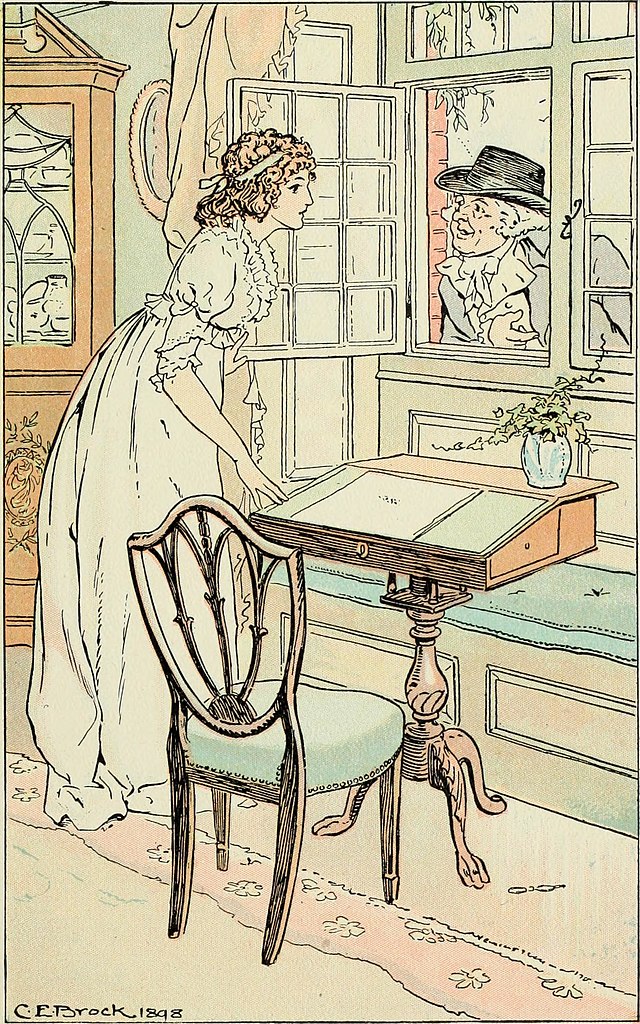
Jane Austen wrote her manuscripts with quill and ink at a desk similar to this, from a C.E. Brock illustration for Sense and Sensibility.

How Jane Austen Chose to Publish Her Books

Hybrid Publishing

The first book Jane Austen sold to a publisher was Susan, which was later published as Northanger Abbey. Like today, agents helped to place books with publishers. Jane’s brother Henry usually acted as her agent. But for this first book, Henry’s lawyer, William Seymour, was the agent who sold the copyright to publisher Benjamin Crosby on Jane’s behalf, in 1803 for £10. Crosby advertised the book once, but never published it. In 1809, Jane attempted to get the manuscript back from Crosby, in a letter in which she signed herself as M.A.D. (Mrs. Ashton Dennis). Crosby threatened to take legal action if she tried to publish the book herself, and he demanded the £10 back. Jane didn’t have that money, which would have been half her annual allowance.

Finally, in the spring of 1816, Henry, acting as her agent himself, bought it back on her behalf for the £10. Austen revised it and changed the name, since a novel called Susan had come out in the years in between. (Modern authors still have to watch for novels with the same name as theirs.) She added a preface apologizing for its being out of date. It was not published until after her death, when Henry got it published on commission.

Publishing on Commission (similar to today’s Self-Publishing)

Austen’s second book to be accepted for publication, and the first that was actually published, was Sense and Sensibility. Her brother Henry, acting as her agent, got the publisher Thomas Egerton to publish it. Out of the profits, Jane had to pay for the production, advertising, and commission. Fortunately it did well. If it had not, she might have had to pay as much as £180, which she certainly could not afford. She had faith in this “baby,” though. In a letter in 1811 (April 25), when she was correcting the proofs of Sense and Sensibility, she wrote to Cassandra, “I am never too busy to think of S&S. I can no more forget it than a mother can forget her sucking child.”

Egerton printed 750 copies in October, 1811, a large print run for a first-time author. Two positive reviews launched it well, and by July, 1813, the copies were sold out and Jane had earned £140 pounds in profits. A second edition was published in October, which continued to give Jane income until 1817.

Sense and Sensibility was published on commission, with the author responsible for costs, in 1811.

Selling the Copyright (more like modern, traditional publishing)

Unfortunately Jane Austen did not make such a good choice for her second published novel, Pride and Prejudice. Perhaps she had been discouraged because her father had previously offered it to a publisher, who chose not to look at it. (Though I must say, her father wrote possibly the worst query letter ever! All it told the publisher was that the novel was about the length of Burney’s Evelina, with no further information. They declined to see it.)

In any case, rather than again risking money she didn’t have, she sold the copyright of Pride and Prejudice to Thomas Egerton. Based on the success of Sense and Sensibility, they paid her £110. Then they paid all the costs of publishing and took all the profits. Egerton published the first edtiion in January of 1813, a second edition that fall, and a third edition in 1817. They made much more money than Jane did on Pride and Prejudice, which of course was quite popular.

Novels were normally published in three volumes. (This made it easier for circulating libraries to lend them out.) This third volume of Pride and Prejudice, published in 1813, begins with Elizabeth and the Gardiners approaching Pemberley.

Back to On Commission (which Austen calls publishing for herself)

For the rest of her books, Jane went back to taking the risk of publishing on commission, where she was responsible for the costs.

Mansfield Park was published on commission in May of 1814. The first edition sold out in six months. She made somewhere between £310 and £340 on it.

Emma was published in December 1815 (dated 1816). Austen turned to a more prominent London publisher, John Murray, to publish Emma. This may have been because Egerton did not want to do a second edition of Mansfield Park, or possibly because Murray was more prestigious. (Egerton was basically a military publisher; Henry apparently had connections there.) Murray offered to buy the copyrights for Emma, Sense and Sensibility, and Mansfield Park, for £450 total. Austen thought this was too low. She wrote to her sister telling her of Murray’s offer, saying he was “a Rogue of course, but a civil one” (Oct. 17, 1815).

So Jane Austen published Emma and a second edition of Mansfield Park on commission, paying the costs herself. She and the publisher decided to print 2,000 initial copies of Emma, Austen’s largest initial print run. Unfortunately, Mansfield Park did not sell well this time, and only about three-quarters of the copies of Emma had sold by February, 1817. At that point, after taking out the costs for publishing both books, Austen received only £38.18.

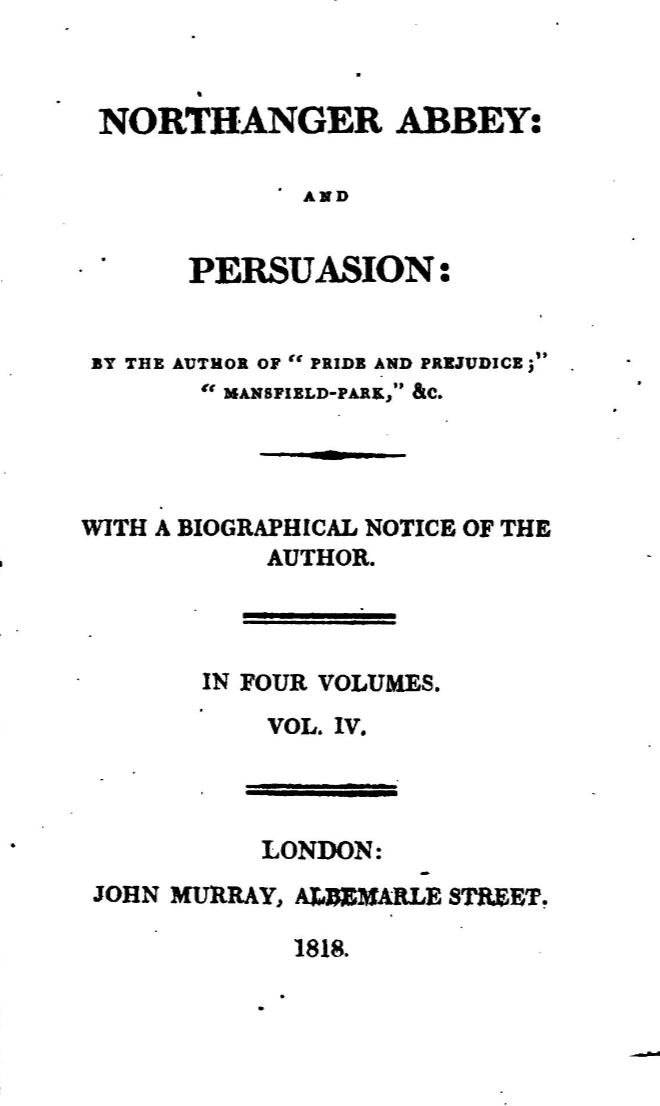
Northanger Abbey and Persuasion: When Jane Austen died in 1817, she left her manuscripts and copyrights to her sister Cassandra. Cassandra and Henry negotiated with John Murray to publish her last two complete novels, Northanger Abbey and Persuasion, in a four-volume edition at the end of 1817 (the books were dated 1818). This included a biographical notice of the author, written by Henry. He publicly revealed for the first time that Jane Austen was the author of all six novels. (The others were identified as “by a Lady” or “by the author  of . . .” the previous books.) Further income from the books went to Cassandra.

As two shorter novels, Northanger Abbey and Persuasion were published together in four volumes, with Henry’s “biographical notice” revealing his sister’s identity as author.

So, Jane Austen essentially self-published her novels, in terms of the expenses. The notable exception was Pride and Prejudice, for which she sold the copyright, taking less risk but substantially reducing her profits. Her first foray into selling a copyright was even more unsuccessful, since the publisher didn’t even publish Northanger Abbey. However, they were no doubt chastised when Henry, after buying back the manuscript, gleefully informed them that it was by the author of Sense and Sensibility and Pride and Prejudice!

Risks and benefits were as hard to gauge back then as they are now.

A professor writing for the British Bank has estimated that Jane Austen’s lifetime income from her books was around £631 before tax, or £575 after tax. That’s just a little more than the average yearly salary for a country clergyman. It’s hard to make clear comparisons to today, but one estimate claims it is equivalent to over £45,000 in today’s money, or about $56,000.

Not too bad for an obscure clergyman’s daughter from the countryside. She would have been glad to know that continued profits from her books helped support her beloved sister.

Jane Austen’s Published Books

Title

Written/Revised

Published

Publisher

How?

Income during Austen’s lifetime

Sense and Sensibility (originally Elinor and Marianne)

1795 as letters, 1797 as narrative/1809-10

Oct. 1811; 1813

Egerton

commission

£140 + income from second edition

Pride and Prejudice (originally First Impressions)

1796-7/1811-12

Jan., 1813; fall, 1813; 1817

Egerton

Sold copyright

£110

Mansfield Park

1811-13

May, 1814; 1816

Egerton; Murray

commission

£310 – £340 on first edition

Emma

1814-15

Dec. 1815 (title page says 1816)

Murray

commission

£38.18, after paying for losses on second edition of MP

Northanger Abbey (originally Susan)

1798-9 /1803/1816

Dec. 1817, title page dated 1818

Murray

Sold copyright to Crosby, 1803, £10; bought back in 1816

Posthumous publication, benefited Cassandra

Persuasion

1815-16

Dec. 1817, title page dated 1818

Murray

On commission with Northanger Abbey

As above

Do you want to know how the books were made and circulated? This series by historian Kathryn Kane, beginning with “The Making of Regency Books,” answers that question. It was a huge job to produce a book, with most of the work done by hand. And books were very expensive. Most people could only afford to get them from circulating libraries, if at all. So the discussions of the libraries of Netherfield and Pemberley emphasize the wealth of the Bingleys and Darcys. Novels were published in three volumes, at an average of seven shillings per volume. The equivalent price today for one three-volume novel would be $90!  For about the same price, readers could join a circulating library and read as many novels as they wished, a volume at a time.

Kane finishes with a deep dive into Sense and Sensibility’s writing and publication. 

Most importantly, in the long run, Austen’s books were published. The manuscripts were not left to moulder somewhere due to lack of money or publishers. Because Jane got them published, they were republished, again and again through the centuries, and give us much joy today!

Sources

Jane Austen’s Works 

Jane Austen’s Income 

Jane Austen Statistics 

Brenda S. Cox is the author of Fashionable Goodness: Christianity in Jane Austen’s England

Read Full Post »

As we continue to analyze Jane Austen’s novels and identify the best romantic tropes used in each one, we’re well on our way to proving that Austen not only used romantic themes ingeniously but also played an important role in developing several key plot devices that are regularly used in modern filmmaking today.

Last month, I wrote about Rom Coms and Emma. This month, I’m delving into Mansfield Park and finding the romantic themes found in the novel that are commonly found in romantic movies today.

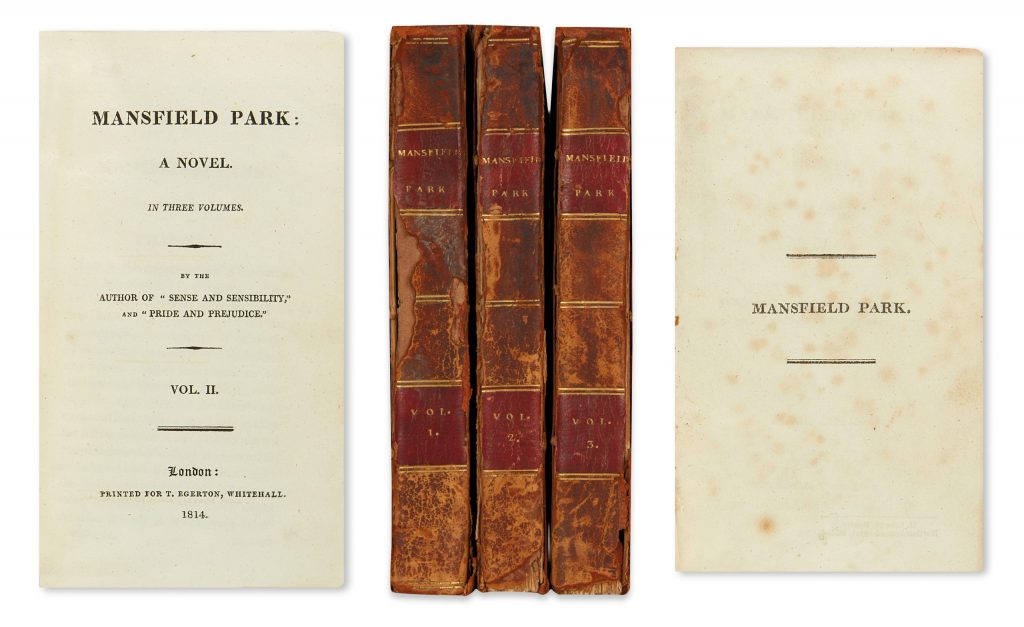
Mansfield Park, 1st Edition, 1814, Swann Auction Galleries

Romantic Themes in Mansfield Park

In Mansfield Park, there are several themes that ring true as romantic tropes we’re familiar with today:

The Ugly Duckling-Turned-Swan (aka the “Make-over”)

Following this train of thought, we see Fanny Price blossom and come into her own in MP. Her transformation isn’t necessarily outward. She doesn’t exactly go to the mall and get a makeover, but she does come out of her shell and begin to stand on her own two feet.

The “makeover” in this novel is actually a bit inverted because while Fanny later gains some of her own agency and confidence, the real change that occurs is that the people around her finally see her for who she really is and start to value her!

The Diamond-in-the-Rough

Adjacent to the “ugly duckling” theme, many rom coms play with the idea that the main character is wonderful just as she is, but she is overlooked, shy, or overshadowed by other characters. There’s usually an “a-ha” moment where one or more characters finally see the main character in a new way.

In MP, Edmund and his family members finally wake up and see Fanny for her true worth. Miss Crawford is the shiny object that distracts Edmund from much of the novel from seeing Fanny’s quieter brilliance.

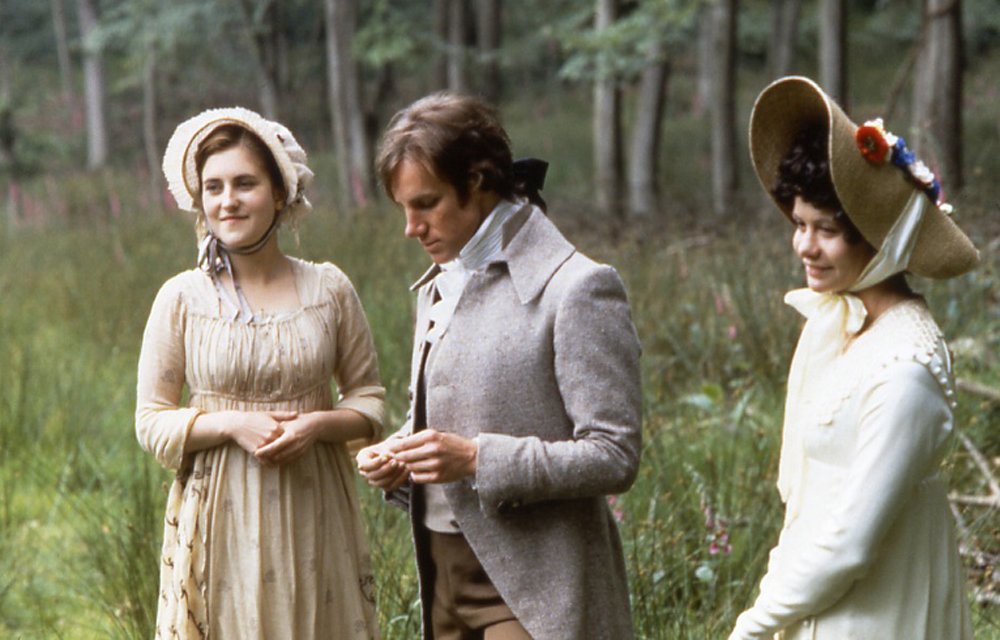
Mansfield Park (1983)

Red Herring (aka, the Shiny Object)

Similar to the chemistry and relationship between Emma and Mr. Knightley (and the Frank Churchill distraction), there’s a red herring (or several) in Mansfield Park as well.

In The Take’s “The Rom Com Explained,” we find this explanation of the red herring theme: “Rom-com leads often start out with a red herring love interest who seems very appealing but turns out to be all wrong. Meanwhile, as the protagonist spends time with someone they aren’t actively trying to impress, they can be their unfiltered self and get to know the other person in a real way. This long-developing chemistry leads to a moment of epiphany, where the character suddenly realizes the feelings that have been crystal-clear to the viewer all along.”

In Mansfield Park, the arrival of Henry and Mary Crawford (siblings) is the pebble thrown into the pond at Mansfield. This disrupts the regular rhythm of life for Fanny and Edmund and the rest of the Bertram family and sets the plot spinning.

Henry throws a wrench into several plot lines, while Mary comes between Fanny and Edmund. Edmund, dazzled by Mary’s beauty, is blinded by Mary and only sees her through rose-colored glasses. Fanny waits in the wings, heart aching, as he falls for Mary.

Mary, similar to Wickham, Willoughby, and others, is the “shiny object” that keeps Edmund distracted and causes havoc for Fanny. Fanny cannot prove what she thinks is wrong with either of the Crawfords. She has no other recourse but to wait patiently until Mary and Henry both show their true colors.

Mansfield Park (2007)

Best Friends-to-Lovers

Of all the themes in rom coms used today, Best Friends-to-Lovers is one of the most popular and it fits Mansfield Park beautifully. While Emma and Mr. Knightley have a bit of this vibe, much of their chemistry comes from their sparring matches (like Elizabeth and Darcy). But with Fanny and Edmund, they are incredibly close friends who share many of the same interests, qualities, and values. Edmund is the first person to take an interest in Fanny when she comes to live at Mansfield.

If you think of MP as a new school, Fanny is the new kid and the popular kids won’t talk to her or play with her. Edmund is different. Edmund helps Fanny when she is sad and lonely. At first, she looks up to him, but as they grow up, mutual respect and affection grows. Later, at least for Fanny, love begins to bud.

The Love Triangle

As in most Austen novels, there’s a love triangle, which is probably the most popular trope in most romantic comedies today.

In Mansfield Park, there are multiple love triangles, but we don’t see all of them at first. The one we focus on most is the Fanny-Edmund-Mary triangle. While Fanny hides lovelorn feelings for Edmund, Edmund doesn’t see Fanny as more than a friend/cousin he grew up with. Miss Crawford comes to town at exactly the wrong moment and steals the show.

Until Edmund sees Miss Crawford for her true self, he is blinded by her alluring personality and beauty and cannot see Fanny standing right in front of him.

Love Triangles similar to Mansfield Park

When I started looking for modern movies with similar themes (Best Friends-Turned-Lovers, Ugly Duckling-Turned Swan, Unrequited Love), I posted questions on my Instagram account (@KindredSpiritBooks) and on the Jane Austen Fan Club on Facebook. I received dozens and dozens of answers to this intriguing question!

If you’ve ever wanted to know what themes come up most often in movies, take a look at this list; it’s the longest list I’ve had yet in this series. There’s no denying that movie-goers respond well to love triangles—especially when the triangle involves two close friends finally realizing their love for one another!

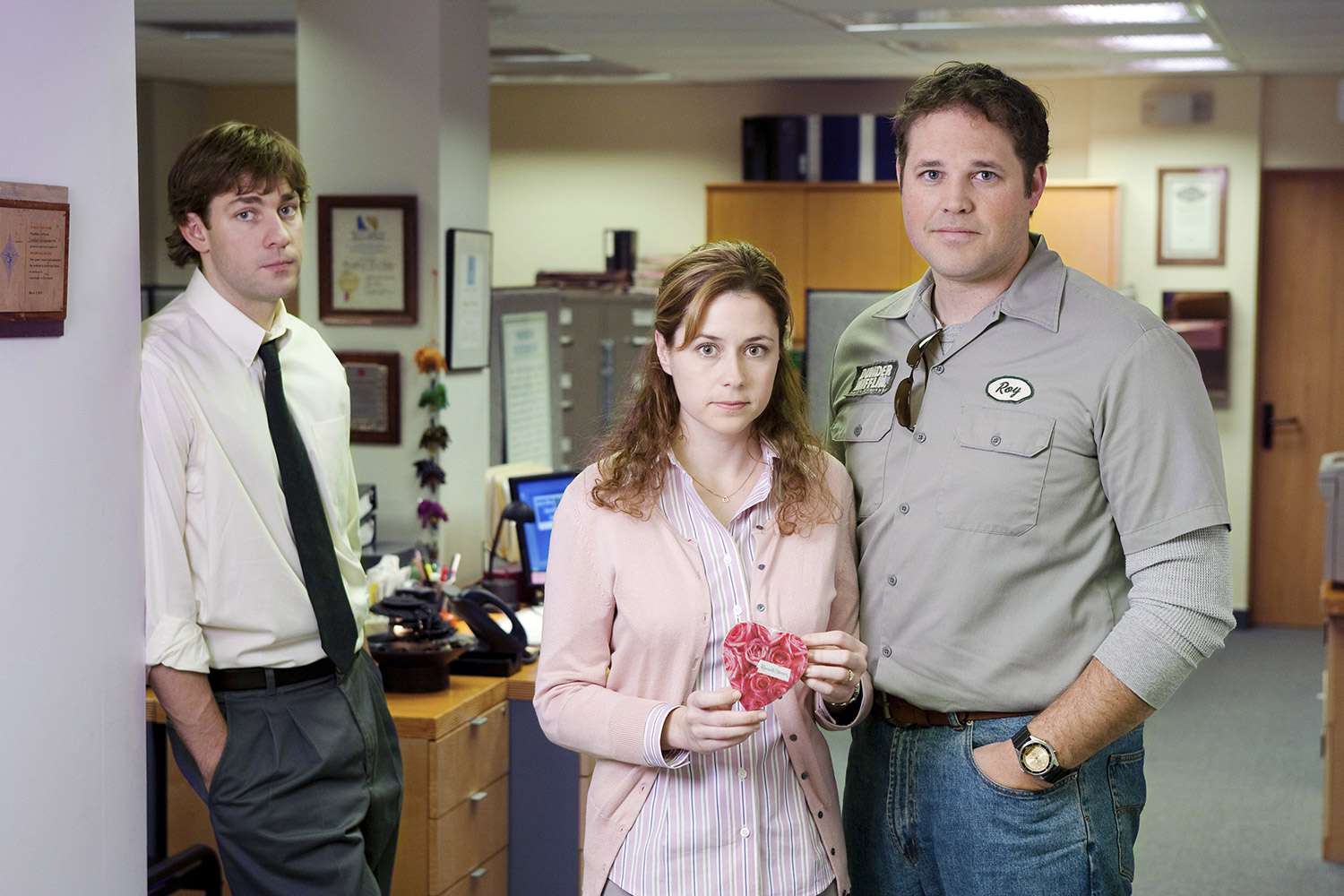
The Holiday, 10 Things I Hate About You, 13 Going On 30, A Cinderella Story, A Walk to Remember, Always Be My Maybe, America’s Sweethearts, Can’t Buy Me Love, FRIENDS (Chandler and Monica), Crossing Delancey , Drive Me Crazy, Easy A, Ever After, Get Over It, Grease, He’s Just Not That into You, Love and Basketball, Love, Rosie , Made of Honour, Maid in Manhattan, Miss Congeniality, Moonstruck, Never Been Kissed, Pretty in Pink, Pygmalion (My Fair Lady), Sabrina, She’s all That, She’s the Man, Sixteen Candles, Some Kind of Wonderful, Something Borrowed, Superman, The Duff, The Office (Jim and Pam), The Perfect Man, The Princess Diaries, The Summer I Turned Pretty, The Truth About Cats & Dogs, Trojan War, Whatever It Takes, While You Were Sleeping, Wild Hearts Can’t Be Broken, Win a Date with Todd Hamilton, Yesterday, Your Place or Mine.

Always Be My Maybe
Jim, Pam, and Roy from The Office

When asked what themes they saw in Mansfield Park that are common in romantic films today, several fans quipped, “The Cousins-to-Lovers” theme? Which made me laugh out loud. Yes, cousins did marry cousins during Austen’s time, but it’s still a funny remark.

I’m sure you can add others to this list! In each of these movies, there is some element of MP present.

Fanny Price

When I took these polls, the one thing everyone agreed on was this: We like Fanny Price because she doesn’t change her morals, her convictions, or her personality just to gain acceptance or love. She does blossom, but she doesn’t change. She is the same through-and-through, which makes her a very admirable heroine. Edmund finally wakes up and begins to see her in a new light, but she doesn’t become more like Mary Crawford; she remains steady, true Fanny.

Fanny has a lot to lose in terms of a future when she refuses to give in to Henry Crawford’s proposal and her uncle’s pressure. Without an inheritance of her own, her only options are to continue living with her aunt and uncle Bertram as long as they will have her or find work as a governess. And yet, though she’s timid and easily intimidated, she does not yield.

Mansfield Park (2007)

Have you seen any of the film versions of Mansfield Park? If so, which one do you think remains most faithful to the original text? (I’ve yet to find one that I enjoyed as much as the novel, but I’m open to suggestions!)

Are there any other books or movies in this genre that allow the heroine to stay true to herself as she wait patiently for her dreams to come true?


RACHEL DODGE teaches college English classes, gives talks at libraries, teas, and book clubs, and writes for Jane Austen’s World blog. She is the bestselling author of The Little Women DevotionalThe Anne of Green Gables Devotional and Praying with Jane: 31 Days Through the Prayers of Jane Austen. Now Available: The Secret Garden Devotional! You can visit Rachel online at www.RachelDodge.com.
Read Full Post »

« Newer Posts - Older Posts »