This Jane Austen blog brings Jane Austen, her novels, and the Regency Period alive through food, dress, social customs, and other 19th C. historical details related to this topic.
I have occasionally been asked whether Jane Austen’s parents were descended from royalty. I knew this to be the case with Mrs Austen, having traced the pedigree of her grandmother the Honourable Mary Brydges, who was the daughter of the 8th Lord Chandos of Sudeley, back to the Plantagenet king, Edward III. Prof. John McAleer had written on the subject too, in an article on the topic in Persuasions 11, entitled The Comedy of Social Distinction in Pride and Prejudice, by JOHN McALEER.
Alas, Prof. McAleer was led astray by some misinformation that appears to have had its origins in the later 19th century: Jane Atkins was categorically not the daughter of Sir Jonathan Atkins, but of John Atkins of Brightling, in Sussex, so George Austen was not a descendant of Sir Jonathan. Nevertheless I could still trace him back to royalty through his previously unexplored maternal line, that of Rebecca Hampson. The most recent of the kings in her pedigree was Edward I. This story remains to be told, and I promise that I will do it; but the first of the charts attached to this article trace the lineage via George Austen: Austen Royal Descent 1 – George.docx (1).
Image designed by Vic Sanborn
The second to the eighth charts show different ways in which Cassandra Leigh’s pedigree could be traced back to Edward III, the grandson of Edward I. It’s interesting that all of these resolve into two lineages. In charts 2, 3, 4, and 6, the lines descend through various people to the Hon. Charles Brydges of Wilton Castle, and his wife Jane Carne. From then, the next six generations to Mrs Austen are identical. The descent in the second group, charts 5, 7, and 8, reaches Katherine Neville and her husband Clement Throckmorton of Haseley and Claverdon, Warwickshire; and in those, the next six generations to Mrs Austen are also identical (though different from the first group).
Conventionally, the husband’s name is listed first, followed by his wife’s. In these charts I have placed each couple’s direct offspring first, whether female or male. The spouses, in the earlier generations, were almost all descended from earlier kings; these charts record only the most recent royal ancestors – though still from a log way back.
Someone, possibly a genealogically-minded statistician, worked out that everyone of English descent had Plantagenet royal ancestry. Taking this a step further, everyone of European ancestry is descended from Charlemagne. There is an interesting article on the subject in the Scientific American: https://www.scientificamerican.com/article/humans-are-all-more-closely-related-than-we-commonly-think/. Most people have lost the linkage; it’s only because Jane Austen’s parents both had prominent ancestors that we know.
Prof. McAleer listed a few historically notable royal ancestors, and these belonged to both Austen parents. I’ll add a few: Alfred the Great. Aethelred II – “Ethelred the Unready” – and his first son Edmund “Ironside.” The historical King Duncan I of Scotland, who met his death at the hands of his cousin Macbeth!
I did my best to discover all of the ancestral lines, back to the King Edwards, though it’s possible that I’ve missed one, or that others remain to be discovered. But I hope that there are enough here to satisfy everyone!
About the author:
Ronald Dunning, Author
Ronald Dunning is the creator of Ancestry.com: The Jane Austen Page ” which is undergoing an update as his research continues. He learned through his grandmother that her family was in some way related to Jane Austen. After moving from Canada to England in 1972, he pursued this intriguing information and discovered that Frank Austen [Jane’s brother] was her great-great-grandfather. Find more information in Deb Barnum’s 2012 interview with Mr. Dunning for Jane Austen in Vermont, An Interview with Ron Dunning on his Jane Austen Genealogy ~ The New and Improved Jane Austen Family Tree!
On January 9, 1773, Jane Austen’s older sister Cassandra Austen was born – 250 years ago – and we Austen fans are celebrating her life worldwide!
The two Austen sisters were nearly inseparable, from the time Jane was born until she passed away. She was the yin to Austen’s yang . . . or to put it in Regency terms, she was the darning needle to Jane’s stockings, the saucer to her tea cup. If you love Jane, then you would have undoubtedly loved Cassandra!
A Friend and Companion
When Jane was born, her father famously wrote: “We have now another girl, a present plaything for her sister Cassy, and a future companion.”
Reverend Austen was right on both counts. When the girls were young, Jane was extremely attached to Cassandra. So much so that when Cassandra went away to school, Jane was allowed to go as well. Not because she was necessarily ready for school, but because, as their mother said, “if Cassandra’s head had been going to be cut off, Jane would have hers cut off too.”
As they grew up, the sisters became the closest of companions and the dearest of friends. Of particular note, Cassandra is known for her sketches and watercolor paintings, particularly those believed to be of Jane and those that accompany Jane’s History of England.
Excerpt from the History of England by Jane Austen, illustrated by Cassandra Austen, the British Library.
Cassandra and Jane
Much of what we know about Austen’s personal life is largely due to the letters Jane wrote to her sister. Though Cassandra destroyed many of Jane’s letters after her death, there is still much we can find out about the two sisters through reading Jane Austen’s letters. Cassandra’s own letters about Jane’s illness and death provide a tender glimpse into the love and closeness of the Austen sisters.
I have lost a treasure, such a sister, such a friend as never can have been surpassed. She was the sun of my life, the gilder of every pleasure, the soother of every sorrow; I had not a thought concealed from her, and it is as if I had lost a part of myself… I thank God that I was enabled to attend her to the last…
Cassandra Austen to Fanny Knight, July 18, 1817
Jane Austen by Cassandra
A Year of Cassandra
To honor Cassandra’s life and legacy, Jane Austen’s House Museum launched its “Year of Cassandra,” during which the museum will feature special events and exhibitions to celebrate her life.
If you’re like me and you want to be part of this special celebration but don’t live close enough to participate in person, the Museum is planning a “Cassandra-themed” Virtual Tour of the museum in March. The tour description is as follows: “Find out about Cassandra’s life at Chawton Cottage and discover objects related to her on a lively, fact-filled tour that you can enjoy from the comfort of your own home.” You can find the details HERE.
Cassandra’s Orchard
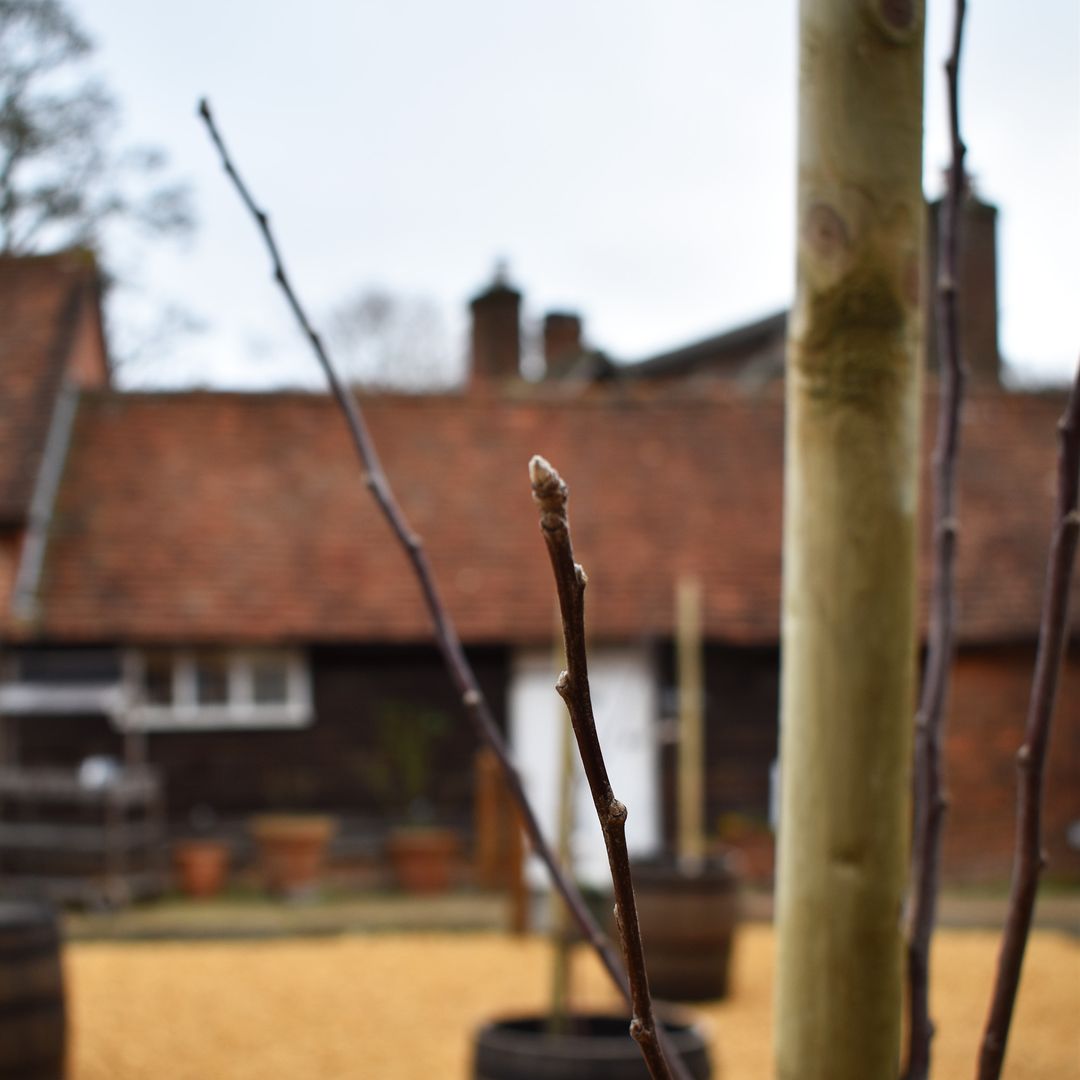
Of special note is the commemorative orchard being planted in Cassandra Austen’s honor, which has been named “Cassandra’s Orchard.” The name itself certainly makes me want to visit Chawton Cottage again one day soon, but the descriptions are even more intriguing:
Jane’s letters to her are filled with references to plants, flowers and fruits from the orchard, now sadly lost from the grounds of the House.
We will recreate this lost orchard, using dwarf varieties suitable for growing in containers. There will be a tree for every novel, and donors’ names will be recorded on plaques for each tree. The orchard will provide blossom in the spring, delicious shade in the summer, and fruits in the autumn. We will underplant the trees with plants for pollinators, turning this empty space into a haven for people and wildlife alike.
Cassandra’s Orchard, Photo courtesy of Jane Austen’s House Museum.
More About Cassandra
I’ve been following along with the progress of the Cassandra’s Orchard project, and I was delighted when the museum announced in December (on Jane’s birthday) that it had reached its fundraising goal. I can just imagine what a wonderful addition this little orchard will make to Jane Austen’s house.
I’m thankful for Cassandra Austen because I know that having someone who believes in you, supports you, and challenges you intellectually is important in every person’s life – but especially in the lives of writers, artists, and creatives. The very fact that she was so loved by Jane means that Cassandra must have been quite a remarkable person.
If you’d like to know more about Cassandra Austen’s life, Vic here at Jane Austen’s World has built quite the catalog of articles over the years. You can access those articles HERE. Of particular note is the article entitled, “Cassandra Austen: Jane’s confidante, supporter and helpmate” that is well worth your time.
“[They] thrive by sleep, not long but deep” – Welsh saying*
Recent research shows that until 200 years ago our sleep patterns followed two cycles every night. “Each block of sleep would be around four hours, with most people staying awake for two to four hours in between.” (Sleep in the 1800’s…, 2014).
In many societies interrupted sleep was so common that it was considered normal. The first awakening occurred around midnight, three to four hours after nightfall, when people in Western cultures generally went to bed due to lack of light, for most of the populace did not have the means to afford expensive candles.
Two decades ago Roger Ekirch, a university distinguished professor in the department of history at Virginia Tech, researched sleep habits in Europe and America. He discovered many references to biphasic sleep in over 500 original sources from centuries past, such as diaries, medical texts, literature, prayer books, and even a crime report: He found descriptions written in English, Italian, French, and Latin. Sleep documentation also existed in Africa, the Middle East, South Asia, and Latin America, with some referring back to Ancient Greece. Ekirch would uncover over 2,000 preindustrial sleep documents in his searches.
Richard Westhall, Tate
The Dream, Richard Westhall, 1765-1836
A Woman Ministering to Another, Three Weeping Children. Young: Night Thoughts null Richard Westall 1765-1836, Tate Gallery
According to sources, some individuals took the quiet time of first wakefulness to complete tasks, such as those of housewives or servants, or to write letters, or record their dreams. Others ate a small snack, chatted with a guest or spouse, read, prayed, attended to necessary bathroom needs, or made love. Individuals followed their own nightly rituals, be it alone or with someone else.
“…it was suggested that fertility among laborers was increased due to the midnight wakefulness; men who came home physically exhausted were more likely to have enjoyment, and successful intercourse, if there was a rest period after the day’s troubles.” – The History of Sleep Before the Industrial Revolution (historycooperative.org)
Although there were many references to segmented sleep in the past, knowledge of this once common phenomenon was largely lost to the modern world. Interrupted or biphasic sleep was not practiced everywhere. The diaries of Samuel Pepys and James Boswell indicate that both men slept uninterrupted. Studies the world over mentioned a variation of sleep patterns and practices. While hunter-gatherers in Tanzania, Namibia, and Bolivia slept through the night, a rural society in Madagascar practiced segmented sleep. – (The Atlantic)
The Industrial Revolution changed sleeping patterns for Western Europeans. In the late 18th and early 19th centuries, lamps filled with whale oil, kerosene, or coal gas lit streets, factories, and homes many hours beyond sunset. This increase in light both outside and inside homes and establishments affected daily habits.
“Following experiments with coal-gas for lighting in the 1790s, gas lights now illuminate streets, house, factories and commercial properties.” – P. 42, A Visitor’s Guide to Jane Austen’s England.
Sue Wilkes, author of the Visitor’s Guide, discussed an 1817 article in Ackermann’s Repository that mentions improved lights in a variety of city settings, including factories. The new brilliantly lit lamps were used
“for lighting Halls, Staircases, Dining-Rooms, Drawing-Rooms, Counting-Houses, Banking-Houses, Public-Offices, Churches, Chapels, Ball-Rooms, Public Places, etc.” – Wilkes, A Visitor’s Guide, p 42
Lamp-lit city streets (by 1807 in London and 1820 in Paris) promoted increased travel and crowd participation in nightly entertainments, including operas and gambling clubs.
Not everyone was so affected. People living in the rural countryside and small villages still scheduled nightly events to coincide with the full moon to guide their way along unlit lanes. When visiting friends in an adjoining village, the gentry and pseudo gentry (like the Austens) would remain as overnight guests after a long event like an assembly ball, rather than to return home in the dark of the night. Thus, sleeping habits changed more slowly in areas with far flung villages – but even the people in these regions would change their bedtime behavior by the mid 19th century.
For many, sleep transformation was sadly a result of economic necessity. Poor country folk, who were displaced from their common lands and denied access to growing their own food and feeding their animals, flocked to cities where factory owners recruited cheap labor. Their employers found no profit in 8 hour work days, and so laborers returned home after working from 10-14 hours a day, 6 days per week. They stumbled into beds for a few hours of sleep before waking and returning to work. The laborers (which included men, women and children) had no choice but to change their sleep habits.
Yet was one long, uninterrupted sleep period possible in a factory city? The cheaply built houses (tenements) for the poor, described in excruciating detail by Ian Mortimer in his book, The Time Traveller’s Guide to Regency Britain, were located in narrow streets and had thin walls that let in the incessant noise of clattering wagons, loud conversations, and barking dogs. The squalid, overcrowded conditions, overpowering stench of rotting food, putrid effluence of backed up privies, and the constant infestation of lice and bed bugs in uncomfortable beds prevented sound sleep. Most likely these poor factory ‘slaves’ stumbled out of beds still tired.
Sleep patterns for aristocrats and the very rich varied vastly, for these groups had the luxury of choice. For them, the cost of candles did not factor as a deterrence against staying up at all hours. They could choose to go to bed early or to stay up until dawn and sleep uninterrupted into the afternoon. Their comfortable and very expensive beds and beddings contributed to a sound night’s sleep. Unfortunately, the servants suffered. They remained at their stations to prepare their employers for bed at a moment’s notice, and arose early to anticipate their every need when they awakened.
According to Ekirch, by the mid-1800s, prolonged uninterrupted sleep and early rising was practiced in England and America. The second leisurely sleep was now reduced to stealing a few extra minutes of shut eye before getting ready for the day.
Jane Austen fans and scholars know that she and her sister Cassandra were practically inseparable. Anna Lefroy wrote that the two sisters shared a small sitting room that
“Opened into a smaller chamber in which my two aunts slept. I remember a common-looking carpet with its chocolate ground, and painted press with shelves above for books, and Jane’s piano…but the charm of the room…must have been…the flow of native wit, with all the fun and nonsense of a large and clever family.” (W.& R.A. Austen-Leigh, Jane Austen: Her Life and Letters, 1913.
I wonder if in rural Steventon, Jane and Cassandra experienced biphasic sleep. If so, I imagine them awakening at midnight, chatting and giggling, or discussing Jane’s progress in writing, before falling asleep again. In Chawton Cottage, where the Austen women finally settled down after years of moving from house to house after Rev. Austen’s death, the two women shared a cramped bedroom. They must have been happy, for Jane’s writing blossomed.
There’s something magical about that first awakening in the stillness of the night. At times, when this happens to me, I go to the computer and write a few lines for this blog, or read before dropping off to sleep again. Perhaps our ancestors knew something that we’ve lost over time.
“If I,” said Mr. Collins, “were so fortunate as to be able to sing, I should have great pleasure, I am sure, in obliging the company with an air; for I consider music as a very innocent diversion, and perfectly compatible with the profession of a clergyman.”–Pride and Prejudice
“In the evening we had the Psalms and Lessons, and a sermon at home”–Jane Austen, Letters, Oct. 24-25, 1808 [“Lessons” were the Bible readings for the day, from the Book of Common Prayer, which also prescribed the Psalms to read or sing for that day.]
When I asked some Facebook friends what gave them joy, the most popular response was “Singing!” There’s nothing like singing to raise your spirits. Even “singing the blues” can be cathartic, getting sadness out and making room for joy. (Of course, in Sense and Sensibility, Marianne Dashwood uses music and singing to increase her sadness, rather than relieve it.)
Early Carols
For centuries people have sung Christmas carols to express their joy at Christmastime. I’ve come across three books of Christmas carols published in the years following Austen’s death (1822, 1833, 1861; details in sources below). Almost all the carols in them were known and sung during Austen’s lifetime. Many are secular, about the holly and ivy used to decorate homes for Christmas or the boar’s head that began ancient Christmas feasts. Some are specifically for wassailing. Wassailing was similar to modern caroling, but wassailers carried with them a large bowl of “wassail,” a mixture of apple cider, spices, sugar, and alcoholic beverages. Wassailers sang to each house they visited, wished them prosperity, and drank to their health; the hosts might give them money, Christmas food, or drinks.
Joy is mentioned repeatedly in these songs. A fourteenth century carol, “The Seven Joys,” describes seven joys that Mary experienced; the last one is “To see her own Son Jesus To wear the crown of heaven.” An early seventeenth-century carol begins, “So now is come our joyful’st [most joyful] feast; Let every man be jolly.”
Many tell the Christmas story, or parts of it. Some also tell the story of Adam and Eve, their creation and their fall into sin. Others include the death and resurrection of Christ. Some older carols narrate legends. In “The Cherry-Tree Carol” a cherry tree bows down to Mary, proving her innocence to the doubting Joseph.
Early carols we still sing include “God Rest Ye Merry Gentlemen,” “The First Noel” (which in some versions was sung “Oh well” rather than “Noel”!), and “I Saw Three Ships Come Sailing In.”
Carols at Home and Charity for Carolers
Would Jane Austen and her family have heard and sung Christmas carols? Many were available as published broadsheets (single pages) or known orally. Since the Austen family loved music and singing, it’s quite possible that they sang carols at home during Christmas celebrations. Jane mentions Christmas gatherings in her novels and letters, and singing was probably part of those celebrations.
Would she have heard carolers going door to door? Also likely. Two country parsons of the time, one in eastern England and the other in the West, kept journals that have survived. Since Austen’s father was also a country parson, her family’s experiences may have been similar to theirs.
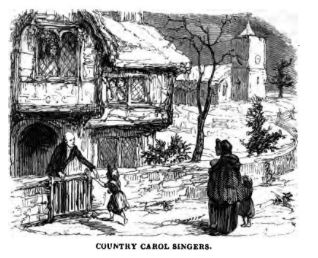
Parson James Woodforde of Norfolk mentions, on Christmas Eve of 1764, that the church’s Singers came to him and sang “a Christmas Carol and an Anthem”; he gives them “cyder as usual” and a gift of money. They also sang to him in 1768 and 1769; it seems to have been a regular practice. In 1781 (when Austen would have been six years old), Woodforde gave money to “Spragg’s lame son for a Christmas carol.” Peter Parley, in his 1838 description of Christmas customs, says groups of ragged children went from door to door singing for alms. Giving money to carolers was part of Woodforde’s extensive Christmas charities; he gave money to more than fifty poor people every St. Thomas’ Day (Dec. 21), and fed Christmas dinner to a number of “poor old men” every Christmas Day.
Poor Children Caroling for Alms, p. 142 in Tales About Christmas, by Peter Parley, 1838
Some years later, Parson William Holland of Somerset also gave charity at Christmastime, including dinners for the Sunday School children (poor children learning reading and religion at the church each Sunday). In 1800 Holland says the poor came “AChristmassing,” which he translates as begging. It seems likely their house to house visits included singing carols. His church Singers came and serenaded his family at the parsonage every Christmas morning, sometimes as early as 5 AM (in 1799) or even 3 AM (in 1809)! Parley calls groups of church musicians, who wandered about playing and singing during the night on Christmas Eve, “the waits.” He says the custom came from earlier times when groups of watchmen wandered the streets at night.
Austen’s family also probably heard and entertained Christmas singers, and gave alms to them and other poor people at Christmas.
“While Shepherds Watched Their Flocks”
In 1792 and 1793, Woodforde says the church Singers sang a Christmas Anthem during the service. In other years he also mentions singing in Christmas services. What would have been sung in Austen’s country churches at Christmas? Most likely, the carol, “While Shepherds Watched Their Flocks by Night.”
In the 1700s in Anglican worship, most congregations only sang Psalms from the Bible, not hymns. In fact, in many small churches there was no singing at all; the Psalms were just read. However, some had groups of “Singers,” like those in Woodforde and Holland’s churches, sometimes with musical instruments. (Holland’s congregation took up money to buy their Singers instruments.) The congregation might sing along with the Singers, but more often just listened.
The Singers generally sang from Tate and Brady’s New Version of the Psalms of David, which was a book of “metrical Psalms.” These are Psalms rewritten in a regular poetic form so they could be sung with standard tunes. In 1700, a Supplement was added which included a few hymns. The only Christmas hymn was “While Shepherds Watched Their Flocks by Night,” which is paraphrased from Luke 2:8-14. It was the only officially approved Christmas carol for churches in the eighteenth century. The words were as we sing them today. It could be sung to any tune in “common meter” (churches had books of tunes with certain meters, patterns of syllables, stress, and rhyme). But it likely was commonly sung to the tune still used in Britain today. (The tune popularly used in the U.S. now is from 1821.)
“Joy to the World”
Anglican country churches in the 1700s were mainly singing Psalms. However, the Dissenters (those outside the Church of England) and the Methodists wrote and sang many hymns during this time, including some Christmas favorites. Isaac Watts, a Dissenter, is considered the Father of English Hymnody. He believed that singing Psalms was not enough, because the Psalms did not express the New Testament experience and the gospel of Christ, or the congregation’s thoughts and feelings as Christians. He rewrote many of the Psalms to express those ideas.
“Joy to the World,” published by Watts in The Psalms of David Imitated in the Language of the New Testament in 1719, was a rewrite of Psalm 98, but it also includes phrases from other Bible verses. Psalm 98:4 (King James Version) says, “Make a joyful noise unto the Lord, all the earth: make a loud noise, and rejoice, and sing praise.” Watts wrote this as “Joy to the World.” Psalm 98:9 says the Lord is coming to judge the earth, which Watts adapted to “The Lord is come; let earth receive her king!” The line “Heaven and nature sing” is from Psalm 96:11, “Let the heavens rejoice, and let the earth be glad.” The third verse of the carol says, “No more let Sins and Sorrows grow, Nor Thorns infest the Ground: He comes to make his Blessings flow Far as the Curse is found.” This is adapted from Genesis 3:17-18, in which God tells Adam that the ground is cursed because of his sin, so Adam will eat from it in sorrow, and it will bring forth thorns and thistles.
As Watts’ songs had been spreading for some years, the Austens may well have sung this one in their home, if not at church. The tune we sing today had not yet been created; it was adapted from Handel in the 1830s.
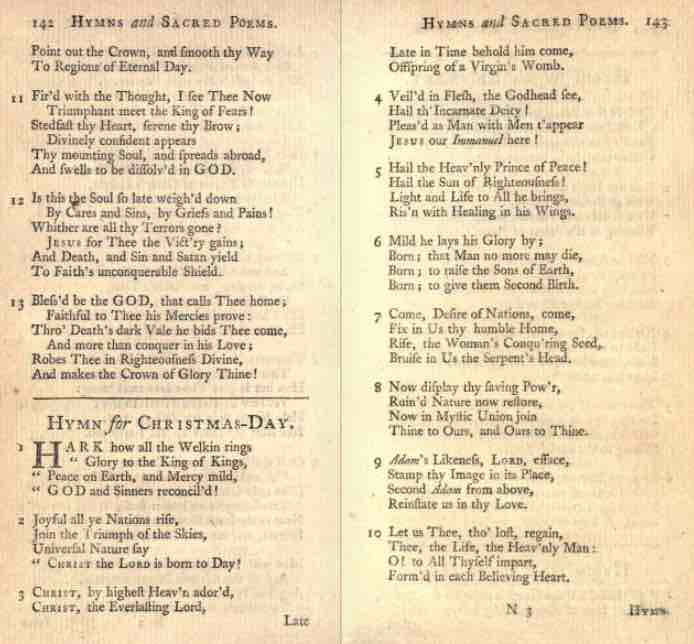
Charles Wesley’s 1739 “Hark how all the Welkin rings” became “Hark the Herald Angels Sing” when George Whitefield modified it in 1753.
“Hark the Herald Angels Sing”
“Hark the Herald Angels Sing” is a Methodist hymn that might also have been sung by the Austens, at home or possibly at church. The Methodists attempted to revive the Church of England, but eventually, on John Wesley’s death, separated and became Dissenters. However Charles Wesley, John’s brother, who wrote thousands of hymns, was strongly committed to the Church of England. His “Hymn for Christmas-Day” was published in Hymns and Sacred Poems in 1739.
It began, “Hark how all the welkin rings!” “Welkin” was an archaic word for the heavens. George Whitefield, another famous Methodist preacher, changed this line and other parts of the song in a collection of hymns he published in 1753. It became “Hark the Herald Angels Sing.” The music we sing it to now was added in the mid-1800s. At that time, Wesley’s four-line stanzas were combined to make our eight-line verses and the chorus was added.
All of these Christmas carols express joy:
“Glad tidings of great joy I bring To you and all mankind.” (“While Shepherds Watched Their Flocks”)
“Joy to the world! The Lord is come. Let earth receive her king!” (“Joy to the World”)
“Joyful all ye nations rise; Join the triumph of the skies!” (“Hark the Herald Angels Sing”)
Wishing you all much joy, whatever holidays you celebrate!
What is your favorite Christmas carol, or other song, that brings you joy?
“I have this moment received £5 from kind, beautiful Edward. Fanny has a similar Gift.”—Jane Austen, Letters, Sept. 15-16, 1813
Gifts are a way of showing how much we love and appreciate the special people in our lives. Of course, our tradition of giving gifts at Christmastime goes back to the story of the “wise men from the East” who brought gifts of gold, frankincense, and myrrh to the baby Jesus. Most of us can’t afford to give such precious gifts today, but we can give gifts that fit the interests, joys, and passions of our friends and relations.
Austen mentions gifts multiple times. She, of course, received a gift of a topaz cross and gold chain from her seafaring brother Charles. In Mansfield Park, Fanny Price’s brother William similarly gives his sister “a very pretty amber cross,” a perfect gift for a woman of deep faith. Her cousin Edmund then gives her another gift suited to her style and personality, “a plain gold chain, perfectly simple and neat.” Fanny responds, “This is the only ornament I have ever had a desire to possess. It will exactly suit my cross. They must and shall be worn together.”
Mary Crawford’s gift, an underhanded way of giving Fanny a gift from Henry, does not fit Fanny’s cross. Symbolically, Austen shows, through these gifts, that soon-to-be-clergyman Edmund is the right husband for Fanny, not immoral Henry Crawford.
Whether for Christmas, a birthday, or another holiday or occasion, it’s easy to find gifts for anyone in your life who loves Jane Austen. Or who you think might love Jane Austen, given the chance. (Or perhaps you want a gift for yourself since, as Vic pointed out to me, you might receive a gift card!) Consider what other interests the person has, and choose something specifically for her or him! I’ll just list a few favorites in each category, and give you links to search for more options.
Let’s shop!
Where To Buy Jane Austen-related Gifts
In the US, you might start by searching Jane Austen Books for whatever type of gift you want.
They all have wonderful gifts, and will also ship internationally (though it’s a little too late to do that for this Christmas, probably!). Due to UK postal strikes, anything shipped from the UK may be delayed this month.
Of course, you can also find many, many Jane Austen items on Amazon and Etsy.
Books and Movies
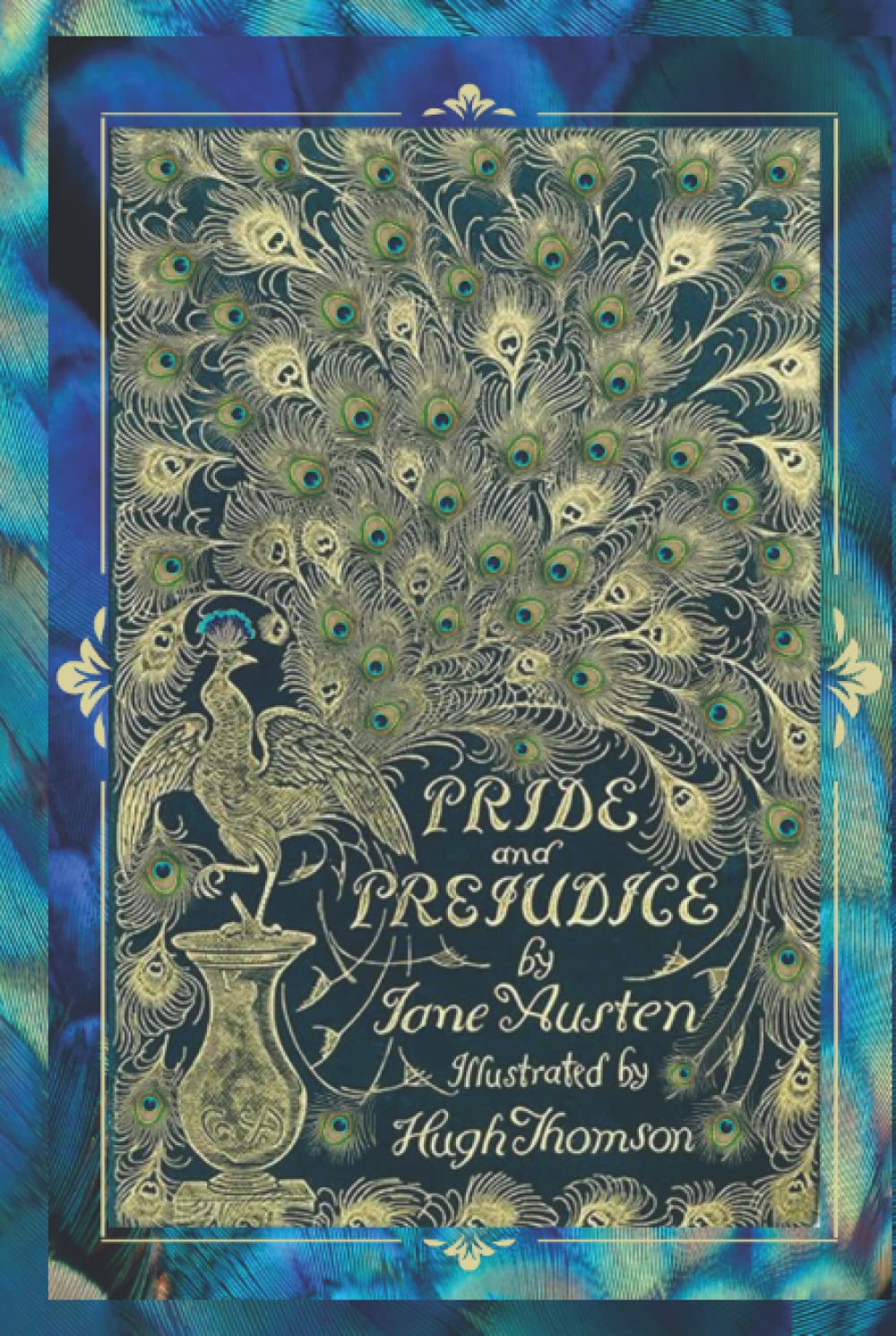
Let’s start with the obvious. Perhaps the person already has all of Austen’s novels, which are freely available in digital formats. But they might like a quality copy of their favorite, with a beautiful cover and illustrations. My favorite is the “Peacock” Pride and Prejudice, with Hugh Thomson’s delightful illustrations. Your local bookstore may have other beautiful versions.
I love my “Peacock” Pride and Prejudice, with Hugh Thomson’s hilarious illustrations! A great gift.
Or, they might enjoy a well annotated version, giving lots of new insights. The Cambridge editions like this one are a great scholarly resource. Copies of the Juvenilia, the Letters, or the Later Manuscripts might also be welcomed by series Austen enthusiasts.
DVDs of Austen adaptations might be a good gift, if you’re sure they don’t already have the one you’re giving.
There are so many books about Austen and her novels that I won’t even try to list them. However, Jane Austen Books lists them by subject, with 42 topics to choose from, each including an impressive list of books!
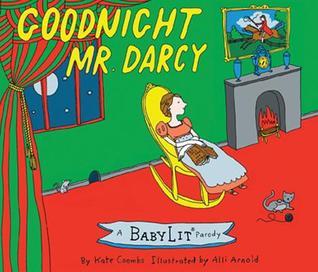
You can find versions of Jane Austen for all ages, including this board book parody, Goodnight Mr. Darcy!
Children
Are you looking for gifts for children? You can find lovely books introducing Jane Austen to teens, children, even babies! Here are a few of my favorites:
Goodnight, Mr. Darcy, also from BabyLit, is a “parody board book,” based on Goodnight, Moon and Pride and Prejudice. I think it’s delightful, though I’m not sure toddlers would understand it! So maybe for an Austen-loving mom who has small children.
Cozy Classics board books Pride and Prejudice and Emma tell the stories for very young readers, in only twelve words, with felt figures. (They do other classics, too, if you think the child would prefer, perhaps, Huckleberry Finn or Moby Dick.)
For ages 8-12, Gil Tavner’s series of adaptations is fun. Northanger Abbey, for example, is a delight.
For more reluctant older readers, including boys, this graphic version of Pride and Prejudice is beautifully illustrated and sticks fairly close to the novel. Search on Amazon for other Pride and Prejudice graphic novels. (There’s even one of Pride and Prejudice with Zombies, which wouldn’t appeal to me, but some might love it!)
For teenage girls, you can easily find new or used copies of Austen’s novels. Northanger Abbey is a good one to start with, since the heroine is a teenager figuring out her place in the world.
Austen-themed puzzles, find-it books, paper dolls, craft books, sewing books, and coloring books are other great choices; see below and read my post on Jane Austen Gifts for Children and Teens for man options.
Puzzles
Does the person you want to give a gift to love puzzles?
I’m looking forward to doing this 1000 piece puzzle with Austen quotes (I usually prefer 500 piece puzzles, but this looks like so much fun!). My friend owns it and she and her daughters work it repeatedly. Or you might try this 1000 piece puzzle with Austen book covers. Or this one with Austen scenes and characters to find. Or others; search Amazon or Etsy for Jane Austen puzzles.
In this puzzle, you can find Jane Austen and characters from all of her novels!
Games
My granddaughters (ages 10 and 14) and I keep playing Marrying Mr. Darcy, a fun card game for girls and ladies. You choose which female character you want to be (ranging from Lydia Bennet to Georgiana Darcy), then take cards that give you points for things like character, wit, and cunning. Cards might also take you to parties or on elopements. At the end you see which suitors you have qualified for (ranging from Mr. Wickham to Mr. Darcy), then roll to see who proposes to you and decide who to accept! Add up your character points and marriage points to see who wins.
I’m sure you know that coloring is not just for kids. It’s a relaxing pastime for adults as well. I have several Jane Austen coloring books, and sometimes I color them while listening to music, and sometimes my grandchildren color them while I read to them (from Jane Austen, of course!).
I have a Pride and Prejudice needle minder, a magnet that holds my needle to my sewing project when I’m not sewing. I love it! Etsy offers a variety of them. This book stack is a cute one.
This site gives sources and ideas for inexpensive ways to dress in Regency costumes. Recommended items could be valued gifts for the Janeite who likes to dress up for festivals and meetings.
Jane Austen t-shirts and sweatshirts are fun for everyday wear. You can even get Austen socks and scarves. (I have a pair of these socks, but when I wear them under pants or a Regency dress, who sees them??)
Jewelry
The Jane Austen Centre in Bath carries a lovely line of Austen-themed jewelry, if you’re looking for something classy.
For more books related to faith and Austen, or for books related to science and Austen, see the post on my blog.
Praying with Jane is a book of devotionals based on Jane Austen’s own prayers.
Fiction
Many Janeites love Austen variations, and a subscription to Kindle Unlimited would be a good way to give them the opportunity to read many. Here are a very few of my personal favorites:
Variations with faith and science themes: See reviews on my blog. One of many good ones, with both faith and science, is Robin Helm’s Yours By Design series, with an added fantasy element; Austen’s Darcy is switched with a modern-day Darcy, with surprising results.
Journals
Journals and Notebooks can be good gifts for those who like to write. I’ve used a Jane Austen Daybook year after year, writing down things I’m thankful for every night, since it has a space for each date.
Calendars
Every year JASNA Wisconsin creates a Jane Austen calendar with lovely pictures (this year’s are from C. E. Brock’s Pride and Prejudice illustrations). Each date gives one or more events from Austen’s life, letters, or novels. I love these!
By now your wish list is probably a mile long! Mine, too. But rejoice in what you have. Think about your Austen-loving friends’ interests and joys, and give gifts they’ll love, to show your love for them!
What is your favorite Jane Austen gift that you have received or given?
Fashionable Goodness: Christianity in Jane Austen's England is now available! By JAW contributor Brenda S. Cox. See Review. Available from Amazon and Jane Austen Books.
Available through December 31st, 2025. Click on image for details, and share this poster with other teachers and students!
The Obituary of Charlotte Collins by Andrew Capes
Click on image to read the story.
Comments
“My idea of good company…is the company of clever, well-informed people, who have a great deal of conversation.” – Jane Austen, Persuasion
Gentle readers: Please feel free to post your comments and continue the conversation! Due to SPAM, we will no longer accept comments on posts after 30 days of publication. In some instances, links will be removed from comments as well.
Administrators and Contributors
Vic Sanborn, founder of this blog, is supported by a team of talented and knowledgeable writers about Jane Austen and the Regency era. They are:
Tony Grant, who now contributes his photos from London and England
Click on their names to enter their own blogs.
In addition, we thank the many experts and authors who frequently contribute their posts and opinions, and who continue to do so freely or at our request.
Click here to enter the page. Topics include Regency fashion, historic foods, Jane Austen societies, British sites, related topics. Click on image.
May we suggest?
Hello, my name is Vic and I live in Maryland, USA. I have adored Jane Austen almost all of my life. I am a proud lifetime member of the Jane Austen Society of North America. This blog is a personal blog written and edited by me and my team. We do not accept any form of cash advertising, sponsorship, or paid topic insertions. However, we do accept and keep books and CDs to review.
If you would like to share a new site, or point out an error, please email us. (Yes, we are fallible. We'll own up to our mistakes and will make the corrections with a polite smile on our faces.) Write us at
Thank you for visiting this blog. Your comments and suggestions are most welcome.
Project Gutenberg: eBook of Stage-coach and Mail in Days of Yore, Volume 2 (of 2), by Charles G. Harper
STAGE-COACH AND MAIL IN DAYS OF YORE: A PICTURESQUE HISTORY
OF THE COACHING AGE, VOL. II, By CHARLES G. HARPER. 1903. Click on this link.















 Jane Austen's World