Feeds:
Posts
Comments

Archive for the ‘Jane Austen’s World’ Category

By Brenda S. Cox

Last week we looked at the lady “Rock Stars of the Regency” identified by Dr. Jocelyn Harris at this year’s JASNA AGM.* The other two Regency celebrities, who Jane Austen certainly knew about, but almost certainly never met, were the Prince Regent and Lord Byron. Both were flamboyant, charismatic, and extravagant. Jane Austen certainly did not like the prince, and I doubt she thought very highly of Byron. Let’s take a look at these two gentleman.Then I’ll add another famous gentleman, one I think she might have admired.

The Prince Regent (1762-1830)

As you probably know, King George III’s eldest son became Regent of England during the king’s madness from 1811-1820. When his father died, the Prince Regent became King George IV, until his own death in 1830.

The Prince Regent, later King George IV, by Henry Bone, 1816, public domain, wikimedia

Sometimes called “Prinny,” the Prince of Wales (heir to the throne) was an elegant man with a wide education, excellent artistic taste, and great charm. As a boy, his father insisted that he be taught simplicity and hard work. The prince was whipped severely for any laziness or lying. However, he disappointed his father’s hopes. The prince was known for his faults more than for his strengths.

By the time he was seventeen, he was already involved with several women. A series of many mistresses followed. Although he could not legally marry without his father’s consent, he went through a form of marriage with a Catholic widow, Mrs. Maria Fitzerbert, in 1785. This quasi-marriage to a Catholic caused him difficulty with Parliament, who were often being asked to pay his bills. (Catholics faced many restrictions at this time, and if the prince were actually married to a Catholic he could not legally become king.)

Prinny constantly ran up amazing debts. He lavishly furnished his mansion, Carlton House, running up almost £270,000 in debt! Parliament helped him defray that debt, partially. He immediately began another project, the even more opulent and fantastically expensive Marine Pavilion at Brighton.

In 1789, the king appeared to be going mad, probably because of the disease porphyria. The prince’s supporters tried to get the prince declared regent. His enemies attacked him as being Catholic, or married to a Catholic, and as a gambler who spent his time with unsavory people. Newspapers condemned the prince as “a hard-drinking, swearing, whoring man” who “at all times would prefer a girl and a bottle to politics and a sermon” (quoted in Oxford Dictionary of National Biography). The king recovered, and the prince did not become regent yet.

To get his debts settled, the prince agreed to marry his cousin Caroline, daughter of the Duke of Brunswick. Caroline and the prince had one daughter, Charlotte. (Charlotte eventually died giving birth to a stillborn child, so she never inherited the throne.)

The prince’s marriage to Caroline was miserable from the start. The prince soon went back to his mistresses, and Caroline was later also accused of sleeping around, though it was not proven.

The king lapsed back into madness in 1811, and the prince was sworn in as regent. His political policies were unpopular. Oddly, considering that his formerly-beloved Mrs. Fitzherbert was Catholic, he was strongly against giving any civil rights to Catholics.

In 1820 his father died and he became King George IV. He did not want his wife Caroline to be queen, so he put her on trial for adultery. She was not convicted, but she died a few weeks after his coronation.

George IV’s years of indulgence, gluttony, and drinking took their toll, and he became more and more ill. He died in 1830.

Jane Austen’s Perspective

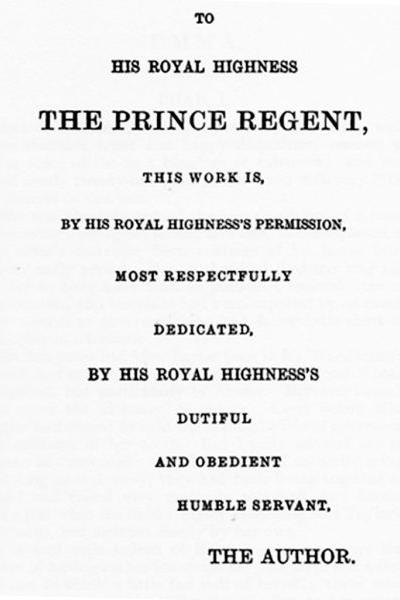
The Prince Regent was a fan of Jane Austen’s. He requested, via his librarian, that she dedicate Emma to him, and she reluctantly did. He apparently read her books often, and kept a set of them in each of his residences. She did not return his admiration.

Jane Austen reluctantly dedicated Emma to the Prince Regent, at his request.

In 1813, when the Regent was in the midst of a controversy with his wife, Austen wrote about her in a private letter: “Poor Woman, I shall support her as long as I can, because she is a Woman, & because I hate her Husband” (Feb. 16, 1813).

Why did Jane Austen “hate” the Prince Regent? I imagine there were multiple reasons:

  • He treated his wife very badly, avoiding her, flaunting his unfaithfulness to her, slandering her, and finally putting her on public trial. Earlier he had also been unfaithful to his first “wife,” Mrs. Fitzherbert, and even allowed others to slander her in Parliament.
  • He was extravagant, wasting the country’s money. He was a Sir Walter Elliot on steroids, not willing to give up any pleasure, inordinately proud of his position, and always spending far beyond his income.
  • He was known for drinking, gambling, laziness, and of course sexual immorality. He also apparently had little regard for church or religion. Austen did not appreciate such shortcomings.

For more on the Prince Regent: Colleen Sheehan speculates delightfully about all the places in Emma where Jane Austen may have been making fun of the Prince Regent in “Jane Austen’s ‘Tribute’ to the Prince Regent: A Gentleman Ridiculed with Difficulty.” Mr. Knightley, as a true gentleman, contrasts with the Regent. Be sure to follow the link at the end of Sheehan’s article, which takes you to a second article with an entertaining alternate solution to the “courtship” riddle!

Lord Byron (1788-1824)

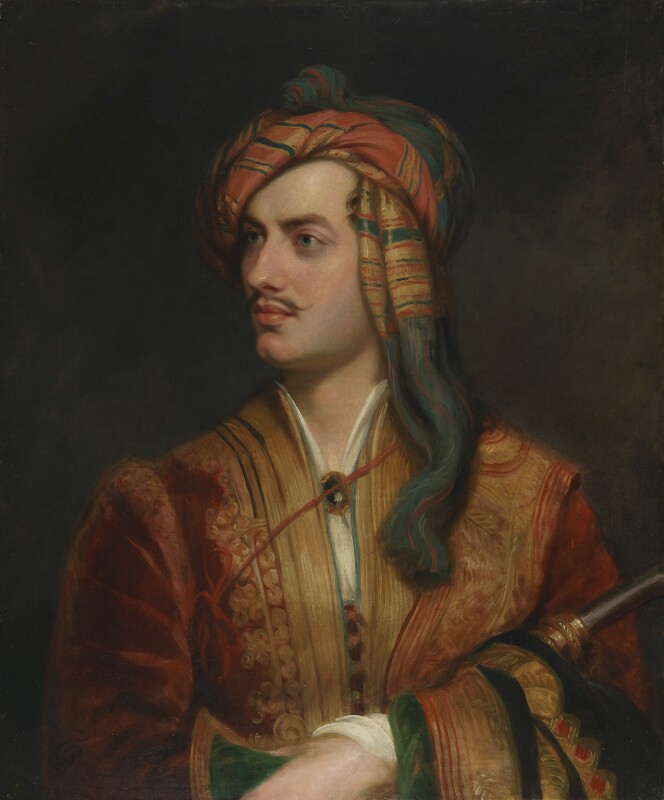
“Mad, bad, and dangerous to know.” That’s how one of Byron’s lovers, Caroline Lamb, described him. George Gordon Noel, Lord Byron, was as famous and infamous as the Prince Regent.

Lord Byron, replica by Thomas Phillips, circa 1835, based on a work of 1813. © National Portrait Gallery, London Creative Commons license (CC BY-NC-ND 3.0)

Byron’s narrative poem Childe Harold’s Pilgrimage, based on his travels in southern Europe and the Ottoman Empire, took London by storm in 1812. The upper classes adored him. He was quite cynical about society and its institutions, however. He called his country’s leaders “The Mad—the Bad—the Useless—or the Base” (from an epigram written in 1814).

Byron soon became known as much for his love affairs as for his poetry. An affair with married Caroline Lamb, whom he called a “little volcano,” ended when he got bored with her. She, however, blatantly pursued him everywhere. (Her husband, by the way, later became Lord Melbourne, the prime minister who so much influenced young Queen Victoria.) She even published a popular novel, Glenarvon, based on her marriage and her affair with Byron.

In the following years, Byron continued to write romances about Byronic heroes: broody men with dark secrets, in exotic settings. He also continued to have torrid affairs with married women. He became close friends with his married half-sister Augusta, who he considered the only woman who understood him. It’s possible, but not proven, that he was the father of her daughter Medora, born in 1814.

Perhaps the desire to squash rumors about his relationship with his half-sister contributed to Byron’s decision to get married in January, 1815. He married Annabella Milbanke (niece of Lady Melbourne, Caroline Lamb’s mother-in-law). Apparently they were fond of each other, and Byron “esteemed” her. However, the marriage was a disaster and they separated in January, 1816. She believed he was insane.

They had a daughter, Augusta Ada Byron. (That daughter became Ada Lovelace, one of the developers of the first computer.) One of Byron’s later lovers, Claire Clairmont, gave him another daughter, Allegra. Allegra died of a fever at age five. Byron also had a child with one of his maids, and he provided for her.

Byron spent money extravagantly. He inherited his title and family estates, but they were already deeply encumbered by debt. At first he refused to take payment for his writing (making his publisher rich instead), but by 1814 he began to accept, and even negotiate for, large amounts for the copyrights of his books.

Byron continued traveling, writing, and having affairs. His newer books, including Don Juan, increasingly shocked society. His original publisher finally refused to publish any more of Byron’s books, but Byron quickly found another publisher.

Lord Byron eventually got involved in the Greek struggle for independence, which suited his romantic ideals. He fell ill and died in Greece in 1824.

Jane Austen’s Perspective

Byron’s personal life was doubtless repugnant to Jane Austen. His open adultery with a long series of married women, and his taking sexual advantage of maidservants, would both have disgusted her. I imagine she also thought poorly of his extravagance and debts. What about his writing?

Lord Byron was the epitome of the literary movement, Romanticism. He wrote and lived the untamed passions of individual desire, the wildness of nature, imagination, and vision. Jane Austen epitomizes the best of the opposite movement, Rationalism. It emphasized self-control, order, harmony, balance, and logical truth. Austen and Byron did have something in common, though: both used irony and satire to confront flaws in their society, though in different ways.

Austen, like others in her society, read Byron’s books. In 1814 she wrote unenthusiastically, “I have read the “Corsair,” mended my petticoat, and have nothing else to do.” There is no indication that Byron read Austen’s books. Byron’s wife, however, wrote in 1813 that Pride and Prejudice was “a very superior work . . . the most probable fiction I have ever read.”

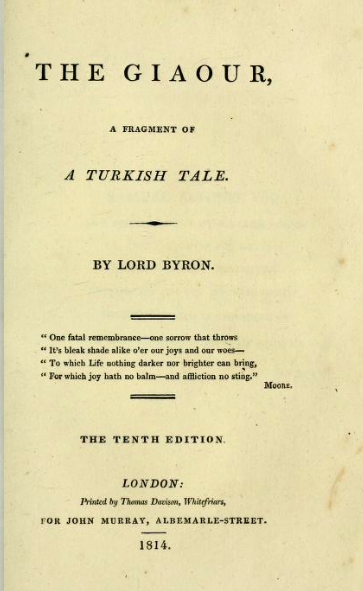
In Persuasion, Anne Elliot and Captain Benwick talk about Lord Byron and Walter Scott and disagree about their merits. They also mention Lord Byron’s “dark blue seas.” Benwick appreciates the “impassioned descriptions of hopeless agony” in Byron’s Giaour and Bride of Abydos. Anne doesn’t think Byron’s poetry is healthy reading for the grieving Benwick. She encourages him to read more prose, especially works by the “best moralists, such collections of the finest letters, such memoirs of characters of worth and suffering, as occurred to her at the moment as calculated to rouse and fortify the mind by the highest precepts, and the strongest examples of moral and religious endurances.”

Anne Elliot and Captain Benwick discuss how to pronounce the title of Lord Byron’s Giaour. (Online dictionaries say it’s something like JOW-er, or jowr. Merriam Webster says it means “one outside the Islamic faith.”)

According to the editors of the Cambridge edition of Persuasion (Janet Todd and Antje Blank), Giaour and Bride of Abydos “have exotic eastern settings, in which despotic rulers murder disobedient women and moody, passionate heroes are consumed with grief and guilt over violent crimes they commit.” They suggest that Anne Elliot’s alternative reading would have included Samuel Johnson’s articles in The Rambler. Johnson recommends (in issues 32 and 47) that in times of calamity, loss, and sorrow, we turn to hard work, diligence, and keeping our minds busy with other things.

I think Anne might also have recommended another of Austen’s favorite writers, William Cowper. Cowper suffered with depression for much of his life. One of the remedies that helped him at various periods was keeping busy with meaningful tasks, especially writing. Both Johnson and Cowper were known for their devotion to God; Byron, on the other hand, was known for his religious skepticism. Both Johnson and Cowper died well before the Regency, so we can’t consider them “Regency rock stars.” However, both were very popular authors that Jane Austen admired.

For more on Lord Byron and Jane Austen, see “Romanticism, a Romance: Jane Austen and Lord Byron, 1813-1815,” and “Jane Austen and Lord Byron: Connections.”

For those who like their history presented as fiction, I enjoyed this novel, based on Byron’s marriage: Dangerous to Know, by Megan Whitson Lee.

Lord Byron” by John Greenleaf Whittier (1807-1892) offers the next generation’s perspective on Byron’s religious views.

On Samuel Johnson, see “Finding Jane Austen’s ‘Dear Dr. Johnson’ at the Godmersham Park Library.

On William Cowper, see “William Cowper: Joy and Depression, Glimmers of Light in the Midst of Darkness,” “’With what intense desire she wants her home’: Cowper’s Influence on Jane Austen,”  and “William Cowper, Beloved of Jane Austen.

William Wilberforce? (1759-1833)

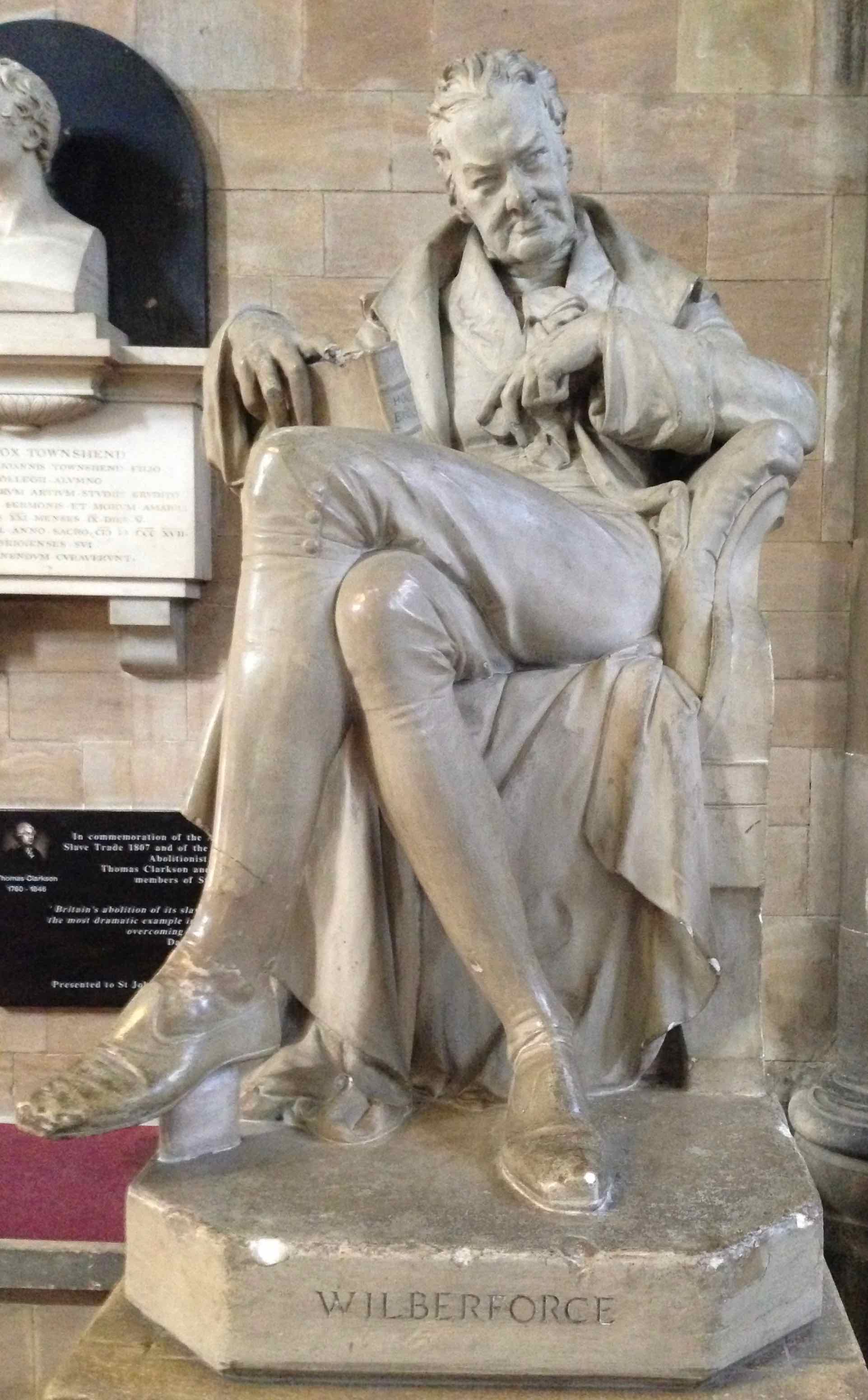
I want to nominate one more “rock star of the Regency”; this time, one that Austen may have admired, though she doesn’t mention him. In an age of corrupt, self-seeking politicians, a mad king, and a profligate Prince Regent, M.P. William Wilberforce lived a life of integrity, devotion to God, and concern for the poor and downtrodden. Wilberforce was much loved and respected in England, even by those who disagreed with him, for his gentle kindness and his persuasive speaking.

Statue of William Wilberforce at St. John’s College, Cambridge University. Photo ©Brenda S. Cox, 2020.

Wilberforce is best known for leading the fight against the slave trade and slavery. Thomas Clarkson, who Jane Austen said she “loved,” worked with Wilberforce. Clarkson collected evidence and wrote books promoting abolition. Wilberforce and his friends persevered for almost twenty years, against great opposition, until the British slave trade was abolished in 1807. The House of Commons, who had previously voted down Wilberforce’s proposal ten times, this time gave him a standing ovation. The fight continued until slavery was abolished in the British Empire in 1833, as Wilberforce was dying.

In contrast to other “rock stars” of the Regency, Wilberforce lived frugally. He was wealthy, but during his lifetime he gave away most of his wealth to people in need and to various causes he supported. For example, he supported groups working to relieve the miseries of climbing boys (chimney sweeps’ apprentices), to reform prisons, and to prevent cruelty to animals. He helped start the first “free church” in the country, a church in Bath where the poor got the best seats on the main floor rather than being marginalized because they could not pay pew rents. He also financially supported free education for the poor. However, he was not a radical, and he has been criticized for supporting government crackdowns on rioters and protesters, and for opposing labor unions.

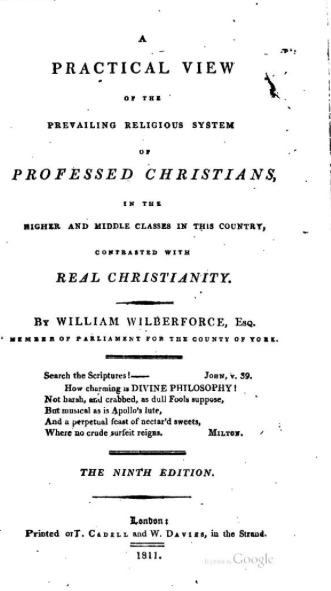
Wilberforce was also a leader of the Evangelical movement in the Church of England. (Please note that the word evangelical did not have the same political implications that it has today; it meant, and technically still means, those with certain religious beliefs.) He wrote a best-selling book which challenged the shallow faith of the upper and middle classes of his day.

William Wilberforce’s Practical View of the Prevailing Religious System of Professed Christians

Jane Austen’s Perspective

Obviously Jane Austen would have admired Wilberforce’s faith, lifestyle, and integrity. In 1809 her sister was trying to persuade her to read a letter by Evangelical Hannah More, and Austen wrote, “I do not like the Evangelicals.” However, by 1814, her niece was considering marrying an Evangelical. Austen wrote “I am by no means convinced that we ought not all to be Evangelicals, & am at least persuaded that they who are so from Reason and Feeling must be happiest & safest. . . . don’t be frightened by the idea of his acting more strictly up to the precepts of the New Testament than others.” She was not an Evangelical herself, but apparently her attitude toward the Evangelicals was very positive at that point. Wilberforce’s actions and reputation may have been one reason for that change.

For more about Wilberforce, see “William Wilberforce’s Joy”  and “William Wilberforce.”

We have now considered Jocelyn Harris’s five “Rock Stars of the Regency,” plus my own nominees for others.

What do you think of them? And what do you think Jane Austen would have thought? Who would you add to this roster?

In the presentation for the *Jane Austen Society of America’s Annual General Meeting, the “rock stars” were skilfully played by:

Emma Brodey as Emma Hamilton

Deborah Barnum as Dora Jordan

Linda Troost as Fanny Burney

Christopher Duda as The Prince Regent

Paul Savidge as Lord Byron

Jocelyn Harris, as the narrator, was dressed as Dolly Parton.

“Rock Stars of the Regency” was originally scheduled to be shown at Cleveland’s Rock & Roll Hall of Fame, but instead, of course, it was online.

Sources: These summaries are based on entries in the online Oxford Dictionary of National Biography, plus Jocelyn Harris’s presentation for the JASNA AGM, “Rock Stars of the Regency.”

Please note that the thoughts about Austen’s responses to the rock stars are mine, not Dr. Harris’s.

You can connect with Brenda S. Cox, the author of this article, at Faith, Science, Joy, and Jane Austen or on Facebook.

Read Full Post »

Who were the famous and admired “rock stars” of Regency England? At the Jane Austen Society of North America’s Annual General Meeting (JASNA AGM) recently, Dr. Jocelyn Harris identified five charismatic celebrities of Regency England. Jane Austen would certainly have known about them.

Dr. Harris chose:

  • Emma Hamilton
  • Dora Jordan
  • Fanny Burney
  • The Prince Regent
  • Lord Byron

Who were these people, and what might Jane Austen have thought about them? As I watched their presentations, I thought that Austen probably didn’t think very highly of some of them. See what you think.

Emma Hamilton

Emma, Lady Hamilton is best known for her love affair with the naval hero Lord Nelson.

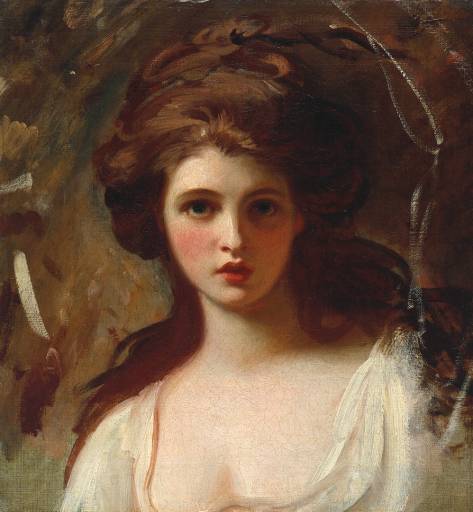
George Romney was captivated by Emma Hamilton’s beauty, as were other artists. This shows Emma as Circe. Public domain via wikimedia.

Early in her life, Emma Lyon worked as a housemaid, but her classical beauty and vivacious spirit brought her to the attention of several rich young men. She became the mistress of one, had his child, then moved in with one of his friends. That friend traded her to his rich uncle, Sir William Hamilton, in exchange for becoming his uncle’s heir. Hamilton, the British ambassador to Naples, married Emma and made her Lady Hamilton in 1791; he was sixty and she was about twenty-six.

In Naples, Emma became known for her dramatic “attitudes.” She wore classical Greek dress and struck a series of poses representing various emotions and classical stories. She was very expressive and visitors loved to watch her. She was also talented at learning languages. She helped her husband, and later Lord Nelson, with diplomacy. After a few years, she became seriously overweight, but apparently was still enchanting.

Emma Hamilton by George Romney, circa 1785 ©National Portrait Gallery, London.   Creative Commons license (CC BY-NC-ND 3.0)

Around 1798 Emma Hamilton and Lord Nelson fell in love. Both were married to someone else. But they seem to have adored each other. She bore him three children, though only one survived, a daughter named Horatia. Nelson said of her, as she was courageously seeing him off to sea, “Brave Emma! Good Emma! If there were more Emmas there would be more Nelsons.”

Emma’s husband died in 1803, then Admiral Nelson died in 1805. Emma was heartbroken at Nelson’s death. She received a large legacy and annuity, but continued her extravagance until she was imprisoned for debt in 1813. Friends helped her get released. She spent her final days, drunken and bedridden, in Calais, France. Her daughter Horatia tended her until she died in 1815. When Horatia returned to England, she was taken in by Nelson’s sisters, and ended up marrying a curate and having a large family. She acknowledged that Nelson was her father, but refused to acknowledge Lady Hamilton as her mother.

Jane Austen’s Perspective

In her letters (Oct. 11, 1813), Austen says that she is tired of biographies of Nelson, though she hasn’t read any. Perhaps his open adultery diminished his glory in her eyes, though we don’t know for sure. Her brother Frank wrote admiringly of Nelson’s judgment and decisiveness, and his ability to motivate others. He said nothing of Nelson’s moral values, however (Jane Austen: Her Life and Letters, 1913, chapter 12).

Austen makes no mention of Emma Hamilton in her writings. Dr. Harris speculates that Mrs. Smith of Persuasion, whose maiden name was Miss Hamilton, might have some connection to Emma Hamilton, or even Emma Woodhouse herself, as Emma Hamilton was also known as a matchmaker and lady bountiful. To me it seems unlikely that Austen would have named either of them after such a scandalous celebrity. In Mansfield Park, fashionable Mary Crawford thinks of adultery as folly to be concealed. However, it seems to me that Austen agrees with her hero and heroine, Edmund Bertram and Fanny Price, who consider it serious sin. So I don’t think she would have thought very highly of Emma Hamilton.

For more on Emma Hamilton (1765-1815), see “Emma at Home: Lady Hamilton and Her ‘Attitudes,’” which includes further links.

Dorothy Jordan

Dorothy Jordan was a famous actress of Austen’s time. In her early years, she shone in a variety of roles, but eventually settled down to become a comic actress. Sarah Siddons (who might be considered another Regency “Rock Star”) was the queen of tragedy, and Dorothy Jordan was the “comic muse.” A woman of several names, she was also called Dora or Dorothea. She was born Dorothy Bland and when her father deserted the family she became Dorothy Phillips. She was commonly known as Mrs. Jordan, though she never married.

Jordan’s parents were a vicar’s daughter who had become a London actress, and an Irish captain whose father, a judge, disinherited him for his liaison with Jordan’s mother. (They may have married, but as minors, the marriage was not valid.) Her father later made a legal marriage in Ireland to another woman.

By 1779, eighteen-year-old Dorothea was working as an actress in Dublin. She was seduced by her manager, conceived his child, and fled when he threatened her with debtor’s prison. (Her manager reminds me of Willoughby with Eliza, only even worse!) She got another job in Leeds, where they called her Mrs. Jordan because she was pregnant (therefore “Mrs.”) and had crossed over the water to get to England from Ireland, like the Israelites crossing the Jordan River in the Bible.

She gradually moved up in her profession, until she was acting in the Theatre Royal in Drury Lane. There she became the mistress of Richard Ford, son of the court physician, and had three children with him.

In 1790, Prince William Henry, duke of Clarence (third son of George III), fell in love with her and she became his mistress. He provided her with an annuity of £1200, a carriage, and provision for all her children. However, she continued to act around the country, and she shared her income with the duke. People wondered which of them supported the other!

She bore ten children to the duke and acted as his wife and hostess. However, in 1811 his debts were increasing and he told her they had to separate so he could marry someone rich.

Mrs Jordan from The Life of Mrs Jordan by J Boaden (1831), public domain

Mrs. Jordan continued acting, to great acclaim, and traveling. She was very well-paid, but generous and extravagant. Late in her life, while she was in ill health, her son-in-law defrauded her of much of her money. She died impoverished near Paris, with only about £10 to her name.

Jane Austen’s Perspective

Austen mentions Mrs. Jordan in a letter (1801), admiring Cassandra’s resignation when she could not come to London and see Mrs. Jordan. According to Dr. Harris, in 1814, when Jane was looking forward to seeing the play “The Devil to Pay” and expecting to be “very much amused,” Jane was going to see Mrs. Jordan perform. No doubt the sisters, great fans of the theater, much admired Mrs. Jordan’s acting, as everyone else did. We don’t know what Austen thought of Mrs. Jordan’s personal life. Harris speculates that Jordan’s personality, arch, playful, bewitching, and frank, may be reflected in Elizabeth Bennet.

Mrs. Jordan seems to have been a faithful and domestic “wife” to the Duke of Clarence for many years, and popular opinion held that he should not have deserted her. Their children, who received the surname FitzClarence, were of course illegitimate. Fitz-, by the way, simply means “son of,” though from the 1600s it came to be used for illegitimate royal children. (Did the Fitzwilliams of Pride and Prejudice have an illegitimate royal ancestor? Or were they from an older Norman family, perhaps descended from the younger son of a warrior named William? It could be either.) Clarence’s oldest son, by Mrs. Jordan, could not inherit the throne after the Duke of Clarence became King William IV.

In Emma, Emma thinks Harriet is well-born, the illegitimate daughter of a nobleman. However, it turns out that Harriet is the daughter of a tradesman. Emma thinks, “The stain of illegitimacy, unbleached by nobility or wealth, would have been a stain indeed.” Did Jane Austen herself think that that it was acceptable for those with “nobility or wealth” to have illegitimate children? Or was she continuing to make fun of Emma’s snobbishness?

Personally, I think that as a devout Anglican, Austen would not have approved of Mrs. Jordan’s liaison even with a duke. But, she may have felt sympathy for a couple who loved each other but were not legally allowed to marry. And Mrs. Jordan seems to have been a good influence on her Duke. I see no firm evidence either way for Austen’s opinion. She certainly admired Mrs. Jordan as an actress.

For more on Dorothy Jordan (1761-1816), see “Mrs. Dora Jordan—The Comic Muse.

On Sarah Siddons (1755-1831), see “Austen’s Regretted Mischance to see Mrs. Siddons” and “The Indomitable Mrs. Siddons.

Fanny Burney (Madame D’Arblay)

Our third “Rock Star” was a popular novelist like Jane Austen, but Burney was much more well-known in her time than Austen. Burney came from a more conventional middle class background than Emma Hamilton or Dorothy Jordan did. Her father was a well-known music teacher who went on musical tours of Europe; Fanny helped him with the books he wrote.

Her family brought her into contact with some of the leading people of her day, including Samuel Johnson, the painter Sir Joshua Reynolds, writer Hester Thrale (later Piozzi), bluestockings Elizabeth Montagu and Hannah More, and many others. Austen, of course, did not move in such intellectual or social circles.

Like Jane Austen, Burney published her first book, Evelina, anonymously. Not even her father knew that she had written it until some months after it came out. (He had disapproved of her earlier writing, but liked Evelina.) It was well-reviewed and over 2000 copies sold. Bookstores in fashionable spas and in London had a hard time keeping it in stock. Burney’s next, longer book, Cecilia, was also a great success.

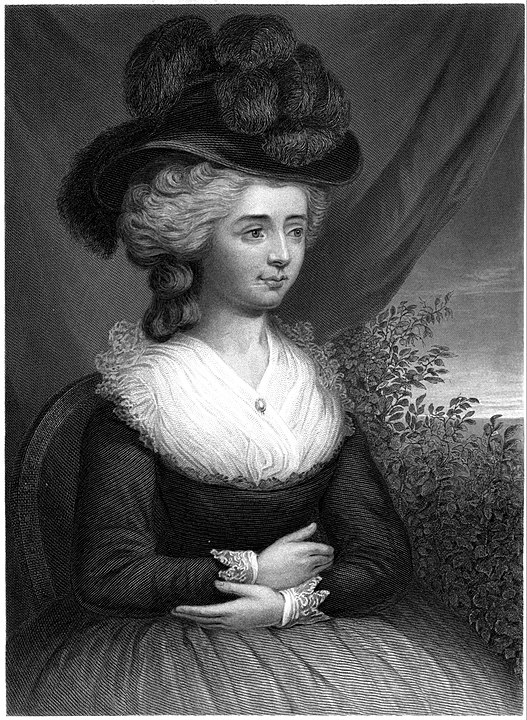
Portrait of Madame D’Arblay (Fanny Burney) engraved from a painting by Edward Francis Burney (Portraits of Eminent Men and Women, 1873), public domain, wikimedia

After a few years without writing, Burney was offered a place at court, as second keeper of the robes to Queen Charlotte. Her father persuaded her to accept, for the family’s advantage. However, Burney was miserable with the drudgery and routine of court life. She did have one adventure, though, when King George III, in a fit of madness, chased her around Kew Gardens. After five years she asked to retire due to ill health, and was allowed to go.

At age forty-one, Fanny met a French military officer, D’Arblay. They fell in love and were married. Fanny’s father was unhappy about the match, since Fanny had little money and D’Arblay had none. However, they had a happy marriage. Their son Alexander was born about a year and a half after their wedding.

Fanny continued writing; mostly plays that were not performed in her lifetime (one was performed for one night, but was an immediate failure). Her novel Camilla, though, was another success, and provided enough money for the D’Arblays to build their own home.

While Fanny’s siblings sometimes acted scandalously, she herself lived a conventional, moral life. Her books express solid moral values, while showing the restrictions placed on women. She died in her home in London in 1840. Fanny Burney has been called the mother of English fiction. She was one of the first successful English novelists.

Jane Austen’s Perspective

Burney’s novels Cecilia and Camilla are mentioned in glowing terms in Northanger Abbey:

“‘It is only Cecilia, or Camilla, or Belinda’; or, in short, only some work in which the greatest powers of the mind are displayed, in which the most thorough knowledge of human nature, the happiest delineation of its varieties, the liveliest effusions of wit and humour, are conveyed to the world in the best-chosen language.”

Jane Austen subscribed to Camilla. (That means that she gave financial support for it before it was published, something like a Kickstarter campaign today.) In her letters, Austen also mentions characters from Burney’s novels. The novels seem to have influenced her own. Harris also speculates that Burney’s experiences at court, recorded in her journals and passed on by Austen’s mother’s cousin Cassandra Cooke (Burney’s neighbor), might be reflected in some of Fanny Price’s experiences in Mansfield Park. Austen obviously admired Fanny Burney’s work, and I think she would have admired Burney personally as well. Jocelyn Harris calls Burney and Austen “sisters of the pen.”

Two other women authors of Jane Austen’s day might qualify as “rock stars,” in terms of popularity, even more than Fanny Burney. Maria Edgeworth, whose novel Belinda is mentioned in Northanger Abbey along with Burney’s novels, was the most successful novelist of her time, in terms of sales and income. Hannah More, whose writings Austen doesn’t seem to have cared for, wrote mostly nonfiction, a tremendous range of books for rich and poor, which were wildly popular. She wrote and worked for causes including the abolition of slavery, education for women and for the poor, and better moral values.

For more on Fanny Burney (1752-1840), see “Only a Novel: The Life of Fanny Burney.”  For more on Burney’s novels, and ways they may have influenced Jane Austen, see “Jane Austen a-Shopping with Burney’s Evelina.

On Maria Edgeworth (1768-1849), see “Maria Edgeworth, Jane Austen’s Forgotten Idol.

On Hannah More, see “Jane Austen’s Novels and Hannah More’s Life—Intersecting Planes” and “Jane Austen, Hanah More, and the Novel of Education.”

What do you think of these “rock stars” of Austen’s England? What do you think Austen would have liked and not liked about them? Are there other women of the time that you would nominate?

In Part 2 we’ll look at some gentlemen “Rock Stars of the Regency.”

Source: These summaries are based on entries in the online Oxford Dictionary of National Biography, plus Jocelyn Harris’s presentation for the JASNA AGM, “Rock Stars of the Regency.”

You can connect with Brenda S. Cox, the author of this article, at Faith, Science, Joy, and Jane Austen or on Facebook.

Read Full Post »

In Part 1 of this series, we learned about the “morning” portion of a Regency woman’s day including pre-breakfast activities, breakfast foods and drinks, social calls, midday refreshments, and dressing for dinner. Now, we’ll explore the evening portion.

Evening: As we said last time, the typical Regency day consisted of two parts: “morning” and “evening.” Evenings were marked by changing clothes for dinner. For Jane Austen and the heroines in her novels, evenings varied greatly depending on where they were and who they were with. Evenings at home were usually quiet and modest; the Austen family enjoyed reading and talking together in the evening when they were home. Evenings out in company were lively and filled with dinners, games, and dances.

Dinner: Dinner was the largest and most formal meal of the day for people of Austen’s day and proper etiquette was essential. The timing of dinner moved later during Austen’s life, settling at six or seven. It was considered fashionable to delay dinner. The later the meal, the more candles needed; thus, affluent families could afford later dinners.

In company and at home, evening attire was more formal than day wear. Dinners at home tended to be more simple, with one course instead of two. This is undoubtedly when young girls learned proper mealtime etiquette from their mothers. For dinners in company, the food was as “lavish as the host’s budget allowed” (All Things Austen 147).

When dinner was served in company, guests walked into the dining room in couples, with the rank of the ladies determining the order in which they entered: “Where rank was equal, married women went before single women, and older ladies took precedence” (133). Once in the dining room, the hostess sat at the top of the table, the host at the bottom.  The “pre-eminent male guest was seated on the hostess’ right hand, the chief female guest at the host’s right” (134).

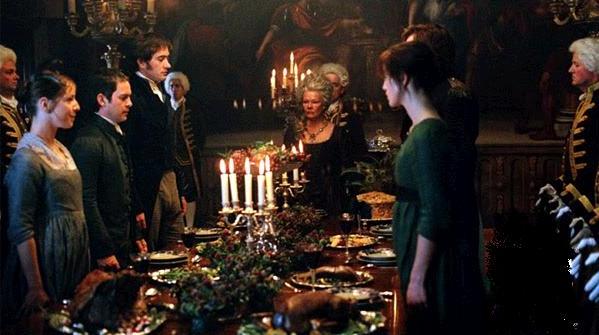
lady-catherine-de-bourghs-table

Dinner with Lady Catherine de Bourgh: Pride and Prejudice, 2005.

Dinner Courses: The first course was comprised of a variety of dishes including joints of meat and boiled or roasted fowl. There was always soup and very often a whole fish.  When these were removed, the second course was brought out. For the second course, the same amount of dishes were served, with new meat perhaps, but “the emphasis this time round was on the lighter savoury concoctions like fricassees and patties, together with a selection of fruit tarts, jellies and cream puddings” (43).

Two courses were served in grand households every day and in ordinary households when there was company. We see this in Pride and Prejudice: “Mrs. Bennet had been strongly inclined to ask [Mr. Bingley and Mr. Darcy] to stay and dine;” however, though she always “kept a very good table, she did not think anything less than two courses could be good enough for a man on whom she had such anxious designs, or satisfy the appetite and pride of one who had ten thousand a year.” (PP)

After the second course was removed, the cloth was cleared and dessert was brought out.  Dessert was usually served with wine and included “tidbits which could be eaten using the fingers” such as “dried fruits, nuts and sweet and spicy confections.” (ATA)

Interestingly, food was not passed around the table as we might do today. Men helped women to the dishes within reach, but servants did not take dishes around the table to serve each guest (as we might see, for example, in Downton Abbey). Sometimes a popular dish might be duplicated on both ends of the table but not always.

After dinner: At home, people often took walks and spent their time after dinner less formally. However, in company, the ladies retired after dinner to the drawing room, again in order of rank. The men stayed behind to drink port and talk uninhibited.

“If this was the hour most looked forward to by many of the men, it could be the most tedious hour for the women, thrown on their own resources in the drawing-room, with neither alcohol nor male company to inspirit the scene.”
-Maggie Lane, Jane Austen and Food

We certainly see this occur in Lady Catherine De Bourgh’s drawing room: “When the ladies returned to the drawing room, there was little to be done but to hear Lady Catherine talk, which she did without any intermissions till coffee came in” (PP).

Tea: Tea was taken once the men rejoined the women. The ladies poured coffee and tea, and usually some light refreshment was given, such as cake or toast. Men would approach the women for a cup, which often allowed conversations to spark. It’s not surprising that everyone looked forward to this portion of the evening, especially unmarried people.

Evening Entertainment: After tea, at home and in company, men and women spent the evening together. At home, they might read out loud, play the piano, sew, write letters, or read. At Netherfield when Elizabeth is staying to care for Jane, many important scenes and conversations occur in the drawing room after dinner. Mr. Darcy uses that time to write to his sister and read books, while Miss Bingley uses her time trying to get his attention.

In company, music was often performed, as we see in Emma and Sense and Sensibility with playing and singing. In Mansfield Park, Mary Crawford plays the harp. Cards and games like whist and lottery were also enjoyed by all once the tea table was cleared. At a private ball or at a large enough party in a home, there was usually dancing.

Supper: If a woman’s stays weren’t already about to burst after several courses of dinner, dessert, and tea time, there was supper to look forward to at the end of the evening. At home and in small gatherings, it was a simple meal laid on a smaller table in the drawing room where everyone was gathered. At a ball or larger gathering, supper was a much more substantial meal and must include soup.

Austen herself was known for staying out until the wee hours of the morning after a dance or party, which is why Regency women often slept later in the morning. When they arrived home, women retreated to their rooms. What a relief it must have been, after a long evening of eating, dancing, and socializing, to take down one’s hair, change out of one’s dress, petticoats, and stays, and slip into bed.

This is just a sample of the way Jane Austen’s Regency women might spend their evenings. Next month, we’ll look more closely at women’s issues of the time, such as female education and accomplishments, hygiene and beauty, fashion and cosmetics, and pregnancy and childbirth.

Food for thought: If you could spend an evening with Jane Austen, what activities would you most like to do?

Rachel Dodge is the author of Praying with Jane: 31 Days Through the Prayers of Jane Austen (2018) and The Anne of Green Gables Devotional: A Chapter-By-Chapter Companion for Kindred Spirits (November 2020). Rachel teaches college English classes, gives talks at libraries, teas, and book clubs, and writes for Jane Austen‘s World blog and Jane Austen‘s Regency World magazine. You can visit her at RachelDodge.com.

Read Full Post »

“They who buy books do not read them, and … they who read them do not buy them.” – Robert Southey

Introduction:

Circulating libraries benefited Jane Austen and authors of her era in two ways. They rented out books, pamphlets, and magazines economically to people of modest means, like Austen. After books were published, library subscriptions made them available to a wider readership than was previously possible.

A short history of circulating libraries:

Circulating libraries were first mentioned in the Oxford English Dictionary in 1740, when Dr. Samuel Fancourt used the words to advertise his store in Salisbury. He had started his library five years before to rent out religious books and pamphlets, then moved his store to London in 1742, where it thrived.

Other already existing London bookshops adopted Fancourt’s commercial library model and its descriptive term. In a little over 30 years, the circulating library had sprung up all over London, as well as Bath and other resort spas, and by 1801 an estimated 1,000 of these libraries had spread all over England. This library concept traveled to British Colonies the world over. A monthly parcel of books could also be ordered by subscription from a London circulating library and shipped to a foreign location, such as a plantation in Ceylon (Parasols & Gloves & Broches & Circulating Libraries,” Mary Margaret Benson).

The difference between subscription and circulating libraries:

An article about subscription vs circulating libraries by JASACT (Jane Austen and all that – in Canberra), explains that the two terms are often confused with each other. Subscription libraries consisted largely of serious book collections that covered specific topics, such as science, history, travel, or theology. Annual fees from male subscribers went towards purchasing books for the collections, which tended to be lofty and not open to the public.

The Roxburghe Club was a club for book lovers established after the sale of the library of the Duke of Roxburghe, which was one of the great libraries of the day, which concluded June 17, 1812. Its membership was men who loved and who could afford books, comprised of a mixed group of aristocrats, businessmen and academics.” – Club London in the Georgian and Regency Eras, Lauren Gilbert

Circulating libraries were established as businesses with the aim of making money from a mass market that consisted of men, the rising middle classes, and women. Instead of focusing on narrow subjects, circulating libraries offered a variety of materials designed to please as many reading tastes as possible (JASACT). These included the novel, which quickly rose in popularity with the fairer sex.

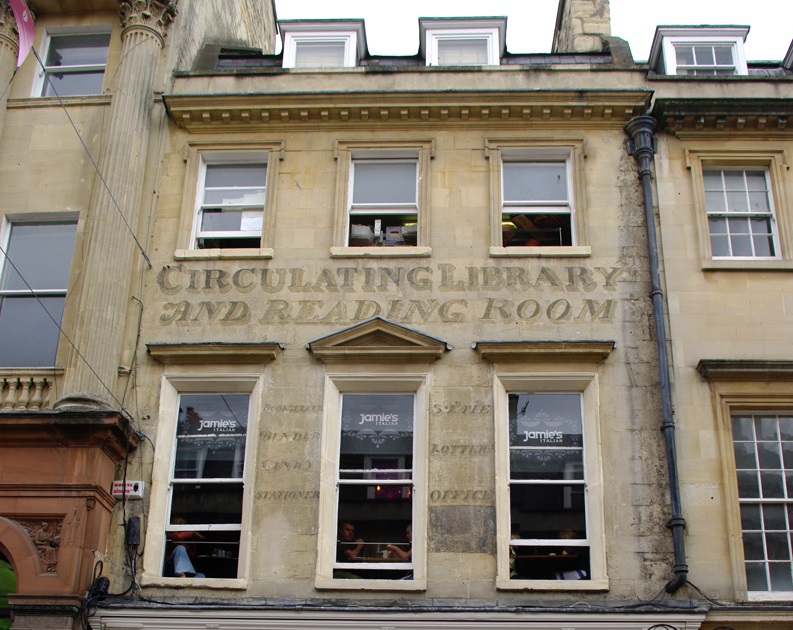
Image of lettering on a building in Bath that was once a Circulating Library and Reading Room on Milsom Street. Image courtesy of Tony Grant.

Lettering on a building in Bath that was once a Circulating Library and Reading Room on Milsom Street. Image courtesy of Tony Grant.

The libraries began to expand from London and leisure resorts to more rural communities across England. Paul Kaufman in an article entitled “The Community Library: A Chapter in English Social History” mentions a circulating library in 1790 operated by Michael Heavisides in Darlington, Durham, a provincial market town. His 16-page catalogue offered only 466 books in 1,014 volumes with a modest list of topics, many of which were not au courant:

All types of fiction predominate, standard and cheapest contemporary types, many with the thinly veiled “history” and “memoir” titles…Shakespeare’s Poems (1 vol.), Milton’s Works, the Odyssey, Pilgrim’s Progress and Holy Ward, translations of Lucan and Ovid, Knox’s Essays, Cook’s Voyages, Spectator, Tatler, and Mirror, Smollett’s History of England (10 vols.), Salmon’s History of England (13 vols.), Thompson’s Poems, Rousseau’s Emile, Berkeley’s Minute Philosopher, Arabian Tales, and two apparently separate Persian Letters.” (The Bodleain.)

While the selection was small, even for regency libraries, Mr. Heavisides was successful enough to run his business for 30 years.

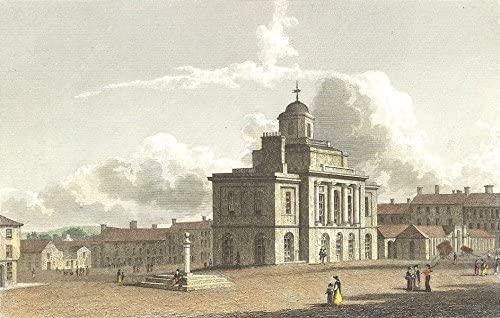
Image of Darlington in 1830

Darlington in 1830

Circulating libraries as consumers:

A new business relationship between booksellers and publishers emerged during the last quarter of the 18th century. Circulating libraries were

…business enterprises, aimed at readers who could not afford to buy books, but who would be willing to pay perhaps half a guinea a year as a subscription fee, and then a few pence rental fee for each volume, or at readers who were away from town-perhaps at a seashore spa!-for a time, as well as those voracious readers who wanted the latest books at bargain prices.” – “Parasols & Gloves & Broches & Circulating Libraries,” Mary Margaret Benson.

The British book industry first began to sell books to the libraries. Publishers then realized they could increase profits by owning a library and renting out their own books.

Image of a circulating library owned by Messrs Lackington Allen & Co, 1809. Image in the public domain

Circulating library of Messrs Lackington Allen & Co, 1809. Image in the public domain

John Lane, who was the proprietor of the Minerva Press, and both the leading publisher of gothic fiction in England and “the principal wholesaler of complete, packaged circulating libraries to new entrepreneurs,” realized that he could make substantial profits from catering to the tastes of readers like Isabella Thorpe and Catherine Morland of Northanger Abbey. (Lee Erickson, p. 583)

People were quite willing to rent a novel they were unwilling to buy.”- Lee Erickson

Only the rich could afford to purchase books in Austen’s day. Publishers generally did not print their own books. They contracted a printer and estimated the number of copies that would sell. Since paper was expensive (much of it was handmade and then taxed), publishers would order new books when the first estimated run sold out. As the popularity of books and novels rose, so did their price. Between 1810 and 1815 books cost the equivalent of $90 to $100 American dollars today.

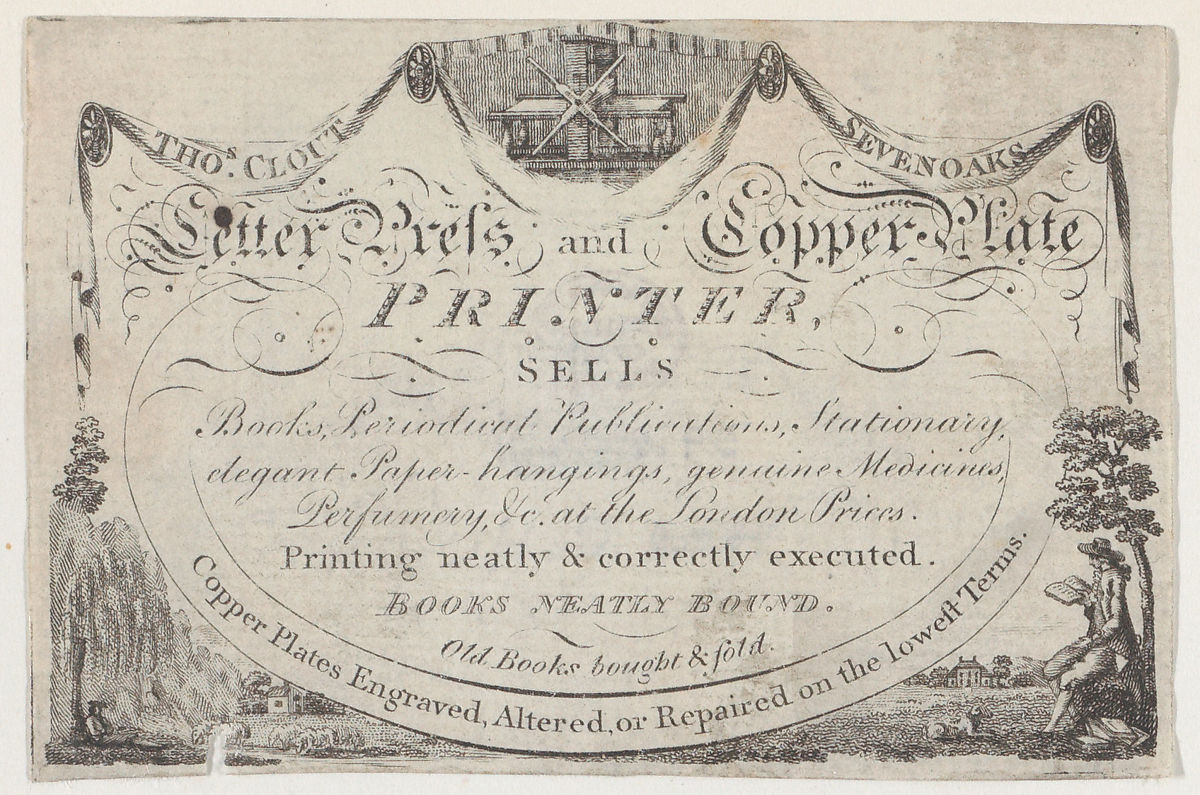
Image of a Trade Card of Thomas Clout, Printer. An engraving of a printing press is at the top center of the card. Public domain image, courtesy of the Metropolitan Museum of Art.

Trade Card of Thomas Clout, Printer. Notice the printing press at the top center of the card. Public domain image, courtesy of the Metropolitan Museum of Art.

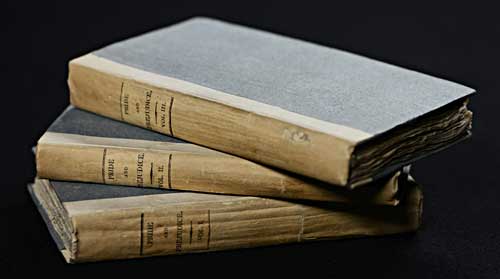
To increase rentals, publishers began printing three-decker novels, also known as leviathans. These 3-volume novels became the standard until almost the end of the 19th century. The advantage of three volumes was that each book was rented out one at a time to a customer. When a reader finished Volume the First, she would turn it in and check out Volume the Second, and so forth. This meant that three customers would read one book at any one time. In Northanger Abbey, Henry Tilney described a typical three-decker set to his sister, Eleanor:

Miss Morland has been talking of nothing more dreadful than a new publication which is shortly to come out, in three duodecimo volumes, two hundred and seventy–six pages in each, with a frontispiece to the first, of two tombstones and a lantern …”

Image of a three-volume first edition of Pride and Prejudice bound in a simple publishers board. National Library of Scotland

Three-volume first edition of Pride and Prejudice bound in simple publishers board. National Library of Scotland

New authors like Jane Austen often took the financial risk of publishing their novels. Jane took this gamble after her father sold her first novel Susan in 1803 for £10 to Benjamin Crosby, who allowed it to languish unpublished on his shelves. Six years later, she wrote the publisher under the pseudonym of Mrs. Ashley Dennis, or M.A.D., for the return of her manuscript. Crosby quickly shot back a reply, saying her MS. would be hers if she paid the same amount for it that he paid her. For Jane that £10 represented almost half her yearly allowance, and so the book remained unpublished until after her death.

Austen learned her lesson from this experience and in 1811 she published Sense and Sensibility on commission, which guaranteed its publication. The novel’s success (which made Austen a profit of £140) ensured that she would not have to self publish again.

The rise of the novel:

What shall we say of certain books, which we are assured (for we have not read them) are in their nature so shameful, in their tendency so pestiferous, and contain such rank treason against the royalty of Virtue…that she who can bear to peruse them must in her soul be a prostitute…” – James Fordyce, Sermons to Young Women

Jane wrote her “pestiferous” novels, as Fordyce called all fiction largely aimed at the female market, at an auspicious time. The leisured upper and rising middle classes’ demand for books increased during a period when their costs went up. In addition, the number of literate people was rapidly expanding. In Jane Austen’s England, Roy and Lesley Adkins wrote:

…it has been estimated that two out of three working men could read to some extent, thought rather fewer had writing skills, and not nearly as many working women could read.” (p 231)

In Emma, Austen wrote about Mr. Martin’s sensible taste in reading and of his neat writing skills, which astonished Emma. Individuals who could not read enjoyed hearing a book read to them during group reading, a form of entertainment that the literate Austen family also followed. Paul Kaufman in “The Community Library” (p. 46) mentioned that reading also became a liberating force for the higher servant level. One imagines that cooks, butlers, housekeepers, and governesses were among them.

Circulating libraries fulfilled an insatiable appetite for subscribers. Library proprietors followed the money and increasingly offered more novels to accommodate female readers, although men generally had little regard for fictional stories. Many, like Mr. Collins (Pride and Prejudice), a devotee of Fordyce, held them in great contempt. Sir Edward Denham (Sanditon), could hardly contain his disdain for novel reading:

Sir Edward, approaching Charlotte, said, “You may perceive what has been our occupation. My sister wanted my counsel in the selection of some books. We have many leisure hours and read a great deal. I am no indiscriminate novel reader. The mere trash of the common circulating library I hold in the highest contempt. You will never hear me advocating those puerile emanations which detail nothing but discordant principles incapable of amalgamation, or those vapid tissues of ordinary occurrences, from which no useful deductions can be drawn. In vain may we put them into a literary alembic; we distill nothing which can add to science. You understand me, I am sure?”

Pity poor Charlotte having to listen to that drivel. Contrast Lord Denham’s pompous opinions with Henry Tilney’s charming and succinct statement:

The person, be it gentleman or lady, who has not pleasure in a good novel, must be intolerably stupid.” (Northanger Abbey)

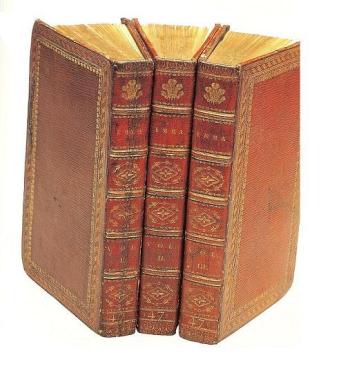
It is interesting to note that Austen rewrote Susan (Northanger Abbey) before she began to write her unfinished novel, Sanditon, and that she and her family were avid novel readers. Still, reading fiction belonged largely to the pervue of women. Gothic and romance novels, popularized by Frances Burney, Maria Edgeworth, and Ann Radcliffe, were regarded as disposable throwaways only good enough for one-time reading. Few people purchased novels or kept them on their shelves, and so they were cheaply published with a simple binding known as publishers boards. The Prince Regent owned a handsome three-volume book of Emma, but this was the exception, not the rule.

Image of the 3-decker edition for the Prince Regent of Emma.

The Prince Regent’s edition of Emma by Jane Austen, courtesy Deirdre Le Faye via Jane Austen in Vermont.

Despite Fordyce’s dire warnings, by the end of the 18th century fully 75% of books rented out by circulating libraries were novels. Ninety percent of Mr. Heavisides books in his circulating library in Darlington were listed as standard and “cheapest contemporary” fiction.

This short discourse, gentle reader, brings Part One of Circulating Libraries to an end. In the second installment, discussions will center on subscription fees, libraries as social hubs, subscription books, reading rooms, characteristics of large city and small rural libraries, and Jane Austen’s descriptions of circulating libraries in her novels and letters.

Sources:

Read Full Post »

Reviewed by Brenda S. Cox

The Journal of a Georgian Gentleman: The Life and Times of Richard Hall, 1729-1801 provides fascinating insights into Jane Austen’s England.


The Journal of a Georgian Gentleman, by Mike Rendell, explores 18th century life in England

Richard Hall was a tradesman, a hosier who made stockings in a shop near London Bridge. Like the Coles in Emma, he “was of low origin, in trade,” but moved up in society as he became wealthier. Hall accumulated his fortune through hard work, marriage, inheritance, and investments. From selling silk stockings, he moved into selling fine fabrics, silver buckles, and other fashionable accessories. Hall eventually owned several estates, and retired as a country gentleman. 

I asked the author, Mike Rendell, to tell us more about how he wrote this book.

Rendell says he inherited “a vast pile of old family papers, . . . stuffed into tea chests and boxes in the back of the garage” in his grandmother’s house. He focused on the papers related to Richard Hall and found it “a fascinating voyage of discovery.” 

This trunk was full of papers from the eighteenth century.

Rendell continues, “For instance, if he [Richard Hall] recorded in his diary that he had ‘visited the museum’ it made me research the origins of the British Museum, realizing that he was one of the earliest visitors. Which led on to researching what he might have seen, etc.”

He adds, “Writing my first book opened my eyes to a great deal about the world in which Jane [Austen] was brought up. I love her works – especially P&P and I must admit to binge-watching the entire BBC version in a single sitting, at least twice a year!”

In the context of Richard Hall’s story, Rendell tells us about many aspects of life in the eighteenth century, based on his extensive research. For example:

Religion

Richard Hall was a Baptist, one of the Dissenter (non-Church of England) groups in Austen’s England. This meant that even though Hall loved learning, he was not able to attend university. Oxford and Cambridge, the two English universities, would not give degrees to Dissenters. Hall could have studied in Holland, but his family decided to bring him directly into their hosiery business instead.

Richard Hall’s grandfather and father were Baptists, and Richard attended a Baptist church and listened to sermons by the famous Baptist preacher Dr. John Gill for many years. Richard also collected printed sermons by Dr. Gill. However, it was not until Richard was 36 that he “gave in his experience” and was baptized. Rendell explains that “giving in his experience” meant “explaining before the whole church at Carter Lane in Southwark how he had come to faith in Christ.”

Some of the leaders of the English Baptists of the time are part of Hall’s story, as well as disputes and divisions between Baptist churches.

Hall sometimes attended Anglican churches, and was even a churchwarden for a time. Rendell comments, “The fact that he was a Baptist did not mean that he was unwilling to attend Church of England services – just as long as the gospel was being preached.”

Methodists were another important movement in Hall’s England, though they were still part of the Anglican Church for most of Hall’s lifetime. One of Hall’s relatives, William Seward, became an early Methodist minister, preaching to open-air crowds. Rendell writes that Seward “died after being hit by a stone on the back of the head while preaching to a crowd at Hay-on-Wye, on 22 October 1740 – one of the first Methodist martyrs.”

Silhouette of Richard Hall, probably “taken” (cut out) by his daughter Martha. In 1777 Martha “gave her experience” and was baptized in a Baptist church, as her father had done.

Science

Rendell often explains advances in science that affected Hall’s life (and Jane Austen’s). He writes, “By the standards of his day . . . Richard was a well-educated man. Above all, he was a product of his time – there was a thirst for knowledge all around Richard as he grew up. There were new ideas in religion, in philosophy, in art and in architecture. This was the age of the grand tour, of trade developments with the Far East, and a new awareness of the planets and astronomy as well as an interest in chemistry and physics. It was a time when the landed gentry were experimenting with new farming methods – inspired by ‘Turnip’ Townsend and Jethro Tull – and where a nascent industrial revolution was making its faltering first steps.” Richard wrote down many scientific “facts”—or fictions—some of which are listed in an appendix.

Surprisingly, Richard Hall records several times that he saw the Aurora Borealis in southern England. Apparently, the aurora was sighted many times in Austen’s England, though it has since migrated northward.

Rendell also tells us about an invention that greatly improved transportation: the development of macadam roads. These were named for the Scotsman John McAdam who invented the process. When bitumen (tar) was added in the nineteenth century, such roads were called “tar-macadamised”: a word eventually shortened to “tarmac.”

Travel was quite an adventure in Austen’s time. Richard Hall made this detailed paper cutout of a coach and four, showing one of the fastest means of transportation available at the time. Hall also did cutouts of a coach and four about to crash because of a boulder in the road, and a one-horse coach being held up by a highwayman.

Medicine

Richard Hall’s small daughter was inoculated against smallpox, which meant she was given the actual disease. She had “between two and three hundred pustules.” But Richard writes that about three weeks later, “Through the goodness of God . . . the Dear Baby finally recovered from inoculation.” 

About ten years later, inoculation–giving the patient a hopefully mild case of smallpox–was replaced by vaccination. Dr. Edward Jenner developed this technique, where patients were given cowpox rather than smallpox to develop their immunity. However, Jenner became a member of the Royal Society (of scientists) not for his work on vaccination, but for his observations of cuckoos and their habits! He also experimented with hydrogen-filled balloons. The “naturalists” (not yet called “scientists”) of this age were interested in topics that nowadays we would separate into many different branches of science.

When Hall’s first wife, Eleanor, died of a stroke, he cut this tiny Chinese pagoda in memoriam, with her name, age, and date of death. Rendell says it is “like
lace. It is just an inch and a quarter across and most probably fitted in between the outer and inner cases of his pocket watch. In other words it was worn next to his heart. Very romantic!”

Weather

Hall also noted the weather. In 1783 he refers often “to a stifling heat, a constant haze, and to huge electrical storms which illuminated the ash cloud in a fearsome manner.” These were the effects of a huge volcanic eruption in Iceland, the Laki volcano. This eruption, the most catastrophic in history, caused an estimated two million deaths worldwide, and wiped out a quarter of the population of Iceland. In England, the harvest failed, cattle died, and about 23,000 people died of lung damage and respiratory failure.

Highwaymen were another danger in Austen’s England. In this paper cutting by Richard Hall, a criminal, possibly a highwayman, hangs on the gallows while spectators are unconcerned.

Language

Richard Hall wrote a list for himself of words that sound different than they look. He gives the spelling, then the pronunciation, which helps us see how people in his area and level of society spoke. A few examples:

Apron—Apurn

Chaise—Shaze

Cucumber—Cowcumber

Sheriff—Shreeve

Birmingham—Brummijum

Nurse—Nus

Dictionary—Dixnary

The history of some words are also explained. For example, the word “gossip” was a contraction of “God’s siblings.” Such women helped mothers in childbirth. The “gossips” offered sympathy, kept men away, and chattered in order to keep up the mother’s spirits throughout her labor.

Museums and Exhibitions

Rendell describes several museums and exhibitions that Hall visited. One of the most intriguing is Cox’s Museum, which Hall and his wife visited the year Austen was born. It featured rooms full of “bejewelled automata.” The most famous was a life-size silver swan, still a popular exhibit at the Bowes Museum in Durham (northern England). The Museum says it “rests on a stream made of twisted glass rods interspersed with silver fish. When the mechanism is wound up, the glass rods rotate, the music begins, and the Swan twists its head to the left and right and appears to preen its back. It then appears to sight a fish in the water below and bends down to catch it, which it then swallows as the music stops and it resumes its upright position.” No less a personage than Mark Twain admired this swan and wrote about it in The Innocents Abroad.

Richard Hall’s upbringing stressed values which still resonate with many people today. Rendell writes, “. . .from an early age it had been instilled into Richard that there were only three things which could help stop the fall into the abyss of poverty, sickness and death. The first was a strong belief in the Lord, and that without faith you got nowhere. The second was the importance of education. The third was that you got nothing without working hard for it. These were the cornerstones of his upbringing – and of the whole of his subsequent life.”

Richard Hall was an artist of paper cutting. He cut out everyday objects and scenes. Many, like this finely-done rapier, were found among his books and journals.

And Much More

The Journal of a Georgian Gentleman is full of treasures for those of us who love reading about Jane Austen’s time period. We learn about guilds, clothing, food, disasters, transportation, prices, medical advances, explorers, and much more. 

To Rendell, Richard Hall “came across as a bit of a joyless, pious individual but then I thought: hang on, he had to face exactly the same problems as we do today – illness, worries about the business, problems with a son who was a mischief maker at school, problems with the drains etc etc. When he re-married  he fell out with his children because they didn’t approve of his new bride – and they excommunicated him [avoided and ignored him] for the rest of his life. In that sense his life was just as much of a mess as the ones we lead today!”

While Rendell originally wrote this story for his own family, when he decided to make it widely available he found he needed to promote it. He ended up in a surprising job. He says, “I had never before tried public speaking but quickly found that I loved it – and ended up with a totally new ‘career’ as a cruise ship lecturer (when Covid 19 permits!) travelling the world and talking about everyday life in the 18th Century. . . . These talks include talks about Jane Austen – in particular about the different adaptations, prequels, sequels, etc. of Pride and Prejudice – as well as talks about the venues used in the various films of Jane’s books. I also write articles for Jane Austen’s Regency World. . . . One thing led to another and I have now had a dozen books published, with two more in the pipeline.”

Mike Rendell’s books include topics such as Astley’s Circus (Astley’s is mentioned in Emma and in one of Jane Austen’s letters), Trailblazing Women of the Georgian EraPirates and Privateers in the 18th Century, and more. 18th Century Paper Cutting shows the illustrations used in this article, along with other lovely paper cuttings by Richard Hall. See Mike Rendell’s blog at mikerendell.com for more of Mike’s books and blog posts.

The Journal of a Georgian Gentleman is available from amazon in the US and the UK. It is offered on kindle unlimited. If you order a paperback copy from Mike Rendell (Georgiangent on amazon.co.uk), he says, “if anyone orders a copy I will ask (through amazon) and see if they want a personal dedication/signed copy before popping it in the post.” (It is listed there as a hardback but is actually a paperback.)

By the way, Rendell pointed out that Jane Austen’s nephew, James Edward Austen-Leigh, also did paper cutting (or silhouettes). You can see examples of James’s work in Life in the Country. There is also a well-known silhouette of Jane’s brother Edward being presented to the Knight family; that one was done by a London artist, William Wellings.

The Journal of a Georgian Gentleman gives us valuable insights into the life of an Austen-era tradesman who became a country gentleman. What would you most like to know about the life of such a person?

Images courtesy of Mike Rendell.

___________

Brenda S. Cox blogs about Faith, Science, Joy, and Jane Austen, and is currently working on a book entitled Fashionable Goodness: Christianity in Jane Austen’s England. You can also find her on Facebook.

Read Full Post »

« Newer Posts - Older Posts »