Feeds:
Posts
Comments

Archive for the ‘Jane Austen’s World’ Category

Till this moment, I never knew myself.”–Elizabeth Bennet in Pride and Prejudice, quoted in 30-Day Journey with Jane Austen.

In these days of stress and anxiety, do you long for a few minutes of peaceful reflection each day? Take a 30-Day Journey With Jane Austen. Jane is an excellent travel companion!

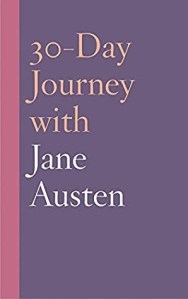
Cover of the book 30-day Journey with Jane Austen by Natasha Duquette

30-day Journey with Jane Austen by Natasha Duquette

Natasha Duquette has chosen thirty profound passages from Jane Austen. Most are from Austen’s novels; the last three are from her prayers.

Each daily passage is followed by an explanation, putting the passage in context and sometimes including connections to Austen’s life. Then a Reflection section connects the passage to our lives, giving us thoughts to chew on for that day.

The brief chapters in this book encouraged and inspired me each morning.

Highlights

Here are a few highlights that I appreciated:

Some reflections focus on our own hearts. On Day Two, Elinor Dashwood considers how “extravagance and vanity” have made Willoughby “cold-hearted and selfish” (Sense and Sensibility). Duquette points out that the Austen family themselves had to live economically, unlike some of Austen’s characters.

Natasha Duquette tells us that Elinor “realizes unthinking habits of luxury have led Willoughby to waste the valuable gifts placed in his hands. . . . Wasteful choices can interfere with true joy in our lives.”

The section concludes, “Focus on practices that build positive attachments to God, to human beings, and to other gifts in your life, rather than to material possessions. Think about how you might steward your resources wisely, hold them lightly, and express gratitude for them joyfully.”

A good reminder to live each day with thankfulness for what we have. We can experience joy today, whatever our circumstances, rather than wait for joy from what we might get in the future.

The Dashwoods teach us about peace as well as joy. On Day Three, volatile Marianne Dashwood “resolves to form habits that can lead to health and peace.” She intends to enjoy nature, reading, music, and her sister’s companionship. Could you find health and peace today in any of those ways?

Practical Suggestions

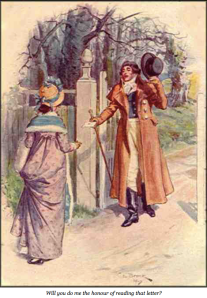
Some lessons are concrete. On Day Seven, Elizabeth Bennet reflects on Darcy’s letter as she walks for two hours. Duquette points out, “The classical philosopher Aristotle believed reason was sharpened by walking. Austen agreed.”

Image of Elizabeth and Darcy: After Elizabeth receives Darcy's letter, she walks alone for two hours to consider what the truth is. C. E. Brock illustration of Pride and Prejudice, public domain.

After Elizabeth receives Darcy’s letter, she walks alone for two hours to consider what the truth is. C. E. Brock illustration of Pride and Prejudice, public domain.

The Reflection section adds, “Such walking grounds us in reality. Often an answer to a problem will crystallize not as we are sitting statically before a computer screen but as we are physically moving somehow.” Duquette encourages us to “Reconsider a problem or challenging situation in your life as you exercise.”

Even in days of isolation, we need ways to exercise our bodies and give ourselves time to think. I walk up and down the hall of my small apartment for thirty minutes each day, thinking and praying. Others of you may have the opportunity to walk outside, as Elizabeth Bennet did, enjoying the outdoors as you consider whatever comes to mind.

Encouragement for Relationships

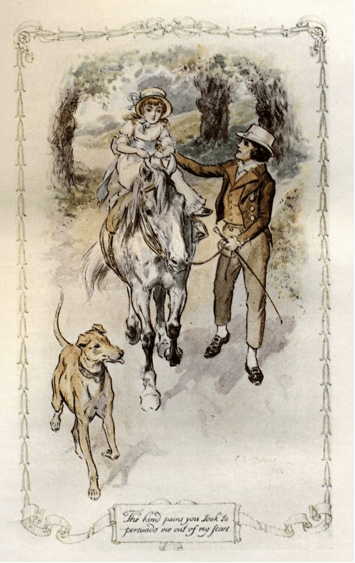
Day 10 is about our relationships. In Mansfield Park, Edmund finds his little cousin Fanny crying. He asks persistent questions and listens well, to console her. He then takes her outside, where she can be comforted by the beauties of nature. Duquette explains, “Edmund’s care for Fanny is pastoral, foreshadowing his eventual call into life as an Anglican priest.”

Jane Austen was sent away from home to study with Mrs. Cawley when she was only seven. So she knew how Fanny felt.

Duquette encourages us to notice people who are sad, and “then make time and space to listen to their story in a peaceful environment. You may be surprised at the effectiveness of such gentle attention.” Such deep connections, whether virtual or in person, can encourage you both.


Image of Edmund’s small kindnesses to Fanny Price made a big difference to Fanny. C. E. Brock illustration of Mansfield Park, public domain.

Edmund’s small kindnesses to Fanny Price made a big difference to Fanny. C. E. Brock illustration of Mansfield Park, public domain.

Spiritual Reflections

On Day 15, we think a bit about our mortality. Tom Bertram of Mansfield Park faced death, and because of that he became a better person. Duquette says, “Anglicans in Austen’s day would pray for a good death as part of their liturgy on a Sunday morning.” She encourages us to think about death, not fearfully, but to put our lives in perspective. We might consider, as Tom did, whether we are living for others as well as for ourselves.

The last three days, based on Austen’s prayers, focus more on our relationship with God. Day 30 encourages us to examine our own hearts, and look for ways to “reflect the infinite love of God to a hurting world deeply in need of mercy and grace.”

The 30-Day Journey Series: “Our Greatest Spiritual Thinkers”

30 Day Journey with Jane Austen is the newest addition to the 30-Day Journey series by Fortress Press. The publisher says:

“Enrich each day with wisdom from our greatest spiritual thinkers. Through brief daily readings and reflections, the 30-Day Journey series invites readers to be inspired and transformed. By devoting a moment to meaningful reflection and spiritual growth, readers will find deeper understanding of themselves and the world, one day at a time.”

I’m delighted, though a little surprised, to see Jane Austen join our “greatest spiritual thinkers”! The others in the series are Julian of Norwich, Dorothy Day (Catholic social activist), Martin Luther King, Jr., Dietrich Bonhoeffer, St. Hildegard of Bingen, and Emily Dickinson. Quite a varied lineup of thinkers.

I recommend 30-Day Journey With Jane Austen as a peaceful, encouraging way to begin each day. It will help you to reflect more deeply on important truths and how they might affect your life.

Links about the book:

About the blog post author:

Brenda S. Cox writes on “Faith, Science, Joy, and Jane Austen” at brendascox.wordpress.com .

About Natasha Duquette:  For those who would like to know more about the author of 30-Day Journey With Jane Austen:

Dr. Natasha Duquette, Academic Dean and Professor of Literature, Our Lady Seat of Wisdom College, B.A., University of Alberta, M.A., University of Toronto, Ph.D., Queen’s University

Dr. Natasha Duquette is author of 30-Day Journey with Jane Austen (Fortress Press, 2020) and is currently serving as editor-in-chief for The Palgrave Encyclopedia of Romantic-Era Women’s Writing (Palgrave MacMillan), which is a collaborative project involving writers based in universities around the globe. She is also author of Veiled Intent (Pickwick, 2016), co-editor of Jane Austen and the Arts: Elegance, Propriety, and Harmony (Lehigh University Press, 2013), and editor of Sublimer Aspects: Interfaces between Literature, Aesthetics, and Theology (Cambridge Scholars Publishing, 2007). For the Chawton House Library series, she produced the first annotated, scholarly edition of Helen Maria Williams’s Julia, a novel interspersed with poetical pieces (Routledge, 2009).

Her articles have appeared in the journals PersuasionsPersuasions On-Line, English Studies in CanadaChristianity and LiteratureNotes and QueriesMosaic, and Women’s Writing. She has contributed essays to multiple collections, including Through a Glass Darkly: Suffering, the Sacred, and the Sublime in Literature and Theory (Wilfred Laurier University Press, 2010) and Art and Artifact in Austen (University of Virginia Press, 2020). Her research has been supported by fellowships from SSHRC, Chawton House, and Gladstone’s Library.

Dr. Duquette enjoys teaching courses on eighteenth-century satire, aesthetics, Jane Austen, African literature, and Indigenous writers of North America. Before coming to Our Lady Seat of Wisdom College, she taught full-time at the Royal Military College of Canada, Biola University in Southern California, and Tyndale University in Toronto, where she also served as Associate Dean of undergraduate studies for four years.


Read Full Post »

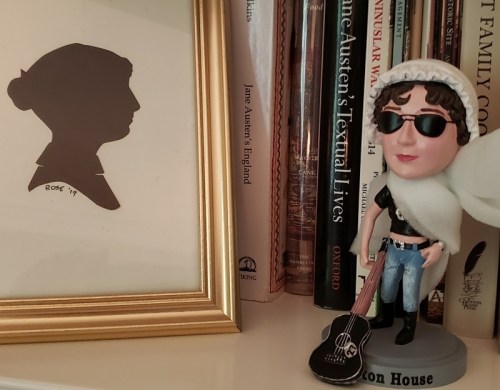
Inquiring readers: Today is the 203rd anniversary of Jane Austen’s death. She lived from December 16th, 1775 to July 18, 1817, and managed to achieve more in 41 years than a majority of us in twice that time. My previous posts marking this occasion were somber. This one provides a more light hearted, science fictiony approach. The North American Friends of Chawton House sent a limited edition of Celebrity Jane, a bobblehead doll, after I made a contribution that qualified me for this gift. NAFCH challenges Celebrity Jane doll possessors to share photos of Bad Ass Jane, as I renamed her, in various locations in our lives. I chose home.

Image of Bad Ass Jane meeting her 18th century silhouette, as drawn by Mr. Rose at the 2019 AGM in Williamsburg

Bad Ass Jane meets her 18th century silhouette, as drawn by Mr. Rose at the 2019 AGM in Williamsburg

It was a dream. It must have been. I had been researching Jane Austen’s life in Steventon until I fell asleep. Then, when I awoke around 2 A.M., as I am wont to do, I saw a bad ass version of Jane Austen on my bookshelf, staring at a silhouette of herself. Only she wasn’t quite the spinsterish virgin that I knew and loved so well, Oh, no! She was Bad Ass! A Rocker Chick. A person who would have appealed to my rebellious younger self and my current, well, rebellious me.

She still wore her virginal cap, but from the neck down she wore a black tee, low rise jeans that bared her midriff, and leather boots! Best of all she carried a guitar. Regency Jane loved playing music every morning on her piano forte. Bad Ass Jane (BAJ) plays electric guitar at every opportunity. (How BAJ finds the time to write—heaven knows.)

I gruffed at this strange Jane, who wanted to discuss the books in my book shelf, most of which pertained to her life and history. I needed my beauty sleep and promised her a tour of my house and gardens the following morn, but she would have none of it. She desired my company NOW! Jane played a few tunes on her guitar, which woke me more efficiently than two cups of Moroccan coffee. She mesmerized me with her persistence, pluck, and talent.

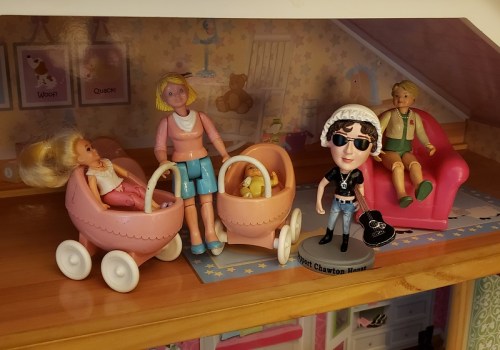
Image of Bad Ass Jane meets Cassandra, her two children, and mother wearing pearls.

Bad Ass Jane visits Cassandra, her two children, and mother wearing pearls.

I pointed to a 5 foot tall doll house, in which my 7-year-old grand nieces played occasionally. “Here’s your family.” I gestured to the top floor of the house where two female adults and two children resided.

BAJ peered inside. “My family? They look strange and somehow not themselves. And the fashion! Oh, so revealing. Who are those children?”

“Dear Jane,” I said familiarly. “Recall that this is a dream and that this story is a mere figment of my imagination and the result of a host of wishes. Tom Fowle never died. He returned with Lord Craven from the West Indies healthy and hale and became the intended heir of a living in Shropshire. He and Cassy married and had two beautiful children. Your mama, Mrs. Austen, acquired a gorgeous necklace of pearls, brought back by Tom.”

Copy of Bad Ass Jane in the ficus tree

Bad Ass Jane in the ficus tree

“How strange,” BAJ muttered. She wandered from the doll house to our ficus tree lit with fairy lights.


She then visited the wine corner. Recalling that she had a fondness for a tipple here and there, I offered a glass. Savoring the wine (a nice Australian Shiraz), we discussed her family, my family (our fathers, with their dry wit and extensive libraries had much in common), and our writing. She was better than me. Way. And more successful. Way. I felt humbled in her presence.

When BAJ learned about her enduring fame–the JASNA Societies, the JA groupies, the Austenesque novels and stories–her bobble head bobbled. “Goodness, I’m famous! Did I become rich?”

I shook my head sadly. “Not you, but Cassandra and your ancestors benefited most generously.”

When dawn broke, we walked into my back yard. BAJ played her guitar in the morning, much as she played her pianoforte before breakfast. I was mesmerized. It was time to greet the sun.

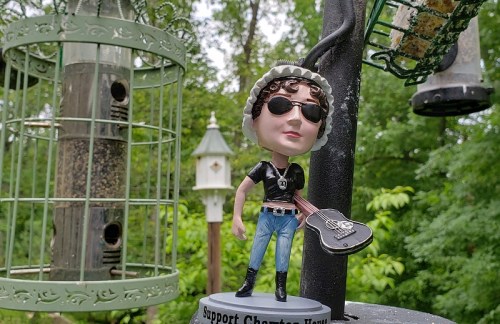
Image of Bad Ass Jane at the bird feeders

Bad Ass Jane at the bird feeders

I pointed to my bird feeders, where my hungry hordes of wildlife shrieked for their breakfast: blue jays, red cardinals, musical wrens, and colorful goldfinches. The deer, chipmunks, and squirrels were silent but watchful. Their ferocious appetites challenged my meager resources weekly. All stood a respectful distance away as I filled tubs, tubes, platforms, and the ground.

An impatient BAJ wanted in on the action and hopped right on to the feeders. In an impeccable British accent, she asked, “Pray, where are they?”

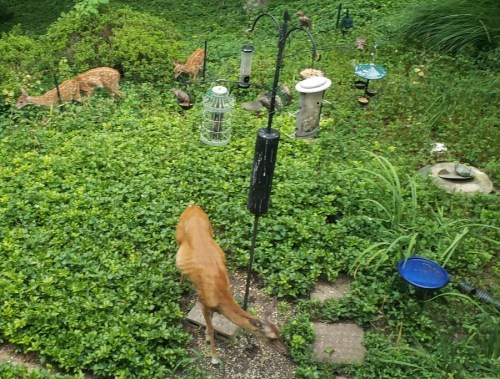
birds-deer

The deer and their fawns and birds appeared as we stood still

“Gurl,” I said. “Your Bad Ass attitude must’ve scared them. Stay still and behold the magic.” Shy creatures appeared flock by flock and one by one from the forest within feet of us. BAJ noted with irony that the brown sparrows were as common in the U.K. as in my back yard.

We visited the flowers. “They’re nothing as fabulous as your English gardens,” I cautioned, and so we viewed several areas designed to be deer proof.

At the last, BAJ noticed a sign. “Pray, what is this?”

Image of BAJ posing with an American security sign

BAJ meets an American security sign

“The sign is for security,” I answered. “This deters burglars. We call in and help arrives within, well, whenever.”

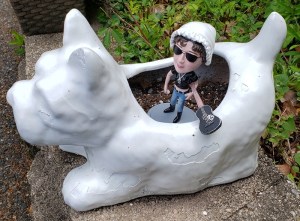
She laughed and said, “Is not a dog more effective?,” and jumped into a West Highland Terrier planter.

Image of BAJ's Westie carriage

BAJ Westie carriage

I guffawed. Jennie, our Westie is all bark and no bite. Poof, my dream ended. Once again I missed the chance to ask BAJ the questions swirling in my head. I’d assumed that I had all the time in the world. Ah, well. The mystery that is Miss Jane Austen continues.

Read Full Post »

It will, I believe, be everywhere found, that as the clergy are, or are not what they ought to be, so are the rest of the nation.”—Edmund Bertram in Mansfield Park

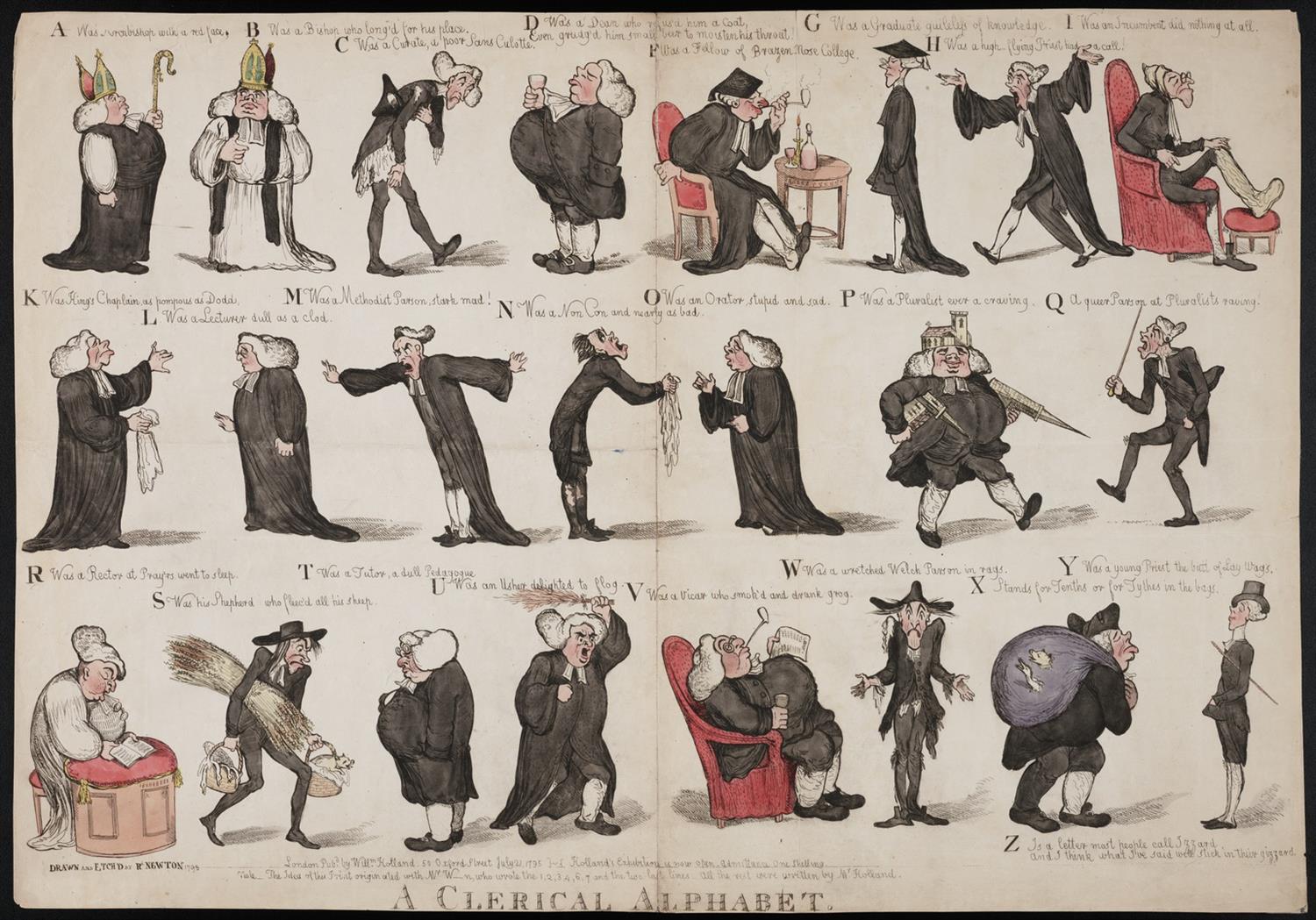
Richard Newton’s “A Clerical Alphabet,” published in 1795. Illustrations by Richard Newton; captions by Newton and publisher William Holland. Courtesy of the Lewis Walpole Library, Yale University.

Richard Newton’s “Clerical Alphabet” satirizes the English clergy of Austen’s time. You may be familiar with cartoonists, or caricaturists, of the eighteenth century like Thomas Rowlandson and James Gillray. Some of Rowlandson’s cartoons are based on Richard Newton’s work. Newton’s popular cartoons mocked the “establishment,” including fashions, politicians, the king, and even the church. Newton lived only 21 years. He died of typhus in 1798, shortly after he drew a satirical series on death!

Jane Austen herself wrote satirically, though much more gently, of the clergy. We laugh with her at foolish Mr. Collins, presumptuous Mr. Elton, and gluttonous Dr. Grant. It seems, though, that they performed their jobs as ministers adequately. In Emma, Miss Nash has copied down all the texts (Bible passages) Mr. Elton preached from since he came to Highbury. In Mansfield Park, Mary Crawford says Dr. Grant’s curate does much of his work. But at least Dr. Grant preaches good sermons, according to both Mary and Fanny Price.

Three of Jane Austen’s heroes, Edmund Bertram, Edward Ferrars, and Henry Tilney are conscientious clergymen. Sense and Sensibility tells us of Edward’s “ready discharge of his duties in every particular,” meaning that he willingly and eagerly did all that a clergyman was supposed to do. Henry Tilney employs a curate to do his duties while he is at Bath and Northanger Abbey. But Henry faithfully attends parish meetings, and I think he would have done his duties well once he was full-time at Woodston.

What were the clergy (church ministers or pastors) really like in Austen’s England? Many were good men, serving God and their communities. Jane’s father and brothers and her cousin Edward Cooper were faithful clergymen.

Mary Crawford of Mansfield Park, though, doesn’t think much of the clergy. “A clergyman is nothing,” she tells Edmund. Edmund and Fanny have much higher ideas of what the clergy can be, and should be.

Edmund says that the clergy “has the charge of all that is of the first importance to mankind, individually or collectively considered, temporally and eternally, . . . the guardianship of religion and morals, and consequently of the manners which result from their influence.” By “manners,” he explains that he means actions based on religious principles. He says the clergy have a huge influence on the people of their area.

Unfortunately, the church system in Austen’s day allowed anyone with a gentleman’s education and the right family and social connections to become a clergyman. Even an immoral man like Wickham could have been a clergyman, if he had not renounced his claim.

Newton’s cartoon shows us some of the major issues in Austen’s Church of England. Some of his clergymen are very fat and some are very thin. The church livings of Austen’s England were unevenly distributed. Some provided a high income, others a low income, and some were moderate. Let’s look in more detail at Newton’s criticisms of the Church of England in Jane Austen’s time, and how they connect to Austen’s novels.

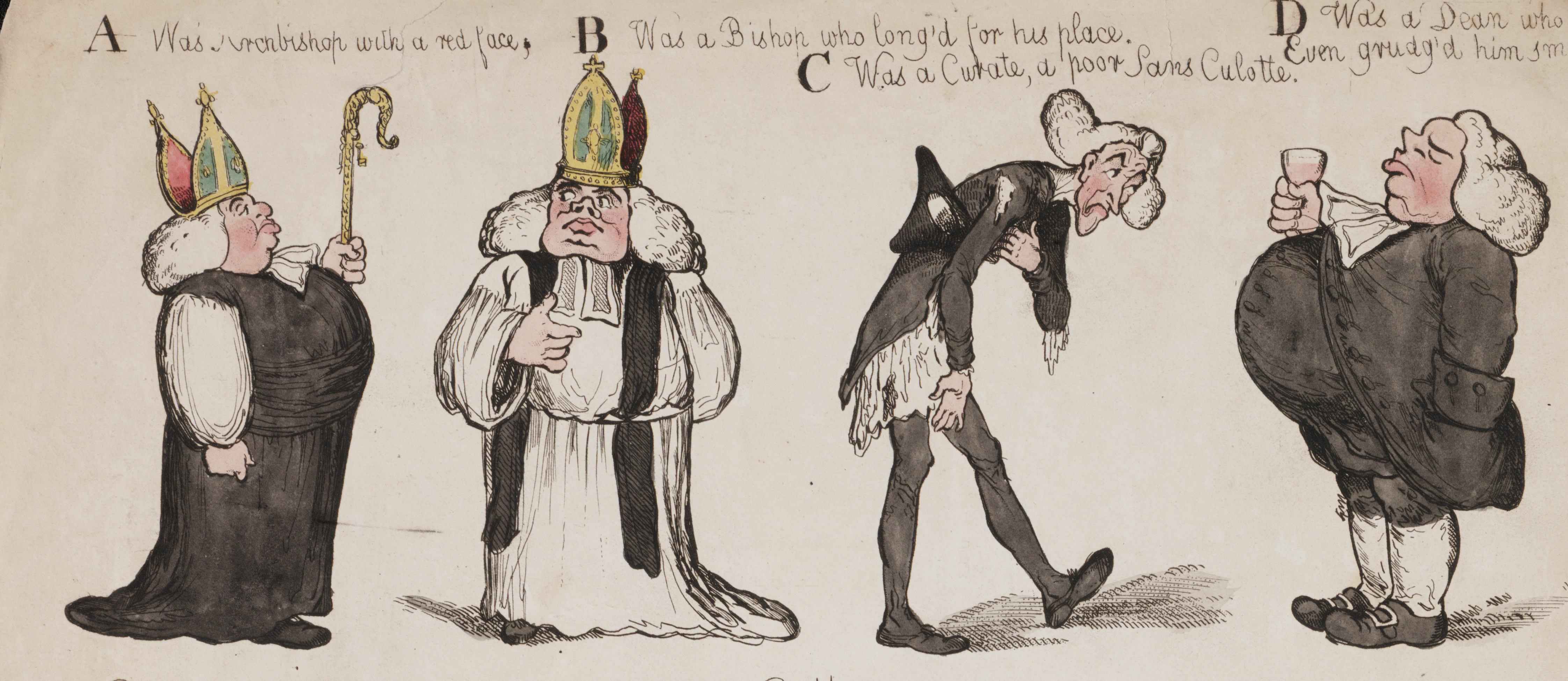
A, B, C, D, and E of Richard Newton’s “Clerical Alphabet,” published in 1795. Courtesy of the Lewis Walpole Library, Yale University.

The “Clerical Alphabet” begins:
A Was Archbishop with a red face,
B Was a Bishop who long’d for his place.
C Was a Curate, a poor Sans Culotte,
D Was a Dean who refus’d him a Coat
Even grudged him small beer to moisten his throat. (No picture for E, just a caption.)

A-B: In the Church of England, the king was the supreme authority of the church, and under him was the archbishop of Canterbury, then the archbishop of York. Each archbishop supervised a number of bishops, and the bishops supervised the more than 11,000 parish priests of England. Bishops and archbishops were wealthy men, with high incomes from the church. They were members of the House of Lords in Parliament. Mr. Collins says he is not worried that the archbishop or Lady Catherine will rebuke him for dancing. In reality, the archbishop would not know of Mr. Collins’s existence! Collins is exalting Lady Catherine by putting her at the same level as the highest church official.
C: Sans Culotte is French for “without pants” (more literally “without knee breeches”; the peasants wore long trousers instead of the knee breeches worn by upper classes). The “Sans Culotte” were the lower class French people who supported the French Revolution. In the English church, curates were the lowest rung of the clergy. Most lived on stipends of only £50 per year or less, barely enough for survival. They either assisted rectors and vicars, or led services in their place. In Persuasion, Mary Musgrove looks down on Charles Hayter as “nothing but a country curate.
D-E: A dean was another wealthy church leader, the head clergyman overseeing a major church. In Mansfield Park, Mrs. Grant says they can move to London if someone commends “Dr. Grant to the deanery [the dean’s office] of Westminster or St. Paul’s.” Dr. Grant does get such a promotion at the end of the book. However, his gluttony kills him. No doubt this is Jane Austen’s own satire of wealthy clergymen!
Small beer was cheap beer with a low alcohol content. The church was not generous to the poor curates.

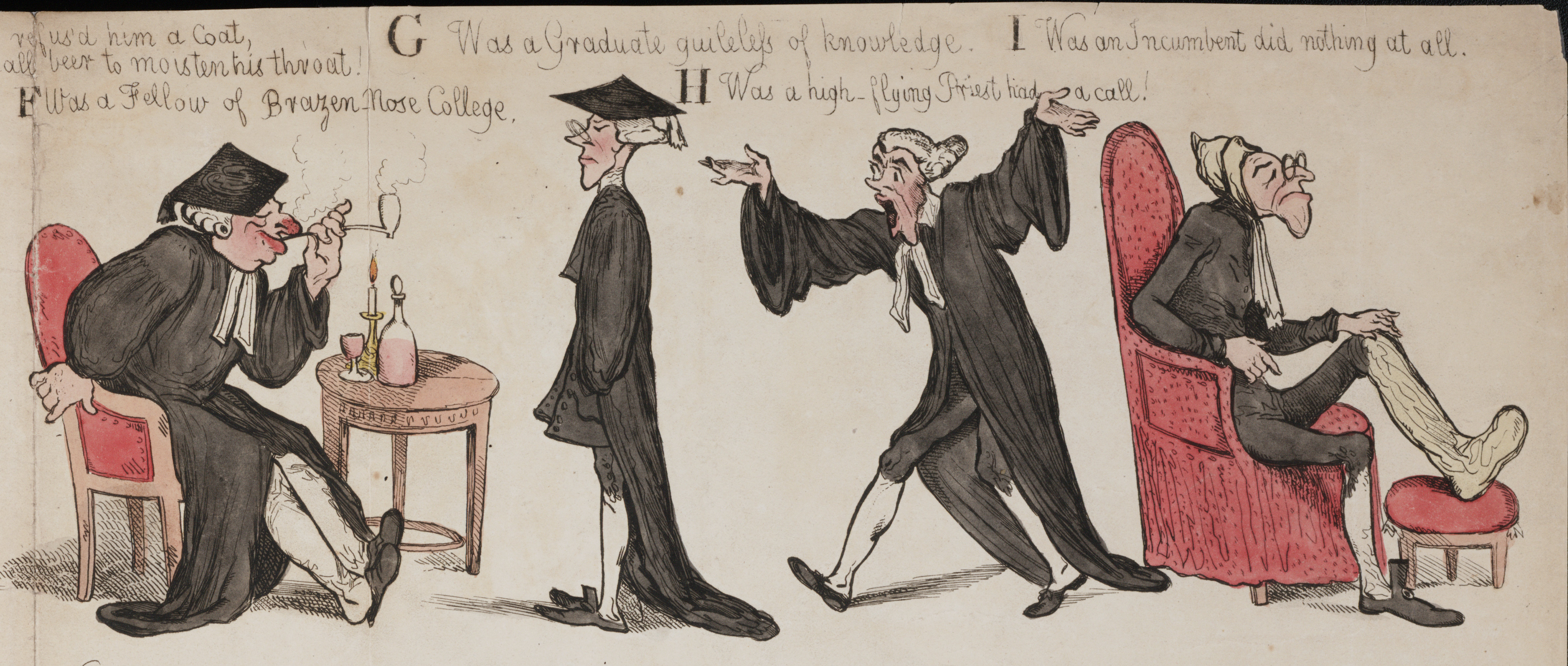
F, G, H, and I of Richard Newton’s “Clerical Alphabet,” published in 1795. Courtesy of the Lewis Walpole Library, Yale University.

F Was a Fellow of Brazen-Nose College
G Was a Graduate guileless of knowledge
H Was a high-flying Priest had a call!
I Was an Incumbent did nothing at all.

F: Brazen-Nose College is a pun on Brasenose College of Oxford University. Fellows were the senior members of a college, usually clergymen. This one enjoys his pipe and his wine.
G: The graduate, without knowledge, is likely a member of the highest social classes. The nobility and others with wealth could graduate from Oxford or Cambridge University simply by being there for a certain amount of time. Students who were not as rich had to write essays in Latin and take exams. Clergymen followed the same course of study as any other gentlemen, plus they had to show up for one course on theology. Edward Ferrars says he was “properly idle” at Oxford.
H: The clergy was considered an occupation at this time, not usually a calling from God.
I: Once a man had a church living (a post as rector or vicar of a parish), he was the incumbent. He held the living until he died. In old age, or if he moved elsewhere, he would hire a curate to perform his duties. Although Dr. Grant gets a post at Westminster and moves to London, he still has the income from the parish of Mansfield Park (he is still the incumbent) until he dies. Then Edmund can take that parish.
(At this time, I and J were considered to be the same letter. So there is no J in this alphabet. That is also why the Jane Austen sampler has an I but no J.)

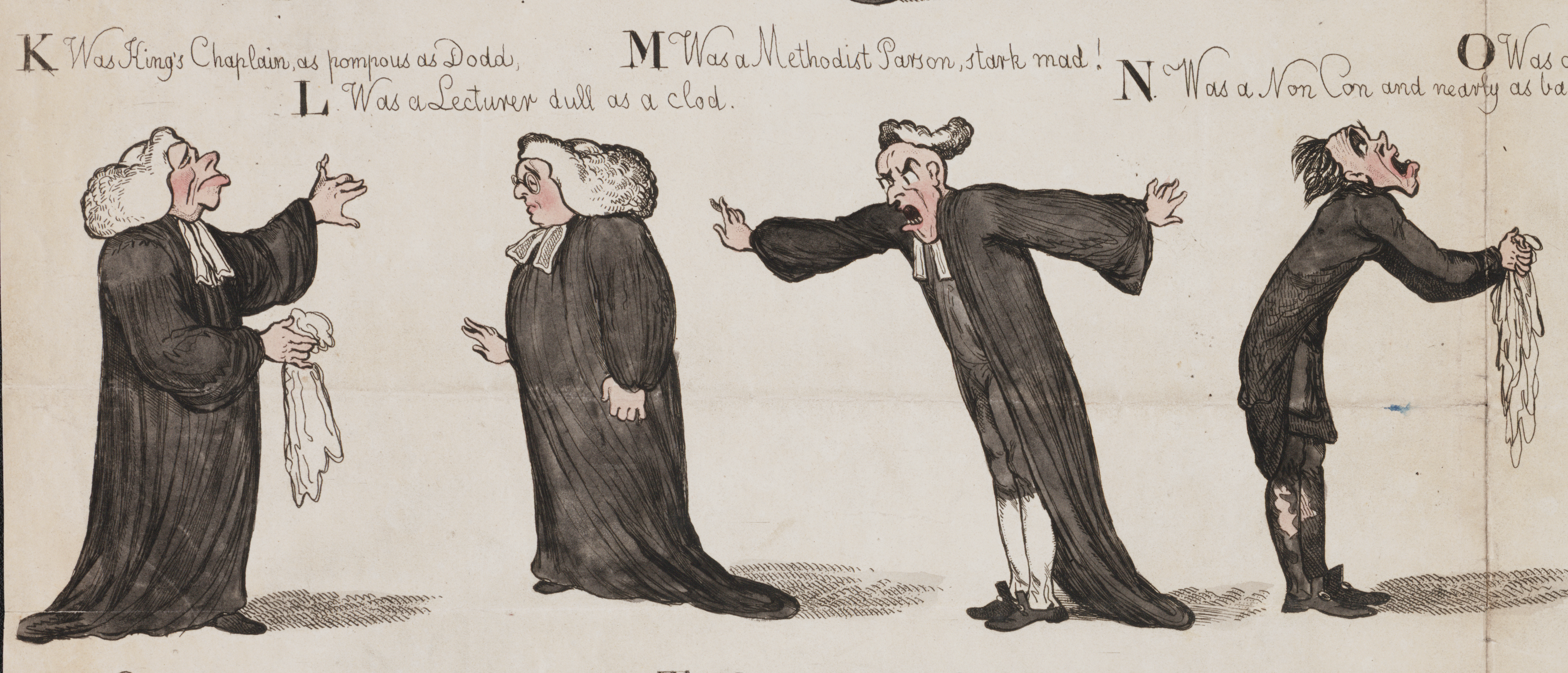
K, L, M, and N of Richard Newton’s “Clerical Alphabet,” published in 1795. Courtesy of the Lewis Walpole Library, Yale University.

K Was King’s Chaplain as pompous as Dodd,
L Was a Lecturer dull as a clod.
M Was a Methodist Parson, stark mad!
N Was a NonCon and nearly as bad.

K: The king’s chaplain was the king’s personal priest for the Chapel Royal. William Dodd (1729-1777) was an extravagant clergyman who became chaplain to the King of England in 1763. To clear his debts, he forged a bond for £4200. He was convicted and hanged in 1777.
L: A lecturer was a preacher chosen and paid by the congregation who gave additional sermons (“lectures”) at a church, usually at afternoon or evening services.
M: The Methodists were part of the Church of England until around this time. They were known for their emotional enthusiasm and their focus on salvation by grace. Some Methodist preachers, including John Wesley, preached to large open-air meetings. According to Wesley’s Journal, listeners sometimes responded with “outcries, convulsions, visions, and trances.” More orthodox Anglicans considered this madness. When Edmund rebukes Mary Crawford, she ridicules him, saying, “when I hear of you next, it may be as a celebrated preacher in some great society of Methodists.” In the late 1700s, the Methodists separated from the Church of England and became Dissenters.
N: A NonCon was a Non-Conformist or Dissenter, a person who did not “conform” to the Church of England (or “dissented” from its statement of faith). These included Catholics, who faced major prejudices in Austen’s England. Baptists, Quakers, Independents, Unitarians, and others all fell into this category. They were usually from the middle and lower classes at this time. They could not get a degree from the universities, and were not supposed to hold public office. Mainstream Anglicans thought Nonconformists were enthusiasts (excessively emotional) like the Methodists.

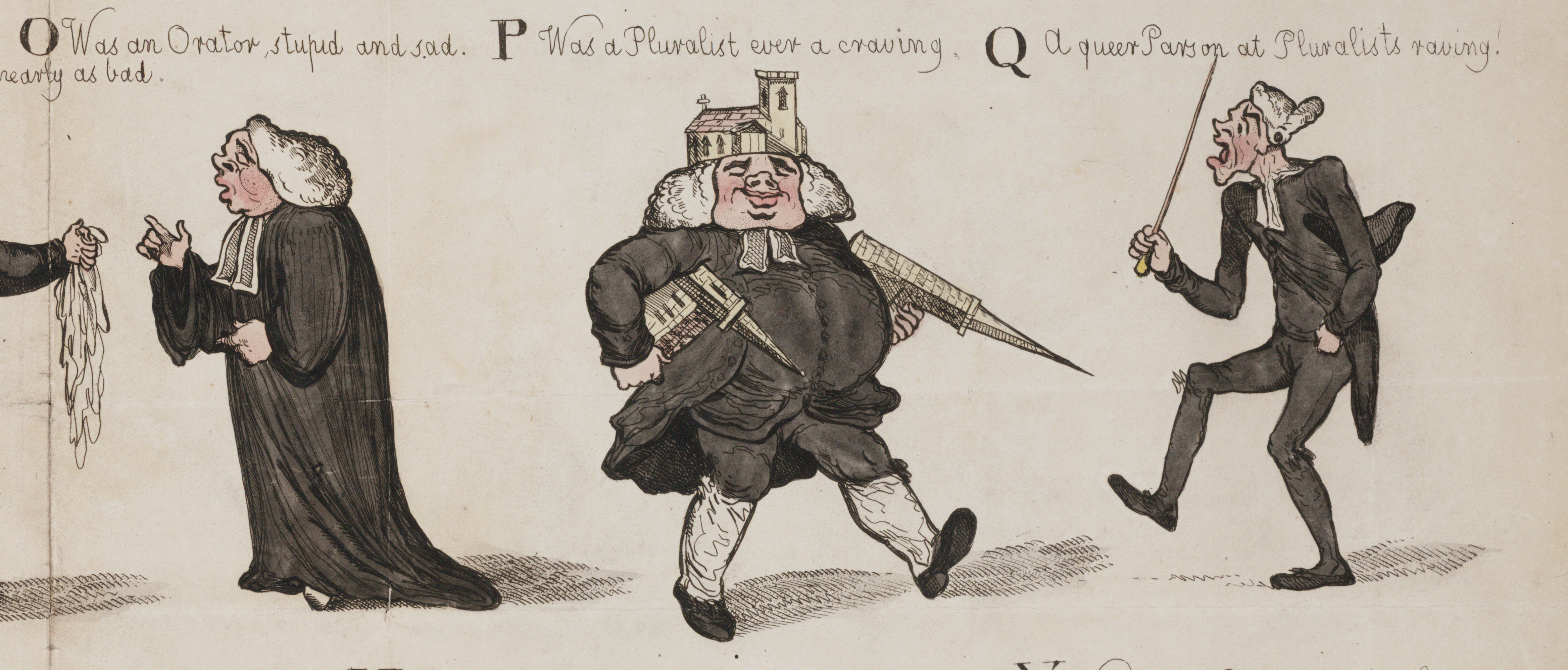
O, P, and Q of Richard Newton’s “Clerical Alphabet,” published in 1795. Courtesy of the Lewis Walpole Library, Yale University.

O Was an Orator, stupid and sad.
P Was a Pluralist ever a-craving
Q A queer Parson at Pluralists raving!

O: An orator, as today, was a public speaker. In Mansfield Park, Edmund and Henry Crawford discuss how to best read the liturgy and preach in Church of England services. They agree that it was often done poorly. Edmund says that things have changed, and now, “It is felt that distinctness and energy may have weight in recommending the most solid truths.” Edmund is concerned with communicating truth. Henry, though, would like to speak well in order to be popular and admired.
P-Q: Pluralists held multiple church livings. They might live in one parish and serve as its minister and pay curates to serve the others, while they took most of the income from those parishes as well. They were not necessarily fat, though. Some livings were quite small and the clergyman needed a second one. Jane Austen’s father held two livings, at Steventon and Deane. They were close enough together that he could lead services at both churches on Sundays, and the income from each was low. Some pluralists, however, were extremely wealthy. In Mansfield Park, Sir Thomas Bertram says a clergyman should reside in his parish to set an example and care for the people of the parish. We don’t know what Edmund did once he had two parishes to care for, at Mansfield Park and Thornton Lacey.

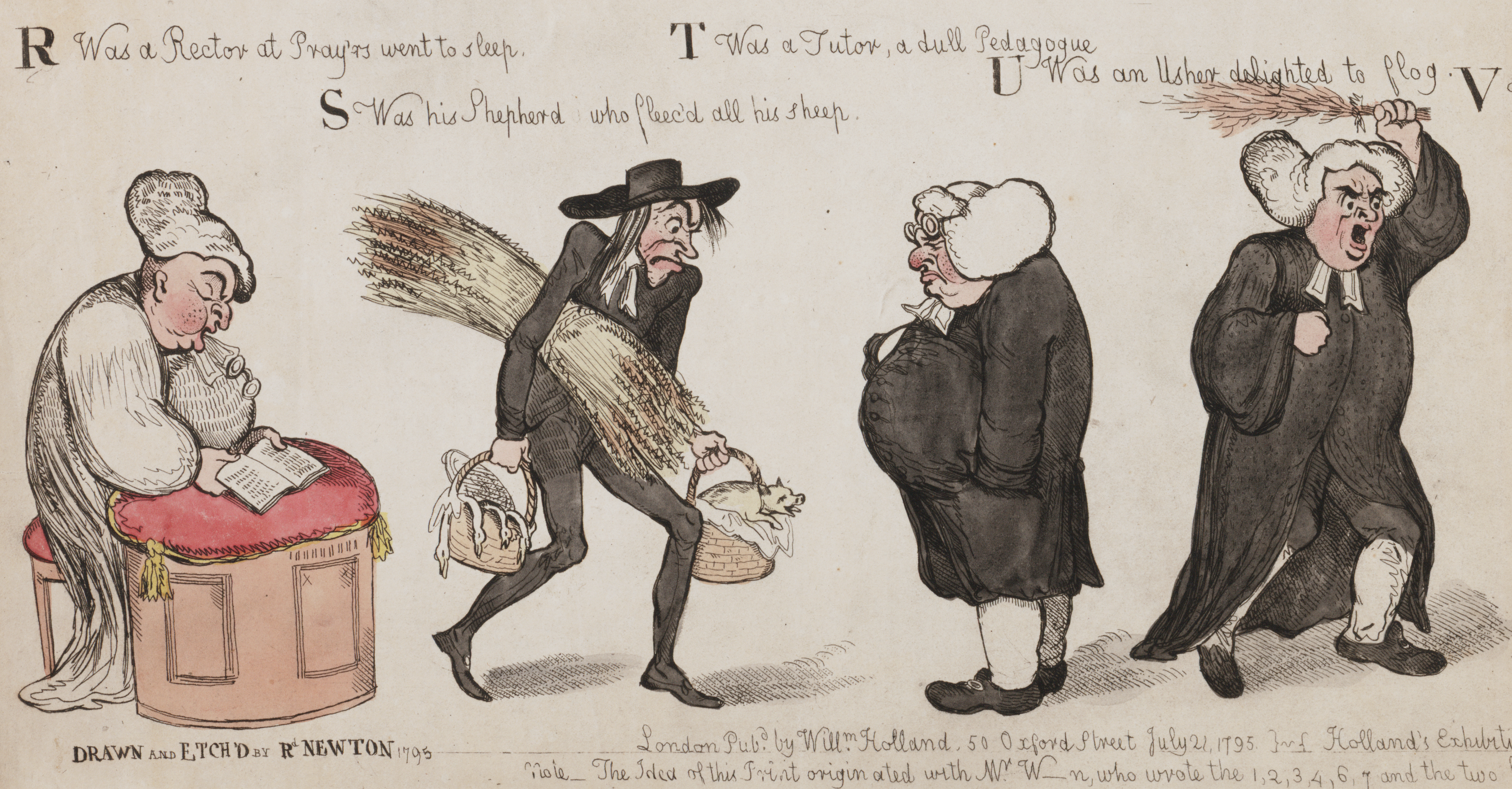
R, S, T, and U of Richard Newton’s “Clerical Alphabet,” published in 1795. Courtesy of the Lewis Walpole Library, Yale University.

R Was a Rector at Pray’rs went to sleep
S Was his Shepherd who fleec’d all his sheep.
T Was a Tutor, a dull Pedagogue
U Was an Usher delighted to flog.

R: Mr. Collins was quite proud of being a rector. The rector received all the tithes from the parish; a vicar like Mr. Elton only received a portion of the tithes.
S: This is a play on words. The clergyman was to be a shepherd, caring for his parishioners, his flock. However, he also had to collect tithes from them: one-tenth of their farm income, including crops, the young of animals, and even eggs from their poultry.
T: At Oxford, each student had a tutor responsible for his education. The tutor gave assignments and lectured. A pedagogue is a teacher, especially a pompous or strict one.
U: An usher was an assistant to a schoolmaster. Schools were often run by clergymen. Flogging, or whipping, was a common punishment.

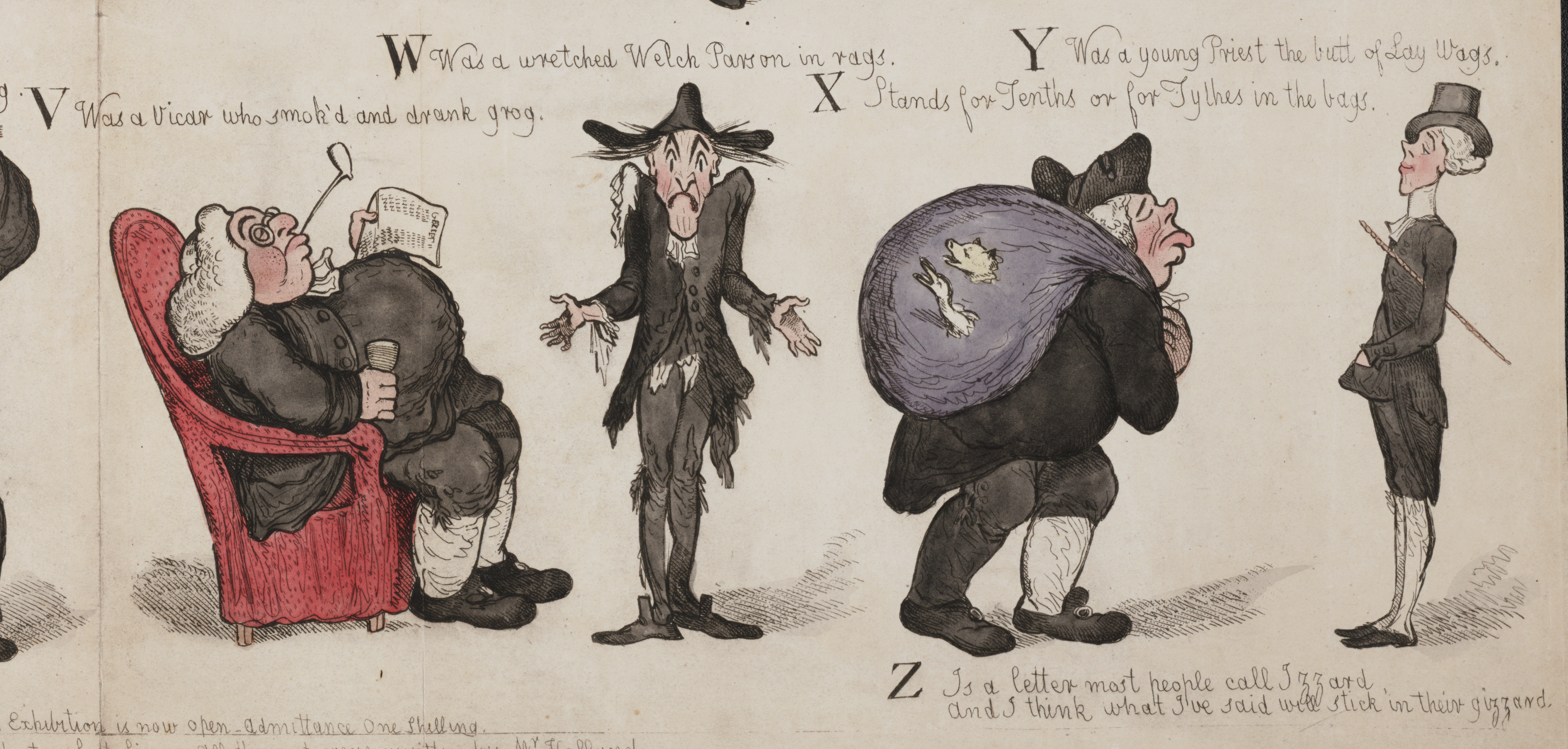
V, W, X, Y, and Z of Richard Newton’s “Clerical Alphabet,” published in 1795. Courtesy of the Lewis Walpole Library, Yale University.

V Was a Vicar who smok’d and drank grog.
W Was a wretched Welch Parson in rags.
X Stands for Tenths or for Tythes in the bags.
Y Was a young Priest the butt of Lay Wags.
Z Is a letter most people call Izzard
And I think what I’ve said will stick in their gizzard. (No picture for Z.)

V: A vicar, like Mr. Elton, was a clergyman who only got about a quarter of the tithes for the parish; someone else, often the squire, received the rest. Drunkenness was a widespread issue in Austen’s England. Grog was an alcoholic drink, usually rum and water. It was usually associated with sailors.

W: The church in Wales was poor compared to the church in England.

X: The clergy’s main income came from tithes, collected from farmers in the parish (see S). People of the parish were legally required to pay tithes to the clergyman, even if they were Dissenters. This sometimes caused friction between clergymen and the people of the parish.

Y: Laymen, who were not clergy, made fun of this priest. Johnson’s Dictionary says a wag is anyone “ludicrously mischievous.” The cartoonist Newton himself was apparently one of these “lay wags” making fun of priests.

Z: Izzard is a dialectal word for z, first recorded about 1726. Newton wasn’t afraid to irritate his readers.

Do any of these clergymen remind you of characters in Austen’s novels? I think Dr. Grant might have become the fat dean if he had lived long enough. Mr. Collins might end up as the dozing rector. And Collins wanted to be a pluralist; he hoped for more livings from Lady Catherine.

This was obviously an exaggerated picture of the church in Austen’s England. Because of such clergymen who abused their positions, though, many people like Mary Crawford thought poorly of the church and the clergy. The cartoon points out some of the issues that later generations would correct.

About the author: Brenda S. Cox blogs on Faith, Science, Joy, and Jane Austen, and is working on a book entitled Fashionable Goodness: Christianity in Jane Austen’s England.

The British Museum www.britishmuseum.org/collection/term/BIOG40122 offers brief information about Newton and a link to Newton’s many caricatures held by the British Museum. For more about Richard Newton and his life and cartoons, see Lambiek.

Read Full Post »

The Bath Royal Literary and Scientific Institute (BRLSI). BRLSI is a respected non profit organization set up 200 years ago as a centre for Enlightenment ideas and intellectual discussion in Bath, England (where Jane Austen lived!).
The Institute is having a virtual lecture this Saturday July 4th at 7.30pm British time (2.30pm ET, 11.30am PST) with Dr. Georgina Newton regarding Jane Austen’s Feminist Message for Young Women Today.
Cost of this virtual lecture is just two pounds to get a ticket (2.50 USD) – and it is all online, so you can join in from wherever. The money raised will go towards the upkeep and preservation of the society. Click on this link to reserve your virtual spot.
From the BRLSI website :
Jane Austen’s Feminist Message for Young Women Today (LIVE ONLINE LECTURE)
Jane Austen’s novels typically conjure images of love, romance and femininity. But her acute observations on how society treated women in relation to equality, financial independence and opportunity reveal a mind strikingly in step with feminist thinking in the 21st Century.
In this special talk for the Bath Royal Literary and Scientific Institution, Dr Georgina Newton examines how the hopes and concerns of today’s young women compare with those of Jane Austen’s era and how the author of Pride and Prejudice has much to say to modern readers.
SATURDAY JULY 4TH, 7.30pm GMT (2.30pm ET, 11.30am PST).


Read Full Post »

“after descending to the brink of the river for the better inspection of some curious water-plant, . . .” –Pride and Prejudice, chapter 43; Elizabeth Bennet, the Gardiners, and Mr. Darcy do a bit of “botanizing” during their walk at Pemberley.

On May 30 and 31, 2020, Chawton House hosted a refreshing Virtual Garden Festival. If you missed it, you can still watch most of it online. You can virtually tour the beautiful Chawton House Gardens with Chawton House volunteer Yvette Carpenter or walk the Jane Austen Garden Trail with Clio O’Sullivan. An intriguing section of the gardens highlights a pioneering woman botanist of the eighteenth century. She lived in an era when science was the nearly-exclusive province of men.

The Elizabeth Blackwell Herbal Garden

The Elizabeth Blackwell Herb Garden is inside the Walled Garden built by Edward Knight. In Jane Austen’s letter of July 3-6, 1813, she wrote from her home, Chawton Cottage, that her brother Edward Knight was enjoying his property at nearby Chawton House. She said, “He talks of making a new Garden . . . at the top of the Lawn behind his own house—We like to have him proving & strengthening his attachment to the place by making it better.” The garden Edward built (which was finished after Austen’s death) has been restored, and the Herb Garden was added in 2016. 

Each section of the Elizabeth Blackwell Herb Garden is planted with medicinal herbs that were used to treat different parts of the body. For example, the Chest Bed includes herbs used to treat ailments of a person’s chest, such as coughs. The other sections are Head Beds, Digestion Beds, and Skin Beds. Carpenter tells us that many of these medicinal herbs, such as rosemary, were also used in cooking. Others have -wort as part of their names, indicating they were used for healing. For example, doctors today still recommend the use of St. John’s Wort for the treatment of mild to moderate depression. In the 1700s, Blackwell said it was used against “melancholy and madness.” Other herbs, as the narrator points out, sound magical, like the dragon tree, snakeweed, and mandrake.


Elizabeth Blackwell, Lady Botanist

The plants in this garden are described in a book owned by the Chawton House Library. A Curious Herbal (1737-9), by Elizabeth Blackwell, is said to be the first herbal produced by a woman. It was also far superior to other herbals available at the time. An “herbal” was a book of plants used as medicines. Blackwell drew and colored 500 meticulously-detailed color plates, each of a different plant, with its flower, seeds, and fruit. Along with each plate is the name of the plant in various languages, a description of it, and how it was used medically. The British Library shows 42 pages of A Curious Herbal online, with summarized information about 38 of the plants. (The Biodiversity Heritage Library offers a complete scanned version.)

Amanda Edmiston, an herbalist and professional storyteller, tells Elizabeth Blackwell’s story. According to Edmiston, Elizabeth was born around 1707 in Aberdeen, Scotland. She was the daughter of a wealthy merchant. Elizabeth eloped with a physician named Alexander Blackwell. His medical credentials were called into question, so they fled to London and she set him up in a printing business. (In Scotland, unlike England, women kept their own property after marriage, so she had the money to do this.) Unfortunately, Alexander was also not qualified to be a printer. He got deep into debt, and ended up in debtor’s prison. Elizabeth, penniless, stayed loyal to her husband, and looked for a way to support herself and their young son, and to pay off his debts. 

Elizabeth Blackwell came up with a plan as she and her son enjoyed the Chelsea Physic Garden. Physic meant medical; the plants in this garden were used to treat illnesses. It was filled with exotic plants. Sir Hans Sloane, a respected doctor and renowned naturalist, had collected the plants on his botanical journeys around the world. Many, including cocoa, came from the Americas. Elizabeth became friends with Sir Hans, as well as with the director and the head gardener of the Physic Garden. They supported her idea of creating a whole new herbal, including both native and imported plants. The Worshipful Society of Apothecaries, who rented the garden from Sir Hans Sloane, also officially approved her project. This support was crucial, since otherwise the scientific work of Blackwell, a woman, would probably not have been accepted and respected. 

The Physic Garden, Chelsea: men botanizing in the garden, near the statue of Sir Hans Sloane, 1750. Wood engraving by T. W. Lascelles after H. G. Glindoni, 1890.. Credit: Wellcome Collection. Attribution 4.0 International (CC BY 4.0)

The Physic Garden, Chelsea: men botanizing in the garden, near the statue of Sir Hans Sloane, 1750. Wood engraving by T. W. Lascelles after H. G. Glindoni, 1890.. Credit: Wellcome Collection. Attribution 4.0 International (CC BY 4.0)

Even after Blackwell’s achievement, women botanists of the 1760s had to disguise themselves as men to study plants. In the 1790s, a clergyman wrote that it was “unseemly” for girls to study botany. But with the approval of medical and botanical experts, Elizabeth had been able to publish her groundbreaking Curious Herbal

A Curious Herbal

Before this time, most plants in herbals were not drawn from life. For example, mandrakes were often drawn with the root in the shape of an actual man and were said to scream as they were uprooted (as Harry Potter experiences in his magical herbology classes!). Elizabeth Blackwell, however, drew all 500 plants directly from real plants, some from the Physic Garden and others from other collections in Europe. Her illustrations were thus completely accurate. They can still be used today to clearly identify plants. 

It was said that her husband Alexander wrote the text of the book while he was in prison. Edmiston speculates that it’s more likely that Elizabeth did the writing herself. She had access to experts and to a library including texts that she often references. The idea that Alexander, a male physician, had written the text was probably a fiction to make the book more acceptable.

Elizabeth Blackwell published a section of the herbal with four plants every week, from 1737 to 1739 (about forty years before Jane Austen’s birth). Serial publication made her knowledge available and affordable for many, as well as giving her a regular income. The book did well and raised enough money for her to pay her husband’s debts and get him out of prison. However, he then took a job in Sweden. He got caught up in a plot there to overthrow the king and was executed, just as his wife was about to travel to join him. So Elizabeth and her son were on their own again; we don’t know much about the rest of her life.


In Edmiston’s further videos, she tells stories about many of the plants in Blackwell’s herbal. In Afternoon Tea with the Curious Herbal, we learn about cucumbers, tomatoes, green tea, chocolate, and coffee. Part 3, A Walk Through a Garden, includes stories about rosemary, St. John’s wort, lavender, yarrow, sage, and lemon balm. Take a look!

Other Lady Botanists

Blackwell was not the only woman botanist who published about plants in the eighteenth and nineteenth centuries. In “The Women Who Wrote Plants,” Katie Childs introduces us to other women whose books on botany are in the Chawton House Library. 

My favorite title is The Wonders of the Vegetable Kingdom, by Mary Roberts, published in 1822. The “wonders” are described in a series of letters; perhaps imitating the approach of the famous naturalist Gilbert White. (Gilbert White’s Natural History of Selborne in 1789 was a groundbreaking book on the natural world and ecology. You can visit his house, which is now a fascinating museum, just a short drive from Jane Austen’s house at Chawton.) Roberts also wrote A Popular History of the Mollusca, with 18 color plates showing varieties of seashells and the creatures that live in them. It doesn’t sound like a “popular” subject, but perhaps it was in her day!

While women were not expected to write adult books on botany during Austen’s lifetime, it was fine for them to write botany textbooks for children’s education. These are quite detailed, like adult books. Priscilla Wakefield’s text for children, Introduction to Botany, was published in 1796. She wrote it as a series of letters, with color illustrations. In Katie Childs’ presentation, she tells us that Wakefield was a Quaker social reformer who started a maternity hospital. Elizabeth Fry, the famous Quaker prison reformer, was Wakefield’s niece.

Plate from An Introduction to Botany by Priscilla Wakefield, 1796, at archive.org

Botany did become a fashionable pursuit for elegant ladies. Botanical Rambles (1826), by Lucy Sarah Atkins, is subtitled, “Designed as an Early and Familiar Introduction to the Elegant and Pleasing Study of Botany.” The ability to draw plants accurately became an “accomplishment” ladies aspired to. Books were written specifically on how to draw plants, including information about the plants themselves. Watch Ms. Childs’ talk for more about early female botanical writers, and to see illustrations from their books.

Beatrix Potter, Expert on Fungi!

Speaking of discrimination against women in science, especially in botany: Much later, in 1897, a paper on fungi by Beatrix Potter (yes, the author of Peter Rabbit) was presented at the Linnaean Society in London. However, since she was a woman, she was not allowed to present, or even to attend the meeting. Her paper, presented by her uncle, was not taken seriously since it was written by a woman. Today, though, Beatrix Potter’s illustrations of various fungi are used around the world to identify species of mushrooms.

Highlight of the Festival: Gardens in Jane Austen

On Sunday, the Garden Festival offered some presentations specifically for gardeners, so if gardening is one of your passions, you may want to check those out.

For Jane Austen lovers like me, though, the highlight of the festival was “Love in the Shrubbery: Gardens in Jane Austen’s Life and Works.” Kim Wilson, author of In the Garden with Jane Austen, finished out the festival with this charming presentation. In it, she shows us gardens Austen knew. She also explains and illustrates those terms like shrubbery and wilderness, describing places where Austen’s ladies and gentlemen walk. Did you know that shrubberies had paths made of gravel to keep the ladies’ feet dry, since wet feet were considered potentially fatal? (Think of Marianne Dashwood, sitting in wet shoes and stockings before her near-fatal illness.) If you only have time to watch one video from the Chawton House Virtual Garden Festival, I recommend this delightful 28-minute presentation.

I also joined in an engaging creative writing workshop led by Claire Thurlow, “A Garden Writing Retreat.” Claire encouraged the participants to imagine ourselves in our own special gardens as we write. While that workshop is not available online, you might use Kim Wilson’s talk, or any of the virtual garden tours from the festival, to enjoy time in a virtual garden today. I hope it will refresh your soul.

Note for anyone who might be wondering: There was also a later Elizabeth Blackwell, first woman to graduate in medicine in the United States, in 1849. Both Blackwells were pioneering women in the medical field of their times.

A Word About the Author: Brenda S. Cox blogs on “Faith, Science, Joy, . . . and Jane Austen!” at brendascox.wordpress.com . Under the category “Science” at her site, you will find other articles on science in Jane Austen’s England, including women of science like Caroline Herschel and Mary Anning.

Quote from Austen’s letters is from p. 224 of Deirdre Le Faye’s fourth edition of Jane Austen’s Letters.

Links embedded in the article:


Read Full Post »

« Newer Posts - Older Posts »