Feeds:
Posts
Comments

Archive for the ‘Jane Austen’s World’ Category

The week of Christmas and the new year has been traditionally a time for joy and celebration. In Jane Austen’s day, the decorations and celebrations weren’t quite so over-the-top commercial as they are today. Mistletoe, holly, and evergreen boughs decorated the halls, while roaring fires warmed hearth and home. Fine foods were prepared for friends and family at holiday gatherings, and gift giving was considered optional and not mandatory.

Cruikshank image. Holiday dinner party. Image @LIFE magazine.

Cruikshank image. Holiday dinner party. Image @LIFE magazine.

In her letters, Jane mentioned making wine. She was also  known to imbibe a glass or two, as did many Regency ladies. One can imagine that she heartily enjoyed a glass of homemade wine during long winter evenings. A Regency household in the country was akin to a cottage factory, processing freshly picked fruits and vegetables in summer and fall for consumption during the winter months.

Elderberry bushes, native to both Europe (Sambucus nigra)  and North America (Sambucus canadensis), ripened in August and September. The American elderberry can be found growing in old fields and meadows. The European elderberry blooms earlier than its American counterpart, with some sporting pink flowers. By Christmas, the first flasks of elderberry wine could be served at the table.  Some elder wines (depending on their strength) were ripened until spring. (Edible Landscaping)

Elderberry wine has a rich red color.

Elderberry wine has a rich red color.

Mrs. Maria Eliza Ketelby Rundell’s elder wine recipe, written over two hundred years ago, reflects how housewives made the wine back then, using ingredients and kitchen supplies that were readily available. In 1806, John Murray (who published Emma, a second edition of Mansfield Park, Persuasion and Northanger Abbey)  published  A New System of Domestic Cookery: Founded up Principles of Economy; and Adapted to the Use of Private Families. Rundell’s cookbook became wildly popular in the first half of the 19th century in both England and America. One imagines that the Austen women were well aware of its existence.

Mrs. Rundell

Mrs. Rundell

According to Mrs. Rundell:

English wines would be found particularly useful, now foreign are so high priced, and though sugar is dear, they may be made at a quarter of the expense. If carefully made, and kept three or four year,s a proportionable strength being given, they would answer the purpose of foreign wines for health, and cause a very considerable reduction in the expenditure.”

Holly Bush Inn, where Mrs. Rundell, it is speculated, wrote her recipes.

Holly Bush Inn, where Mrs. Rundell, it is speculated, wrote her recipes. Image @Persephone books (Link below)

Rundell’s book of recipes went through dozens of editions in Britain and the United States, where it was published in 1807. The following recipe for Elder Wine comes from the Google eBook 1857 edition:

Rundell Domestic Cookery

Elder Wine.

To every quart of berries put two quarts of water, boil half an hour, run the liquor, and break the fruit through a hair sieve; then to every quart of juice put three quarters of a pound of Lisbon sugar, coarse but not the very coarsest. Boil the whole a quarter of an hour with some Jamaica peppers, gingers, and a few cloves. Pour it into a tub, and when of a proper warmth, into the barrel, with toast and yeast to work, which there is more difficulty to make it do than most other liquors. When it ceases to hiss, put a quart of brandy to eight gallons, and stop up. Bottle in the spring or at Christmas. The liquor must be in a warm place to make it work.

Elder berries and elder flowers. Public domain image

Elder berries and elder flowers. Public domain image

While Rundell’s recipe seems simple, some terms require explanation. In those days, sugar was classified according to place of origin, such as Brazil, or entrepot, a place of entry without excise duties, such as Lisbon. (Richard Bradley, 1736) Prospect book glossary.

19th c. hair sieve

19th c. hair sieve

Image of Hair Sieve at Worth Point

The hair sieve mentioned by Rundell was most likely made with coarse horse hair, as shown in the above image. The mesh is quite fine. Sugar was an expensive commodity (Jane Austen was in charge of the tea and sugar stores in Chawton cottage, keeping the keys, no doubt, to the locked containers), but as previously explained, making your own wine provided a cost saving measure. The High Price of Sugar.

Jamaica peppers are generally known today as allspice. The peppers are larger than peppercorns and were gathered from Jamaica pepper trees. The “toast and yeast” mentioned in the recipe most likely meant bread yeast. Elder wine ferments particularly well in oak casks.

Jamaica pepper

Jamaica pepper

One can only guess what Mrs. Rundell’s elder wine, which was fortified with brandy, tasted like – strong, sweet, alcoholic, and fruity. The clusters of berries, dark purple when ripe, had many uses:

Elderberry bushes … [have] a long history of use for food, drink and medicinal purposes. Elderberry pie, jam and jelly, tarts, flavored drinks, and of course wine are a few of its better known uses.

Elderberry wine has a unique flavor that changes considerably over time. When too few berries are used, the wine is thin and unlikely to improve. When too many berries are used, the tannins and other flavor constituents may overpower the palate and require dilution, blending or prolonged aging to mellow. Between these extremes are wines that often offer exceptional enjoyment. – Winemaker Magazine

It seems that the berries had to be processed as quickly as possible after picking. There were times, I imagine, that the Austen women were busy working alongside their servants in the kitchen, processing foods, canning and pickling, and making wines and ales from recently harvested produce.

Another “job” that the Regency housewife assumed was that of nurse. Recipes for cough lozenges and simple medicinals made from herbs and plants were passed down through the generations. Elder berries were known to have many medicinal benefits:

Recipe for a "Decoction fameuse," which contains elderberry (among other ingredients). Image @MCRS Rare Book Blog

Recipe for a “Decoction fameuse,” which contains elderberry (among other ingredients). Image @MCRS Rare Book Blog

Recent research shows that elder builds up the immune system and directly inhibits the influenza virus. Elder contains an enzyme that smoothes the spikes on the outside of the virus, which the virus uses to pierce through cell walls. Elderberries have also been recommended in cases of bronchitis, sore throat, coughs, asthma, colds and constipation.” – The Health Benefits of Elderberry Wine

18th century red wine drinker, Franz Laktanz Graf Von Firmian

18th century red wine drinker taking his “medicine”, Franz Laktanz Graf Von Firmian

What better way to soothe one’s respiratory condition than with a nice glass of elder wine!

Ma(i)sonry Maisonry - Vintage 18th Century Wine Bottles - 1stdibs

This article from KansasCity.com, “Elderberry wine as a medicinal: A recent USDA reaction,” shows how ridiculous current U.S. health laws can be on the use of medication:

Federal authorities have seized bottles and drums of elderberry juice concentrate from a Kansas winery, contending that the company’s claims of its benefits for treating various diseases make the product a drug.

…”Products with unapproved disease claims are dangerous because they may cause consumers to delay or avoid legitimate treatments, Dara Corrigan, the FDA’s associate commissioner for regulatory affairs, said in a news release. “The FDA is committed to protecting consumers from unapproved products on the market.”

Aquatint, Rowlandson. Image @Amazon

Aquatone, Thomas Rowlandson. Image @Amazon

Wine was reserved not only for medicinal purposes or family gatherings, but for daily consumption. Bumpers of wine, or a tankard or cup filled to the brim, were common quantities.  The Georgians were notorious drinkers, for alcohol was safer than unboiled water and contaminated city or town wells.

London society of the Georgian period was renowned for its heavy consumption of alcohol. Poor people tended to drink beer or gin, but a wider range of alcoholic drinks was available to the rich. These included wines such as French claret; fortified wines such as sherry, port or Madeira; and spirits such as brandy and rum. It is noted in the text that Mr Stryver and Sydney Carton have wine, brandy, rum, sugar and lemons with which to concoct their punch.

During the Georgian period, beer might be drunk from pewter tankards, and other drinks, from glass goblets or tumblers.- Bookdrum

Detail, Elder Win Stand in Holborne, by George Scharff, 1842

Detail, Elder Wine Stand in Holborne in Winter, by George Scharff, 1842

In winter, elder wine heated in coppers was sold for a penny per wine glass from portable wood stands that contained glassware. (See image above.) This tradition lasted at least through the Victorian era, as attested by the modern Wedgewood scene below.

More About the Topic

Wedgewood. Victorian scene of an elder wine stand

Wedgewood. Victorian scene of an elder wine stand

Read Full Post »

matters-of-fact-in-jane-austen-2012-x-2001Jane Austen scholars and fans have always known that there’s so much more to her novels than the mere surface description of a romantic tale. Janine Barchas, author of Matters of Fact in Jane Austen, points out that in addition to Jane’s wit, intelligence , humor, and creativity in penning her novels, she associated her fictional characters with famous British families.  For the contemporary Regency reader, the Woodhouses, Fitzwilliams, Wentworths, and Dashwoods were the celebrities of their day. In  choosing famous names, Jane Austen ramped up her readers’ interest in her fictional characters by associating them with notable names, places, and events.

In her book, Barchas examines genealogy, history, and geography and comes up with some fascinating information that has recently surfaced via online documents and texts. I had always assumed that Jane pulled names out of a hat, or picked them for how well they fit the character. (Mr. Wickham for the charming villain, Mr. Knightley, who is kind and good and a bit of a knight in shining armor.) According to Barchas, that is not necessarily the case. Take Northanger Abbey, for instance. Among Bath’s wealthiest residents n the 18th century were the Allens from Prior Park, a grand and beautiful Palladian mansion that was visible from #4 Sydney Place, the house in which the Austens resided before Rev. Austen’s death.

Janine Barchas (l) and Juliette Wells (r) at the Brooklyn JASNA AGM.

Janine Barchas (l) and Juliette Wells (r) at the Brooklyn JASNA AGM.

The Dashwood family gained a notorious reputation, with one of its members, Sir Francis Dashwood, becoming a prominent libertine in the Hell-Fire Club. The garden in his mansion, West Wycombe Park, featured risqué statues and Hell Fire caves. In contrast, the Ferrars (Ferrers) lived staunch Catholic lives in their medieval manor, Baddesley Clinton. Interestingly, Stoneleigh Abbey, where Jane stayed with her mother, whose family were the Leighs of Stoneleigh Abbey, is only a half day’s ride from Baddesley Clinton.

And then there are the Wentworths, the grandest family of them all. Names seen on the Wentworth genealogy tree include Woodhouse, D’arcy, Bertram, Watson, and Fitzwilliam. Wentworth House in Yorkshire is quite grand, with vast grounds and public paths. After the “real” Frederick Wentworth died in 1799, his estate was passed on to the Vernons. (Shades of Lady Susan!) The contemporary Regency reader would have known that the Whig Wentworths resided in Wentworth House, while the Tory Wentworths lived in Wentworth Castle.

history of england_jane_cassandraThe History of England from the reign of Henry the 4th to the death of Charles the 1st, by a partial, prejudiced, and ignorant historian.

At the books beginning, Barchas mentions Jane Austen’s love for word play, riddles, and puzzles. The History of England, written when Austen was 15, was illustrated with 12 small watercolor portraits by Cassandra, Jane’s older sister.

CassandraAusten-JaneAusten(c.1810)reversed

Portrait of Jane Austen by Cassandra, 1810.

According to Annette Upfal and Christine Alexander: “the portraits which Cassandra drew into her sisters’ historical satire are encoded with veiled meaning.”

Mrs Casandra Austen

Mrs Cassandra Austen

They argue that Austen’s summary discussion of kings and queens was comically interpolated with recognizable portraits of namesakes: brothers Edward, Henry, and James Austen, for example, stand in for Edward VI, Henry V, and James I, respectively. Similarly, cousins Mary Lloyd and Edward Cooper may have served Cassandra as models for Mary I and Edward IV. “

Upfal and Alexander also matched the profiles and portraits of Jane and her mother to those of Mary, Queen of Scots (Jane) and that of Elizabeth I (Mrs Austen). Barchas devotes scarcely a full page to this information and yet, as you can see, one can spend many minutes trying to decide how Jane and Cassandra used their family members and friends as models for the historical characters.

The Nenries

The Henries: the 4th, 6th, 7th, and 8th. Images from Jane Austen Fiction Manuscripts.

Marys Elizabeth and Henry

Henry the 5th, Elizabeth the 1st, Mary Queen of Scots, and Mary I. Some images from Wikimedia Commons. All others from Jane Austen Fiction Manuscripts.

cassandra james edward charles

James the 1st, Edward the 4th, Edward the 6th, and Charles the 1st

Austen family

Austen family

Matters of Fact in Jane Austen is not an easy read, for the book is crammed with facts, information, and new insights. One simply cannot skim over its pages, but should read each new chapter closely in order to learn what Jane’s contemporaries knew readily and well. Imagine an author writing a satirical novel today about a family going bankrupt and the daughters having to work for a living, using the Kardashian/Jenner family names and Los Angeles as a setting, and throwing in a crooked politician, lobbyist, Wall Street banker, and well-known radio talk show host. We would laugh and guffaw and understand the associations and jokes, but two hundred years from now, readers would be left clueless. In this book Barchas acts as our Regency guide, pointing out to us what was once obvious.

This is a serious, scholarly work, one that I highly recommend to readers who enjoy new and illuminating perspectives about Austen’s novels and life.

Janine Barchas is an associate professor of English at the University of Texas, Austin. She is the author of Graphic Design, Print Culture, and the Eighteenth-Century Novel.

Order the book here:

More on the topic:

Read Full Post »

dear_mrs_eltonGentle readers: Good news! Mrs. Elton has returned, but with a twist. Diana Birchall and I hope that you’ll enjoy this interesting development in Mrs. Elton’s life. T’ill next time, and wishing you all the best of holidays … Vic (Toby) and Diana (Mrs. Elton)

15th August, 1818
Fairweather Plantation, Raleigh

To: Augusta Hawkins, Bristol

My dearest darling Augusta,

When we parted I pledged I would refrain from contacting you until I was WORTHY of your hand. Our ambitions have borne fruit, my Angel, and of such a magnitude that I can now hold my head high as I formally ask your father for your hand. Even as I write, my man of business has sailed ahead of me to arrange for a house and carriage in Bristol. I shall leave the choice of furnishing to you, my dearest, for your taste is as restrained and exquisite as The Prince Regent’s.

Lo, all these eight years I have worn your locket with its precious strand of your hair next to my heart, as you have kept my promise ring next to yours, I’ll warrant. The last sweet words you whispered in my ear before I set sail (forever etched on my brain – “Do not return until you can claim me openly”), your pledge of unwavering love, and your faith in my abilities have kept me strong even through the darkest and most trying times. There were agonizing moments when I despaired of ever seeing you again, for the New World is as you feared – a wild and dangerous place, where a man is just a hair’s breath away from meeting his MAKER. But fate has been kind and I have emerged triumphant! It is as you predicted, my dearest – my uncanny skills at the gaming table have made my fortune in the form of a fine and thriving tobacco plantation in the Carolinas.

Expect me on the next mail packet from the Americas, for I cannot wait another moment to see your fair face and hold you in my arms.

Your loving, faithful and obedient servant, “Toby”

Tobias Evander McKiddie

P.S. I did not for a moment believe the spiteful rumours that came my way of your marriage to a mere country vicar not a half year after my departure. “You slander my faithful Augusta!” were the last words one lying cur heard after I shot him dead. However, the curious rumour persists, and we must address its origin before it DEFILES your spotless reputation.

BeFunky_opie portrait of swift 1802

On receiving this letter at the post-office, yellowed, water-stained, and slightly torn, covered all over with American stamps, Mrs. Elton stood for a moment, silent. This was so odd a posture for her, that Mrs.Ford (for the post-office was in a corner of the store) asked if she was well.

“Oh! Perfectly, perfectly well, Mrs. Ford. I am only surprised. It is not every day that one receives a letter from America, you know.”

“I should say not, Mrs. Elton,” exclaimed Mrs. Ford. “That is why I fetched it down for you, when you came by. In the ordinary course of things I should have sent it with the post-boy on his donkey, and you would have had it by tea-time, but this seemed so very special.”

“Yes, yes,” said Mrs. Elton, absently.

“And your man did not come for the post this morning, as he usually does. I had thought there might be illness at the vicarage, or some such.”

“Oh, dear no, Mrs. Ford. I was not expecting any thing, and did not think to tell Charles to fetch the letters this morning, when he went to the fishmonger’s. We are having a select little dinner to-night, you know.”

“Yes, I heard – the Westons and the Coles,” said Mrs. Ford, very interested. “My! I am sure you have your head full of cares to-day. No one in Highbury gives a more elegant dinner than you, Mrs. Elton. You are quite famous for it.”

“Not at all. It is only that I learnt at Maple Grove how things should be done in proper style. I do not allow any pitiful doings at my table. Meat and drink should be plentiful and wholesome, but with something more elegant, more recherche, when there is company. That was why I wanted to be sure to get the very best piece of fish the town affords…”

“To be ordering fish, and to find a letter from America!” said Mrs. Ford, laughing winningly and holding up her hands, but sticking to the subject that she was afire with curiosity to hear about.

But Mrs. Elton had recollected herself, and slipped the letter into her reticule, slapping it shut with finality. “Yes,” she said, “and I must hurry home and take it to Mr. Elton, for it is sure to be for him. A letter of business about church affairs – perhaps about converting the Indians,” she finished, in an effort of imagination.

“Well! Only think! America! Indians! But the letter,” Mrs. Ford pursued wisely, “is addressed to you.”

“That must be some mistake,” Mrs. Elton said firmly, “for I know no one in America. But my husband has such an extensive correspondence, I am sure he will not be at a loss.”

“I’ve never seen him get a letter from America before,” said Mrs. Ford skeptically, “nor anyone in this village for that matter.”

“There is always a first time. Good day, Mrs. Ford.”

Mrs. Elton prided herself on a stately glide, as befitted the vicar’s wife, when on foot, as she was today owing to the pleasant autumn weather. She now regretted not taking the carriage, as she was exposed to the eyes of the village, and she knew the story of the letter was circulating like wildfire faster than she could reach home. Accordingly, she walked as quickly as she dared, and the last few yards she might be said to be guilty of scurrying.

Not even taking off her bonnet and gloves, she stood in the entry way, tore open her letter, and read.

She only looked up, to see her husband come in, having walked back from Donwell where he had been conferring with Mr. Knightley on parish business.
“Why, Augusta, it must be true then,” he exclaimed cheerfully, “that must be the famous letter from America you are reading! John Carpenter told me of it, as I crossed the last field over from Martin’s.”

He noticed her stricken expression. “What is it, then?” he asked, concerned. “Is it really from America? What can America have to do with us?”

Mutely she put the letter in his hands. He read. Their eyes met for a moment, and he struck the letter to the ground. “That puppy!” he exclaimed.

“It is that puppy you told me about long ago – is it not?”

“Yes, Philip,” she said faintly.

He began to pace. “What insolence! Arrant nonsense. You were not engaged before we met – I know. You told me the whole story, long ago.”

Augusta found her voice. “Certainly not. You remember how I told you of my difficulty in – in getting rid of the young man. He presumed too much then, and you see it is apparent he still does – now.”

“I should say so!” Mr. Elton picked up the letter, smoothed it out thoughtfully, though his own brow was furrowed. “Augusta, this is a sort of thing that could cause some damage, if it became known.”

“Oh, Philip!”

“Never you worry. Do you know,” he concluded, folding it up again, “it looks to me as if this gentlemen intends mischief – a breach-of-promise suit or something of that sort. This is not about sentiment. He is after money, I’ll be bound.”

“What – what shall we do?”

“I am not exactly certain, not being a lawyer myself, but I tell you what, dearest,” he looked at her resolutely, “we cannot do better than to take this to Mr. Knightley.”

“Mr. Knightley!”

“Why, yes. He is the magistrate, and absolutely safe as houses, you know. A secret is a secret with him. And Mr. John Knightley, his brother, is the very person to consult about a delicate matter, and the law.”

“But – oh, Philip, what if he tells Mrs. Knightley? Or Miss Bates! Only think! It will be all over town in an hour!”

“Don’t be silly, my dear. Men of business do not behave in such a way. Yes, I am decided. Do not worry, I say. I will walk back over to Donwell this very moment, and secure Knightley’s advice. It is the best thing going.”

“I suppose you know best,” she agreed. “Oh, Philip, you are not – angry?”

“Not with you,” he answered briefly, and strode out of the house.

About Diana Birchall

Diana and her cat, Pindar

Diana and her cat, Pindar

Diana Birchall grew up in New York City, and was educated at Hunter College Elementary School, the High School of Music and Art, and C.C.N.Y, where she studied history and English literature. She has worked in the film industry for many years and is the “book person” story analyst at Warner Bros. Studios, reading novels to see if they would make movies. A lifelong student of Jane Austen, whom she calls her writing teacher, Diana is the author of Mrs. Darcy’s Dilemma, a charming and best-selling sequel to Jane Aust­en’s Pride and Prejudice. Originally published by Egerton House Press in England, it is now available in a new reprint edition from Sourcebooks. Diana’s comedy pastiche In Defense of Mrs. Elton,based on characters from Jane Austen’s Emma, was published by the Jane Austen Society in the U.S., the U.K. and Australia. It forms part of the “compleat” Mrs. Elton Trilogy, which is collected in the volume Mrs. Elton in America, published by Sourcebooks. 

Read more about Diana in this link.

Read Full Post »

Inquiring readers:  CLD Stationery has been creating personalised stationery for over thirty years. Its staff has learned a great deal about the traditions and etiquette of stationery and letter writing through the ages, especially the history of personal correspondence, from beautiful writing instruments and the development of the quality of paper to the evolution of quality inks.  At my request, this post was written especially for Jane Austen’s World. Enjoy!

How many of us take pens and paper for granted? Correspondence is such an integral part of our daily lives and it has played such an important role in the history of our civilisation.

Jane Austen as we know well, was a prolific writer and not just of novels, she enjoyed writing many personal letters that are thankfully, still in existence today for us to enjoy.  In particular, there are many splendid examples of letters that Jane sent to her sister Cassandra that have been collected into this fascinating book.

“You deserve a longer letter than this; but it is my unhappy fate seldom to treat people so well as they deserve” From a letter to her sister Cassandra, 1798

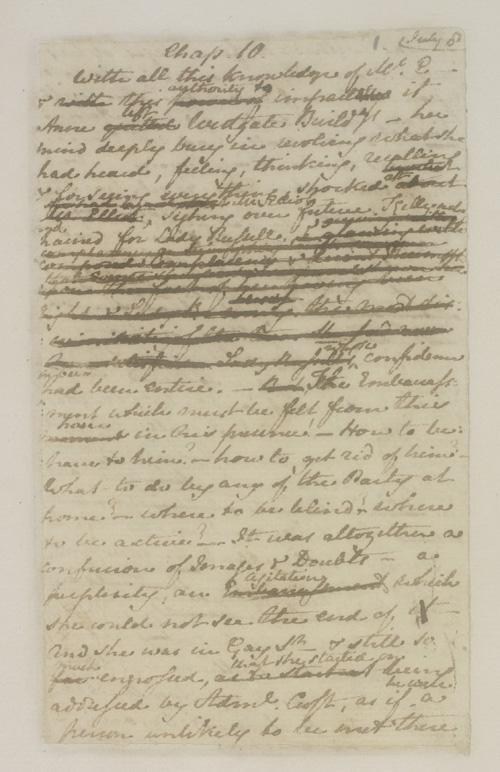
Her letters are delightfully witty and they are also beautifully written – despite her misgivings. When you think of how easy it is for us to write and edit our work today on a computer, it adds an extra dimension to her wonderful writing skills.  The image below shows a real excerpt in her own handwriting from the novel Persuasion.

http://www.janeausten.ac.uk/manuscripts/blpers/1.html

During Jane Austen’s life, metal pen nibs had already been invented but were still rare and much more expensive than using a quill pen.  The majority of people were still using feather quills for all their personal correspondence. Jane Austen at this time would be using a quill made from a large goose feather or perhaps even a crow’s feather for smaller text.  The most desirable and hiqh quality quills were made from swans or peacocks feathers.

The feather quill has the ability to hold a little ink, allowing for less dipping time than using a reed or fine brush, this accounts for its huge popularity.  Interestingly, the feather quill is still used today as the preferred choice for calligraphy experts, due to it’s flexibility. The quill is cut with a knife to vary the thickness of writing, creating the perfect bespoke nib for the writer.

“I must get a softer pen. This is harder. I am in agonies. … I am going to write nothing but short sentences. There shall be two full stops in every line.” From a letter to her sister Cassandra, 1813

The quill cannot just be taken from the goose and cut, it needs to be hardened and there is some skill needed in creating the perfect writing tool – as you can read from Jane’s frustrations with her own quill!

If, like Jane Austen, you are a prolific letter writer and you favour the personal touch of a handwritten letter, then do visit our CLD Stationery website where we have a great selection of personalised stationery, from invitations to correspondence cards.

Read Full Post »

Inquiring readers: Paul Emanuelli, author of Avon Street (click here to view the book and order it), has contributed posts for this blog before about the City of Bath as a Character ,  Law & Order and Jane Austen’s Aunt,  Walking in Austen’s Footsteps, and Food – To Die For: Food Preparation in the Georgian EraHe has graciously sent in an article about crime and an incident involving Jane Austen’s aunt, Mrs James Leigh-Perrot. Paul writes about Bath in his own blog, unpublishedwriterblog. It is well worth a visit!

Workhouses are thought to date back as far as the fourteenth century and the aftermath of the “Black Death.” The plague was merciless in Britain and outbreaks recurred at intervals throughout the fourteenth and fifteenth centuries. As a result, the working population was decimated and the shortage of labour pushed up wages. To try and halt this, several Acts of Parliament were passed aimed at forcing all able-bodied men to work and to keep wages at their old levels, but their main effect was to create itinerant labourers who travelled around the country looking for areas where they could earn more.

bathmap1902-2500

Layout of Bath Workhouse in 1848

The Poor Law Act of 1388 tried to stop this by introducing regulations restricting the movements of all labourers and itinerant beggars. No one could leave their own parish to seek work elsewhere without the written permission of the local Justice of the Peace, and the poor were prohibited from begging and could only receive help from the Parish in which they were born. Alms houses were built for the destitute but the earliest known reference to the term “Workhouse” dates back to 1631, when the mayor of Abingdon (near Oxford) records:-

“wee haue erected wthn our borough, a workehouse to sett poore people to worke”

A further Poor Law Act in 1597 governed the care of the destitute right up until the 19th Century. This law required the local justices of the peace to appoint, annually, “Overseers of the Poor” to find work for those in need, to apprentice children, and to provide,

“the necessary relief of the lame, impotent, old, blind and such other being poor and not able to work”.

This Poor Law required poor rates to be charged as a local tax, replacing voluntary charitable funding. The rate of charge and arrangements for distribution were to be decided by the Overseers. Though most parishes had houses set aside for the old, infirm and destitute these were more like alms-houses than workhouses and most support was given in the form of subsistence payments known as “out relief.”

bath1

Aerial photo of Former Bath Workhouse taken in early 20th Century

The real growth in workhouses took place in the nineteenth century, following the end of the Napoleonic Wars. Hundreds of thousands of troops returned home to find there was no work for them. Most had been agricultural workers before the war and the new technology in farming had reduced the need for labour. At the same time a series of poor harvests had pushed up food prices and the Importation Act of 1815 had prohibited the importation of cheaper cereals from abroad. For most people, bread was the main part of their diet and yet they could no longer even afford bread. So many had become destitute and were starving by the early 1830s that the system could not support them. The Government sought a cheaper alternative to “out relief.”

Read the rest of Paul’s fascinating post and the workhouse in Bath at this link:

Click Here

In keeping with December, Charles Dickens’ anniversary, and a Christmas Carol, Paul sent this message:

 In “A Christmas Carol” the Spirit of Christmas Present reveals two children hidden under his robes. Scrooge asks him if they are his children and the Spirit replies that they are the children of Man – “This boy is Ignorance. This girl is Want. Beware them both, and all of their degree, but most of all beware this boy, for on his brow I see that written which is Doom, unless the writing be erased.’

‘Have they no refuge or resource.‘ asks Scrooge.

‘Are there no prisons.‘ said the Spirit, turning on him for the last time with his own words. ‘Are there no workhouses.‘”

OliverTwistOliver Twist

Oliver Twist Workhouse image

The well known passage from Oliver Twist:

“Child as he was, he was desperate with hunger, and reckless with misery. He rose from the table; and advancing to the master, basin and spoon in hand, said: somewhat alarmed at his own temerity:

‘Please, sir, I want some more.’

The master was a fat, healthy man; but he turned very pale. He gazed in stupified astonishment on the small rebel for some seconds, and then clung for support to the copper. The assistants were paralysed with wonder; the boys with fear.

‘What!’ said the master at length, in a faint voice.

‘Please, sir,’ replied Oliver, ‘I want some more.’

More about Avon Street: Order the book

  • Paperback: 320 pages
  • Publisher: The History Press (March 28, 2012)
  • Language: English
  • ISBN-10: 0752465546
  • ISBN-13: 978-0752465548

Read Full Post »

« Newer Posts - Older Posts »