Feeds:
Posts
Comments

Archive for the ‘Mansfield Park’ Category

When Jane Austen wrote letters to her sister or brothers, she had the choice of sending them two ways: One was to assume her siblings would pay to receive her letters. The other was that Jane would pay to send the letter. As we know, Jane lived on a budget of a mere £50 per year, as did Cassandra, and so their letters were crossed to save money on weight and pages.

Letter to Godmersham

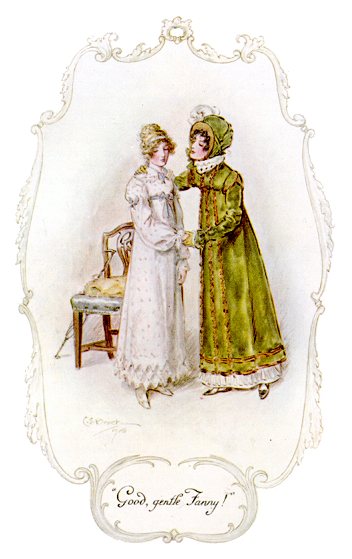
In the following passage from Mansfield Park, Jane writes about 10 year old Fanny Price’s dilemma: She wants to write to her brother William, the sibling she loves the most, but she has no paper on which to write him, and even if she had the paper, she has no funds to send the letter. Her cousin Edmund offers a solution. 

“My dear little cousin,” said he, with all the gentleness of an excellent nature, “what can be the matter?” And sitting down by her, he was at great pains to overcome her shame in being so surprised, and persuade her to speak openly. Was she ill? or was anybody angry with her? or had she quarrelled with Maria and Julia? or was she puzzled about anything in her lesson that he could explain? Did she, in short, want anything he could possibly get her, or do for her? For a long while no answer could be obtained beyond a “no, no—not at all—no, thank you”; but he still persevered; and no sooner had he begun to revert to her own home, than her increased sobs explained to him where the grievance lay. He tried to console her.

“You are sorry to leave Mama, my dear little Fanny,” said he, “which shows you to be a very good girl; but you must remember that you are with relations and friends, who all love you, and wish to make you happy. Let us walk out in the park, and you shall tell me all about your brothers and sisters.”

On pursuing the subject, he found that, dear as all these brothers and sisters generally were, there was one among them who ran more in her thoughts than the rest. It was William whom she talked of most, and wanted most to see. William, the eldest, a year older than herself, her constant companion and friend; her advocate with her mother (of whom he was the darling) in every distress. “William did not like she should come away; he had told her he should miss her very much indeed.” “But William will write to you, I dare say.” “Yes, he had promised he would, but he had told her to write first.” “And when shall you do it?” She hung her head and answered hesitatingly, “she did not know; she had not any paper.”

“If that be all your difficulty, I will furnish you with paper and every other material, and you may write your letter whenever you choose. Would it make you happy to write to William?”

“Yes, very.”

“Then let it be done now. Come with me into the breakfast-room, we shall find everything there, and be sure of having the room to ourselves.”

“But, cousin, will it go to the post?”

“Yes, depend upon me it shall: it shall go with the other letters; and, as your uncle will frank it, it will cost William nothing.”

“My uncle!” repeated Fanny, with a frightened look.

“Yes, when you have written the letter, I will take it to my father to frank.”

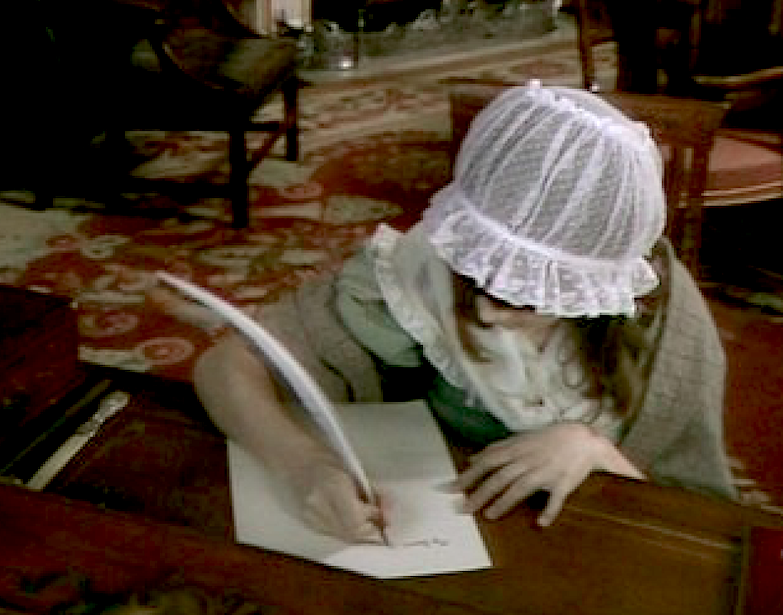
Screen Shot 2023-07-28 at 5.40.45 PM

Fanny writes William a letter. (Mansfield Park, 1983)

Fanny thought it a bold measure, but offered no further resistance; and they went together into the breakfast-room, where Edmund prepared her paper, and ruled her lines with all the goodwill that her brother could himself have felt, and probably with somewhat more exactness. He continued with her the whole time of her writing, to assist her with his penknife or his orthography, as either were wanted; and added to these attentions, which she felt very much, a kindness to her brother which delighted her beyond all the rest. He wrote with his own hand his love to his cousin William, and sent him half a guinea under the seal. Fanny’s feelings on the occasion were such as she believed herself incapable of expressing; but her countenance and a few artless words fully conveyed all their gratitude and delight, and her cousin began to find her an interesting object. He talked to her more, and, from all that she said, was convinced of her having an affectionate heart, and a strong desire of doing right; and he could perceive her to be farther entitled to attention by great sensibility of her situation, and great timidity. He had never knowingly given her pain, but he now felt that she required more positive kindness; and with that view endeavoured, in the first place, to lessen her fears of them all, and gave her especially a great deal of good advice as to playing with Maria and Julia, and being as merry as possible.

From this day Fanny grew more comfortable. She felt that she had a friend, and the kindness of her cousin Edmund gave her better spirits with everybody else. The place became less strange, and the people less formidable; and if there were some amongst them whom she could not cease to fear, she began at least to know their ways, and to catch the best manner of conforming to them.”

Edmund’s solution was a third option not available to Jane or her family. Franking privileges were available to all peers and sirs, like his father, Sir Thomas Bertram, a baronet. He who would write his name diagonally across the sealed letter. This act automatically paid for the postage. — Regency Trivia: Franking Privileges, Ella Quinn

This scene sets the stage for the special relationship between the lonely, bewildered Fanny and her kind cousin, who has made her feel welcome and at home at a time when she felt adrift. Their connection would stand the test of time.

More on the Topic:

The Regency Post — A Pity We’ve Lost Letters, Shannon Donnely’s Fresh Ink

Jane Austen — Quills and Correspondence

Read Full Post »

As we continue to analyze Jane Austen’s novels and identify the best romantic tropes used in each one, we’re well on our way to proving that Austen not only used romantic themes ingeniously but also played an important role in developing several key plot devices that are regularly used in modern filmmaking today.

Last month, I wrote about Rom Coms and Emma. This month, I’m delving into Mansfield Park and finding the romantic themes found in the novel that are commonly found in romantic movies today.

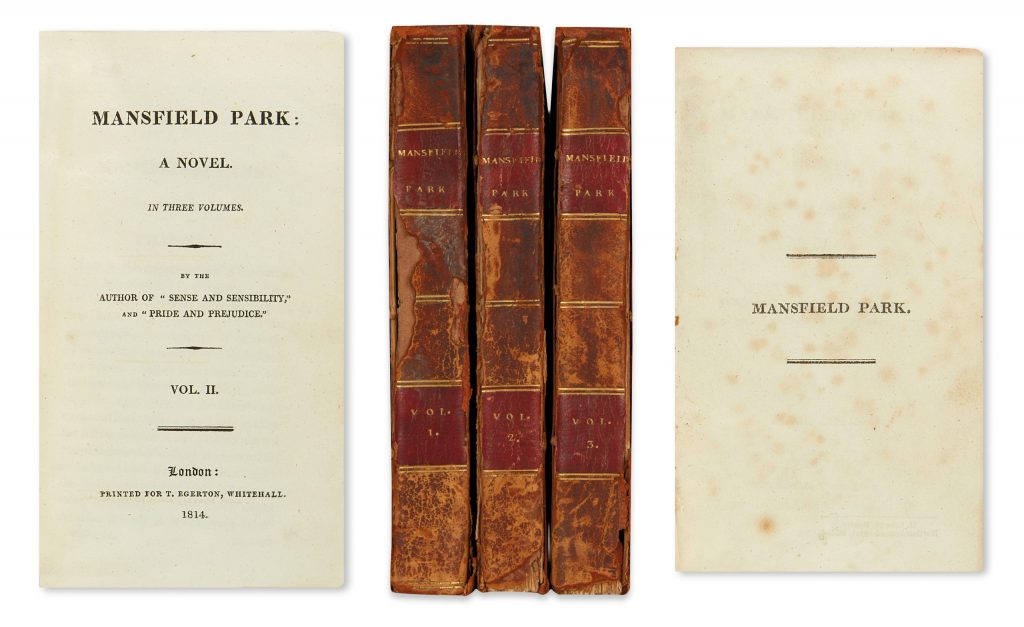
Mansfield Park, 1st Edition, 1814, Swann Auction Galleries

Romantic Themes in Mansfield Park

In Mansfield Park, there are several themes that ring true as romantic tropes we’re familiar with today:

The Ugly Duckling-Turned-Swan (aka the “Make-over”)

Following this train of thought, we see Fanny Price blossom and come into her own in MP. Her transformation isn’t necessarily outward. She doesn’t exactly go to the mall and get a makeover, but she does come out of her shell and begin to stand on her own two feet.

The “makeover” in this novel is actually a bit inverted because while Fanny later gains some of her own agency and confidence, the real change that occurs is that the people around her finally see her for who she really is and start to value her!

The Diamond-in-the-Rough

Adjacent to the “ugly duckling” theme, many rom coms play with the idea that the main character is wonderful just as she is, but she is overlooked, shy, or overshadowed by other characters. There’s usually an “a-ha” moment where one or more characters finally see the main character in a new way.

In MP, Edmund and his family members finally wake up and see Fanny for her true worth. Miss Crawford is the shiny object that distracts Edmund from much of the novel from seeing Fanny’s quieter brilliance.

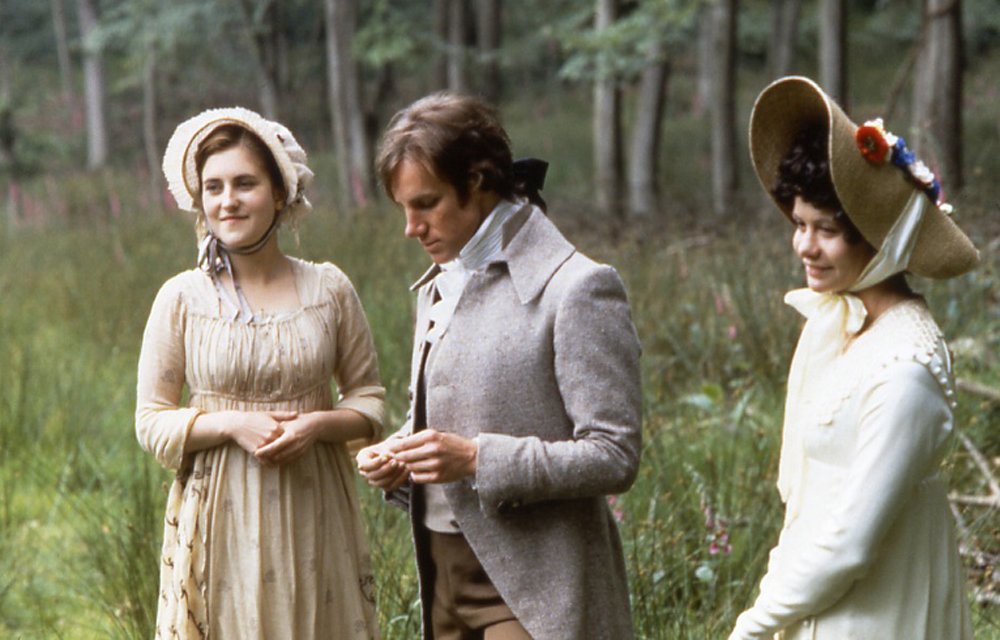
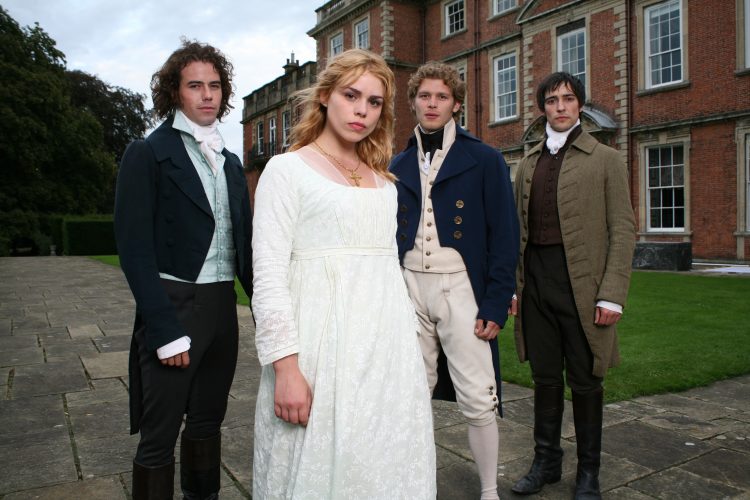
Mansfield Park (1983)

Red Herring (aka, the Shiny Object)

Similar to the chemistry and relationship between Emma and Mr. Knightley (and the Frank Churchill distraction), there’s a red herring (or several) in Mansfield Park as well.

In The Take’s “The Rom Com Explained,” we find this explanation of the red herring theme: “Rom-com leads often start out with a red herring love interest who seems very appealing but turns out to be all wrong. Meanwhile, as the protagonist spends time with someone they aren’t actively trying to impress, they can be their unfiltered self and get to know the other person in a real way. This long-developing chemistry leads to a moment of epiphany, where the character suddenly realizes the feelings that have been crystal-clear to the viewer all along.”

In Mansfield Park, the arrival of Henry and Mary Crawford (siblings) is the pebble thrown into the pond at Mansfield. This disrupts the regular rhythm of life for Fanny and Edmund and the rest of the Bertram family and sets the plot spinning.

Henry throws a wrench into several plot lines, while Mary comes between Fanny and Edmund. Edmund, dazzled by Mary’s beauty, is blinded by Mary and only sees her through rose-colored glasses. Fanny waits in the wings, heart aching, as he falls for Mary.

Mary, similar to Wickham, Willoughby, and others, is the “shiny object” that keeps Edmund distracted and causes havoc for Fanny. Fanny cannot prove what she thinks is wrong with either of the Crawfords. She has no other recourse but to wait patiently until Mary and Henry both show their true colors.

Mansfield Park (2007)

Best Friends-to-Lovers

Of all the themes in rom coms used today, Best Friends-to-Lovers is one of the most popular and it fits Mansfield Park beautifully. While Emma and Mr. Knightley have a bit of this vibe, much of their chemistry comes from their sparring matches (like Elizabeth and Darcy). But with Fanny and Edmund, they are incredibly close friends who share many of the same interests, qualities, and values. Edmund is the first person to take an interest in Fanny when she comes to live at Mansfield.

If you think of MP as a new school, Fanny is the new kid and the popular kids won’t talk to her or play with her. Edmund is different. Edmund helps Fanny when she is sad and lonely. At first, she looks up to him, but as they grow up, mutual respect and affection grows. Later, at least for Fanny, love begins to bud.

The Love Triangle

As in most Austen novels, there’s a love triangle, which is probably the most popular trope in most romantic comedies today.

In Mansfield Park, there are multiple love triangles, but we don’t see all of them at first. The one we focus on most is the Fanny-Edmund-Mary triangle. While Fanny hides lovelorn feelings for Edmund, Edmund doesn’t see Fanny as more than a friend/cousin he grew up with. Miss Crawford comes to town at exactly the wrong moment and steals the show.

Until Edmund sees Miss Crawford for her true self, he is blinded by her alluring personality and beauty and cannot see Fanny standing right in front of him.

Love Triangles similar to Mansfield Park

When I started looking for modern movies with similar themes (Best Friends-Turned-Lovers, Ugly Duckling-Turned Swan, Unrequited Love), I posted questions on my Instagram account (@KindredSpiritBooks) and on the Jane Austen Fan Club on Facebook. I received dozens and dozens of answers to this intriguing question!

If you’ve ever wanted to know what themes come up most often in movies, take a look at this list; it’s the longest list I’ve had yet in this series. There’s no denying that movie-goers respond well to love triangles—especially when the triangle involves two close friends finally realizing their love for one another!

The Holiday, 10 Things I Hate About You, 13 Going On 30, A Cinderella Story, A Walk to Remember, Always Be My Maybe, America’s Sweethearts, Can’t Buy Me Love, FRIENDS (Chandler and Monica), Crossing Delancey , Drive Me Crazy, Easy A, Ever After, Get Over It, Grease, He’s Just Not That into You, Love and Basketball, Love, Rosie , Made of Honour, Maid in Manhattan, Miss Congeniality, Moonstruck, Never Been Kissed, Pretty in Pink, Pygmalion (My Fair Lady), Sabrina, She’s all That, She’s the Man, Sixteen Candles, Some Kind of Wonderful, Something Borrowed, Superman, The Duff, The Office (Jim and Pam), The Perfect Man, The Princess Diaries, The Summer I Turned Pretty, The Truth About Cats & Dogs, Trojan War, Whatever It Takes, While You Were Sleeping, Wild Hearts Can’t Be Broken, Win a Date with Todd Hamilton, Yesterday, Your Place or Mine.

Always Be My Maybe
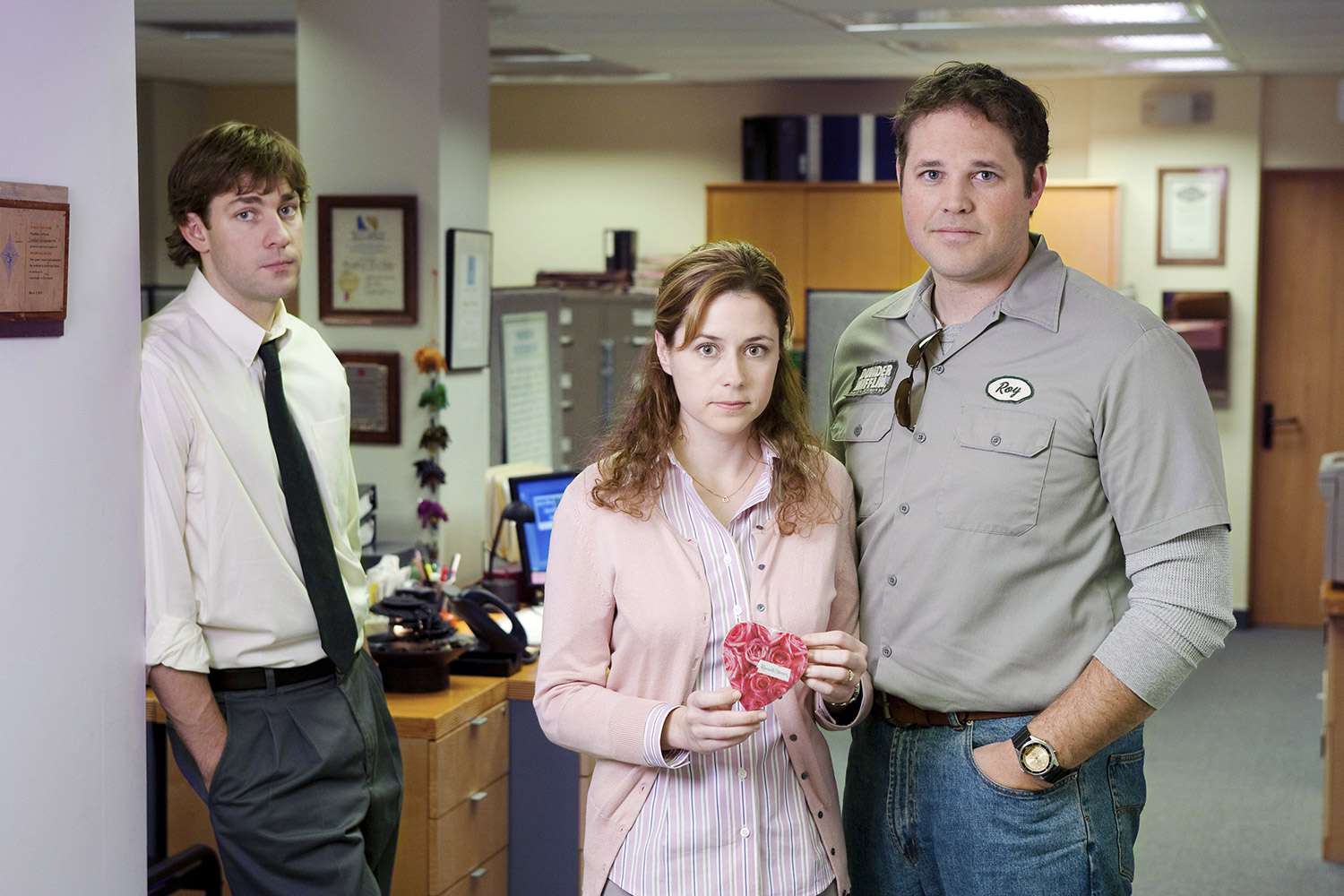
Jim, Pam, and Roy from The Office

When asked what themes they saw in Mansfield Park that are common in romantic films today, several fans quipped, “The Cousins-to-Lovers” theme? Which made me laugh out loud. Yes, cousins did marry cousins during Austen’s time, but it’s still a funny remark.

I’m sure you can add others to this list! In each of these movies, there is some element of MP present.

Fanny Price

When I took these polls, the one thing everyone agreed on was this: We like Fanny Price because she doesn’t change her morals, her convictions, or her personality just to gain acceptance or love. She does blossom, but she doesn’t change. She is the same through-and-through, which makes her a very admirable heroine. Edmund finally wakes up and begins to see her in a new light, but she doesn’t become more like Mary Crawford; she remains steady, true Fanny.

Fanny has a lot to lose in terms of a future when she refuses to give in to Henry Crawford’s proposal and her uncle’s pressure. Without an inheritance of her own, her only options are to continue living with her aunt and uncle Bertram as long as they will have her or find work as a governess. And yet, though she’s timid and easily intimidated, she does not yield.

Mansfield Park (2007)

Have you seen any of the film versions of Mansfield Park? If so, which one do you think remains most faithful to the original text? (I’ve yet to find one that I enjoyed as much as the novel, but I’m open to suggestions!)

Are there any other books or movies in this genre that allow the heroine to stay true to herself as she wait patiently for her dreams to come true?


RACHEL DODGE teaches college English classes, gives talks at libraries, teas, and book clubs, and writes for Jane Austen’s World blog. She is the bestselling author of The Little Women DevotionalThe Anne of Green Gables Devotional and Praying with Jane: 31 Days Through the Prayers of Jane Austen. Now Available: The Secret Garden Devotional! You can visit Rachel online at www.RachelDodge.com.

Read Full Post »

“We are to have a tiny party here tonight; I hate tiny parties–they force one into constant exertion.” — Jane Austen to Cassandra, May 21, 1801,  while visiting her Aunt Jane and Uncle James Leigh-Perrot in Bath
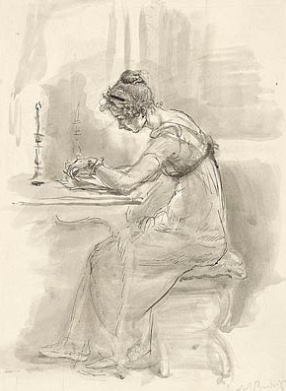
Drawing of a Regency woman writing a letter

Image by Isabelle Bishop, from the Morgan Library Exhibit of Life, Work, and Legacy of Jane Austen.

Inquiring readers, 

Tomorrow it will be December, a time for parties, celebrations, family gatherings, and Christmas activities, mostly  in Christian regions. During Austen’s time, people associated this period with the religious calendar, as well as with pagan traditions observed since ancient times. Celebrations during Austen’s life began on Dec 6th, St. Nicholas Day, and lasted until January 6th, or 12th night — the Feast of the Epiphany. 

Since 2009, this blog has posted many articles about British Christmas and New Year’s traditions, with food, dress, and customs during the Regency era and before. Austen described holiday festivities in her novels, and balls, such as the one at Netherfield Park, but none of her personal descriptions are as detailed as those mentioned in this letter to Cassandra, which tells of a large musical party that her brother Henry and sister-in-law, Eliza, held in their house in London ( 64 Sloane Street) on 25th April, 1811.
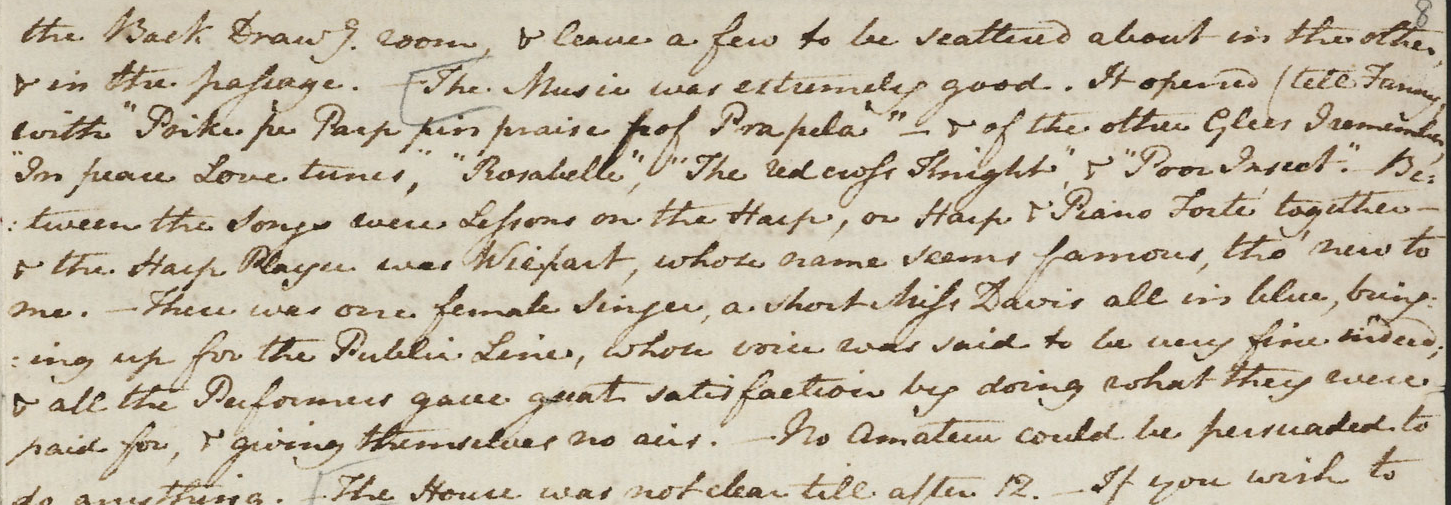
snip of the letter

Detail of Austen’s letter to Cassandra. Image: British Library Online.

The reason for Austen’s visit was to work on proofs for Sense and Sensibility, her first published novel. I chose this letter because musical parties and get-togethers were given frequently, regardless of the time of year. The songs, decorations, and fashions might have changed with the seasons, but Austen’s description of this large party, the musicians, and the guests must have seemed quite familiar to her contemporaries, despite her spare details.

NOTE: I’ve related only the details of the party in the letter. Read the full transcript at this link to The British Library.

The Letter 

  1. To Cassandra Austen (# From Deirdre Le Faye’s Fourth Edition of Jane Austen’s Letters)

Thursday, 25, April 1811

Sloane St Thursday April 25

Before the party:

My dearest Cassandra

… Our party went off extremely well. There were many solicitudes, alarms, and vexations, beforehand, of course, but at last everything was quite right. The rooms were dressed up with flowers, &c., and looked very pretty. A glass for the mantlepiece was lent by the man who is making their own. Mr. Egerton and Mr. Walter came at half-past five, and the festivities began with a pair of very fine soals. 

(Soals is an obsolete spelling for sole, a flat fish. Hannah Glasse described a recipe for Fricasee of Soles made with lemon soles or a larger, thicker plaice fish, which fed more people.)

In this passage, Jane described the usual hustle and bustle before a grand party that we all have felt in our own lives. In this letter, she provided more details for her sister than in her novels for her readers.)

Mr Egerton is the publisher who brought out Jane’s first novel, “Sense and Sensibility”.)

Events leading up to the party:

Yes, Mr. Walter — for he postponed his leaving London on purpose — which did not give much pleasure at the time, any more than the circumstance from which it rose — his calling on Sunday and being asked by Henry to take the family dinner on that day, which he did; but it is all smoothed over now, and she likes him very well.”

(This sentence is somewhat enigmatic. Why would his postponement not give him much pleasure? How was the situation smoothed over? Mollands.net says this about Mr. Walter: [He] must have been related to Jane through her grandmother (Rebecca Hampson), who married first, Dr. Walter; secondly, William Austen. Mr. Ronald Dunning wrote a post about  Rebecca Hampson for this blog just a week ago. 

As the festivities began:

At half-past seven arrived the musicians in two hackney coaches, and by eight the lordly company began to appear. Among the earliest were George and Mary Cooke*, and I spent the greater part of the evening very pleasantly with them. The drawing-room being soon hotter than we liked, we placed ourselves in the connecting passage, which was comparatively cool, and gave us all the advantage of the music at a pleasant distance, as well as that of the first view of every new comer.”
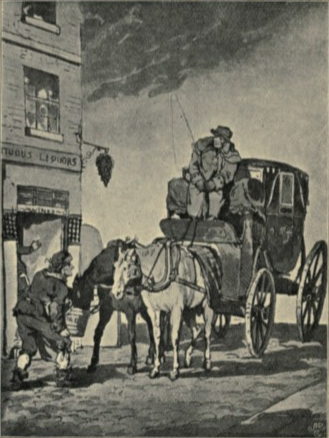
Black and white drawing of a Hackney Coach drawn by two horses

Hackney Coach, ca 1800

(Two hackney coaches carried 6 people per coach, so we may surmise that at least 12 musicians arrived with their  instruments. 

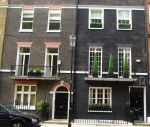
Houses in town were listed as 1st, 2nd, 3rd & 4th rate, fourth being the largest and first being the smallest. Henry’s house, located on 64 Sloane Street, is today unrecognizable from its Georgian size and façade. At the time he and Eliza rented the house, it was a 3rd rate house (3 windows wide), worth between £ 350 and £ 850 with from 500 – 900 square feet of floor space.) Because Henry was a successful banker during this time and Eliza had considerable means of her own, we can surmise that the house they rented was most likely on the larger side of 500 – 900 square feet of floor space.

Austen comments on a few acquaintances:

I was quite surrounded by acquaintances, especially gentlemen; and what with Mr. Hampson, Mr.Seymour, Mr. W. Knatchbull, Mr. Guillemarde, Mr. Cure, a Captain Simpson, brother to the Captain Simpson, besides Mr. Walter and Mr. Egerton, in addition to the Cookes, and Miss Beckford, and Miss Middleton, I had quite as much upon my hands as I could do. Poor Miss B. has been suffering again from her old complaint, and looks thinner than ever. She certainly goes to Cheltenham the beginning of June. We were all delight and cordiality of course. Miss M. seems very happy, but has not beauty enough to figure in London.”

This slideshow requires JavaScript.

(Fashion: While Austen did not describe the clothes worn by guests, Cassandra would have easily envisioned what people wore. Jane had a limited yearly budget for personal items. At a party held on Christmas, 1811, she would have refurbished a previously worn evening gown, from 1810 or before. The 1811 evening dresses had narrower skirts, mostly without trains, and hems cut at or above ankle length. Eliza de Fuillide, a woman of rank and fortune, would have worn the latest fashion. Henry Austen was quite prosperous when he rented the house at 64 Sloane Street and therefore was able to spare no expense in hosting this party.

Although Jane hated tiny parties because they required constant exertion, this musical party seemed to require as much of her attention as the former. Her wit was on full display in this letter.  Miss M., sadly, has not sufficient funds nor the looks to attract a possible husband, unlike Jane Bennet in “Pride and Prejudice” or Cassandra Austen, as described by Lucy Worsley in “Jane Austen at Home.”

Many of the people mentioned by Jane are identified by Deidre Le Faye. Find their descriptions at the end of this article.**

Cheltenham, whose famous mineral waters were founded in 1716,  was prominent during the Georgian era. (Christy Somers noted a short article by Carolyn S. Greet, in Jane Austen Reports for 2003, “Jane and Cassandra in Cheltenham. Diana Birchall wrote: 

“In the spring of 1816 Jane and Cassandra paid a visit to Cheltenham, primarily for the sake of Jane’s health. Other members of the family had previously visited the little town, including James and his wife Mary, as Jane had mentioned in a letter of 1813. Cheltenham was then in its fashionable heyday, with its attractions being both therapeutic and social. It was still small and rustic compared with Bath, and all the buildings were still grouped along the single mile-long High Street. It was not lit with gas until 1818, and had a single set of Assembly Rooms, theatre, libraries, shops, and lodging houses. There is a description of the saline wells, which people drank from in the morning, for a laxative effect.- Reveries Under the sign of Austen

Numbers Attending the Party:

Including everybody we were sixty-six — which was considerably more than Eliza had expected, and quite enough to fill the back drawing-room and leave a few to be scattered about in the other and in the passage.”

Jane had mentioned standing in the connecting passage, which was cooler than the two drawing rooms. The image below might be a facsimile of Henry’s and Eliza’s first floor, which typically consisted of two rooms for entertaining guests. One was larger than the other. A passageway connected the stairs to the two rooms. 

The first floor:

“It was held on the first floor in the octagonal rear salon and the front drawing room. Jane told Cassandra that she spent most of the time talking to friends in ‘…the connecting Passage, which was comparatively cool, & gave us all the advantage of the Music at a pleasant distance, as well as that of the first view of every new comer.’ There were glee singers, a harpist and floral decorations” – Walking Jane Austen’s London. Louise Allen, Bloomsbury Publishing10 Jul 2013 .

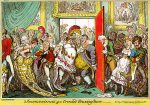
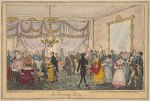
None of the above images showed fashions even close to those worn in 1811. Formal menswear had not changed much, however, and the illustrations do give us an idea of how these parties were held.

Sixty-six people in a Regency London townhouse would have presented quite a squeeze. Even on a cold day in December, the rooms, with candles burning in chandeliers and candelabras, and heat rising from the kitchen in the basement, would have already been hot. In April, when this letter was written, the heat would have been substantial. The large group of guests would have intensified the heat even more. We do not know if the 66 guests included the musicians and singer. As Cruikshank’s images showed, card tables were set up, a common practice that Jane does not mention. One wonders if they were set up on the ground floor, near the dining room, and the floor just above the kitchen. This level would also have been easier for older people to reach. One can only conjecture about these arrangements.

Deirdre Le Faye mentions Winnifred Watson’s description of the interior of 64 Sloane Street, but the few remaining copies of her small out of print booklet, “Jane Austen in London,” are above my budget (one was listed at over $260) and so I could not read it. London townhouses built after the great London fire followed strict guidelines in both design and materials. Henry and Eliza at this juncture in their lives could probably afford a 3rd rate house with a larger square footage of floor space, perhaps even 900 sq. feet. 

Using Jane’s description, and Deirdre Le Faye’s mention of this house, I found this image and quickly drew the other one very badly.

The Music:

The music was extremely good. It opened (tell Fanny) with “Poike de Parp pirs praise pof Prapela”; and of the other glees I remember, “In peace love tunes,” “Rosabelle,” “The Red Cross Knight,” and “Poor Insect.” Between the songs were lessons on the harp, or harp and pianoforte together; and the harp-player was Wiepart, whose name seems famous, though new to me. There was one female singer, a short Miss Davis, all in blue, bringing up for the public line, whose voice was said to be very fine indeed; and all the performers gave great satisfaction by doing what they were paid for, and giving themselves no airs. No amateur could be persuaded to do anything. “

This image of Regency guests listening to musicians sits on the Alamy website. Since I have not purchased it, please click on the  link to view it: https://www.alamy.com/thomas-rowlandson-a-little-evening-music-georgian-cartoon-of-a-fashionable-image9616736.html 

(Interestingly, the phrase “Poike de Parp pirs praise pof Prapela” was a special language that Jane used with her niece Fanny by placing a ‘p’ in front of every word. The only one I could decipher was Harp for Parp. https://bit.ly/3o8Nb97, Jane Austen, Her Contemporaries and Herself: An Essay in Criticism, By Walter Herries Pollock, 1899, Google Books.

Mollands.net adds:  Jane and her niece Fanny seem to have invented a language of their own–the chief point of which was to use a ‘p’ wherever possible. Thus the piece of music alluded to was ‘Strike the harp in praise of Bragela.’)

Miss Davis was a professional singer in London. Jane mentions that no amateur stepped up to play after listening to these fine players and singer.

About musicians during this time: 

“Amateur orchestras in city taverns or in gentlemen’s clubs competed with the professional concerts that began to sprout up in public places. (- The Rage for Music, Simon McVeigh) Local musicians would be hired for assembly balls in small towns. Musicians with a more professional background would be enlisted to play at more stylish events, like the Netherfield Ball. The lady asked to lead a set would choose the music and the steps, and relay her request to the Master of Ceremonies. “  https://janeaustensworld.com/2010/07/12/jane-austen-and-music/

Cities like London or Bath provided steady incomes for musicians. In order to make ends meet, those living in rural areas traveled from town to town to the different public assemblies or parties.

Glees

Glees were quite popular at this time. Jane mentioned glee songs in Mansfield Park. “Fanny Price was the only one of Austen’s heroines who never receives any musical training at all.” Fanny was unsuccessful in enticing Edmund to go outside to look at the stars. As soon as he hears singing, he says to her, “We will stay till this is finished, Fanny.” She was mortified.

Austen also mentioned glees in this letter to Cassandra, which during her time were songs for men’s voices in three or more parts, usually unaccompanied, popular especially c. 1750–1830. These songs, by the way, were nothing like the productions created for the TV series, Glee, which ran from 2009-2015. I found one glee recording on YouTube: Reginald Spofforth- 18th Century Glee Club: L’ape E La Serpe, from Vanguard Classics. 

In Peace Love Tunes the Shepherds Reed, the glee was meant for three voices, with words supplied by Walter Scott. Instrumentals were accompaniments for Piano Forte & Harp, or two performers on one Piano Forte. This glee was written by J. Atwood

This Rosabella score by John Wall Calcotte (1766-1821) in this link is for a cappella (originally). Piano accompaniment was added later by William Horsley. The lyrics were by Walter Scott.

The Red Cross Knight was written by Callcott, 1797. Also written by Callcott is the Poor Insect, a refrain from “The May Fly.”
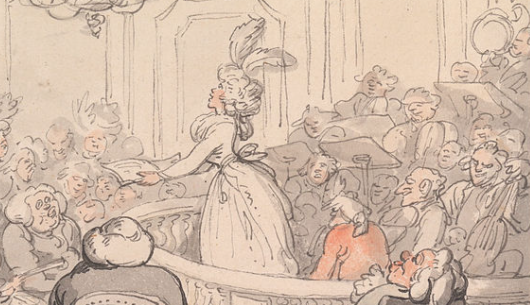
Comforts of Bath-The Concert-Rowlandson-Google Art Project-Wikimedia Commons

Detail: The Concert, The Comforts of Bath, Thomas Rowlandson, 1798. Wikimedia Commons

At Party’s End:

The house was not clear till after twelve.” 

This party lasted a little over four hours. London had street lights that guided guests back to their lodgings and houses. In country houses, parties, which were scheduled under the light of the full moon, often lasted until the wee early hours. After a party at a country house, Jane would often spend the night as a guest at a friend’s house, at times with her dear friend Martha Lloyd if she could manage it. 

The following day:

Her party is mentioned in this morning’s paper.”  

“…in the Morning Post of 25 April, which must have been very gratifying, even if the newspaper spelled her name wrong: ‘Mrs H Austin had a musical party at her house in Sloane-street.” – http://what-when-how.com/Tutorial/topic-673689/London-A-Tour-Guide-for-Modern-Traveller-10.html  “Travel Reference In-Depth Information, Walk 1: Sloane Street to Kensington, A Tour Guide for the Modern Traveler.”

The guests:

* Cooke family of Great Bookham. Rev. George Cooke and his unmarried sister Mary. Their father, Rev. Samuel Cooke was Jane’s godfather. 

**

  • Mr. George Hampson was a baronet who chose not to use his title. He is one of Jane’s cousins through her relationship to her grandmother, Rebecca Hampson, whose second husband was William Austen.
  • Mr. William Seymour, Henry Austen’s friend and a lawyer, who, it was speculated, might have considered proposing to Jane, but he didn’t.
  • M. Wyndham Knatchbull, merchant in London, or Reverend Doctor Wyndham Knatchbull, the eldest son of Sir Edward Knatchbull, 8th Baronet. 
  • Mr. Guillemarde is probably John Lewis Guillemarde, who lived in London
  • Mr. Capel Cure, who lived in London. His father, George, had first married Elizabeth Hampson, daughter of Sir George Hampson, but she died childless. Capel is the son of George Cure’s second wife.
  • Captain John Simpson, brother of Captain Robert Simpson. 
  • Mr. Thomas Egerton, Austen’s first publisher. He brought out S&S, P&P, and the first edition of Mansfield Park. His presence at the party, and Jane’s purpose for visiting Henry and Eliza to complete work on Sense & Sensibility connects his attendance at the party in a marvelous way.
  • Miss Maria Beckford, unmarried, lived with the Middleton family as hostess for her brother-in-law, John Middleton. When in London for the season Miss Beckford lived at 17 Welbeck Street. (Le Faye, p 495)
  • Miss Middleford. No explanation by Ms. Le Faye.)

Additional sources:

Characteristics of the Georgian Townhouse , June 3, 2009 , Jane Austen’s World, Vic

Jane Austen’s Letters, 4th Edition, Deirdre Le Faye, 2011, Oxford University Press. 

Jane Austen’s visit to Sloane Street , Kleurijk Jane Austen, 9-2014

Jane Austen, Her Contemporaries and Herself: Walter Herries Pollock · 1899 – Explanation of “Poike de Parp pirs praise pof Prapela”

Georgian Terrace Houses, April 27, 2021, Random Bits of Fascination.com, Georgian Townhomes

Thank you, Tony Grant, for contributing the 3 current photographs of Hans Place (2) and of 64 Sloane Street (1).

Read Full Post »

Inquiring readers: Victoria Grossack, FCAS, the author of this piece and an actuary, sent this highly interesting article about Jane Austen and mathematics, a first topic for this blog. Enjoy!

Janeites esteem Jane Austen as a literary genius. Her characters are exquisitely drawn and her dialogue can be wickedly funny. She also uses the stream of consciousness technique before it became popular. All devotees know her novels are classics.

What about Austen as a mathematician, however? She never promotes herself in this regard. Like most female authors in her day, she doesn’t promote herself at all, not even putting her name on her novels – but in her writing, her mathematical abilities are evident. In fact, she uses math in a way that would make most actuaries proud. (Note: Actuaries are specialized mathematicians who generally work for insurance companies, which is relevant to some of the math Austen uses.)


Monetary Sums, Large and Small

Jane Austen and almost all of her characters are aware of the value of money, which would be true of most mathematicians (and certainly all actuaries). In fact, money is often a motivator for her characters’ choices in her novels. The young ladies often need to marry so they will have husbands to support them, while the single gentlemen are more attracted to single young ladies when they have significant dowries. Mr. Darcy’s income of £10,000 per annum makes him more handsome in Pride & Prejudice, while Mr. Wickham only courts Mary King after she inherits £10,000. Mr. Collins’s financial situation even wins him the hand of Charlotte Lucas:

Without thinking highly either of men or matrimony, marriage had always been her object; it was the only provision for well-educated young women of small fortune, and however uncertain of giving happiness, must be their pleasantest preservative from want. (Pride & Prejudice, Chapter 22)”

Image of the front and back of a half guinea

Image of a half guinea in the time of George III

However, Austen’s comprehension goes well beyond large, round sums and the necessity of an income. Mansfield Park has a lovely passage in which monetary gifts to William Price are discussed by his two aunts, Mrs. Norris and Lady Bertram.

Mrs. Norris seemed as much delighted with the saving it would be to Sir Thomas as with any part of it. “Now William would be able to keep himself, which would make a vast difference to his uncle, for it was unknown how much he had cost his uncle; and, indeed, it would make some difference in her presents too. She was very glad that she had given William what she did at parting, very glad, indeed, that it had been in her power, without material inconvenience, just at that time to give him something rather considerable….”

“Mrs. Norris seemed as much delighted with the saving it would be to Sir Thomas as with any part of it. “Now William would be able to keep himself, which would make a vast difference to his uncle, for it was unknown how much he had cost his uncle; and, indeed, it would make some difference in her presents too. She was very glad that she had given William what she did at parting, very glad, indeed, that it had been in her power, without material inconvenience, just at that time to give him something rather considerable….”

“I am glad you gave him something considerable,” said Lady Bertram, with most unsuspicious calmness, “for I gave him only £10.”

“Indeed!” cried Mrs. Norris, reddening. “Upon my word, he must have gone off with his 3 pockets well lined, and at no expense for his journey to London either!” (Mansfield Park, Chapter 31)”

The amount of Mrs. Norris’s gift to William Price is never mentioned in Mansfield Park, but Jane Austen told her family (A Memoir of Jane Austen) that Mrs. Norris gave her nephew only one pound. Besides being a perfect contrast of the miserly Mrs. Norris versus her much more generous sister, the dialogue shows how well Austen understood the importance of relatively small sums, and how much £10 would mean to a midshipman in William Price’s position.

The Distress of Debt

Another reason for seeking a marriage settlement is to deal with debt. Several of the gentlemen (Willoughby in Sense & Sensibility, and Wickham in Pride & Prejudice) marry to escape debt, making life choices that they would have preferred not to make.

However, marriage is not the only solution to debt. Austen’s last novel, Persuasion, begins with the fact that the baronet, Sir Walter Elliot, has been living beyond his means and needs to “retrench” in order to regain solvency. As he is one of those people who is really bad at managing money, Austen comes up with the best method that will save him money: 

“Quit Kellynch Hall.” The hint was immediately taken up by Mr. Shepherd, whose interest was involved in the reality of Sir Walter’s retrenching, and who was perfectly persuaded that nothing would be done without a change of abode. (Persuasion, Chapter 2)

This change of abode is critical to the plot of Persuasion. It’s also sound business advice. 

Some readers may object that the examples given so far only prove that Austen had a mercenary side and do not demonstrate her understanding of mathematics. So let’s move on to other passages involving annuities and livings. These also concern money, but the math is more challenging.

Annuities and Livings

Annuities are insurance contracts that provide a fixed income stream, often for a person’s remaining lifetime. An annuity is a series of payments; these days annuities are often used as a way to pay out retirement, or are awarded in lieu of some lottery sum.

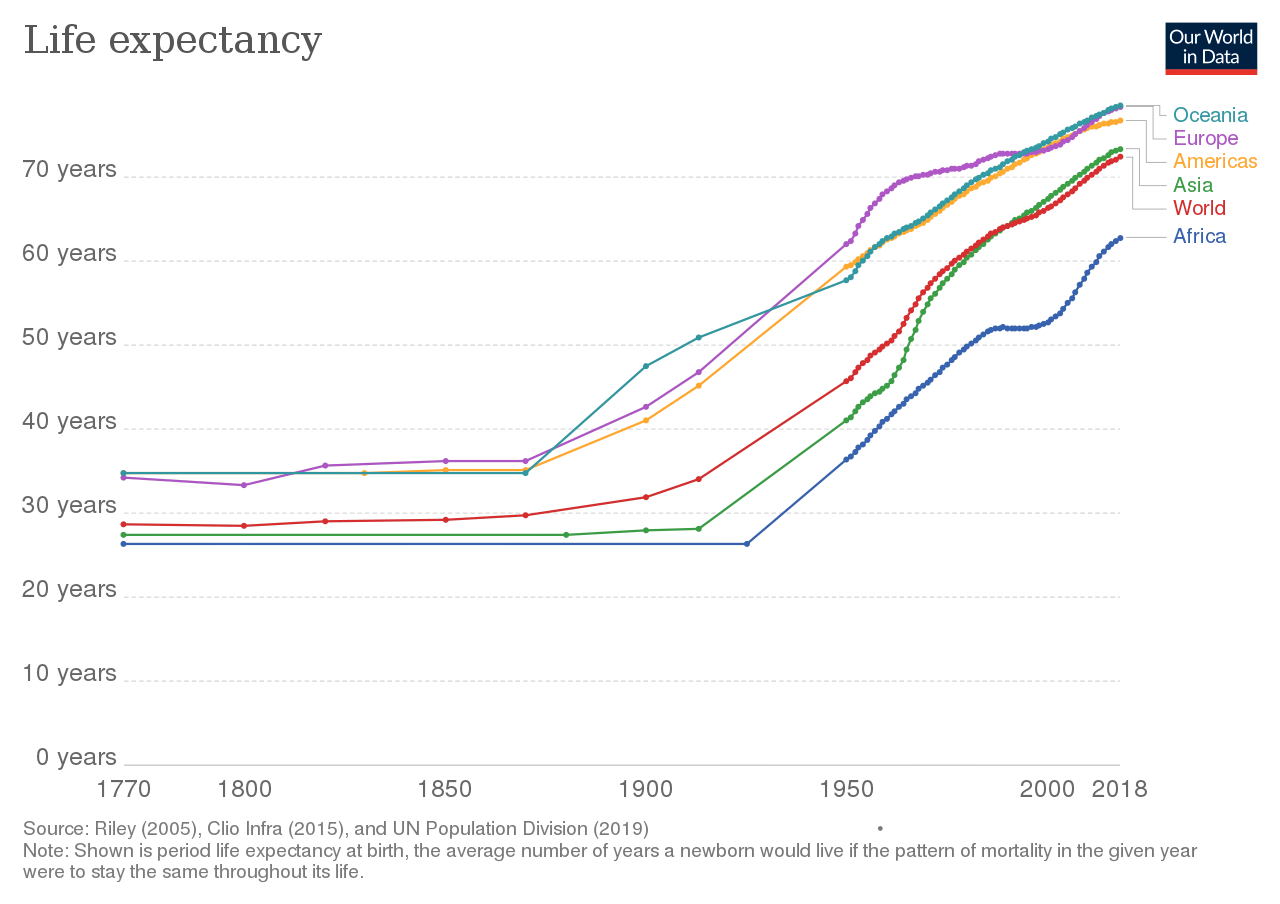
Life expancy from 1770 to 20018 of people from Oceania, Europe, Americas, Asia, World, Africa

Life expectancy over time

Now, annuities, when used by life insurance companies and pension funds, are fairly sure things because they can rely on expected values, i.e., mortality tables. In other words, life insurance companies and pension funds know approximately when their annuitants will die, on average. These organizations can manage because they work with large pools of people. Each annuitant can land anywhere on a distribution, but on average, given enough customers, an insurance company can have confidence in its ability to pay annuities.

However, if you are just one individual promising an annuity to just one other individual, you cannot rely on averages, because you can land anywhere on a distribution. It’s like throwing a pair of dice: on average, they will sum to 7, but you can roll anything from 2 to 12, and the probability of rolling something besides the mean is pretty good.  

So, that’s the underlying math. In Sense & Sensibility, Austen describes the dilemma a couple is facing when debating whether or not to promise an annuity to Mr. John Dashwood’s widowed stepmother. This sort of annuity would have to be guaranteed by them; they would not be in the position of a life insurance company that can have confidence in averages. Here are some of the remarks made by Fanny Dashwood to her husband, Mr. John Dashwood:

“… if you observe, people always live forever when there is an annuity to be paid them; and she is very stout and healthy, and hardly forty. An annuity is a very serious business; it comes over and over every year, and there is no getting rid of it. You are not aware of what you are doing. I have known a great deal of the trouble of annuities; for my mother was clogged with the payment of three to old superannuated servants by my father’s will, and it is amazing how disagreeable she found it. Twice every year these annuities were to be paid; and then there was the trouble of getting it to them; and then one of them was said to have died, and afterwards it turned out to be no such thing. My mother was quite sick of it. … It has given me such an abhorrence of annuities, that I am sure I would not pin myself down to the payment of one for all the world.” (Sense & Sensibility, Chapter 2)

Fanny Dashwood’s speech demonstrates her meanness, but Jane Austen has also demonstrated her sophisticated understanding of the uncertainty associated with an annuity.

Let’s move on to livings. A living is the salary of a clergyman, a fixed number of pounds, associated with fulfilling the duties of a particular parish, sometimes paid in kind instead of cash. Austen, daughter and sister of several clergymen, understood the importance of livings.

Livings are critical to the characters in Pride & Prejudice and in Mansfield Park. In Sense & Sensibility, Austen gives real insight into the livings market, when a living for a small parish is being given by Colonel Brandon to Mr. Edward Ferrars. The discussion below takes place between Mr. John Dashwood and John’s half-sister, Elinor.

Really!—Well, this is very astonishing!—no relationship!—no connection between them!—and now that livings fetch such a price!—what was the value of this?”

“About two hundred a year.”

“Very well—and for the next presentation to a living of that value—supposing the late incumbent to have been old and sickly, and likely to vacate it soon—he might have got I dare say—fourteen hundred pounds. And how came he not to have settled that matter before this person’s death? Now, indeed it would be too late to sell it, but a man of Colonel Brandon’s sense! I wonder he should be so improvident in a point of such common, such natural, concern!” (Sense & Sensibility, Volume III, Chapter 41)

This shows Austen’s deep understanding of the mathematics of the livings market – as well as her talent to explain the situation clearly and to use that situation for effectively displaying the personalities of her characters.

Insistence on Accuracy

Austen’s mathematical talent is visible in matters, such as her understanding of chance in cards and her calculation of distances in journeys. She does not always go into these areas in depth, but they serve as reliable backgrounds for some of her scenes.  

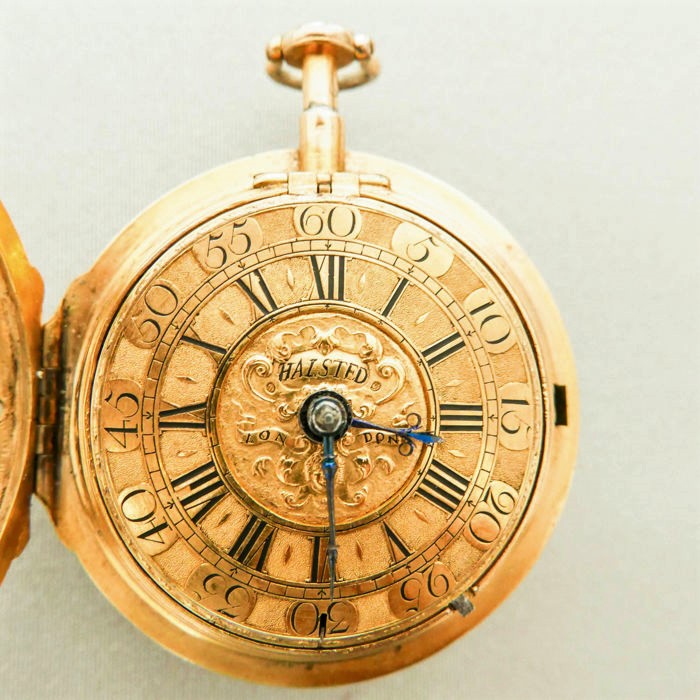
Gold pocket watch opened, with cover and numerals inside

Halsted Pocket Watch

Furthermore, Austen is aware – as are most mathematicians – that a significant proportion of the population is not especially good in mathematics, and that their calculations and estimations should not be relied upon. The following dialogue takes place in Mansfield Park, between the characters Mary Crawford and Edmund Bertram:

I am really not tired, which I almost wonder at; for we must have walked at least a mile in this wood. Do not you think we have?”

“Not half a mile,” was his sturdy answer; for he was not yet so much in love as to measure distance, or reckon time, with feminine lawlessness. … “We have been exactly a quarter of an hour here,” said Edmund, taking out his watch. “Do you think we are walking four miles an hour?” (Mansfield Park, Chapter 9)

As the passage above was written more than two hundred years ago, we’ll skip over the lack of political correctness. Instead, let’s focus on the fact that nearly every mathematician (or actuary) has to insist on using reasonable data and accurate calculations. Moreover, most mathematically inclined persons will review calculations, even their own, because mistakes are so easy to make.

Testing Assumptions for Reasonability

Just as important as data and accurate reckoning are the underlying assumptions. Mathematicians, when creating scenarios and simulations, always need to determine whether their assumptions are reasonable. Something similar comes up in Northanger Abbey, when Henry Tilney tells Catherine Morland she has allowed her imagination to run away with her.

“Dear Miss Morland, consider the dreadful nature of the suspicions you have entertained. What have you been judging from? … Consult your own understanding, your own sense of the probable, your own observation of what is passing around you. … Could they be perpetrated without being known, in a country like this, where social and literary intercourse is on such a footing, where every man is surrounded by a neighbourhood of voluntary spies, and where roads and newspapers lay everything open?” (Northanger Abbey, Chapter 24)

Austen insisted on making stories out of the probable rather than what was wild and fanciful. She always keeps her assumptions grounded in reality.

Proxy variables

My favorite example of Austen’s display of mathematical ability is when she uses a proxy variable. Here’s Wikipedia’s definition of a proxy variable: “In statistics, a proxy or proxy variable is a variable that is not in itself directly relevant, but that serves in place of an unobservable or immeasurable variable. In order for a variable to be a good proxy, it must have a close correlation, not necessarily linear, with the variable of interest.”

In Emma, the following dialogue takes place between Mrs. Elton, the local vicar’s new bride, who recently arrived from Maple Grove, and Jane Fairfax, who happens to be the best educated of all of Austen’s heroines:

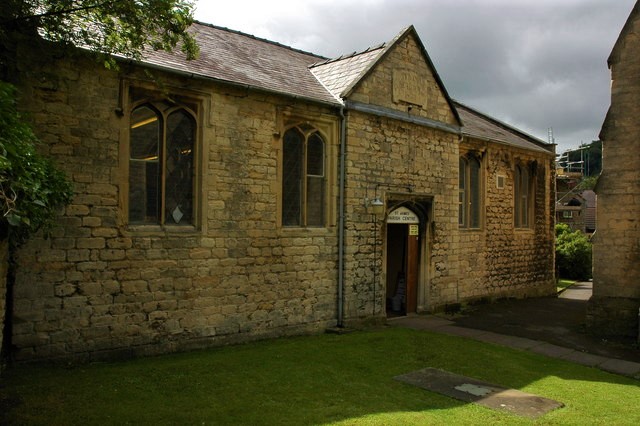
Photograph of the front of a modest stone building

Former National School, 1833, Gloucestershire.

“I do believe,” she continued, “this is the most troublesome parish that ever was. We never heard of such things at Maple Grove.”

“Your parish there was small,” said Jane.

“Upon my word, my dear, I do not know, for I never heard the subject talked of.”

“But it is proved by the smallness of the school, which I have heard you speak of, as under the patronage of your sister and Mrs. Bragge; the only school, and not more than five-and-twenty children.” (Emma, Volume III, Chapter 16)

The number of children in the school serves as a proxy variable for the size of the parish. It is a perfect example of a proxy variable.

Family Connections

As we have seen, Jane Austen repeatedly shows her understanding of mathematics. The case, in my opinion, is proved, but there is additional circumstantial evidence. Mathematical talent often runs in families. Two of Jane’s brothers became admirals in the Royal Navy; in fact, the brother closest to her in age, Sir Francis Austen, rose to become Admiral of the Fleet. They could not have achieved these positions without strong abilities in mathematics. (Note: my own brother is an actuary.) 

Black and white image of Jane Austen's sailor brother

Sir Francis Austen

Jane Austen never used the term actuary, even though actuaries existed when she lived. Of course, she was writing about romance in country villages and not about insurance companies. In her six finished novels, she only uses the word mathematician on one occasion. This paragraph takes place in Emma, when Emma has witnessed an event – Mr. Frank Churchill’s rescue of Harriet Smith from a threatening mob – which she hopes will lead to romance:

Could a linguist, could a grammarian, could even a mathematician have seen what she did, have witnessed their appearance together, and heard their history of it, without feeling that circumstances had been at work to make them peculiarly interesting to each other?—How much more must an imaginist, like herself, be on fire with speculation and foresight!—especially with such a groundwork of anticipation as her mind had already made. (Emma, Volume III, Chapter 3)

Austen’s use of the word mathematician in this passage indicates she probably had some familiarity with people who could calculate. 

Jane Austen writes both intelligently and intelligibly on many topics associated with mathematics. I do not think I am being an imaginist when I maintain that this literary genius of the early nineteenth century had a profound understanding of mathematics.

About the Author:

Photo of the author

Author, Victoria Grossack

Victoria Grossack is a Fellow of the Casualty Actuarial Society and has worked for companies such as Folksamerica Reinsurance and Zurich Financial Services; she currently supplies materials for the Actuarial Bookstore. She also writes novels celebrating birds, Greek mythology, and Jane Austen. Her Jane Austen-based novels include: The Meryton Murders, The Highbury Murders, The Mansfield Park Murders and Mrs. Bennet’s Advice to Young Ladies. Her novels can be found at Amazon.

Citations:

Lodge, David, “The best stream of consciousness novels,” The Guardian, January 20, 2009.

Austen-Leigh, James Edward, A Memoir of Jane Austen, Richard Bentley and Son, 1871.

Roser, Max, “Life Expectancy,” Our World in Data

Victoria’s Article in Actuarial Review entitled “Jane Austen, Actuary?” September 21, 2021: Click here to read it

Read Full Post »

Inquiring readers, This fascinating post written by author Clyve Rose explains to film viewers who have not read Emma the short, confusing scene shown in Autumn de Wilde’s 2020 film adaptation of Austen’s novel. Ms. Rose reviews the history of Gipsies or Gypsies in Regency England and Europe in general, and provides insights into why this nomadic group was shunned and feared.

Painting of a young gypsy woman by Karlis Teodors Huns, 1870.

Public domain image of a young Gypsy woman with a tambourine, painted by Kārlis Teodors Hūns, 1870. Wikimedia Commons.

In Chapter 39 of Austen’s Emma, we come upon a curious incident. Miss Harriet Smith (the pretty and ‘natural daughter’ of no-one-yet-knows), out walking with a companion, is accosted by a ‘group of gypsies’. This incident is curious for many readers, and for many reasons.

For modern readers who may not understand the fear and attendant danger of such an episode, it is worth remembering that merely associating with “such a set of people” was judged to be a crime in Regency England. From the 1500s onwards the Crown made several attempts to rid their green and pleasant land of these ‘other’ residents, including deporting them to the colonies and attempting to legislate them out of all existence. By Austen’s time, any conversation or ‘consorting’ with ‘gypsies’ was considered a criminal act for which one could be incarcerated — or worse. A case in 1782 saw a fourteen year old girl hanged for such acquaintance, on the orders of the local magistrate.

That Harriet Smith speaks to the ‘gypsies’, offers them money, and then pleads with them would have been enough to see her in trouble with the law. While the local Highbury magistrate (our hero, Mr Knightley) would be unlikely to order Harriet hanged (I doubt even Austen could redeem a hero who sentences his heroine’s ‘particular friend’ to the gallows), Miss Smith still, technically, commits a crime in this scene. Leaving aside the impact this moment has on the romantic machinations of Emma and her friends, it affords us a rare glimpse into a Regency England that is not often represented in contemporary works.

Austen’s England is a very specific place. A place inhabited only by the English themselves. It is very interesting that one of the few glimpses her readers ever receive of the scaffolding behind this construct, is in the novel where her heroine is labelled by the author herself as ‘an imaginist’ – because, of course, the ideal of a homogenous England is pure imagination: Especially as the empire was at its height at the time, both from a cultural and a mercantile perspective.

There are hints of a similar façade – and Austen’s awareness that this is a façade – in Mansfield Park as well. Sir Thomas Bertram’s references to the slave trade in Jamaica, and its importance as the mainstay of his wealth, is touched upon. He even suggests introducing some of his ‘stock’ at Mansfield Park, but this is not taken seriously. What happens in Jamaica must stay in Jamaica. England is only for the English, Sir Thomas!

The British Empire once spanned a quarter of the known world, but at no point were the native-born residents of these colonies truly deemed to be ‘English’. These antipodeans were not, after all, actually resident in England itself. At least, not most of them. What if the ‘non-English’ people were not ‘out there’ in the colonies? What if they did, in fact, live in England right alongside the Bertrams, the Woodhouses, the Knightleys – and even the Bennets?

Which brings me to the Romany of England: Their position in these narratives is unique; almost as unusual as their place in Regency England – because of course they had one. They lived, loved, and mattered in the same geographic spaces as Emma Woodhouse and Harriet Smith.

The fact is, this ‘England-only-for-the-English’ was peopled by another culture entirely. England was, and is, a shared land. Two cultures, so vastly different in so many ways, coexisted for centuries, and rarely peacefully. The English Romany were as present and alive and wonderfully romantic as the Regency English. Coming from a mostly oral tradition, Romany stories from that time are rarely found in print but that they were there, and experienced this period, and undoubtedly have stories to tell about it – is visible even in the work of authors determined to showcase only their ‘own England’ to their ‘own’ readers.

Austen’s England has the backing of every powerful institution of her day. In terms of crafting the dominant narrative, the English are able to draw on the Crown, the Military, the Law, and of course the Church, which played such a vital part in the lives and lovers of Regency England. Even Heaven sides with the English in Austen’s world view. Her father, let’s not forget, was a clergyman. In the incident ascribed above, Austen does not specifically accuse the ‘gypsies’ of being heathens, but they are clearly depicted as ‘other’; outside the town limits of Highbury itself and dark, terrifying, criminal, and dangerous. They certainly do not ‘fit’ in Austen’s England, and are quite unsatisfyingly removed from Emma’s tale as soon as they have served their rather meagre narrative purpose: “The Gypsies did not wait for the operations of justice: they took themselves off in a hurry.”

Or rather, the author moved them quickly off her bleached white pages and out of ‘her’ England – despite the truth that there were non-English people present in Austen’s England; other voices with their own perspectives and their own stories worth telling, and worth writing. Contemporary Regency writers can not erase these different voices from their tales, because these real people existed all around them, finding their way into these ‘English-only’ narratives with the same kind of side-eye once given to the Irishman and the Scot. The cultural difference between these latter still-European folk and the Romany is, however, far greater – which may account for the fact that their treatment at the hands of English Regency writers seems to have been far worse.

It is difficult to be born into a place that never allows you to become a part of it without a fight, a plea, an effort to assimilate and cut away the parts of you that discomfit the powerful dominant culture all around you. It is more than difficult; it is painful and damaging. The very term ‘marginalisation’ is an admission of the lack of narrative ‘space’ allotted to the voices fiction has chosen to leave unloved, and unnoticed.

The term ‘marginal’ itself bothers me. It is almost (but not quite) a pejorative, which is why I place it in single quotes. I have here done the same with the term ‘gypsy’. I am aware that neither term is universally regarded as harmful. Debates rage all over this, on may fronts. I am only one writer; one voice among many and I have no answers. That there is ongoing debate however, is encouraging.

For myself, born into a marginalised culture with a mostly oral tradition, the ‘minor’ incident in Emma stands out. After all, my own tribe has quite a bit in common with the Romany. There was once a link made between the Romany of Europe and the Lost Tribes of Israel. It turned out to be incorrect, but the placement of ‘other’ in an otherwise ‘native’ land is a context embedded into my lived experience every day – and that’s quite apart from the grim reality shared in the concentration camps of Europe during World War II; a shared history I am sure not even an imaginist like Austen – or Emma – could envisage. Its very surreality is what allows deniability to play so plausibly in the minds of those focused on the façade, rather than any kind of ‘real’ history.

Real history is profoundly unromantic – and yet, somehow, we still try. There is beauty in stories, in narratives of the tales about long-ago lovers and their imagined worlds. There is much solace to be found in story – I love re-reading Austen (although Emma is not my favourite of her works), but in between the wonder of her words, I find myself reading for traces. Traces of others who were there – and whose stories deserve to be told.

Image of Clyve Rose. Permission of her publicist Andrea Kiliany Thatcher, taken by photographer Kira, www.artphotobykira.com.au

Image of Clyve Rose. Permission of her publicist Andrea Kiliany Thatcher, taken by photographer Kira, http://www.artphotobykira.com.au

About Clyve Rose:

Clyve Rose has been writing historical romance fiction for the best part of two decades. Her newest work, Always a Princess, published by Boroughs Publishing Group, debuts this September. She works in the historical romance, fantasy, and speculative fiction genres. She also creates literary novels under an alternative pen name. In between her devotion to fiction writing, Clyve researches various mythologies and historical periods, often basing her characters on actual historical personalities.​

One of her novels was longlisted for a Hachette Development Award for Fiction while her paranormal short story, The One Below, won the Passionate Ink (RWA) award for best Speculative Fiction Short.

​Visit her online at:

Connect with Clyve Rose at ClyveRose.com and Instagram.com/ClyveRose, in which she writes “Clyve Rose is an award-winning Regency Romance author. New Regency release out on 8 Sept. 2020.”

Read Full Post »

« Newer Posts - Older Posts »