Feeds:
Posts
Comments

Archive for the ‘Mansfield Park’ Category

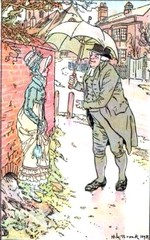
Mansfield Park, Brock. Image @Austenprose

During the 17th century, ladies used parasols for protection from the sun. A century later they were using oiled umbrellas as protection from the rain as well. By the early 19th century, the design of the umbrella had improved and its use had become widespread. After Maria’s marriage, Fanny Price was overtaken by a heavy shower close to the Parsonage and sought shelter under an oak. When the Grants spotted her, they sent out a servant, but Fanny was reluctant to come in:

A civil servant she had withstood but when Dr Grant himself went out with an umbrella there was nothing to be done but to be very much ashamed and to get into the house as fast as possible; and to poor Miss Crawford, who had just been contemplating the dismal rain in a very desponding state of mind, sighing over the ruin of all her plans of exercise for that morning, and of every chance of seeing a single creature beyond themselves for the next twenty four hours, the sound of a little bustle at the front door and the sight of Miss Price dripping with wet in the vestibule was delightful. – Jane Austen, Mansfield Park
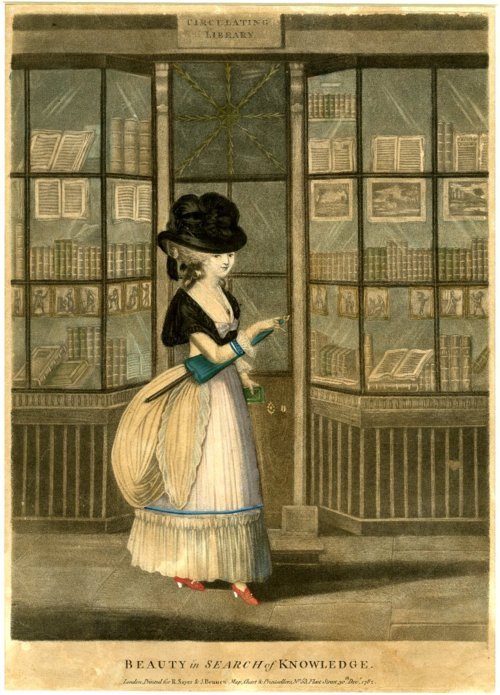
Beauty in search of knowledge, 1782. This 18th century woman carries an early version of an umbrella. These models were heavy and cumbersome. Image @Harry Elkins Widener Collection, Harvard College

A century before Mansfield Park was published (1814) men did not use umbrellas, which were regarded as women’s accessories:

A young man who borrowed one from a coffee house in a downpour in 1709 was excoriated as effeminate in a newspaper. It would have been a cumbersome model, ill-suited to being carried around. Similar heavy umbrellas were kept in churches to protect the parson during burial services. – A Brief History of the Umbrella 

Yet the following passage from Notes and queries, Volume 54, William White (Oxford University Press, 1876,  p. 202), suggests that men began to use umbrellas earlier than Jonas Hanway, who braved ridicule from street urchins and hackney coachmen, who regarded the use of the umbrella as a threat to their livelihood:

1745 – Paid for umbrella, box and carriage.
It is not stated for whose use this was intended; most probably for the minister when officiating at funerals. This is a remarkable entry, as the introduction of umbrellas into England is attributed to a much later period. The employment of the umbrella in the streets London is said to have been by Jonas Hanway, who died in 1786; but the following passage from the Trivia of Gay, who died in 1732, shows it was in use at a much earlier period

Good housewives Defended by th’ umbrella’s oily shed,
Safe through the wet on clinking pattens tread.”
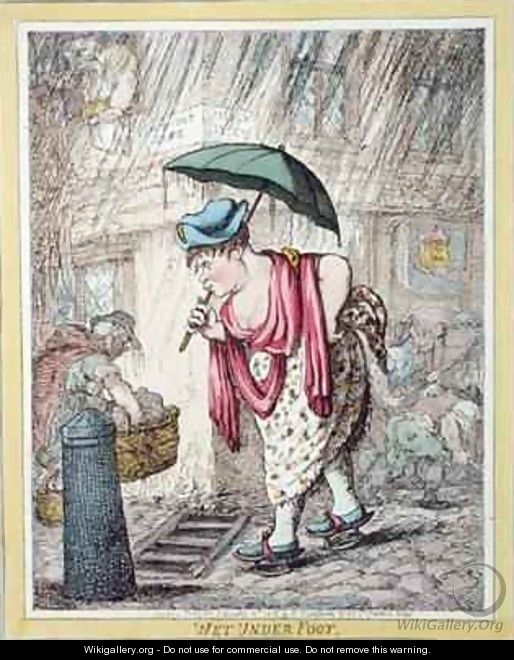
Wet under foot, James Gillray. Image @Wikigallery. The woman is wearing "clinking" pattens as well as carrying an umbrella.

In 1893, Georgiana Hill wrote this descriptive history of the umbrella in England:

Umbrellas were a recent fashion in the earlier part of the century. During the first ten years of George the Third’s reign, the only umbrellas in use were large carriage umbrellas, which required an attendant to hold them. In the country they were hardly known at all. The philanthropist, Jonas Hanway, in 1756, boldly unfurled an umbrella in the streets of London, being the first man who ventured upon such an innovation. Surely Hanway deserves to be held in grateful remembrance by the male sex for this spirited effort towards the emancipation of his brethren from the thraldom of custom. He was jeered and ridiculed by the populace, but was not to be laughed into giving up the sheltering oilskin. About twenty years later, a valiant footman named John Macdonald began to use a silk umbrella, which he had brought from Spain. The boys shouted after him: “Frenchman, why don’t you get a coach?” but he grasped his umbrella more firmly and went on his way, and in some three months time he was able to use it without exciting remark. Miss J. Gay Trivia Hutton, writing in 1779 from Derbyshire, says: “Mrs Greaves lent us their umbrella, and servant to carry it.” Miss Hutton’s brother was the person to use an umbrella in Birmingham, a Frenchman being the first.

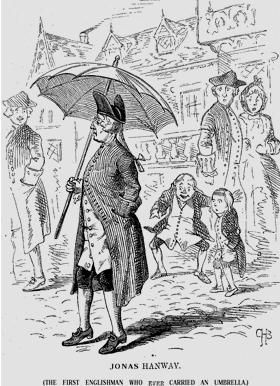
Jonas Hanway. Image @Wikipedia. This caricature depicts how long early umbrella handles were.

The town beau, when he first carried an umbrella, was caricatured in the prints as the rain-beau holding a tiny parasol over his head. A gentleman once borrowed an umbrella from the mistress of a coffee- house in Cornhill, and after the following satirical advertisement in The Female Tatler: “The young gentleman belonging to the Custom house, that for fear of rain borrowed the umbrella from Will’s Coffee house in Cornhill, of the mistress, is hereby advertised to be dry from head to foot on the like occasion he shall be welcome to the maid’s pattens.”

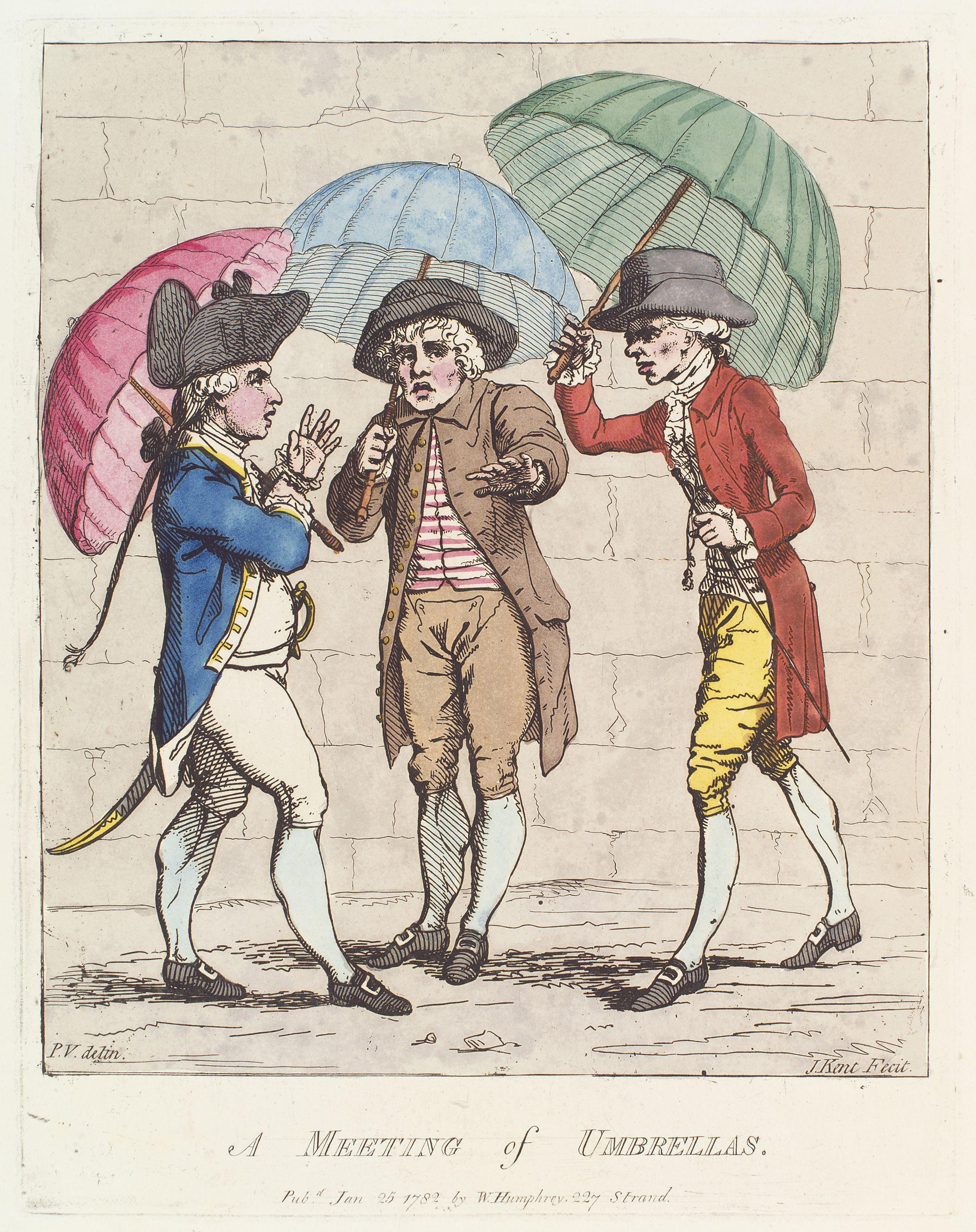
A meeting of umbrellas, James Gillray, 1782. By now, men used umbrellas as a matter of course.

An illustration of the want of umbrellas afforded in one of the caricatures of the period, showing a respectable citizen’s family from Vauxhall in a downpour of rain – the old gentleman with a handkerchief tied over his head to save his wig, and his wife’s cardinal on his to protect his best coat, while the wife herself and her daughters are tripping along in gowns turned up round their waists, and their heads enveloped in coloured handkerchiefs. In 1797 there was one umbrella in all Cambridge, and that was kept at a shop, and let out like a sedan chair ,by the hour. In London women carried umbrellas before men had taken to them, but the first umbrellas were heavy awkward machines made of oilskin or taffeta. Still, in spite of their cumbrous character, women who had to trudge along the streets on rainy days rejoiced in their shelter. With cloak and umbrella, they were able to face the dripping roofs and waterspouts, which were as much to be avoided as the rain. To the fashionable lady. who only walked in fine weather, the one important consideration was the parasol, but it was otherwise with the thrifty citizeness. Great must have been the relief and saving of clothes when the new invention came into use:

Good housewives all the winter’s rage despise,
Defended by the riding hood’s disguise;
Or underneath the umbrella’s oily shade,
Safe through the wet on clinking pattens tread.
Let Persian dames the umbrella’s ribs display,
To guard their beauties from the sunny ray;
Or sweating slaves support the shady load,
When Eastern monarchs show their state abroad;
Britain in winter only knows its aid,
To guard from chilling showers the walking maid.”
– J Gay Trivia

– A history of English dress from the Saxon period to the present day, Volume 1, By Georgiana Hill , 1893, p. 173-74.
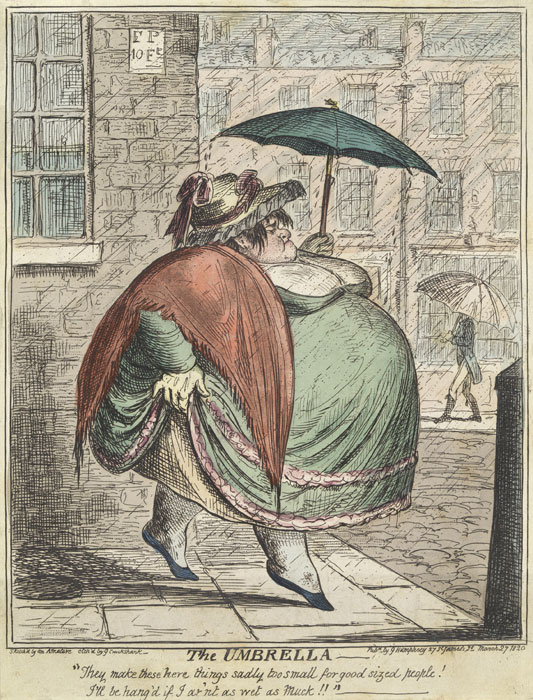
The Umbrella, 1820. This cartoon depicts how little protection these early umbrellas afforded. Cruikshank exaggerates the woman's size to demonstrate the point. Image @Art Tattler

Early umbrellas were heavy and cumbersome to use:

Early umbrellas were made of oiled silk with heavy wooden frames which made them difficult to open or close when wet. Whalebone (baleen) was also used but this still made the article heavy. It wasn’t until 1852 that Samuel Fox invented the steel ribbed umbrella claiming that he was using up stocks bought for making corsets. This made umbrellas much lighter and more portable. – Come rain or shine: historic umbrellas and parasols 

More on the topic:

Read Full Post »

Jane Austen fans tend to read her books repeatedly throughout their lives.  In an article in the Guardian UK, Charlotte Higgins describes how her identity with a Jane Austen character changes with age. Here are some of her thoughts:

If you read Jane Austen more or less annually, as I have done since my late teens, you end up marking yourself against the characters. Oh reader, when I first read Pride and Prejudice I was Lydia’s age. I am about to become older than the delightful Mrs Croft in Persuasion. I still hang on to Anne Elliot, though. A tender 27 she may be, but in modern money I reckon you can give her another 10 years.

This is so true. I am starting to identify more with Mrs. Croft and Lady Russell than Anne Elliot. Charlotte Higgins goes on to say:

Persuasion is a very middle-aged novel, with its melancholic flavour and its acknowledgement that yes, you can make a grotesque mess of your life (the romance part I find much less satisfactory than the bleakly comic first three quarters of the book, essentially before one reaches Bath). It is true, however, that you can tell you are middle-aged when you start to empathise with P&P’s Mrs Bennet: with what Sir Walter Elliot would call “the rapid increase of the crow’s foot” comes a sense of sympathy with this character, written off as absurd in one’s heedless youth. At least she is trying to save her daughters from a future of poverty. And she’s certainly not getting any help from that husband of hers.

So true again. Only in recent years have I become impatient with Mr. Bennet and more sympathetic with his silly wife. I have also become more observant of Mrs. Jennings in Sense and Sensibility, of how hospitable she is, how she tries to become a matchmaker to all the unmarried ladies, and how her house is open to guest seemingly all the time. Yes, she is a silly and irritating woman, traits I could not stand when I was young (thus I could not appreciate her other than as a comic relief character), but now I rather like her positive qualities, as I do Mrs. Palmer’s. Elinor Dashwood is aware of Mrs. Palmer’s good nature and would tolerate her better if she weren’t such an unflaggingly cheerful airhead all the time.

Mrs. Jennings and Mrs. Palmer, Sense and Sensibility

As I get older I see that Lady Catherine de Bourgh is all bluster, and that her authority over Elizabeth Bennet is precisely zero. Young Lizzie is smart enough to know that, but as a 19 year-old reader, I was in awe of Lizzie’s stubborn attitude towards that lady when she stormed to Longbourn to demand Lizzie promise never to marry Mr. Darcy.

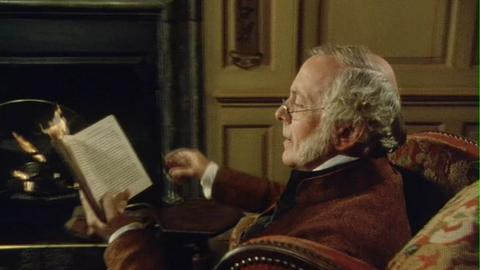
Mr. Bennet reading. Image from Jim and Ellen Moody

There are other ways that my attitude towards Jane Austen’s novels is changing. I notice how few happy marriages are portrayed. Right off the bat I can think of only the Crofts, the Gardiners, the John Knightleys, and the Musgroves. These days, I am more on the side of a pragmatic Charlotte Lucas, who has learned long ago not to look at the world through rose colored glasses, than Elizabeth, who waits for love. To be sure, she snagged her Mr. Darcy, but would Charlotte have had such an opportunity? I think not. I also see that Fanny Price’s strength of character and resolve in the face of so much bullying is a trait to admire; and that Mr. Bennet’s extensive library and unwillingness to compromise a cushy lifestyle were acquired at the expense of his family’s future financial security.

As the years roll by, my tastes and preferences for Jane’s novels are changing. Persuasion and Pride and Prejudice are running neck and neck in my favorite category. P&P used to have the field all to itself. While I loathed Mansfield Park the first time I read it, I don’t mind it so much now, and I find Emma less and less interesting and much too long . Perhaps I should lay the book aside for a few years.

Are your tastes and preferences changing towards Jane Austen’s books and characters as time goes on? How? Curious minds want to know.

Read Full Post »

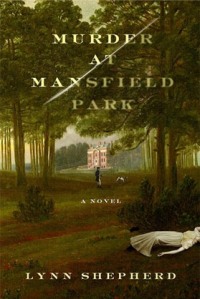
Consider this recipe for a modern Austenesque mystery: Take a familiar and beloved novel, Mansfield Park, with characters whose motives and actions we know intimately, and tear the book up. Throw the pages inside a bag, shake vigorously, and let the characters and plot fall where they may. Add a writer who has cooked up a complex plot for a delicious murder (or two or more, who knows?), and you have Murder at Mansfield Park, a truly hearty and satisfying new mystery novel.

Lynn Shepherd, the chef of this roman à clef, has by dint of her imagination turned  Jane Austen’s classic novel topsy turvy. The characters’ names are familiar, the setting is the same, some of the action as originally described by Jane Austen has been retained, and yet Ms. Shepherd has managed to create something new, refreshing and different.

I must admit to disliking mysteries in general, as many regular readers of my blog know. And I tend not to review Jane Austen sequels. But this novel is different. Oh, I was skeptical at first, slogging through the first chapter, trying to wrap my mind around the changes in the characters. And then I got caught up in the plot and became absorbed to the point where I could not put the book down.

Some red herrings are thrown into the mix, but not so many as to make the reader angry. The plot’s denouement was more than satisfactory and made logical sense. I suppose a true mystery fan might have guessed the killer sooner. Truth be told I held off guessing, for I wanted to be surprised, and so I was.

That Murder at Mansfield Park is Lynn Shepherd’s first novel is most surprising. Her writing style is lovely and effortless as she weaves several plot elements into a seamless whole. Rather than copy Jane Austen, Ms. Shepherd uses Mansfield Park as a take-off point. This novel is intelligently written and assumes that the reader has some command of the English language and enough background knowledge in history, Jane Austen, and other subtle historical and social references to understand the numerous references that crop up.

I give Murder at Mansfield Park six regency fans, my highest rating ever.

Post script: Gentle reader – If you are curious to learn more about Lynn’s novel after reading my review, be forewarned. Many reviewers have spoiled the plot by giving away too much of Lynn’s changes while gushing about them. Honestly, does no one take Review a Novel 101 any more? One irresponsible reviewer of a major online news publication even gave away who was murdered, ignoring the fact that half the fun of this mystery is guessing who the victim will be. So be careful, wary reader, of careless reviewers who do not even bother to place *Spoiler Alert* at the top of their reviews.

Read Full Post »

…they are very affectionate and playful, and bear the confinement of the house better than many other breeds, racing over the carpets in their play as freely as others do over the turf. For this reason, as well as the sweetness of their skins, and their short and soft coats, they are much liked by the ladies as pets.Chest of Books, Dog Breeding, The Pug

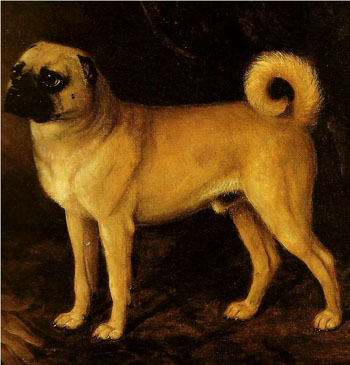
Gainsborough's painting of a pug sold for £993,250 at Sotheby's in 2009

Much has been made of Lady Bertram’s affection for her pug in Mansfield Park, and some have identified the dog as a symbol of imperialism, sexism and oppression. (Slipping the Leash: Lady Bertram’s Lapdog, Sally Palmer.) I see pug as a symbol of Lady Bertram’s wealth, indolence, and misplaced affection, for she cares much more for her dog’s minute-to-minute well-being than her childrens’. Towards the end of the novel, Lady Bertram showers more affection on Fanny Price than her disgraced daughter Maria, offering Fanny a puglet from Pug’s next litter.

William Hogarth, self-portrait with pug

Pugs are among the oldest breed of dogs. Their root can be traced to 400 BC China, where the dogs were bred to adorn the laps of Chinese sovereigns during the Shang dynasty.   By the 1300s there were three main types of dogs that are identifiable as founders of breeds of today: the Pekingese, the Japanese Spaniel, and the Pug.*  Small dogs presented as gifts arrived in Europe via the Dutch East India Company. In The Netherlands, the pug became the official dog of the House of Orange, and by 1688, William and Mary had  introduced the pug to England. Their popularity spread quickly  throughout the British Isles, and during this period the little dog may have been bred with the old type King Charles Spaniel.

Pug with clipped ears, J.A. Howe, 1850

The Victorians made dogs acceptable as pets in Britain and, as a result, they are largely responsible for the degree of genetic disorders in dogs today. They bred dogs to achieve a fashionable look or to emphasise a cute, childlike appearance as seen in the pug, the King Charles spaniel and other lapdogs. A Potted Relationship of Dog and Man Through the Ages

Engraving, pair of 19th century pugs. Notice the clipped ears.

Reading Mansfield Park again, I came to realize that Jane Austen’s choice of a dog for Lady Bertram was a stroke of genius, for Pug is the canine reflection of herself. The tiny dog’s affectionate and inactive natures makes it the perfect house-bound dog. They are known for preferring human laps over engaging in outdoor exercise. Unless they are trained from puppyhood to be more independent, Pugs suffer from separation anxiety should their humans leave them for very long. Just recently, when I took my terrier to a dog park to exercise and play with his own kind, I saw a Pug contentedly sitting in his mistress’s lap, observing the commotion and rambunctious activity around him with a look that I can only describe as Pug-eyed horror. Though a young dog, he was not at all inclined to move. His mistress, a young woman, sighed, saying this was her first Pug and that she’d had not idea how very disinclined they were to do anything but sit, eat, and sleep. She did add that he was a perfect apartment pet.

George Selwyn and pug by Reynolds, 1766

Today’s Pug looks different from their 18th & 19th century counterparts, who were longer in leg and less wrinkled of face. Many had their ears clipped, a practice banned in England in 1895. Today’s Pug is stockier (tending to obesity in older age), needs a thorough cleaning of its facial folds to prevent infection,  and is prone to illnesses due to overbreeding. Nevertheless, this affectionate pet is still popular, gentle with children and considered an excellent little guard dog.

Dermot, a Westminster Dog Show Quality Pug

More on the Topic

* The Pug FAQ

Read Full Post »

IMDb has become an indispensable site for those of us who love movies. I especially love the trivia the site features about each film. Take Emma 2009, for example. Costumes that were recycled from other films are listed there. Let’s look at a few:

Johdi May's purple coat

The purple coat Jodhi May (Mrs. Weston) wears on market day in Highbury is the same costume Hattie Morahan (Elinor Dashwood) wears when she arrives at Barton Cottage in “Sense & Sensibility” (2008).

Elinor in purple pelisse

The dark Spencer worn by Louise Dylan (Harriet Smith) to visit the poor is the same costume Lucy Scott wears in “Pride and Prejudice”(1995).

Harriet Smith (Louise Dylan) in dark spencer

The off-white dress with floral embroidery on the bodice worn by Christina Cole (Mrs. Elton) for her big entrance in church is the same costume worn by Cesca Martin in “The Regency House Party” (2004) during her “engagement,” and by Natasha Little (Becky Sharp) at Park Lane in “Vanity Fair” (1998).

Christina Cole as Mrs. Elton, Her Entrance in Church

The gray gown with gold bow print worn by Tamsin Greig (Miss Bates) to Miss Taylor’s wedding is the same costume worn by Anna Massey (Aunt Norris) in “Mansfield Park” (1983), Phyllida Law (Mrs. Bates) in Emma (1996), Lindsay Duncan (Mrs. Price) when Fanny leaves home in Mansfield Park (1999), Janine Duvitski (Mrs. Meagles) in “Little Dorrit” (2008), and Linda Bassett (Mrs. Jennings) in London in “Sense & Sensibility” (2008).

Miss Bates in gray pelisse and Emma in a floral gown

The floral print dress worn by Romola Garai (Emma) to Miss Taylor’s wedding is the same costume worn by Dagmara Dominczyk (Mercedès Iguanada) for Edmond’s homecoming at the beginning of The Count of Monte Cristo (2002).

Johdi May in lilac floral colored wrap dress

The lilac colored floral wrap dress Jodhi May (Anne Taylor/Weston) wears at Hartfield is the same costume worn by Denise Black (Mrs.Brocklebank) in “To the Ends of the Earth” (2005), and Alex Kingston (Mrs.Bennet) in “Lost in Austen” (2008).

Wearing a floral waistcoat at the Cole's party, Jonny Lee Miller as Mr. Knightley

The blue floral waistcoat Jonny Lee Miller (Mr.Knightley) wears at the Coles’ party is the same costume worn by Joseph Beattie (Henry Crawford) in Mansfield Park (2007) (TV).

Henry and Mary Crawford

For more recycled fashion comparisons, go to this link.

Read Full Post »

« Newer Posts - Older Posts »