Feeds:
Posts
Comments

Archive for the ‘PBS Movie Adaptation’ Category

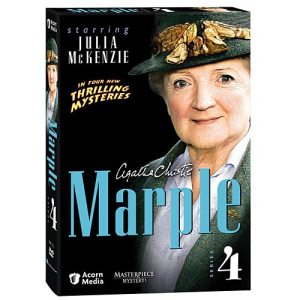
Miss MarpleYour own DVD set of Marple, Series 4 is available for shipping today! Agatha Christie’s spinster sleuth is brilliantly played by Julia McKenzie in this delightful mystery series. Julia as Miss Marple dons the traditional tweeds as if they were made for her, and the casts for all four episodes are stellar: Matthew MacFadyen, Rupert Graves, Wendy Richard, Hattie Morahan, Sylvia Simms, Anna Chancellor, Jemma Redgrave, Russell Tovey, Amanda Root, Elliot Cowan, Joan Collins, and Nigel Terry are among the suspects and victims. This set of finely produced DVDs, issued by Acorn Media, includes the following episodes:

Disc 1 A POCKET FULL OF RYE

Who poisoned wealthy businessman Rex Fortescue? Miss Marple barely has time to ponder this question before her former maid Gladys turns up strangled on the Fortescue estate, a clothes peg stuck on her nose. The murders seem to bear an uncanny resemblance to a child’s nursery rhyme. Miss Marple and Inspector Neele uncover clues from the dead man’s shadowy past that may reveal a method to the madness. Go to the PBS page to read about this episode.

Disc 2 MURDER IS EASY

Murder is easy, as long as nobody thinks it’s murder. So says elderly Miss Pinkerton to Miss Marple during a chance encounter on a train. Soon Miss Pinkerton herself dies, and Miss Marple believes that it was no accident. Her curiosity piqued, she travels to the peaceful village of Wychwood-under-Ashe to investigate. Charming her way into village life, she befriends a former policeman and discovers a shocking secret—one worth killing for.  Read the recap on Austenprose

Disc 3 THEY DO IT WITH MIRRORS

Miss Marple’s old friend Carrie-Louise has always had a soft heart for charitable causes. This time it’s juvenile criminals, lodged in a reformatory on the estate she shares with her husband. But her sister, Ruth van Rydock, is worried about her and asks Miss Marple to pay a visit. With her sharp eyes and unerring sleuthing skills, Miss Marple quickly assesses the situation—but not in time to prevent a murder. Can she save her friend from becoming the next victim? Read the synopsis and about the cast in this PBS link.

Disc 4 WHY DIDN’T THEY ASK EVANS?

A dying man’s last words turn young Bobby Attfield into an amateur detective. With the help of two assistants, beautiful socialite Frankie Derwent and family friend Jane Marple, he sets out to solve the riddle they pose. When someone tries to kill Bobby, it only strengthens his resolve. A trail of clues leads the unlikely trio to Castle Savage and its strange inhabitants, the discovery of yet another murder, and the lingering question: why didn’t they ask Evans? Read our review in this link.

Read Full Post »

David Suchet is the quintessential Poirot

David Suchet is the quintessential Poirot

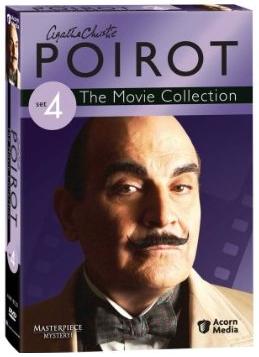
Alas the two Poirot episodes with David Suchet on PBS’s Masterpiece Mystery! have been aired and are no longer available for online viewing on PBS’s website. The good news is that the DVD set is for sale on July 7th. Beautifully packaged by Acorn Media, this fabulous boxed set offers three DVDs:

1. Cat Among the Pigeons

As Meadowbank School for Girls begins its term, a new student causes the headmistress, Miss Bullstrode (Harriet Walter, Atonement), unease. Princess Shaista is a political refugee hiding from revolutionaries in her native land. Fortunately, when the bodies start turning up, Poirot is on hand. Read my short review of the episode on this blog.

2. Mrs. McGinty’s Dead

With help from mystery novelist and old friend Ariadne Oliver (Zoe Wannamaker), Poirot tries to save a man from hanging for a murder he might not have committed. As Poirot tracks down the real killer, he finds his own life at risk. Read my short review of the episode on this blog.

3. Super Sleuths: Poirot – Exclusive bonus

This 47 minute DVD features inteviews with stars Dvid Suchet, Philip Jackson (Chife Inspector Japp), Hugh Fraser (Captain Hasings), and Puline Moran (Miss Lemon). Also interviewed are producer Brian Eastman, director Ed Bennett, and writer Anthony Horowitz (Foly’s War).

Suggested price of the 3-Vol Boxed set is $49.99 at Acorn Media but it is on sale at Amazon.com for $36.99. Acorn media distributes distinctive home video releases to the North American market with a focus on British television.

Read Full Post »

With The Old Curiosity Shop, Masterpiece Classic aired its last special for the 2009 season last night. Which film was your favorite? Curious minds want to know.

the-old-curiosity-shop-1b1d7ef6-7e9c-4c39-adea-f899b8e38345

Read Full Post »

Society was aware of Mr and Mrs Merdle. Society had said ‘Let us license them; let us know them.

The Merdles and Sparkler

The Merdles and Sparkler

Mr Merdle was immensely rich; a man of prodigious enterprise; a Midas without the ears, who turned all he touched to gold. He was in everything good, from banking to building. He was in Parliament, of course. He was in the City, necessarily. He was Chairman of this, Trustee of that, President of the other. The weightiest of men had said to projectors, ‘Now, what name have you got? Have you got Merdle?’ And, the reply being in the negative, had said, ‘Then I won’t look at you.’

This great and fortunate man had provided that extensive bosom which required so much room to be unfeeling enough in, with a nest of crimson and gold some fifteen years before. It was not a bosom to repose upon, but it was a capital bosom to hang jewels upon. Mr Merdle wanted something to hang jewels upon, and he bought it for the purpose. Storr and Mortimer might have married on the same speculation.

Like all his other speculations, it was sound and successful. The jewels showed to the richest advantage. The bosom moving in Society with the jewels displayed upon it, attracted general admiration. Society approving, Mr Merdle was satisfied. He was the most disinterested of men,–did everything for Society, and got as little for himself out of all his gain and care, as a man might. – Charles Dickens, Book the First: Poverty, Chapter 21: Mr Merdle’s Complaint

Mr. Merdle kisses Fanny's hand

Mr. Merdle kisses Fanny's hand

For those who have not read the book or seen the last installment, spoilers ahead:

The Merdles  take front and center stage at the start of the last installment of PBS Masterpiece Classic’s Little Dorrit, fulfilling the promises that this film’s theme of bankruptcy and fallen fortunes is a relevant one in today’s world. Mr. Merdle, played by Anton Lesser, was the Man of the Age. He made money for his investors seemingly out of thin air and they loved him for it. Yet Mr. Merdle (the last name is a play on the French word Merde, meaning shit) seemed to be chronically unhappy, despite his showy wife, elegant house, and sterling reputation.  The viewer soon learns what had been keeping him preoccupied: he was stealing from one fund to pay for another (shades of Bernard Madoff), and issuing shares without collatoral.  His house of cards tumbled down, and along with it, all his investors. Instead of facing the consequences, Merdle committed suicide with a pen knife he has borrowed from his daughter-in-law Fanny. To deaden the pain of stabbing his jugular vein with a blunt knive, he drank laudanum, leaving others to literally clean up his messes. Merdle’s demise affected a score of people, but except for the money they lost and their uncertain financial future, his wife, daughter-in-law and stepson did not seem greatly affected by his suicide. Fanny wondered when her pen knife would be returned and the butler took off  soon after learning that the family was bankrupt, leaving his post without notice. With a few deft touches, Charles Dickens showed how quickly the mighty can fall and that the world really doesn’t give a shit except in the instance where it is affected.
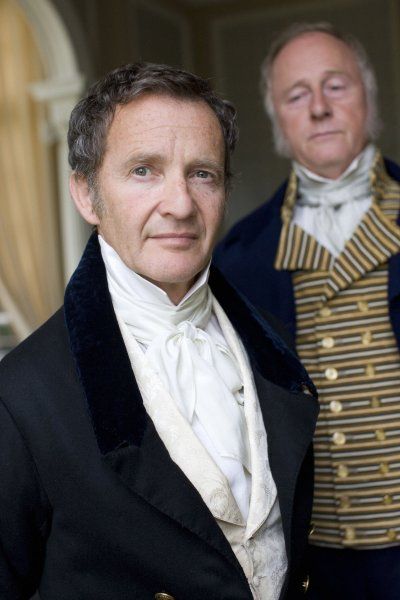
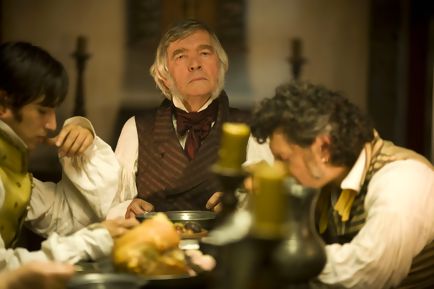
Anton Lesser and Nick Jones as Mr. Merdle and his butler

Anton Lesser and Nick Jones as Mr. Merdle and his butler

Most people could and still can lose other people’s money without much conscience, but during this and the Regency era debt was considered to be a matter of honor (would that it was today).  Social historian Eric Hobsbawm argued that “Bankruptcy was, according to economic theory, the penalty of inefficient businessmen, and its spectre haunts the novels of Victorian England.”  (Victorian Web) Mounting debts affected people in different ways. George Brummel fled to France in 1817 rather than face debtor’s prison when he fell out of favor with the Prince Regent and could not repay his creditors. He was not the only gentleman to flee to the continent due to insolvency. The cost of gambling, bad investments, horses, carriages, fine food and a decent wardrobe could tip a modest – even a great – fortune over the edge. Other individuals, like William Dorrit and Arthur Clennam, were sent to debtor’s prison. Some chose suicide, like Mr. Merdle, leaving their families to face the consequences.
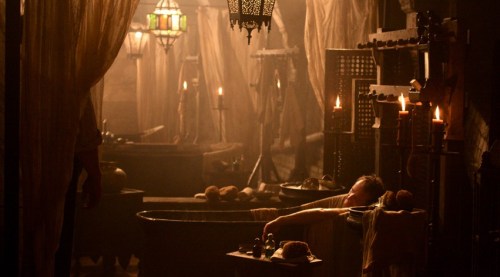
Bath house where Merdle committed suicide

Bath house where Merdle committed suicide

The tale of Little Dorrit is not only based on Dicken’s personal experience of watching his father incarcerated in the Marshalsea, but the novel is also set against the backdrop of real bank failures:

Little Dorrit was originally published between 1855 and 1857 (many of Dickens’ works first appeared in serial form) at a time when the collapse of the Royal British Bank was receiving much publicity. The collapse was a result of the bank having channelled most of its capital into Welsh gold mines in the vain hope the Wales would prove to be the next California. (The discoveries which sparked the California Gold Rush had been made in 1848). After the bank’s collapse it was discovered that the directors had made secret loans to themselves and their friends.

Dickens used the preface to Little Dorrit to defend what he called “that extravagant conception, Mr. Merdle, by alluding to “a certain Irish bank” – the Tipperary Bank which failed in 1857 – and he also mentioned “the curious coincidence” that the public examination of the former directors of the Royal British Bank took place when he was finishing the book. – The Financial Fiction Genre

Arthur and Amy on their wedding day

Arthur and Amy on their wedding day

After losing his and his partner’s investments in Merdle’s schemes, Arthur Clennam (Matthew Mcfadyen) went willingly to the Marshalsea instead of escaping his obligations. After his debts were paid he settled for a “modest life of usefulness and happiness” by marrying Amy Dorrit (Claire Foy).

More links:

Missed an episode? Watch episodes online at this link through May 3rd.
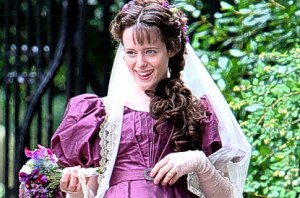
A happy ending after all

A happy ending after all

Read Full Post »
The Dorrits in Venice

The Dorrits in Venice

In Little Dorrit, Mr. William Dorrit followed an age old tradition when he decided to take his family on a Grand Tour of the Continent in order to educate them and expose them to the sights and monuments that influenced Western Civilization. Through Mrs. General, he introduced lessons of deportment and elocution to his children. Amy, who was the least willing to leave, made sure that the Plornishes and Maggy were well-provided for before the family departed.

Pam Ferris as Mrs. General

Pam Ferris as Mrs. General

The Grand Tour took more than a year because transportation before the advent of the railway was slow. Itineraries varied, although Paris and Rome were favorite destinations. Before the Napoleonic Wars, young gentlemen were expected to go on a 1-2 year Grand Tour with a tutor. The results were often mixed. (Click on this link to read my post on the topic.) Some heirs returned with souvenirs and their heads stuffed with knowledge, and others frittered their time away, or worse, lost their fortune at the gaming tables. Travels to the Continent ceased during the Peninsular Wars, but picked up again as soon as Napoleon was defeated. As the 19th century progressed, more and more women began to travel abroad with their families and/or chaperones. The Grand Tour began to make inroads with the rising middle class, as well as with Americans, and survives to this day in the form of a “world tour,” with (typically) recent college graduates and retirees taking several months to a year traveling.

The Dorrits likely departed England from Dover and landed at Calais, the same route as today’s  Chunnel. In the early 19th century, the short voyage across the English Channel was fraught with danger. People risked seasickness or a shipwreck should a sudden storm appear. It took three days to make the journey from Dover to Paris.  Lodging would have been provided by inns along the way, hotels, friends of the family, or, as in the case of the Dorrits, a convent or monastery set up for the purpose of putting guests up for the night. It was at such a lodging that the Dorrits met Rigaud, who was traveling with the newly married Gowan and a concerned and downhearted Pet. Much to Amy’s distress, the Frenchman took an inordinate interest in her as well. As the Dorrits crossed the Swiss Alps towards Italy, Amy was seen to be the only member of the family to appreciate the natural wonders of her surroundings or to show genuine curiosity.

Map of a modern grand tour

Map of a modern grand tour

After the St. Bernard Pass, the Dorrits would have encountered Turin before journeying on to Venice.

Henry Gowan, William Dorrit, and Rigaud at their lodging

Henry Gowan, William Dorrit, and Rigaud at their lodging

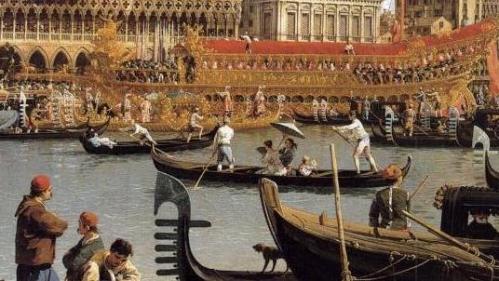
It was traditional for Grand Tour visitors to remain for several months in a major destination city, as the Dorrits did in Venice. Visitors did not carry a great deal of cash, for fear of robbery, but brought letters of credit that they would present at the nearest bank. Unlike other cities in Western Europe, Venice had been an independent maritime state for over a thousand years. Its wealthy merchants had created a sumptuous city that was influenced culturally and artistically by the East. Saint Mark’s Basilica is one of the most recognizable and beautiful examples of Byzantine architecture in the world. The city’s watery setting also made it unique and unforgettable. In a letter written on a grand tour in 1932, the author reveals that little had changed in Venice in over a century, or indeed through today:

Journeying by gondola

Journeying by gondola

I suppose most people think that one cannot go anywhere in Venice except by gondola. That is not so at all. There are sidewalks and narrow streets and alleys that lead all over the city. The small canals from 15 to 40 feet wide are traversed by gondolas and sometimes small motorboats. The houses rise directly from the water’s edge in many cases. Thus along the Grand Canal the front steps lead right into the water where private or public gondolas are waiting — taxis, you know. Some of these palaces are very beautiful. Each has tall mooring posts, decorated with the family arms or gay stripesGrand Tour 1932

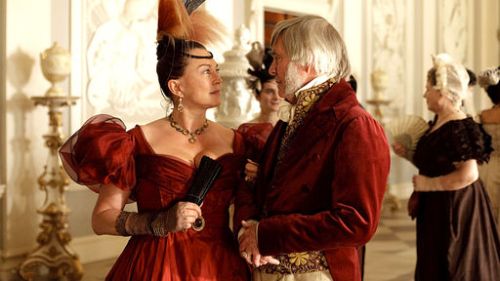
Mrs. Merdle and William Dorrit in Venice

Mrs. Merdle and William Dorrit in Venice

Spoiler Alert for those who have not read the book: William Dorrit was never able to escape the influence of 23 years in the Marshalsea, and on the evening of his death in Venice he imagined he was back in prison again. Of his children, only Amy remained humble and true to herself throughout the journey. Although it was evident that she deeply appreciated her beautiful surroundings, she never stopped missing England or the friends she had left behind.

Missed an episode on Masterpiece Classic? You can watch past episodes online until early May at this link.

Fanny visits the museum

Fanny visits the museum

More About the Grand Tour

My other Little Dorrit Reviews:

Read Full Post »

« Newer Posts - Older Posts »