Feeds:
Posts
Comments

Archive for the ‘Persuasion’ Category

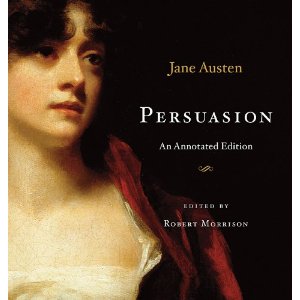
Harvard University Press has done it again and wowed us with a superb annotation of a Jane Austen novel! Persuasion: An Annotated Edition, edited by Robert Morrison is slated to be released in November. This large edition hardback is a mouthwateringly scrumptious book that contains 102 color illustrations (some of which are included in this review), notes on the original text, a 21-page introduction by Dr. Morrison, the text of Persuasion and annotations placed in the far margins, the original ending of Persuasion, (which Jane Austen abandoned), biographical notice of the author by her brother Henry Austen (written shortly after her death), and further recommended reading. Annotator, Dr. Morrison, describes the book as the most profound novel that Jane Austen has written, containing “her most compelling and adult love story.”
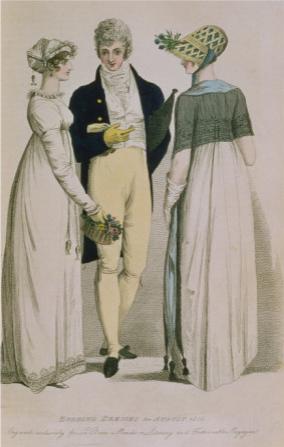
1808 evening dresses, August issue of Le Beau Monde.

I found every part of this book worthy of reading. In his foreword, Dr. Morrison sets up the novel in context of the Napoleonic Wars and Jane Austen’s experience with her sailor brothers and knowledge of how the wars changed the British class system, allowing self-made men like Admiral Croft and Captain Wentworth to rise in the world, while those who clung to traditional conventions, like Sir Walter Elliot and his daughters Elizabeth and Mary, to become increasingly anachronisistic. Dr Morrison explains in an interview for Harvard Press:

“Austen, on the other hand, is a novelist, and the emphasis when editing her is frequently on her immensely insightful views on social structures, sexual politics, economic pressures, and individual obligations and aspirations. Editing her means developing a very clear sense of the difference between riding in a barouche and riding in a curricle, of what it means to command a frigate as opposed to a sloop.“ – Interview with Robert Morrison, Harvard Press 
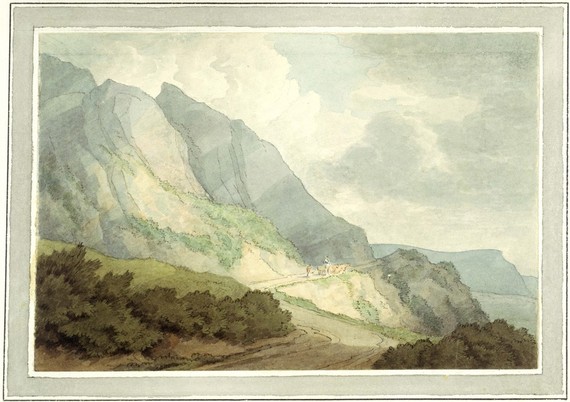
Between Lyme Regis and Charmouth, by John White Abbot

The star attractions of this book are the annotations, which are liberally sprinkled in the sidebars of each page. Dr. Morrison chose information that would appeal to seasoned readers of the novel as well as those who are reading it for the first time. He discusses naval rank, the various reasons why Anne’s family pressured her to not marry Wentworth, descriptions of the duties of apothecaries and surgeons, inheritance laws, the streets and buildings in Bath, descriptions of Lyme Regis, letter writing, and more. He explained in an interview for Harvard Press:

“Knowing my prose was going to appear right beside Austen’s really did change the way I approached writing my commentary. I have tried to use the commentary to illuminate the text as often as I can, and from as many different angles as I can, and to emphasize both what I believe to be central in Persuasion, and what the finest critics from Austen’s day to ours have written about it. I have attempted to produce a commentary that is in immediate and active dialogue with her text, rather than in a relationship that is more distant and intermittent.” – Interview, Harvard Press
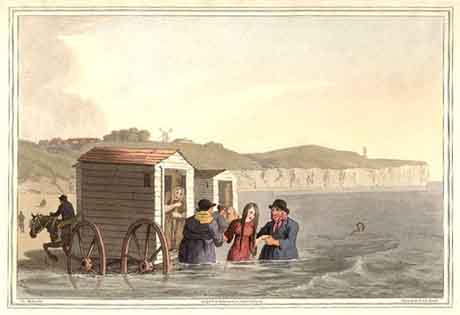
Sea bathing at Scarborough

I find it hard to read a novel smoothly while referring to the annotations, which I regard as interruptions, so I generally read the annotations alone. I then refer to the sections of the novel that are described. After going through the annotations, I will sit down and read the novel again. That second reading is much enriched because of the additional information. (I am curious to know how others tackle reading an annotated book!)
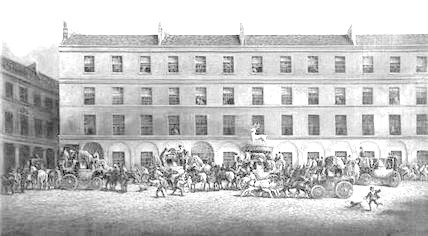
The White Hart Inn

Professor Morrison ends his interview with Harvard Press by comparing the radical change in Anne from a faded to a blooming woman to the transformation in Jane Austen’s novels: “[Persuasion] signals a radical change from what she has written in the past, and throws searching light on the world that is to come.”
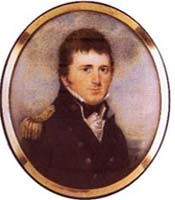
Francis Austen, Jane Austen's sailor brother.

Persuasion, an annotated edition will sit proudly on my bookshelf next to last year’s edition of Pride and Prejudice: An Annotated Edition by Patricia Meyer Spacks, also from Harvard University Press. I give this book five out of five Regency teacups.

Dr. Robert Morrison. Image @Galit Rodan

About the author: Robert Morrison, is an English professor and world-class scholar of Romantic and Victorian literature at Queen’s University, Ontario, Cananda. He is the author of the acclaimed biography of Thomas de Quincey entitled The English Opium Eater.

Hardcover: 360 pages, 102 ills.
Publisher: Belknap Press of Harvard University Press; Annotated edition
Language: English
ISBN-13: 978-0674049741

Read Full Post »

Gentle Readers, Laurel Anne from Austenprose and I were chatting the other day about this, that, and the other, for we are both a bit Jane Austen nutty (if you haven’t noticed.) As you continue reading, you will need to know only one thing:  we are just a wee bit longer in the tooth than Jane’s young heroines:

LA: Vic and I were chatting on the phone today. Over the course of our three plus year Austen-inspired friendship we have mostly emailed, so this was a treat. She has the most infectious laugh which made me laugh too. Of course we were talking about our favorite author and she remarked that Austen excelled at humor and the amazing secondary characters she developed. Somehow it just popped out and I boldly asked her what Jane Austen character she most identified with. Without hesitation she replied, Lady Russell from Persuasion. “Lady Russell?” I replied in surprise! “Well, yes.”

Jane Rus.., er, Mrs. Russell

She then revealed that she is often wrong about the advice she gives people. At work she gathers the young-uns around her and freely offers opinions, whether they are solicited or not. When she gives wrong counsel – which she admits is more often than not – she torpedos herself in a most spectacular fashion. “The error of my ways does not go unnoticed by this unforgiving crowd. Unlike Lady Russell, I will own up to a misteak, er, mistake or two, and apologize for having interfered, but I hold the line at groveling.”

Another reason why she identifies with this character is her independence. Lady Russell is a widow with a healthy income and she has no intention of remarrying and being subjugated by a man. “I am a divorced woman who has discovered the joys of living singly on my own terms and by my own schedule. Ah, what total, selfish bliss!”

Vic further admitted that at a party, or when she lets her hair loose, she starts to resemble Mrs. Jennings. You know the type: a bit vulgar, out for a good time, giggling at precisely the wrong moments, and making those with a more composed nature feel uncomfortable with crass jokes and loud language. “Like Mrs. Jennings, I have a good heart. But I can be out there and in your face too. I might seem unseemly to a quieter person like Elinor, and be totally disliked by the likes of a Marianne, but my friends and family get me, and that’s what counts.”

Oh Vic! You are such a card. Lady Russell and Mrs. Jennings? She then turned the tables on me. “Now, who do you identify with in Jane’s novels? Are you like me, a bossy and interfering carouser? Or are your a bit more sedate and ladylike?”

Harriet Smith (Tony Collette) patiently poses for Emma

Vic: “Sedate. A total Harriet Smith,” LA replied. Many years ago a dear Janeite friend tagged her as a Harriet to her Emma. “It seemed appropriate since I was often asking for advice and was very mailable to change.” In her view, Harriet was a bit of a ditz and gullible which she has been accused of too. The thing she liked about being a Harriet is that Austen gave her such a great ending. She is resilient, and after being tossed about in love no less than three times in a year, Harriet gets the man she wanted in the first place and proves Emma, with her self-important airs, was totally clueless about the human heart. “I like having the last laugh, and being right.” ;-)

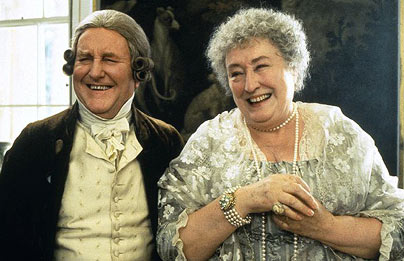
Sir John Middleton (Robert Hardy) and Mrs. Jennings (Elizabeth Spriggs)

Lately LA thinks she has evolved into Sir John Middleton from Sense and Sensibility. He was the Dashwood’s cousin and landlord of Barton Cottage. He is very gracious and likes to pop in and make sure his tenants are comfortable and entertained. He is a bit of a bore and talks too much about things that are not of interest to his young companions, but he likes dogs, has a good heart and loves to laugh. “As an enthusiastic bookseller, I like to inform customers of their choices and make suggestions. I am also a bit of an organizer and enjoy planning events on my blog, and orchestrating the 23 authors in my anthology. It is like herding cats, but I like being the boss of my own world!”

One man’s ways may be as good as another’s, but we all like our own best. Persuasion, Ch 13

Now our question. Which Jane Austen character do you, estimable viewer, most identify with, or which character are you afraid of becoming? Feel free to leave your comments!

Read Full Post »

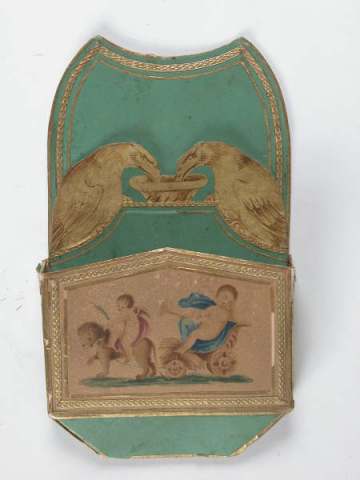
One of a pair of card racks made of decorated cardboard, French, c. 1820, at Attingham. ©National Trust/Claire Reeves

About two weeks ago, The National Trust asked a question about card racks: How were they used? The organization had acquired a number of beautiful examples of 1820’s card racks from Attingham, an estate in Shropshire.  Laurel Ann from Austenprose referred me to the site and to Emile de Bruijn, who had asked the question. I jumped right in, only to discover how little I (or anyone, really) knew about the topic. There was much lively speculation about these beautiful items.

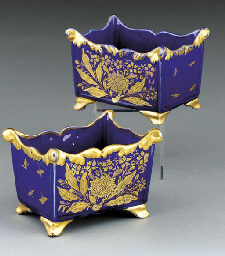
Card racks are small, only large enough to hold visiting cards or small notes. They were designed to be hung somewhere, perhaps on a wall, or over a fireplace mantle. Many were made from cardboard, yet sturdier porcelain examples exist. Their true purpose is now obscure and has faded from memory.

These facts came out as I researched the topic:

It seems that young ladies decorated these card racks from the turn of the 19th c. until at least 1830. Mary Russel Mitford wrote in Our village: sketches of rural character and scenery, Volume 4, 1830:

With regard to accomplishments she knew what was commonly taught in a country school above twenty years ago, and nothing more: played a little, sang a little, talked a little, indifferent French, painted shells; and roses, not particularly like nature, on card-racks and hand screens; danced admirably; and was the best player at battledore, and shuttlecock, hunt the slipper, and blind man’s buff in the county.” p. 131

French emigres made card racks to earn a living:

During the period when the French emigres were so numerous in this country, he (Rudolph Ackermann) was one of the first to relieve their distress by liberal employment. He had seldom less than fifty nobles priests and ladies engaged in manufacturing screens, card racks, flower stands, and other ornaments.” – English coloured books, 1906, Martin Hardie

Rudolph Ackermann kept on hand in his Repository the supplies ladies needed for making hand made items:

No. 3 is a new embossed gold seed-paper. It is used, in a variety of ways, for ladies’ fancy work — in card-racks, hand and fire-screens, chimney ornaments, boxes, watch–stands and cases, &c. It is manufactured by Mr. S. Solomon, and sold, wholesale and retail, at R. Ackermann’s Repository, No., 101, Strand.” – From The Repository of arts, literature, commerce, manufactures, fashions and politics (1809)

And of course I found a Jane Austen connection. In Persuasion, Mrs. Smith makes pin money by creating hand made items:

One might argue that perhaps Nurse Rooke’s patients themselves are practicing charity by buying the thread-cases, pin-cushions, and card-racks. One finds, however, that they do not do so willingly. Nurse Rooke is skilled not only in invalid care, but also in sales. In the case of Mrs. Wallis, Nurse Rooke’s current invalid, Mrs. Smith says, “‘I mean to make my profit of Mrs. Wallis . . . . She has plenty of money, and I intend she shall buy all the high-priced things I have in hand now’” Thread-cases, Pin-cushions, and Card-racks: Women’s Work in the City in Jane Austen’s Persuasion, Susan E. Jones, Persuasions Online

Ironstone ware card rack. Image @Christie's

More speculation and information about card racks can be found in the comment section of the National Trust post. (I have included only my own findings.) It is fascinating to learn how quickly a once popular pasttime has lost its meaning. If anyone can help the staff at The National Trust, do go over and leave a comment.

Read Full Post »

Jane Austen fans tend to read her books repeatedly throughout their lives.  In an article in the Guardian UK, Charlotte Higgins describes how her identity with a Jane Austen character changes with age. Here are some of her thoughts:

If you read Jane Austen more or less annually, as I have done since my late teens, you end up marking yourself against the characters. Oh reader, when I first read Pride and Prejudice I was Lydia’s age. I am about to become older than the delightful Mrs Croft in Persuasion. I still hang on to Anne Elliot, though. A tender 27 she may be, but in modern money I reckon you can give her another 10 years.

This is so true. I am starting to identify more with Mrs. Croft and Lady Russell than Anne Elliot. Charlotte Higgins goes on to say:

Persuasion is a very middle-aged novel, with its melancholic flavour and its acknowledgement that yes, you can make a grotesque mess of your life (the romance part I find much less satisfactory than the bleakly comic first three quarters of the book, essentially before one reaches Bath). It is true, however, that you can tell you are middle-aged when you start to empathise with P&P’s Mrs Bennet: with what Sir Walter Elliot would call “the rapid increase of the crow’s foot” comes a sense of sympathy with this character, written off as absurd in one’s heedless youth. At least she is trying to save her daughters from a future of poverty. And she’s certainly not getting any help from that husband of hers.

So true again. Only in recent years have I become impatient with Mr. Bennet and more sympathetic with his silly wife. I have also become more observant of Mrs. Jennings in Sense and Sensibility, of how hospitable she is, how she tries to become a matchmaker to all the unmarried ladies, and how her house is open to guest seemingly all the time. Yes, she is a silly and irritating woman, traits I could not stand when I was young (thus I could not appreciate her other than as a comic relief character), but now I rather like her positive qualities, as I do Mrs. Palmer’s. Elinor Dashwood is aware of Mrs. Palmer’s good nature and would tolerate her better if she weren’t such an unflaggingly cheerful airhead all the time.

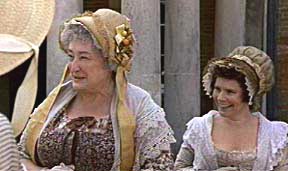
Mrs. Jennings and Mrs. Palmer, Sense and Sensibility

As I get older I see that Lady Catherine de Bourgh is all bluster, and that her authority over Elizabeth Bennet is precisely zero. Young Lizzie is smart enough to know that, but as a 19 year-old reader, I was in awe of Lizzie’s stubborn attitude towards that lady when she stormed to Longbourn to demand Lizzie promise never to marry Mr. Darcy.

Mr. Bennet reading. Image from Jim and Ellen Moody

There are other ways that my attitude towards Jane Austen’s novels is changing. I notice how few happy marriages are portrayed. Right off the bat I can think of only the Crofts, the Gardiners, the John Knightleys, and the Musgroves. These days, I am more on the side of a pragmatic Charlotte Lucas, who has learned long ago not to look at the world through rose colored glasses, than Elizabeth, who waits for love. To be sure, she snagged her Mr. Darcy, but would Charlotte have had such an opportunity? I think not. I also see that Fanny Price’s strength of character and resolve in the face of so much bullying is a trait to admire; and that Mr. Bennet’s extensive library and unwillingness to compromise a cushy lifestyle were acquired at the expense of his family’s future financial security.

As the years roll by, my tastes and preferences for Jane’s novels are changing. Persuasion and Pride and Prejudice are running neck and neck in my favorite category. P&P used to have the field all to itself. While I loathed Mansfield Park the first time I read it, I don’t mind it so much now, and I find Emma less and less interesting and much too long . Perhaps I should lay the book aside for a few years.

Are your tastes and preferences changing towards Jane Austen’s books and characters as time goes on? How? Curious minds want to know.

Read Full Post »

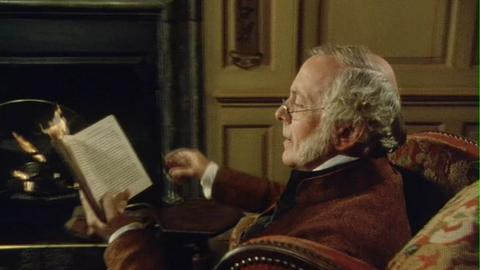
Camden Place, Bath. Sir Walter Elliot and his family reading.

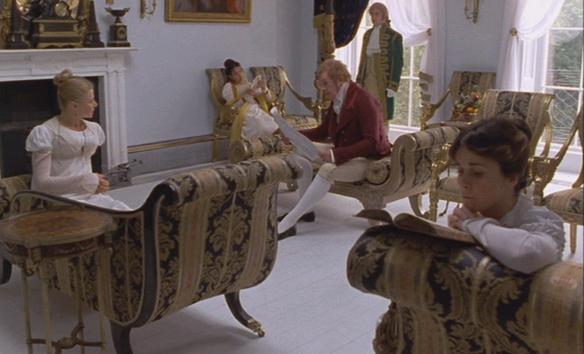
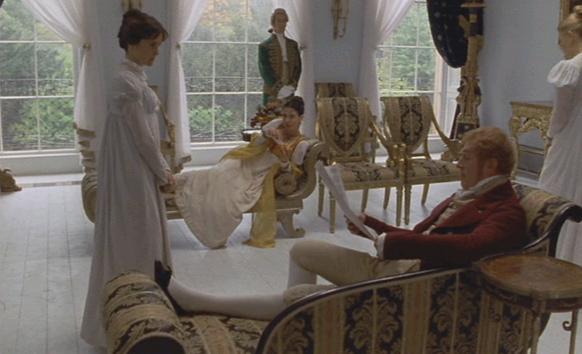
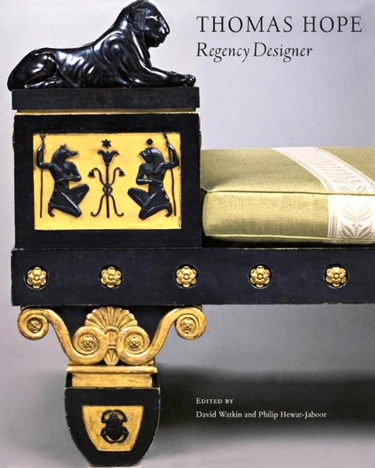
Thomas Hope (1769–1831), the style icon of the Regency interior, would have been happy with these images of Sir Walter Elliot’s interior of Camden Place in Persuasion 1995.  Thomas Hope was known for the “decorative details and ornament based on influences from his nearly ten-year Grand Tour, as well as from motifs from ancient Greece and Egypt.”

Camden Place: A view of the Drawing Room

Hope’s startling juxtaposition of styles included Egyptian, Greek, Roman and Indian elements, as well as his own version of the French Empire style. Classical sculpture and vases were displayed alongside modern paintings and sculpture. Most striking of all was the inventive and exotic furniture that Hope designed specifically for the house. – Exhibition, Thomas Hope, V&A Museum

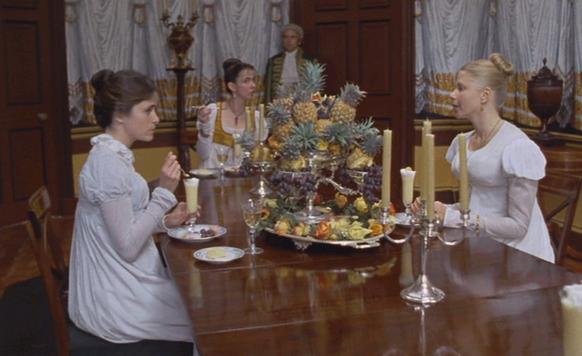
Camden Place: Dining Room (Anne and Elizabeth Elliot and Mrs. Clay)

From these images it is quite obvious that the set designer of this film chose furniture and draperies that for the Regency era would have been regarded as ultra fashionable. Sir Walter might have moved from Kellynch Hall to reduce his expenses, but his tastes remain expensive and he shows no inclination to follow the rules of economy.

More on the Topic

Thomas Hope: Regency Designer

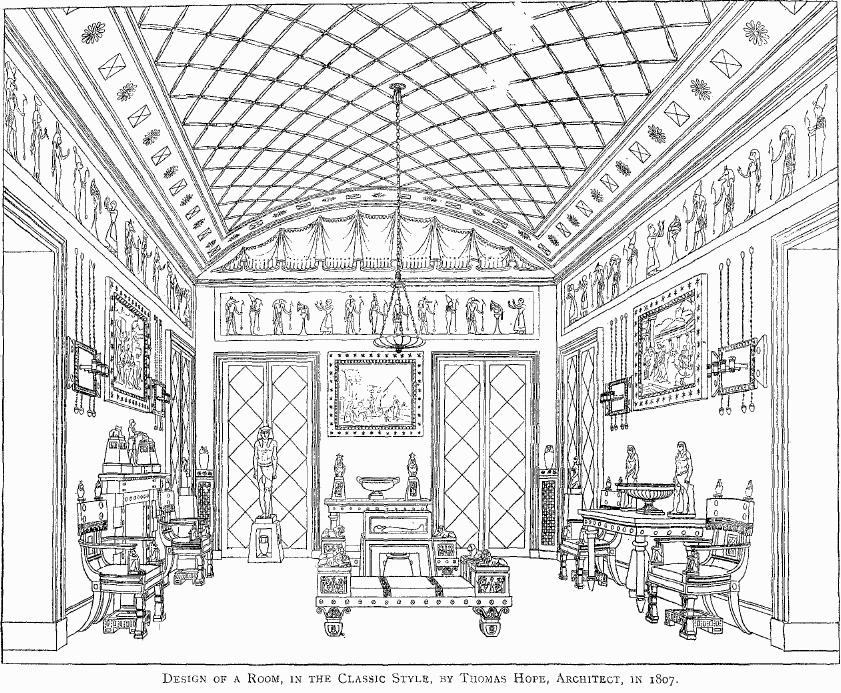
Like designers of his day, Sir Thomas Hope drew his planned room design ahead of time. Witness the following whole room design:
Design of a room, 1807, by Sir Thomas Hope

Read Full Post »

« Newer Posts - Older Posts »