This Jane Austen blog brings Jane Austen, her novels, and the Regency Period alive through food, dress, social customs, and other 19th C. historical details related to this topic.
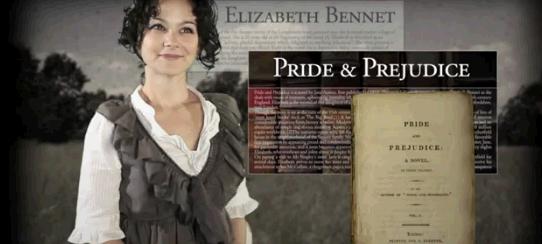
Inquiring readers, Josh Kurz, an independent filmmaker, just finished a piece for the Chemical Heritage Foundation, A Distillations Explainer about tears. This funny yet educational two-minute segment features Elizabeth Bennet. Thanks, Josh, for pointing me to your video.
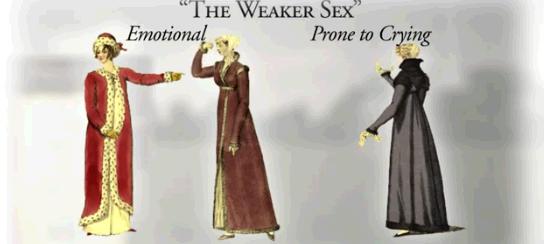
There is evidence to suggest that crying relieves stress. While Elizabeth Bennet is not some namby pamby miss, she does produce three kinds of tears: Basal tears, reflex tears, and emotional tears with added proteins. This short video will explain all three.
Elizabeth Bennet played by Carla Rosati. Brought to us by “Distillations: We Tell the Story of Chemistry”. Directed by Josh Kurz.
If women cry from emotion, it is to their benefit!
A Request from a Graduate Student: Hello Fellow Jane Austen Readers! Have you ever read a published sequel to a Jane Austen novel? Are you a fan of Jane Austen sequels?
My name is Cliff Bryant, and I am a graduate student at Virginia Tech, conducting a research project on readers of published sequels of Jane Austen?s novels. I want to find out how readers came to read the sequels, and whether or not you like them.
If you are interested in participating in my study, just click on the link, and take the survey. It will take less than 10 minutes, and I will release the results in a few weeks, so you can check back and see how you compare to other Jane Austen sequel fans. (Feel free to contact me with questions at cliffbryant@vt.edu.)
(Just to be clear, I am talking about actual published sequels to the novels, not web fan fiction, or mash-ups like Pride and Prejudice and Zombies – though maybe that will be my next project!).
If you choose to participate, thanks so much! Just click the link, review the consent information, then take the survey!
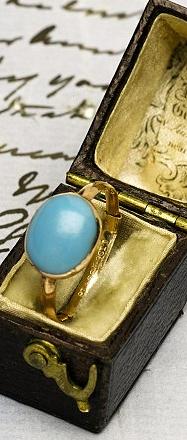
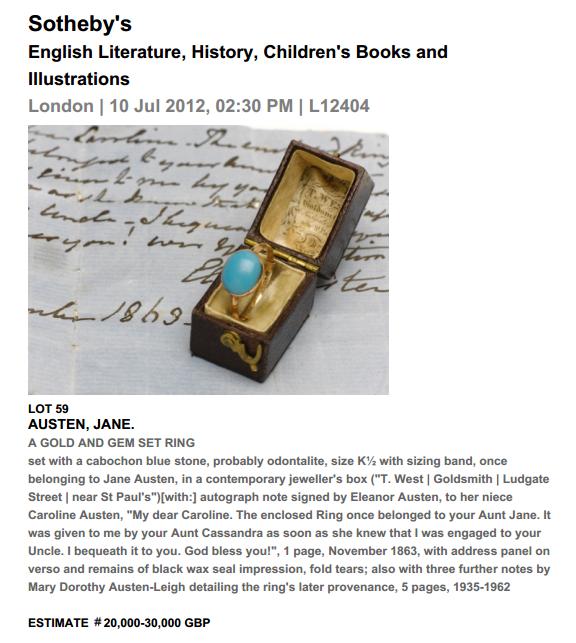
I am jumping a bit late on the Jane Austen bandwagon with news of this ring. Coverage by Austen Authors and Austenonly is quite detailed and interesting, and I have very little to add to their information other than to offer the text of the PDF document put out by Sotheby’s. The ring, as well as original editions of Jane’s books, will be auctioned on July 10th.
I will say that this cabochon ring is lovely and made of a semi-precious stone, which makes sense, considering Jane’s economic situation. Amazingly, no one knew of this possession until quite recently, when it came time to be sold. The £30,000 price tag will be realized quickly, no doubt, and the number of people who will bid on this rare item will push the price well past its original estimate. Does anyone want to bet for how much this ring will eventually go? Let’s hope it will find a home in a British museum.
PROVENANCE
Jane Austen (1775-1817); her sister Cassandra (1773-1845); given in 1820 to her sister-in-law Eleanor Austen (née Jackson), second wife of Rev. Henry Thomas Austen (d. 1864); given in 1863 to her niece Caroline Mary Craven Austen (1805-1880, the daughter of Rev. James Austen); her niece Mary A. Austen-Leigh (perhaps first to her mother Emma Austen-Leigh, née Smith); her niece Mary Dorothy Austen-Leigh; given to her sister Winifred Jenkyns on 27 March 1962; thence by descent
LITERATURE
W. Midgley, ‘The Revd. Henry and Mrs Eleanor Austen’, Collected Reports of the Jane Austen Society: 1976-85 (1989), 86-91
CATALOGUE NOTE
An intimate personal possession of Jane Austen’s, hitherto unknown to scholars, that has remained with the author’s descendants until the present day. The stone is probably Odontalite, a form of fossilised dentine that has been heated to give it a distinctive blue colour, which came into fashion in the early 19th Century as a substitute for turquoise. It is an attractive but simply designed piece, befitting not only its owner’s modest income but also what is known of her taste in jewellery. Fanny Price, the heroine of Mansfield Park, is given a gold chain by her cousin Edmund “in all the niceness of jewellers packing”, with the comment that when making his choice “I consulted the simplicity of your taste” – in contrast to the more elaborately decorated chain that she had been given by Mary Crawford. Similar sentiments are found in one of Austen’s letters when she informed her sister Cassandra that “I have bought your locket … it is neat and plain, set in gold” (24 May 1813).
On Jane’s death her jewellery, along with other personal possessions, passed to Cassandra, and she appears to have given a number of pieces as mementos. After Jane’s death Cassandra wrote to Fanny Knight that Jane had left “one of her gold chains” to Fanny’s god-daughter Louisa (29 July 1817), and she appears to have given the best-known piece of jewellery known to have belonged to her sister, the topaz cross given to her by her brother Charles in 1801 (see her letter to Cassandra, 26 May 1801), to their mutual friend Martha Lloyd.
Three years after Jane’s death, Cassandra gave the ring to Eleanor Jackson, on hearing the news that she was about to marry her brother Rev. Henry Thomas Austen. Henry had been Jane’s favourite brother and was closely involved in getting her novels into print. He lived locally to Cassandra and was by this time a clergyman (curate of Chawton from 1816, appointed perpetual curate of nearby Bentley in 1824), having previously gone bankrupt as a banker. Eleanor, his second wife, was the niece of the rector of Chawton, Rev. Papillon, and seems to have been known to the Austen family for many years.
Eleanor kept the ring for many years, bequeathing it to her niece Caroline shortly before her death. Caroline’s brother, James-Edward Austen-Leigh, wrote A Memoir of Jane Austen, and Caroline herself assisted this project by committing her own childhood memories of her aunt to paper, for her brother’s use. Caroline never married and the ring passed in turn to James-Edward’s daughter Mary, at which point it passed beyond the generation who had personal memories of Jane.
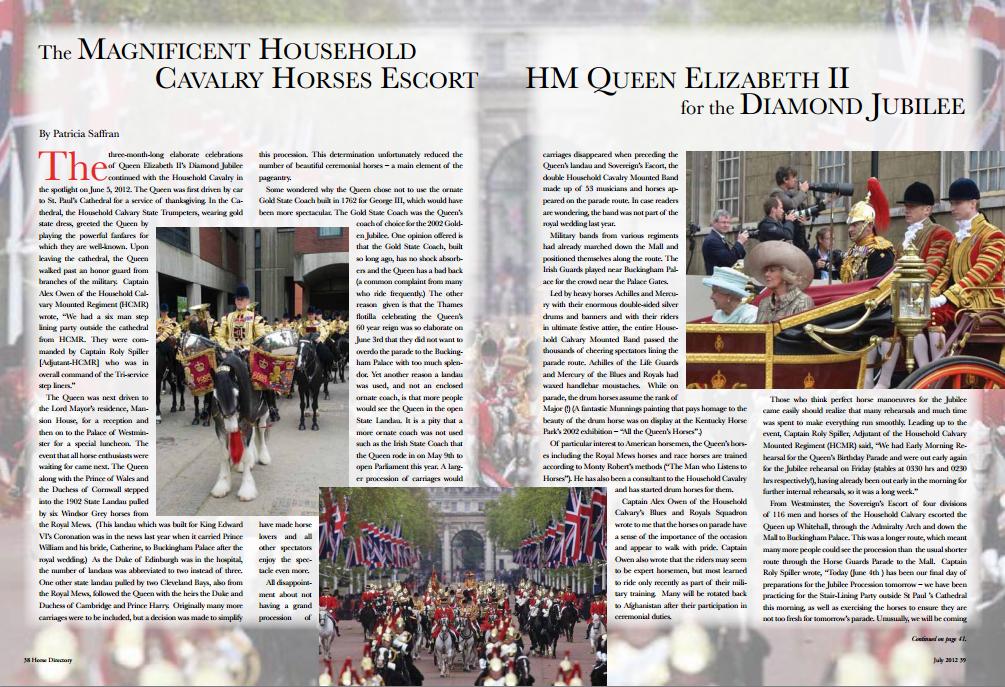
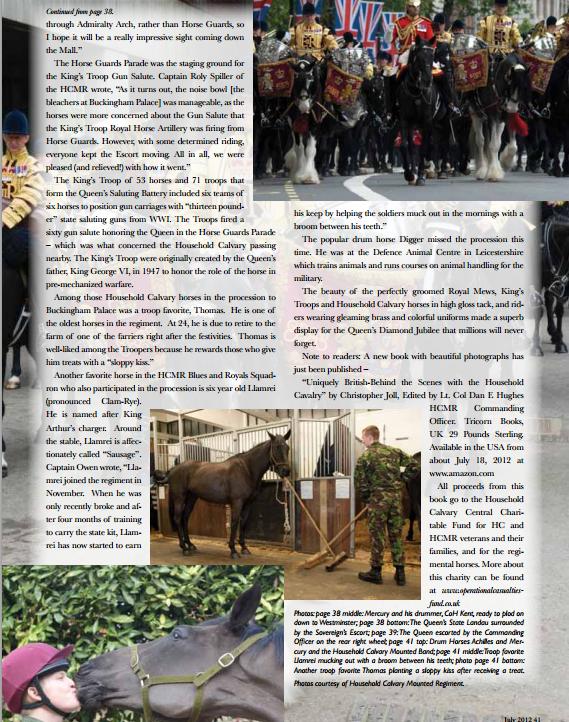
First page of the article. Click on image to view the photos in more detail.
The three-month-long elaborate celebrations of Queen Elizabeth II’s Diamond Jubilee continued with the Household Cavalry in the spotlight on June 5, 2012. The Queen was first driven by car to St. Paul’s Cathedral for a service of thanksgiving. In the Cathedral, the Household Calvary State Trumpeters, wearing gold state dress, greeted the Queen by playing the powerful fanfares for which they are well-known. Upon leaving the cathedral, the Queen walked past an honor guard from branches of the military. Captain Alex Owen of the Household Calvary Mounted Regiment (HCMR) wrote, We had a six man step lining party outside the cathedral from HCMR. They were commanded by Captain Roly Spiller [Adjutant-HCMR] who was in overall command of the Tri-service step liners.
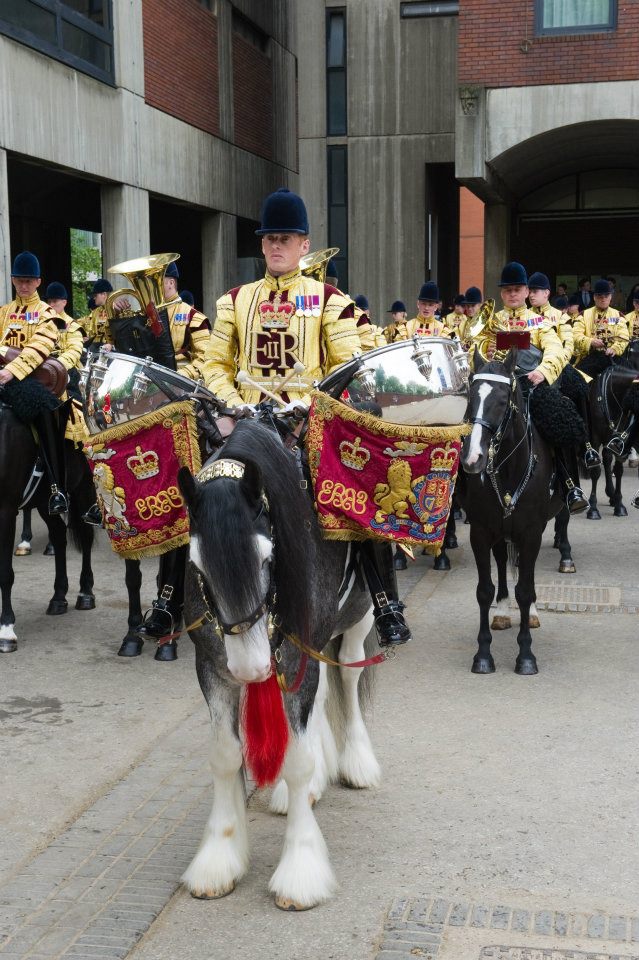
Mercury and his drummer, CoH Kent, ready to plod on down to Westminster.
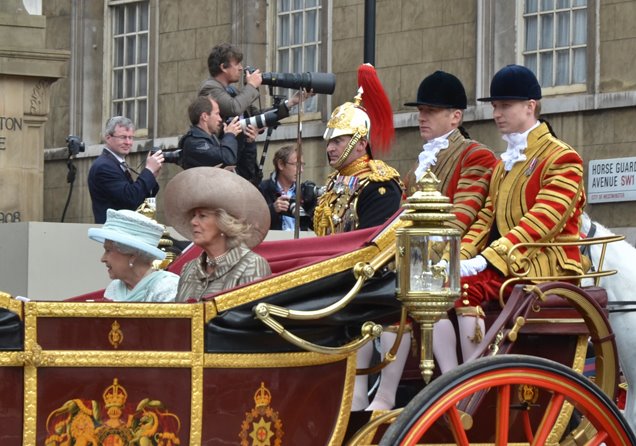
The Queen was next driven to the Lord Mayor’s residence, Mansion House, for a reception and then on to the Palace of Westminster for a special luncheon. The event that all horse enthusiasts were waiting for came next. The Queen along with the Prince of Wales and the Duchess of Cornwall stepped into the 1902 State Landau pulled by six Windsor Grey horses from the Royal Mews. (This landau which was built for King Edward VII’s Coronation was in the news last year when it carried Prince William and his bride, Catherine, to Buckingham Palace after the royal wedding.) As the Duke of Edinburgh was in the hospital, the number of landaus was abbreviated to two instead of three. One other state landau pulled by two Cleveland Bays, also from the Royal Mews, followed the Queen with the heirs the Duke and Duchess of Cambridge and Prince Harry. Originally many more carriages were to be included, but a decision was made to simplify this procession. This determination unfortunately reduced the number of beautiful ceremonial horses, a main element of the pageantry. Some wondered why the Queen chose not to use the ornate Gold State Coach built in 1762 for George III, which would have been more spectacular. The Gold State Coach was the Queen’s coach of choice for the 2002 Golden Jubilee. One opinion offered is that the Gold State Coach, built so long ago, has no shock absorbers and the Queen has a bad back (a common complaint from many who ride frequently.) The other reason given is that the Thames flotilla celebrating the Queen’s 60 year reign was so elaborate on June 3rd that they did not want to overdo the parade to the Buckingham Palace with too much splendor. Yet another reason a landau was used, and not an enclosed ornate coach, is that more people would see the Queen in the open State Landau. It is a pity that a more ornate coach was not used such as the Irish State Coach that the Queen rode in on May 9th to open Parliament this year. A larger procession of carriages would have made horse lovers and all other spectators enjoy the spectacle even more.
All disappointment about not having a grand procession of carriages disappeared when preceding the Queen’s landau and Sovereign’s Escort, the double Household Cavalry Mounted Band made up of 53 musicians and horses appeared on the parade route. In case readers are wondering, the band was not part of the royal wedding last year.
Military bands from various regiments had already marched down the Mall and positioned themselves along the route. The Irish Guards played near Buckingham Palace for the crowd near the Palace Gates.
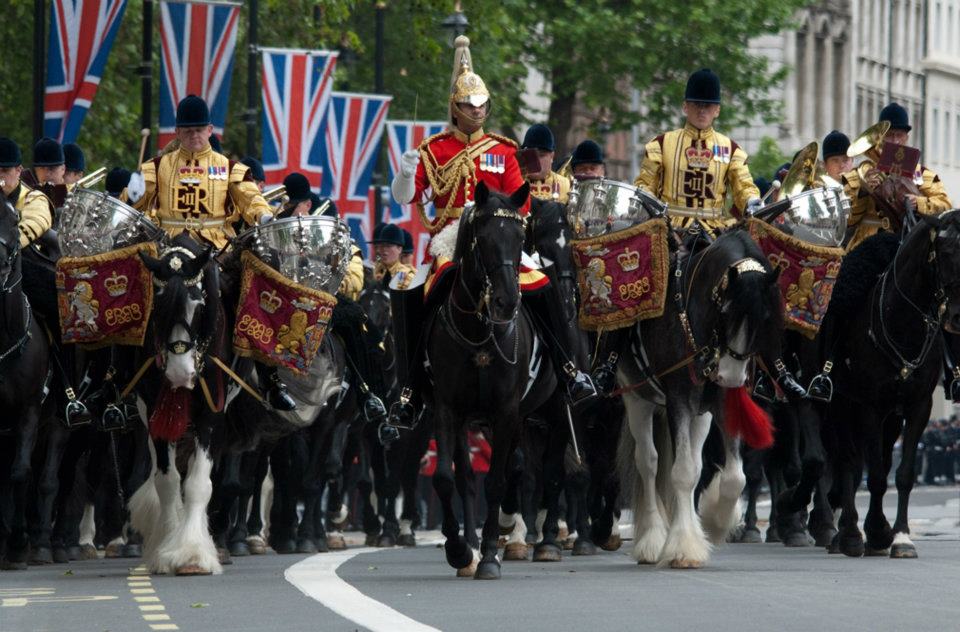
Led by heavy horses Achilles and Mercury with their enormous double-sided silver drums and banners and with their riders in ultimate festive attire, the entire Household Calvary Mounted Band passed the thousands of cheering spectators lining the parade route. Achilles of the Life Guards and Mercury of the Blues and Royals had waxed handlebar moustaches. While on parade, the drum horses assume the rank of Major (!) (A fantastic Munnings painting that pays homage to the beauty of the drum horse was on display at the Kentucky Horse Park’s 2002 exhibition “All the Queen’s Horses”.)
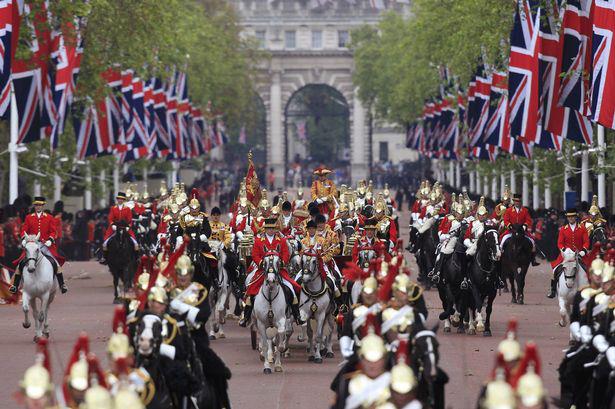
The Queen’s landau and Sovereign’s Escort
Of particular interest to American horsemen, the Queen’s horses including the Royal Mews horses and race horses are trained according to Monty Robert’s methods (The Man who Listens to Horses). He has also been a consultant to the Household Cavalry and has started drum horses for them.
Captain Alex Owen of the Household Calvary’s Blues and Royals Squadron wrote to me that the horses on parade have a sense of the importance of the occasion and appear to walk with pride. Captain Owen also wrote that the riders may seem to be expert horsemen, but most learned to ride only recently as part of their military training. Many will be rotated back to Afghanistan after their participation in ceremonial duties.
Those who think perfect horse manoeuvres for the Jubilee came easily should realize that many rehearsals and much time was spent to make everything run smoothly. Leading up to the event, Captain Roly Spiller, Adjutant of the Household Calvary Mounted Regiment (HCMR) said, “He had Early Morning Rehearsal for the Queen’s Birthday Parade and were out early again for the Jubilee rehearsal on Friday (stables at 0330 hrs and 0230 hrs respectively!), having already been out early in the morning for further internal rehearsals, so it was a long week.”
Second page of the article, somewhat cropped.
From Westminster, the Sovereign’s Escort of four divisions of 116 men and horses of the Household Calvary escorted the Queen up Whitehall, through the Admiralty Arch and down the Mall to Buckingham Palace. This was a longer route, which meant many more people could see the procession than the usual shorter route through the Horse Guards Parade to the Mall. Captain Roly Spiller wrote ,”Today (June 4th ) has been our final day of preparations for the Jubilee Procession tomorrow. We have been practicing for the Stair-Lining Party outside St Paul’s Cathedral this morning, as well as exercising the horses to ensure they are not too fresh for tomorrow’s parade. Unusually, we will be coming through Admiralty Arch, rather than Horse Guards, so I hope it will be a really impressive sight coming down the Mall.”
Drum Horses Achilles and Mercury and the Household Calvary Mounted Band
The Horse Guards Parade was the staging ground for the King’s Troop Gun Salute. Captain Roly Spiller of the HCMR wrote, As it turns out, the noise bowl [the bleachers at Buckingham Palace] was manageable, as the horses were more concerned about the Gun Salute that the King’s Troop Royal Horse Artillery was firing from Horse Guards. However, with some determined riding, everyone kept the Escort moving. All in all, we were pleased (and relieved!) with how it went.”
The King’s Troop of 53 horses and 71 troops that form the Queen’s Saluting Battery included six teams of six horses to position gun carriages with thirteen pounder state saluting guns from WWI. The Troops fired a sixty gun salute honoring the Queen in the Horse Guards Parade, which was what concerned the Household Calvary passing nearby. The King’s Troop were originally created by the Queen’s father, King George VI, in 1947 to honor the role of the horse in pre-mechanized warfare.
Among those Household Calvary horses in the procession to Buckingham Palace was a troop favorite, Thomas. He is one of the oldest horses in the regiment. At 24, he is due to retire to the farm of one of the farriers right after the festivities. Thomas is well-liked among the Troopers because he rewards those who give him treats with a sloppy kiss.
The Queen escorted by the Commanding Officer on the rear right wheel.
Another favorite horse in the HCMR Blues and Royals Squadron who also participated in the procession is six-year-old Llamrei (pronounced Clam-Rye). He is named after King Arthur’s charger. Around the stable, Llamrei is affectionately called Sausage. Captain Owen wrote, “Llamrei joined the regiment in November. When he was only recently broke and after four months of training to carry the state kit, Llamrei has now started to earn his keep by helping the soldiers muck out in the mornings with a broom between his teeth.”
The popular drum horse Digger missed the procession this time. He was at the Defence Animal Centre in Leicestershire which trains animals and runs courses on animal handling for the military.
The beauty of the perfectly groomed Royal Mews, King’s Troops and Household Calvary horses in high gloss tack, and riders wearing gleaming brass and colorful uniforms made a superb display for the Queen’s Diamond Jubilee that millions will never forget.
Note to readers:A new book with beautiful photographs has just been published: “Uniquely British-Behind the Scenes with the Household Cavalry” by Christopher Joll, Edited by Lt. Col Dan E Hughes HCMR Commanding Officer. Tricorn Books, UK 29 Pounds Sterling. Availablein the USA from about July 18, 2012 at http://www.amazon.com
All proceeds from this book go to the Household Calvary Central Charitable Fund for HCR and HCMR veterans and their families, and for the regimental horses. More about this charity can be found at http://www.operationalcasualtiesfund.co.uk
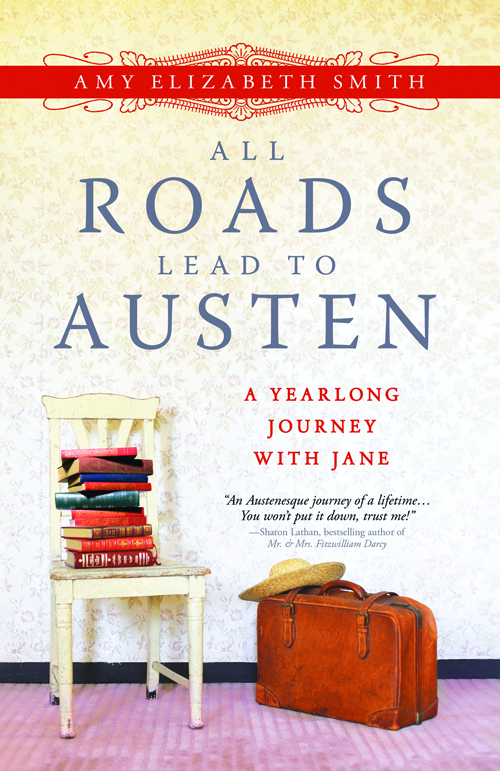
Inquiring Readers: All Roads Lead to Austen: A Yearlong Journey with Jane Austen by Amy Elizabeth Smith is now available through Sourcebooks. I will be reviewing this fabulous, intelligently written book later this week. Meanwhile, enjoy my interview with Ms. Smith about her Latin American adventure as she discusses Jane Austen’s novels en Español with Latin American book groups. All readers of this blog from any country can enter a contest to win a copy of this charming book. Please click on this link and leave your comment. Make sure to leave a way I can reach you. Contest is now closed!
Amy, I love that Jane Austen, a spinster who didn’t travel far or frequently in her lifetime, is so beloved the world wide over. Which country surprised you most in terms of her popularity there and why?
I found translations of Austen left and right in bookstores in Argentina. I met plenty of people there who’d read Austen and liked her or who’d seen film adaptations of her novels and enjoyed them. And the Jane Austen Society of Buenos Aires was the first Austen society in South America. But sometimes it’s hard not to be influenced by stereotypes about people — I’d heard that Chileans were “the English of South America,” so somehow I thought Austen would be popular in Chile. But when I was living in Santiago, the capital (which I absolutely loved), a number of people told me Austen’s not very well known in Chile.
As for Argentineans, I’d heard over and over from people in Mexico, Guatemala, Ecuador, and other places that Argentineans are, well, pretty arrogant. Other latinos kept passing on jokes like, “When Argentineans see lightening, what do they think is happening? They think it’s God, taking their picture!” So, I guess I got the idea that Argentineans might think Austen was stuffy or old fashioned or some such thing. But she’s popular, at least in Buenos Aires, according to my experiences.
What aspects of that particular culture do you think Jane would have enjoyed the most?
Bookstores, bookstores, bookstores. I had great experiences in bookstores all over Latin America, but Argentina — and Buenos Aires specifically — really is the bookstore capital of South America. It’s so easy for us now to take for granted that we can get our hands on just about any book we want, any time. We’ve got access to bookstores, next-day delivery with websites, and good public libraries. And electronic readers have made it easier than ever — just order whatever book you want, wherever you are on the planet! But imagine what it must have been like for an imaginative, inquisitive reader like Austen — how often did she ever set foot in a bookstore? How often could she afford to pay for books from a circulating library? How many books did her family or friends or neighbors actually own? I think Austen would have fainted from sheer pleasure at the sight of bookstore after bookstore on Avenida Corrientes in Buenos Aires.
Librerias Libertador: One of my favorite bookstores on Corrientes, in Buenos Aires
Jane Austen fans cross all religious boundaries. Can you identify any characteristics that Janeites share across the world, besides their obvious love for Jane Austen’s novels?
I honestly can’t speak for many places beyond Latin America (although I might try a next project in some other interesting countries!). But I suspect that there’s a kind of optimism that people — especially women — love about Austen. Her leading ladies find love, not in spite of being strong and intelligent, but because of it. That’s a pretty appealing idea in a world were, in many places, women are still told they’d better not appear too smart, or they’ll scare men off.
What were some of your most memorable experiences in writing this book?
I actually started the book while I was still traveling, although I didn’t finish it until after my trip was done. I wrote the first portion on Guatemala while I was living in Puerto Vallarta, Mexico. I was living well away from the tourist area, renting a partially-finished house that had glass in only one or two windows, so it was pretty noisy — street vendors would cruise by with loudspeakers, selling ice cream, vegetables, you name it. The people across the street had a huge bird caged outside their house that shrieked and chattered like a demon. And animals would wander in at will — there was one very persistent cat that kept making me jump out of my skin by appearing under my writing table with no warning.
There were animals all over the place in that neighborhood — no leash laws for dogs, and some of the neighbors had roosters and other farm animals. When I wanted a break from writing, I’d wander out to buy groceries or take my clothes to the laundromat. I always carried them in a plastic bag, and there was this goat a few houses down from me that was only tied up about half of the time. When it was loose, it usually ignored me, but when I had that plastic bag with laundry, it would come bolting after me — maybe its food came in a plastic bag, and it thought I had something good to eat? Or maybe it knew I had laundry and really wanted to eat my socks. Who knows. Sometimes I actually miss that goat — laundry day’s not the same without it.
A friendly neighborhood rooster from Puerto Vallarta, Mexico
Thank you, Amy, for your wonderful insights and good luck with your book. (I just love the cover!) Is there anything else you would like my readers to know about All Roads Lead to Austen?
Amy Elizabeth Smith
I had two main sources of inspiration for this book — Azar Nafisi’s Reading Lolita in Tehran, and my own Jane Austen students at the University of the Pacific, in California. Readers can enjoy All Roads as a fun opportunity to sit back and be an armchair traveler, but I’d also love it if the book inspired some other international journey I could sit back and read about. Austen in China? Turkey? Belgium? Bora Bora? I’d love to see somebody else take on a journey like this with Jane. Even if they don’t want to write a whole book about it — I’d love to have people share reading-on-the-road stories on my website (http://allroadsleadtoausten.com/). Consider that an official invitation! And thanks so much for letting me visit here at Jane Austen’s World!
To Enter the Contest:Please make sure to leave your comment on Jane Austen Todayat this link. The first two comments left on this post will be included in the random number generator drawing at midnight EST USA time on June 11. Please leave all other comments on Jane Austen Today. Make sure to leave a way I can reach you.
Fashionable Goodness: Christianity in Jane Austen's England is now available! By JAW contributor Brenda S. Cox. See Review. Available from Amazon and Jane Austen Books.
Available through December 31st, 2025. Click on image for details, and share this poster with other teachers and students!
The Obituary of Charlotte Collins by Andrew Capes
Click on image to read the story.
Comments
“My idea of good company…is the company of clever, well-informed people, who have a great deal of conversation.” – Jane Austen, Persuasion
Gentle readers: Please feel free to post your comments and continue the conversation! Due to SPAM, we will no longer accept comments on posts after 30 days of publication. In some instances, links will be removed from comments as well.
Administrators and Contributors
Vic Sanborn, founder of this blog, is supported by a team of talented and knowledgeable writers about Jane Austen and the Regency era. They are:
Tony Grant, who now contributes his photos from London and England
Click on their names to enter their own blogs.
In addition, we thank the many experts and authors who frequently contribute their posts and opinions, and who continue to do so freely or at our request.
Click here to enter the page. Topics include Regency fashion, historic foods, Jane Austen societies, British sites, related topics. Click on image.
May we suggest?
Hello, my name is Vic and I live in Maryland, USA. I have adored Jane Austen almost all of my life. I am a proud lifetime member of the Jane Austen Society of North America. This blog is a personal blog written and edited by me and my team. We do not accept any form of cash advertising, sponsorship, or paid topic insertions. However, we do accept and keep books and CDs to review.
If you would like to share a new site, or point out an error, please email us. (Yes, we are fallible. We'll own up to our mistakes and will make the corrections with a polite smile on our faces.) Write us at
Thank you for visiting this blog. Your comments and suggestions are most welcome.
Project Gutenberg: eBook of Stage-coach and Mail in Days of Yore, Volume 2 (of 2), by Charles G. Harper
STAGE-COACH AND MAIL IN DAYS OF YORE: A PICTURESQUE HISTORY
OF THE COACHING AGE, VOL. II, By CHARLES G. HARPER. 1903. Click on this link.









 Jane Austen's World