Feeds:
Posts
Comments

Archive for the ‘Popular culture’ Category

Gentle readers, strap on your seat belts. Tony Grant from London Calling sent in his review of “A Jane Austen Education: How six novels taught me about love, friendship and the things that really matter“by William Deresiewicz. Let’s just say this is a review by a bloke about a bloke’s book. There will be no teacup or regency fan ratings this time. 

Just recently a dear friend sent me a copy of A Jane Austen Education by William Deresiewicz. I had read some of the reviews written on a few of the Jane blogs and my impression from those was that it must be a fresh, slightly different approach to engaging with Jane’s works. I sort of put the idea of reading it to one side, I must admit. I thought it would be just another quirky angle on Jane. Anything with Jane’s name attached to it sells, doesn’t it? However, now having a copy here in front of me I decided, at the very least, I should have a look, delve in, and see what I thought.

The front cover was at first a mystery and slightly off putting. A paper doll cut out suited gentleman, headless, to be placed over an inanimate cardboard cut out of a Regency, or did it look more early Victorian, gentleman, presumably wearing underwear, seemed an odd choice. One dimensional, stiff, inanimate, stuck in one pose, drinking tea, ah yes, there was the Jane connection. What did all this reveal about what I was about to discover between the sheets?

The contents page revealed a nice straightforward approach. Chapter 1 Emma, Every Day Matters, Chapter 2 Pride and Prejudice, Growing Up and so on through the six published novels, each providing William with a stepping stone along his journey of self discovery and growth. And to round it all off, a nice concluding chapter “The End of the story.” Yes, a well-ordered and neatly constructed narrative was bound to follow.

By the end of the first chapter I had our William sussed. Start with the personal stuff (my life was crap-type thing) – provide an overview of the novel, characters, and plot, and then follow through by laboriously comparing his life events with the characters and events in the book. And finally, relating how it had changed him for the best. I began to feel that I was about to hunker down for a tortuous time. But things were worse than that, William was depressed. Now I’m fine with depression and especially manic depression. All the great comedians profess to be depressives. We have had and have (some of them are dead by the way) Peter Sellers, Spike Milligan and John Clease. All of them are professed manic depressives who used this depth of pain to create some of the greatest humour ever. Winston Churchill suffered from what he termed his ”black dog.” Virginia Woolf and Sylvia Plath, both incredible writers who could bare their souls and take us to places in the human psyche we would never have dreamed of, both took their lives. Life was too unbearable.

However William writes,

Well it just sat there, that realisation, like a lump in my gut – sat there for weeks. I didn’t know what to do with it, how to get rid of it, how to dig myself out the hole I just discovered I was in. But I knew I couldn’t live like that anymore.”

This passage is a build up to telling his girlfriend at the time, that he thought they should part their ways. There was no depth to their relationship apparently. This level of depression is the equivalent of having a bad cold. In the hierarchy of depressive situations, William is not going to reach into our emotional depths and inspire us with what is a very common place situation. I was hoping things would get better, but no, he droned on in this flat slightly miserable way all through the first chapter. And what did he learn from Emma?

“Even I was beginning to realise what a real relationship looked like,” he droned.

Oh I see!!!!!!! Yes, I was really beginning to see.

I was getting the idea. I really do hope William gets his full share of the kudos that Jane’s name, applied to a title, provides. I was beginning to think, what else is there? What other value?

At one stage, I must say, I thought that the analysis part of each chapter had worth, William is an English literature lecturer at a university after all, but then I got bored with that too. He is far, far too contrived. Later in the book, here is William analysing Mansfield Park, my favourite Austen novel,

“What Austen recommended to us, she urged upon her nearest and dearest, too. Love means effort and self control – for the sake of others, and thus, ultimately, for your own.”

Oh God, this is beginning to sound so profound. Life’s hard lessons learned so emphatically, and by a writer so young too.

I squirmed a few times while reading this. Yes, I did persevere. The book was compelling in a ”how can it get worse?” sort of way.

But this is the real sneaky bit. Come on William, tell us the truth. What were you thinking when you wrote this stuff ?

We had jumped each other one night the previous summer, and though we had been together for over a year we had little in common and had never much progressed beyond the sex.”

Honesty, the baring of ones soul, telling it like it is — it’s all in this book. William repeats at discrete, well-paced intervals, lightly (and apparently carelessly), how bad he feels about superficial relationships and jumping into bed for hot steamy one night stands. Any bloke down my pub would laugh at him heartily and call him a …….!!! No I really can’t write what I know my mates would say. William might sue me. This book just ain’t for blokes, let’s put it that way.

It does beg the question who this little boy lost saga is for.

By the end of the book William tells us he has found true, deep, long-lasting love. He has found out at last what it means to be “intimate.” One of the most squirm-creating moments in this whole squirm-creating edifice was earlier in the book when William asks a girlfriend in a cafe what intimacy was and if they were being intimate at that time.

The book ends: (Warning: Spoiler alert.)

That first weekend she came to Brooklyn, the visit that sealed our fate, she brought along a book, just in case there was some downtime. [I’m trying to imagine what the downtime might entail and why and how there could be downtime.] She knew I was a graduate student by that point, but she had no idea what I studied or whom I was writing my dissertation about. It was just the thing she happened to be reading at the time.

The book was Pride and Prejudice.

Reader, I married her.”

So let me get this right. In the end, after all the soul searching, all those profound life lessons it boiled down to Pride and Prejudice?

We’ve been taken through the superficial relationships and I must admit, when I got to the end of the book, I discovered William’s photograph on the back of the fly sheet. It startled me. This bloke had superficial relationships!!!!! There has been the father who disapproved. There has been the depressive moments, mild depression by the way, boring and ordinary, that nothing but a good blow of the nose into a handkerchief wouldn’t have solved. There have been the life lessons learned. I’m sorry, I can’t get it out of my head: This young bloke has learned life’s lessons through Jane Austen already. Where does he go from there? My experience is nothing like that. Life creeps up on you imperceptibly. You adapt and grow slowly, often without noticing and sometimes you regress badly. Life and life’s lessons are nowhere near as easy to learn, as William makes out, by reading a set of novels. You can’t learn it in your head, you have to live life. Sometimes I think it’s impossibly to learn the so-called life lessons. Often we are just stuck, through no fault of our own, because we are who we are.

I am very reluctant to throw a book onto a fire, for echoes of the many evil political regimes that have done that sort of thing come to mind. What I’ll do, out of gratitude to my friend who sent me this copy, is put it on my bookshelf to gather dust. Then I’ll forget about it.
Read Full Post »

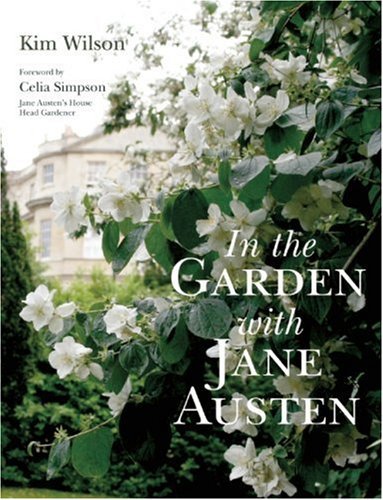
Instead of commemorating Jane Austen’s death at 41 on July 18, 1817, I would like to celebrate her life with a book giveaway of In the Garden With Jane Austen by Kim Wilson. It is a slim hard-back book filled with color photographs. In it Kim discusses the gardens that Jane Austen would have known and visited.

This contest will end on July 18th at midnight, EST. The winner will be chosen by random number generator.

To leave a comment, please let me know which flower you would leave behind at her grave. Update because of a confusion: A comment enters you into the contest. CONTEST CLOSED: Congratulations Eileen Landau! Your comment about a tussie-mussie was chosen by Random.org

Read Full Post »

Gifts from Julie Wakefield

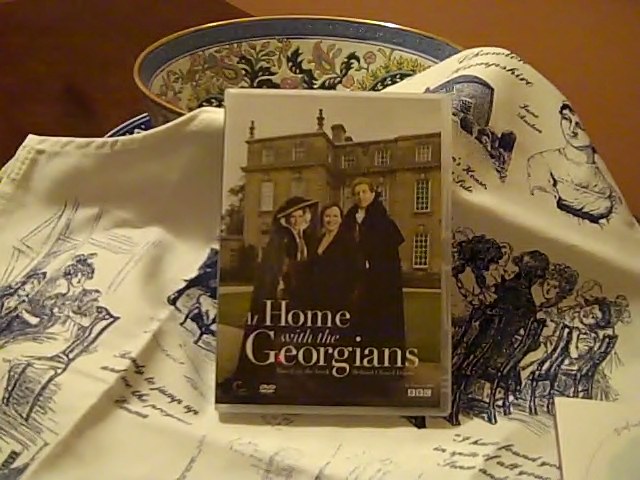
Gentle readers, as many of you know, I have been laid up with a broken foot and have only recently begun to follow a full schedule again. So many friends and readers have wished me well, making me feel like a million dollars. Julie Wakefield from the fabulous blog Austenonly sent me a package from England that simply took my breath away: The DVD of Amanda Vickery’s outstanding BBC series, At Home With the Georgians, based on her book; an apron featuring images of Chawton Cottage and illustrations by Hugh Thompson; two Penguin Classics – Some Country Houses and their Owners by James Lees-Milne and Birds of Selborne by Gilbert White, and bookplates! Thank you, Julie. I love, love, love this package, which came from the heart.


Click on these links to read Julie’s posts about At Home With the Georgians and Hugh Thompson’s illustrations:

Find the gifts online:

Read Full Post »

By Tony Grant. All rights reserved

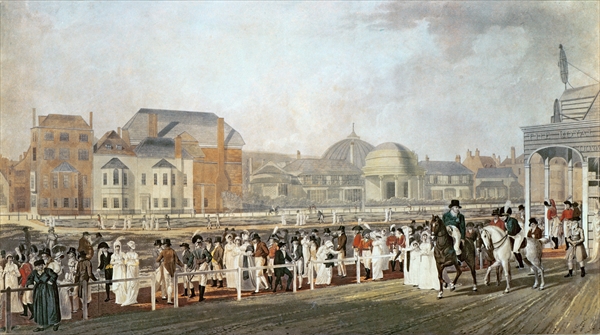
Jane Austen knew Brighton. In Pride and Prejudice it is the place Lydia Bennett rushes off to, enamoured of the regimental officers who had inhabited Meryton for a while before being moved to Brighton, especially Wickham. It is the place she elopes with Wickham from.

Brighton as it looked in Jane Austen's day. Charles Richards

It could be interpreted that Brighton is Jane’s symbol of profligacy and impulsive actions. It could be argued that this was so especially as the Prince Regent used Brighton in this way. The regiment Lydia has gone to be near is there to defend the coast against invasion. This is the time of the Napoleonic Wars when invasion is a threat and the total disruption of the world Lydia, the Bennet sisters and Jane herself knew.

Brighton Beach, John Constable, 1824

Brighton was also a new type of place. Jane begins to explore the development of seaside resorts in her unfinished novel Sanditon. It was the sort of place that people came from far afield and from various points of the compass, strangers, to be thrown together for short periods of time. It is interesting to see Jane begin to explore the loosening of moral codes and social rules within this sort of setting. Beau Nash invented his own code for these places at Bath and Tunbridge Wells. He had to invent a way for people to socialise.

Brighton Museum, The Pavilion Stable Block. Image @Tony Grant

Lydia Bennet has been shopping in the scene where Brighton is introduced in Pride and Prejudice and has obviously come back from her expedition with something not at all suitable.

“ Besides, it will not much signify what one wears this summer, after the — shire have left Meryton, and they are going in a fortnight.”

“Are they indeed?” cried Elizabeth, with the greatest satisfaction.

“They are going to be encamped near Brighton: and I do so want papa too take us all three for the summer! It would be such a delicious scheme, and I dare say would hardly cost anything at all. Mamma would like to go too of all things! Only think what a miserable summer else we shall have!”

“Yes,” thought Ellizabeth,”that would be a delightful scheme, indeed, and completely do for us at once. Good Heaven! Brighton, and whole campful of soldiers, to us, who have been overset already by one regiment of militia, and the monthly balls of Meryton.”

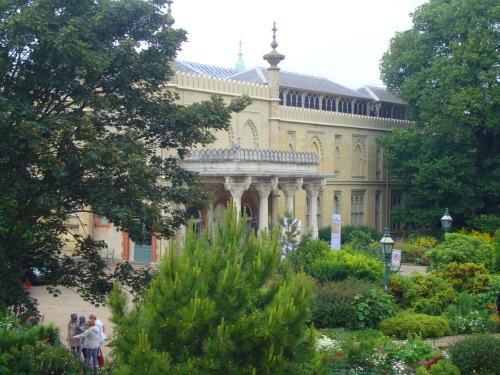
Brighton Pavilion close up. Image @Tony Grant

So it appears that Lydia wants to go to Brighton and Elizabeth does not. In each case, to be fair to Brighton, their reasoning comes from a consideration of the military presence there. Lydia wants to go because of the regiment she has become acquainted with near Meryton and Elizabeth doesn’t want to, because of the same reason. Their views are not formed here by Brighton itself. At this time Brighton was becoming a very popular seaside resort frequented by no less a profligate person as the Prince Regent himself.

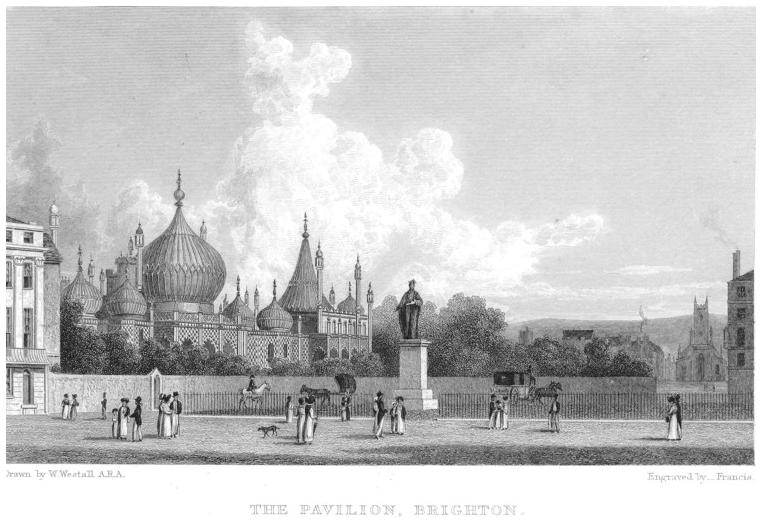
The Pavilion, Brighton by Westall

There he built a magnificent palace called The Brighton Pavilion. As for Jane Austen’s personal opinion we can only conjecture. She liked fun and dancing. Brighton had an abundance of these. She also enjoyed the seaside. The Austens visited Lyme and other seaside places in Devon and Cornwall and possibly South Wales.

The stable block from the Pavilion. Image @Tony Grant

Brighton Pavilion was begun in 1787. It was a farm house which the Prince Regent bought. There, he could have liaisons with Mrs Fitzherbert, his secret lover, away from the glare and attention of London. He got the architect Henry Holland, who had designed Carlton House , to develop it for him.

Brighton Beach today. Image @Tony Grant

Between 1815 and 1822, the designer John Nash redesigned and extended the Pavilion. It is the work of Nash which we see today.

On bank Holiday Monday, 30th May, Marilyn, myself, Emily and Abigail drove down to Brighton from Wimbledon. It was a lovely sunny day. Brighton sea front was a little breezy and the water was too cold to go in for a dip but it was one of those bright sparkling days fresh and invigorating
and to be in Brighton was glorious. We went into the Pavilion to explore the magnificent interiors.

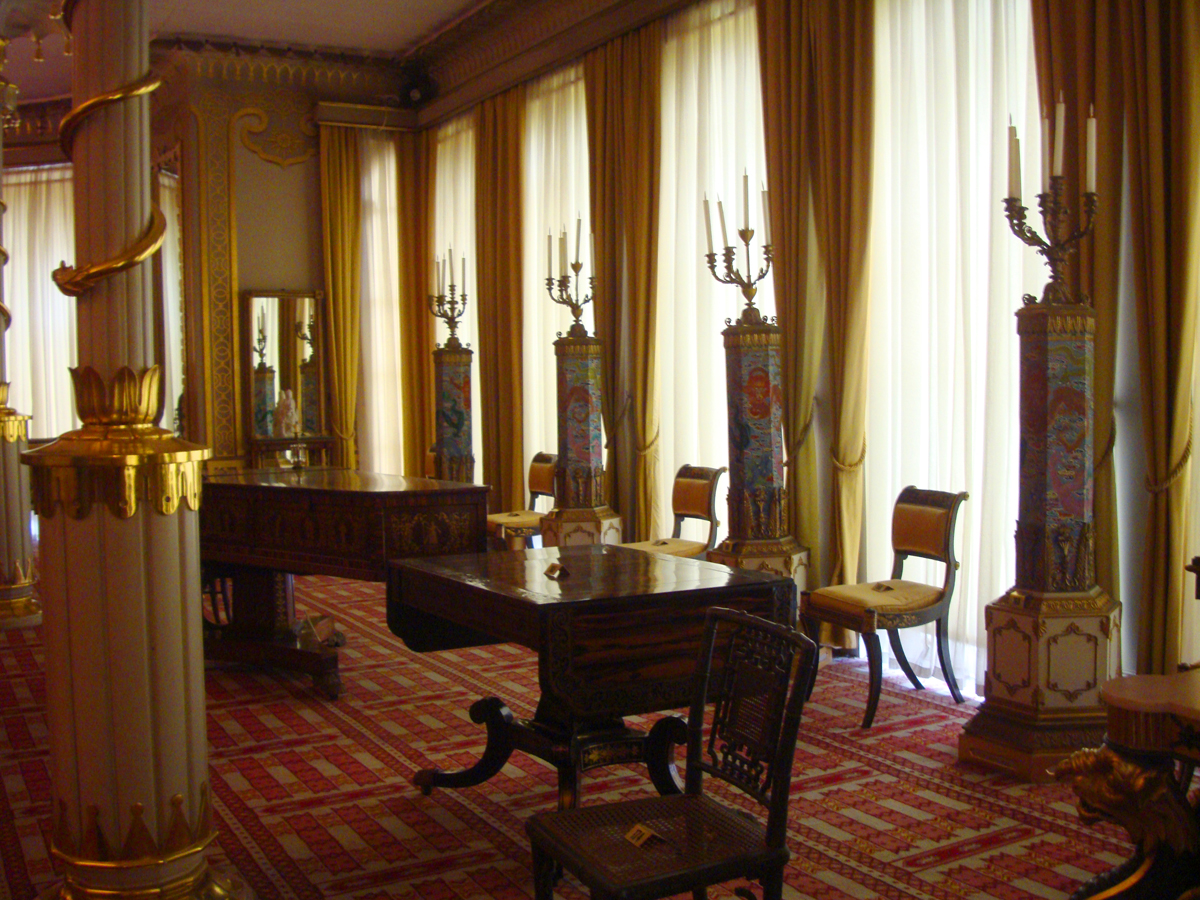
Dining table at Royal Pavilion. Image @Stay in Sussex

Photography is not allowed inside the pavilion. They are very strict about this. We saw some professional photographers, who queued at the entrance in front of us, turned away amidst quite a hullaballoo. They said they had received permission to come and photograph the interior of the pavilion. The security people argued they had not been informed and had no paper work to confirm their assertions. When we got inside, I had put my DSLR safely away in its bag and zipped it up firmly.

The retiring room after dinner. Image @Tony Grant

However, I slipped a small SONY digital camera inside my sleeve just in case an opportunity to snap a furtive, clandestine picture arose. There are a lot of security cameras around the pavilion so I had to position myself out of view of the cameras to take the pictures I did take. Some are blurred because of my hurried attempts. A person near me was asked to put their camera away but I escaped notice.

Upstairs inside the Pavilion. Image @Tony Grant

I think the city council of Brighton and Hove, who own the pavilion, don’t want some plastic copy of the pavilion ending up as a casino in Las Vegas. Ha! Ha!

Car parking. Image @Tony Grant

Brighton today is a glorious mixture of the brash, the tacky, and the brilliant. It has a very special feel to it like no other place. You can feel a very creative energy about the city.

Church Street. Image @Tony Grant

There is some magnificent graffiti , great restaurants and pubs and a whole community of new artistic entrepreneurs starting businesses connected with fashion, music, art and theatre.

Cafe society. Image @Tony Grant

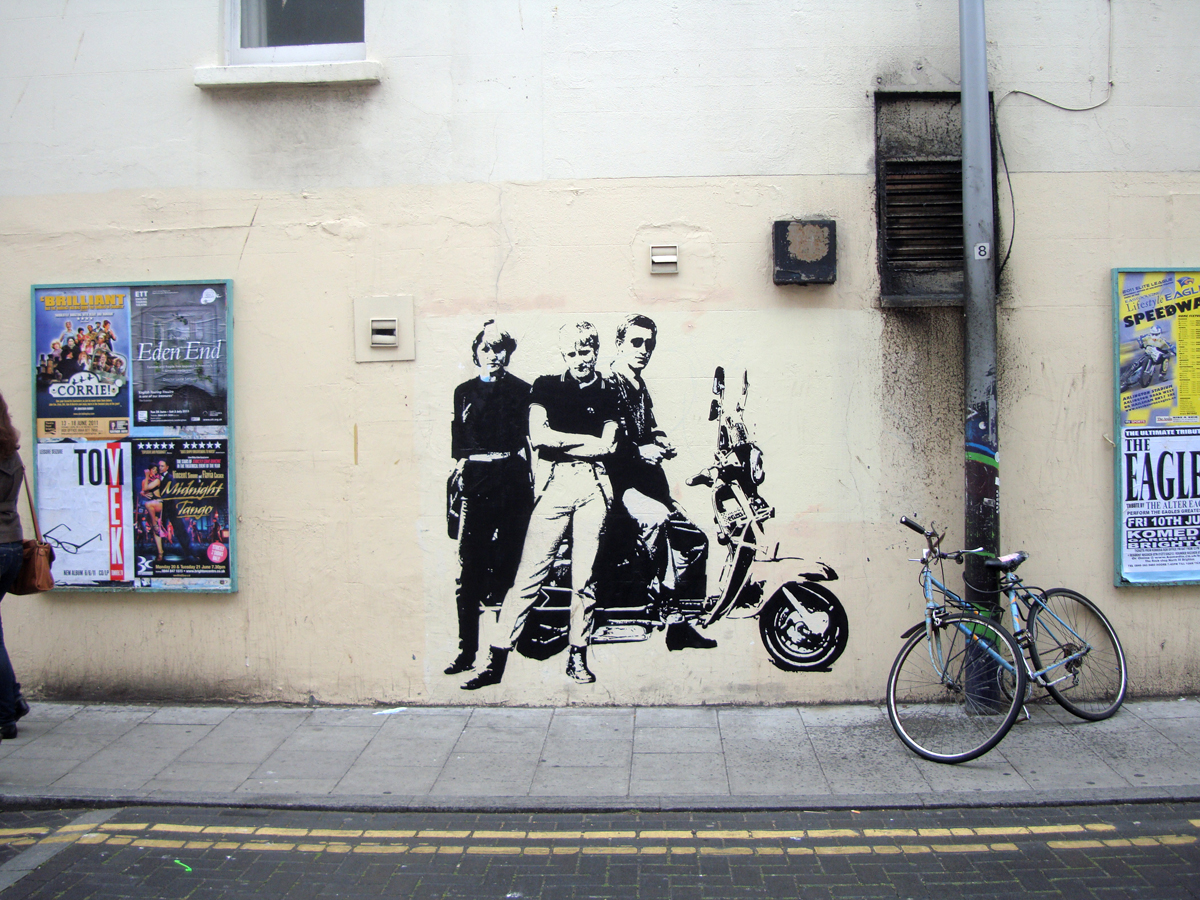
I found one piece of graffiti that made my heart beat that little bit faster. Compared to most graffiti in Brighton it looked understated but I think it must be an original Banksy. Nobody has ever interviewed Banksy and obviously that is not his real name. Nobody knows what he looks like. He is
a mystery to the public. Since the 1990’s, from his first wall cartoons in Bristol where he originates he has made social , religious and political comments through his art. His graffiti appears in the most unusual places. He has had books of his work published and art galleries show his work all over Europe.

Banksy's Mods Reduced. Image@Tony Grant

So I had found an iconic Banksy!!! Across the road and down an alleyway from a café we were having a cup of tea in. It shows some Mods. The Mods were a subculture of youth that originated in the early to mid sixties. They wore smart clothes with military style parkas and RAF, red, white
and blue roundels on their backs.

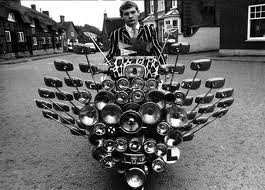
Mod on his bike

They rode motor scooters, Vespas and such like. They listened to Pete Townsend and the WHO. The Who were a MOD group and their lyrics reflect the MOD culture.

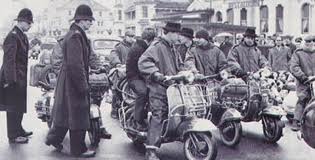
Smart MODS and their scooter

They were working class youth, factory workers, with their girlfriends, who challenged society in their own special way through clothes, music and lifestyle. Brighton and Margate were two coastal resorts they frequented, especially on Bank Holidays and weekends in the summer.

MODS and the police

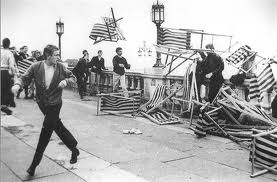
They would gather in their thousands. In opposition, the Rockers, leather clad and motorbike riders who rode BSA and Triumph 650’s, another sub culture of the time who listened to Elvis music, would come and challenge them on the beaches of Brighton and Margate. There would be pitched battles on the beach at Brighton using, stones, chains, knives and deck chairs.

MODS deck chairs

Deck chairs were always readily at hand on the beach. People would end up in hospital. The WHO film, Quadrophenia, is about one such MOD group coming to Brighton. A pitched battle on the beach is portrayed in the film and of course the music is The Who. So you can imagine my excitement seeing a real Banksy recalling those times and the meaning it has for Brighton.

Brighton has other memories too. Our political parties have a conference every year to discuss any progress made, to air views and opinions and to announce new policies. The conferences are held at the major seaside resorts around the country, Blackpool, Brighton and Bournemouth. Each political party takes it in turn to congregate in each resort.

The Grand Hotel. Image @Tony Grant

You might remember on the 12th October 1984 at The Grand Hotel in Brighton, The Provisional IRA blew up the Conservative Party. Margaret Thatcher was working late in the hotel when the bomb went off. They wanted to assassinate Thatcher. They failed to kill any government minister
but Norman Tebbits wife was crippled for life. Some other officials were killed and thirty four were badly injured and rushed to hospital. The Grand Hotel has been rebuilt and extended and presents a magnificent structure right on the seafront.

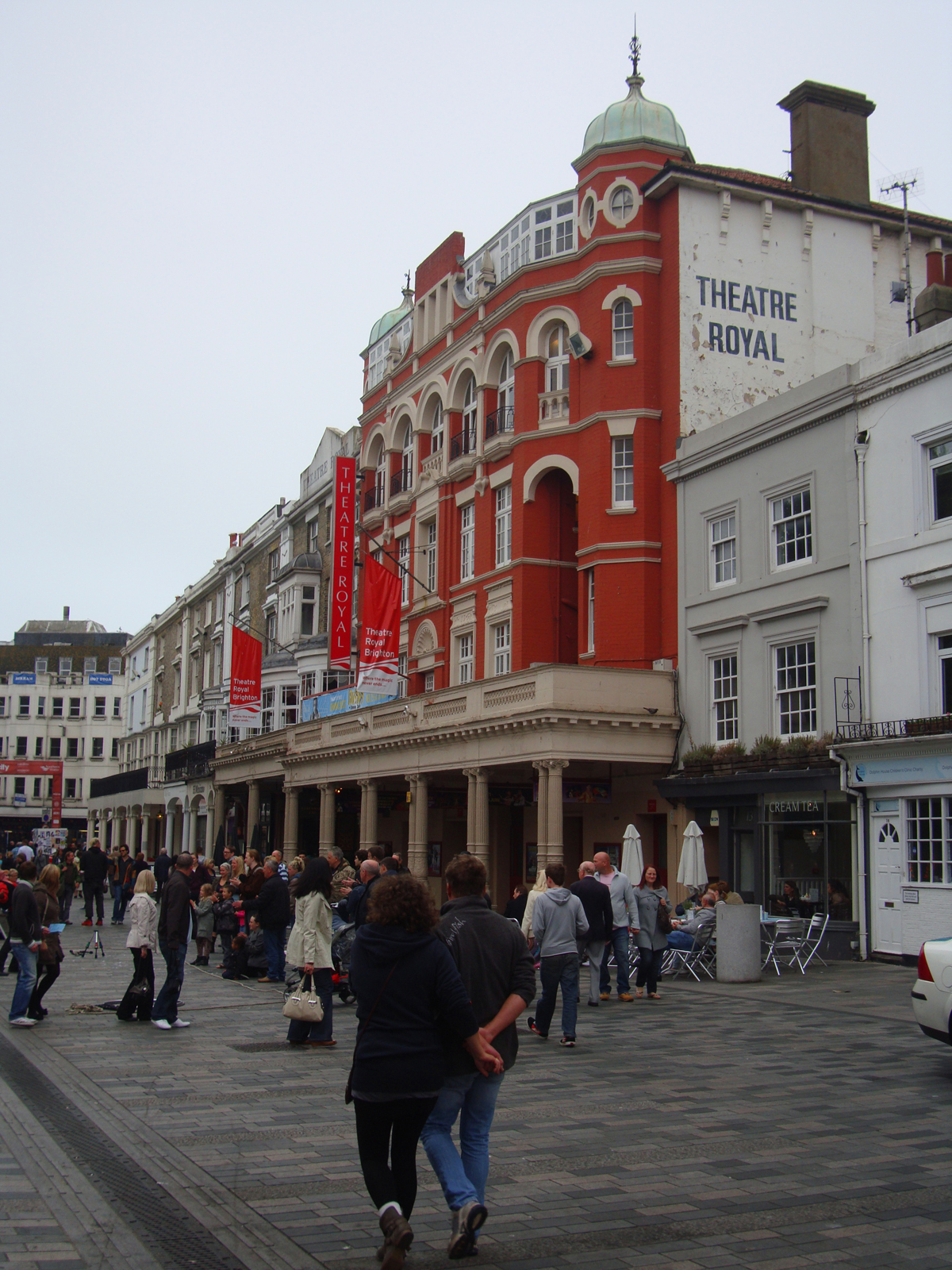
Theatre Royal. Image @Tony Grant

Brighton is famous as a film set. Apart from The Who’s Quadrophenia, some minor B comedy movies from the fifties were filmed there starring Norman Wisdom. Oh What A Lovely War, directed by Richard Attenborough used Brighton Pier extensively and just recently the dark and sinister,
Brighton Rock starring Helen Mirren, based on Graham Greens novel of the same name is set there.

Brighton. Image @Tony Grant

Some film clips:

Brighton shop, 1930z styles. Image @Tony Grant

Purple Heart. Image @Tony Grant

The Sussex. Image @Tony Grant

Read Full Post »

The Magnificent Ceremonial Horses of the Wedding Procession Conduct the Royal Couple to a New Life is an article written by Patty of Brandy Parfums for Horse Directory Magazine. Patty and the editor of the magazine have graciously allowed me to publish the article on this blog.

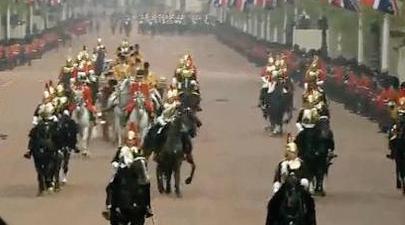
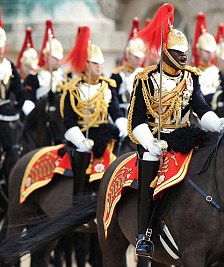
The Household Cavalry Mounted Regiment surround the Royal Couple

Royal-horse-loving early-risers who tuned in on April 29, 2011 for the Royal Wedding of Prince William and Catherine Middleton, now the Duke and
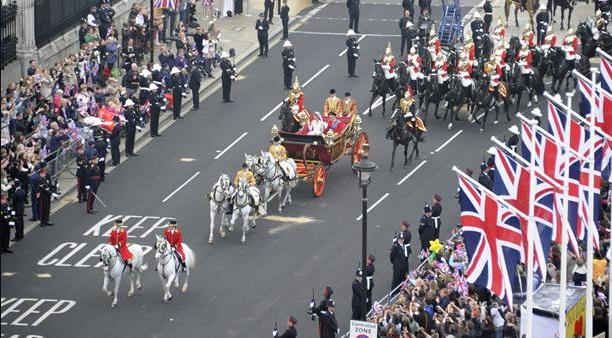
Duchess of Cambridge, may have noted that the trip to Westminster Abbey was a break with royal tradition in that there were no horses. Instead, the procession included a motorcycle escort, a 1950 Rolls-Royce Royal Phantom IV for Kate and her father, and other limos and mini-vans. In absolute contrast, the splendid procession back to Buckingham Palace featured the trotting Royal Mews carriage horses, and the trotting mounted Household Cavalry regimental horses of the Life Guards, and the Blues and Royals.

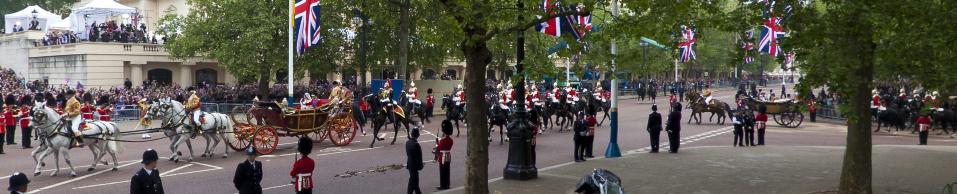
Panoramic view of the wedding procession

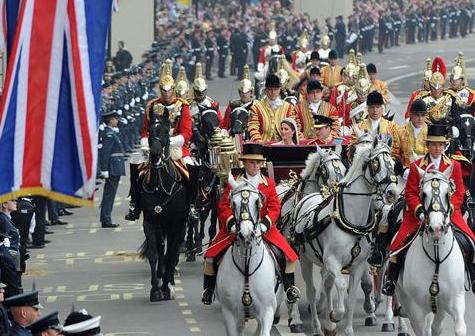
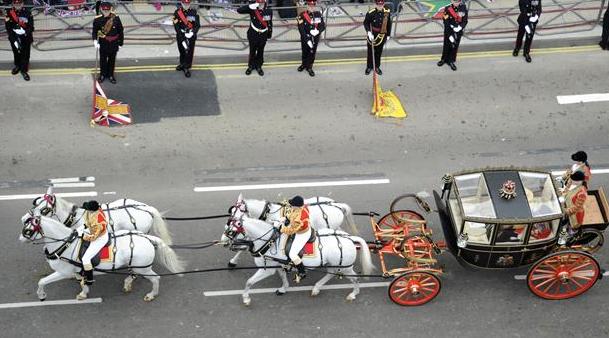
The carriage horses in the procession were mainly Windsor Greys and Cleveland Bays from the Royal Mews, a 32 horse stable near Buckingham Palace. All the royal carriage horses are first trained to be ridden, and then they are taught to pull a carriage. Most were bred at the private Royal Mews, Hampton Court Palace. The Greys pulled the 1902 State Landau of the newlyweds, as well as the 1830 Scottish State Coach with the Queen and Prince Philip. The Bays pulled the Ascot Landaus, and the 1988 Australian State Coach. In the procession, there were four outriders on four of the carriage horses.

A team of Windsor Greys pull the 1902 State Landau. Image @USA Today

Riding alongside a beaming Prince William and his bride Catherine in the 1902 State Landau was William’s friend, Major Nicholas van Cutsem of the Household Cavalry, on his beautiful charger Darcy. The happiness of the royal couple in the open landau delighted the crowd.

The procession. Image @USA Today

Other notable horses in the Household Cavalry mounted procession included Valerian, Goliath, and surprisingly, the horses Beatrice, William and Catherine (also known as Fat Kat!). Viper and Valerian are twenty years old, the oldest of the 184 horses on duty on that day. While the average regimental horse stands at 16.2hh or bigger, Goliath is18.2hh. According to his regiment, Goliath is a “loveable horse with great manners, that is, until he is in sight of the feed stall. He will certainly escape and get his fill.”

A horse and four team pull the carriage with Queen Elizabeth and Prince Phillip. Image @USA Today

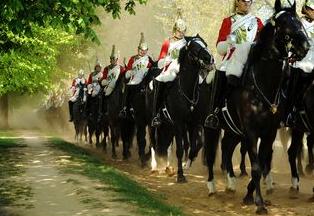
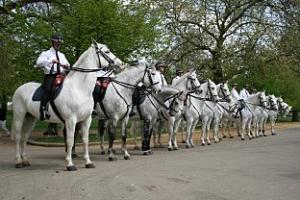
These and the other mounted horses are all Irish Draught/Thoroughbred Crosses, bred in Ireland to be strong enough to carry the weight of the rider, heavy regimental kit, and tack. There are 235 Cavalry Black horses, along with 14 greys, and 3 drum horses (not used on the day), all housed in the Hyde Park Barracks.

The Life Guards practice in Hyde Park

The Life Guards, regimental horse troops who protect the sovereign, originally date back to the restoration of King Charles II in 1660. All the mounted riders in the wedding procession took great care with their kits. One of the riders, Lance Corporal Daniel Hughes told the Telegraph “We’re proud and we’re always striving to be the best.”

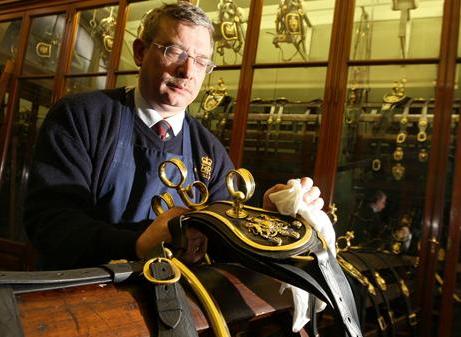
State harness cleaner David Oates polishes the round buckle part of the state harness. Image @USA Today

It took 5 hours to clean the tack, and 6 hours to clean the uniform, shine the brass armor and helmet topped with horsehair, whiten the gloves, and then he had to shine the boots to a mirror image, and extra time, of course, to groom the horses to a glossy coat, with perfectly cut mane.

Once ready, the horses and riders were given an official inspection by the Silver Stick (the historic protective officer for the monarch), Colonel Stuart Cowen, Commander Household Cavalry. Captain Roly Spiller told the Telegraph, “The main thing is that we get the bride and groom from the Abbey safely back to the Palace.”

Soldiers from the Household Cavalry

Most of the mounted riders are primarily operational soldiers who have been deployed in places like Bosnia and Afghanistan. A special charity looks after the returning soldiers – the Household Cavalry Central Charitable Fund which incorporates the Household Cavalry Operational Casualties Fund.

Lewisham horses train to be part of the Grey escort

The hours of training of the all the horses by the coachmen and regimental riders resulted in a resplendent joyous procession on the royal wedding day of William and Catherine

More on the topic:

Read Full Post »

« Newer Posts - Older Posts »