Feeds:
Posts
Comments

Archive for the ‘Pride and Prejudice’ Category

Inquiring readers: This is the first of many posts I’ll be writing about “Pride and Prejudice” in honor of that novel’s 200 year anniversary in 2013. Enjoy.

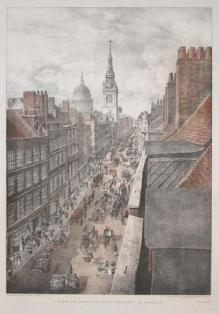
Cheapside in 1823. Engraved by T.M. Baynes from a drawing by W. Duryer.JPG

Cheapside in 1823. Engraved by T.M. Baynes from a drawing by W. Duryer. Image @Wikipedia

Some London streets seem determined never to distinguish themselves. No mediaeval scuffle has ever occurred in them; no celebrated church hoards its monuments; no City hall cherishes its relics there; no celebrated person has honoured it by birth or death. Gracechurch Street is one of these unambitious streets. It derived its name, says Stow, from the grass or herb market there kept in old time, and which gave its name to the parish church of St. Bennet. – British History Online,
It is a woeful fact that I most likely crossed Gracechurch Street on my first visit to London and never new it. We had just visited Tower Hill and were heading for St. Paul’s Cathedral on foot. My husband and I wandered here and there and got lost, no nearer to our destination. This part of London seemed a mismash of old and mostly modern buildings, with wide and narrow streets, some twisting and winding, others straight. It was nothing like the old London my 24-year-old self had expected to see, for at that time I did not fully realize the extent of the devastation that the great fire of 1666 had wrought. Those changes were compounded by the London Blitz during WWII and recent modernization.
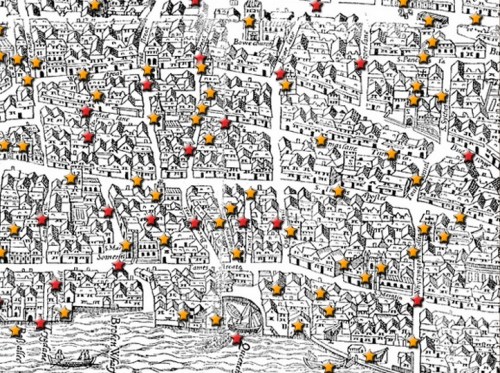
Early modern map of Cheapside. Image @The Map of Early Modern London

Early modern map of Cheapside. Image @The Map of Early Modern London One can see Bow Church at the top center.

We finally boarded a transit bus and missed noticing Gracechurch Street. Not that I would have searched for it. At that time I would not have recalled the few references in Pride and Prejudice to the street where Lizzy Bennet’s aunt and uncle Gardiner lived.

Mr. Gardiner was a sensible, gentlemanlike man, greatly superior to his sister, as well by nature as education. The Netherfield ladies would have had difficulty in believing that a man who lived by trade, and within view of his own warehouses, could have been so well bred and agreeable. Mrs. Gardiner, who was several years younger than Mrs. Bennet and Mrs. Philips, was an amiable, intelligent, elegant woman, and a great favourite with all her Longbourn nieces. Between the two eldest and herself especially, there subsisted a very particular regard. They had frequently been staying with her in town.

The first part of Mrs. Gardiner’s business on her arrival, was to distribute her presents and describe the newest fashions.

I love the Gardiners, two sane people in a novel filled with characters and oddballs. They provide ballast and sound advice to Elizabeth, who wisely turned to Mrs. Gardiner, not her mother, when mulling a problem about love and life. Mr. Gardiner was a merchant who lived close to his warehouse. Despite their middle class background, the Gardiners are more refined and sensible than many of their social betters. Elizabeth is proud to introduce them to Mr. Darcy when visiting his estate, knowing that their restrained behavior would not make him (or her) cringe.
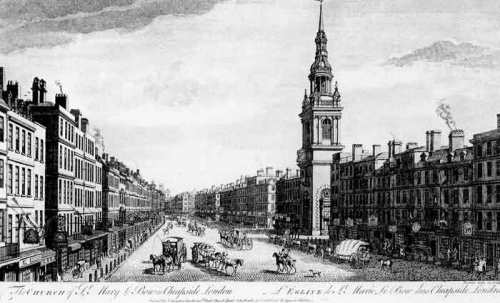
Cheapside in the mid 18th century. Image @Republic of Pemberley

Cheapside in the mid 18th century. Image @Republic of Pemberley

Caroline Bingley, whose snobbishness was evident when she paid Jane a hasty courtesy call at Gracechurch Street, demonstrated a decided lack of class when she all but wrinkled her nose at a neighborhood she had probably managed to avoid all her life, an interesting attitude considering her family’s wealth came from trade and she was but one generation away from the “stench” of the merchant class. Social calls, their timing and length – or lack thereof – could be used to extend a friendship or give the cut direct, which in this instance Miss Bingley chose to do to Jane. Her lack of civility and coolness before and during the visit finally opened Jane’s eyes to Caroline’s desire to end their friendship. This was an event that Mrs. Gardiner and Lizzy correctly predicted beforehand:
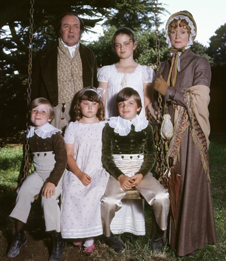
The Gardiners and their brood, Pride and Prejudice, 1995

The Gardiners and their brood, Pride and Prejudice, 1995

Chapter 25:  [Mrs. Gardiner] Poor Jane! I am sorry for her, because, with her disposition, she may not get over it [her failed love affair with Bingley] immediately. It had better have happened to you, Lizzy; you would have laughed yourself out of it sooner. But do you think she would be prevailed on to go back with us? Change of scene might be of service — and perhaps a little relief from home, may be as useful as anything.”

Elizabeth was exceedingly pleased with this proposal, and felt persuaded of her sister’s ready acquiescence.

“I hope,” added Mrs. Gardiner, “that no consideration with regard to this young man will influence her. We live in so different a part of town, all our connexions are so different, and, as you well know, we go out so little, that it is very improbable they should meet at all, unless he really comes to see her.”

“And that is quite impossible; for he is now in the custody of his friend, and Mr. Darcy would no more suffer him to call on Jane in such a part of London! My dear aunt, how could you think of it? Mr. Darcy may, perhaps, have heard of such a place as Gracechurch Street, but he would hardly think a month’s ablution enough to cleanse him from its impurities, were he once to enter it; and, depend upon it, Mr. Bingley never stirs without him.”

“So much the better. I hope they will not meet at all. But does not Jane correspond with the sister? She will not be able to help calling.”

“She will drop the acquaintance entirely.”

Dennis Severs house, a Georgian merchant's house. Image @photographsRoelof Bakker, www.rbakker.com

Dennis Severs house, a Georgian merchant’s house in Spitalsfield. Image @photographs
Roelof Bakker, http://www.rbakker.com

“…lessen their chance of marrying men of any consideration in the world.

With this phrase, Austen gives us a clue about the Bennet girls’ situation, but, as we know, the ending of Pride and Prejudice proves this forecast wrong (for Lizzy and Jane, at least).

Lizzy is right about Caroline Bingley, but not about Darcy. In the following scene her prejudice towards that proud man comes to the fore. She assumes that Mr. Darcy’s attitude towards Gracechurch Street will echo that of Caroline Bingley, for this bustling shopping district simply wasn’t an area that the upper crust tended to visit. Caroline, Darcy and Bingley made their observations about the Bennet family during their stay at Netherfield:

Darcy and Caroline at breakfast

Darcy and Caroline at breakfast

“I think I have heard you say that their uncle is an attorney in Meryton”

“Yes; and they have another, who lives somewhere near Cheapside.”

“That is capital,” added her sister, and they both laughed heartily.

“If they had uncles enough to fill all Cheapside,” cried Bingley, “it would not make them one jot less agreeable.”

“But it must very materially lessen their chance of marrying men of any consideration in the world,” replied Darcy.

Darcy, it turns out, is made of finer stuff than Caroline Bingley, for when he visits the Gardiners in his quest to find Wickham, his attitude is anything  but snobbish – stubborn, as Mrs. Gardiner later relates, but not snobbish. While arranging Wickham’s marriage to Lydia, he visits Gracechurch Street on several occasions and even dines with the Gardiners, leaving them with a very positive impression of his character:

Chapter 51 [Letter from Mrs. Gardiner to Lizzy after Lydia revealed Darcy’s part in her marriage to Wickham] He dined with us the next day, and was to leave town again on Wednesday or Thursday. Will you be very angry with me, my dear Lizzy, if I take this opportunity of saying (what I was never bold enough to say before) how much I like him. His behaviour to us has, in every respect, been as pleasing as when we were in Derbyshire. His understanding and opinions all please me; he wants nothing but a little more liveliness, and that, if he marry prudently, his wife may teach him. I thought him very sly;—he hardly ever mentioned your name. But slyness seems the fashion.

Mansion House, Cheapside. Image @Darvill's Rare Prints

Mansion House, Cheapside. Image @Darvill’s Rare Prints

At the time that Jane Austen wrote Pride and Prejudice, Cheapside was a very elegant thoroughfare with many sumptuous warehouses, convenient coffee houses, and  smart shops. In Real Life in London, Pierce Egan writes a passage in which Tom and Bob walk through this area filled with shopkeepers, bankers, merchants, shoppers, and “walking” billboards:

“Neither,” replied Dashall; “this is no other than the shop of a well-known dealer in stockings and nightcaps, who takes this ingenious mode of making himself popular, and informing the passengers that

“Here you may be served with all patterns and sizes,
From the foot to the head, at moderate prices;”

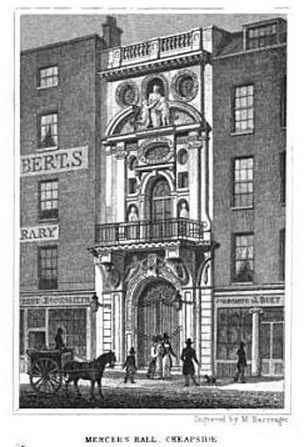
Mercer's Hall, Cheapside. Image @London and Its Environs

Mercer’s Hall, Cheapside. Image @London and Its Environs in the Nineteenth Century

with woolens for winter, and cottons for summer—Let us move on, for there generally is a crowd at the door, and there is little doubt but he profits by those who are induced to gaze, as most people do in London, if they can but entrap attention. Romanis is one of those gentlemen who has contrived to make some noise in the world by puffing advertisements, and the circulation of poetical handbills. He formerly kept a very small shop for the sale of hosiery nearly opposite the East-India House, where he supplied the Sailors after receiving their pay for a long voyage, as well as their Doxies, with the articles in which he deals, by obtaining permission to style himself “Hosier to the Rt. Hon. East India Company.” Since which, finding his trade increase and his purse extended, he has extended his patriotic views of clothing the whole population of London by opening shops in various parts, and has at almost all times two or three depositories for Romanis, the eccentric Hosier, generally places a loom near the door of his shops decorated with small busts; some of which being attached to the upper movements of the machinery, and grotesquely attired in patchwork and feathers, bend backwards and forwards with the motion of the works, apparently to salute the spectators, and present to the idea persons dancing; while every passing of the shuttle produces a noise which may be assimilated to that of the Rattlesnake, accompanied with sounds something like those of a dancing-master beating time to his scholars. his stock. (sic) At this moment, besides what we have just seen, there is one in Gracechurch Street, and another in Shoreditch, where the passengers are constantly assailed by a little boy, who stands at the door with some bills in his hand, vociferating—Cheap, cheap.”

“Then,” said Bob, “wherever he resides I suppose may really be called Cheapside?”

“With quite as much propriety,” continued Ton, “as the place we are now in; for, as the Irishman says in his song,

“At a place called Cheapside they sell every thing dear.”

During this conversation, Mortimer, Merrywell, and Harry were amusing themselves by occasionally addressing the numerous Ladies who were passing, and taking a peep at the shops—giggling with girls, or admiring the taste and elegance displayed in the sale of fashionable and useful articles—justled and impeded every now and then by the throng. Approaching Bow Church, they made a dead stop for a moment.

“What a beautiful steeple!” exclaimed Bob; “I should, though no architect, prefer this to any I have yet seen in London.” – Real Life in London, Egan
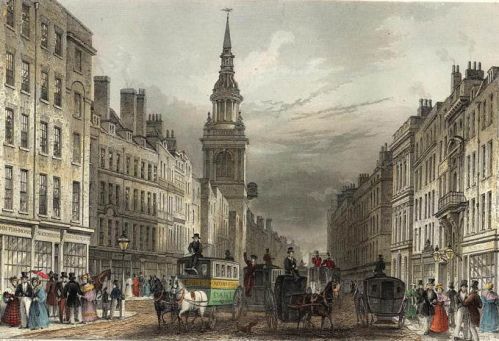
Cheapside and Bow Church engraved by W.Albutt after T.H.Shepherd publ 1837 edited. The pretty steeple is visible in this image. (wikipedia)

Cheapside and Bow Church engraved by W.Albutt after T.H.Shepherd publ 1837 edited. The pretty steeple is visible in this image. (wikipedia)

Once upon a time, Cheapside and Gracechurch Street were in the commercial heart of the city of London. It was the main shopping district in Jane Austen’s day. She describes the journey to Gracechurch street and Lizzy’s visit with the Gardiners in this lively scene:

Chapter 27: It was a journey of only twenty-four miles, and they began it so early as to be in Gracechurch Street by noon. As they drove to Mr. Gardiner’s door, Jane was at a drawing-room window watching their arrival; when they entered the passage she was there to welcome them, and Elizabeth, looking earnestly in her face, was pleased to see it healthful and lovely as ever. On the stairs were a troop of little boys and girls, whose eagerness for their cousin’s appearance would not allow them to wait in the drawing-room, and whose shyness, as they had not seen her for a twelvemonth, prevented their coming lower. All was joy and kindness. The day passed most pleasantly away: the morning in bustle and shopping, and the evening at one of the theatres.
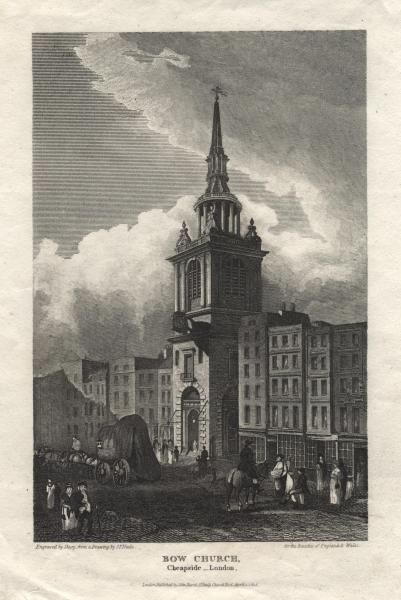
steel engraving of the Bow Church on Cheapside Street in London (the Bow Church is probably better known as Saint Mary's Le Bow and it is said that all true Cockneys were born within the sounds of this church's bells)

Steel engraving of the Bow Church on Cheapside Street in London (the Bow Church is probably better known as Saint Mary’s Le Bow and it is said that all true Cockneys were born within the sounds of this church’s bells) Image @bouletfermat.com

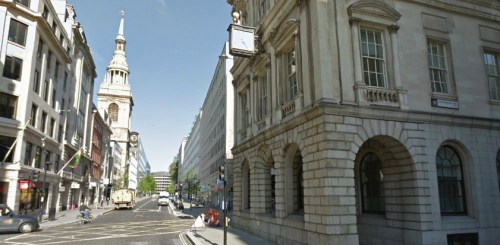
Gracechurch Street means grass-church and was thus named because of a hay market nearby (1680-1868). The distinctive steeple of  St Mary-le-Bow Church is the only structure remaining today that Jane Austen would have recognized. A church has stood on this ground since Saxon times. After the Fire of 1666, Christopher Wren designed a new structure, which was destroyed during a 1941 bombing was and carefully reconstructed during the 1950s. Today, Gracechurch Street largely resembles a modern office block.
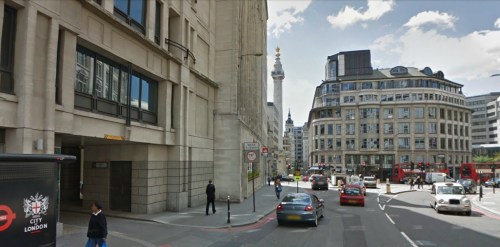
Gracechurch street today (Google maps)

Gracechurch street today (Google maps)

In the 17th century, coffeehouses arrived in the City and these soon became the place to pick up news. Some houses became the makeshift offices of the trades they served, giving birth to some of the world’s greatest financial institutions – the London Stock Exchange started in Jonathan’s Coffeehouse in Change Alley and Lloyds of London takes its name from Edward Lloyd, the proprietor of a coffeehouse in Tower Street. This, coupled with the founding by Royal Charter of the Bank of England in 1694, was the catalyst for the development of the City as a financial centre. – History of Cheapside

Cheapside was anything but cheap, the name “cheap” being the Saxon term for market. (Learn more about Cheapside Street here.) The names of the streets in that section of the City described the trades contained within this district: Wood Street, Milk Street, Bread Street, Honey Lane, Poultry and Friday Street for fish.

Today plans are afoot to revitalize this section of London and return it to its glory as a major shopping destination. History of Cheapside
More on the topic:

Read Full Post »

Celebrating Jane Austen’s Pride and Prejudice: 200 Years of Jane Austen’s Masterpiece, By Susannah Fullerton, published by Voyageur Press, USA 2013 (Published in the UK as Happily Ever After: Celebrating Jane Austen’s Pride and Prejudice) Available in January, 2013

200 Years of Pride and Prejudice: The Beginning

I was asked by Frances Lincoln, the UK publishing firm who published A Dance with Jane Austen (read review here) if I would write a book about 200 years of Pride and Prejudice. I had barely finished Dance and knew it would be difficult to meet the tight deadline, but how could I resist? What better way to celebrate 200 years of that wonderful novel than to write a book about what it has meant to me and to so many people and about the extraordinary afterlife it has enjoyed. And so I set to work and I can honestly say that no book has given me such joy to write. For months I was deeply immersed in the world of the Bennets, Mr Collins, Lady Catherine and Mr Darcy. I have always adored the novel, but as I wrote my own book about it, I came to appreciate it even more, to be more fully aware of its intricacies, skill and its amazing power to charm and enchant again and again and again.

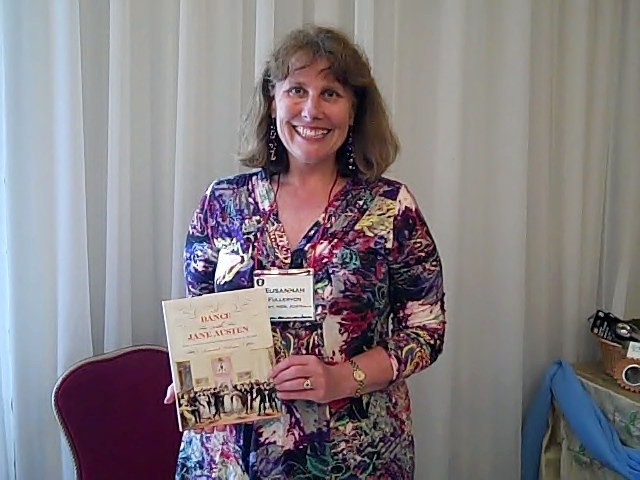
Susannah Fullerton at JASNA AGM 2012 with her new book, A Dance With Jane Austen

My book looks at many aspects of the novel. We all know that it was originally turned down, but for how long did it languish before its author again tried to get it into print? It was not a best-selling book, but from the beginning it had its admirers – who were they, and what did they say about it? I loved writing a chapter about the first sentence. Would I find enough to say, I wondered, as I sat down to write – a whole chapter about a few lines?? Could it be done? In the end, the problem was having almost too much to say, and I hope that chapter will make my readers see clearly just why that first sentence has achieved such fame.

I then turned to the characters. Every reader loves Elizabeth Bennet (I think there must be something wrong with anyone who does not fall in love with Elizabeth!), but why do we love her so, and in what ways is she so radically different from every heroine who had come before? How does her creator skilfully introduce her to us, show her growing and learning as the novel progresses, and endear her to us so greatly? And what of Mr Darcy, that archetypal romantic hero, progenitor of so many tall, dark and handsome men in romantic novels? I loved writing chapters on heroine and hero. I also explore their families and relatives – the Bennets and Mr Collins on her side, Lady Catherine, Anne, Georgiana and Colonel Fitzwilliam on his. How is each character revealed to us and what have 200 years done for them in the way of sequels and further careers?

Pride and Prejudice Translations

In the same year that Pride and Prejudice was published, the first translation appeared. It was published in a Swiss journal, written in French. Jane Austen never knew about it and received no money for it, which is probably a good thing – her own characters would have been almost unrecognisable to her in that Swiss ‘bastardisation’. Generally Pride and Prejudice fared badly for many decades in European translations, but things slowly improved and the non English-speaking world is now catching up on the delights of reading Jane Austen.

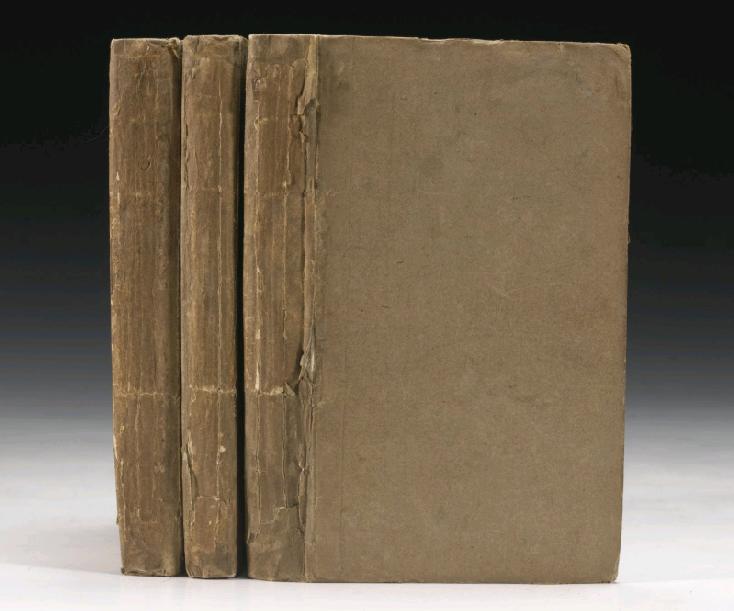
Pride and Prejudice, 1813 edition. Image @Sotheby’s

They say you should not judge a book by its cover, but many people still do, and Pride and Prejudice has had an extraordinary range of covers over 200 years. From the first edition, to the modern Chick-Lit covers, and much in between, it has been ‘packaged’ in a myriad of different ways. And as for illustrations, they range from the positively ugly (where Elizabeth isn’t handsome enough to tempt anyone at all!) to the gorgeously decorative. My book includes many of these illustrations from the familiar Hugh Thomson ones, to some that will be very new indeed to my readers.

Film Adaptations of Pride and Prejudice

We all know about the Greer Garson film version, the lovely Elizabeth Garvie TV series and the hugely popular Colin Firth BBC series, but did you also know about the Dutch TV version, the Italian one with a Mrs Bennet rather like Lucrezia Borgia, the Israeli version (modernised), and several old BBC adaptations? My chapter on the various films will tell you about those, plus modernisations such as Lost in Austen and Bride and Prejudice. And there’s a chapter on sequels. I knew there were lots of them out there, but until I began my research for this chapter I had no idea quite how many, or to what lengths some of them go. There are sequels, prequels, continuations which mix characters from all the Austen novels, modern re-tellings, zombie-infiltrated versions, and even pornographic sequels. You will be amazed at the afterlife of Darcy and Elizabeth in the minds of some sequel writers!!

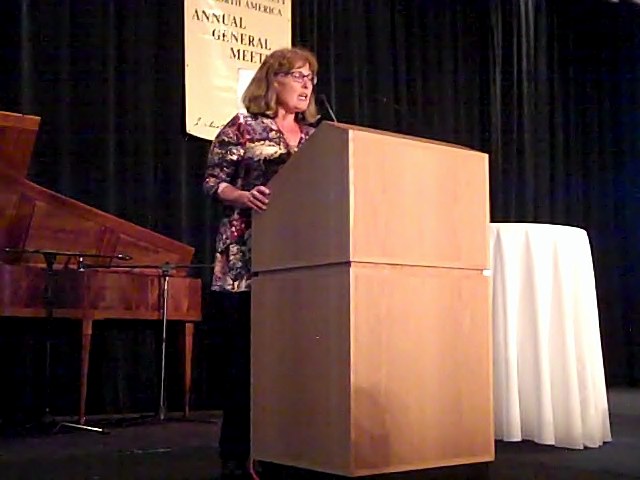
Susannah Fullerton discussing Dirty Dancing in Jane Austen’s Ballrooms at the JASNA AGM 2012 Brooklyn, NY

Today Pride and Prejudice is big business. There is the tourism it has engendered – theme tours, sightseeing in houses where films were made, swimming in a certain lake, and travel to Jane Austen museums and centres. And there is marketing – you won’t believe what items Pride and Prejudice has inspired, from soaps to clothes pegs, skateboards to romper suits. Pride and Prejudice sells things, and manufacturers have given full vent to the fancy in creating literary merchandise from the novel.

And, finally, what of Pride and Prejudice in the future? In this age of kindles and Ipads, audio versions and information on the internet, what will the future of this adored novel be? I had to speculate of course, but see if you agree with me?

Celebrating Pride and Prejudice: 200 Years of Jane Austen’s Masterpiece is, if I say so myself, a very beautiful book. The illustrations are just gorgeous and were chosen with great care, and the book is a pleasure to hold. I hope you will also love its content! I am thrilled that it has also been published by Voyageur Press, an American publisher and that I have been invited to do a lecturing tour in the USA next year to talk about it. I wrote this book for every person who has fallen in love with Pride and Prejudice , who has read and re-read it, discussed all the film versions, and who feels that Elizabeth and Darcy are a part of their lives. I do hope you will want to read it and will join me in celebrating the fact that Pride and Prejudice has lived ‘happily ever after’ for 200 years!

Susannah Fullerton
President, Jane Austen Society of Australia

Preorder the book at Amazon.

Hardcover: 240 pages
Publisher: Voyageur Press (January 1, 2013)
Language: English
ISBN-10: 0760344361
ISBN-13: 978-0760344361

Read Full Post »

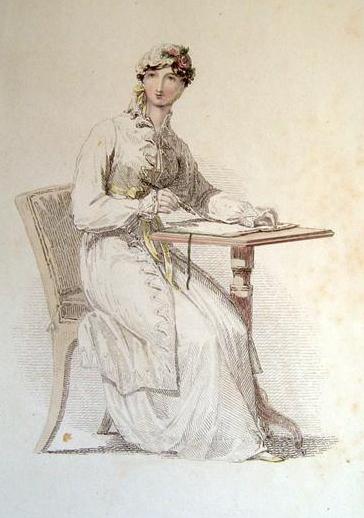
Lady writing at her desk, 1813, Ackermann fashion plate, morning dress.

It is a truth universally known that during her lifetime, Jane Austen published her novels as “a lady.”  While some in the family knew about her writing success – her brother Henry and sister Cassandra swiftly come to mind – many did not, including the cousins. When a genteel woman like Jane was described as being at “work”, the phrase meant needlework and sewing clothes for the poor basket. A lady simply did not sully her hands by toiling at a trade. Jane did not want it bandied about that she was the author of Pride and Prejudice or Sense and Sensibility, but her proud siblings, Henry in particular, couldn’t restrain themselves and bragged about their talented sister.  The word got out and the least well-kept secret was the name of the lady who wrote those delightful novels.

James Edward Austen, the son of Jane’s eldest brother James, and a favorite nephew of hers, discovered at school in 1813 that his favorite aunt was the author of two novels he had enjoyed immensely. The 11-12 year-old was so delighted with the news that he penned an enthusiastic poem about his discovery and sent it to her:

To Miss J. Austen

No words can express, my dear Aunt, my surprise
Or make you conceive how I opened my eyes,
Like a pig Butcher Pile has just struck with his knife,
When I heard for the very first time in my life
That I had the honour to have a relation
Whose works were dispersed throughout the whole of the nation.

I assure you, however, I’m terribly glad;
Oh dear! just to think (and the thought drives me mad)
That you made the Middletons, Dashwoods, and all,
And that you (not young Ferrars) found out that a ball
May be given in cottages never so small.
And though Mr. Collins, so grateful for all,
Will Lady de Bourgh his dear Patroness call,
‘Tis to your ingenuity he really owed
His living, his wife, and his humble abode.

James Edward Austen as a young man.

When Edward Austen-Leigh, as he became later known in life, was 72, he penned his now famous Memoirs of Jane Austen,  leaving a legacy of the memories that he and his cousins retained a half century after her death. Had Edward not embarked on this quest, his memories (he was 16 when Jane died), and those of Caroline Austen and Fanny Knatchbull, might not have been captured in print. While his book preserved those fading memories, they also “sanitized” his aunt Jane’s reputation, erasing much of her sharp tongue and wit and replacing it with sweetness of character:

The grave closed over my aunt fifty-two years ago; and during that long period no idea of writing her life had been entertained by any of her family. Her nearest relatives, far from making provision for such a purpose, had actually destroyed many of the letters and papers by which it might have been facilitated. They were influenced, I believe, partly by an extreme dislike to publishing private details, and partly by never having assumed that the world would take so strong and abiding an interest in her works as to claim her name as public property. It was therefore necessary for me to draw upon recollections rather than on written documents for my materials; while the subject itself supplied me with nothing striking or prominent with which to arrest the attention of the reader…

Edward Austen-Leigh at the time he wrote Memoirs of Jane Austen

The motive which at last induced me to make the attempt [to write this memoir] is exactly expressed in the passage prefixed to these pages. I thought that I saw something to be done: knew of no one who could do it but myself, and so was driven to the enterprise. I am glad that I have been able to finish my work. As a family record it can scarcely fail to be interesting to those relatives who must ever set a high value on their connection with Jane Austen, and to them I especially dedicate it; but as I have been asked to do so, I also submit it to the censure of the public, with all its faults both of deficiency and redundancy. I know that its value in their eyes must depend, not on any merits of its own, but on the degree of estimation in which my aunt’s works may still be held; and indeed I shall esteem it one of the strongest testimonies ever borne to her talents, if for her sake an interest can be taken in so poor a sketch as I have been able to draw.

Bray Vicarage:
Sept. 7, 1869.

Read Full Post »

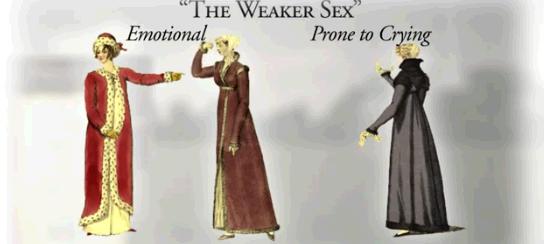
Inquiring readers, Josh Kurz, an independent filmmaker, just finished a piece for the Chemical Heritage Foundation, A Distillations Explainer about tears. This funny yet educational two-minute segment features Elizabeth Bennet. Thanks, Josh, for pointing me to your video.

There is evidence to suggest that crying relieves stress. While Elizabeth Bennet is not some namby pamby miss, she does produce three kinds of tears: Basal tears, reflex tears, and emotional tears with added proteins. This short video will explain all three.

Elizabeth Bennet played by Carla Rosati. Brought to us by “Distillations: We Tell the Story of Chemistry”. Directed by Josh Kurz.

If women cry from emotion, it is to their benefit!

Read Full Post »

“there seem to be very few, in the style of a Novel, that you can read with safety, and yet fewer that you can read with advantage.”- Sermons to Young Women, James Fordyce, 1766

It’s no secret that Jane Austen’s family were novel readers during an age when such books were considered frivolous and not worthy of reading. (Writing a novel was considered an even worse offense!) Enter Jane Austen and Pride and Prejudice. In her delightful book, Jane created a satiric scene in which Mr. Collins confirmed Mr. Bennet’s opinion of his young cousin’s foolishness. After he enjoyed the younger man’s inanity for a while, Mr. Bennet proposed that Mr. Collins read to the group. The girls chose a novel, of which Mr. Collins disapproved:

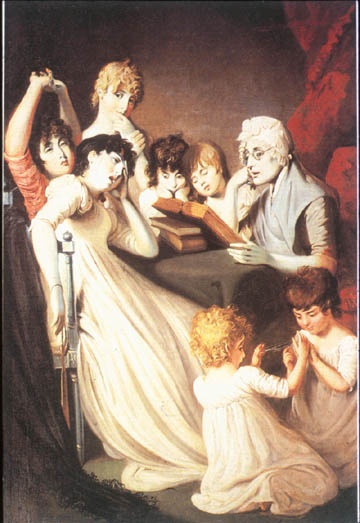
John Opie, "A Moral Homily"

John Opie, “A Moral Homily”

Mr. Bennet’s expectations [regarding Mr. Collins] were fully answered. His cousin was as absurd as he had hoped, and he listened to him with the keenest enjoyment, maintaining at the same time the most resolute composure of countenance, and, except in an occasional glance at Elizabeth, requiring no partner in his pleasure.

By tea-time, however, the dose had been enough, and Mr. Bennet was glad to take his guest into the drawingroom again, and, when tea was over, glad to invite him to read aloud to the ladies. Mr. Collins readily assented, and a book was produced; but on beholding it (for everything announced it to be from a circulating library), he started back, and begging pardon, protested that he never read novels. Kitty stared at him, and Lydia exclaimed.—Other books were produced, and after some deliberation he chose Fordyce’s Sermons. Lydia gaped as he opened the volume, and before he had, with very monotonous solemnity, read three pages, she interrupted him with—

“Do you know, mamma, that my uncle Philips talks of turning away Richard; and if he does, Colonel Forster will hire him. My aunt told me so herself on Saturday. I shall walk to Meryton to-morrow to hear more about it, and to ask when Mr. Denny comes back from town.”

Lydia was bid by her two eldest sisters to hold her tongue; but Mr. Collins, much offended, laid aside his book, and said—

“I have often observed how little young ladies are interested by books of a serious stamp, though written solely for their benefit. It amazes me, I confess;—for, certainly, there can be nothing so advantageous to them as instruction. But I will no longer importune my young cousin.”

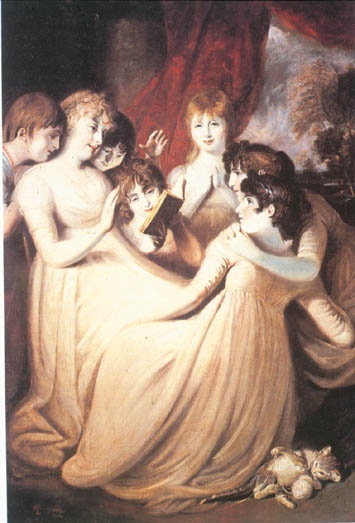
John Opie, “A Tale of Romance”

One cannot but help enjoy the irony of the situation. During his lifetime, Dr Fordyce was considered an excellent orator and his sermons were much appreciated, but by the time Jane Austen began to write her novels his luster had dimmed and novel reading was becoming more acceptable. These wonderful paintings by John Opie represent both sides of the sermon/novel story. In the first painting the governess is reading boring homilies to her charges in the hope of educating them. She is completely unaware of their expressions. One girl yawns, another can barely keep her eyes open, and a third looks pensively at the viewer as if to say, “Can you believe this?” Two of the youngest children entertain each other by playing cat’s cradle, and the girl sitting nearest the reader is about to fall asleep. What a wonderful tableau! One can imagine that the Bennets must have looked much like this ensemble before Lydia blurted out her question.

The second painting depicts the delight that the ensemble takes in listening to a tale of romance. They are all engaged and smiling and hanging onto every word from the reader. A kitten is left to play with a wool ball by itself.

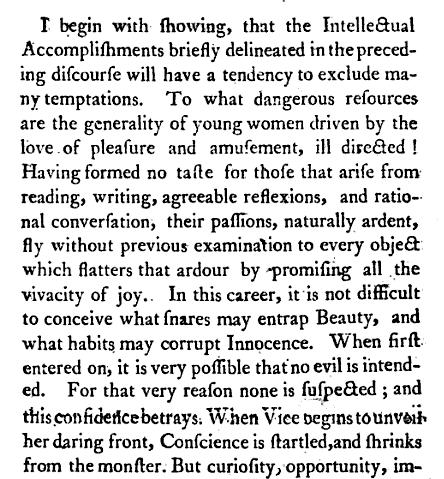
Jane Austen employed words to create an ironic tone; John Opie used images. Both used their respective mediums to make a memorable point. Today, Dr. Fordyce’s sermons are largely forgotten. The following excerpt from Sermon VIII, Volume 2 demonstrates why he was considered dull and stodgy even 200 years ago:

Sermons to Young Women, Volume 2, James Fordyce, 1767. You can download the volume as an ebook at this link.

Read Full Post »

« Newer Posts - Older Posts »