Feeds:
Posts
Comments

Archive for the ‘Regency Customs’ Category

Copyright (c) Jane Austen’s World.

Hear what a male writer has observed on the fashion of exposing the bosom! A woman, proud of her beauty, says he, may possibly be nothing but a coquet: one who makes a public display of her bosom, is something worse.” – The Mirror of  Graces, by A Lady of Distinction, 1811, p. 120

Could the above statement possibly be true in light of our modern assumptions that the Georgian bossom was displayed in all its soft glory for all to see?

Waiting on the ladies

Our modern perception is heavily influenced by the caricatures of the period that make fun of unrestricted Regency gowns. But how much did contemporary cartoonists exaggerate? And what sort of woman would have exposed her bosom to such an extent that she would have been regarded as worse than a coquet? To be fair, the above image depicts a time (the 1820s) when the waist had gone as high as it could go under a woman’s bosom, skirts had widened and become conical shaped, and hems were festooned and decorated and shortened to reveal slippers and ankles.

Regarding the bosom, the proof is in the pudding, and the best way to assuage our curiosity is to view contemporary examples year by year.

From left, upper row: 1794-1795 walking gowns. 1795-1800 round gown. From left, lower row: 1797 Countess of Oxford. 1798, round gown.

Gentle reader, as you peruse the gallery of images, please look for a pattern. You shall begin to see a distinction between day and evening dress, regardless of the time of year.

1st column, top: 1800, Salucci family. Bottom: 1800 V&A gown. 2nd column, top: 1801 April day gowns. Bottom: 1801 Marie Denise Villiers

While I believe that a variety of cleavages were on display during the Regency era (and I shall delve more into this topic later), the top left portrait of Mrs. Salucci is one of the few instances in which a shadowed cleavage is clearly painted or drawn.

1802 Bosoms. Top right: Princess Augusta. Other two images from Ladies Monthly Museum.

Why is this? One can safely assume that a voluptuous woman with large breasts, even when wearing a dress with a modest neckline, would reveal some cleavage. Thin girls or women with small bosoms would not have as much difficulty following the rules of decorum. Before the 20th century, the feminine ideal was a woman whose curves were bounteous and whose figures were pleasingly plumb. Rich husbands and fathers were proud to show off their well-fed women. Only the poor, who toiled all day and never had enough to eat, or the sick, or those who were metabolically overchallenged, were thin and scrawny. Thus, it made sense that during the Regency heaving bosoms were de rigueur. But were they?

In this image I have included both French, English, and American gowns. Left to right, clockwise, starting at the top. 1803, Costume Parisien. 1803, Mirroir de la Mode. 1805, American neoclassical gown. 1805, English cotton muslin, Kyoto costume Institute. 1804, three French Promenade dresses.

Regardless of nationality, a woman could choose to be as modest (or daring) as she liked. As far as I can tell from fashion images and portraits, modesty won hands down. High necklines, chemisette inserts,  and high collars ruled the day. But night provided a different story.

1806 gowns. Top left, Binney sisters. Top right, Opera and drawing room gowns. Bottom image, Lady Codrington.

In the above composite image of 1806 gowns, more of the bosom is revealed than in previous images. Consider the sources. The Binney sisters and Lady Codrington, who were sitting for their portraits, would have chosen their best gowns to wear. Full dress, or evening dress, revealed more skin. The third image also depicts evening wear. In those two images you can more readily understand why empire gowns created such a stir at first:

Observers of the period frequently deplored the absence of modesty conveyed by a style that was predicated on the prominence and exposure of the breasts and on the barely veiled body….Sheer, narrow dresses … caused a sensation at the beginning of the nineteenth century, more because of their contrast with the elaborate hooped costumes of previous decades than for any real immodesty. – Source: Two dresses [French] (1983.6.1,07.146.5) | Heilbrunn Timeline of Art History | The Metropolitan Museum of Art

1807 Regency gown fashion plates

By now you have seen enough examples to have noticed a trend. Examine the above fashion plate images. Which necklines belong to full dress, or evening gowns, and which belong to day gowns or walking gowns? Of the five necklines, only the top left can be construed as revealing. And this neckline, depending on the size of the woman’s breasts, could be both modest or plunging.
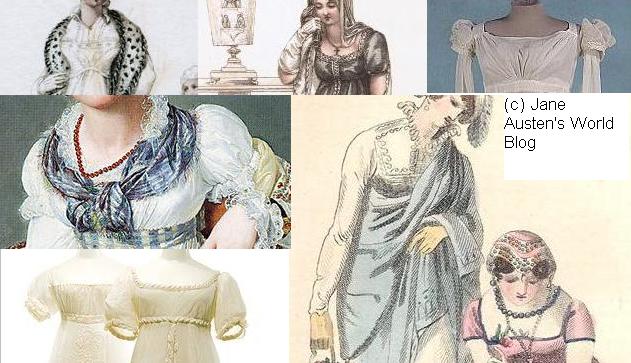
1810 Regency gowns

The 1810 Regency gowns demonstrate a variety of necklines and layers of clothing. As in Cassandra’s portrait of Jane Austen,  chemissetes were widely used. Fichus, shawls, tippets, and pelerines were also popular. The widow in the evening mourning gown (top middle) wears a cross that lies inside her cleavage. The white embroidered gowns (top right and lower left) demonstrate how the neckline is determined by whether the gown is worn for day (top right) or for evening (lower left, image of French gowns, Metropolitan Museum of Art.)
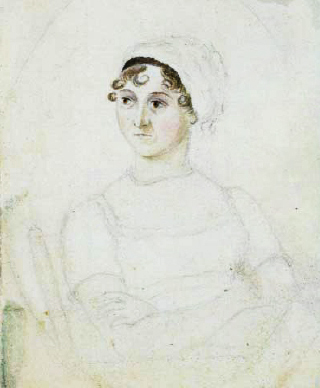
Jane Austen by Cassandra, 1810

In the image painted by Cassandra, Jane wears a simple gown, much like the Binney sisters were wearing. You can observe her chemisette under the low neckline, which created a more modest look for day time.
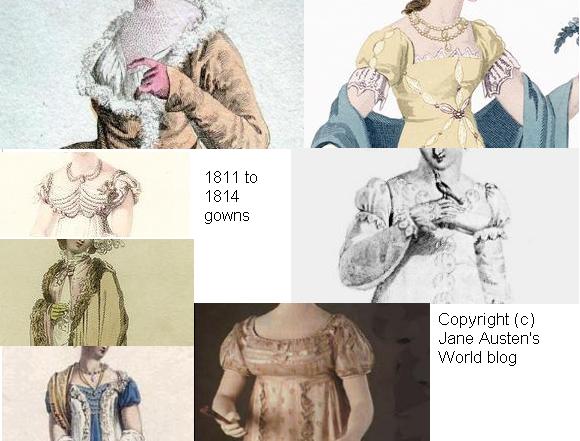
Regency gowns, 1811-1814

Princess Charlotte’s 1814 bellflower court gown (lower right), while breathtaking, did not reveal her bosom. The image of the 1812 full dress (second from top on the left) is a bit misleading, for the decorative drooping elements give the illusion that the neckline is lower than it actually is.  (In this example, it is hard to see the line of the silk fabric running across the top.) The other day gowns cover the torso quite modestly.
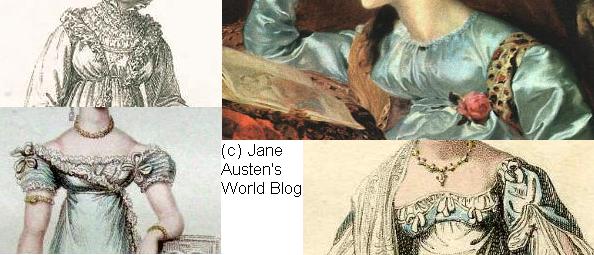
1815-1816 Regency Gowns

The high necklines of the 1815 morning gown at top left and Mrs. Jens Wolff’s 1815 satin dress at top right would make a Quaker lady proud. The two 1816 evening gowns show a relatively modest neckline (lower left) and one that could be quite daring (lower right).

Until now I have not discussed the role that corsets played in propping up the bust line. Regency stays, which were darted and laced in the back, were quite short and were much less constricting than earlier Georgian models that cinched in the waist. The purpose of the Regency stay was to support a woman’s bust and create the distinctive Regency “shelf” silhouette.
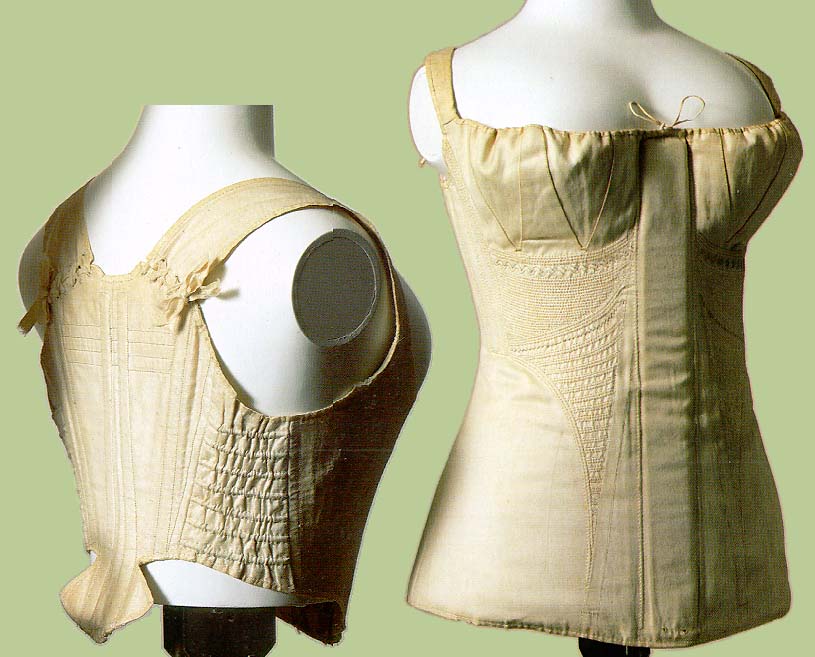
1819 stays (short on left, long on right with inserted busk). Image @ Kyoto Costume Institute

A rigid wood or bone busk, which served to separate the breasts and encourage good posture, was inserted in the stays (or corseted petticoat).
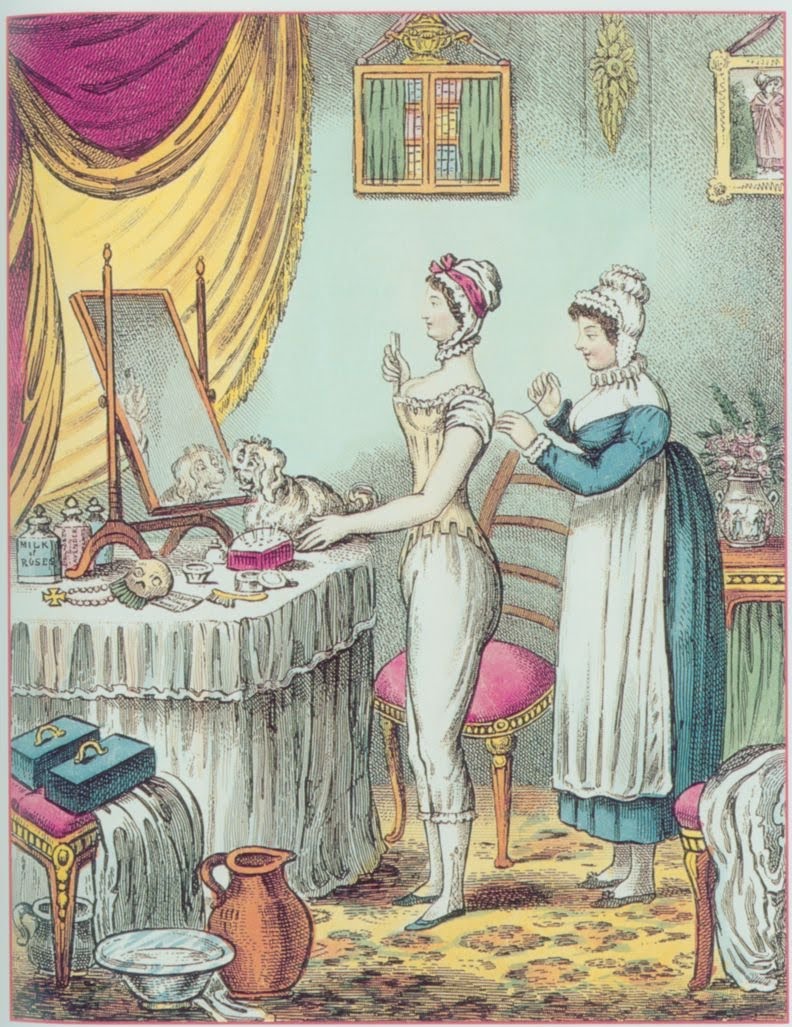
1810 German copy of James Gillray's cartoon. The lady inserts her busk as her maid ties her stays.

Busks might provide one explanation of why so few drawings and paintings of the era depict a deep, shadowed cleavage, for the breasts were splayed aside. The busks were often hand-carved and decorated by a woman’s sweetheart. The exerpt from a poem entitled: On a Juniper Tree, cut down to make Busks, waxes eloquently about the tree’s sacrifice for beauty.

She cut me down, and did translate,

My being to a happier state.

No martyr for religion died

With half that unconsidering pride;

My top was on that altar laid,

Where Love his softest offerings paid:

And was as fragrant incense burned,

My body into busks was turned:

Where I still guard the sacred store,

And of Love’s temple keep the door.
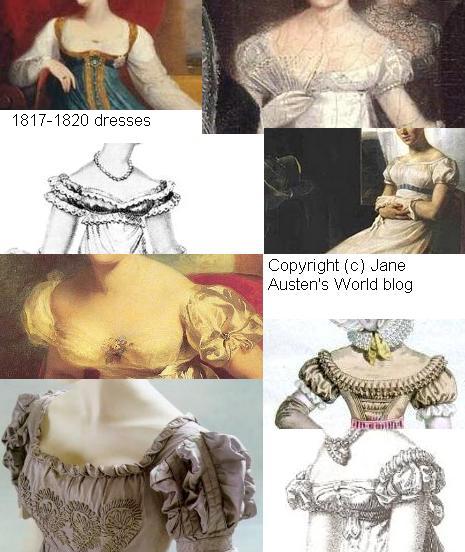
1817-1820 dresses

By 1817, the stark neoclassical outlines of empire gowns at the turn of the century had given way to a fancier more decorative outline, in which embellishments were added both at the top of the gown and at its hem. The 1817 portrait of Princess Charlotte (top left) is bittersweet, for she died in fall of that year in childbirth. Once again, the popular princess fails to exhibit her cleavage.

Rolinda Sharples’ painting of the cloak room at Clifton Assembly Rooms (top right) shows a woman with a small bust wearing a low décolleté ball dress. Countess Blessington (second from bottom, left) also wore a daring neckline for her sitting for her portrait by Thomas Lawrence. The two evening gowns at the bottom are modest, and the 1820 beige walking dress with its high ruff neck demonstrates the Tudor influences in dress embellishments. Also note the lowered waistline.
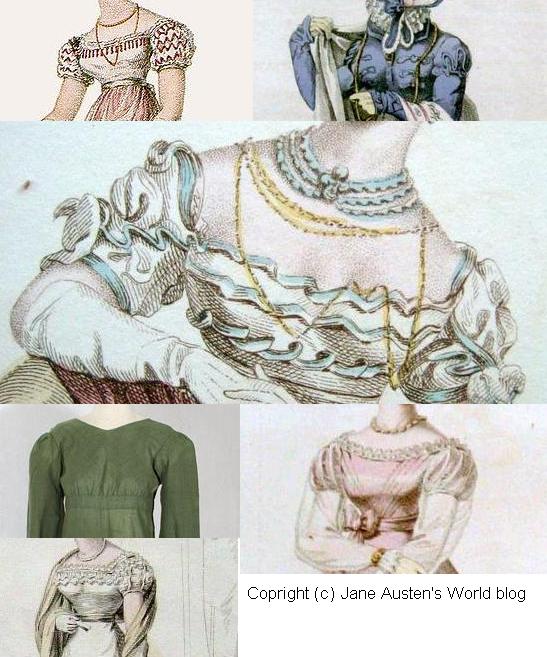
1823-1825 dresses

By 1823, Jane Austen had been dead for six years. She would have been shocked to see how many furlebows, tucks, rows of lace, and ribbons decorated ladies gowns. At this time, the waistline was gradually lowering back to its natural position. Gone was the neoclassical Regency empire silhouette. Note how the three ball gowns shown in this series of images provide hardly any chance for a lady to show off her cleavage.

One can see the hint of shadow of the woman’s breasts in the large 1823 La Belle Assemblee image in the center and how the artist accommodated the influence of the busk. I included the plain every day green 1825 American gown to show the kind of dress an ordinary woman would sew for herself and wear.

I hope this post has cast a light on a Regency lady’s bosom. A Lady of Distinction wrote in 1811:

Let the youthful female exhibit without shade as much of her bust as shall come within the limits of fashion, without infringing on the borders of immodesty. Let the fair of riper years appear less exposed. To sensible and tasteful women a hint is merely required.”

A tasteful hint? I can only conclude that exposing too much of one’s bosom was not considered lady-like behavior. Thin and small breasted women experienced an easier time following society’s strictures. The well-endowed had a tougher row to hoe, although an enterprising young virgin could always insert a handy nosegay to hide her feminine bounty or add  a pretty bow or a lace embellishment at the precise spot where a gentleman’s eyes should not stray.

Brazen hussies, light skirts, and women of easy virtue could bare as much skin as they pleased, having no reputation to protect. A very rich matron, whose place in society was secure, might be tempted to show more of her bosom than was prudent, but even she would refrain from displaying too many of her feminine allures before she was married!

Next, I will discuss heaving bosoms in Regency films and on book covers, and how the two media have influenced our perception of Regency bustlines.

More on the topic:
Read Full Post »


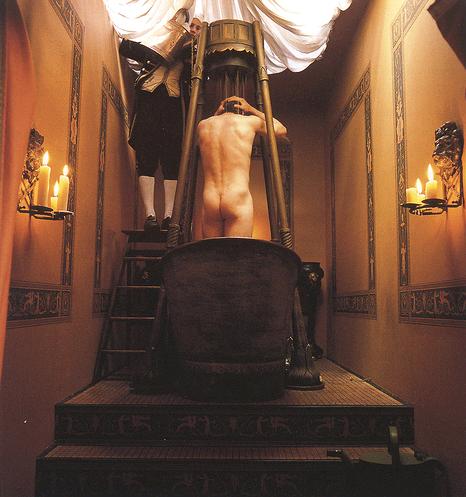
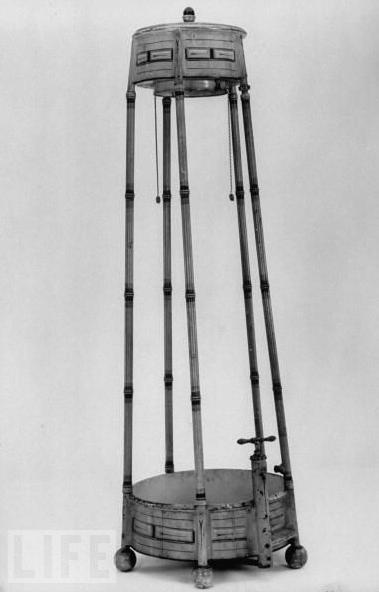
Copyright (c) Jane Austen’s World. Take a good look at this contraption. Life Magazine gave it the following description:

A treasury of old tubbery, Regency shower 12 feet high was a fancy bathing apparatus in England around 1810, pump lifted water from tank at bottom through pipe to top tank, water could be used over and over again.” – Life Magazine image

Readers familiar with the Regency era know that attitudes towards bathing and hygiene were on the cusp of change. In the early 18th century, a person might wash their face and hands daily, but at the most they would bathe every few weeks or months. Towards the end of the century, cleanliness was no longer regarded as frivolous by a growing number of people. Beau Brummel was a particular proponent of bathing and his affectation for cleanliness became the dandy’s creed. Others began to associate bathing with good health.

Washing made a comeback in the later 18th century. The age of revolution and romanticism valued simplicity and naturalness, and water – in the form of mountain torrents and medicinal springs – became fashionable. Rousseau recommended bathing children in ice-cold water, winter and summer, and a sophisticated clientele sought to relieve its frayed nerves and overtaxed digestions by taking the waters at spas. John Wesley, the founder of Methodism, who invented the phrase “Cleanliness is next to godliness”, wrote a manual claiming that cold baths had been known to cure blind-ness and leprosy, as well as “hysterick cholik” in ladies. – Review of Clean, An Unsanitized History of Washing

Image from Regency House Party.

The Americans echoed the British attitude towards cleanliness:

Until the last third of the 18th century, bathing practices were not clearly defined or categorized. The perceived effects on the body of the cold and warm bath were debated regularly in prescriptive literature, as were reasons for bathing in the first place. Motives for bathing changed somewhat over time, and different methods had specific connotations: did one bathe for pleasure, as a restorative of good health, for leisure and/or hot weather refreshment, as a luxurious display, or for actual, bodily cleanliness? Whatever the motivation, it was then up to the bather to decide whether she or he adhered to the cold or warm water method. – Bathing, Monticello.org

The pump is evident in this portable bath shower from the mid 19th c.

If a person opted to take a shower, the effect was at first quite bracing, for only cold water was used with this fairly new contraption, invented  in 1767)by William Feetham. In the image from Regency House Party, a servant is seen pouring water into the basin, but Feetham’s patented invention included a pump that forced the water to the upper basin and a chain that was pulled by the bather to pour water over himself. The advantage was that less water was used in bathing (A typical bath tub would require from 6-8 buckets of heated water to be carried from the nearest water source and up several flights of stairs). The early shower system’s disadvantage was clear:  the same water would be reused during the course of the shower. Not only did one reuse dirty water, but one felt quite cold during the process.

When the temperature of a bed-room ranges below the freezing-point, there is no inducement . . . to waste any unnecessary time in washing,” wrote Charles Francis Adams, grandson of President John Quincy Adams and brother of historian Henry Adams.  To Bathe or Not to Bathe

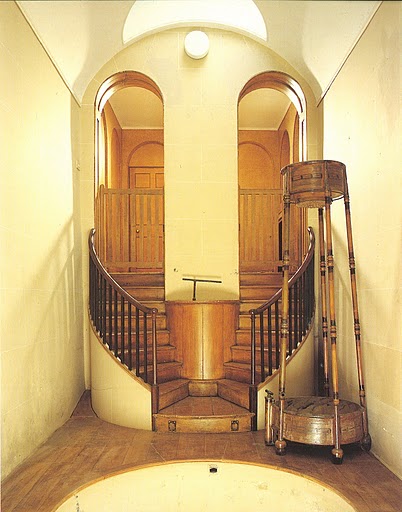
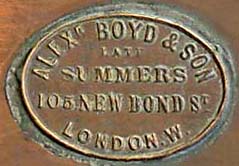
The elaborate bath house at Wimpole Hall, Cambridgeshire, with the shower made by Alexander Boyd of New Bond Street (See their mark below).

Philip Yorke, 3rd Earl of Hardwicke

The bath house at Wimpole Hall was unusual for its day. Around 1792, Sir John Soane designed the plunge pool for the 3rd Earl of Hardwicke. The pool held 2,199 gallons of water that was heated by a boiler below it in the basement.

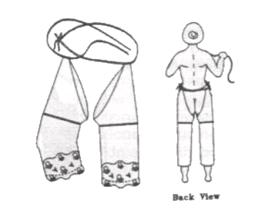
The 10 – 12 ft tall metal supports, or poles, of these showers were painted to resemble bamboo wood and even offered a shower curtain for privacy. To protect their hair, bathers wore a conical hat made out of oil cloth.

Until plumbing with warm water was introduced inside the bathroom, the use of shower baths remained rare. Towards the middle of the 19th century, attitudes began to change.

Plumbers began to introduce indoor plumbing, and inventors experimented with perfecting showering tools and pumping in hot water. Improvements in showering equipment was continuous, as the patent given to William Feetham (below) in 1822 attests:  To William Feetham of Ludgate Hill, in the City of London, Stove grate Maker and Furnishing Iron monger, for his Invention of certain Improvements on Shower Baths, Sealed June 13 1822.

The intention of these improvements is to enable the patient, who is using the bath to regulate the flow of water, and thereby to soften the shower according as inclination or circumstances may require. This object is effected by two contrivances: the first is an adjustable stop, which may be set so as to prevent the cock from turning beyond any certain distance, so as to limit the opening of the water way to any required discharge; the second is a division of the perforated box or strainer into several chambers by two or more circular concentric partitions, by which limited quantities of water let out from the cistern above are necessarily confined to limited portions of the surface of the strainer …  Read more about the patent in The London Journal of Arts and Sciences, Vol. 5, Sherwood, Neely, and Jones, 1823, p284-6.

Feetham's Shower Bath, 1822

The Patentee states: “I do not claim, or intend hereby to claim, as my invention any of the parts which may be already in use, but I do claim the means of regulating the flow of the water from the cock of a shower bath, and also the method of extending, or contracting within central limits, the shower of water at pleasure.”

In December, 1822, Mr. Feetham was granted the patent for the following improvements:

Shower bath patent #4680 granted December 13, 1822

By the 1870’s, even middle class houses began to have hot water pumped in, for the increased rents the landlords were able to command for houses with hot water made it worthwhile for them to invest in plumbing.  Sponge baths were still recommended for “invigorating the system,” and as late as 1875 The Ladies Everyday Book cautioned that it was a great mistake to make a bath a regular event.

Godey’s Ladys Book, a popular ladies magazine in the U.S., reflected the changes in attitude towards bathing (as does John Leech’s 1851 cartoon):

Godey’s, June 1855:
The shower -bath  has the merit of being attainable by most persons, at any rate when at home, and is now made in various portable shapes. The shock communicated by it is not always safe; but it is powerful in its action, and the first disagreeable sensation after pulling the fatal string is succeeded by a delicious feeling of renewed health and vitality. The dose of water is generally made too large; and, by diminishing this, and wearing one of the high-peaked or extinguisher caps now in use, to break the fall of the descending torrent upon the head, the terrors of the shower-bath  may be abated, while the beneficial effects are retained.

Godey’s, March 1858:
The Shower Bath, whether of fresh or salt water, whether quite cold or tepid, is a valuable agent in the treatment of many nervous affections; it will suit some whom the general bath will not. It is well for persons of weak habit, or who suffer from the head, to have a thin layer of warm water put in the bottom of the shower bath  before getting in. Useful hand shower  baths are now manufactured for children.

Domestic Sanitary Regulation, John Leech 1851. In this scene, the shower is installed in the kitchen. The children are wearing the conical caps to protect their hair as they wait their turn wearing blankets, jackets or robes.

More on the topic:
Read Full Post »

Copyright (a) Jane Austen’s World. Gentle Readers, The previous post elicited a question about Regency underdrawers or a lady’s unmentionables. My answer was so long that I decided to create a new post from it.

1742 and 1794 fashion silhouette contrast

Drawers, which made their first serious appearance in 1806, and were fashioned after men’s underdrawers, were still optional during 1810. They would be worn more frequently as the century progressed. Underdrawers were considered risque, for the garments resembled men’s pant legs.  Even if the garments were worn, they did not resemble the pretty underdrawers that we associate with the Victorian era.

Image of early under drawers

As you can see in this image, early ladies underdrawers consisted of two tubes of cloth that were tied to the waist, allowing a woman to, uhm, attend to her business without having to remove too many clothes. In an era without indoor plumbing, this must have been an important consideration.

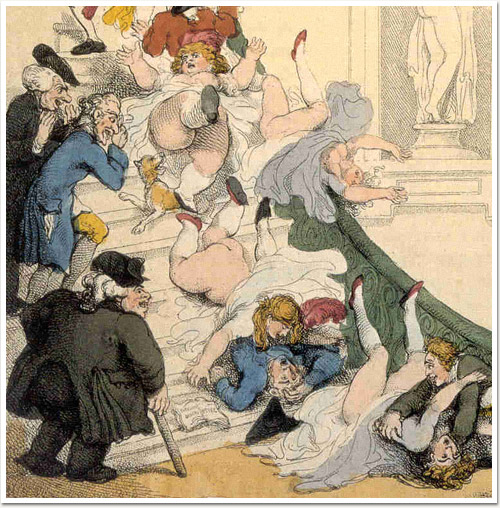
I recently viewed a shameless cartoon by Thomas Rowlandson of a group of travelers (3 ladies and a gent, all family members), who were attending to their calls of nature on the side of the road. Because the image is quite vulgar, which many of Rowlandson’s images tend to be, I will only link to it. From the headdresses that the ladies are wearing, this cartoon was drawn much earlier than 1806. As you can see, no underdrawers obstructed the group from relieving their most pressing needs.

Detail of the Exhibition Staircase, Rowlandson, 1800

Detail of Rowlandson's Exhibition Staircase, 1800

Rowlandson’s Exhibition Staircase cartoon has a given date of 1800. The ladies’ tumble down a steep, crowded staircase forcibly reminds us that underdrawers were still a fashion consideration for the future.

Underdrawers belonging to the Duchess of Kent, 1810-1820. *Image@Regency Society of America Pro Boards

By 1820, wearing drawers was still optional, but by the 1850’s, the caged hooped skirts made them a necessity, for a hoop could be wildly unpredictable. One wrong swinging move or errant gust of wind, and a lady’s most delicate (or indelicate) parts would appear in full view. The 1956 version of The King and I contains one of my favorite scenes in which the King’s wives wear Western dresses for the first time. When the King enters, they immediately drop down to bow to him. Their hooped skirts swung straight up in the air, revealing their bare bottoms and shocking Anna, who had not anticipated such an END (ahem) to her well-meant scheme.

Caged crinoline

Needless to say, by the mid-19th century, ladies wore drawers as a matter of course.

*Regency Society of America Pro Boards

Read Full Post »

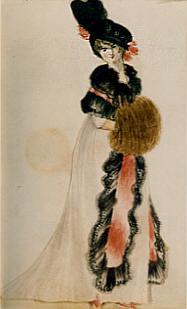
Watercolor by James Stanier Clarke. Thought to be of Jane Austen in 1815, when she visited Carlton House just months before the publication of Emma

Posted by: Tony Grant, London Calling

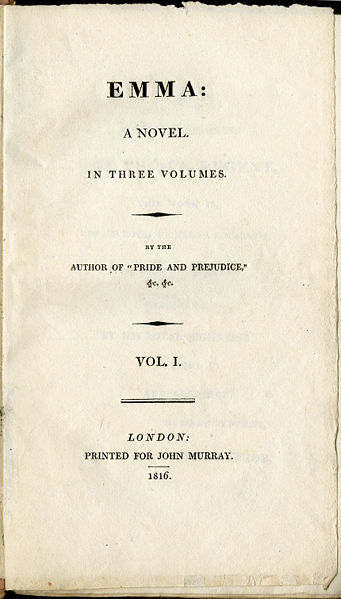
Jane Austen published Emma in December 1815, sixteen years after the French Revolution had ended but during a time when the women of that revolution were campaigning for women’s suffrage and especially for female education. It wasn’t a concept of education that had been considered before for women. Women were always thought unable to think like men. Their minds and brains worked differently on a much more superficial level, apparently. The grave subjects of philosophy, concepts about societies social needs, the study of History,mathematics,science, theology or Latin or Greek, were certainly not encouraged. It was a form of intellectual slavery. Women were kept childlike They were for marrying, procreating, looking after the home, bringing up children and being proficient in the finer arts of sewing, playing the pianoforte, singing, speaking French and being able to shop in a dress shop.

Rouseau and the Marquis de Condorcet (Marie Jean Caritat) in France and Mary Wollstonecroft here in England had different ideas for womens education.These ideas were infiltrating into the thoughts of Englishmen and women. They were the sort of ideas that would change society. I think Jane Austen introduced the character of Jane Fairfax to hint at such radical ideas. Jane Fairfax is an uncomfortable character within Emma. Emma Woodhouse can’t relate to her although they appear to be each others doppelganger, a mirror reflection of each other in many ways. But of course mirror reflections are opposites and you can’t actually become in contact with your reflection. There is a barrier, a layer of glass between you and your reflection. Jane and Emma, seem to exist in parallel worlds that cannot touch.

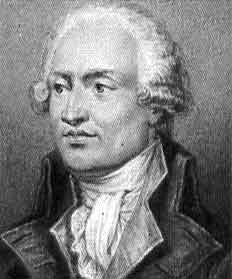
Marquis de Condorcet

Jane Austen, herself was an authoress earning money from what she wrote, but she still remained within the bounds of decent society. Emma is introduced by, “the Author of Pride and Prejudice.” She did not use her name. She was careful enough to dedicate Emma to The Prince Regent when it was suggested she might like to. She followed her urges and her intelligence and her talents but she kept her head down. She herself was critical of the education offered to young ladies and she herself had a horror of the profession of teacher as a result of her own experiences. Towards the end of her life Jane was writing Sanditon. Her heroine, Charlotte Heywood, is perhaps the most radical of her characters, in her views and in her actions. Would Jane Austen have eventually, “come out?”

Jane Fairfax was the daughter of Lieutenant Fairfax, and her mother had been, before marriage, Miss Bates, the youngest daughter of Mrs Bates of Highbury.When her father was killed in action in a foreign country and her mother died soon after of consumption, Jane had returned to live with her grandmother and aunt, her mother’s elder sister in Highbury. However, Colonel Campbell, her fathers superior officer, offered to educate her and bring her up in his own small family to give her all the benefits of education and culture he could provide. Lieutenant Fairfax had been instrumental in saving his colonel’s life years before and being a dear officer and friend, Colonel Campbell felt it his duty to look after his friends daughter, Jane. Here is a passage from Emma describing Jane Fairfax’s education.

“ She had fallen into good hands, known nothing but kindness from the Campbells, and been given an excellent education. Living constantly with right minded and well informed people., her heart and understanding had received every advantage of discipline and culture; and Colonel Campbells residence, being in London, every lighter talent had been done justice to, by the attendance of first rate masters.”

It is interesting to note that Jane alludes to two sorts of education in relation to Jane Fairfax. First she says that she was, “given an excellent education,” and associated with well informed people and received every advantage of discipline and culture. The discipline bit is a little vague. It might refer to personal, behavioural discipline or it might refer to an intellectual discipline of the mind, inquisitive, challenging ideas, thinking. Maybe Jane Austen is being vague on purpose to allay the doubts and fears of the middle class reading masses. But what does Jane Austen mean by “an excellent education?” We know what she means by, “every lighter talent.”

It can only mean one thing. Jane Fairfax had been educated in cultural aspects that might include history, geography, mathematics, science and all the areas of learning usually kept for the great universities and the exclusive education of men.She had had the influence of right minded and well informed people too. Jane Austen herself had undoubtedly been immersed in and influenced by this sort of cultural education by way of her father’s library and erudite discussions with her intelligent and learned brothers.

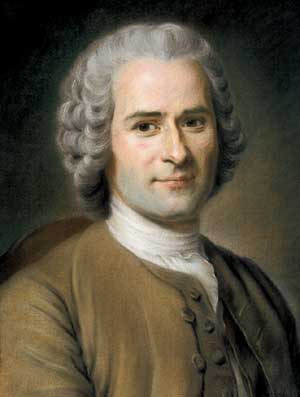
Jean Jaques Rousseau

Jean Jaque Rouseau ( 28th June 1712 – 2 July 1778) was a philosopher and writer.
He thought;

“ The education of women should always be relative to that of men. To please, to be useful to us, to make us love and esteem them, to educate us when young, to take care of us when grown up.”

His idea of education being important to women was so that they could then, in turn, educate their sons. He was only a little on the way to realising the full possibilities and potential for women. He wasn’t for giving women total freedom.

Marie Jean Antoine Nicolas Caritat (1743 – 1794) the Marquis de Condorcet, wanted to go much further than Rouseau with women’s education and freedoms. He wanted universal education as did Adam Smith, Thomas Paine and Thomas Jeffereson. He thought that the advances in reason and science would automatically limit family sizes leaving women the freedoms to expand their talents and energies in other directions. He wanted women to be admitted to the rights of citizenship. A very modern gentlemen. He had to go into hiding for his beliefs.

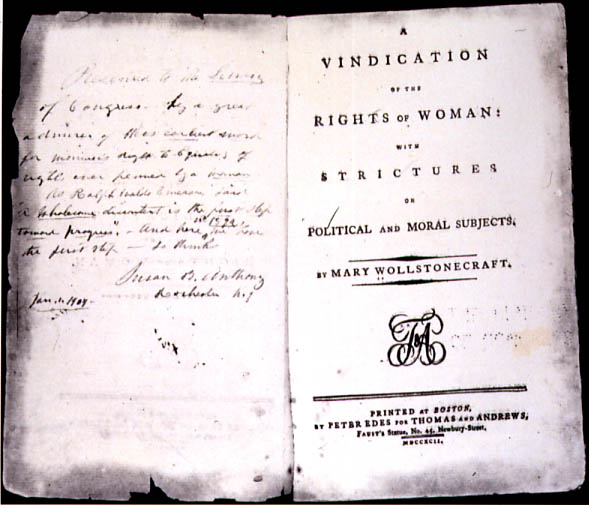
In England there was Mary Wollstonecroft. In the introduction to her “A Vindication of the Rights of Woman,” Mary Wollstonecroft writes,

“Contending for the rights of woman, my main argument is built on this simple principle, that if she be not prepared by education to become the companion of man, she will stop the progress of knowledge and virtue; for the truth must be common to all, or it will be inefficacious with respect to its influence on general practice. And how can woman expected to co operatre unless she knows why she ought to be virtuous? Unless freedom strengthens her reason till she comprehends her duty, and see in what manner it is connected with her real good. If children are to be educated to understand the true principle of patriotism, their mother must be a patriot; and the love of mankind, from which an orderly train of virtues spring, can only be produced by considering the moral and civil interest of mankind; but the education and situation of woman at present shuts her out from such investigations.”

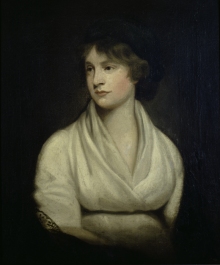
Mary Wollstonecraft

What Mary Wollstonecroft is actually saying here is that men and women need to be equal for the good and progress of mankind and if women are to be the teachers of children they need an education which enables them to think and explore and understand ideas, otherwise she cannot teach those ideas. An argument which cannot be challenged surely. Teachers today have degrees and are expected to have a thorough knowledge of their subjects and to be able to think and be creative.

How does this bring us back to Jane Fairfax? Jane Fairfax has had an, “excellent education,” and she appears to be evasive. It might be more a case of her having to be evasive as a means to survival. Emma Woodhouse cannot form a close relationship with her. As the novel unfolds we learn Jane is breaking societies strongest taboos. She and Frank Churchill are a match made in the realms of a freedom not acceptable in the England of those times. They are of a different economic and class backgrounds. Frank Churchill’s guardian, Mrs Churchill, while alive, would never condone such a relationship. Jane and Frank keep it secret and have to resort to all manner of subterfuge. Emma Woodhouse, in all her plans and manoeuvrings, and imaginings is defeated. Jane Austen is delving into areas that are perhaps closer to her own heart than she may well want to admit out right. In her final novel Sanditon, I think the way the character of Charlotte Heywood develops Jane was becoming more outspoken in her views about hypocrisy and the role of women in society. If Jane had lived into old age, with societies changes becoming more rapid with the industrial revolution, she might have become a champion of womans rights herself.

Finally, Jane Austen resolves the dilemmas, in a sort of Midsummer Nights Dream way. Characters find their true loves and permission is given, after Mrs Churchill’s death, for Frank and Jane to marry. So we have a happy ending for everybody. In a way, because Jane rounds everything off too nicely, as modern readers used to the full force of rough reality in the modern classic novel, perhaps we itch for Jane Austen to have gone the full hog. But, written as it was in the Georgian period, it was brave enough to allude to these issues. Jane couldn’t resist her true beliefs, really.

Gentle Readers, Tony Grant, who lives in England and oversees the blog, London Calling, wrote this most timely post. At the turn of the 19th century, women were not allowed to vote. This post points out the harsh realities for our female ancestors just a few generations ago. Regardless of party affiliation, I urge every woman in the U.S. to go to the polls on November 2 and exercise their hard-won freedom to VOTE for the candidate of their choice. – Vic

Images: Wikimedia Commons

Read Full Post »

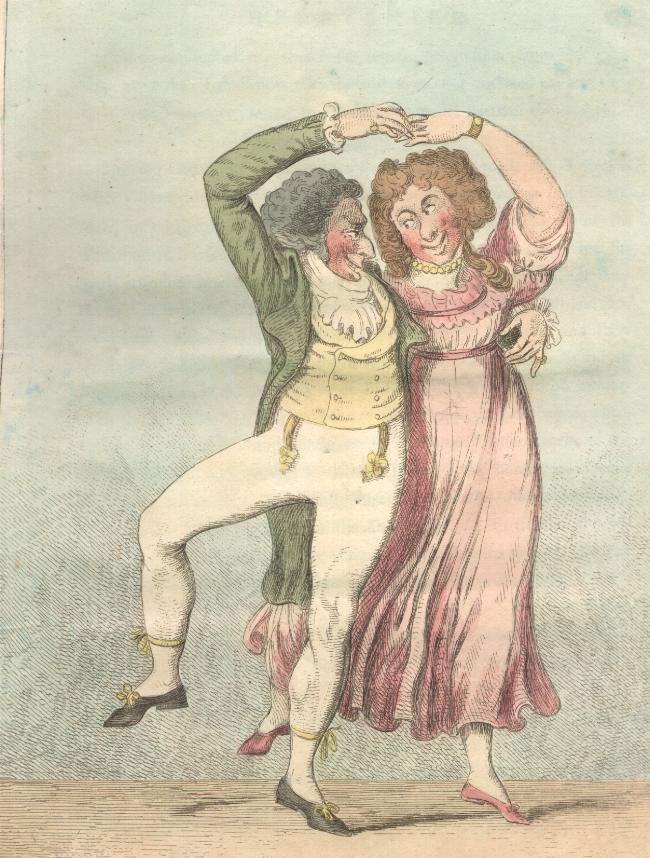
Allemande

Definition of an Allemande -Music:
An allemande (also spelled allemanda, almain, or alman) (from French “German”) is one of the most popular instrumental dance forms in Baroque music, and a standard element of a suite, generally the first or second movement.

Definition of an Allemande – Dance:

A 17th and 18th century court dance developed in France from a German folk dance: a dance step with arms interlaced.

The name ‘country dance’ has nothing to do with country as opposed to town, but comes from the French ‘contre-danse’, describing the way in which the dancers start by standing up facing each other in two long rows, men on one side and girls on the other. The leading couple would then move off down the row, the other couples falling in behind them; there was no fancy footwork involved, but the dancers would weave their way in a variety of patterns across the floor, linking arms or hands with their partners s the figure required – the ‘allemande’figure involved a ‘a great deal of going hand in hand, and passing the hands over heach other’s heads in an elegant manner’. – Jane Austen, The World of Her Novels, Deirdre Le Faye, p. 104.

More on the topic:
Read Full Post »

« Newer Posts - Older Posts »