Feeds:
Posts
Comments

Archive for the ‘Regency Customs’ Category

Martha Gunn, dipper

Martha Gunn, dipper

In a scene in 1998’s Vanity Fair with Natasha Little as Becky Sharp, she visits Brighton with her husband and friends. The film, set during the Regency era, depicted a scene in which one of the party is taken from a bathing machine and dipped into the cold waters by a large woman. The bather floats on her back with her bathing costume billowing from the trapped air. This comical scene was based on fact. Brighton during the late 1790’s early 1800’s  employed some twenty male and female “dippers”” whose jobs were to vigorously dip their clients into the sea and push them through the waves, keeping them afloat, then help them back into the bathing machine.

floating with billowing skirt vanity fair 1998Brighton’s most famous dipper was Martha Gunn, a large, sturdy woman whose fame exists to this day. Bathers were separated by sex, a restriction that remained until 1930 in Brighton, and were drawn  into the waters by horses hitched to bathing machines. The bathers would be inside the vehicles changing into their bathing costumes, or not, for, screened from the world and the opposite sex, they would enter the waters au naturel. The terminology for immersion differed for the sexes. When men immersed men into the waters, it was called bathing. When women immersed women into the waters, they were dipping.

Sea Bathing machine

Sea Bathing machine

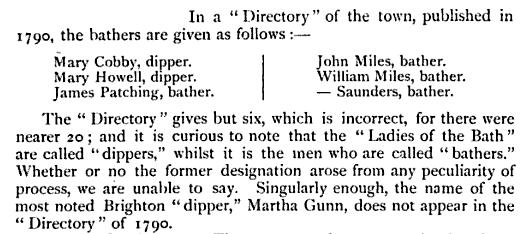
On page 233 in a Directory of Brighton published in 1790 the bathers are listed as follows:
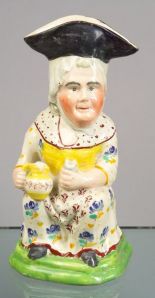
Martha Gunn Toby Jug

Martha Gunn Toby Jug

Born in 1726, Martha Gunn dipped seaside visitors from around 1750 until she was forced to retire through ill health around 1814. She was such a popular figure that the Prince of Wales granted her free access to his kitchens.  The dipper was known as ‘The Venerable Priestess of the Bath’ by the locals. Large and  strong, well known and respected by the townsfolk as well as the visitors, Marth appeared in comic caricatures of the times. “Life for Dippers and Bathers was not easy – standing all day in the sea even in August calls for a tough constitution and Martha Gunn’s ample size was no doubt one of the reasons for her success in the cold waters.” ( Martha Gunn) Mrs. Gunn died in 1815 and is buried in the yard at St Nicholas Church. Her portrait hangs in the tea-room of the Royal Pavilion, and her house still stands on 36 East Street. Her fellow dippers and bathers continued to perform their duties in Brighton until the mid 19th century.

[Dippers] were also technicians of the ritual process: on-site masters of the requirements of the sea-bathing treatment. They judged the waves, the state of their clients, and their daily requirements: bathing at such and such a time or for so long. Many of the bathers could not swim: Dippers, often women, were essential figures of dependable strength and assurance. This might explain the inordinate affection of them. The ritual purging and bathing, the ministrations of the Dipper, and the natural influence of the seashore itself with its salt water, sea air, and ‘ozone’ were vital ingredients in both the reality and perception of a Cure. – Ritual Pleasures of a Seaside Resort, Chris Jenks, p169.

Martha's grave

Martha’s grave

Read Full Post »

“Invite him to dinner, Emma, and help him to the best of the fish and the chicken, but leave him to choose his own wife.” – Jane Austen, Emma

By the time breakfast was served in a regency household, the family had been up for a while. After rising, people would engage in tasks such as letter writing, practicing the piano, taking a walk or riding. In larger households, the cook and maids would busy themselves heating the stove and boiling water. In more modest establishments, such as the Austen household at Chawton, Jane would help with preparing breakfast. A simple repast of toast, rolls, cheese, tea, coffee, chocolate, or ale would be served between nine and ten. The more elaborate breakfast would not be featured until Victorian times.*

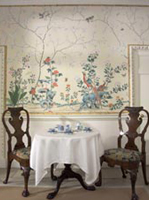
chinoiserieIndividuals would rise early, at around 6:00 in the morning. Within the next half-hour or so, people would start work. Breakfast would be taken later, at around 9:00 and afterwards. The morning’s work would finish with ‘dinner’–probably taken between 12:30 and 14:00. Work continued until late. For some, there was tea in the late afternoon, between 17:00 and 18:00. It would be common not to leave one’s work before 19:00. After the evening meal, people would go to bed at around 22:00 – Time and Work in England 1750- 1830, Hans-Joachim Voth
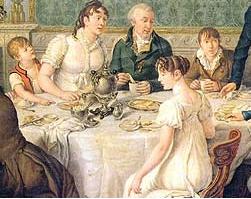
Nuncheon or luncheon was a midday meal served at an inn. For several centuries this meal was simply a snack. Dr. Johnson’s 1755 Dictionary defined luncheon as “as much food as one’s hand can hold.” In the Regency home, such meals had no official name and often consisted of only a cold snack and drink to provide sustenance until the evening meal.*

Morning

food

After breakfast with the children, the first job of the lady of the house would be to talk to the housekeeper. It would be important for them to communicate about the other servants, making sure they were doing their jobs properly and behaving correctly above and below stairs.

They would also discuss the evening meal. If visitors were expected, the lady would choose meals that were lavish and unusual. (They loved showing off) When these matters were dealt with the wife would then check through the household accounts. Bills for meat, candles and flour would usually be paid weekly. When the early morning activities were finished, the social whirl would begin! High society ladies would either receive calls or visit others. Tea would be drunk and snacks eaten.- The Regency Townhouse

During the medieval period dinner was eaten at midday, but this meal was slowly moved up to 3 in the afternoon, then pushed up to five. These meals became elaborate affairs of at least two or three courses, which Louis Simond, a French/American traveler to London, described in wondrous detail in his travel diary. During Jane Austen’s time tea would be served an hour or so after the meal, or from 3-6 o’clock, depending on when dinner was served. Suppers became light snacks, except in the case of a grand ball, where elaborate buffets might be served.

In 1798 Jane Austen writes of half past three being the customary dinner hour at Steventon, but by 1808 they are dining at five o’clock in Southampton. There are many mentions of the timing of dinner in the novels, but none is so explicit as in the fragment The Watsons. Tom Musgrave knows perfectly well that the unpretentious Watson family dine at three, and times his visit to embarrass them, arriving just as their servant is bringing in the tray of cutlery. Tom compounds his rudeness by boasting that he dines at eight: the latest dinner hour of any character. At Mansfield Parsonage they dine at half past four and at Northanger Abbey at five. The effect of London fashion can be seen in the difference between the half past four dinner at Longbourn and that at half past six at Netherfield. – Jane Austen in Context, Janet Todd, p. 264

  • *Jane Austen’s World, Maggie Lane

Read Full Post »

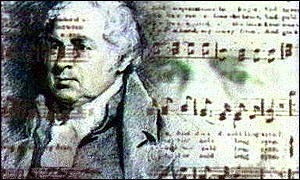
Robert Burns, Auld Lang Syne

Robert Burns, Auld Lang Syne

Midwinter celebrations  have been celebrated in England since ancient times. In Scotland one such celebration was known as Hogmanay; in England it was called New Year’s Eve. The Gregorian calendar marks December 31st as the last day of the year, but New Year’s Day was not always celebrated on January 1st. In Anglo-Saxon England the year started on the 25th of December. The day has also been celebrated  on March 1st, March 25th, and September 24th, depending on which calendar was used. As early as the 17th century,when the legal year began on March 25th,  Samuel Pepys would write about the passing of the old year on December 31st, eighty years before England moved the start of the year to January 1st.

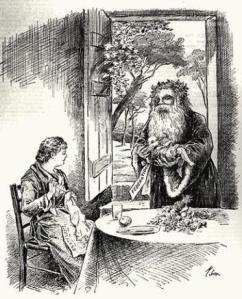
Father time

Father time

Today we sing  Auld Lang Syne at the stroke of midnight. Commonly thought to be written in the 1700s by the poet Robert Burns, who was inspired by earlier renditions, the song was published after his death in 1796. According to the BBC article, Have Old Connections Been Forgot? BBC news story, the song is “now thought that the tune to match the words was part of the overture for Rosina, an obscure operetta written in 1783 by Englishman William Shield, who was born in Swalwell, Gateshead in 1748.” The words Auld Lang Syne literally mean “old long ago,” or “the good old days.”

Since the days of the Romans, the passage of time has been associated with the god Saturn, who is the inspiration of Old Father Time.  Read my other post about New Year’s Eve at this link.

Have a safe and happy New Year’s Celebration!

Read Full Post »

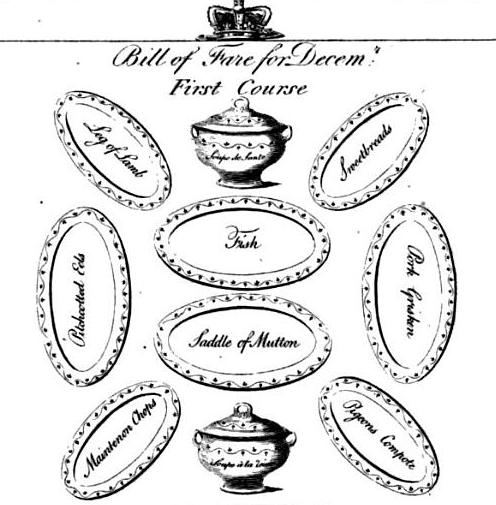
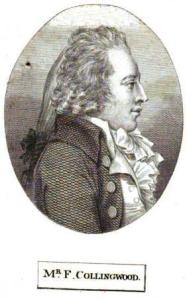
By the end of the eighteenth century, fashionable gentlemen began to dine with regularity in large taverns. As tavern food gained in popularity, the chefs who cooked the fare began to publish their own cookbooks.  These new culinary stars claim not to have learned their trade in a private household, but through methodical study as an apprentice.* The Universal Cook: And City and Country Housekeeper (1792) was written by John Francis Collingwood and John Woollams, the two principal cooks at The Crown and Anchor Tavern in the Strand. In their cookbook, which had the distinction of also being printed in French*, the two chefs discuss the meats, produce, and fruits that were in season. The foods listed below were common for the month of December:
banquet
MEATS
Beef, Mutton, Veal, Pork, House-Lamb, and Doe Venison.

POULTRY
Geese, Chickens, Wild Ducks, Turkeys, Pullets, Pigeons, Capons, Fowls, Hares, Rabbits. Woodcocks, Snipes, Larks, Teals, Widgeons, Dottrels, Partridges, and Pheasants.

First course

First course

FISH
Turbot, Gurnets, Smelts, Cod, Gudgeon, Eels, Sturgeon, Dorees, Codlings, Soles, Cockles, Mussels, Holobets, Bearbet, Carp, and Oysters.

VEGETABLES
Cabbages, Savoys, Potatoes, Skirrets, Garlick, Rocombole, Brocoli, purple and white; Scorzonera, Salfifie, Celery, Endive, Carrots, Leeks, Beets, Parsnips, Turnips, Lettuces, Cresses, All sorts of small Sallad, Onions, Shalots, Cardoons, Forced Asparagus, Spinach, Parsley, Thyme, and  All sorts of Pot Herbs.

FRUIT
Apples, Pears, Medlars, Services, Chesnuts, Hazle Nuts, Grapes, and Walnuts. The Universal Cook And City and Country Housekeeper By Francis Collingwood, John Woollams

Second course

Second course

Preparing the kitchen garden in December

Collingwood and Woollams also devoted a chapter of their cookbook to the kitchen garden. In December there were few plants that continued to grow, so much of their advice is spent on digging the soil in trenches and preparing it for spring sowing; as well as saving cauliflower, broccoli, and artichokes from hard frost.

mr-collingwoodmr-woollams

DUNGING and digging the ground is the principal business to be done in the kitchen garden this month and laying it in ridges to enrich for sowing and planting after Christmas with some principal and early crops for the ensuing spring and summer Dress your artichoke beds by first cutting down any remaining Items …Pay diligent attention to your asparagus hotbeds to keep up the heat of the beds by linings of hot dung and to admit air in mild days… Take up your red rooted beet on a dry day and let them be placed in sand and under cover for use in case of hard frosts… In all moderate weather give air to your cauliflowers in frames  The Universal Cook And City and Country Housekeeper By Francis Collingwood, John Woollams

The Universal Cook’s Bill of Fare for December describes a two-course meal consisting of 16 dishes and two soups. I’ve listed two recipes from the Second Course that use methods and ingredients that are still common:

diningroom-2005Ragout of Celery (From the Universal Cook)
To ragoo Celery, CUT the white part of the celery into lengths and boil it till it is tender. Then fry and drain it, flour it and put to it some rich gravy, a very little red wine, salt, pepper, nutmeg and catchup. Give it a boil and then send it up to table. The Universal Cook And City and Country Housekeeper By Francis Collingwood, John Woollams

*All Manners of Food, Stephen Mennell, p. 99

Other posts about Regency food on this blog:

Read Full Post »

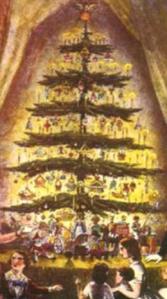
christmas-tree1Fact: Queen Charlotte introduced the Christmas tree to England. Recently I read in Yahoo answers.com that the Christmas tree was introduced to England by Prince Albert, Queen Victoria’s consort. The majority of the readers had “voted” that this must be so. Wrong. While he and Queen Victoria popularized the custom, they did not start the tradition.

In 1800, Queen Charlotte, the German-born wife of King George III and mother of the Prince Regent, placed a decorated yew tree in Queen’s Lodge, Windsor for the children of leading families. She had also arranged a ‘pyramid of toys upon the table’ to hand out as gifts.  Dr. John Watkins, the Queen’s biographer, wrote the following description:

In the middle of the room stood an immense tub with a yew tree placed in it, from the branches of which hung bunches of sweetmeats, almonds, and raisins in papers, fruits and toys, most tastefully arranged, and the whole illuminated by small wax candles. After the company had walked around and admired the tree, each child obtained a portion of the sweets which it bore together with a toy and then all returned home, quite delighted. – Windsor Castle and the Christmas Tree

Another contemporary writer penned this observation:

A fir tree, about as high again as any of us, lighted all over with small tapers, several little wax dolls among the branches in different places, and strings of almonds and raisins alternately tied from one to the other, with skipping ropes for the boys, and each bigger girl had muslin for a frock, a muslin handkerchief, and a fan, and a sash, all prettily done up in a handkerchief, and a pretty necklace and earrings besides.

More about Christmas traditions during the regency era:

On this site:

On other sites:

Read Full Post »

« Newer Posts - Older Posts »