There was nothing romantic about marriage in England before the 17th Century. The institution was viewed as a means of securing or advancing the family fortune. Alliances through marriage were arranged by parents; offspring were regarded as pawns; and couples were often engaged and wed while they were still children.
By the 18th and 19th centuries, the idea of marrying for love was gaining ground, although it was considered déclassé to demonstrate too much passion for one’s spouse. A man proposed to the woman of his choice, but parental approval of the engagement, especially for the woman, still needed to be obtained, for a father could withold a fortune from a daughter, whereas it was out of his power to prevent a son from inheriting his estate. Certain conventions, such as marrying for money, power, or position, did not change. David Shapard writes in The Annotated Pride and Prejudice:
Marriages among the upper classes frequently involved people whose families were related, or allied, in some way, for such marriages could further strengthen the family ties that were so crucial in this society in determining power, wealth, and position, especially among the upper classes. (p 645)
When Lady Catherine de Bourgh confronted Elizabeth Bennet with her suspicions about the younger woman’s relationship with Mr. Darcy, she told her that her daugher Anne had been intended for Mr. Darcy from infancy. By the early 19th century such parental arrangements were no longer common. Lady Catherine refers to this change in the first part of her speech:
The engagement between them is of a peculiar kind. From their infancy, they have been intended for each other. It was the favourite wish of his mother, as well as of her’s. While in their cradles, we planned the union: and now, at the moment when the wishes of both sisters would be accomplished in their marriage, to be prevented by a young woman of inferior birth, of no importance in the world, and wholly unallied to the family! Do you pay no regard to the wishes of his friends? To his tacit engagement with Miss De Bourgh?
A little later, Lady Catherine declares:
My daughter and my nephew are formed for each other. They are descended, on the maternal side, from the same noble line; and, on the father’s, from respectable, honourable, and ancient – though untitled – families. Their fortune on both sides is splendid. They are destined for each other by the voice of every member of their respective houses; and what is to divide them? The upstart pretensions of a young woman without family, connections, or fortune. Is this to be endured! But it must not, shall not be. If you were sensible of your own good, you would not wish to quit the sphere in which you have been brought up.”
Lady Catherine was right. Mr. Darcy’s immense fortune would have attracted the most desirable women in all of Britain. The fact that he proposed not once but twice to Elizabeth gave Pride and Prejudice, to my way of thinking, a Regency fairy tale ending.
Once a woman came out in Society she had but one duty to fulfill: to find a suitable match. Jane Austen wrote about Miss Mainwaring in Lady Susan:
Sir James Martin had been drawn in by that young lady to pay her some attention; and as he is a man of fortune, it was easy to see HER views extended to marriage. It is well know that Miss M. is absolutely on the catch for a husband…” (XIV, Mr. De Courcy to Sir Reginald)
While finding a suitable husband was the ultimate object of a young girl who was coming out, her life after the marriage would not be her own. Once the vows were said, the husband took charge of his wife’s possessions and she would have little say in how he chose to spend her income. Woe betide the poor woman who made a miserable match, or who did not bear her husband male children. In Maria, or the Wrongs of a Woman, a novel written in 1798 by Mary Wollstonecraft about a spectacularly bad marriage, the landlady lamented, “Women must be submissive. Indeed what could most women do? Who had they to maintain them, but their husbands?” (Chapter Thirteen).
Not all marriages led to an unhappy ending, however. The first Duke of Richmond was an inveterate gambler. While staying in The Hague (Holland) in 1719, he lost a huge sum to the Irish Earl of Cadogan. At the time, the earl’s daughter, Sarah, was only thirteen years old. The Earl of March, the duke’s son, was eighteen. To pay off the debt, the Duke of Richmond agreed to an engagement between Sarah and the young earl, and a reduction of 5,000 pounds in Sarah’s marriage settlement. The deal sealed, the wedding was hastily arranged between the girl and the young earl, who had plans to embark on a Grand Tour with his tutor.
It seems almost incredible to our nineteenth century civilization that the marriage of this nobleman when Lord March, during his father’s lifetime, and a mere youth at college, should have been a bargain to cancel a gambling debt which his father was unable to meet. “The young Lord March,” writes Sir William Napier, “was brought from college, the lady from the nursery for the ceremony. The bride was amazed and silent, but the bridegroom exclaimed, ‘Surely you are not going to marry me to that dowdy?’ Married he was, however, and his tutor instantly carried him off to the continent. Lady Sarah went back to her mother, a daughter of Wilhelm Munter, States Councillor of Holland.
Three years afterward Lord March returned from his travels, an accomplished gentleman, but having such a disagreeable recollection of his wife that he avoided home, and repaired on the first night of his arrival to the theatre. There he saw a lady of so fine appearance that he asked who she was. ‘The reigning toast, the beautiful Lady March.’ He hastened to claim her, and they lived together so affectionately that, one year after his decease, in 1750, she died of grief.
The Mothers of Great Men and Women, and Some Wives of Great Men By Laura Carter Holloway, Laura C Langford, 1883
In Aristocrats, Stella Tillyard writes about the union:
Thus in an extreme form, [the 2nd Duke of Richmond and his duchess] acted out the powerlessness of aristocratic children, who could become pawns in a parental chess game, who were sacrificed for family alliances or sold for money and prestige.
When he grew up, [the duke] developed a taste for practical jokes, and came to see his marriage as one of them…He was never ashamed to demonstrate, in portraits, letters and drawing-rooms his love for his wife and children.” (p. 10)
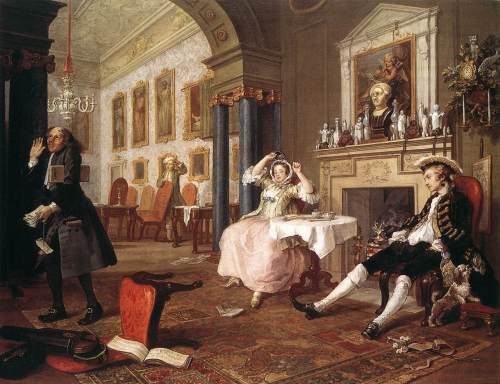
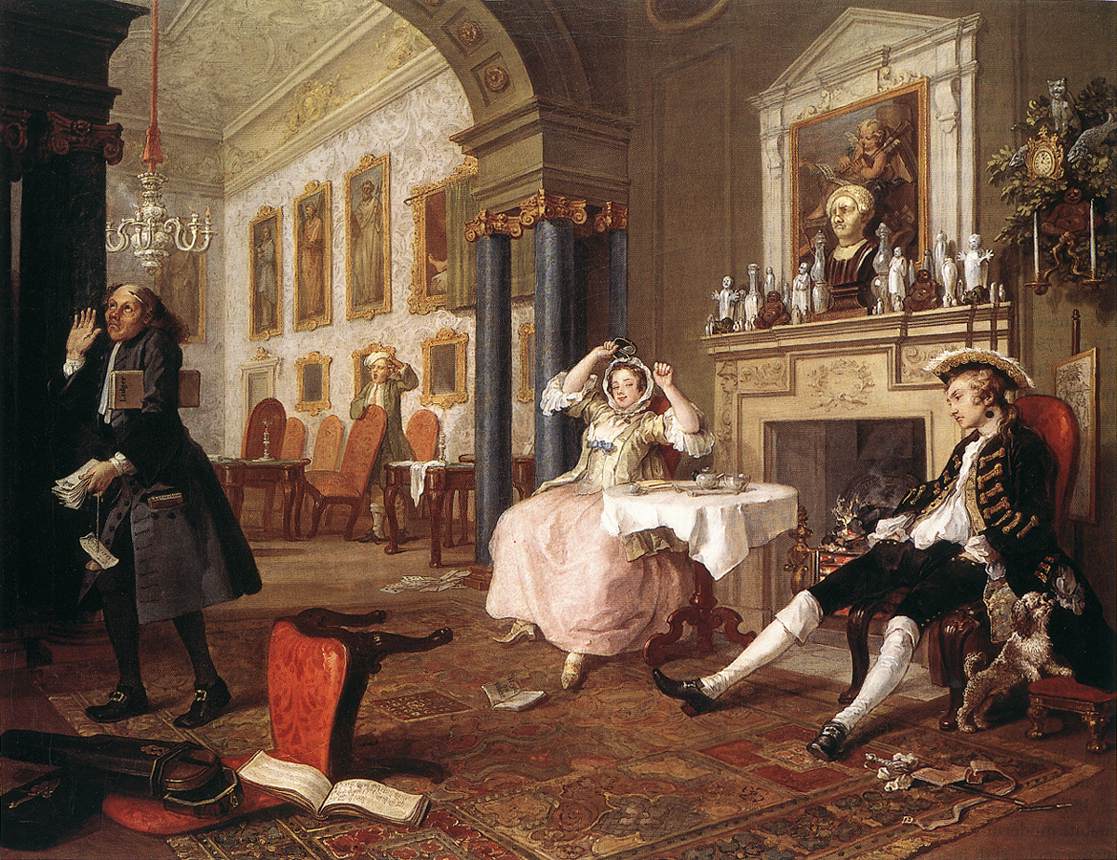
Image: William Hogarth, Marriage à La Mode, Tête à Tête, 1745
Update: Marriage a La Mode, Part 3, The Inspection, Georgianna’s Gossip Guide
Read Full Post »
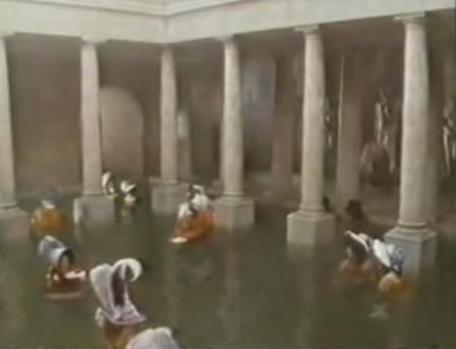 I had always wondered about this hot bath scene in 1986’s Northanger Abbey (click on the link to watch a 2-minute YouTube video) and how accurate it was. I was particularly curious to know if men and women truly mingled in the hot baths, and what kind of items were placed on the floating objects that the bathers held. While Jane Austen did not write this scene in her novel, the scene in the film lent a note of authenticity to Catherine Morland’s visit to Bath.
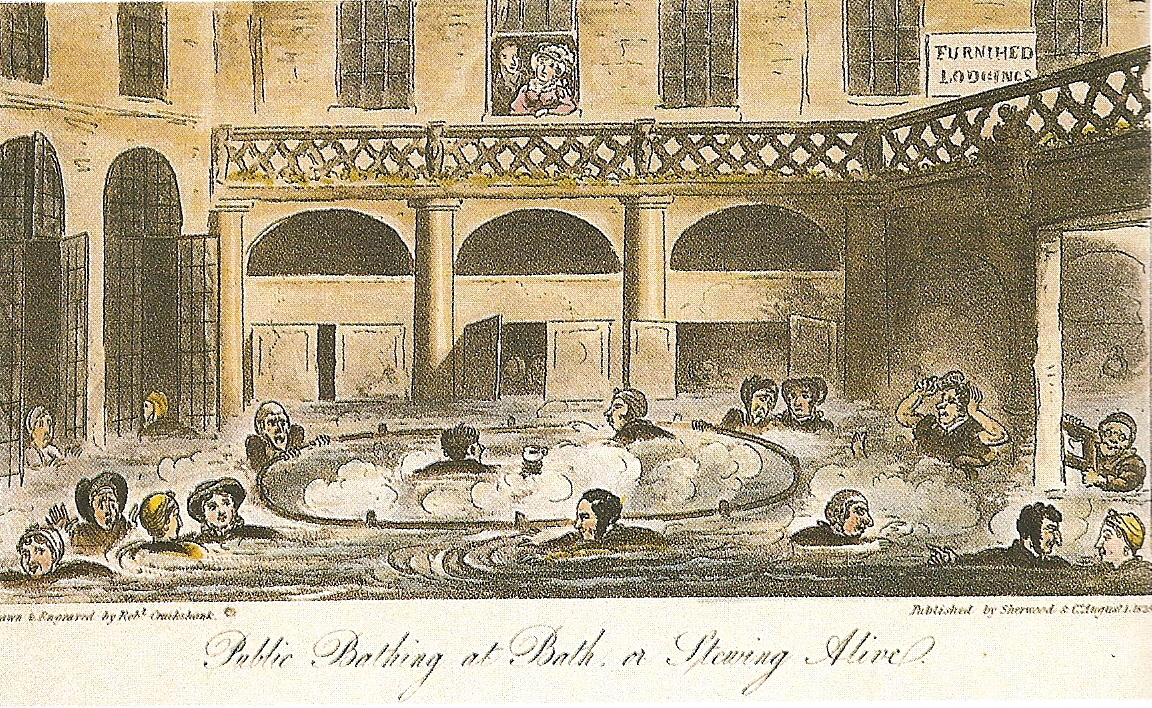
In the eighteenth century pride of place went to the Pump Room, where warm mineral water was sold by the glass, and the King’s Bath. This giant communal cistern was right under the windows of the Pump Room, open to the gaze of all. Patients sat in the bath with hot water right up to their necks. Men were enveloped in brown linen suits. Women wore petticoats and jackets of the same material. They sat side by side in a hot, faintly sulphurous mist.









 Jane Austen's World