Understanding the subtle nuances behind formal introductions and customary greetings during Jane Austen’s lifetime is a lot of fun, and it can provide a unique level of insight into her books. The reason: Austen uses breaches of etiquette and manners as commentaries on her characters. In her book Those Elegant Decorums, Jane Nardin says, “In Jane Austen’s novels, a person’s social behavior is the external manifestation of his moral character” (12).
Austen utilizes greetings such as formal introductions, handshakes, curtsies, bows, and even the infamous “cut,” in order to help drive her plots, provide insightful information about her characters, and give subtle hints to her readers.
Making Introductions
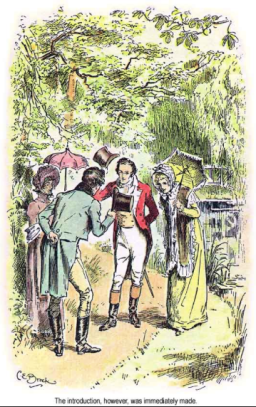
Throughout her novels, Jane Austen makes clever use of the rule that two strangers cannot interact socially until they have been properly introduced by a third party or mutual acquaintance. Today, it might seem rude to mingle with someone in a social setting and not introduce ourselves, but Kirsten Olsen says in All Things Austen that “genteel people who had not been introduced simply did not speak to one another” (132). Austen is able to use this code of conduct to the advantage and disadvantage of her characters.
Catherine Moorland feels the disadvantage of this rule acutely when she first goes to Bath: “she longed to dance, but she had not an acquaintance in the room” and Mrs. Allen only says, “every now and then, ‘I wish you could dance, my dear—I wish you could get a partner.’” (Northanger Abbey 21). Because they have no acquaintance, Catherine cannot dance. When they find a place for tea next to a large party of people, they even spend the meal “without having anything to do there, or anybody to speak to, except each other” (22). But if a girl cannot get a dance partner or find friends at the tea table without an acquaintance, how can she meet a marriage partner? Luckily, there was an exception to this rule: The master of ceremonies at the Lower Rooms could make a proper introduction, which is how Catherine meets Henry Tilney. (See Vic’s article on The Lower Assembly Rooms and Bath Society for more.)
Austen also uses this rule of introductions as the essential “hook” that grabs the reader’s attention at the beginning of Pride and Prejudice when Mrs. Bennet harasses Mr. Bennet to pay a visit to Mr. Bingley. Among the gentry in the country, when someone moved into the neighborhood, it was polite for his neighbors to call on him. Obviously, Mr. Bennet must introduce himself so that his daughters can meet Mr. Bingley. However, there is another reason for Mrs. Bennet’s insistence: Once the call is made, it must be returned. As Olsen says, “virtually all visits required a reciprocal visit so that once one started visiting at a particular house, it was hard to stop” (Olsen 385). This bit of information makes Mrs. Bennet’s shrewd scheming even more humorous for she knows it will inevitably lead to her daughters being introduced to Mr. Bingley.
Later in Pride and Prejudice, when Mr. Collins introduces himself to Mr. Darcy without having been formally introduced, it is an embarrassing breach of conduct, especially as he is of inferior social rank: “Elizabeth tried hard to dissuade him from such a scheme, assuring him that Mr. Darcy would consider his addressing him without introduction as an impertinent freedom, rather than a compliment to his aunt; that it was not in the least necessary there should be any notice on either side; and that if it were, it must belong to Mr. Darcy, the superior in consequence, to begin the acquaintance” (PP 79). This is not merely a terrible social faux pas—Austen is bringing attention to Mr. Collins’s ignorance and over-inflated sense of pride in regard to his connection to Lady Catherine de Bourgh.
Polite Gestures and Greetings
Austen also uses bows, curtsies, nods, and other physical gestures purposefully; body language carries a lot of meaning in her books. Bowing and curtsying, for instance, was to be done elegantly and gracefully. However, the depth and duration of a bow depended on the circumstances. For example, “A short, curt bow, more like a nod, could indicate displeasure or mere formal acknowledgement, while a long bow could be ridiculous in some situations and lend emphasis to one’s words or departure in others” (Olsen 131). We see an example of this subtlety when Mr. Darcy only bows slightly and moves away after Mr. Collins comes forward to introduce himself. Mr. Collins tells Elizabeth that the introduction went well, but from mere observation Elizabeth can see that the opposite is true.
Gentlemen were also expected to bow upon taking leave of a lady. Bows or tips of the hat were given in greeting to women, social superiors, and to acquaintances seen at a distance. Nodding was also important. Nodding was also common courtesy among women. And, much like a visit, a tip of the hat or nod of the head must be returned, as we see in Northanger Abbey when Catherine is looking for Mr. Tilney but is also occupied with “returning the nods and smiles of Miss Thorpe,” which “claimed much of her leisure” (Austen NA 35).
Shaking hands was generally used between men of the same social class. However, Olsen says that “women could choose to shake hands, even with a man, though conduct books indicated that this was a favour (sic) to be distributed with care” (131). We see in Sense and Sensibility that Marianne has become accustomed to granting this favor to Willoughby (and is hurt by his apparent indifference) when she holds out her hand to him and cries: “Will you not shake hands with me?” when they see one another at a party in London (176). When she first sees him, he merely bows “without attempting to speak to her, or to approach.” After spending so much time together, he is incredibly uncomfortable and acts as though they do not know each other as well as they do. Austen uses this scene to reveal to the reader that Willoughby’s feelings and intentions toward Marianne have changed abruptly.
The Cut
Finally, we see that once two people have been introduced, each one must give and return the appropriate calls, bows, curtsies, and nods. When someone deliberately chose not to engage in these polite customs and acknowledge an acquaintance, it was known as a “cut.” Olsen explains that “[a]n introduction was a matter of some importance, as once two people were introduced, they had to ‘know’ each other for good, acknowledging each other’s presence every time they met and accepting visits back and forth. The only way out of perpetual acquaintance was for one…to do something so horrific and unforgivable that the other might ‘cut’ him” (Olsen 132).
For instance, when meeting on the street, if one man saw a gentleman acquaintance, he would tip his hat. The other could then nod back. However, to ignore the other person and refuse to acknowledge him was a “cut.” The “cut” is used pointedly in Pride and Prejudice when Darcy sees Wickham in Meryton: “Mr. Wickham, after a few moments, touched his hat—a salutation which Mr. Darcy just deigned to return. What could be the meaning of it? It was impossible to imagine; it was impossible not to long to know” (73).
The cut is highlighted several times in Austen’s novels because “in her social world it was almost as dramatic an incident as could possibly happen” (Olsen 133). We see the cut used several times as a way to show that a relationship between two people has been broken for one reason or another. In Sense and Sensibility, after Willoughby breaks Marianne’s heart and she become ill, he tells Elinor that Sir John spoke to him for the first time in two months when they met in public. He says “[t]hat he had cut me ever since my marriage, I had seen without surprise or resentment” (330). Depending on the situation, sometimes it is the one being cut or the one giving the cut who is at fault.
In Pride and Prejudice, when Jane visits Miss Bingley in London, Miss Bingley waits several weeks before returning the call (though a call should be returned within a day or two. Jane writes to Elizabeth: “It was very evident that she had no pleasure in [the visit]; she made a slight, formal, apology, for not calling before, said not a word of wishing to see me again, and was in every respect so altered a creature, that when she went away, I was perfectly resolved to continue the acquaintance no longer” (148). This is a subtle cut and was considered highly impolite.
In each of her novels, Austen utilizes social gestures such as they to give her readers special insight into her characters and plots. When someone is in error, we should always look closely to find out why Austen has written it that way. Often, when the code of conduct is not followed, something (or someone) is amiss. Exploring these nuances is one way to understand the underlying meaning in Austen’s books. For more on these topics, see… (links/references)
Rachel Dodge, May 24, 2017
Inquiring readers: About Ms. Dodge, the author of this article (and more to come):
Rachel Dodge’s knowledge of Jane Austen and the Regency World is impeccable. She has an M.A. in English literature in creative writing and public relations, and is a free freelance web and marketing content writer/editor for churches, missionary organizations, and small businesses. Rachel is a frequent speaker at libraries, literary groups, and reading groups about Jane Austen, 18th-century literature, and the Regency Era. Her written works include: “Exploring Womanhood: Moral Instruction, the Ideal Female, and 18th-Century Conduct in Pride & Prejudice.” (Master’s Thesis on the topic of female etiquette in Jane Austen’s Pride and Prejudice). She belongs to JASNA National, JASNA Greater Sacramento, and Inspire Writers.
You can see why I am so pleased to add Rachel to the Jane Austen’s World group of contributing writers! Please welcome her aboard.
Works Cited
Austen, Jane, and R. W. Chapman. Northanger Abbey and Persuasion. Oxford, Oxford University Press, 1988.
–. Pride and Prejudice. Oxford, Oxford University Press, 1988.
–. Sense and Sensilibity. Oxford, Oxford University Press, 1988.
Nardin, Jane, and Jane Austen. Those Elegant Decorums the Concept of Propriety in Jane Austen’s Novels. Albany, State Univ. of New York Press, 2012.
Olsen, Kirstin. All Things Austen: A Concise Encyclopedia of Austen’s World. Oxford, Greenwood World, 2008.












 Jane Austen's World