This Jane Austen blog brings Jane Austen, her novels, and the Regency Period alive through food, dress, social customs, and other 19th C. historical details related to this topic.
Copyright (a) Jane Austen’s World. Gentle Readers, The previous post elicited a question about Regency underdrawers or a lady’s unmentionables. My answer was so long that I decided to create a new post from it.
1742 and 1794 fashion silhouette contrast
Drawers, which made their first serious appearance in 1806, and were fashioned after men’s underdrawers, were still optional during 1810. They would be worn more frequently as the century progressed. Underdrawers were considered risque, for the garments resembled men’s pant legs. Even if the garments were worn, they did not resemble the pretty underdrawers that we associate with the Victorian era.
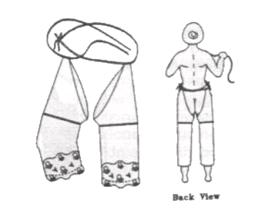
Image of early under drawers
As you can see in this image, early ladies underdrawers consisted of two tubes of cloth that were tied to the waist, allowing a woman to, uhm, attend to her business without having to remove too many clothes. In an era without indoor plumbing, this must have been an important consideration.
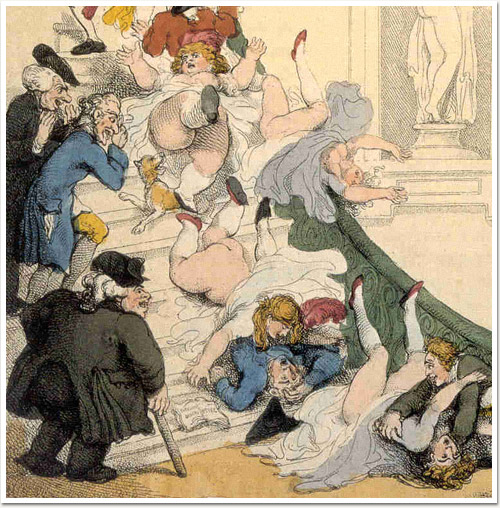
I recently viewed a shameless cartoon by Thomas Rowlandson of a group of travelers (3 ladies and a gent, all family members), who were attending to their calls of nature on the side of the road. Because the image is quite vulgar, which many of Rowlandson’s images tend to be, I will only link to it. From the headdresses that the ladies are wearing, this cartoon was drawn much earlier than 1806. As you can see, no underdrawers obstructed the group from relieving their most pressing needs.
Detail of Rowlandson's Exhibition Staircase, 1800
Rowlandson’s Exhibition Staircase cartoon has a given date of 1800. The ladies’ tumble down a steep, crowded staircase forcibly reminds us that underdrawers were still a fashion consideration for the future.
Underdrawers belonging to the Duchess of Kent, 1810-1820. *Image@Regency Society of America Pro Boards
By 1820, wearing drawers was still optional, but by the 1850’s, the caged hooped skirts made them a necessity, for a hoop could be wildly unpredictable. One wrong swinging move or errant gust of wind, and a lady’s most delicate (or indelicate) parts would appear in full view. The 1956 version of The King and I contains one of my favorite scenes in which the King’s wives wear Western dresses for the first time. When the King enters, they immediately drop down to bow to him. Their hooped skirts swung straight up in the air, revealing their bare bottoms and shocking Anna, who had not anticipated such an END (ahem) to her well-meant scheme.
Caged crinoline
Needless to say, by the mid-19th century, ladies wore drawers as a matter of course.
Copyright (c) Jane Austen’s World. A fine mist and cool air will greet my dog and me on our morning walk. I intend to put on a thick short coat and scarf, and faux fur lined boots. How would my Regency counterpart have dressed in November, 1810, precisely 200 years ago?
More elegantly, I decided. While I putter on my computer in my jammies and robe, and sip coffee upon first rising, my Regency counterpart would have sipped hot chocolate from a delicate china cup and written letters, read from a book, or practiced on the pianoforte, as Jane Austen was wont to do in the early morning.
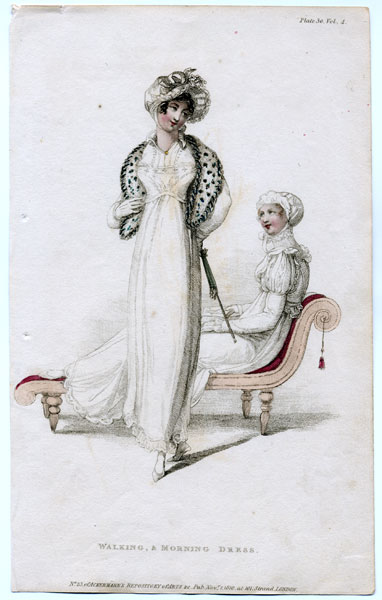
The maid would have started a fire in the morning room, but the house overall would have felt much cooler than it did even a month ago. A Rumford stove, which was becoming quite popular, would have retained more heat, but as you can see, our Regency miss is swathed in a cap, long sleeved dress, and a high-necked chemisette. She wears gloves, stockings, and thin slippers. Layered as she is (for she probably wore a corseted petticoat underneath her ensemble and perhaps even a chemise), she would have felt comfortably warm. Had she still felt cold, she could opt to throw a thick shawl around her shoulders and a small throw over her lap.
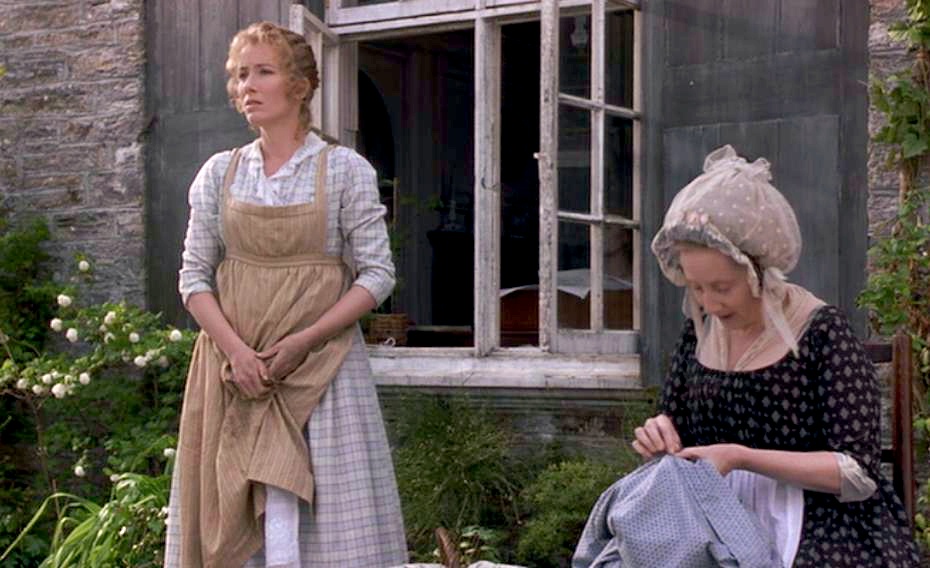
Morning dress, or undress, were dresses worn by ladies who expected to be seen only by close members of the family or guests in the home. They were never meant to be seen by visitors. Undress outfits, especially in more modest households where women worked alongside their servants, preparing vegetables or overseeing household duties, gardening and the like, were covered by aprons and pinafores.
In this image from Sense and Sensibility 1996, Elinor and Mrs. Dashwood are shown wearing undress. As soon as Edward Ferrars nears the house, the women tidy themselves, taking off their aprons, and making sure they look neat and presentable. They would not have had time to change into nicer outfits, nor would they have likely had many choices of dress to choose from.
Some Regency ladies who stayed at home all day would remain in a state of undress until dinner, when they changed into a gown suitable for the dinner table. Others would change their outfit much sooner, when they were ready to leave the house or if they had arranged to receive visitors. After I finish writing this post, I shall put on my half-dress, replacing my morning robe with a walking outfit consisting of a hooded sweatshirt, long-sleeved t-shirt, jeans a short coat and a scarf. I’ll exchange these outdoor exercise clothes with a more formal office look for work, which means that I will have worn three outfits by nine a.m.
My Regency counterpart would also change her outfit. A lady of fashion would look vastly more elegant in her walking outfit with its little fur tippet artfully arranged over a long-sleeved spencer jacket than me in my walking suit. If she was married or a spinster, she would place her jaunty hat with its soft capote crown over a cap, whose lace trim would peep out from beneath the hat’s brim. Sturdier leather slippers, leather gloves, a reticule and umbrella or parasol would complete the ensemble.
A middle class lady would look less modish than the idealized women depicted in Ackermann’s Repository, which was the Vogue magazine of its day. She would have fewer clothes to choose from, and most likely possessed only one walking outfit instead of a variety, and certainly not in the first stare of fashion.
Whatever her social background, our Regency lady was now ready to meet the world and visit friends, go shopping, or generally run errands outside of the house. The walking outfit in the Ackermann plate provided sufficient layers for a lady to stay warm during her walks and errands. Should the November day turn particularly windy and wet, she would most likely trade the tiny fur tippet for a more substantial shawl or cloak. The middle class Regency lady might trade her shawl for her only cloak, which she would keep for years until its usefulness was outworn.
Copyright (c) Jane Austen’s World. Inquiring Reader, When I visited Bath years ago, I kept a journal, which I completely forgot about until yesterday, when I found it among a pile of papers. It is the custom in my family to arrange for lodging on the day of our arrival and the night before our departure in any foreign land, and to trust in the suggestions from the people at the local visitor’s bureau for the rest of the vacation. We visit such establishments after 3 or 4 PM, when many hotels begin to deeply discount their rooms. This habit is a bit like gambling, but for us it has paid off spectacularly.
My budget-minded family has followed this practice successfully, sometimes even at the height of tourist season, in England, the Netherlands, France, New Zealand, and the great American west. The pay-off is in finding lodging in charming hotels or B&Bs at a fraction of their normal price. (Our best bargain ever was in the French Quarter in New Orleans at the Place d’Arms, where we spent 4 glorious days in a luxury suite for $78/night. It was April, perfect weather for N.O.)
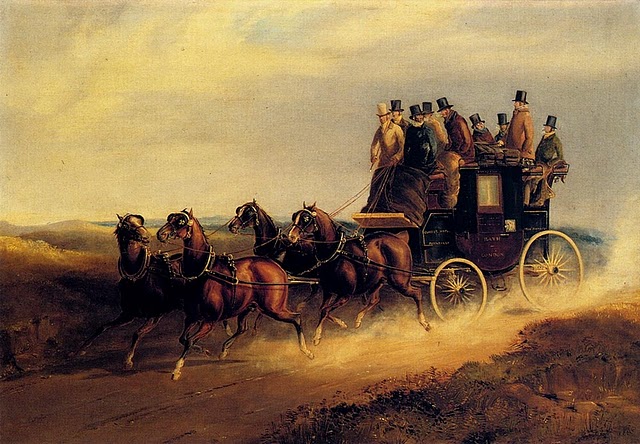
Bath to London coach on the open road
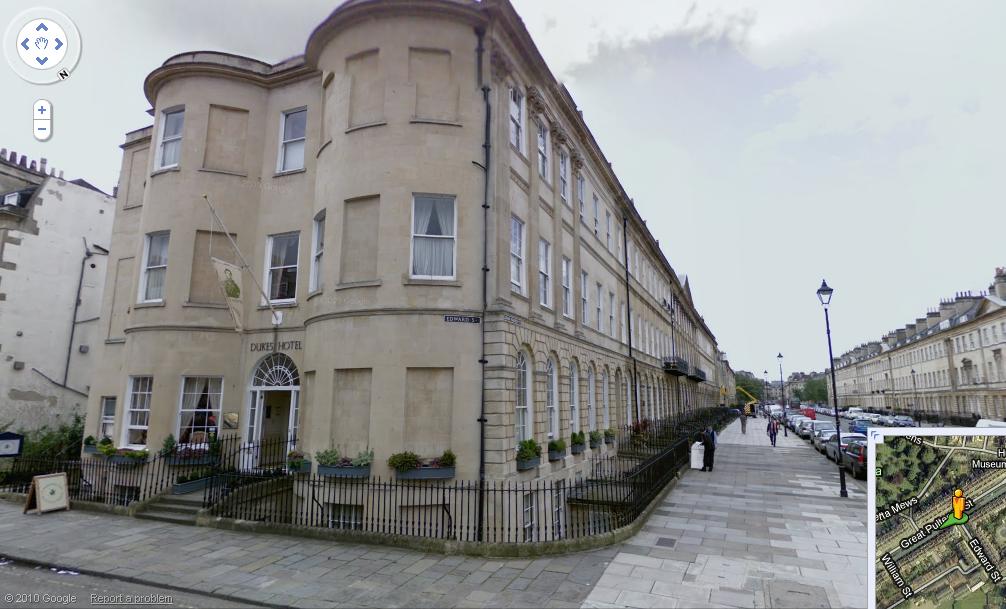
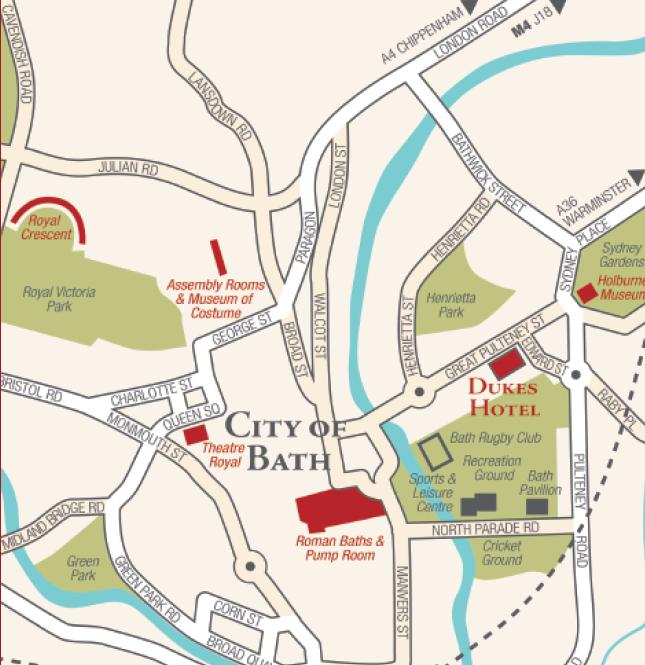
Back to England. My ex and I traveled from London to Bath (yes, we rented a car, and yes, he successfully negotiated his way out of London with me reading the map and helping him to enter and exit the round-abouts. Talk about a hair raising journey, for he had never driven on the British side of the road before and I am at best a terrible map reader). We entered Bath along the London Road, looking for the distinctive blue and white V sign, and discussed the price we were willing to pay. Those good people steered us to the Dukes Hotel on Edward Street, just off Great Pulteney Street, across the Pulteney Bridge in Bathwick and near Sydney Gardens.
The Dukes Hotel on the corner of Edward Street and Great Pulteney Street
As a Georgette Heyer and Jane Austen fan, I felt that I had simply died and gone to heaven.
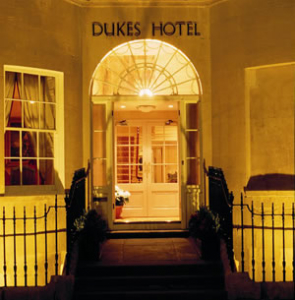
Entrance to the Dukes Hotel
Compared to Bath’s ancient Roman buildings and medieval streets, Great Pulteney Street is rather modern. In the 3rd quarter of the 18th century, the city council voted to expand Bath’s boundaries across the River Avon. This era marked an expansion and growth for the city that resulted in the addition of thousands of new houses inside Bath proper and outside of it. Sir William Pulteney, who resided on an estate called Bathwick and fortuitously located across the river, commissioned architect Thomas Baldwin to design and build Great Pulteney Street. The task was completed in 1789.
Location of the Dukes Hotel
Situated at one end of this long broad thoroughfare is Sydney Gardens, the pleasure gardens mentioned so often by Jane Austen and Georgette Heyer and others who have journeyed to Bath.
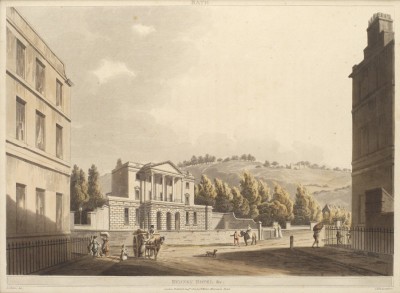
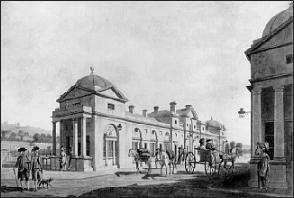
Bath Hotel at the entrance of Sydney Gardens 1825
Seen prominently at the entrance of Sydney Gardens was the Bath Hotel (see a 360 panoramic view), now the Holburne Museum.
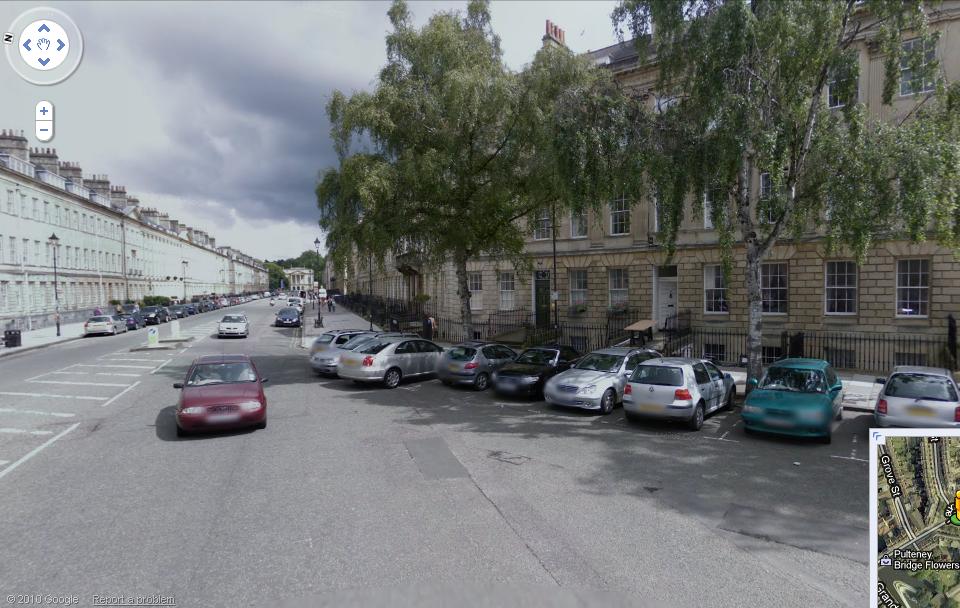
View from Laura Place towards Sydney Gardens with the Holburne Museum barely visible at the end of the street.
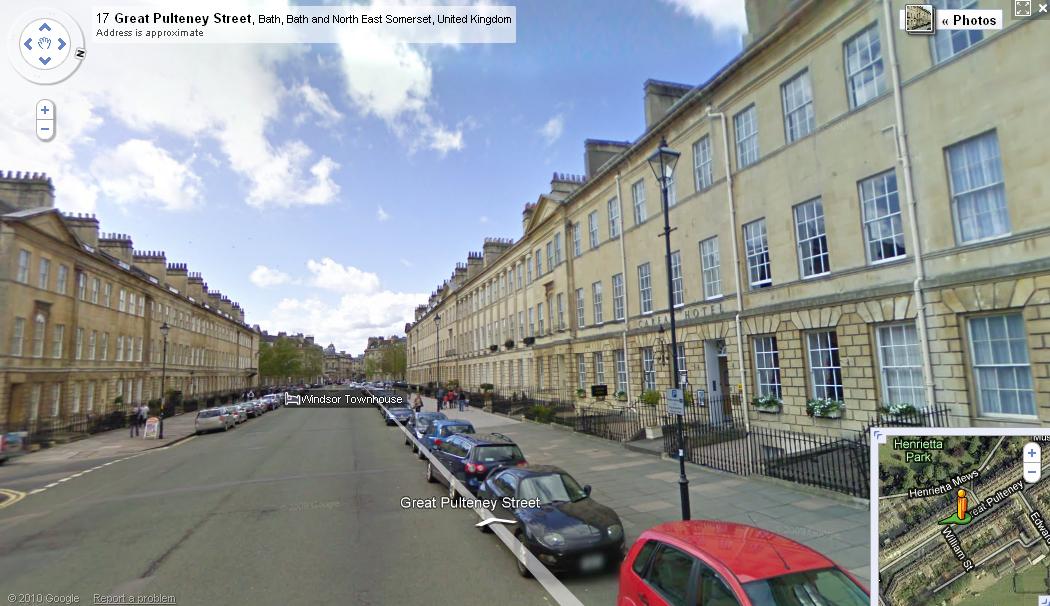
To return to our first evening in Bath, our room at the Dukes Hotel was charming but offered no view (which often happens when you wait for a bargain). We immediately set off to explore Bath on foot, for it was mid-July when the days were long. Great Pulteney Street did not disappoint me with its wide sidewalks and row upon row of graceful houses made of Bath stone. I would take this walk several times per day, and it is this street in particular that I still recall most vividly. I imagined myself wearing a Regency outfit and hearing the clopping of horses’ hooves and the rattling of carriages as I made my way towards Bath proper.
The wides expanse of Great Pulteney Street, walking from Edward St. towards Pulteney Bridge
At this point I must share with you why I am using Google earth images. My own photos are still missing. You can imagine how delighted I was to be able to reconstruct my journey from my newly found journal and the images I pulled from Google maps.
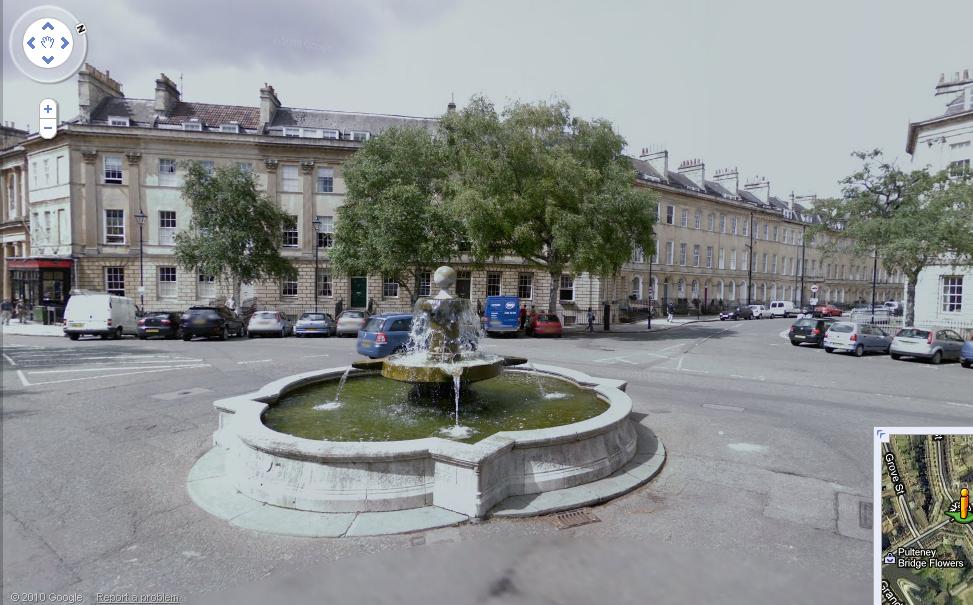
Laura Place. The fountain was built in the third quarter of the 19th century.
We walked past Laura Place, where Lady Dalrymple from Persuasion had taken a house for three months, until Great Pulteney Street ended at the fountain. It is then named Argyle Street.
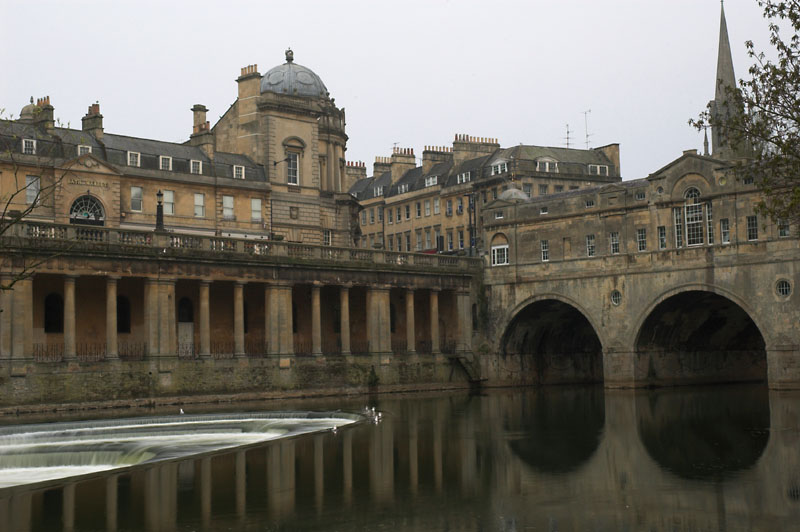
Pulteney Bridge, 1779 by Thomas Malton Image @Victoria Gallery
We ambled along slowly, taking in all the sights and brazenly looking into windows when we could, and continued on to Pulteney Bridge, a Palladian bridge designed by the Adam brothers and finished in 1773. The bridge has seen several renovations since, especially in the design of the shops that line it.
The Weir as seen below the bridge
We walked down the steps to the bank of the river and listened to the rush of water on the Weir until the sun set. Click here for an arial view of the walk I have just described.
And so I conclude our first evening in Bath, which, due to the stress of driving in a foreign land from a major city along by-ways that eschewed busy thoroughfares, ended quite early for us. I did have time to write down my thoughts at a tiny desk in our third floor room.
What can be more appropriate than to discuss body snatching on the very weekend of All Hallow’s Eve, when witches and goblins and ghosts wander throughout the night? This post will offer a variety of facts about grave robbers, resurrectionists, and sack-em-up gentlemen who haunted cemeteries, waiting for a fresh body to snatch.
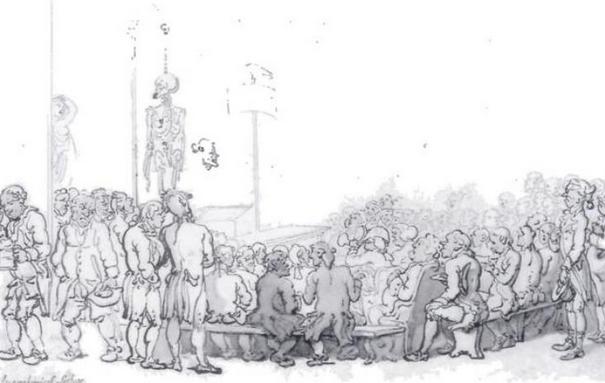
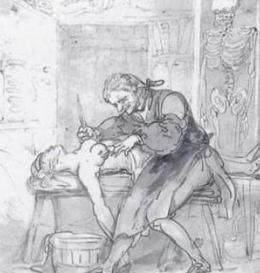
Anatomical Lecture, Thomas Rowlandson
Since the 15th century, British anatomists have been on the hunt for fresh cadavers to dissect and study. By the 18th century medical students were expected to gain practical knowledge of the human body through dissection as a pre-requisite for becoming licensed surgeons. It was the custom to study the corpses of criminals who had been executed for murder, but with the proliferation of medical schools, demand for anatomical specimens outpaced the supply. Medical students turned to stealing corpses for their own use, and thus, during this early period of body snatching, grave robbers belonged primarily to the class of ‘gentlemen’.
Reconstruction of Inigo Jones's Barber Surgeons anatomy hall, 1636
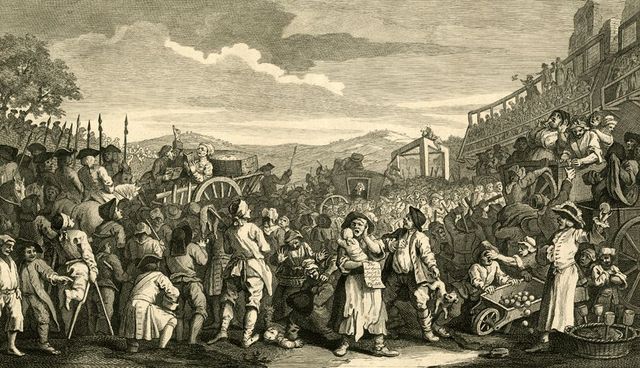
“By 1820 statutes defining crimes with capital punishments numbered over two hundred. In the words of barrister Charles Phillips, “We hanged for everything- for a shilling- for five shillings- for five pounds- for cattle- for coining- for forgery, even for witchcraft- for things that were and things that could not be”. An act of Parliament during 1752 further outraged the public by making hanging in chains or dissection of those condemned to death for murder mandatory. – Canadian Content
Executions of murderers provided fresh fodder for anatomists
“The gruesome trade [of Resurrectionists] was driven by laws which only permitted the bodies of executed criminals to be used for medical science at the height of the Enlightenment. But with only about 50 executions being carried in London every year and a lack of refrigeration meaning that specimens rapidly putrefied, demand for about 500 bodies each year far outstripped supply.” – The Independent
Thomas Rowlandson, The Persevering Surgeon
The laws for grave robbing had not quite caught up with the times, for those who carried away an unclothed body could not be touched, but if they so much as took one sock or piece of clothing with it, they could be hung. The corpse was hastily stuffed in a sack, and hauled to the nearest medical school before the robbery was detected.
Rowlandson, The Resurrectionists, 1775
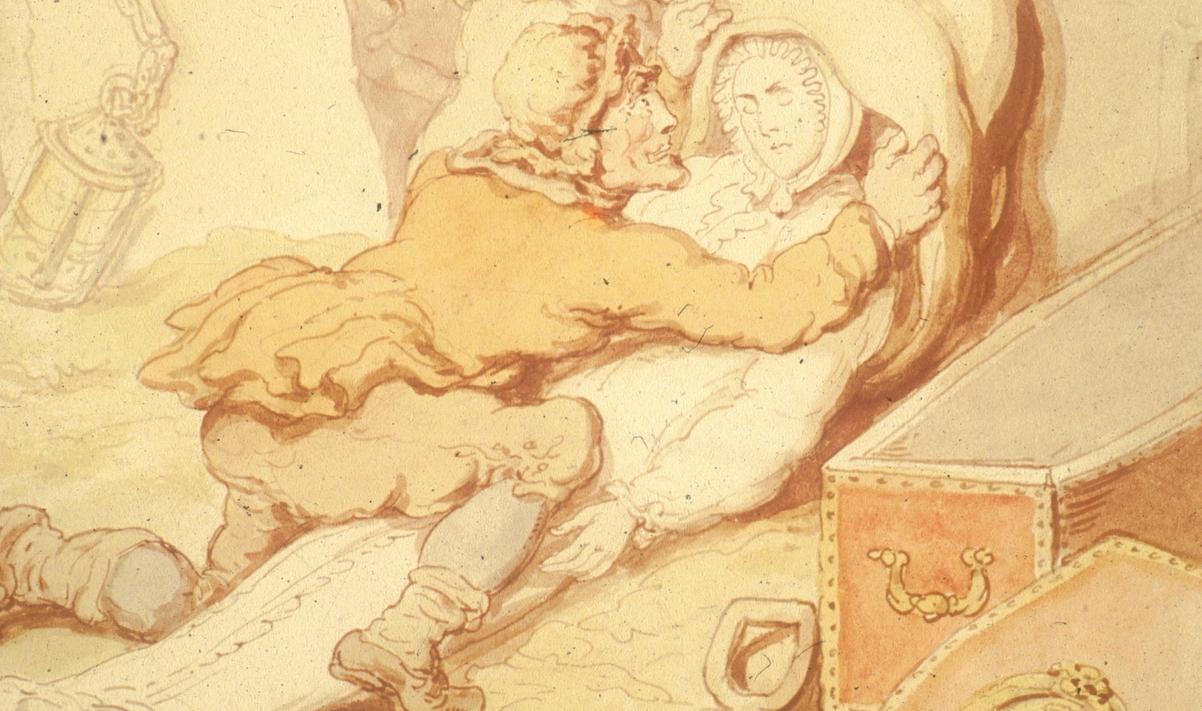
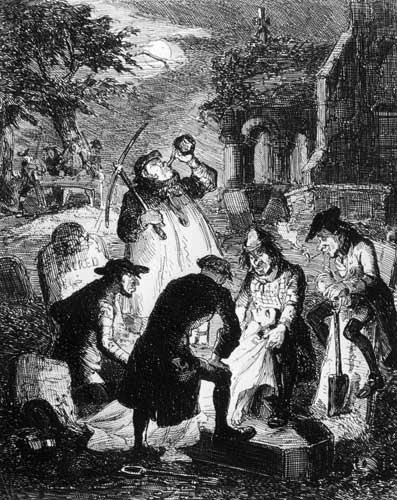
Medical students and their professors snatched bodies throughout the 18th and 19th centuries, but due to a lucrative business, an entirely new criminal element emerged: the resurrection men or gang of grave robbers. Many of these men made quite a tidy living. Resurrectionists were so efficient and became so indispensible to anatomists, that prominent physicians and surgeons would often exert their influence to keep them out of jail:
Detail of The Resurrrectionists by Rowlandson
“Typically, a member of the gang, or his wife, would spend the day loitering in a likely graveyard waiting for a funeral…At night, two members of the gang would appear and, after carefully laying a sheet on the ground, would uncover the head portion of the grave, dumping the loose dirt on the sheet. The body would be pulled from the coffin head first with ropes, the shroud stuffed back in the grave, and the dirt carefully replaced.” – Body Snatching: A Grave Medical Problem, p 401
The business of selling bodies was such a good money maker that some people even kidnapped and murdered children in order to sell their bodies to the highest bidder. One such prolific grave robber was John Bishop, who was actually tried and convicted of murdering a 14 year old boy for the purposes of selling him to a surgeon. All together Bishop admitted to stealing between 500 and 1000 corpses and of murdering 3 people to sell their bodies, although that number could be higher. – Histatic blog
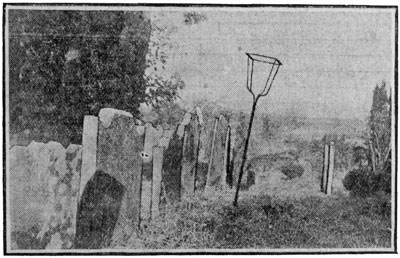
Lamp in Mallusk Cemetery for relatives who stood watch over the dead.
Look out posts in cemeteries were common, and relatives took turns watching the graves to protect their recently buried loved ones. “In the centre of the ancients have it all to themselves. Here we are in a bygone age. There is a thin iron standard with a lamp frame — a famous relic of the body-snatching days. They had no watch-house here, and so the relatives of the recently-interred lighted the lamp and sat by the graveside every night for the usual period.” – Mallusk Burying Ground
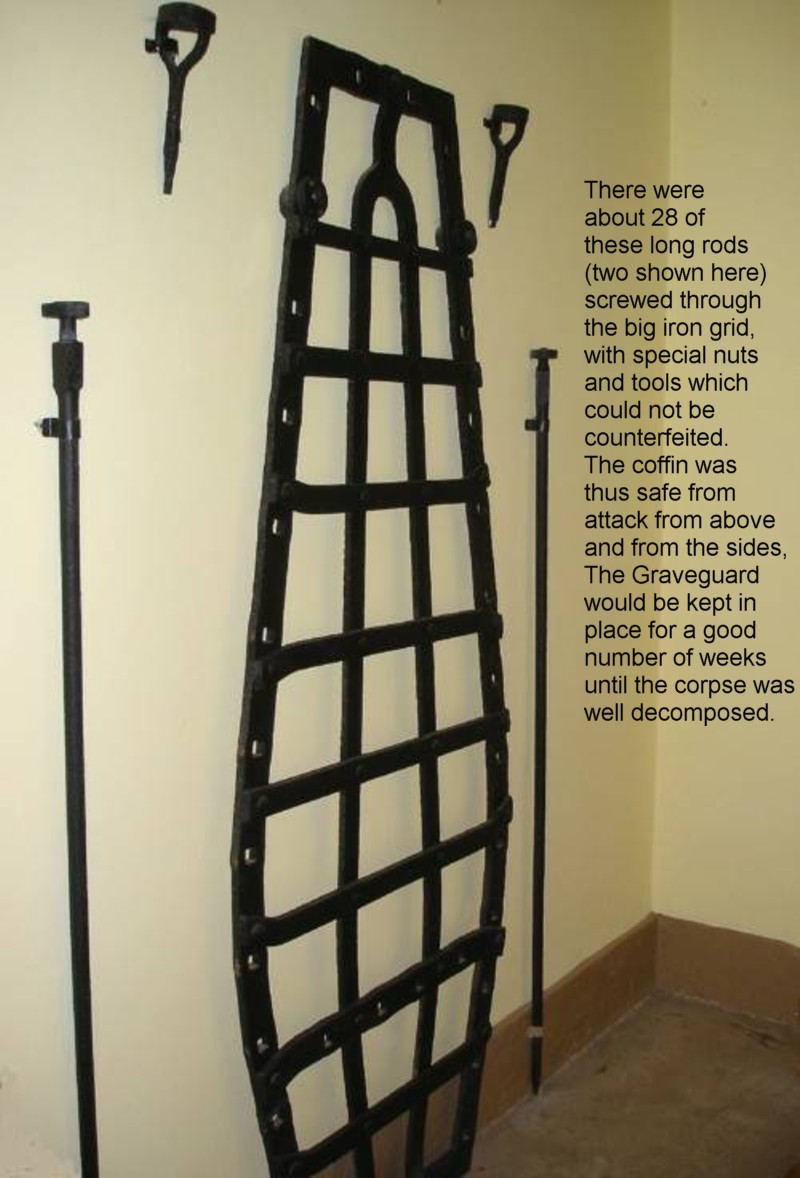
Iron grill to detract body snatchers
The families of the dead tried to purchase robber-proof coffins made with metal. There was a catch, however. Only the very rich owned the land in perpetuity in which they were buried. While their vaults could be secured and reinforced, ordinary people were buried in plots of land that were reused time and again. Thus, wrought iron and metal coffins designed to stave off grave robbers made the practice of recycling bodies in one plot impossible, and many cemeteries began to refuse such reinforced coffins.
Inventions to protect the dead.**
“Opposition to the body-snatchers took many forms. Mourners often set spring guns and other booby traps over fresh graves to discourage the body-snatchers, and it was not uncommon for relatives to mount a night watch over a fresh grave for 2 or 3 weeks until the body had decomposed sufficiently to be useless for dissection.” – A Grave Medical Problem, p. 403
Resurrectionists at work
In Richmond, Virginia, 19th century Resurrectionists had only 10 days in which to procure a newly buried body. If the robbers waited longer, the body would be too putrid to be useful. The best months for grave robbing and dissection in Richmond were between October and March, when the weather was cool enough to slow down the rate of decomposition.
Robbing a body under stealth of night
One assumes that the bodies were dead before they were delivered to anatomists. This was not always the case, as in this incident in 1816, when the subject delivered to Mr. Brooke’s Theatre of Anatomy was still very much warm and alive:
“October 21st Marlborough Street. It was stated yesterday that a most extraordinary affair happened at Mr Brooke’s The Theatre of Anatomy Blenheim Street. On Sunday evening a man, having been delivered there as a subject, a technical name for a dead man for dissection in a sack, who, when in the act of being rolled down the steps to the vaults, turned out to be alive, and was conveyed in a state of nudity to St James’s Watch house.
Curiosity had led many hundreds of persons to the watch house, and it was with difficulty the subject could be conveyed to this Office, where there was also a great assemblage. The Subject at length arrived. He stated his name to be Robert Morgan, by trade a smith. John Bottomley, a hackney Coachman, was charged also with having delivered Morgan tied up in the Sack. The Subject appeared in the sack in the same way in which he was taken, with this difference, that holes had been made to let his arms through.
The evidence of Mr Brookes afforded much merriment. He stated that on Sunday evenin,g soon after seven o clock, his servant informed him, through the medium of a pupil, that a coachman had called to inquire if he wanted a subject from Chapman, a notorious resurrection man. Mr B agreed to have i,t and in about five minutes afterwards a Coach was driven up to the door, and a man answering to the description of Bottomley brought Morgan in a sack as a dead body, laid him in the passage at the top of the kitchen stairs, and walked away without taking any further notice. On Harris witness’s servant taking hold of the subject’s feet, which protruded through the bottom of the sack, he felt them warm and that the subject was alive.
Here the prisoner Morgan, who seems to have enjoyed the narrative with others, burst out into a fit of laughter.
Mr Burrowes, the Magistrate – ” Is it usual, Mr Brookes, when you receive a subject, to have any conversation with the parties who deliver it?”
Mr Brookes – ” Sometimes, but dead bodies are frequently left, and I recompense the procurers at my leisure.”
Mr Brookes resumed his evidence, and stated that he put his foot upon the sack ,upon being called by his servant, and kicked it down two steps, when the subject called out: “I m alive,” and forcing half his naked body out of the sack threw the whole house into alarm. – Social England Under the Regency, Vol 2, John Ashton, 1816, p 114
Burke and Hare turned to killing their victims in order to supply medical schools with fresh fodder
William Burke and William Hare, infamous body snatchers from Edinburgh, Scotland, delivered bodies that were remarkably fresh. It turns out that in their zeal to earn a quite comfortable living, they murdered at least 17 victims.
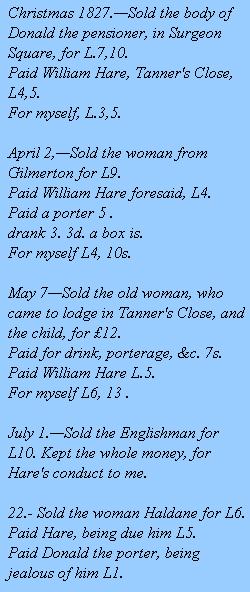
Partial account of the bodies Burke disposed of and sold*
Over time, anatomists began to recognize the bodies the two men delivered but kept silent about their suspicions. Burke tempted fate one time too often. On Halloween night in 1827, he met Mrs. Docherty at a bar and persuaded her to drink with him at his lodgings. After much jollying and merriment, he killed the woman (his favorite method was suffocation, so as not to leave a mark).
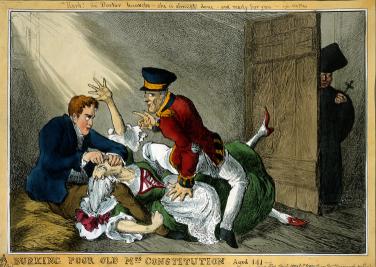
Burke and Hare hard at work
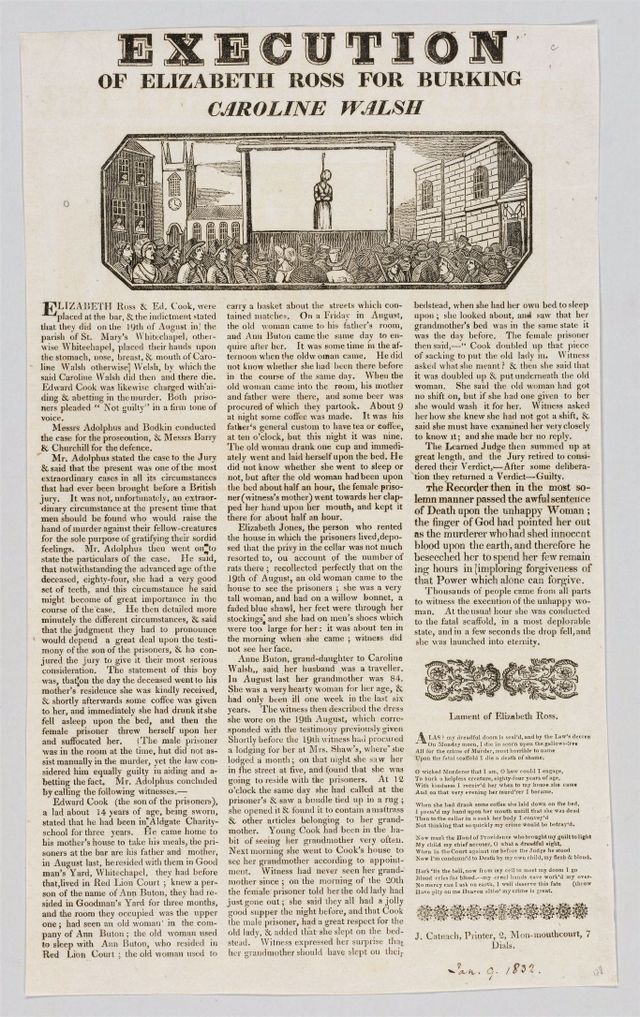
But Burke was so drunk and addled that he was unable to dispose of her body in a timely manner. His landlady and neighbors discovered poor Mrs. Docherty’s body the following day, and Burke was made to stand trial. The public was incensed upon learning that Burke and Hare killed their subjects, and from then on the act of killing people to obtain biological specimens for anatomists was known as Burking.
Burking became a verb. Click on image to read the article
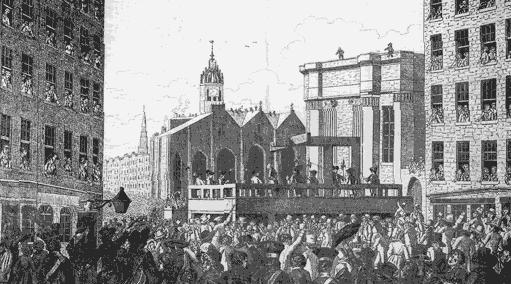
Burke and Hare were arrested in 1828. Hare turned king’s evidence, and Burke was found guilty and hanged at the Lawnmarket, the Royal Mile, on the 28th January 1829. Burke’s body was publicly dissected at the Edinburgh Medical College and his skeleton, death mask, and items such as a leather wallet made from his tanned skin are now displayed at the Royal College of Surgeon’s museum. – Burke and Hare
Execution of William Burke
The story is so fascinating, that it has been filmed and covered in the press repeatedly. Watch this preview of a film on Burke and Hare by John Landis that will make its debut in the UK first.
Over time, public outrage over body snatching and the abuses with the Royal College of Surgeons and the hospitals in relation to the resurrectionist trade became such that Parliament passed the Anatomy Act in 1832, which sanctioned the delivery of the corpses of any unclaimed dead to anatomy schools. During this period, hospitals were considered death houses, and all but the most desperately ill people avoided going to them. People also avoided dying in workhouses for fear of having their bodies claimed for dissection. While the practice of dissection was legitimized by this act, poor people were still fearful of having their bodies “snatched”, albeit legally.
Burke's skeleton on view. As justice would have it, his body was studied by anatomists.
Definition of an Allemande -Music:
An allemande (also spelled allemanda, almain, or alman) (from French “German”) is one of the most popular instrumental dance forms in Baroque music, and a standard element of a suite, generally the first or second movement.
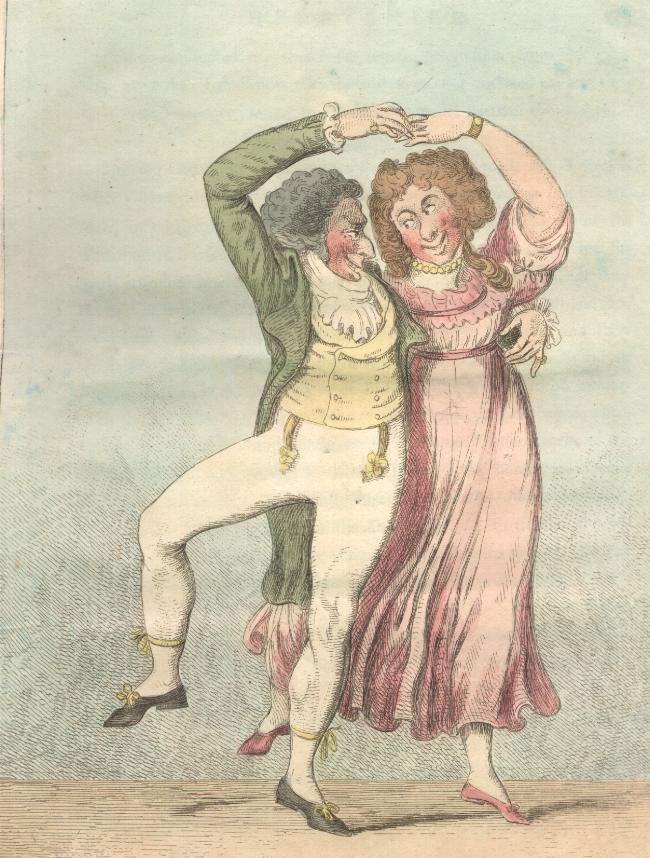
A 17th and 18th century court dance developed in France from a German folk dance: a dance step with arms interlaced.
The name ‘country dance’ has nothing to do with country as opposed to town, but comes from the French ‘contre-danse’, describing the way in which the dancers start by standing up facing each other in two long rows, men on one side and girls on the other. The leading couple would then move off down the row, the other couples falling in behind them; there was no fancy footwork involved, but the dancers would weave their way in a variety of patterns across the floor, linking arms or hands with their partners s the figure required – the ‘allemande’figure involved a ‘a great deal of going hand in hand, and passing the hands over heach other’s heads in an elegant manner’. – Jane Austen, The World of Her Novels, Deirdre Le Faye, p. 104.
Fashionable Goodness: Christianity in Jane Austen's England is now available! By JAW contributor Brenda S. Cox. See Review. Available from Amazon and Jane Austen Books.
Available through December 31st, 2025. Click on image for details, and share this poster with other teachers and students!
The Obituary of Charlotte Collins by Andrew Capes
Click on image to read the story.
Comments
“My idea of good company…is the company of clever, well-informed people, who have a great deal of conversation.” – Jane Austen, Persuasion
Gentle readers: Please feel free to post your comments and continue the conversation! Due to SPAM, we will no longer accept comments on posts after 30 days of publication. In some instances, links will be removed from comments as well.
Administrators and Contributors
Vic Sanborn, founder of this blog, is supported by a team of talented and knowledgeable writers about Jane Austen and the Regency era. They are:
Tony Grant, who now contributes his photos from London and England
Click on their names to enter their own blogs.
In addition, we thank the many experts and authors who frequently contribute their posts and opinions, and who continue to do so freely or at our request.
Click here to enter the page. Topics include Regency fashion, historic foods, Jane Austen societies, British sites, related topics. Click on image.
May we suggest?
Hello, my name is Vic and I live in Maryland, USA. I have adored Jane Austen almost all of my life. I am a proud lifetime member of the Jane Austen Society of North America. This blog is a personal blog written and edited by me and my team. We do not accept any form of cash advertising, sponsorship, or paid topic insertions. However, we do accept and keep books and CDs to review.
If you would like to share a new site, or point out an error, please email us. (Yes, we are fallible. We'll own up to our mistakes and will make the corrections with a polite smile on our faces.) Write us at
Thank you for visiting this blog. Your comments and suggestions are most welcome.
Project Gutenberg: eBook of Stage-coach and Mail in Days of Yore, Volume 2 (of 2), by Charles G. Harper
STAGE-COACH AND MAIL IN DAYS OF YORE: A PICTURESQUE HISTORY
OF THE COACHING AGE, VOL. II, By CHARLES G. HARPER. 1903. Click on this link.

















 Jane Austen's World
.jpg)
