Feeds:
Posts
Comments

Archive for the ‘Regency Life’ Category

Inquiring Readers, Adriana Zardinia, member of the Jane Austen Society of Brazil and who oversees that organization’s excellent blog, graciously sent me an English translation of her post on a Jane Austen inspired wedding. Enjoy!

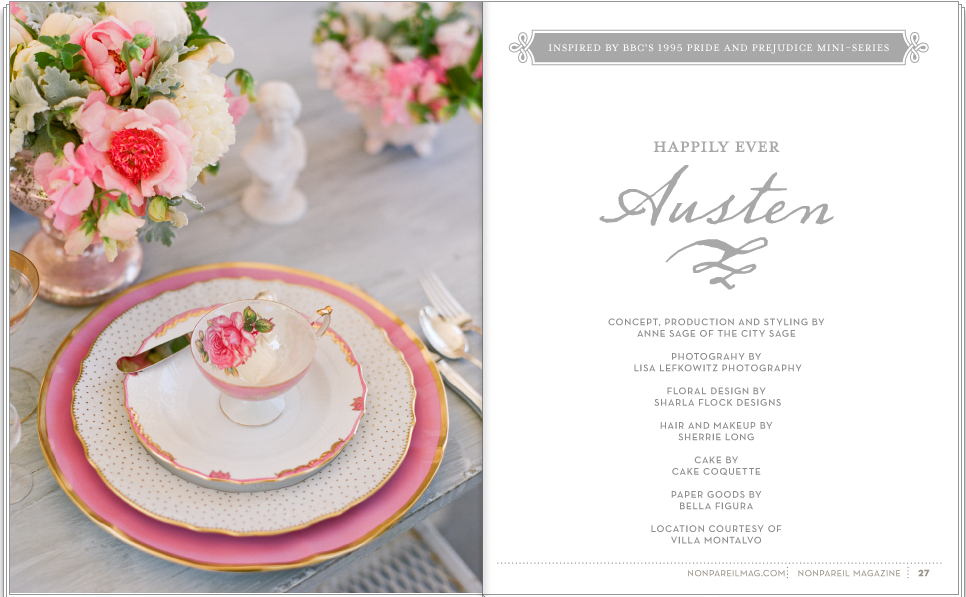
This post shows pictures from a magazine article based on Pride and Prejudice.

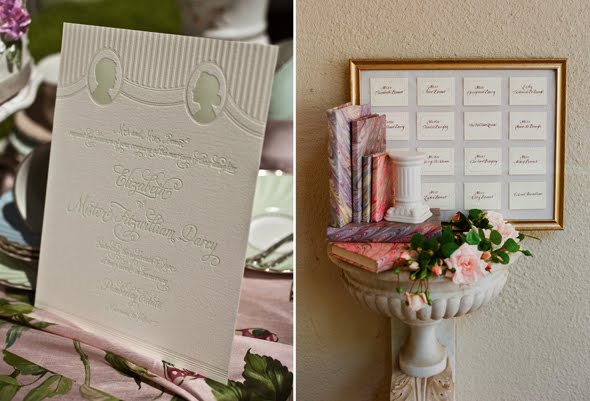
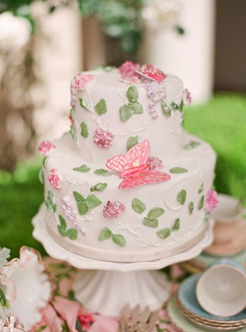
Anne, from The City Sage, showed some pictures from Nonpareil Magazine,  inspired by Jane Austen’s Pride and Prejudice, more precisely, Lizzy Bennet’s and Mr. Darcy’s wedding. Some pictures are not in the magazine’s pages and you can see them at this link.

Details of the invitation

Bride and groom

Look how perfectly chosen the flowers, candies, clothes and reception place are! See the entire article, “Happily Ever Austen”, here at this link!

Nonpareil Magazine allows you to download images and instructions for butterfly garlands and a marble table template in this link.

Adriana Zardini

http://www.jasbra.com.br

http://www.adrianazardini.blogspot.com

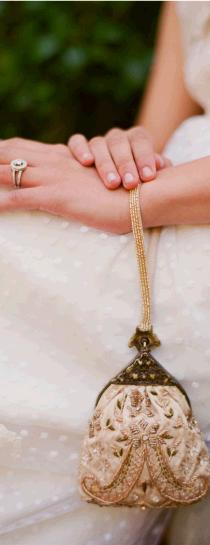
Reticule

More links on the topic

Read Full Post »

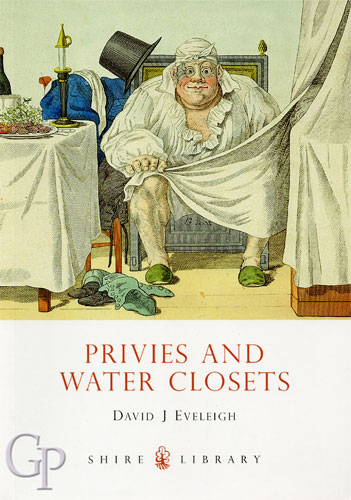
I have reviewed several Shire Library books this past year and have yet to be disappointed. Case in point, Privies and Water Closets by David J. Eveleigh, an excellent small book on the history of fixed and portable sanitation and waste management. I have discovered that this topic is of everlasting curiosity and many of my readers have asked questions similar to the following: How well  did our ancestors manage without indoor bathrooms or running water? This book largely answers the question.

Starting with the 17th and 18th centuries, Mr. Everleigh traces the history of sanitation and the problems our ancestors had in handling waste sewage. While the topic may not seem glamorous, it is hugely fascinating, for sanitation management was intricately connected to the safety of a community’s water supply and the populace’s overall health and well-being. He classified the earliest sanitation methods as either portable or fixed.

Portable Solutions

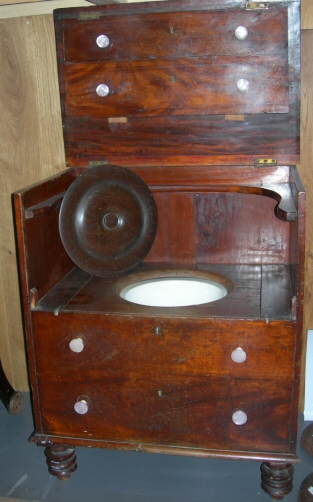
Chamber pots were the easiest method of sanitation. Placed under beds, or a commode or closet stool, the contents could be easily emptied into a covered slop pail and carried outside. In the 17th and 18th century small rooms or closets were introduced that adjoined the bedrooms. These areas were outfitted with a comfortable commode, under which a pan would be placed.

16th century water closet

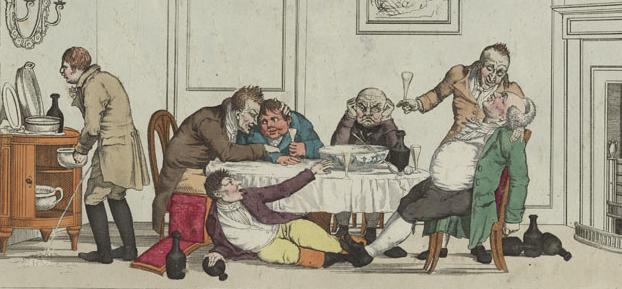
The wealthy did not handle the chamber pots, leaving the servants to clean up after them.  Chamber pots were not always so well situated, as the image below shows (p. 8).
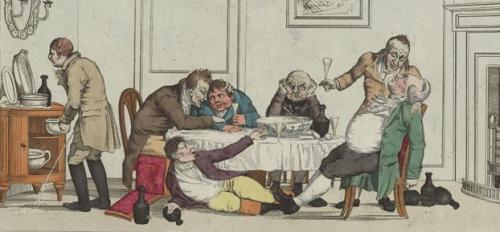
L'apres Dinee des Anglais

English gentlemen, known for their prodigious drinking habits, were wont to relieve themselves where they were – in the dining room, for instance, or in a common room of a public inn – where they did not always aim straight and true (as the young man at left), much to the chagrin and disbelief of French travelers, some of whom wrote about this unsanitary habit.

Fixed Solutions

The privy was a fixed out house (or necessary house or house of office), with no water supply or drain and usually located some distance away from the house. A fixed wooden seat with a rounded hole was placed directly over the cesspit or “void.” Occasionally privies were attached to the side of a building, projecting out from a top floor, or reached through on outdoor entry on the ground floor of a service wing. More often than not they were placed at some distance from the main house at the far end of a garden or yard, where its contents could be used to “enrich” flower and vegetable beds.

Earth closet contents were put on the garden, Chawton Cottage. Photo courtesy Tony Grant**

In cities, neighboring privies were placed side by side in yards and drained into a common cesspool located under an alley that ran between the row of cottages or townhouses. In rich to middle class households, nightsoilmen would be paid to cart the waste away when the household was sleeping. This service was quite expensive, and quite often neglected in poorer districts where the lower classes could not (and landlords would not) hire these men until the cesspools were filled to overflowing.
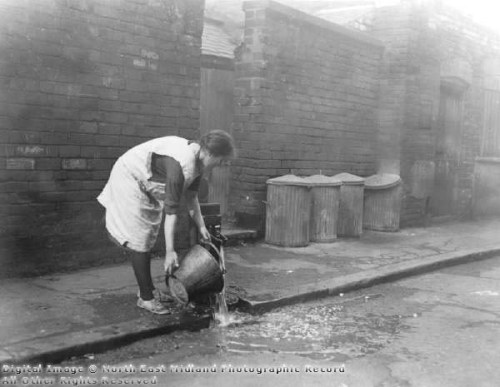
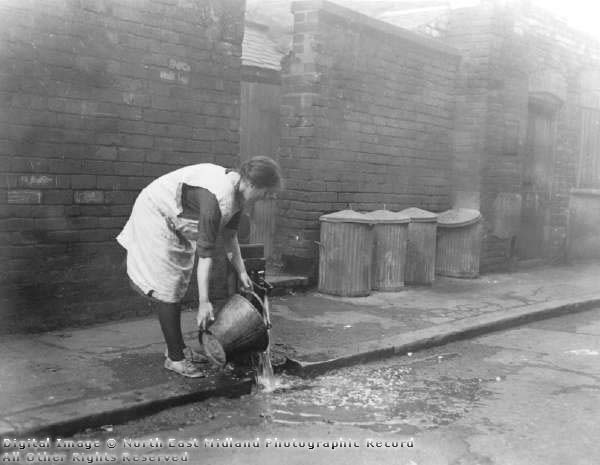
A woman obtains water from a well situated near garbage cans and outdoor privies, which can be seen through the opening in the wall. (Image taken in 1931!)***

Lack of sanitation led to diseases like typhoid, dysentery, and cholera. It was common in the slum districts for cess pools to be left unlined or partially finished, allowing liquid sewage to seep into and contaminate a nearby well, cistern, or other common form of water supply. In cities the public privy was often the only “necessary” available and was shared by a number of households, sometimes as many as sixty-five. The crowding and lack of maintenance and emptying of wastes led to disease and death.
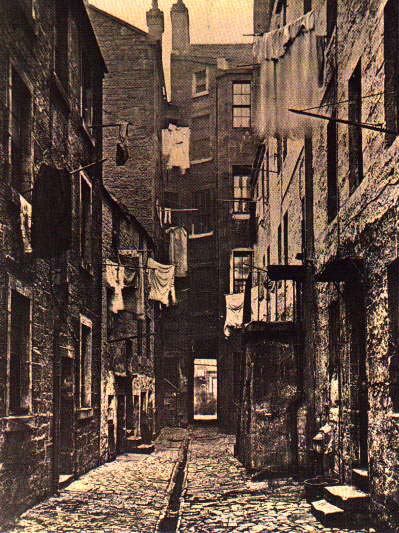
Alley with open sewer drain and privies for the surrounding houses

In Privies and Waterclosets, Mr. Eveleigh traces the improvements in street sewers, indoor plumbing and running water, and sanitary habits throughout the nineteenth century, especially after the second great cholera epidemic in Bermondsey, London in 1849, which killed 13,000 and was the result of water contaminated by raw sewage.

While the book consists of only 64 pages, authors of historical novels will find it a fascinating and welcome addition to their research library. I give this book three out of three Regency fans.

Pages: 64
Published: 2008, Shire Library 479, Shire Publications, UK
150mm x 210mm, soft cover, indexed, new
ISBN 978-0-7478-0702-5

Additional links:

*Image of water closet: Abertillery and District Museum

**Image of Chawton Cottage garden, Tony Grant, London Calling – Personal Hygiene in Jane Austen’s Day

***Image of woman at well, North East Midland Photographic Record, The University of Nottingham, 1931 (This is a correction.)

Read Full Post »
Georgette Heyer’s Regency World by Jennifer Kloester is available August 1.

This extremely interesting compendium of insights and knowledge came my way by One Who Knows how much a fan of Georgette Heyer and Jane Austen I am. Neatly organized into chapters by topic, Kloester provides basic information on the life upper class men and women lived in the Regency Era. Using the historical knowledge she accrued while writing her dissertation on Georgette Heyer, she provides the background on what the Regency was. In Chapter 14, she writes brief, pithy biographical sketches of the Royal family, as well as other real people who appear throughout the Heyer Regency books: Edward Hughes “Golden Ball” Hughes, Sally Jersey, Lady Castlereagh, George Bryan (Beau) Brummell, and noted authors of the day. Her sketches of the Royals are most helpful, for this was an era filled with Royal siblings, offspring and mistresses.

I also enjoyed the chapters on fashion and shopping; the sketches of the various outfits will be most helpful to those readers who do not have a strong foundation in the history of fashion. While men’s fashions began their evolution into the suits of today, women during the Regency enjoyed a rare period of less constriction and heavy underpinnings. Definitions and sketches of pelisses, morning and promenade dresses give good clues to what the characters wear.

Throughout the book, Kloester clarifies definitions by referring to some of Heyer’s Regency novels. So we are reminded that Abigail Wendover first appears to us in Black Sheep dressed in the latest thing in carriage dresses, and that Freddy Standen’s perfectly cut coat and satin knee breeches were identified as just the thing for an appearance at Almack’s. That fine institution of the Marriage Mart is also explained and clarified with references to Cotillion, The Grand Sophy, Friday’s Child, Regency Buck, and Frederica. These references give a nice context to a somewhat dry discussion, and keep the reader engaged in the book.

It is a helpful source of information for the fan of Heyer, for her books are set strongly within the period; Heyer was a meticulous researcher and avid historian. While she defines terms contextually, readers may need a little more information than Heyer provides. Kloester gives it in good doses, enlivened by references to books they may have read, or will be likely to read soon.

It is not, however, the definitive guide for all fans of Austen and Heyer it purports to be. Jane Austen does not set her books in the Beau Monde, or ton, as does Heyer, and her references to clothing, furnishings, and travel are sparse. She is writing in the period, not of the period, and is more interested in the people and their actions than the stuff of their lives. The book does not cite references beyond the mentions in the Heyer books, although Kloester does include an extensive list of resources for someone who wishes to pursue Regency research in Appendix 5. It is not a scholarly work, but an informative one. Her Heyer citations are helpful, if one has read the particular book, and only informative of where to find such an object or how the neck cloth is tied, if not. That being said, the book is filled with tasty little nuggets of information. I enjoyed her brief insights and explanations on the wide-ranging topics.

Reviewed by Lady Anne

Inquiring Readers: Lady Anne is my special friend. I have read Georgette Heyer since I turned 22, and I have read all of her books at least once. But Lady Anne has read Georgette Heyer novels every night for at least 30 years. She knows the plots and dialogs inside and out; and can name every character of all her favorite Georgette Heyer books, including the mysteries and histories. She graciously agreed to review Jennifer Kloester’s book while I tended to a family emergency.

Jane Austen’s World reviews of Georgette Heyer’s novels

For the month of August, join Austenprose‘s celebration of Georgette Heyer!

Read Full Post »

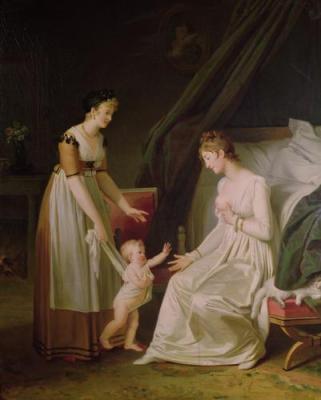
Breastfeeding mother, Marguerite Gerard

French artists Marguerite Gerard (1761-1837) painted this domestic scene of a mother about to breast feed her child.  The subject is unusual in that breasfeeding one’s baby was unfashionable for aristocratic and upper classes,  and the act had become associated with the poor and lower classes.

Generally, wet nurses were paid to feed the babies of the wealthy. Much thought and care went into their selection, and their milk was examined for texture, color, viscosity, and taste. Some thought that aspects of a wet nurse’s personality could be passed through her milk, and therefore her character had to be impeccable. Cassandra Austen, Jane Austen’s mother, sent all her children to the nearby village of Deane to be nursed in their infancy.  Although Cassandra Austen visited her babies daily, they did not return to the family fold until they were around 18 months of age.

The popularity of wet nurses stemmed from the fact that royalty often wanted large families. Wet nurses were hired to feed the newborn so that the royal mother would soon regain fertility and become pregnant again. When royals stopped breastfeeding their children, other women from wealthy families soon followed suit and began to farm their babies out to wet nurses.  This practiced continued until the end of the 19th century, when it largely died out.

Read Full Post »

Repton's design for the gardens for the Royal Pavillion, Brighton

Sir Humphry Repton (1752-1818), who was mentioned in a previous post about the paint color Invisible Green was a famous landscape designer during the end of the 18th century and early 19th century. “In his day, [he]was equal in stature to Capability Brown or Gertrude Jekyll, but is now often-overlooked. However, he was once favoured by the Prince Regent (later George IV), drawing up plans for the Brighton Pavillion, as well as working at Woburn, in Londons Bedford Square, Sherringham in Norfolk and Ensleigh in Devon.”

This 1991 film about Repton’s career, which I found on YouTube and whose title I could not find, features Sir Michael Hordern as the narrator and John Savident as Repton. The special showcases Repton’s magnificent drawings for the redesign of many famous properties; some of his work can still be observed in their natural settings.

About the name: Is it Humphry or Humphrey? I have seen both spellings. The BBC spelled the name as Humprhey, whereas the National Portrait Gallery, Morgan Library, and the majority of sources use Humphry.

Read Full Post »

« Newer Posts - Older Posts »