Feeds:
Posts
Comments

Archive for the ‘Regency Life’ Category

I await each January with joy, knowing that PBS Masterpiece Classic will return. Two years ago PBS concentrated on Jane Austen; last year, two Jane Austen film adaptations were featured; and this year we get to see not only the new adaptation of Emma, but reruns of Persuasion and Northanger Abbey as well. Viewers are also treated to Return to Cranford, the sequel to Cranford, last year’s runaway BBC and PBS hit. Reprising their recurring roles are the stellar actors who represent Cranford’s spinsters and widows and other denizens of this quaint Victorian town. And then we are treated to new characters, each with stories of their own.

Even as I reveled in watching the first new installment of this sequel, I found some of the new stories a tad too familiar and I could not help but shake off a vague sense of disappointment. This feeling was similar to having visited a new vacation spot for the first time. You and your family love the experience so much, you eagerly plan a return. But during the second trip , you feel a slight let down. The wonder and discovery are gone, replaced with  a sense of déjà vu and sameness. You find yourself going over old ground and repeating excursions that somehow don’t seem quite as satisfying as last time.

And so it is with Return of Cranford. All the elements of the original Cranford are still there – the Victorian town ruled by the rigid principles that are followed by a group of widows and spinsters who are set in their old-fashioned ways. The railroad still threatens the town’s placid existence, and the only person barring the line’s completion is Lady Ludlow, whose stubborn resistance is misplaced.

Francesca Annis, pale, gray and achingly beautiful, makes a short but memorable entrance and exit, as does handsome Greg Wise as Sir Charles Maulver, and Claudie Blakley as Martha, Miss Matty’s maid of all work.
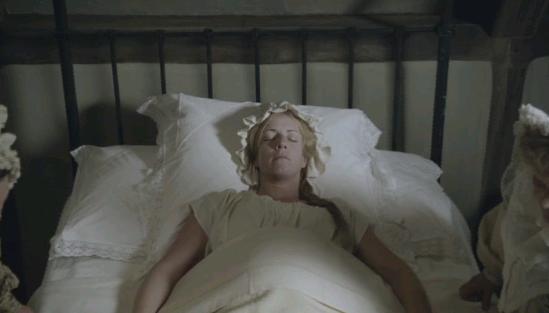
New characters replace the old ones who have (sadly) moved on. The viewer is still treated to a story about star-crossed lovers (Tom Hiddleston as William Buxton and Jody Whittaker as Peggy Bell),  and an implacable father (Jonathan Pryce as Mr. Buxton) who stands in the way of their happiness. They must somehow overcome all obstacles to remain together. Part of the mystery of Return to Cranford is how they will achieve this.

Return to Cranford relies heavily on Judi Dench’s Miss Matty to keep the story threads together. While she was a pivotal character in Cranford, it was her sister Miss Deborah Jenkyns (Eileen Atkins), who was the backbone of Cranford’s widow and spinster society. Miss Deborah inspired steadfast loyalty to her unwavering convictions; Miss Matty, on the other hand, is much softer in character and a person that others want to protect. She has had to grow a strong backbone after her sister’s death, but she is still too easy a touch and has difficulty holding the small band of ‘The Amazons’ together. When hoity toity Mrs. Jamieson’s (Barbara Flynn’s) sister-in-law Lady Glenmire (Celia Imrie) comes to visit, Miss Matty and her cohort are given the sort of social snubbing that Miss Deborah would not have brooked for an instant.

Don’t get me wrong. I am still mad about Miss Matty, who is portrayed by the incomparable Judi Dench. And though her character is too weak to rule the town with the iron fist that her sister Deborah used, she’s become the town’s morally upright compass.

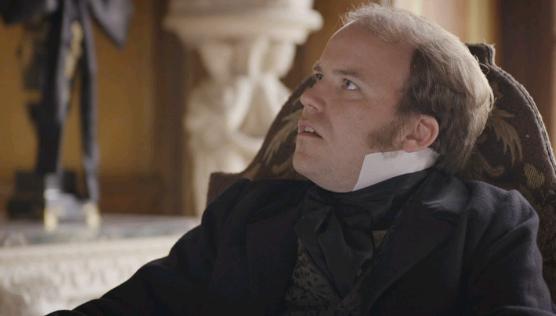
One of the main problems I found with episode one of Return to Cranford is the lack of real tension in the plot. This might be due to the fact that this adaptation was written largely by Heidi Thomas, not by master story teller Elizabeth Gaskell.  A dastardly character is introduced by way of Lady Ludlow’s wastrel son, Septimus (Rory Kinnear), but he is merely an unfeeling cad and shows up only long enough in the film to prove to us that Lady Ludlow had wasted her motherly affection (and money) on an unworthy son. His actions do not produce the tight-as-a-drum-tension that compels a viewer to keep watching a show or a reader to keep turning the pages. The train trip, in which Miss Matty convinces her friends to give the railroad a chance, does not provide much tension either, and the central love story between Peggy Bell and William Buxton seems like something that we have seen before.
Much of the quirky humor I delighted in with the first film is gone, although it was fun to see the ladies get tipsy as they warmed towards Lady Glenmire, and to see Miss Pole get her comeuppance as she makes a bird cage out of a French petticoat hoop frame for her parrot.
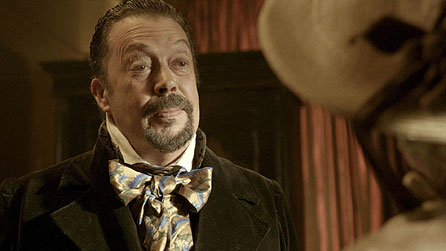
Episode Two gets much better. There’s real tension between Mr. Buxton and his son after William declares his love for Peggy Bell. Rather than honor his father’s wishes to find a more suitable wife, William decides to remain true to Peggy, make his own way in the world and work for the railroad until he has enough money to marry her.  The ladies of Cranford provide a funny backdrop to Lady Glenmire’s romance with Captain Brown. And we follow the fortunes of young Harry, who is torn between two worlds. He does not belong at boarding school and has good reasons for running away. A train accident, which kills poor Mrs Forrester’s cow and puts Harry’s life in danger, provides some true heart-wrenching moments. But all’s well that ends well. Miss Matty finds a satisfying way to unify the town, and the magic act of Senor Brunoni (Tim Curry in a funny role) was a fine (and wonderful) way to end the show and tie up loose story ends.

A friend who watched the show with me (and who did not see Cranford last year), found Return to Cranford delightful. So, I shall attribute my churlishness to a jaded palate and concede that Return is a delightful show, one worthy of viewing and certainly better than anything the competition on commercial television and cable tv have to offer. While my ranking of Cranford was five out of five stars, I rate this sequel a tad lower: four out of five stars.

Read Full Post »

Ever wanted to listen to the music Jane Austen liked? Listen to a 30-minute podcast at this link. There are only four days left to listen Michelle Kerns from the Book Examiner writes:

BBC Radio 4, bless their souls, have put the recordings together with a spirited little commentary by David Owen Norris pondering on the music and Ms. Austen’s history along with Deirdre Le Fay (of Jane Austen Cookbook and multiple Austen biography fame; she reminds me irresistibly of Julia Child), pianist Samantha Curasca, and the lucky Austen inheritor himself, Richard Jenkins.

There are seven compositions featured in the broadcast, ranging from a suggestive little ditty about a maiden who sings all day and night to keep her lover playing his pipe (snort) to the toe-tapping “Bluebells of Scotland.” One song, written by Robbie Burns, Jane rewrote at the very end to make herself the song’s heroine: the original words, “the chains of his Jean” she changed to “the charms of his Jane.” Atta girl.

One charming piano piece, “Allegretto andantino,” is thought to be an original composition written by Ms. Austen herself. Others highlight Jane’s interest in show tunes and songs about the French Revolution, while still others — pages of nursery rhymes — demonstrate her devotion to her legion of young nieces and nephews.

Read Full Post »

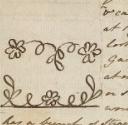
Inquiring reader: Recently I  had the pleasure of viewing Jane Austen’s letters in A Woman’s Wit: Jane Austen’s Life and Legacy, an exhibit showing at the Morgan Libraryin New York City until March 14th. My observations are those of a layman and amateur. Nevertheless, I thought I would share my impressions. As Janeites know, several years before Cassandra Austen’s death, she  ruthlessly censored Jane’s  letters. In this image, taken from the Morgan Library website, you can see that an entire portion of the letter  is missing. To the left of  the same letter, Jane drew the pattern of a piece of lace, writing, “My cloak is come home, and here is the pattern of its lace.”

Portion of autograph letter signed, dated Bath, 2 June 1799 to Cassandra Austen

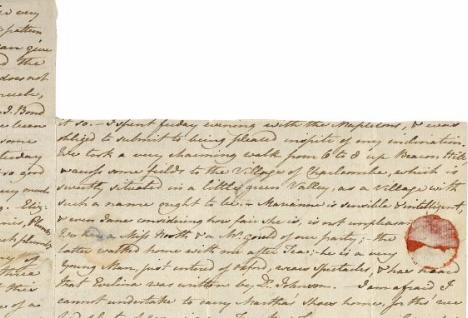
I was struck by how finely some of the portions had been cut out. In one letter that Jane wrote in 1814, Cassandra snipped only a few words and the cut was so unobtrusive that at first I did not spot the missing area. The sentence began with “Edward is quite…” Then nothing. Only a sliver of a line with several additional words cut out. Did the phrase reflect negatively upon Edward or Jane or another member of the family? We shall never know.

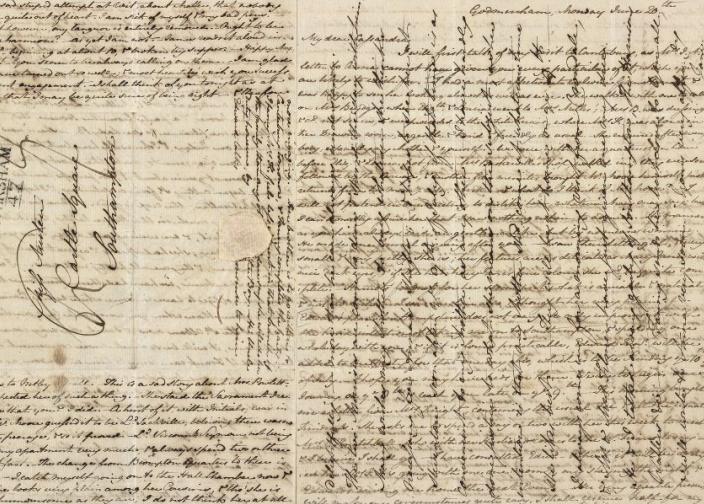
Franking letters was expensive for Jane, whose yearly personal budget consisted of £50 or less. She followed the common practice of cross writing. I noted how straight her lines were, and how carefully she placed them between the blank spaces of the lines on the other side. The letter below shows both practices. The Morgan Library website features this letter and allows you to enlarge it. Scroll to the bottom and study it in more detail. Learn more about crossed letters and the paper Jane used in this link.

Letter to Godmersham

Jane’s letters were not always crossed, nor did she always use both sides of the paper. In this delightful example, written to her  niece, Cassandra, in the last year of her life, Jane takes care to keep a large amount of blank space around the lines. She also writes in a much larger script. Written entirely backwards with an unfaltering hand, the letter must have thrilled its young recipient.

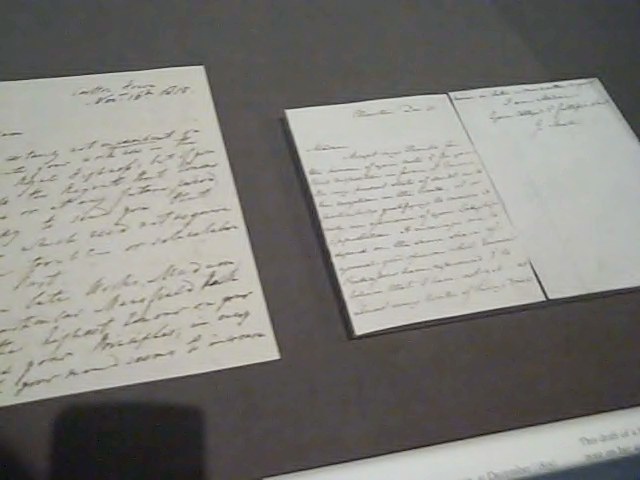
It is estimated that Jane Austen wrote 3,000 letters in her lifetime. Of the 160 that remain, the Morgan Library has purchased 51.  Not all of the lettters in this exhibit were written to family members. In the image below, the letter on the left was written by the Prince Regent’s librarian, James Stanier Clarke, to Jane. To the right of it sits one of her letters to him. I was struck by the brown color of the ink, which in some letters was still strong and vigorous, and in others had faded to a pale, watery color. Jane used iron gall ink, an ink common in her era, which is initially blue-black and then fades to brown.

It is composed of tannin (gallic acid), iron sulfate (known as vitriol in the nineteenth-century), gum arabic, and water. Because it is indelible, it was used for official documents from the middle ages onward. The ink is easy to make, inexpensive, and can be transported as a powder and mixed whenever needed. When first applied to paper, the ink appears pale-gray; as it is exposed to air, the ink darkens to a rich blue-black tone. Eventually, most iron gall ink changes to a brown color, as is evident in Austen’s letters and manuscripts – Thaw Conservation Center.

To learn more about Jane’s letters in the exhibit, I urge you to click on the Morgan Library website and study the few images that are shared with the public. Sadly, the Morgan did not publish a catalog, and much of the information in the exhibit is available only to visitors. Click here to view images from the exhibit. Click here to read about the technicalities of letter writing in Jane Austen’s day.

More links about the exhibit:

More links on this blog about letter writing and the royal mail in Jane Austen’s day:

Read Full Post »

Happy Christmas from Jane Austen’s World


Heap on more wood! — the wind is chill;
But let it whistle as it will,
We’ll keep our Christmas merry still.
Each age has deemed the new born year
The fittest time for festal cheer.
And well our Christian sires of old.
Loved when the year its course had rolled,
And brought blithe Christmas back again,
With all his hospitable train.
Domestic and religious rite
Gave honour to the holy night:
On Christmas eve the bells were rung;
On Christmas eve the mass was sung;
That only night, in all the year,
Saw the stoled priest the chalice rear.
The damsel donned her kirtle sheen;
The hail was dressed with holly green;
Forth to the wood did merry men go,
To gather in the mistletoe,
Then opened wide the baron’s hail
To vassal, tenant, serf, and all;
Power laid his rod of rule aside,
And ceremony doff’d his pride.
The heir, with roses in his shoes,
That night might village partner choose.
The lord, underogating, share
The vulgar game of “post and pair!”
All hailed with uncontroll’d delight
And general voice, the happy night
That to the cottage, as the crown,
Brought tidings of salvation down.
The fire with well dried logs supplied,
Went roaring up the chimney wide;
The huge hail table’s oaken face,
Scrubb’d till it shone, the day to grace,
Bore then upon: its massive board
No mark to part the squire and lord.
Then was brought in the lusty brawn,
By old, blue-coated serving-man;
Then the grim boar’s head frowned on high,
Crested with bays and rosemary.
Well can the green-garbed ranger tell,
How, when, and where, the monster fell;
What dogs before his death he tore,
And all the baiting of the boar.
The wassail round in good brown bowls,
Garnished with ribbon, blithely trowls.
There the huge sirloin reeked: hard by
Plum-porridge stood, and Christmas pie;
Nor failed old Scotland to produce
At such high tide her savoury goose.
Then came the merry masquers in,
And carols roar’d with blithesome din;
If unmelodious was the song,
It was a hearty note, and strong.
Who lists may in their mumming see
Traces of ancient mystery;
White shirts supplied the masquerade,
And smutted cheeks the visor made
But oh! what masquers, richly dight,
Can boast of bosoms half so light!
England was merry England when
Old Christmas brought his sports again.
’Twas Christmas broached the mightiest ale,
’Twas Christmas told the merriest tale;
A Christmas gambol oft would cheer
A poor man’s heart through half the year.

Sir Walter Scott, 1808, from Marmion

Read Full Post »

My Dear Charlotte is a recent novel written in epistolary form by British mystery writer Hazel Holt, who uses Jane Austen’s letters to her sister Cassandra for her inspiration. The main character of the book and the writer of the letters is Elinor Cowper (pronounced Cooper), who lives in Lyme Regis with her parents. She writes faithfully to her older sister Charlotte in Bath. In the letters Ms. Holt includes all the minutia of daily life that Jane wrote down, such as purchasing cloth, refurbishing bonnets, exchanging recipes, and attending balls and assemblies. Jan Ferfus, Professor of English Emerita, Lehigh University writes in the introduction:

“Of course, you don’t have to love Austen to love this book. If you enjoy detective novels, you will find here a completely satisfying murder mystery, coupled with a romance (or more than one, in fact). My Dear Charlotte gives you, in addition to mystery and romance, a portrait of the world of the English gentry at around 1815, immediately after the defeat of Napoleon–its manners and its moral certainty. As in Austen, Napoleon is not directly mentioned, but his shadow is there: one brother of the heroine is a sailor and the other a junior diplomat at the Congress of Vienna. It’s the social world at home that is central, however, with its balls, visits, courtships, gossip, and of course murder, underlining the tensions and rifts within that apparently civilized society.

The book is based on the premise that Jane’s letters make for interesting reading. As the publisher says, “While the story is new, the details having to do with balls, dinners, and other social events are given in the words of Jane Austen herself.”  This excerpt describes events just after Mrs. Woodstock’s murder:

Of course it cannot be denied that Mr Woodstock himself will lead a happier life without his formidable spouse, though I do not believe that he could have summoned up the courage to dispose of her!

Mr Rivers will be glad to be rid of one who would have put obstacles in the way of his plans for the Barbados estate, but I do not think that may be considered a sufficient reason for an honourable man to take a life.

Mrs West, however, seems to me to lack such scruples if they stood in the way of her daughter’s advancement. I do not at present see how she could have brought about Mrs Woodstock’s demise, but no doubt, if I give my mind to it, I may presently think of something.

Poor John coachman also had reason to wish his mistress dead, since his whole happiness (and that of Sarah) depended upon keeping his position at Holcombe and if he had been turned away without a character his case would have been miserable indeed.

So you see, there are a number of people who will be happy at Mrs Woodstock’s death. Perhaps I should add myself to the list for the sake of those hours of tedium and the many irritations she has subjected me to!

Author Hazel Holt

The above passage represents the book at its most exciting because it concentrates on the plot.  As far as I am concerned, Jane Austen’s letters are not all that interesting when taken out of context. The letters to Cassandra are important because they reveal something (anything) about Jane’s life and thoughts. Those that I read from the Brabourne edition seem like watered down pap when compared to the tart and satiric observations of her novels. There were times when I stopped reading My Dear Charlotte, for the book was bogged down by the minutia of daily life instead of clues about the murder. The details were meant to give authenticity, but they should have been used more sparingly. I found the epistolary format also problematic, for it allowed for too much exposition and very little dialogue, and I felt that I was receiving my information third-hand. Instead of getting into Elinor’s head, I was reading about her recipes! In fact, Elinor reveals as little of her thoughts, ideas, and hopes in her letters to Charlotte as Jane did to Cassandra. I would have preferred that Ms. Holt had used the rich dialogue and language in Jane’s books for inspiration, rather than her uneventful life.

Hazel Holt would most likely disagree with my assessment of Jane’s letters. She describes the process of writing My Dear Charlotte in a recent interview, in which she revealed that she found Jane’s letters delightfully chatty:

I thought – holding my breath – that since they are such wonderfully informal, chatty letters, I might just manage to create a sort of facsimile of her world if I wrote my novel in the form of letters, inserting extracts of Austen’s where they would fit in with the story – the perfect, authentic background.

Ms. Holt DOES capture Jane’s ascerbic wit on a few occasions by directly quoting her and weaving these gems into the plot:

“Mrs Holder’s niece, Miss Porter, is recently come into the neighborhood but is not much admired; the good-natured world, as usual, extolled her beauty so highly, that all of Lyme have had the pleasure of being disappointed.”

“I do not remember if I told you that Mrs Heathcote wrote to tell us that Miss Blackford is married, but I have never seen it in the papers, and one may as well be single if the wedding is not in print.”

Perhaps I was expecting too much from the start and didn’t give this book the chance it deserved. As a successful mystery writer, I expected Ms. Holt to wow me from page one. To be fair, as the book progressed and as the characters were introduced and more fully formed, I found myself becoming more involved in the plot. Ms. Holt knows how to write a mystery, though I took a stab in the dark and guessed the murderer early on. Searching the Internet for reviews and comments about My Dear Charlotte, I discovered that many people liked it immensely and gave it rave reviews. As for me, I rate this book two out of three regency fans.

My Dear Charlotte: With the assistance of Jane Austens letters (Paperback), Hazel Holt. ISBN #’s
Standard: 978-1-60381-040-1
Large Print Books: 978-1-60381-041-8
sBook: 978-1-60381-042-5

More on the Topic

Read Full Post »

« Newer Posts - Older Posts »