Feeds:
Posts
Comments

Archive for the ‘Regency London’ Category

“That fellow Weston,” said Brummell, “is an inimitable fellow — a little defective perhaps in his ‘linings,’ but irreproachable for principle and button-holes. He came to London, Sir, without a shilling; and he counts more realized thousands than our fat friend does ‘frogs’ on his Brandenburg. He is not only rich, but brave; not only brave, but courteous; and not alone courteous, but candid. – Beau Brummel

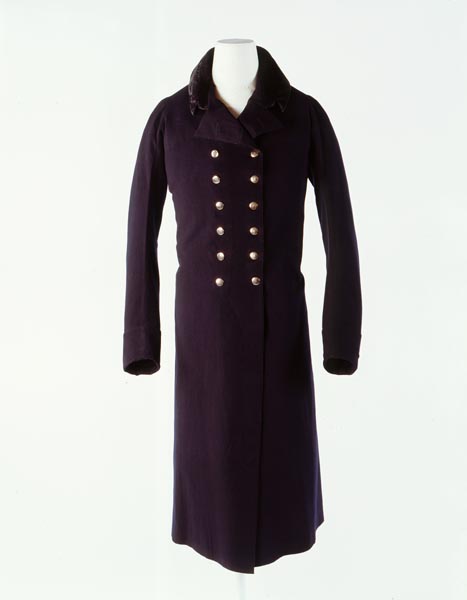
Man's Great Coat by John Weston, 1803-1810

Man

John Weston, Regency London’s most expensive tailor and draper to George, Prince of Wales, was frequently mentioned by Georgette Heyer in her novels. While Ms. Heyer peppered her novels with Weston’s name, I was actually unable to find much about him. This caption from the exhibit a the Museum of London, describes the greatcoat at right: 1803, tailored by John Weston of 38 Old Bond Street.

The prince was passionately interested in clothes and patronised London’s most skilful craftsmen. This slim fitting double-breasted coat, which has a silk velvet collar, is made of high quality British wool facecloth. Charles Jennens, a London button maker, supplied the gilt buttons.

The coat was discovered at Coutts Bank, where the tailor had deposited it for an unknown client, in 1956. A letter accompanying the coat described it as, ‘an exceed[ingly] good blue cloth great coat … made in ev[e]ry respect in the best manner’.

Men of fashion felt a sort of religious awe as they passed over the threshold of Weston, Brummell’s tailor, in Old Bond-street

Read more about London’s tailors at these links:

  • Jean Louis Bazalgette: Fascinating biography of one of the Prince Regent’s earlier, lesser known tailors. (Cached information.)

Read Full Post »

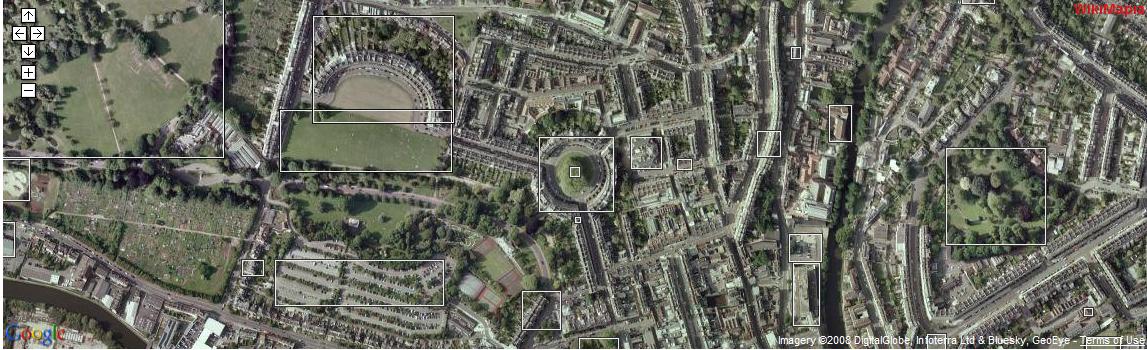
Ah, London. If I were rich, I would visit this city every month. So I shall simply have to rely on interactive maps and panoramic views to satisfy my yearnings.  Wikimapia is an online collaborative mapping system that combines google maps with a wiki system, allowing users to add information. Click here to see an interactive image of a portion of London that shows Hyde Park, Mayfair, and Green Park. The square grids provide detailed information about the mapped area when you move your cursor over them.

Green Park, London

Static map of Green Park, The Mall, and Victoria Monument, London

The exciting part about this project is that if you have visited this part of the world (or better yet, live there) you can add your knowledge about a particular area. This interactive image depicts Green Park and Pall Mall. You can see Buckminster Palace at the lower left, the Victoria Memorial and the Mall leading from it, and St. James’s Palace in the upper right. To view greater details I keep clicking on the images until I see such details as people walking in the park and cars parked in the streets. Amazing.

Bath, England

Static map of Bath, England

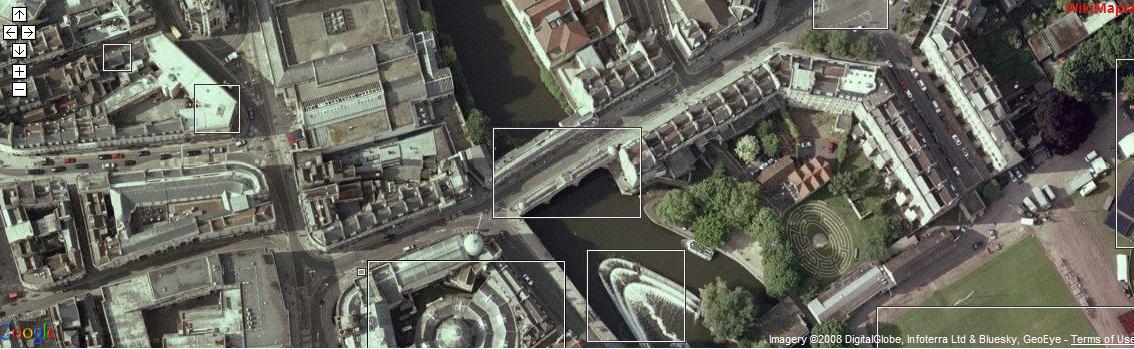
Let’s not forget Jane Austen and her world. This link leads to an interactive map of an arial view of Bath, England, and this link leads to an interactive close up of Pulteney Bridge (see static map below. The details are so fine that you can see cars parked on the streets. Spectacular.

Pultney Bridge

Pultney Bridge, static map

Read Full Post »

Dear Readers, As long as my computer woes continue I will be resurrecting old posts. Originally published in 2007, this post describes the gentlemen’s clubs in St. James’s:

As Pall Mall and the immediate neighbourhood of St. James’s have been for a century the headquarters of those London clubs which have succeeded to the fashionable coffee-houses, and are frequented by the upper ranks of society, a few remarks on Club-land and Club-life will not be out of place here.As Walker observes in his “Original,” the system of clubs is one of the greatest and most important changes in the society of the present age from that of our grandfathers, when coffee-houses were in fashion. “The facilities of life have been wonderfully increased by them, whilst the expense has been greatly diminished. For a few pounds a year, advantages are to be enjoyed which no fortunes, except the most ample, can procure. … For six guineas a year, every member has the command of an excellent library, with maps; of the daily papers, London and foreign, the principal periodicals, and every material for writing, with attendance for whatever is wanted. The building is a sort of palace, and is kept with the same exactness and comfort as a private dwelling. Every member is a master without the troubles of a master. He can come when he pleases, and stay away as long as he pleases, without anything going wrong. He has the command of regular servants, without having to pay or to manage them. He can have whatever meal or refreshment he wants at all hours, and served up with the cleanliness and comfort of his own home. He orders just what he pleases, having no interest to think of but his own. In short, it is impossible to suppose a greater degree of liberty in living.”

From: ‘Pall Mall; Clubland’, Old and New London: Volume 4 (1878), pp. 140-64. URL: http://www.british-history.ac.uk/report.asp?compid=45188. Date accessed: 07 January 2007.

  • This link Will lead you to views of London today. Explore the sights in panoramic views.

Read Full Post »

Want a sense of what the London riverscape once looked like? London’s Lost Rivers offers a map of rivers that once ran above ground, but are now directed under streets through culverts. Click here to view the map, and read a description of the rivers.

“Dead Hogges, Dogges, Cats, and well flayd carryon horse, their noysom corpes soyld the water courses; Both swines and stable dunge, beasts guts and garbage, street durt, with gardners weeds and rotten herbage. And from those waters filthy putrifaction, our meat and drinke were made, which bred infection.”

This description of the rivers in Oxford in 1644, from John Taylor’s “Mad Verse”, gives an idea of how the Thames had long been used as an open sewer. In London, the originally beautiful river Fleet, which fed into the Thames, was one of the first to be railed off as a health hazard. – Thames Pilot: The River Environment

The Fleet River was also know as The River of Wells. Click on previous link and the links below to learn more about this fascinating topic. Find amazing photos of the Fleet sewer in Undercity.

“In the “Dunciad,” Pope, lashing the poorer of his enemies, drives them headlong past Bridewell to the mud-pools of the Fleet”— (From The Fleet River and the Fleet Ditch)

To where Fleet-ditch with disemboguing streams
Rolls the large tribute of dead dogs to Thames,
The king of dykes! than whom no slice of mud
With deeper sable blots the silver flood.

‘Here strip, my children! here at once leap in,
Here prove who best can dash thro’ thick and thin,
And who the most in love of dirt excel,
Or dark dexterity of groping well.

Who flings most filth and wide pollutes around
The stream, be his the Weekly Journals bound;
A pig of lead to him who dives the best;
A peck of coals a-piece shall glad the rest.’
In naked majesty, Oldmixon stands,
And, Milo-like, surveys his arms and hands;
Then sighing, thus, ‘And am I now threescore?
Ah, why, ye gods! should two and two make four?’
He said, and climb’d a stranded lighter’s height,
Shot to the black abyss, and plung’d downright.
The Senior’s judgment all the crowd admire,
Who but to sink the deeper, rose the higher.
Next Smedley div’d; low circles dimpled o’er
The quaking mud, that clos’d, and op’d no more.
All look, all sigh, and call on Smedley lost;
Smedley, in vain, resounds thro’ all the coast.

Image at top from: The River Runs Deep (see link above)

Google map with superimposed Image of the River Fleet at bottom from: Fluffhouse.org. (In this image, the underground Fleet flows from Regent’s Park to the Thames River. Please correct me if I am wrong.)

Read Full Post »

…dirt accumulated faster than all measures to contain it: Cattle were still driven through the streets to and from Smithfield Market until the mid-nineteenth century and horse-drawn vehicles added to the labours of the sweepers stationed at street crossings. Smoke from brick kilns and thousands of sea coal fires polluted the air. In 1813 Henry Austen’s new home above his offices at No. 10 Henrietta Street appeared to Jane to be ‘all dirt & confusion.’ – Jane Austen in Context, Edited by Janet Todd, p 207-208

During Jane Austen’s time and into the earliest days of the twentieth century, crossing sweepers made a living sweeping pedestrian crossings, stoops, and sidewalks of horse manure and litter. Before motorized transport, London boasted over 100,000 horses traversing its streets daily, each one eating a fibrous diet. The crossing sweeper’s job was to shovel the muck, keeping the streets clean for ladies whose long dresses and delicate slippers might get soiled and for gentlemen in their fine raiments.


During “Boney’s” time of terror (Napoleonic Wars), the job of crossing sweeper was often strenuous, and it was said that crossing sweepers could build up a considerable fortune to dig a “channel of viscous mud, a foot deep, through which, so late as the time when George the Third was king, the carts and carriages had literally to plough their way.” In those days, the crossing sweeper had to dig trenches to allow carriages and pedestrians to pass through poorly maintained and muddy roads. As the roads improved, so did the lot of the crossing sweeper, who earned less and less for a job that was to become relatively easier. A good crossing sweeper in an excellent location could still earn a decent living, however. – Chambers, Edinburgh Journal, No. 437, Volume 17, New Series, May 15, 1852

Henry Mayhew described the advantages of this lowly occupation for the London poor:

  • 1st, the smallness of the capital required in order to commence the business;
  • 2ndly, the excuse the apparent occupation it affords for soliciting gratuities without being considered in the light of a street-beggar;
  • And 3rdly, the benefits arising from being constantly seen in the same place, and thus exciting the sympathy of the neighbouring householders, till small weekly allowances or “pensions” are obtained. – Henry Mayhew, London Labour and the London Poor: Volume 2, Crossing-Sweepers

According to the Leeds Industrial Museum, “Children often had more than one way to make money. When it was dry and the streets were not muddy the crossing sweepers, for instance, would do occasional work like catching and opening cabs for people. In the evening they would go outside theatres and operas and tumble for money. Girls mixed ballade singing or lace selling.”

At one time there were so many crossing sweepers that a pedestrian was accosted for money on every stoop and corner, and it would cost a pretty penny to walk from one end of town to another. In 1881, Richard Rowe wrote in London Streets:

IF anyone wants to realize, as the phrase goes, the little army of crossing-sweepers we have in London, let him take a walk – say for a mile or two – on a muddy day, and give a penny to every one who touches hat, makes a bob, as if shutting up like a spy-glass, or trots after him, trailing broom in one hand, and tugging at tangled forelock with the other. I remember when it would have cost anyone, disposed to give in this way, between a shilling and eighteen- pence to walk from the Archway Tavern, Highgate Hill, to Highbury Cock and back. For anyone of a squeezable temperament, therefore, it was decidedly cheaper to take the bus. It is simply as a statistical experiment, just for once in a way, that I recommend this penny-giving. It would be a great misfortune if all crossing-sweepers had pennies given them indiscriminately. I would not make a clean sweep of the sweepers, but I should like to see their ranks thinned considerably – viz., by the elimination of the adults who are able, and the young who might be trained to do something better than what, in the most favourable instances, is little better than a make-believe of work, as a pretext for begging, either directly or by suggestion.


Crossing sweepers worked diligently on both sides of the Atlantic Ocean. In 1882, a New York matron lamented in a letter to the editor of the New York Times about a new regulation that prevented crossing sweepers from working (double click on the image to read it) :

To read more about this fascinating topic, click on the following links:

Click here for an interesting backlink to this post.

Read Full Post »
« Newer Posts - Older Posts »