Feeds:
Posts
Comments

Archive for the ‘Regency Period’ Category

Copyright @Jane Austen’s World. Gentle readers, as you know, the northeast has been socked in by snow, ice, gale winds, and bitterly cold temperatures today.

George Scharf, Sketches of People in Snow. Some scenes of winter have never changed.

This is a perfect time for hunkering inside and drinking hot chocolate. Or is it?
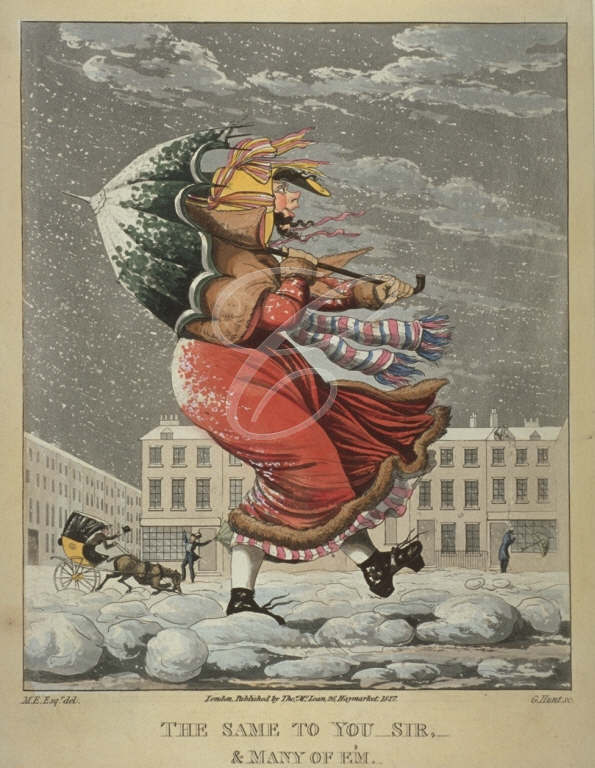
Image @City of London. This young lady is wearing pattens to protect her shoes.

My nephew’s children will go sledding, others will go ice skating, and my dog will bound through the snow drifts with undisguised glee, as people have done for ages.

Winter Amusement, Hyde Park, after Ibbetson, 1789. Note the bare feet on the young child in rags. (Foreground)

As early as the 17th century, the noted diarist John Evelyn noted: ” Having seen the strange and wonderful dexterity of the sliders on the new canal in St James’s Park, performed before their Ma[ties] by divers gentlemen, and others with Scheetes, after the manner of the Hollander,s with what swiftnesse they passe, how suddainely they stop in full carriere upon the ice, I went home by water, but not without exceeding difficultie,s the Thames being frozen, greate flakes of ice incompassing our boate. Pepys entry is as follows: St James’s Park Dec 1 1662. “Over the Park where I first in my life it being a great frost did see people sliding with their skeates, which is a very pretty art.”


Dutch steamers on the frozen Zuyder Zee. The leather straps are quite visible on these skates.

Skating has been around since 3,000 BC or thereabouts and stone age skates have been uncovered in bogs. But it was the lowlanders who took to the sport with glee, using wooden platform skates with iron runners as early as the 14th century. At first, skaters strapped their skates around their shoes with leather straps and propelled themselves forward with wooden poles.
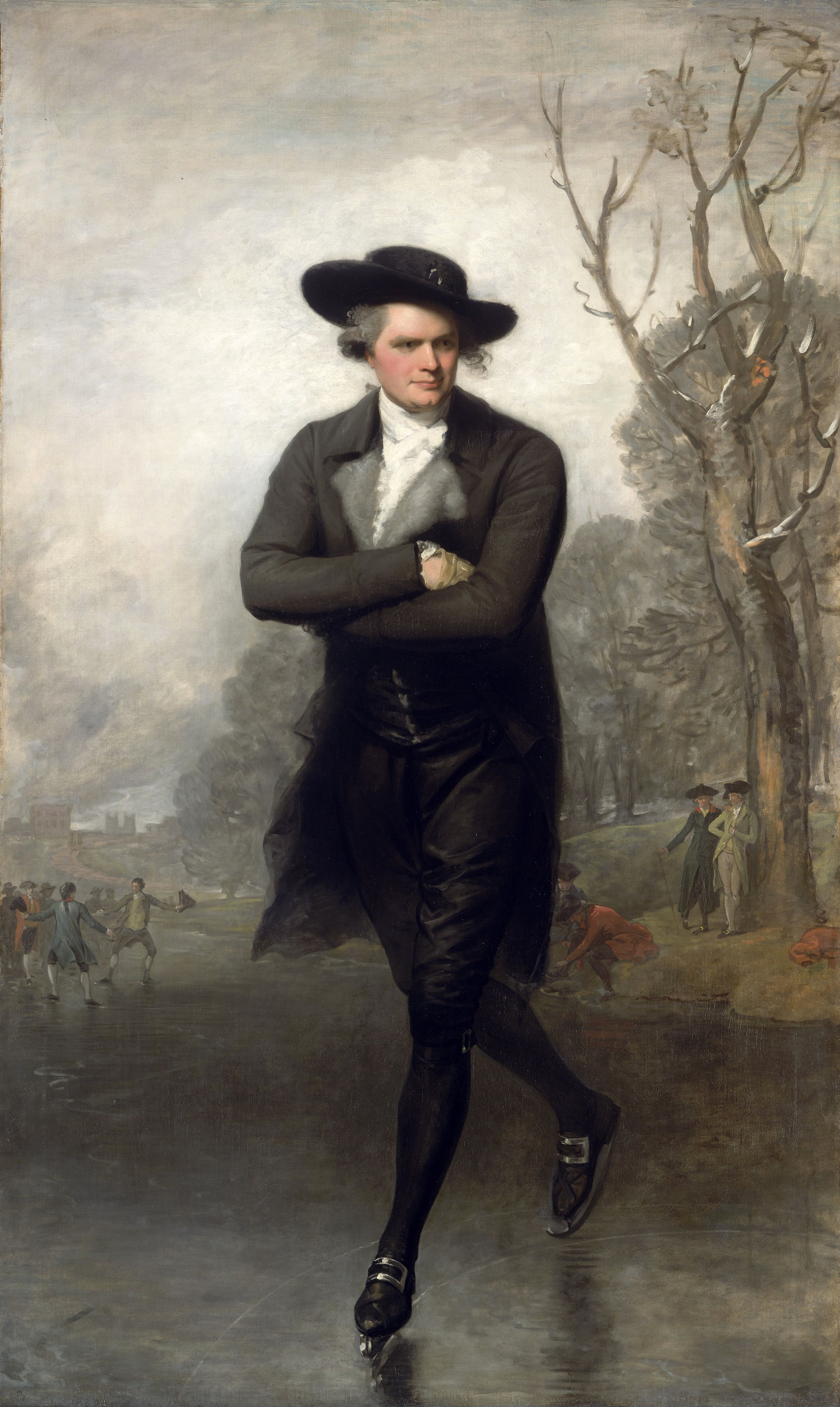
 

William Grant, The Skater, 1782

Then, the Dutch invented a narrower double-edged metal blade that allowed them to glide with their feet, and the poles became obsolete.
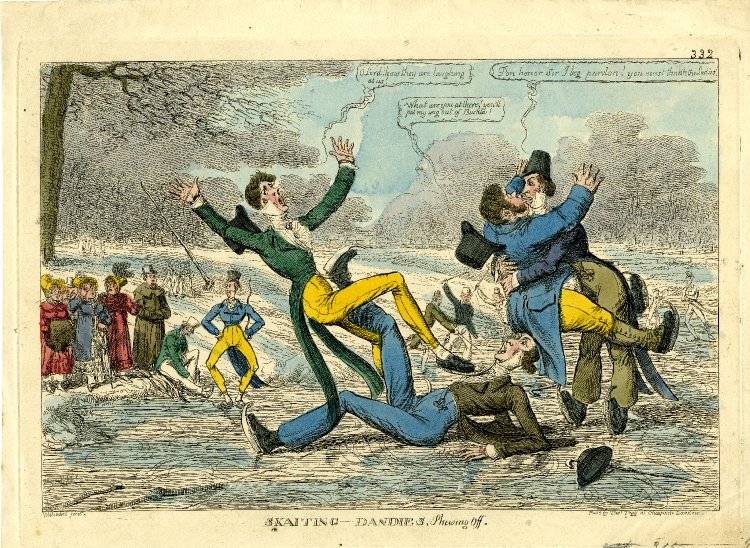
1824 Skating Dandies Showing Off

Many 19th century images exist of people skating on frozen streams and ponds, and sledding or sleighing.
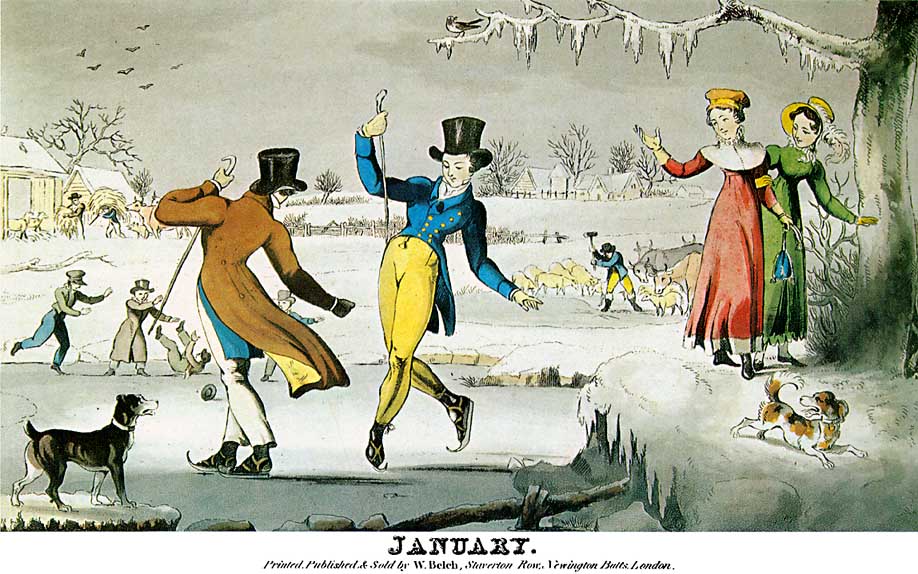
 

1820. In the distance on the right, one can see a man chopping through the ice to allow his cattle to drink water. On the left, another man is spreading grain to feed his animals.

“..moderns sledges are used, which being extended from a centre by the means of a strong rope, those who are seated in them are moved round with great velocity, and form an extensive circle. Sledges of this kind were set upon the Thames during the hard frost in the year 1716 as the following couplet in a song written upon that occasion 1plainly proves:

“While the rabble in sledges run giddily round
And nought but a circle of folly is found” – The sports and pasttimes of the people of England

By the mid 18th century, Robert Jones described paired ice skating, or figure skating in A Treatise on Skating (1772).
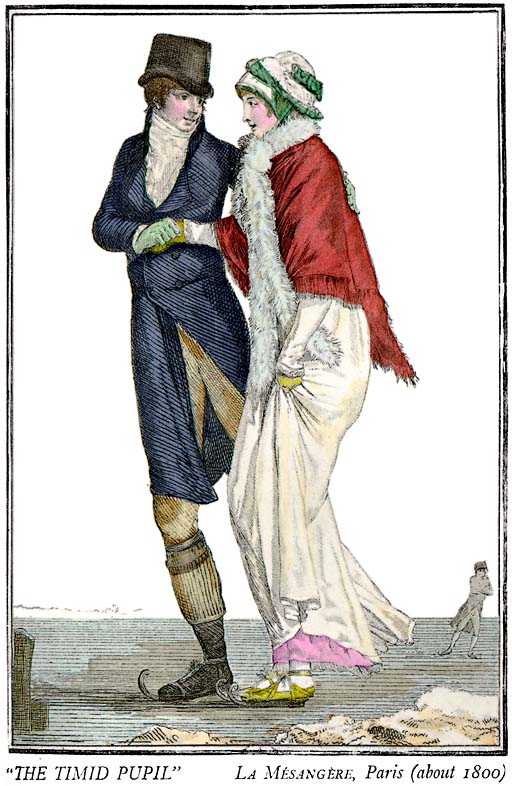
 

The Timid Pupil, 1800. Both this ladies feet are placed together, as her escort gently leads her over the ice.

Sleds and sleighs have been used for centuries to transports logs, people, and good over frozen waters all over northern Europe for centuries.
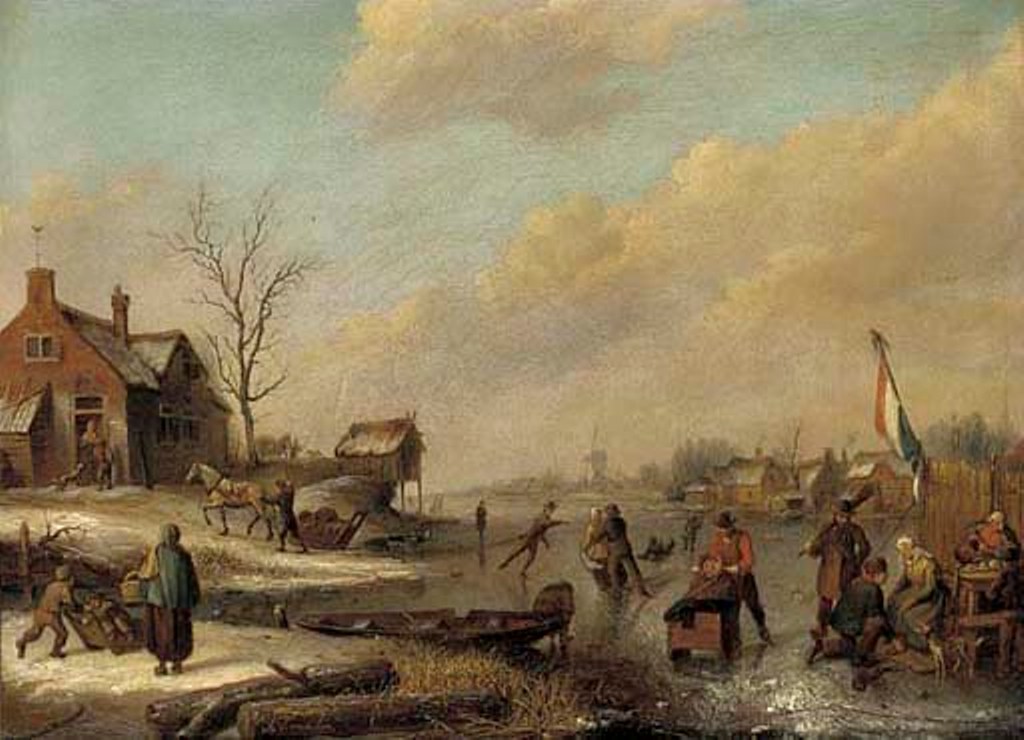
 

Frozen river in The Netherlands with townsfolk skating and sledging using various forms of sleds pushed by people, and one pulled by a horse. By Vermeulen

Called coasting, sliding down hills and inclines on hand sleds or sledges provided hours of pleasure, as well as a practical way to get around over frozen landscapes and water. Wooden sleds pulled by a rope are still a familiar sight today.

19th century porcelain (figures in 18th century dress): man pushing woman on a sleigh

Fancy sleighs pulled by horses (or reindeer in the frozen north) transported groups of people, often in comfort, for their feet were placed upon footwarmers that were heated with hot coals, and their bodies were covered by thick furs or blankets.
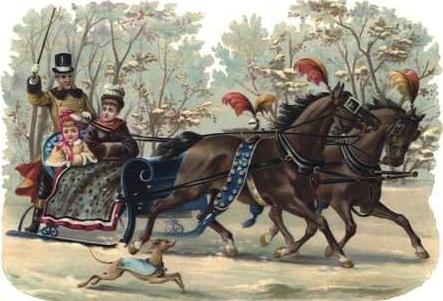
 

Victorian sleigh. The travelers are protected from the cold by muffs and a thick blanket. Even the dog wears a coat. Note the bells on the horses.

More on the topic:

Read Full Post »

In the second episode of At Home With the Georgians: A Woman’s Touch, Amanda Vickery mentioned metamorphic furniture and (remarkably) turned a desk into a bed. A visitor to Tony Grant’s excellent post left this question: What is metamorphic furniture?

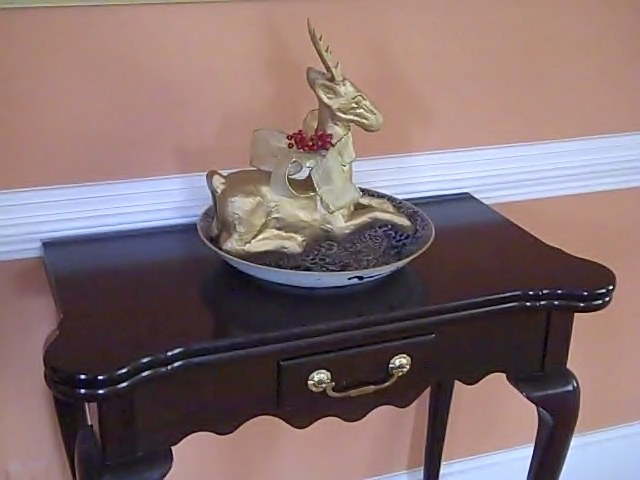
Modern example of metamorphic furniture: hall table/card table

Tony answered the question admirably. This mechanical furniture, wide-spread in Georgian times, had a dual use. A small folding staircase could be transformed into chair or desk, such as a writing table, library table, or card table. These pieces of furniture were great space savers, as I can attest. Only last week I transformed my faux-Georgian hall table into a card table for my guests. I never guessed until Tony’s post that I owned an example of mechanical furniture. Sweet!

The only change I would make in the video (besides the annoying lilt in my voice) is to make sure that the next time I film an example of my furniture, it is thoroughly dusted and cleaned! Extra points if you can spot my pooch in one of the scenes. His hang dog expression tells me that he was out of sorts, having been told to stay put.

This Victorian piano at the Brooklyn Museum pulls out into a bed. Fascinating. The video is available to view until March 2011.

READ MORE: If your interest in the topic is piqued, Clive Taylor (who also left a comment on the previous post) has written a dissertation on the topic (click here to read The Regency Period Metamorphic Chair) and sells metamorphic library chairs/stairs in his shop, Parbold Antiques.

Read Full Post »

“Heigh ho! sing heigh ho! unto the green holly:
Most friendship is feigning, most loving mere folly:
Then, heigh ho, the holly!
This life is most jolly.”
– William Shakespeare, As You Like It

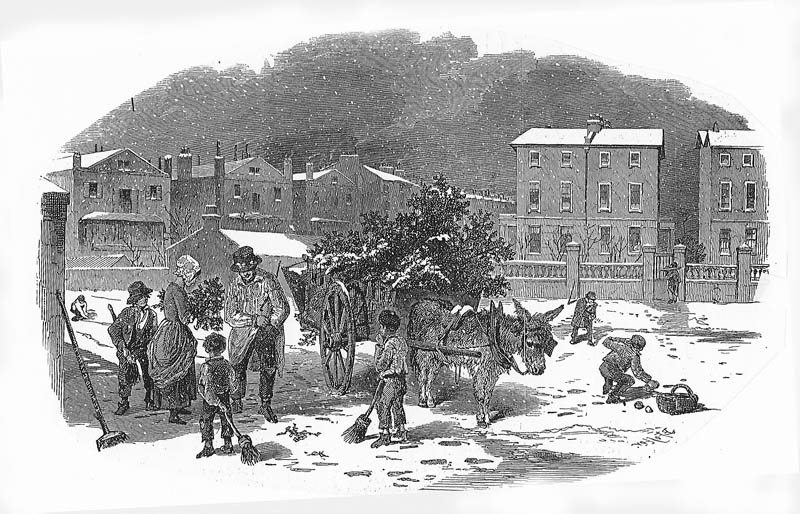
Decorating one’s house with natural boughs has been a Christmas tradition since Celtic times. Boughs of holly with their bright red berries were especially coveted. (Read Mythology and the Folklore of Holly.) One understands how easily people in rural areas could obtain these bright green leaves, but what about those who lived in London? This image of a holly cart pulled by a donkey provides a solution.

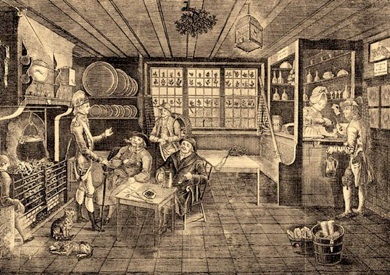
Note that the customer purchases a small amount of boughs. Christmas decorations in the 19th century were modest to none compared to ours. In this 18th-century print of a coffee house or chocolate shop, one can see small leaves of holly placed in each window pane and a bough hanging from the center of the ceiling. (One cannot imagine that mistletoe would  be hung in a public setting.)

Bowles and Carver print, London. Circa 1775

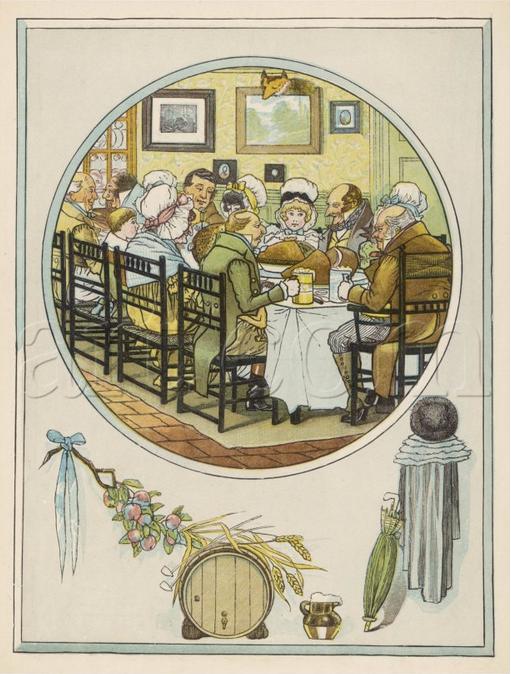
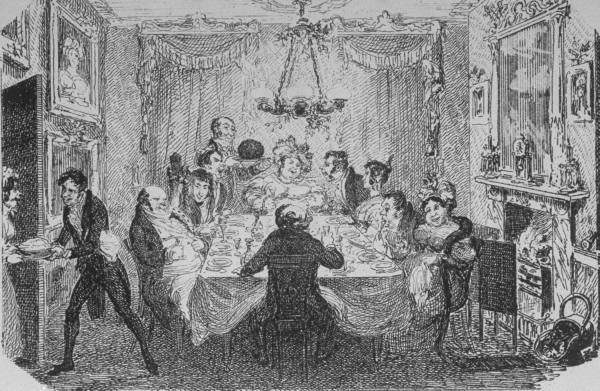
In this image of a lavish family dinner by Cruikshank, not a single bough of holly decorates the room. Most likely a wreath had been hung on the front door or some boughs had been hung from the ceiling. With holly hard to obtain in metropolitan areas, one imagines that the spare use of decorations was as much from necessity as from tradition.

Image: Art.com

This image by Cruikshank of a family celebrating Christmas during early Victorian times  shows a few boughs inserted into the chandelier, a roaring fire, and the Christmas pudding about to be served to the hostess. This year, I have taken the Regency approach to decorating my house, emphasizing the season with just a few well placed decorations. And I love it.

Other Christmas Posts on this blog:

Read Full Post »

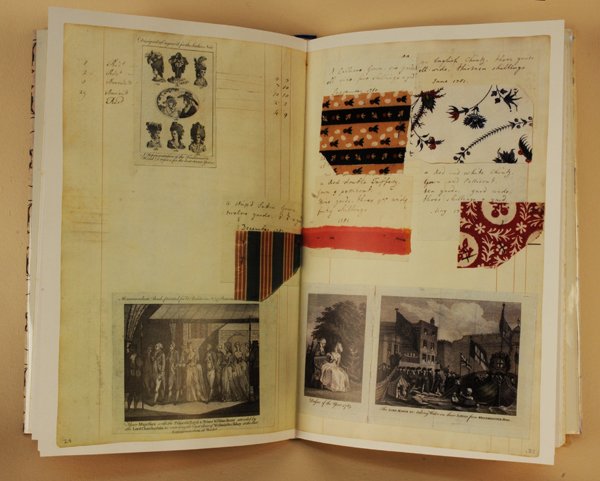
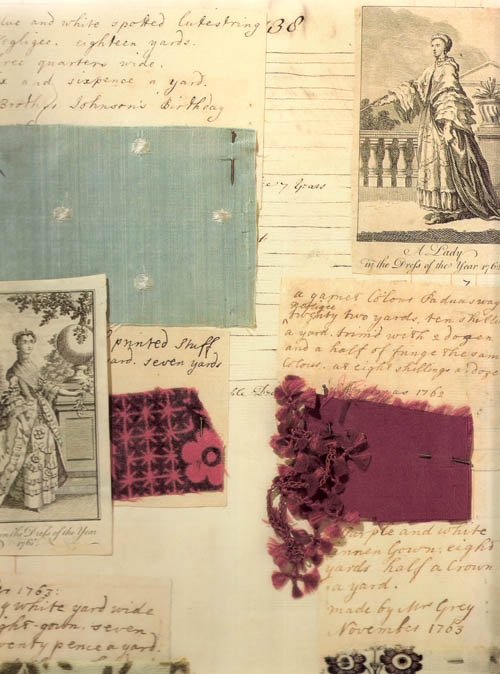
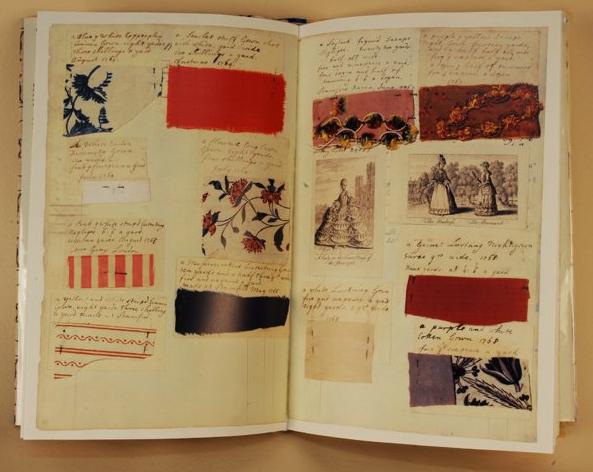
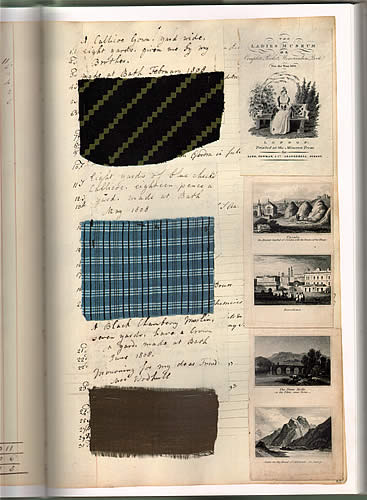
Gentle readers, this YouTube video and these images provide only a sampling of the content of this remarkable book, edited by Natalie Rothstein, who worked in the textile department of the Victoria and Albert Museum before her death. During her lifetime Barbara Johnson (1738-1825) kept a meticulous record of the dresses that were made for her, attaching swatches of fabric and including images from ladies magazines.

Sample pages from the book

Read Full Post »

The environs of London changed dramatically during the 18th and 19th century.

Map of London, Fairburn, 1795

Find them here: Maps of the city are clickable for closer views.  Click on this link: Old London Maps.

List of maps and views in chronological order on the site:

1702
St. Paul’s Cathedral. Pieter Schenk c. 1702. A colourised view of St Paul’s from Westminster.
1720
John Stow (John Strype, editor, and Richard Blome, engraver), maps and plans from the 1720 edition of The Survey of the Cities of London and Westminster.
1750
A map of the Thames between the Tower and Blackwall, giving soundings at low tide, and showing stairs and windmills. Printed in the late 18th century, but showing the Thames as it was in 1750.
1753
A map showing the new roads etc. from Westminster Bridge in May 1753, taken from the Gentleman’s Magazine.
1756
The Proposed New Road from Paddington to Islington 1756 in London.
1786
John Carey’s beautiful Actual Survey of the Country Fifteen Miles Around London, 1786 (which now, of course, includes most of London). This incorporates 24 maps of all eighteenth-century London’s satellite villages and many contemporary views.
1792-99
Richard Horwood’s 1792-1799 Plan of London and Westminster – quite simply, the most detailed map of Georgian and Regency London you will ever find. It shows every house (with numbers), every alley, every tavern, every work and alms house. Magnificent.
1801 John Fairburn’s Plan of Westminster and London, 180

Read Full Post »

« Newer Posts - Older Posts »