Feeds:
Posts
Comments

Archive for the ‘Regency style’ Category

Ransome's HonorRansome’s Honor by Kaye Dacus will not disappoint fans of sweet Regency romances or Christian Romance novels. We first meet Julia Witherington at the age of seventeen accompanied by her parents as they set off for a splendid evening of dancing in Portsmouth’s public assembly hall. The war with France has ended with the Treaty of Amiens. Julia’s father, an admiral, is to be introduced as Sir Edward for the first time and she expects to receive a marriage proposal from dashing Lieutenant Ransome. Sir Edward, who made his fortune in the Royal navy, has filled Julia’s marriage coffers with 30,000 pounds. Although the Lieutenant must still make his mark in the world, Julia is more than willing to share her largesse. But William, too proud to be considered a fortune hunter, changes his mind about proposing. A hurt and humiliated Julia instantly understands that Lt. Ransome had been angling after her father’s patronage and that she’d merely been a means to an end.

Flash forward twelve years and we meet Julia again in 1814. She’s turned into a beautiful, mature, and successful businesswoman who has been managing her father’s sugar plantation in Jamaica. Still unmarried, she has returned to Portsmouth following her mother’s death and become the darling of Portsmouth society. William Ransome, now a captain, is awaiting a new assignment. When Julia learns of his presence in Portsmouth, her stomach clenches at the idea of seeing him again, for she has grown to despise him. Or has she? Their re-meeting is fraught with tension on Julia’s side and it reminded me of Anne Elliot’s first unexpected meeting with Captain Wentworth in Persuasion. In fact, the first third of this novel reminded me of Jane Austen’s last novel, only in this instance it is the Captain who regrets the years apart and Julia’s ego that still smarts from his non action.

Portsmouth, Rowlandson

Portsmouth, Rowlandson

No romance novel would be worth its salt without a villain, and Ransome’s Honor offers three. Foremost in the blackguard department is Sir Drake Pembroke, who has gambled away his extensive fortune and who needs to marry an heiress as quickly as possible to keep the spectre of debtor’s prison at bay. For Georgette Heyer fans, his character reminds me of Stacey Caverleigh in Black Sheep, an equally disreputable fellow! Drake’s Mama, who happens to be Julia’s chaperone, does everything in her power to promote her son as Julia’s mate, and is even willing to use lies and subterfuge to gain the upper hand. (Attention: Plot spoiler) She enlists Julia’s aunt, Lady MacDougall, in her quest to acquire Julia’s fortune to pay of Drake’s debts. And this deception hurts Julia’s feelings most of all, for Lady MacDougall is her dead mother’s sister and Julia had trusted her to look out for her welfare.

In addition to the villains, we meet Julia’s and William’s friends, who add just the right touch of richness to this plot. Depictions of close friendships are one of the main reasons why I adore films like Bridget Jones’s Diary and Notting Hill. A hero’s or heroine’s companions can say so much about them in a manner that is more natural than mere exposition. In Ransome’s Honor, Julia and William can depend on their friends to come to support them, and they play a prominent role in bringing the novel to a satisfying conclusion.
3 regency fansI was pleasantly charmed by this book, which was written in a style that was descriptive enough to give me a sense of time and place. There are still a few loose threads that need to be addressed, such Julia’s missing brother, whose body has never been found at sea, and her concern over the inaccuracy of her father’s sugar plantation’s ledgers, but I suspect that these issues will be resolved in later books. Ransome’s Honor is the first book of the Ransome Trilogy, which is good news for Kaye Dacus fans. I give this book three out of three Regency Fans. You can order your own copy at this link.

Kaye’s website offers some lovely companion posts to her novel.
Read Full Post »

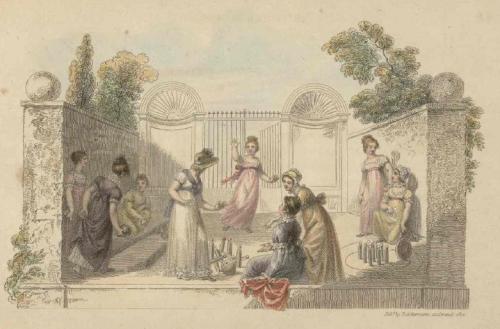
Healthful Sports for Young Ladies was written by Mlle St. Sernin, a French governess, and delightfully illustrated by Jean Demosthene Dugourc (1749-1825). The book, which described exercises that were appropriate for young ladies, was printed in London in 1822 by W. Clowes  for R. Ackermann. The book can be viewed in the digital collection at the Library of Congress

Bowls and nine pins, 1822

Bowls and nine pins, 1822

A regency lady was not expected to unduly exert herself while exercising, but there were forms of physical motion that were acceptable. Swinging, playing hoops, see sawing, archery, and bowls and nine pins were sports that were not unduly frowned upon. Bowling became popular in Britain in the 14th Century and became a favorite pastime of King Edward III’s soldiers.  During the 1400s, the game was brought indoors. Later, bowling became a favorite bar game, with many pubs sporting their own bowling greens.  Heavy balls were rolled on a lawn at a smaller ball called the Jack. During the 18th century the game was called “nine pins” because of the number of pins used. The game was banned in Colonial America due to its association with drinking and gambling. On page 70 of her charming book, Mlle St. Sernin discusses a complicated scoring system:

nine pins

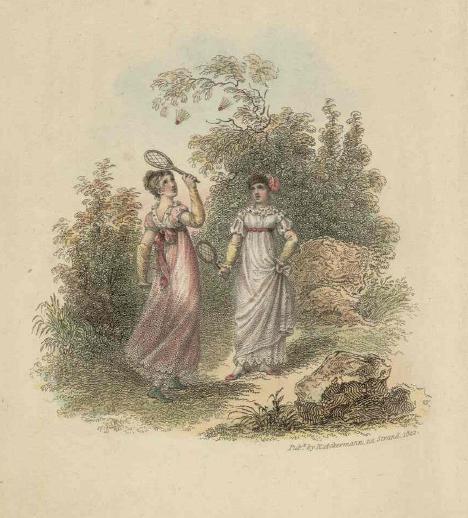
The game of shuttlecock was fairly simple to play. There were no official rules and the sole object was to keep the shuttlecock in the air for as long as possible  by hitting it up. When two people played the game, the idea was to keep the shuttlecock up in the air for as long as possible. A point was lost by the player who let the shuttle fall. A single person playing the game would tally the number of hits for as long as she kept the shuttlecock in play. Below is a description of the game for 4-5 people.

Shuttlecock, 1822

Shuttlecock, 1822

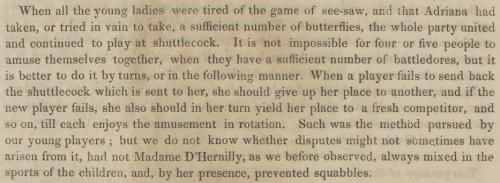
After the introduction of a net, the game, also known as badminton, became more regulated and competitive. Below is a charming explanation of how 4-5  people can play shuttlecock:

shuttlecock

Read Full Post »

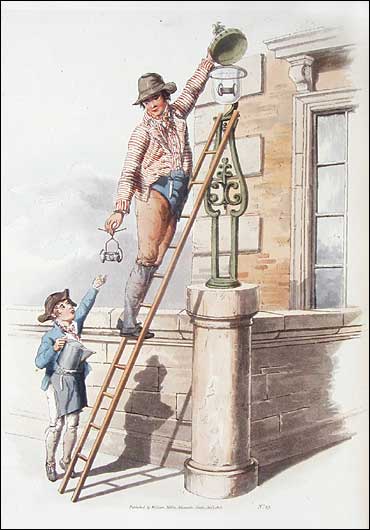
Lamplighter, Pyne, 1808

Lamplighter, Pyne, 1808

In Oxford Road alone there are more lamps than in all the city of Paris. Even the great roads, for seven or eight miles round, are crowded with them, which makes the effect exceedingly grand. – Archenholtz, 1780s

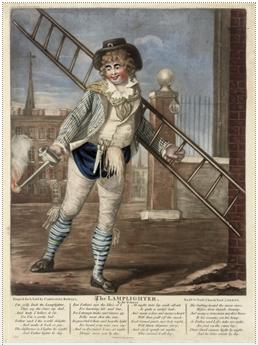
The Lamplighter, 1790's

The Lamplighter, 1790's

Urban development in London grew at a rapid rate during the 18th century, especially in London’s West End, where the great squares were laid out. The population of London surpassed one million in 1815 and an increasing number of bridges were built between 1750 and 1819, boosting development south of the river. In 1750, a system of street lighting with oil lamps was introduced, changing the nature of city life. The lights were supplied with reflectors, a big improvement. Previous to 1736, the lights were lit until midnight, but after that year they stayed on until sunrise, making the streets safer. As the quote suggests, foreign visitors were impressed, for at that time no other city could boast of so much lighting. Before 1750, people who traveled at night hired link boys to light their way. Their torches emitted poor lighting, however, and the streets were dangerous and dark outside their small circles of light.

With the new system of lights, walking the streets at night became relatively safe. The new lights contributed to London’s nightlife and the sense that life in the City was unnatural and not subject to traditional constraints.* The pleasure gardens of London, such as Ranelagh and Vauxhall, offered illuminated entertainment, and fashionable people could travel to theatres, assembly rooms, and each others’ houses, which extended social interaction. Shops lighted window displays and stayed open later,  profiting from the extended hours. The benefit of  better lighting worked both ways, for:

The shop-keepers of London are of infinite service to the rest of the inhabitants by their liberal use of the Patent Lamp, to shew their commodities during the long evenings of winter. Anecdotes of the Manners and Customs of London During the Eighteenth Century, James Peller Malcolm, 1810,  P 383,

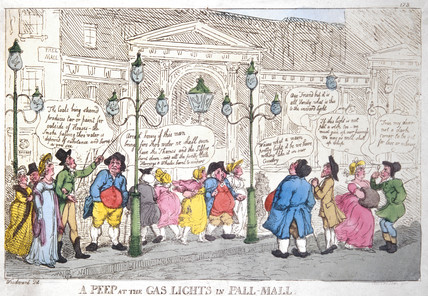
The first gas lights were introduced in Pall Mall on January 28th, 1807. Samuel Clegg had by then set up the London and Westminser Gas Lighting and Coke Company. On December 31, 1813, the Westminster Bridge was also lit by gas, and by 1823, 40,000 lamps covered 215 miles of London’s streets. Today, one can still see the gas lights in Green Park and the exterior of Buckingham Palace.

A peep at the gas lights in Pall Mall, Rowlandson

A peep at the gas lights in Pall Mall, Rowlandson

More on the topic:

Read Full Post »

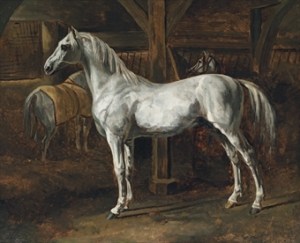
White Horse Standing in a Stable, Gericault

White Horse Standing in a Stable, Gericault

In today’s insulated world, we can only imagine the sights, sounds, and smells of the animals that inhabited Regency London alongside humans. Cows were confined inside small city dairies or allowed to graze in public parks ready to be milked at a moment’s notice. Tens of thousands of cattle and sheep were driven from the countryside through the streets to Smithfield market to feed the masses. Considering that a “horse will on average produce between 15 and 35 pounds of manure per day”, crossing sweepers were kept perpetually busy clearing the streets of dung, for by the end of the 19th century, over 300, 000 horses lived and worked in London. Despite the sweepers’ best efforts, the streets were covered in horse manure. This in turn attracted huge numbers of flies, and the dried and ground-up manure was blown everywhere.* Not a pretty image of a time that we tend to view with nostalgia.

Town planners had to take the lodging of horses and animals into account when designing new squares and terraces, which was no small effort, for stabling these animals and feeding them straw made an enormous demand on urban spaces.

The direct and indirect energy cost of urban horse-drawn transport–in terms of feeding, stabling, grooming, shoeing, harnessing, and driving the hourses and removing their wastes to periurban market gardens–were among the largest items on the energy balances of late-nineteenth-century cities. – Energy in World History, Vaclav Smil,  p. 132

In terms of urban transportation, horses reached the peak of their importance in hauling goods and transporting people between 1820 and 1890. By the turn of the 20th century, horses were rapidly displaced by electric streetcars, automobiles, and buses. The cost of stabling and feeding horses was enormous and most Londoners walked. Those who could afford the luxury of stabling their animals and maintaining their carriages paid a steep price.

Parked carriages, Middlemarch

Parked carriages, Middlemarch

The difficulty and cost of horses and their stabling encouraged walking, which helped to keep the city small and dense. The limited travel span of the horse and cart further restricted urban expansion by constraining the outward movment of industry. An idea of the costs to households of private horse-based transport can be seen in the mews of the more expensive nineteenth-century West End neighbourhoods. Solely designed to house horses, carriages and livery servants, these back passageways behind the grand houses took up considerable space; whilts working horses ate prodigious amounts of feed, and livery men were often some of the best paid domestic staff. – An economic history of London, 1800-1914, by Michael Ball, David Sunderland, p. 229

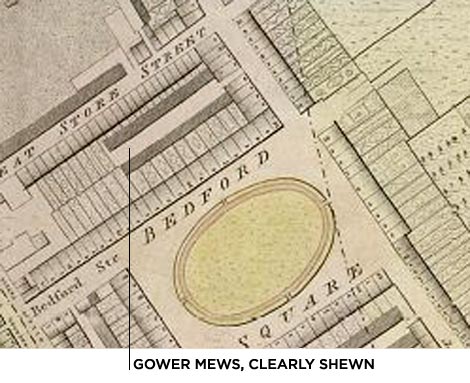
Coaching houses and mews not only had to be located close enough to dwellings for convenience, but they needed to be tucked out of sight , especially in the tony West End (see image below).  These photographs of Garrett Street Stables in Islington, London demonstrate how horses were traditionally kept. The site also tallies the numbers of horses that have been stabled at that location since 1750. While these animal were housed in a well maintained stable, one can only imagine the conditions for animals who were unlucky enough to be owned by those who could barely eek out a living. Costs for maintaining horses and a carriage in London were astronomical and reserved only for the rich if they could find a convenient space to house them. If one purchased a horse, one had to find stables, as Georgette Heyer reminds us in The Grand Sophy, when Sophy shows up in a new phaeton drawn by a pair of horses:

‘Don’t hesitate to tell me which of my mother’s or my horses you would like me to remove from the stables to make room for these!’ begged Mr. Rivenhall, with savage civility. ‘Unless, of course, you are setting up your own stables!’

Gower Mews, since 1792

Gower Mews, since 1792

Relying on a carriage for transport, however, required significant wealth. They were expensive to buy and maintain, needing as they did stabling for the horses and liveries for the coachman and grooms. Even renting a carriage and pair (two horses) with a coachman cost £200–£300 a year (£10,000–£20,000 today). The two-wheeled carriages with one horse (the Ferraris of their day) were called ‘bankrupt carts’ by the Chief Justice ‘because they were, and are, frequently driven by those who could neither afford the Money to support them, nor the Time spent in using them, the want of which, in their Business, brought them to Bankruptcy’. Stabling your own horse, particularly in a city, was harder than finding a parking space today. Just feeding a horse cost £30 a year – more than feeding the groom, in fact – while the coachman’s liveries cost more than his annual salary.

On a practical level, coaches also took some time to prepare and had to be ordered several hours before they were needed. They were therefore more useful for displaying one’s wealth than for surveying one’s estate. They were necessary on long journeys, of course, or when carrying large loads, but otherwise riding a horse or a mule was much the quickest and cheapest option … – Regency House Party, Channel 4 History

The costs of keeping a horse in London are still enormous. Economist Brad DeLong estimates that with exercise, stabling, grooming, shoeing, and other facilities it costs £30,000 to maintain each horse per year, which is considerably more than driving and maintaining a car.


Read Full Post »

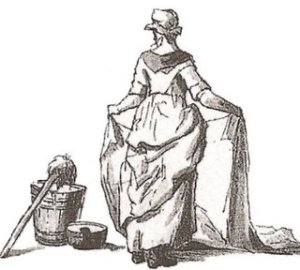
The general servant, or maid-of-all-work, is perhaps the only one of her class deserving of commiseration: her life is a solitary one, and in, some places, her work is never done. She is also subject to rougher treatment than either the house or kitchen-maid – Mrs. Isabella Beeton

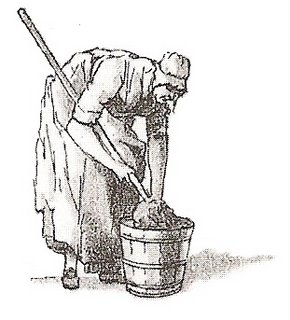
Maid of all work, W.H. Pyne

Maid of all work, W.H. Pyne

Gracie, the maid of all work in Anne Perry’s mystery novels, was lucky. Charlotte Pitt, the wife of Inspector Pitt, was a good and kind mistress who worked alongside her maid and gave gentle instructions. They quickly established a friendly relationship. Charlotte’s kindness did not make Gracie’s work life much easier, but she was luckier than most of her counterparts. In her Book of Household Management, Mrs. Beeton places a maid of all work lower than even a scullery maid. According to Mrs. Beeton, an ambitious scullery maid could learn skills from the kitchen maids and cook and move up the servant ranks, whereas a maid of all work was generally stuck in her position.

As with the scullery maid, the maid of all work was generally a very young girl. She could also be a mature woman so down on her luck that the only other choices open to her were life on the streets or finding shelter in a work house, which was to be avoided at all costs. In Mansfield Park Fanny’s family in Portsmouth is described as being poor, yet even they were able to hire a maid of all work, so you can just imagine what the work conditions were like for these poor women, who literally did everything from cooking, sweeping the floors, hauling water, carrying out slops, looking after the pets and children, laundering, changing the beds, and serving the family at mealtimes. Maids of all work were the first to rise and the last to go to bed. If the house was small, they were lucky to receive a pallet to sleep near the fire in the kitchen. As for time off to rest and recuperate, a maid of all work was at the mercy of her employer.

The following description of a maid of all work comes from ‘The Dictionary of Daily Wants’ – 1858-1859:

MAID OF ALL WORK. – A domestic servant, who undertakes the whole duties of a household without assistance; her duties comprising those of cook, housemaid, nurserymaid, and various other offices, acccording to the exigencies of the establishment. The situation is one which is usually regarded as the hardest worked and worst paid of any branch of domestic servitude; it is, therefore, usually filled by inexperienced servants, or females who are so circumstanced that they are only desirous of securing a home, and of earning sufficient to keep themselves decently clad. In many of these situations, a servant may be very comfortably circumstanced, especially if it be a limited family of regular habits, and where there is a disposition to treat the servant with kindness and consideration.

The duties of a maid of all work being multifarious, it is necessary that she should arise early in the morning; and six or half-past six o’clock is the latest period at which she should remain in bed. She should first light the kitchen fire, and set the kettle over to boil; then she should sweep, dust, and prepare the room in which breakfast is to be taken. Having served the breakfast, she should, while the family are engaged upon that meal, proceed to the various bedchambers, strip the beds, open the windows, &c. This done, she will obtain her own breakfast, and after washing and putting away the things, she will again go upstairs, and finish what remains to be done there.

W.H. Pyne, Microcosm of London

W.H. Pyne, Microcosm of London

As the family will in all probability dine early, she must now set about the preliminaries for the dinner, making up the fire, preparing the vegetables, &c. After the dinner is cleared away, and the things washed and put by in their places, she must clean the kitchen; and this done, she is at liberty to attend to her own personal appearance, to wash and dress herself, &c. By this time the preparation for tea will have to be thought of, and this being duly served and cleared away, she must employ herself in needlework in connection with the household, or should there happen to be none requiring to be done, she may embrace this opportunity to attend to her own personal necessities. Supper has then to be attended to; and this finished, the maid of all work should take the chamber candlesticks, hot water, &c., into the sitting-room, and retire to rest as soon as her mistress or the regulation of the establishment will permit her.

The duties here set down can only be regarded as an outline rather than a detail, the habits of every family varying, and thereby regulating the amount of labour demanded, and the order in which the duties are to be performed. As a rule, however, a maid of all work, if she wish to retain her situation, must be industrious, cleanly, and thoughtful; and not only able to work, but to plan.

Read Full Post »

« Newer Posts - Older Posts »