Feeds:
Posts
Comments

Archive for the ‘Regency style’ Category

Talisman RingInquiring reader,

Although Lady Anne and I are good friends, we often engage in vigorous verbal sparring. You are about to read a typical exchange between the two founders of the Janeites on the James in which we disagree about the merits of The Talisman Ring. The winner is clearly Lady Anne, who has read the novel more times than anyone of my acquaintance. Our conversation is actually quite civilized this time, for during our more heated exchanges we have been known to throw teacups and negus bowls at each other.

Vic: As you know, Lady Anne, I had the toughest time finishing this novel. I wanted to publish a review of The Talisman Ring weeks ago, but I could not care less about how the story ended and kept pushing the book aside. That’s when I felt desperate and decided to enlist your aid.

Lady Anne: When you told me you were having trouble, I was surprised, because I think this is a very sprightly and amusing read.

Vic: That’s because you like mysteries. You actually read them for pleasure. Whodunnits do not thrill me; they never have, to give Georgette her due. I was looking forward to reading The Talisman Ring because so many people have raved about it, and some have called it their favorite GH novel. You can imagine my disappointment when I discovered that it was thin on historical romance and overstuffed with mystery and plot. I kept yawning instead of wondering when and how Sir Tristam and Miss Thane would help Ludovic recover his ring.

Lady Anne: It’s true I am far more of a mystery fan than a basic boy-girl romance reader. But I liked the humor in this, whether it was Sarah’s brother who has strong feelings about smuggled liquor, or the wonderful conversation between Eustacie, Sarah, Tristram and Hugh, as they were walking outside the Inn, where at least four conversational threads go around and through. Or Sarah and Tristram in the dining room of the Dower house. And then, when Ludovic can establish his claim, the first thing Hugh says is I want to buy that horse from you; as if that was the important point. I thought the ebb and flow of dialogue was some of Heyer’s best. But it is true that it is not romantic fluff, but frankly, Heyer does very little of that in any of her books.

Vic: Yes, you are right (again). I hope you are not hinting that I am into fluff and tripe. That would raise my hackles. I like to read Georgette Heyer novels for their scintillating dialogue, historical details, sparkling wit, and the constant push-pull between the hero and heroine, which was sorely lacking in this convoluted mess. Frankly I think Ms. H simply tried to do too much in one novel. She wrote the book in 1936 when she was 34 years old. My sense is that she had not yet developed the effortless style that became the hallmark of her mature romances. In her later novels she could juggle several story lines and introduce an assortment of entertaining characters that I CARED about and who left me gasping from laughing too hard. This plot is too dependent on bunglers, like those Bow Street Runners, who were more ridiculous than realistic. Really, I can’t understand why you like the book so much.

Lady Anne: Nor can I see why you have so much trouble, because the dialogue is great fun. Eustacie, whose English is very literally translated from French is funny. Sarah Thane and Tristram share a very compatible sense of the ridiculous, which serves them so well; they are of an age and oh-so-very tired of the Marriage Mart. But I think what’s missing in The Talisman Ring for you are those historical style nuggets – not much discussion of clothes or curricles, Almacks or balls, or the opera or on-dits – nothing at all of London or the Season. That’s something that continually fascinates you. There is not even discussion of the food they are eating – just the different (illegal) wine that Hugh and Ludovic work their way through.

Vic: You are so right. While GH’s settings were authentic and her historical details are spot on, she concentrated more on dialogue and action in this book. But these are not the only reasons why I dislike The Talisman Ring. Both couples were problematic for me, and our main hero and heroine were provided with very little back story. What exactly was Sarah Thane’s motivation for embroiling herself in someone else’s mess? And Georgette never adequately explained why Sir Tristam was so wary of all women- or perhaps I missed this little detail while I was scratching around for a cup of undiluted caffeine. Please don’t tell me that I could have divined all these details by reading between the lines, for I take no pleasure in such nonsense. Speaking of which, I especially didn’t like Ludovic or Eustacie; their characters seemed too ditzy and unrealistic. In fact they drove me batty. Georgette must have lost interest in them as well, for she did not complete their story or bring it to some conclusion.

Lady Anne: Well, I was certainly more interested in Tristram and Sarah, and I suspect most readers are, because that is where the book ends. And there was nothing clueless about their romance; they knew very early on that they had found each other. I thought it was fun to watch that. It is clear that Ludovic, now that his claim to his title is clear, will marry Eustacie. That was settled early on in the book; as Sarah said, “I think the youngsters will make a match of it,” and Tristram says that Ludovic has no business thinking of marriage when his future is so clouded. That was why all searched for the ring and brought Basil to book. (You were probably nodding over those pages and missed it.) I do agree that the youngsters are more archetypes than interesting characters, but I thought Ludovic was charming in his young and heedless fashion. I suspect Sarah and Tristram’s mother will keep Eustacie safely chaperoned until the courts complete their business, and Ludovic and Eustacie will spend time in London and at the Castle, happily ever after. As far as Heyer’s writing goes, I think it is more to the point that 1936 was when Heyer was in the midst of her first rush of drawing room mysteries – Death in the Stocks, Behold Here’s Poison, They Found Him Dead, and Why Shoot a Butler were all published about that time frame. She was very prolific in the mid-30s. That’s also when she was doing all her big Wellington research; An Infamous Army was published in 1937, and it is generally considered her best work.

Vic: Lady Anne, you sly puss! Have you purchased Jane Aiken Hodge’s The Private World of Georgette Heyer or have you committed all these facts to memory? You are so right. Not only was Georgette busy, she was suffering from a bout of flu when she wrote this book. Oh, I could discourse with you forever, but I must wind up this review. Thank you, Lady Anne, for an enlightening discussion. Perhaps, when I am in a more generous mood, I’ll give The Talisman Ring another chance, but not before I read The Grand Sophy, which is coming out in July.

LadyAnne: Well, I certainly hope you are not looking for lover-like dialogue in The Grand Sophy! That young Miss is as unrealistic as Ludovic and Eustacie put together!

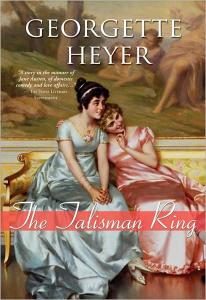
Vic: No sappy, lover-like dialogue for me. I adore the spats that Georgette’s characters engage in and the way her bossy heroines flout convention. To return to The Talisman Ring, you can order the book at this link. The publisher gave it the most luscious cover imaginable. I keep the book out in full view because it looks so pretty on my tabletop.
3 regency fans

Our regency fan rating:

Lady Anne: 3 regency fans

Vic: Cover: 3 regency fans, Story: 1 ½ to 2

Read my other Georgette Heyer reviews below:

Read Full Post »

Inquiring readers,

Last year a reader wrote in to say that the Cornelia Green pattern by Mottahedeh was used as the China for the dining room scenes at Longbourn.

Jane visits Netherfield Park and gets ill.

Jane visits Netherfield Park and gets ill.

Yesterday, Katrina reported that the Royal Doulton china pattern used for the scenes at Netherfield Park early in the film is called English Rennaisance. Thank you for the information!

English Renaissance by Royal Doulton

English Renaissance by Royal Doulton

Another reader asked this question: Does anyone know the pattern of the china that was used in the scene in which Lizzy speaks to Mr. Wickham after she’s read Mr. Darcy’s letter? Please leave a comment if you can identify the china in these images:

Lizzy drinks tea after talking to Wickham.

Lizzy drinks tea after talking to Wickham.

Close up of tea cup

Close up of tea cup

Close up of China in cabinet behind Lizzy

Close up of China in cabinet behind Lizzy

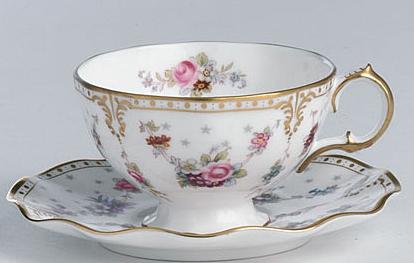
Here are two close up shots of the china in question. UPDATE!! Pattern found. Thank you, Margaret!

Royal crown derby tea cup, Royal Antoinette

Royal crown derby tea cup, Royal Antoinette

Read Full Post »

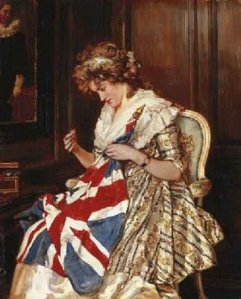
Sewing Victory, Talbot Hughes, 1900

Sewing Victory, Talbot Hughes, 1900

Talbot Hughes was a painter of romanticized genre and historical and landscape scenes who exhibited at the Royal Academy from the age of seventeen (1871) to 1903. For historical accuracy in his paintings he began to collect costumes from the 16th century to the 18th century. The collection was eventually displayed in 1913 at Harrod’s, and the clothes were afterward donated to the Victoria and Albert museum as a gift to the nation.

“The artist…has made the powder and patch era a special study, amassing wardrobes of sacques, flowered brocades, high-heeled mules, and full-bottomed wigs.” He dressed the models for his genre scenes in these clothes, styling hair and accessories to match, mor or less. His painting The Union Jack, for example, shows a ‘comely wench, with elaborately curled locks and a gold and white brocade sacque’. The neoclassical floral stripes of her silk jacket would seem to date from the late 1770’s, whilst her hairstyle and neckerchief are styled to the 1785-90 period. This painting was first shown at the Fine Art Society gallery in London in 1902. – Establishing Dress History, Lou Taylor, 2004,  p. 115.

What to Wear, Talbot Hughes

What to Wear, Talbot Hughes

This link leads to a fascinating site that describes the collection and includes turn of the century photographs of the costumes: Old English Costumes Selected from the Collection formed by Mr. Talbot Hughes A SEQUENCE OF FASHIONS THROUGH THE 18TH & 19TH CENTURIES Presented to the. VICTORIA& ALBERT MUSEUM, South Kensington, by HARRODS LTD. London S. W.  Descriptive notes were rewritten from “The Connoisseur,” November:

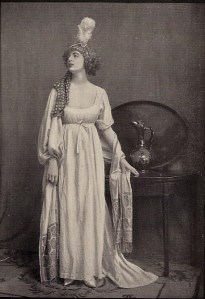
Empire style dress in embroidered muslin, 1800, Talbot Hughes Collection

Empire style dress in embroidered muslin, 1800, Talbot Hughes Collection

With the French Revolution an entire change of fashion took place, admirably shown by the costumes collected by Mr. Talbot Hughes. The elaborate splendour of the patch-and-powder period gave way to an extreme simplicity of dress in the classical style. The heavy brocaded and stiff flowered skirts were replaced by light gauzes and dainty muslins, which revealed the soft contours of the female form with a delightful and child-like grace. This lasted throughout the Empire period, and, indeed, for many years after Waterloo, until the crinoline came to put out the clinging draperies.

So startling was the change that in 1799 a Russian officer, accustomed at home to estimate the rank of a lady by the warmth of her clothing, offered a woman of fashion a penny in Bond Street, under the impression that, from her scantily clothed appearance, she must be a pauper.

Gold embroidered muslin dress, Talbot Hughes Collection

Gold embroidered muslin dress, Talbot Hughes Collection

There are some delightful specimens of this period in the Talbot Hughes collection – little, clinging frocks that must have fitted the ladies inside as closely as a glove, with low bodices and high waists, and with no room for a petticoat over the silk or cotton slip. Describing the fashion in Old Times, John Ashton writes: “I do not say that our English betters went to the extent of some of their French sisters of having their muslin dresses put on damp, and holding them tight to their figures till they dried, so as to absolutely mould them to their form, but their clothes were of the scantiest. As year succeeded year the fashion developed, if one can call diminution of clothing development.”

Muslin dress, 1810, Talbot Hughes Collection

Muslin dress, 1810, Talbot Hughes Collection

That was again the exaggeration of fashion among smart women of high society; but in the middle classes the period was chiefly noted for a charming simplicity. It was Jane Austen’s period, and, wandering among these costumes with Mr. Talbot Hughes, I was reminded again and again of the dear, delightful Jane.

Here is one of the “coquelicot,” or poppy-coloured sashes, which she so much favoured, and the cambric muslins which one reads of so often in her letters, as when she wrote:

“I shall want two new coloured gowns for the summer, for my pink one will not do more than clear me from Steventon. I shall not trouble you, however, to get more than one of them, and that is to be a plain brown cambric muslin for morning wear; the other, which is to be a very pretty yellow and white cloud, I mean to buy in Bath.”

The latest mode of the 18th century

The latest mode of the 18th century

Here are high-waisted gowns such as Jane Austen’s heroines wore when they “pinned up each other’s things for the dance,” and little white caps which saved Jane herself “a world of torment as to hairdressing,” and a cap of “satin and lace with a little white flower perking out of the left, ear, like Harriet Byron’s feather,” and the cloak, or pelisse, such as Jane wore when she went out for a walk in chilly weather, and the huge muff which is so characteristic, in pictures or the time.

The colours of these silks and cotton prints are delicate and “chaste,” as Jane’s young ladies would have said, but they must be described in the language of the time, which was somewhat fanciful.

Muslin dress, 1795-1805, Talbot Hughes Collection

Muslin dress, 1795-1805, Talbot Hughes Collection

“One lady,” wrote Hannah More, “asked what was the newest colour. The other answered that the most truly fashionable silk was a soupcon de vert, lined with a soupir etouffé, et brodée de l’espérance. Now you must not consult your old-fashioned dictionary for the word espérance, for you will there find that it means nothing but hope, whereas espérance in the new language of the time means rose-buds.”

The middle-class ladies of this time were very cunning in their way of [retrimming] old materials with new adornments, and one is reminded of Jane Austen’s announcement:

“I have determined to trim my lilac sarsenet with lilac satin ribbon, just as my chine crape is. Sixpenny width at bottom, or fourpenny at top. Ribbon trimmings are all the fashion at Bath. With this addition it will be a very useful gown, happy to go anywhere.”

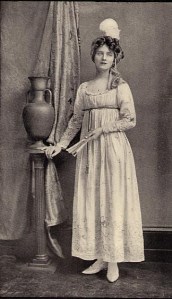
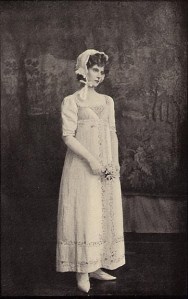
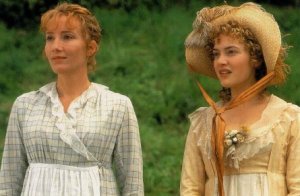
marianne_elinor_waitingThe photographs that accompany this 1913 article are especially interesting. Although the women were dressed as Regency ladies, they definitely have an early 19th century sensibility, made especially so by the hair, make-up, sets, and props. Compare and contrast our modern interpretation of regency fashion with these turn of the 20th century views. Generations from now, our images of that era will seem as dated as these nearly century old photographs.

Read Full Post »

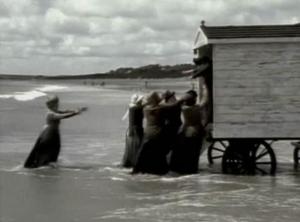
brighton westallBrighton as It Is 1836 has been posted electronically online. A fascinating tour guide, it offers many peeks into a world that is long gone. Most interesting is this page that lists the fares for hiring a sedan chair, bathing machine, pleasure boats, and carriages. One may also find the subscription to the reading room and circulating library. The book is only 108 pages long and a must read for those who are fascinated with Brighton during this period.

Rates for hiring public conveyances

Rates for hiring public conveyances

Update: Compared to the prices of hiring a guide (sedan) chair in Bath in 1806, there was very little difference:

Bath guide chairs, John Feltham, 1806

Bath guide chairs, John Feltham, 1806

Letter of the learned W. Clarke, selected from Nichols’ Anecdotes (p. 6-7):

“July 22, 1736

“We are now sunning ourselves upon the beach at Brighthelmstone, and observing what a tempting figure this island must have made formerly in the eyes of those gentlemen who were pleased to civilize and subdue us. The place is really pleasant; I have seen nothing in its way that outdoes it: such a tract of sea, such regions of corn, and such an extent of fine carpet, that gives your eye command of it all. – But then the mischief is, that we have little conversation besides the clamor nauticus, which is here a sort of treble to the splashing of the waves against the cliffs. My morning business is, bathing in the sea, and then buying fish; the evening is, riding out for air, viewing the remains of old Saxon camps, and counting the ships in the road, and the boats that are trawling. Sometimes we give the imagination leave to expatiate a little-fancy that you are coming down, and that we intend to dine one day next week at Dieppe, in Normandy; the price is already fixed, and the wine lodging there tolerably good. But though we build these castles in the air, I assure you we live here almost under ground. I fancy the architects here usually take the altitude of the Inhabitants, and lose not an inch between the head and the ceiling, and then dropping a step or two below the surface, the second story, is finished something under twelve feet. I suppose this was a necessary precaution against storms, that a man should not be blown out of his bed into New England, Barbary, or God knows where. But as the lodgings are low, they are cheap: `we have two parlours, two bed chambers, pantry ‘ &c. for five shillings per week: and if you really will come down’ you need not fear a bed of proper dimensions. And then the coast is safe, the cannons all covered with rust and grass, the ships moored no enemy apprehended. Come and see…

Bathing machine in Brighton, Vanity Fair

Bathing machine in Brighton, Vanity Fair

Also from the book (p. 8 )

Public attention was first directed to the spot by a treatise of Dr. Russell on the advantages of Sea-bathing, which he successfully recommended in scrophulous and glandular complaints. It was he, too, who caused the valuable chalybeate spring to the West of the town to be enclosed, prior to the erection of the present building. His successor, Dr. Rhellan, continued to add to the reputation of Brighton by publishing a Natural History of the town in 1761.

We now arrive at a period when the increasing popularity of the place was to receive a new stimulus from the presence of the Prince of Wales, afterwards George the Fourth. His first visit was in the summer of the year 1782, when the Prince resided with his Royal relatives, the late Duke and Duchess of Cumberland. He afterwards usually passed the summer and autumnal months at a mansion on the Steyne, then the property of the Lord of the Manor, which, after it had undergone several alterations, he finally purchased in 1814; and shortly after pulled it down to make room for the present Pavilion.

My other posts about Brighton, Transportation, and Seaside Resorts:

Read Full Post »

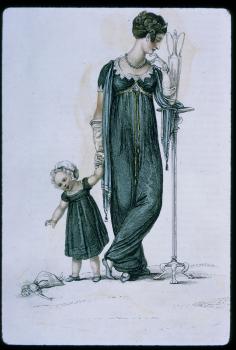
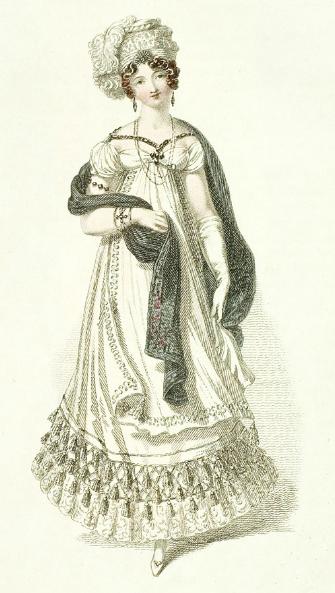
Belle Assemblee Morning Dress, 1818

Belle Assemblee Morning Dress, 1818

Outward manifestations of grief have changed in mourning rituals over the centuries. These days when we think of 19th century mourning, we tend to confuse elaborate Victorian rules of the 1860’s with the less rigid mourning etiquette of the earlier 19th century. Mourning fashions during the Regency Period are fully described in Dressing for Mourning in the Regency on the Jane Austen Centre’s website. Only the wealthy could afford the specially made fashionable mourning outfits shown in the fashion plates featured in Ackermann’s Repository or La Belle Assemblee, but the rising popularity of fashion magazines meant that the details of dress quickly spread through the provinces. Most people remade mourning clothes from an existing wardrobe, adding new linings to cloaks and pelisses, covering existing bonnets with a new piece of crape, and dyeing old dresses. Jane Austen wrote about her mother in 1808: “My Mother is preparing mourning for Mrs E. K. – she has picked her old silk pelisse to peices, & means to have it dyed black for a gown – a very interesting scheme.

One can imagine how an illustration like the one on the right would inspire women to add mourning details to their wardrobes, but such an expensive outfit would still be beyond most women’s means. The middle class was rising in numbers at a time when mourning clothes became more affordable through mass production of cloth. With these cheaper, more readily available clothes, the custom of wearing specially made mourning outfits (as opposed to remade) began to trickle down the social ladder. The very poor, who often did not own more than one outfit, could not afford to follow these wardrobe rules. They could not even afford the dark or black caps and bonnets that were worn with these ensembles. All they could manage at most was a touch of black, such as a ribbon or armband.

Ackermann, Mourning Dress,, 1819

Ackermann, Mourning Dress,, 1819

One feature that characterized custom made or manufactured mourning clothes of the era were broad or deep hems of at least three inches. Women dressed in crêpe, the fabric of choice, or wore black bombazine silk, which had a matte finish as opposed to the sheen of regular silk, and converted their narrow hems into broad hems. Black was the only acceptable color in the first stage of mourning, which for widows and widowers lasted one year and one day.  After the initial mourning period was over, the griever could choose wear subdued grays, purples, lilacs, and lavenders, as well as white, which had been the color of mourning during the medieval period.  There were reports of widows choosing to wear heavy widow’s weeds for the rest of their lives, but in the early 19th century these decisions were made from choice and were not dictated by the inflexible example set by Queen Victoria.

Shiny material was unacceptable during heavy mourning, when only flat matte colors would do. Two stages of mourning – full mourning and half mourning – were already being followed, as evidenced in the fashion plates between 1800 and 1820. The subdued colors of half mourning were supposed to help a person transition to the brighter colors of regular wear, but for some, death was so common in an extended family that it might take some individuals years before they could safely abandon their mourning garb.

Women largely took on the burdens of official grieving. A man might be expected to wear a dark jacket black cravat, black or white shirt, black bordered handkerchief or armband, or a black ornament on his hat, but his life was not turned upside down like a woman’s, for he often wore black clothes as a matter of course.

Locket with Jane Austen's hair (?)

Locket with Jane Austen's hair (?)

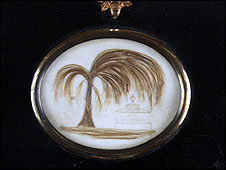
Early in the mourning process, only matte black jewelry made with jet or black amber could be worn. During the second phase of mourning, the wearer was given a wider choice of jewelry to wear. Jewelry made with the beloved’s hair, such as this brooch made (purportedly) with Jane Austen’s hair, was extremely popular and had a long tradition harking back to the 1600’s. In medieval times, giving a token of one’s hair was a gesture of love or courtship.  (Willoughby took a lock of Marianne’s hair, which gave her family the impression that they were engaged.) Hair symbolized life, and was long-lasting. It is remarkable how “fresh” some of the hair samples in centuries old jewelry still seems today.

Evening Dress, Full Mourning, 1817

Evening Dress, Full Mourning, 1817

Widows and widowers followed stricter rules of mourning and for them the mourning period was the most intense and lasted the longest. Friends, acquaintances and employees mourned officially to a lesser degree, depending on their relationship to the dead person. ” The degree of the loss depends on the person, an infant had practically no value to society but adolescents were recognized more. Grandparents were not a marked loss as their usefulness had passed, the longest period is that of a spouse.” – Death.

Author Georgette Heyer, who knew the Regency Period backwards and forwards, included a passage in A Civil Contract in which the bride’s new family contemplated introducing her (Jenny) to Society after her husband’s father had recently died. It was obvious that her new mother-in-law could not introduce her, for she was still wearing the veil and observing the first stages of mourning:

[Lady Oversley] perceived the intricacies of the situation at once, and gave the matter her profound consideration. “She must be presented,” she decided. “It would have a very strange appearance if she weren’t, because one always is, you know, on the occasion of one’s marriage. And there is nothing improper in going to a Drawing-Room when in mourning, though not, I think, in colour—except lavender, perhaps. Only, who is to present her? In general, one’s mother does so, but poor Jenny has no mother, and even if she had—dear me, yes! this is a trifle awkward, because I don’t think you could ask it of your own mother. Not while she is in such deep mourning, I mean! Well, it will have to be me, though I am strongly of the opinion that if we could but hit on a member of your own family it would create a better impression.”
“My Aunt Nassington?” suggested Adam.
“Would she?”
“I think she might.”

It was traditional for the nation to mourn the death of a royal. Princess Charlotte’s death from childbirth in 1817 resulted in an elaborate funeral that rivaled the one held more recently for Princess Diana, and inspired the populace to wear black. This nation wide mourning was a precursor to the elaborate ceremonies that would be planned for Prince Albert’s funeral almost half a decade later in 1861.

More links on the topic:

*A special thank you to Laurel Ann of Austenprose and my blog partner at Jane Austen Today for sending me most of the images for this post.

Half mourning evening dress, 1819

Half mourning evening dress, 1819

Read Full Post »

« Newer Posts - Older Posts »