Feeds:
Posts
Comments

Archive for the ‘Regency Transportation’ Category

apsley house

“The last time! a going! gone.”
“Auctioneer.

“Down! down! derry down!”
“Public.

A toll-gate was moved in 1721 from Piccadilly, near Berkeley Street and the present location of the Ritz Hotel, to the west end of Hyde Park in London. It was a real barrier, its gates stretching across the road, and the area was illuminated by a dozen oil lamps before the age of gas. (London, Vol 1, Charles Knight) After passing through the toll, the first building travelers encountered was “Number One”, London, or Apsley House. The residence was named after Baron Apsley, who built the house in 1771. Its most famous and recognizable resident was The Duke Of Wellington. Hyde Park Corner tollgate was one of the busiest tollgates in London, and remained active until 1825, when it was dismantled piece by piece and sold.
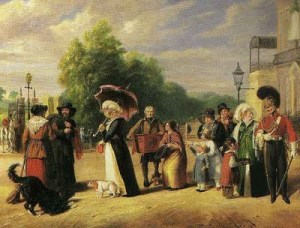
Hyde Park Corner, 1822, Charles Cranmer Jr

Sir,
I have taken the liberty of enclosing you a representation of a scene which took place at Hyde-park-corner last Tuesday, October 4th, being no less than the public sale of the toll-house, and all the materials enumerated in the accompanying catalogue. If you were not present, the drawing I have sent may interest you as a view of the old toll-house and the last scene of its eventful history. You are at liberty to make what use of it you please. The sale commenced at one o’clock, the auctioneer stood under the arch before the door of the house one the north side of Piccadilly. Several carriage folks and equestrians, unconscious of the removal of the toll, stopped to pay, whilst the drivers of others passed through knowingly, with a look of satisfaction at their liberation from the accustomed restriction at that place. The poor dismantled house without a turnpike man, seemed “almost afraid to know itself”—”Othello’s occupation was gone.” By this time, if the conditions of the auction have been attended to, not a vestige is left on the spot. I have thought this event would interest a mind like yours, which permits not any change in the history of improvement, or of places full of old associations, to take place without record.

I remain, sir,
Yours, &c.
A CONSTANT READER.
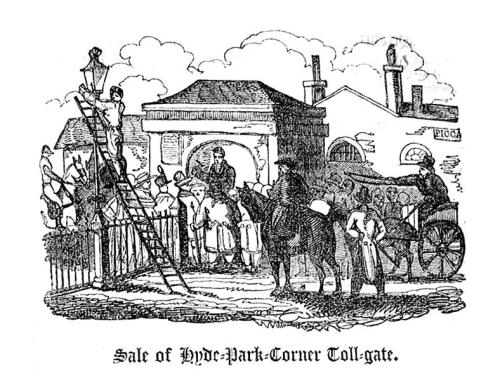
sale of hyde park corner toll gate

These entries come from the October 4th Every-Day Book by William Hone, 1825-26,. The following account relates the dismantling of the property:

The sale by auction of the “toll-houses” on the north and south side of the road, with the “weighing machine,” and lamp-posts at Hyde-park-corner, was effected by Mr. Abbott, the estate agent and appraiser, by order of the trustees of the roads. They were sold for building materials; the north toll-house was in five lots, the south in five other lots; the gates, rails posts, and inscription boards were in five more lots; and the engine-house was also in five lots. At the same time, the weighing machine and toll-houses at Jenny’s Whim bridge were sold in seven lots; and the toll-house near the bun-house at Chelsea, with lamp posts on the road, were likewise sold in seven lots. The whole are entirely cleared away, to the relief of thousands of persons resident in these neighbourhoods. It is too much to expect every thing vexatious to disappear at once; this is a very good beginning, and if there be truth in the old saying, we may expect “a good ending.”

More on the Topic
Read Full Post »

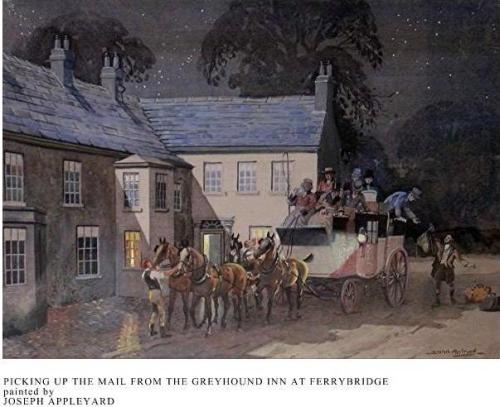
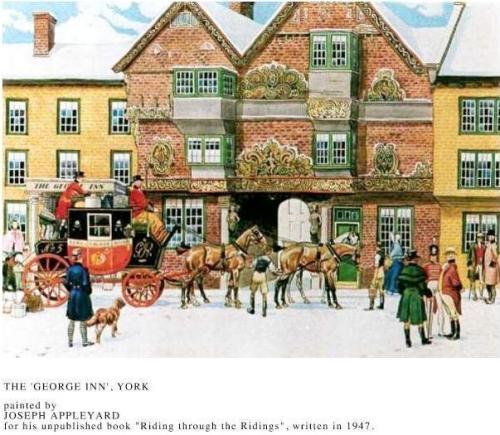
“Riding Through the Ridings”: Random Sketches of Yorkshire Coaching Inns was written and illustrated in 1947 by Joseph Appleyard. An unpublished book, it has found a home online through his son, David. The illustrations fit so well with my recent posts for post boys and the postal mail, that I was eager to share them with you,with Mr. Appleyard’s kind permission.
The George Inn York Joseph Appleyard

The website contains the full transcript and most of the illustrations for “Riding through the Ridings”, whose foreword by Major J. Fairfax-Blakeborough M.C. is telling:
Post-Boys Joseph Appleyard

Some of us are old enough to have talked with the last of the drivers of stage coaches, with post-boys and quaint old ostlers, who could recall the music of the fast-trotting horses and the note on the guard’s horn. Such have heard at first hand of all the bustle there was when the four steaming horses were to be speedily changed, relieved by others standing in readiness for the next stage. More there are who remember the long rows of stables, loose-boxes, saddle rooms and post-boy’s quarters — unused and maybe derelict — in the spacious yards of the old coaching inns. These have also lived to see the end of coach-horse breeding in Yorkshire and the passing of the fairs in the country, at which hundreds of animals were yearly bought to horse the coaches in various parts of the country. Later, in pre-motor days, the best carriage-horses were sold in large numbers at these same Yorkshire fairs; to buyers from all over the world. The horse fairs as they declined, were the swan song of the long ranges of stabling, which were an essential adjunct and integral part of every coaching inn. All this formed the last remaining links with the spacious, leisurely, picturesque coaching-days.

Picking up the mail

Picking up the mail

Major Fairfax-Blakeboroughsums up the illustrations nicely:

The beautifully executed illustrations in this book are marked by their accuracy in technique and detail — no easy achievement in view of the distinctive dress, horse, harness and so forth, which belonged to those days and to a great extent passed with them. Contemporary literature is pregnant with references to the particular care and pride those who played their part in the coaching era took with regard to all these details and how the young sons of patrician families, did not consider their education complete until they could tool a four-in-hand and dress the part with such meticulous exactness that they were mistaken for professional coachmen. The fascinating illustration on the succeeding pages emphasise more than any other of the previous volumes dealing with the epoch, the poetry and romance surrounding it and the important part the old posting houses plated in the life of the nation and as the very hub of their own immediate area.

coach Horse, Joseph Appleyard 1947

coach Horse, Joseph Appleyard 1947

The site also offers a short biography of the artist (1908-1960), and contains photographs, published works, sketches, drawings, book illustrations and newspaper articles of his life and career.

Joe Appleyard attended local evening classes at Leeds School of Art where his fondness of animals gave rise to his interest in Romany and Circus life. He worked full time in window display and general advertising, and painted the scenery of Airedale, Wharfedale and Washburn Valleys in his spare time. Appleyard first began showing his paintings at the Leeds City Art Gallery in 1934, and by 1947 had exhibited over two hundred different works. He co-founded Otley Arts Club, and today his sketchbooks are in a permanent collection at Leeds Art Gallery. His St Leger and racehorse portraits and studies are in a permanent collection at Doncaster Art Gallery.

A light post horse, Joseph Appleyard

A light post horse, Joseph Appleyard

Joe Appleyard, Self portrait, age 26

Joe Appleyard, Self portrait, age 26

David Appleyard writes about designing a website for his father:

The Old Swan Hotel, Harrogate, has three large oil paintings on permanent display, now well restored to remove fifty years of nicotine. The nicotine would not have bothered Joe for he liked his Three Castles cigarettes and as his self-portrait shows political correctness was not an issue in those days! Some twelve years ago I tried to publish “Riding through the Ridings”. My efforts were unsuccessful and the project lay dormant until 1999 when I decided to “publish” it on the Internet. With access to Joe’s remarkably good records the site has grown and showcases more than 200 examples of his work as my tribute to a wonderful father and talented artist.

To see the rest of the illustrations and read the book, click on this link: Joseph Appleyard, Author or type http://www.josephappleyard.co.uk

Read Full Post »

brighton westallBrighton as It Is 1836 has been posted electronically online. A fascinating tour guide, it offers many peeks into a world that is long gone. Most interesting is this page that lists the fares for hiring a sedan chair, bathing machine, pleasure boats, and carriages. One may also find the subscription to the reading room and circulating library. The book is only 108 pages long and a must read for those who are fascinated with Brighton during this period.

Rates for hiring public conveyances

Rates for hiring public conveyances

Update: Compared to the prices of hiring a guide (sedan) chair in Bath in 1806, there was very little difference:

Bath guide chairs, John Feltham, 1806

Bath guide chairs, John Feltham, 1806

Letter of the learned W. Clarke, selected from Nichols’ Anecdotes (p. 6-7):

“July 22, 1736

“We are now sunning ourselves upon the beach at Brighthelmstone, and observing what a tempting figure this island must have made formerly in the eyes of those gentlemen who were pleased to civilize and subdue us. The place is really pleasant; I have seen nothing in its way that outdoes it: such a tract of sea, such regions of corn, and such an extent of fine carpet, that gives your eye command of it all. – But then the mischief is, that we have little conversation besides the clamor nauticus, which is here a sort of treble to the splashing of the waves against the cliffs. My morning business is, bathing in the sea, and then buying fish; the evening is, riding out for air, viewing the remains of old Saxon camps, and counting the ships in the road, and the boats that are trawling. Sometimes we give the imagination leave to expatiate a little-fancy that you are coming down, and that we intend to dine one day next week at Dieppe, in Normandy; the price is already fixed, and the wine lodging there tolerably good. But though we build these castles in the air, I assure you we live here almost under ground. I fancy the architects here usually take the altitude of the Inhabitants, and lose not an inch between the head and the ceiling, and then dropping a step or two below the surface, the second story, is finished something under twelve feet. I suppose this was a necessary precaution against storms, that a man should not be blown out of his bed into New England, Barbary, or God knows where. But as the lodgings are low, they are cheap: `we have two parlours, two bed chambers, pantry ‘ &c. for five shillings per week: and if you really will come down’ you need not fear a bed of proper dimensions. And then the coast is safe, the cannons all covered with rust and grass, the ships moored no enemy apprehended. Come and see…

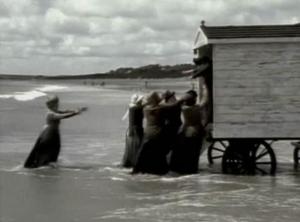
Bathing machine in Brighton, Vanity Fair

Bathing machine in Brighton, Vanity Fair

Also from the book (p. 8 )

Public attention was first directed to the spot by a treatise of Dr. Russell on the advantages of Sea-bathing, which he successfully recommended in scrophulous and glandular complaints. It was he, too, who caused the valuable chalybeate spring to the West of the town to be enclosed, prior to the erection of the present building. His successor, Dr. Rhellan, continued to add to the reputation of Brighton by publishing a Natural History of the town in 1761.

We now arrive at a period when the increasing popularity of the place was to receive a new stimulus from the presence of the Prince of Wales, afterwards George the Fourth. His first visit was in the summer of the year 1782, when the Prince resided with his Royal relatives, the late Duke and Duchess of Cumberland. He afterwards usually passed the summer and autumnal months at a mansion on the Steyne, then the property of the Lord of the Manor, which, after it had undergone several alterations, he finally purchased in 1814; and shortly after pulled it down to make room for the present Pavilion.

My other posts about Brighton, Transportation, and Seaside Resorts:

Read Full Post »

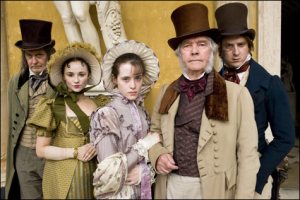
The Dorrits in Venice

The Dorrits in Venice

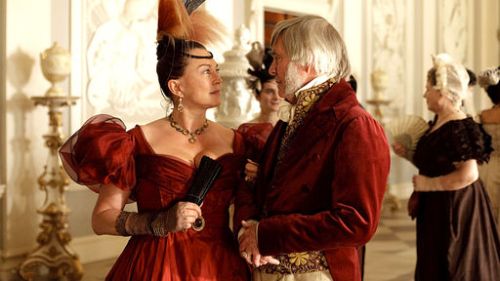
In Little Dorrit, Mr. William Dorrit followed an age old tradition when he decided to take his family on a Grand Tour of the Continent in order to educate them and expose them to the sights and monuments that influenced Western Civilization. Through Mrs. General, he introduced lessons of deportment and elocution to his children. Amy, who was the least willing to leave, made sure that the Plornishes and Maggy were well-provided for before the family departed.

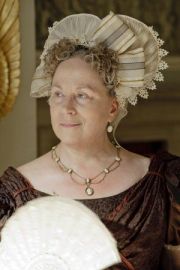
Pam Ferris as Mrs. General

Pam Ferris as Mrs. General

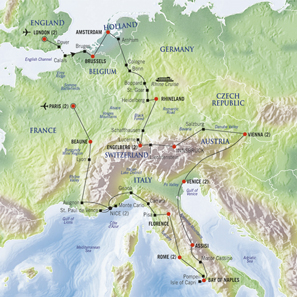
The Grand Tour took more than a year because transportation before the advent of the railway was slow. Itineraries varied, although Paris and Rome were favorite destinations. Before the Napoleonic Wars, young gentlemen were expected to go on a 1-2 year Grand Tour with a tutor. The results were often mixed. (Click on this link to read my post on the topic.) Some heirs returned with souvenirs and their heads stuffed with knowledge, and others frittered their time away, or worse, lost their fortune at the gaming tables. Travels to the Continent ceased during the Peninsular Wars, but picked up again as soon as Napoleon was defeated. As the 19th century progressed, more and more women began to travel abroad with their families and/or chaperones. The Grand Tour began to make inroads with the rising middle class, as well as with Americans, and survives to this day in the form of a “world tour,” with (typically) recent college graduates and retirees taking several months to a year traveling.

The Dorrits likely departed England from Dover and landed at Calais, the same route as today’s  Chunnel. In the early 19th century, the short voyage across the English Channel was fraught with danger. People risked seasickness or a shipwreck should a sudden storm appear. It took three days to make the journey from Dover to Paris.  Lodging would have been provided by inns along the way, hotels, friends of the family, or, as in the case of the Dorrits, a convent or monastery set up for the purpose of putting guests up for the night. It was at such a lodging that the Dorrits met Rigaud, who was traveling with the newly married Gowan and a concerned and downhearted Pet. Much to Amy’s distress, the Frenchman took an inordinate interest in her as well. As the Dorrits crossed the Swiss Alps towards Italy, Amy was seen to be the only member of the family to appreciate the natural wonders of her surroundings or to show genuine curiosity.

Map of a modern grand tour

Map of a modern grand tour

After the St. Bernard Pass, the Dorrits would have encountered Turin before journeying on to Venice.

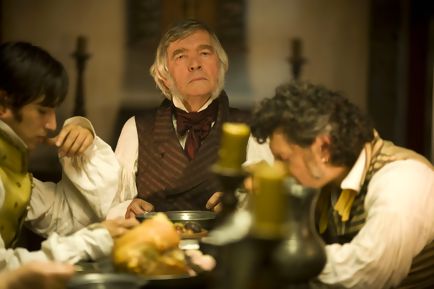
Henry Gowan, William Dorrit, and Rigaud at their lodging

Henry Gowan, William Dorrit, and Rigaud at their lodging

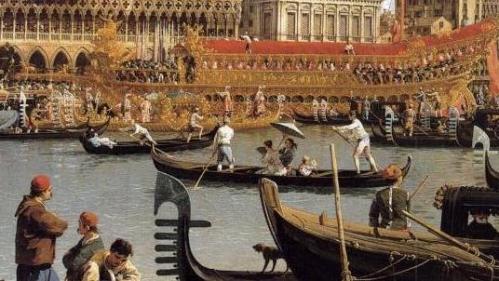
It was traditional for Grand Tour visitors to remain for several months in a major destination city, as the Dorrits did in Venice. Visitors did not carry a great deal of cash, for fear of robbery, but brought letters of credit that they would present at the nearest bank. Unlike other cities in Western Europe, Venice had been an independent maritime state for over a thousand years. Its wealthy merchants had created a sumptuous city that was influenced culturally and artistically by the East. Saint Mark’s Basilica is one of the most recognizable and beautiful examples of Byzantine architecture in the world. The city’s watery setting also made it unique and unforgettable. In a letter written on a grand tour in 1932, the author reveals that little had changed in Venice in over a century, or indeed through today:

Journeying by gondola

Journeying by gondola

I suppose most people think that one cannot go anywhere in Venice except by gondola. That is not so at all. There are sidewalks and narrow streets and alleys that lead all over the city. The small canals from 15 to 40 feet wide are traversed by gondolas and sometimes small motorboats. The houses rise directly from the water’s edge in many cases. Thus along the Grand Canal the front steps lead right into the water where private or public gondolas are waiting — taxis, you know. Some of these palaces are very beautiful. Each has tall mooring posts, decorated with the family arms or gay stripesGrand Tour 1932

Mrs. Merdle and William Dorrit in Venice

Mrs. Merdle and William Dorrit in Venice

Spoiler Alert for those who have not read the book: William Dorrit was never able to escape the influence of 23 years in the Marshalsea, and on the evening of his death in Venice he imagined he was back in prison again. Of his children, only Amy remained humble and true to herself throughout the journey. Although it was evident that she deeply appreciated her beautiful surroundings, she never stopped missing England or the friends she had left behind.

Missed an episode on Masterpiece Classic? You can watch past episodes online until early May at this link.

Fanny visits the museum

Fanny visits the museum

More About the Grand Tour

My other Little Dorrit Reviews:

Read Full Post »

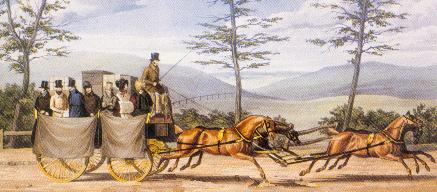
Bianconi Coach

Bianconi Coach

Have you ever heard of Charles Bianconi? The Irish probably have: Bianconi revolutionized public transport in Ireland in the early 19th century. An immigrant in 1802 from Costa Masnaga, Italy, he founded a network of coaching routes  that covered Ireland from Belfast to Cork from a terminus that began at the Hearn Hotel in County Tipperary on July 6th in 1815. The first Bianconi carriage was a two-wheel horse drawn cart that carried three or four passengers.  The new venture, known as the  Bianconi Coach Service for private passengers,  made the 30-year-old immigrant the ” King” of the Irish roads.

Charles Bianconi

Charles Bianconi

Bianconi quickly expanded his fleet  to 900 horses and  67 coaches.

Travel on one of these “Bians” as they were to become known, cost one-penny farthing a mile. Such demand was there for his transport that over the next 30 years a huge network of communications were established, with Clonmel, Co Tipperary as its hub. Huge employment was also now created from this growing transport business. The year 1833 saw the “long car” go into production from his coach building premises in Clonmel which enabled him to carry up to twenty passengers, plus cargo and mail deliveries for both  British and Irish Post Offices. Here in Thurles, his depot was situated in O`Shea`s Hotel which today trades as McLoughneys, a ladies clothing boutique. The stables where he fed and changed his horses between journeys still exists, relatively unchanged, to this very day and  are situated at the rear of Ryan’s Jewellers shop, Liberty Square, Thurles, Co. Tipperary.The advent of railway in 1834 brought home to Bianconi the realisation that his coaching business had now only a limited future. He immediately began to buy shares in the different rail lines as they were being built. He began to sell his coaches and long carts to his employees who had worked for him. – Thurles Information

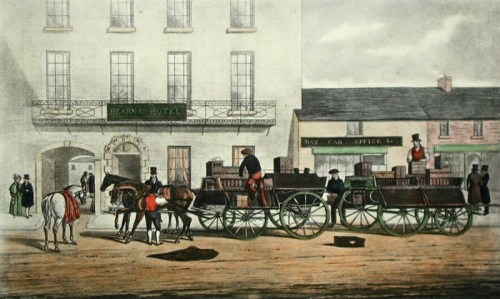
Bianconi Coaches in front of the Hearn Inn

Bianconi Coaches in front of the Hearn Hotel

Read Full Post »

« Newer Posts - Older Posts »