Feeds:
Posts
Comments

Archive for the ‘Regency Travel’ Category

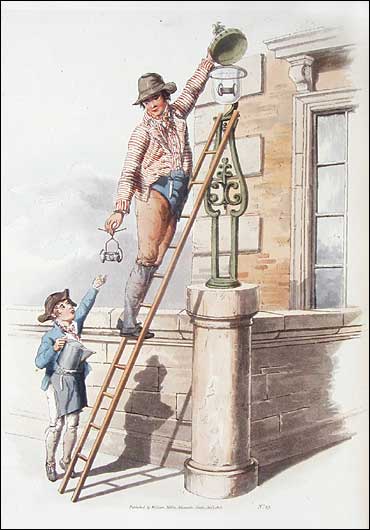
Lamplighter, Pyne, 1808

Lamplighter, Pyne, 1808

In Oxford Road alone there are more lamps than in all the city of Paris. Even the great roads, for seven or eight miles round, are crowded with them, which makes the effect exceedingly grand. – Archenholtz, 1780s

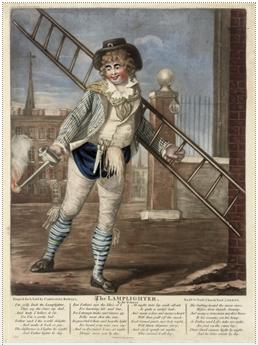
The Lamplighter, 1790's

The Lamplighter, 1790's

Urban development in London grew at a rapid rate during the 18th century, especially in London’s West End, where the great squares were laid out. The population of London surpassed one million in 1815 and an increasing number of bridges were built between 1750 and 1819, boosting development south of the river. In 1750, a system of street lighting with oil lamps was introduced, changing the nature of city life. The lights were supplied with reflectors, a big improvement. Previous to 1736, the lights were lit until midnight, but after that year they stayed on until sunrise, making the streets safer. As the quote suggests, foreign visitors were impressed, for at that time no other city could boast of so much lighting. Before 1750, people who traveled at night hired link boys to light their way. Their torches emitted poor lighting, however, and the streets were dangerous and dark outside their small circles of light.

With the new system of lights, walking the streets at night became relatively safe. The new lights contributed to London’s nightlife and the sense that life in the City was unnatural and not subject to traditional constraints.* The pleasure gardens of London, such as Ranelagh and Vauxhall, offered illuminated entertainment, and fashionable people could travel to theatres, assembly rooms, and each others’ houses, which extended social interaction. Shops lighted window displays and stayed open later,  profiting from the extended hours. The benefit of  better lighting worked both ways, for:

The shop-keepers of London are of infinite service to the rest of the inhabitants by their liberal use of the Patent Lamp, to shew their commodities during the long evenings of winter. Anecdotes of the Manners and Customs of London During the Eighteenth Century, James Peller Malcolm, 1810,  P 383,

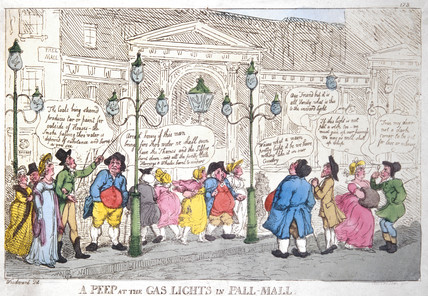
The first gas lights were introduced in Pall Mall on January 28th, 1807. Samuel Clegg had by then set up the London and Westminser Gas Lighting and Coke Company. On December 31, 1813, the Westminster Bridge was also lit by gas, and by 1823, 40,000 lamps covered 215 miles of London’s streets. Today, one can still see the gas lights in Green Park and the exterior of Buckingham Palace.

A peep at the gas lights in Pall Mall, Rowlandson

A peep at the gas lights in Pall Mall, Rowlandson

More on the topic:

Read Full Post »

Bianconi Coach

Bianconi Coach

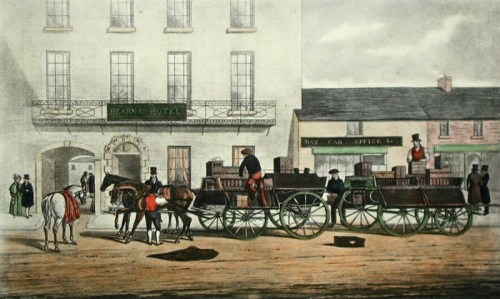
Have you ever heard of Charles Bianconi? The Irish probably have: Bianconi revolutionized public transport in Ireland in the early 19th century. An immigrant in 1802 from Costa Masnaga, Italy, he founded a network of coaching routes  that covered Ireland from Belfast to Cork from a terminus that began at the Hearn Hotel in County Tipperary on July 6th in 1815. The first Bianconi carriage was a two-wheel horse drawn cart that carried three or four passengers.  The new venture, known as the  Bianconi Coach Service for private passengers,  made the 30-year-old immigrant the ” King” of the Irish roads.

Charles Bianconi

Charles Bianconi

Bianconi quickly expanded his fleet  to 900 horses and  67 coaches.

Travel on one of these “Bians” as they were to become known, cost one-penny farthing a mile. Such demand was there for his transport that over the next 30 years a huge network of communications were established, with Clonmel, Co Tipperary as its hub. Huge employment was also now created from this growing transport business. The year 1833 saw the “long car” go into production from his coach building premises in Clonmel which enabled him to carry up to twenty passengers, plus cargo and mail deliveries for both  British and Irish Post Offices. Here in Thurles, his depot was situated in O`Shea`s Hotel which today trades as McLoughneys, a ladies clothing boutique. The stables where he fed and changed his horses between journeys still exists, relatively unchanged, to this very day and  are situated at the rear of Ryan’s Jewellers shop, Liberty Square, Thurles, Co. Tipperary.The advent of railway in 1834 brought home to Bianconi the realisation that his coaching business had now only a limited future. He immediately began to buy shares in the different rail lines as they were being built. He began to sell his coaches and long carts to his employees who had worked for him. – Thurles Information

Bianconi Coaches in front of the Hearn Inn

Bianconi Coaches in front of the Hearn Hotel

Read Full Post »

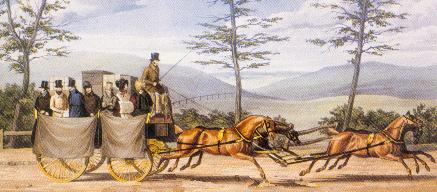
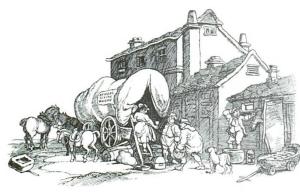
By the end of the 18th century, travel by stage coach was becoming more common in England, especially for the middle and upper classes. Many outlying towns still had no coach services except for those that originated from London, but if one could reach a town or inn that lay along a stage-coach route (by carrier’s wagon, for example) then one could travel to London from any part of the country. People could also opt to travel by Kendal flying wagon, as illustrated below. Travel by stage-coach would have been similar to taking public transportation today, with inns and hostelries taking the place of hotels, motels, and restaurants. A changeover of a team of horses, or feeding them or watering them, would have been the equivalent of filling a tank with gas.

Kendall Flying Wagon, after Rowlandson

Kendal Flying Wagon, after Rowlandson

Dates and times of travel were clearly advertised, including the rates, which were 4 pence or 5 pence for a seat inside the coach, and 2 pence and 3 pence for sitting outside. These costs were prohibitive for the poor, who generally earned a shilling a week (12 pence). A seat outside the coach exposed a traveler to variable weather conditions and hazards, and it was not unusual for passengers to fall off a lurching coach or to be struck by a flying object.

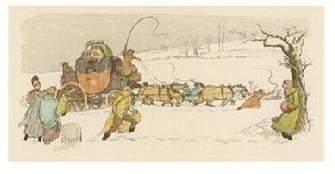
Horses in snow, with passengers alighted and trunks removed

Horses in snow, with passengers alighted to lighten the load

Long distance travel during this time was still a novelty, since the majority of the populace (around 90%) rarely traveled from their place of birth. Most English roads were in poor shape, rutted in good conditions and a muddy quagmire after heavy rains. In addition, people were accustomed to walking long distances, and it was not unusual for laborers to walk 6 miles to work.* The working class would not have chosen to pay for expensive transportation when two sturdy legs could carry them just as well. (Although I imagine a free ride on a friend’s wagon was always welcome.) As with public travel today, passengers could be seated alongside anybody – a considerate traveling companion, someone they instinctively disliked, or a person from a different class or station.

Macadamized roads were just beginning to be introduced during this period and their crushed stone surfaces allowed for greater speed and heavier loads to be carried. Travel time was reduced with these road improvements and with coach modifications, thus a good coach could go as fast as 6.4 miles per hour. This was at the expense of the horses, who lasted only an average of three years pulling heavy loads in all kinds of weather conditions and terrains. Royal Mail coaches went even faster than ordinary coaches, reaching speeds of up to 9 miles per hour, but these elite coaches represented only about 11% of the total coach mileage at its height. Below is a 1754 advertisement for the Edinburgh Stage Coach. Setting out on Tuesday in summer, the coach reached London in ten days. In winter, the journey would take 12 days.  Ultimately, after road and coach improvements and before more efficient trains replaced coach travel as the preferred mode of transportation, the 400 mile trip between London and Edinburgh had been reduced to 40 hours, including all stops and relays (Harper Book of Facts).


Stage-coach and Mail in Days of Yore A Picturesque History of the Coaching Age … By Charles George Harper

Read Full Post »

Shall I ever forget the sensations I experienced upon slowly descending the hills, and crossing the bridge over the Tiber; when I entered an avenue between terraces and ornamented gates of villas, which leads to the Porto del Popolo, and beheld the square, the domes, the obelisk, the long perspective of streets and palaces opening beyond, all glowing with the vivid red of sunset? – William Beckford describing his Grand Tour in a letter, 1780

When Jane Austen’s brother, Edward Austen-Knight returned from his grand tour, he brought back as one of his souvenirs the solemn portrait that we have come to associate with his image. Since the 17th century, it was de rigeur for young English gentleman of privileged background to embark on a 2-4 year trip to see the historic and cultural places of Europe with their tutors.

Ideally, a young man sent on the Grand Tour would return home not just with souvenir portraits painted against a backdrop of Roman monuments, but with new maturity, improved taste, an understanding of foreign cultures, and a fresh appreciation of the benefits of being born British. Norton Anthology of English Literature

There was a marked difference between a gentleman who had gone on such a life-altering excursion and one who hadn’t, a certain polish, if you will, and knowledge of the world that distinguished such a person. Armed with letters of introduction and letters of credit, the young gentleman would set off by boat and cross the channel, landing in Calais. This crossing was fraught with danger. Sea sickness was not uncommon, and ships were known to capsize during heavy storms. Once the pair landed on the continent, they would visit a number of popular Grand Tour sites: Paris, Rome, the Netherlands, Germany, Venice, Florence and Naples were popular destinations.

The Grand Tourist would travel from city to city and usually spend weeks in smaller cities and up to several months in the three key cities. Paris was definitely the most popular city as French was the most common second language of the British elite, the roads to Paris were excellent, and Paris was a most impressive city to the English…Other locations included as part of some Grand Tours included Spain and Portugal, Germany, Eastern Europe, the Balkans, and the Baltic. However, these other spots lacked the interest and historical appeal of Paris and Italy and had substandard roads that made travel much more difficult so they remained off most itineraries. Click here to take an interactive Grand Tour online.

Such a protracted trip came with a hefty price: during the 18th century, a grand tour of three years could cost as much as 5,000 pounds to visit these “museums of history, civility, and culture.”* Many young men, such as Edward Austen-Knight, returned with portraits painted of themselves; others returned with entire collections, influencing the styles at home. It was no coincidence that Neo-classicism and the Palladian ideal were popularized during this era. “In high society, milord anglais on this Grand Tour pillaged the Continent for old Masters (genuine, fake or retouched), took an artist or two in tow, and built and embellished at every opportunity.” (Porter, p 243).

Grand Tours did not always turn out for the best. Some young men, rather than taking the opportunity to acquire as much cultural knowledge and polish as possible, gambled away fortunes, formed mesalliances, or contracted venereal disease during their sexual exploits. Tutors were also known as bearleaders, a title that hints at the unruly behavior of their charges. (Norton Anthology) Lord Chesterfield’s letters to his natural son, who was on the Grand Tour, sought to remind him of how a gentleman ought to conduct himself at all times. After their tour was over, a number of young men in the latter half of the 18th century, continued to copy the tastes and styles of continental society. Marked by their dress and behavior, these dandies were known as macaronis (see image).

Colston Pyranees Mountain View

The Grand Tour was momentarily suspended during the Napoleonic wars, but was quickly revived once the conflict was over. Young ladies, Maria Edgeworth and Mary Wollstonecraft, for instance, would also embark on these journeys with their companions, however these tours were not expected to round out her education or develop her character in the same manner as a man’s. Princess Caroline, who died in childbirth in 1817, had gone on a Grand Tour after the Napoleonic Wars ended, and was romantically involved with an Italian courtier, Bartolomeo Pergami. During the Edwardian era, it was common for a young lady to travel abroad on a relatively short trip with a companion. Lucy Honeychurch in A Room With a View (click here to read my review of the 2007 movie) was one such girl. Jo March from Little Women had hoped to accompany her Aunt Carol to Europe, but it was her sister Amy who was invited along instead.

Update: View Edward Austen Knight’s full painting here and learn about his Grand Tour journals here.

Read Full Post »

A GENTLEMAN AND A LADY travelling from Tunbridge towards that part of the Sussex coast which lies between Hastings and Eastbourne, being induced by business to quit the high road and attempt a very rough lane, were overturned in toiling up its long a scent, half rock, half sand.The accident happened just beyond the only gentleman’s house near the lane a house which their driver, on being first required to take that direction, had conceived to be necessarily their object and had with most unwilling looks been constrained to pass by.He had grumbled and shaken his shoulders and pitied and cut his horses so sharply that he might have been open to the suspicion of overturning them on purpose (especially as the carriage was not his master’s own) if the road had not indisputably become worse than before, as soon as the premises of the said house were left behind expressing with a most portentous countenance that, beyond it, no wheels but cart wheels could safely proceed.The severity of the fall was broken by their slow pace and the narrowness of the lane; and the gentleman having scrambled out and helped out his companion, they neither of them at first felt more than shaken and bruised. But the gentleman had, in the course of the extrication, sprained his foot; and soon becoming sensible of it, was obliged in a few moments to cut short both his remonstrances to the driver and his congratulations to his wife and himself and sit down on the bank, unable to stand. – Jane Austen, Sanditon, Chapter One

At the end of the 18th century and early in the 19th century, the roads in England began to improve vastly over the rutted, dirt tracks that slowed lumberous carriages and that turned into quagmires on rainy days. In those days travel on rural, unimproved roads was laborious. When encountering a steep upgrade, passengers often had to get out of the carriages to lighten the load for the horses or to help push. As with today, accidents on the road were not uncommon. Even with road improvements, passengers sitting outside of a coach were in danger of being flung from their perch and killed.

Information From Highways and Horses, Athol Maudslay

Road improvements began on a large scale in the early 19th century. Engineers placed emphasis on good drainage and thick stone foundations, widening roads, and reducing gradients. However, macadamised roads, which are used to this day, did not come into widespread use until 1816, only a year before Jane Austen died. The custom before then, was “simply to spread a layer of broken rock and gravel on the cleared foundation of earth, which was often lower than the fields on either side. The narrow treads of the farmers’ wagons cut ruts in the soft road, and the hooves of animals further disturbed it. At bad places, everyone took a route that seemed the best at the time, creating a wide disturbed mess.” (Coaching Days and Road Engineers)

As those who live in rural areas today still know, well-drained and crushed stone macadamized roads are not fool proof. They must be graded regularly, or ruts and depressions develop, creating a tough situation for travel:

“Where there is much traffic as in towns macadamised roads get worn into innumerable holes causing the greatest discomfort to persons driving over them I refer to the granite made roads as with those made of a softer stone this discomfort is not felt It was on this account that a road was being taken up at Tunbridge Wells while I was staying there which is mentioned in the chapter on Road Construction and Maintenance The road on the Thames Embankment between Northumberland Avenue and St Stephen’s Club was a striking instance of this peculiarity The whole roadway was one mass of depressions causing the wheels of one’s carriage to fly about in all directions this could of course be remedied by picking up the roadway and laying it afresh but it is no doubt in consequence of the hardness and unyielding nature of the granite that this happens. Highways and Horses By Athol Maudslay


Read more about the topic in these links:

Read Full Post »

« Newer Posts - Older Posts »