Feeds:
Posts
Comments

Archive for the ‘Regency Women’ Category

A Book Review by Brenda S. Cox

“Marianne’s ‘excess of sensibility’ almost destroys her reputation, her health and her happiness, wihle Elinor’s more guarded behaviour is rewarded. But that is fiction; what of real life?”—Prologue to Jane and Dorothy, by Marian Veevers

Jane and Dorothy: A True Tale of Sense and Sensibility, The Lives of Jane Austen and Dorothy Wordsworth, by Marian Veevers. The lovely cover attracted my attention as I perused a library book table focused on Jane Austen.

I had read a review of this book some time ago and suggested it to a literary friend, who said there was no connection between Jane Austen and Dorothy Wordsworth, sister of poet William Wordsworth. But I decided to check out the book and find out how the author connects them. I’m glad I did, as it was a fascinating read.

Jane and Dorothy, by Marian Veevers, explores two parallel lives, Jane Austen’s and Dorothy Wordsworth’s. Veevers works for the Wordsworth Trust.

Jane Austen and Dorothy Wordsworth

Jane and Dorothy follows the lives of two women, living at approximately the same time, who never met. Parallel, never intersecting, similar in some ways and contrasting in others. Connections with Austen’s novels are intertwined in their stories. Jane (1775-1817) is compared to Elinor Dashwood, with strong feelings controlled by reason and religion. Dorothy (1771-1855) is more like Marianne, focusing on her emotions. In one teenage letter to a friend who was sympathizing with her misery, Dorothy wrote, “You cannot think how I like the idea of being called poor Dorothy . . . I could cry whenever I think of it.”

Both were writers. Jane Austen, of course, had four novels published during her lifetime, two more shortly after her death, and her Juvenilia and letters published years later.

Dorothy Wordsworth wrote journals, mostly about her ramblings in nature with her brother, who became a famous poet of Romanticism.  William Wordsworth used his sister’s journals as inspiration and a source of details for his poetry. His discussions and experiences with her also inspired him. A few of Dorothy’s own poems were published during her lifetime, but her journals and her travel narrative of a trip to Scotland were only published after her death.

Both Jane and Dorothy were dependent on their brothers later in their lives. Austen and her mother and sister were financially supported by her brothers after her father’s death, and her brother Edward provided Chawton Cottage where she wrote and rewrote her novels.

Dorothy lost her parents early in life and lived with various relatives as a poor relation, similar to Austen’s Fanny Price, until she threw in her lot with her brother William. Dorothy loved William passionately. (The author discusses rumors of sexual involvement and concludes that the rumors were false.) Dorothy devoted the rest of her life to her brother and, eventually, to his wife and children. Their financial situation was much harder than the Austens’, but they survived.

It was interesting to see the similar social and financial restrictions that society placed on both Jane and Dorothy, particularly as unmarried women, and to see how Jane’s life might have played out differently in other circumstances.

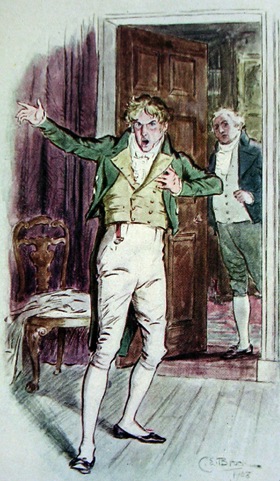
Yates ranting in Mansfield Park. Did Austen love home theatricals, or hate them? Or did she simply see their dangers?
C.E. Brock, public domain.

Austen and Drama

Having read so much about Jane Austen, I wasn’t expecting new insights into her life from this book. However, I found several. I’ll give just one example, from pages 47-50 of Jane and Dorothy.

Veevers discusses Austen’s attitude toward amateur home theatricals in Mansfield Park. Many have commented on the fact that Austen’s family performed such plays when she was growing up, and that she couldn’t really have thought they were wrong. Perhaps it was just the specific circumstances at Mansfield Park that made it wrong, or her attitude had changed due to the growing Evangelical disapproval of drama, or she was attributing disapproval to Fanny and Edmund.

However, Veevers speculates that, first, Jane may not have participated herself in those plays when she was growing up. She says the only evidence we have for that is Jane’s cousin, Phylly Walters, who wrote that “all the young folks” were participating in a performance in 1787—that is rather vague. Or Jane may have participated without enjoying it.

While Austen’s family approved of amateur theatricals, we don’t have to assume that she herself agreed. Instead, those experiences of plays in the Steventon barn may have shown Jane “the dark underbelly” of such practices. Veevers says any “modern-day member of an amateur dramatics company” would recognize these issues. She continues,

“Jane Austen gives an unflinching insider’s view of everything that is worst about amateur acting, from the concealed, but overwhelming self-interest of Julia and Maria Bertram who each hope to have the best part in the play ‘pressed on her by the rest,’ to the self-indulgent over-rehearsal of favourite scenes by some actors, and the insidious, self-gratifying criticisms of others’ performances—‘Mr Yates was in general thought to rant dreadfully . . . Mr Yates was disappointed in Henry Crawford . . .’” etc., etc. “There can be no doubt that this detailed understanding . . . came from real observation. It would seem that brother James’s annual productions in the Steventon barn were riven by jealousy, bad-feeling and unkindness.”—Jane and Dorothy, p. 49

Veevers goes on to speculate that Jane’s opinions may have been influenced by her dear friend Anne Lefroy. Mrs. Lefroy was a clergyman’s wife who apparently disapproved of amateur theatricals, politely declining to participate when a friend invited her. (Also, I would add, it appears those Steventon theatricals were an opportunity for flirtation between Jane’s still-married cousin Eliza and two of her brothers, so perhaps Henry Crawford and Maria Bertram’s fictitious flirtation also had a basis in past experience.)

I don’t think I personally agree with the idea that Austen disapproved of such theatricals, though. Austen certainly enjoyed the professional theatre, “good hardened real acting,” as Edmund Bertram called it, distinguishing that from amateur performances. Austen did, though, write several short, comic plays as a teenager, which may have been acted by her family. On a visit to Godmersham, she and Cassandra acted—most likely by reading aloud— a couple of plays with their nieces and nephews. (The Spoilt Child and Innocence Rewarded, according to Fanny Knight’s diary). Of course, that would have been on a much more limited scale than the play at Mansfield Park, with presumably less objectionable plays.

Whether Austen objected to amateur dramatics in general is questionable, but certainly she had seen enough to very realistically show the pitfalls of such productions in Mansfield Park. So I appreciated this insight from Jane and Dorothy.

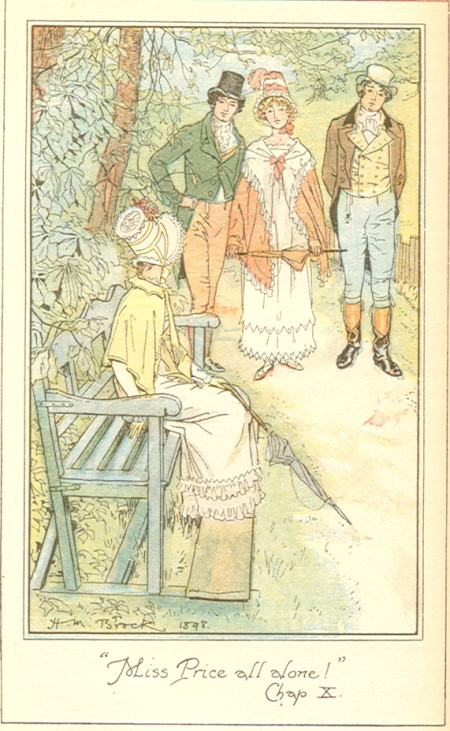
Fanny Price loves nature, like both Jane Austen and Dorothy Wordsworth. Both Jane and Dorothy, like Fanny, experienced being marginalized by wealthier relatives.
H.M. Brock, public domain.

Spinsterhood

The book extensively explores attitudes toward “old maids” in Austen’s society. It’s easy to forget that Austen herself probably experienced prejudices against unmarried women. She certainly sometimes felt herself a poor relation at her wealthy brother’s Godmersham estate. She often lacked autonomy: her living situations and travels were dictated by her parents or brothers. Perhaps those feelings helped her create Fanny Price, dependent and marginalized.

Jane and Dorothy points out many illuminating parallels between Sense and Sensibility and Mansfield Park. Fanny is much like Marianne, with strong feelings. However Austen, when she was a more mature writer, made Fanny spiritually stronger, more nuanced, and with greater depth.

Marianne Dashwood gives way to her feelings and nearly dies. Fanny Price turns to religion and reason to keep her feelings under control, as Marianne determines to do at the end of Sense and Sensibility.
C.E. Brock, public domain.

End of Life

Dorothy lived much longer than Jane. Sadly, though, Dorothy’s last twenty years were spent with “her mind completely broken.” She had given her life to taking care of her family; that same family gave her loving care for those long years. It’s been speculated that she may have had some kind of dementia, or possibly severe depression. (She suffered, in fact, similarly to William Cowper in his final years. Cowper’s poetry, by the way, impacted both women.)

Of course we all wish that Jane had lived longer and written more. However, thinking of the many ways a spinster (like Miss Bates, for example, or Dorothy Wordsworth) might end up in Austen’s world, perhaps Jane’s earlier demise from an unknown disease was not the worst possible ending for her. The recent book and series Miss Austen also imagines long-lived Cassandra suffering late in her life.

As Veevers concludes,

“Jane and Dorothy were two unmarried, childless women who had failed to fulfil the destiny that their society prescribed for their sex. But they neither drooped nor withered as [1838 writer] Carlisle expected, nor developed the chagrin and peevishness which Dr. Gregory [1774] believed inseparable from their condition. Instead they forged their own meanings from their lives. . . . Jane and Dorothy were not simply products of their time. They made choices in their lives, and it was those choices which defined them.”

I found it fascinating to trace the choices of these two parallel lives, and the resulting joys and sorrows, during the same time in history. Well-written, easy to read, and compelling, Jane and Dorothy  is worth reading for anyone who wants to get deeper into “Jane Austen’s World.”


Brenda S. Cox is the author of Fashionable Goodness: Christianity in Jane Austen’s England. She also blogs at Faith, Science, Joy, and Jane Austen.

Read Full Post »

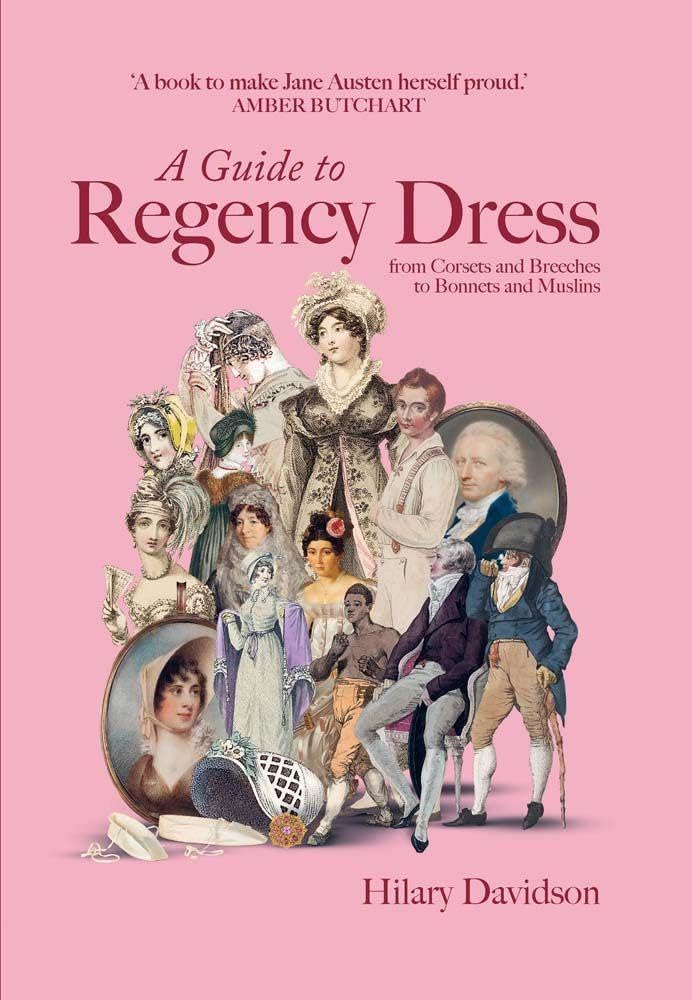
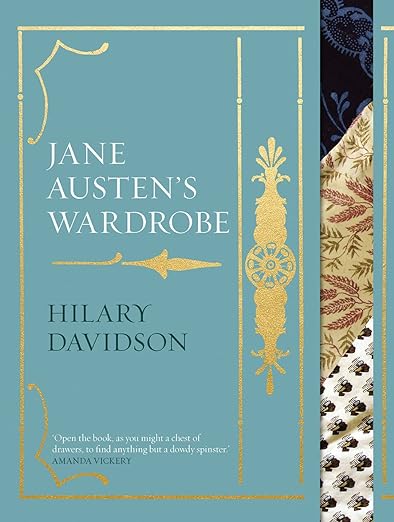
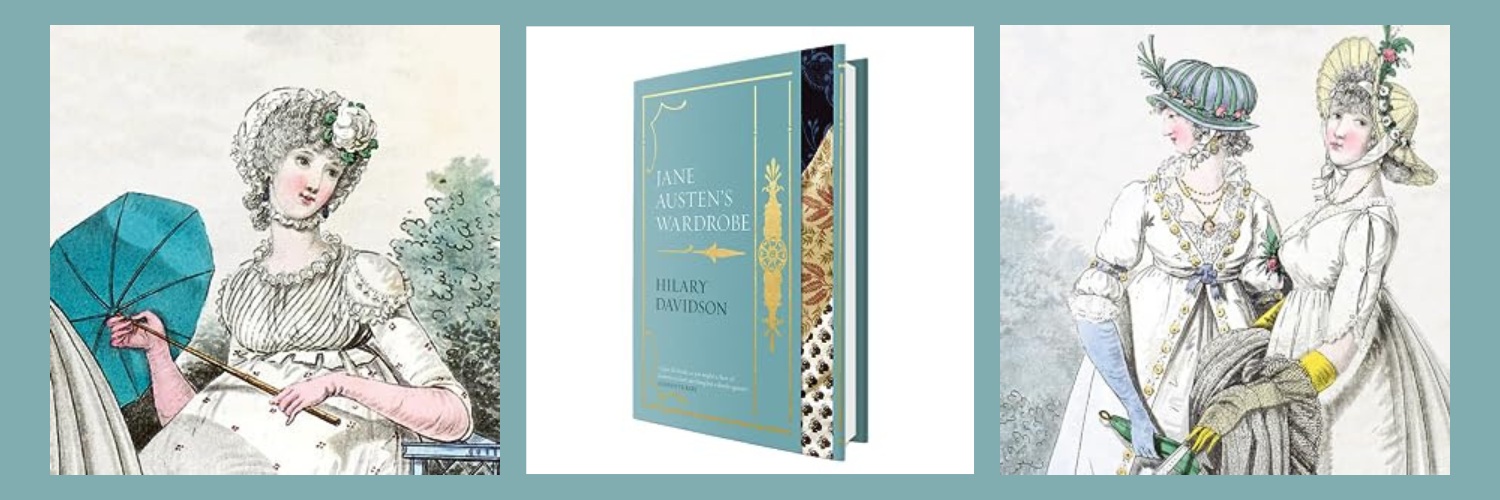
Dear readers, I have an exquisite new book to share with you today: Jane Austen’s Wardrobe by Hilary Davidson!

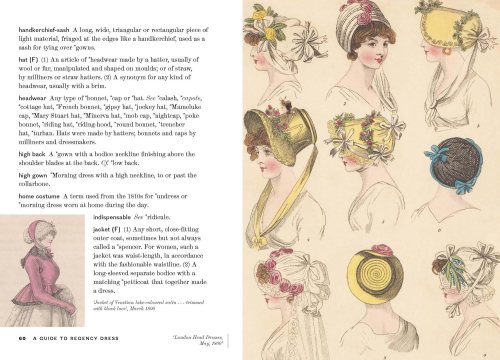
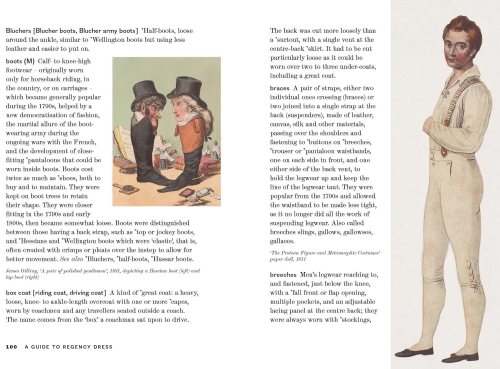
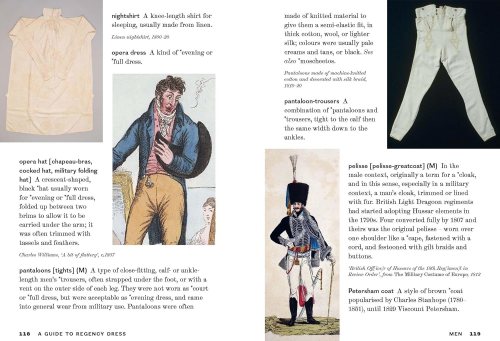
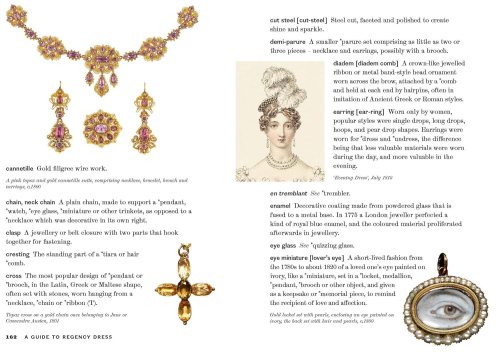
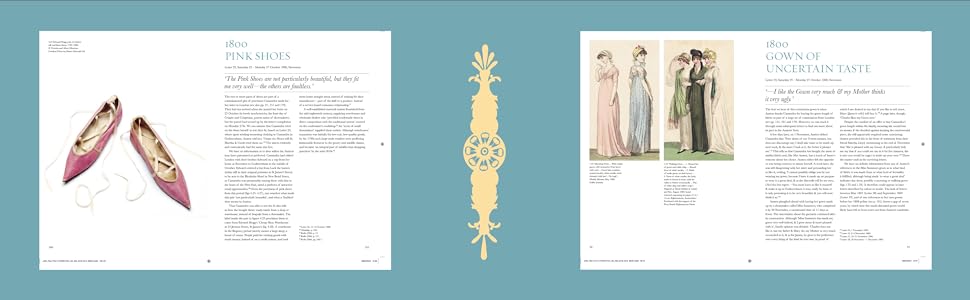
Filled with incredible photos and written information, it’s one of the most detailed books I’ve seen in a long time on this topic. Not only is it beautiful, it is filled with fascinating information on one of my most favorite topics.

This is my new favorite book on Jane Austen’s Regency Fashion. I know I’ll continue to pour over it for years to come!

Austen’s Wardrobe by Category

Within the pages of this lovely book, Davidson works her way through Austen’s personal wardrobe chronologically, from head to toe. Davidson’s system for cataloging Austen’s wardrobe is fascinating! For those of us who delight in a linear and/or chronological order to a wide and varied topic, Davidson definitely checks all the boxes.

First, she breaks all of Austen’s clothing down into the following categories:

  • Clothes Press: Gowns
  • Closet: Spencers, Pelisses and Outer Garments
  • Band Box: Hats, Caps and Bonnets
  • Shelves: Shawls, Tippets, Cloaks and Shoes
  • Dressing Table: Gloves, Fans, Flowers, Trims and Handkerchiefs
  • Jewelery Box: Necklaces, Rings and Bracelets
  • Drawers: Undergarments and Nightwear

Davidson even includes several pages of sketches, descriptions, and explanations for Jane’s “Portrait Gown” – which I found completely engrossing.

Austen’s Letters Quoted

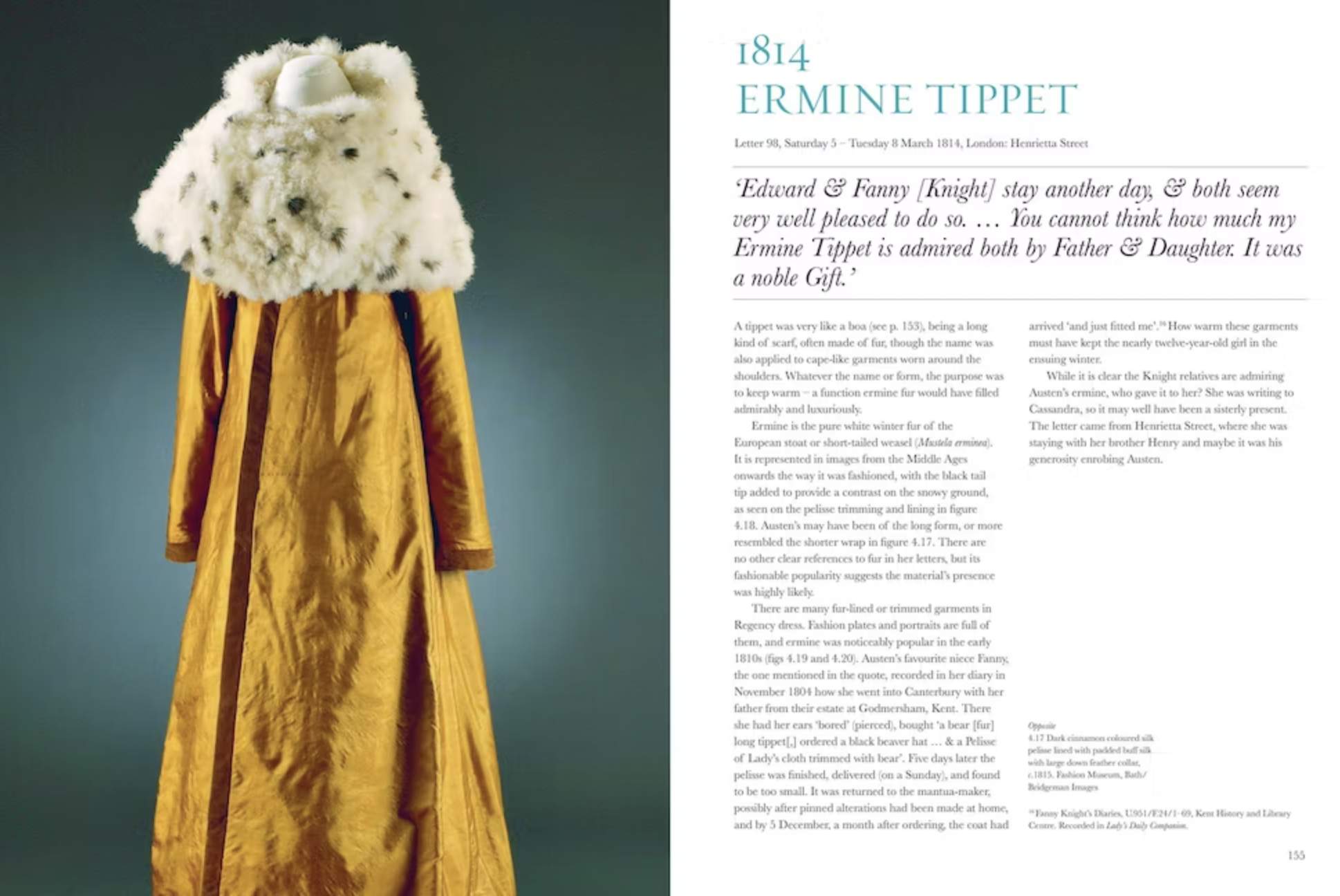
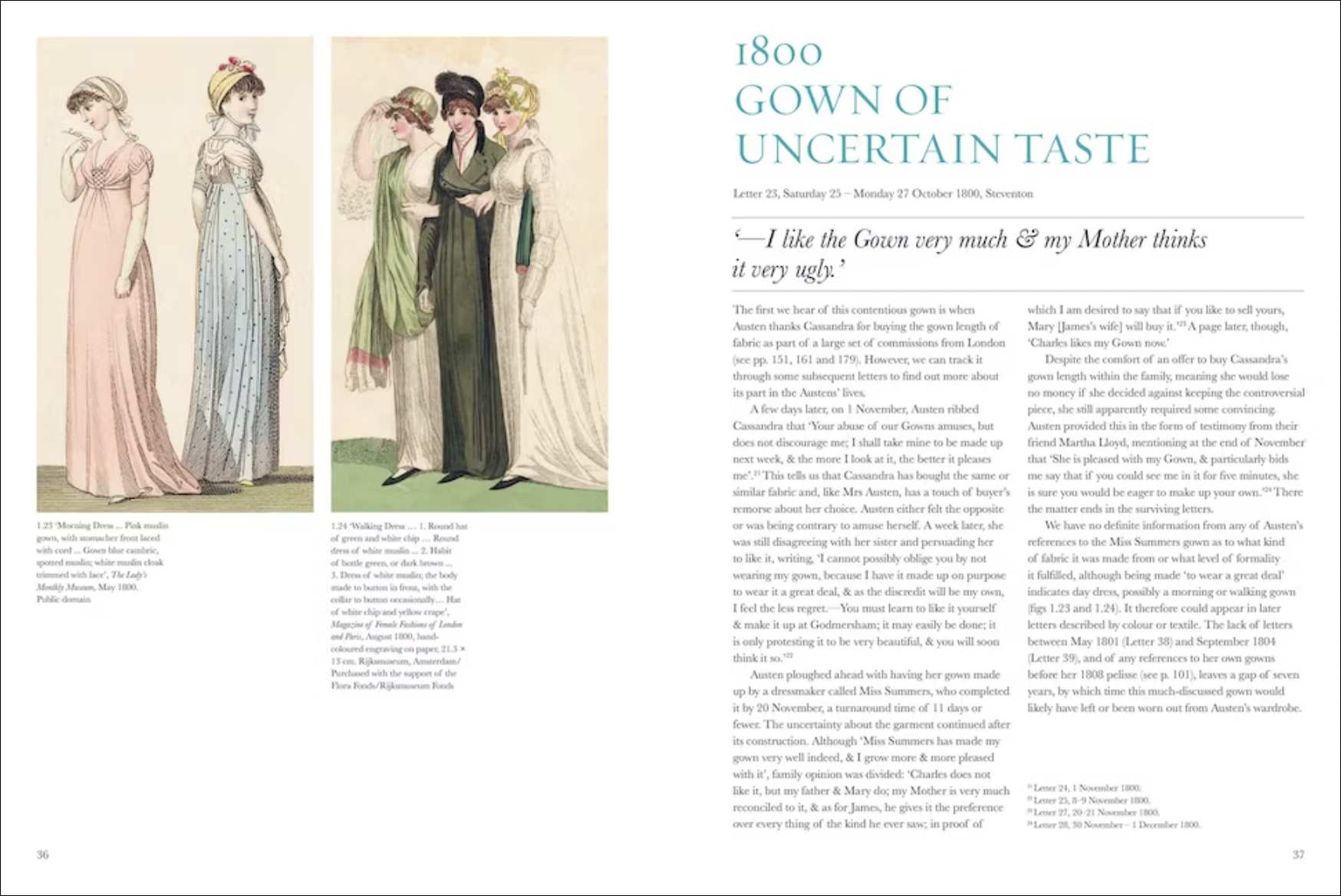
Next, Davidson utilizes Austen’s personal letters to explore every inch of Austen’s wardrobe, working her way through each category in chronological order. To do this, she shares one quote at time, citing portions of letters that mention Austen’s clothing. Then, for each article of clothing, every hat, and every piece of jewelry, she explains that quote in great detail and provides photos to aid our understanding.

For instance, Austen writes this in Letter 65:

“I can easily suppose that your six weeks here will be fully occupied, were it only in lengthening the waists of your gowns. I have pretty well arranged my spring & summer plans of that kind, & mean to wear out my spotted Muslin before I go. –You will exclaim at this–but mine has signs of feebleness, which with a little care may come to something.”

Tuesday 17 – Wednesday 18 January, 1809, Castle Square

Davidson provides photos of spotted muslin fabric swatches and a photo of a dress made of spotted muslin, dated 1805-10. Then she explains the muslin fabric, provides quotes from Austen’s novels about muslin dresses, and explains Austen’s quote. She goes over the dress styles, what was involved in “lengthening the waist” of a gown, the meaning of “worked” fabric, and the ins and outs of fragile fabrics of that time period, including how women used belts to cover holes in the fabric when a waist was lengthened.

I found this incredibly interesting because I’ve always been curious about Austen’s extensive quotes about her dresses and hats in her letters. The result is a delightful (and sometimes hilarious) tour through Jane Austen’s closet in her own words, with pictures and explanations to match!

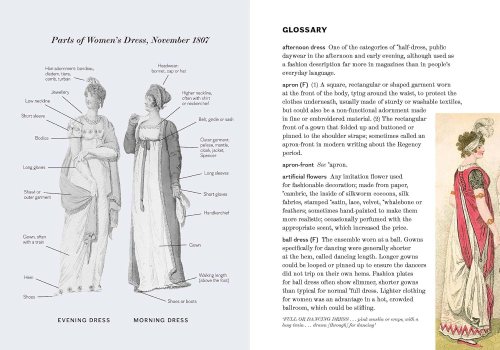
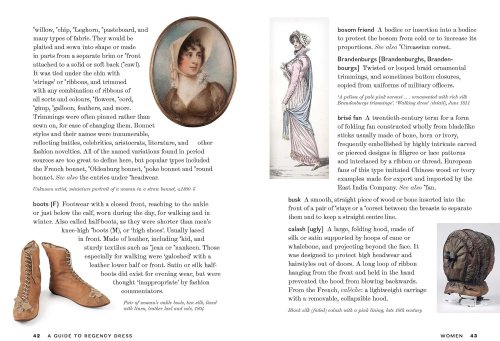
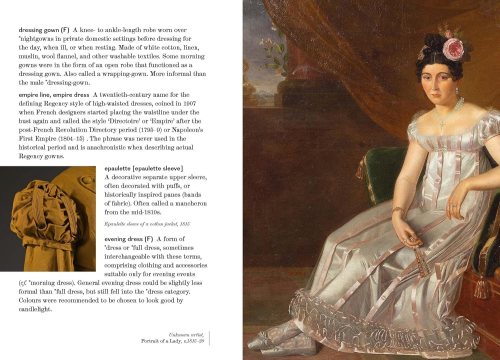
Here are several more examples, provided by Yale University Press:

Informative and Beautiful

Like many of Austen’s heroines, this book is both intelligent and beautiful. Inside and out, this book is absolutely stunning. The photos provide a detailed look into Jane Austen’s clothing that is hard to find, especially all in one place. This book feels like a worldwide museum tour of all the most exquisite clothing artifacts from Austen’s time.

This is the perfect addition to any Jane Austen library – and it will look gorgeous on your coffee table!

Book Description

Hilary Davidson delves into the clothing of one of the world’s great authors, providing unique and intimate insight into her everyday life and material world.
 
Acclaimed dress historian and Austen expert Hilary Davidson reveals, for the first time, the wardrobe of one of the world’s most celebrated authors. Despite her acknowledged brilliance on the page, Jane Austen has all too often been accused of dowdiness in her appearance. Drawing on Austen’s 161 known letters, as well as her own surviving garments and accessories, this book assembles examples of the variety of clothes she would have possessed—from gowns and coats to shoes and undergarments—to tell a very different story.

The Jane Austen Hilary Davidson discovers is alert to fashion trends but thrifty and eager to reuse and repurpose clothing. Her renowned irony and wit peppers her letters, describing clothes, shopping, and taste. Jane Austen’s Wardrobe offers the rare pleasure of a glimpse inside the closet of a stylish dresser and perpetually fascinating writer.

About the Author

Hilary Davidson is a dress, textile and fashion historian and curator. Her work encompasses making and knowing, things and theory, with an extraordinary understanding of how historic clothing objects come to be and how they function in culture.

Hilary is equally skilled in analysing historical and archaeological material culture artefacts; presenting engaging, fascinating talks to diverse audiences; and producing influential academic research.

Her extensive experience includes:

  • Scholarly research
  • Lecturing, teaching and public talks
  • Broadcasting and journalism
  • Historic dressmaking

Hilary trained as a bespoke shoemaker in her native Australia before completing a Masters in the History of Textiles and Dress at Winchester School of Art (University of Southampton) in 2004. Since graduating, Hilary’s practice has concerned the relationship between theoretical and highly material approaches to dress history, especially in the early modern and medieval periods.

As a skilled and meticulous handsewer, she has created replica clothing projects for a number of museums, including a ground-breaking replication of Jane Austen’s pelisse. At the same time she lectured extensively on fashion history, theory and culture, on semiotics, and cultural mythologies, especially red shoes.

In 2007 Hilary became curator of fashion and decorative arts at the Museum of London. She contributed to the £20 million permanent gallery redevelopment opening in 2010, and curated an exhibition on pirates, while continuing to publish, teach and lecture in the UK and internationally. In collaboration with Museum of London Archaeology, Hilary began analysing archaeological textiles and continues to cross disciplines by consulting in this area in England and Australia. She also worked on the AHRC 5-star rated Early Modern Dress and Textiles Network (2007-2009) and from 2011 has appeared as an expert on a number of BBC historical television programmes, and as a frequent radio guest speaker in London and Sydney.

From 2012 Hilary worked between Sydney and London as a freelance curator, historian, broadcaster, teacher, lecturer, consultant and designer, while working on a PhD in Archaeology at La Trobe University, Melbourne. In addition to historical studies she has been a jewellery designer, graphic designer, photographer, gallerist, and worked in retail fashion and vintage clothing. In 2022 she moved to New York City to take up the role of Associate Professor and Chair of the MA Fashion and Textile Studies: History, Theory, Museum Practice at the Fashion Institute of Technology.

Hilary has taught and lectured extensively, including at the University of Southampton, Central St Martins, the University of Cambridge, the University of Glasgow, New York University London, The American University Paris, Fashion Design Studio TAFE Sydney and the National Institute of Dramatic Art (NIDA), Sydney. She speaks regularly at academic conferences and to the public. Her first monograph book was Dress in the Age of Jane Austen (2019) followed by Jane Austen’s Wardrobe in 2023. Her extensive publications can be found on Academia and ResearchGate.

To Order the Book:

You can order the book by clicking HERE
or by clicking the image below:

Recommended Book Gift

I hope you’ve enjoyed this short tour of this stunning new book by Hilary Davidson. If you’re looking for a gift for a fellow Jane Austen fan, or if your friends or family members need an idea for a gift for you this holiday season, I highly recommend this one!


RACHEL DODGE teaches college English classes, gives talks at libraries, teas, and book clubs, and writes for Jane Austen’s World blog. She is the bestselling author of The Little Women DevotionalThe Anne of Green Gables Devotional and Praying with Jane: 31 Days Through the Prayers of Jane Austen. Now Available: The Secret Garden Devotional! You can visit Rachel online at www.RachelDodge.com.

Read Full Post »

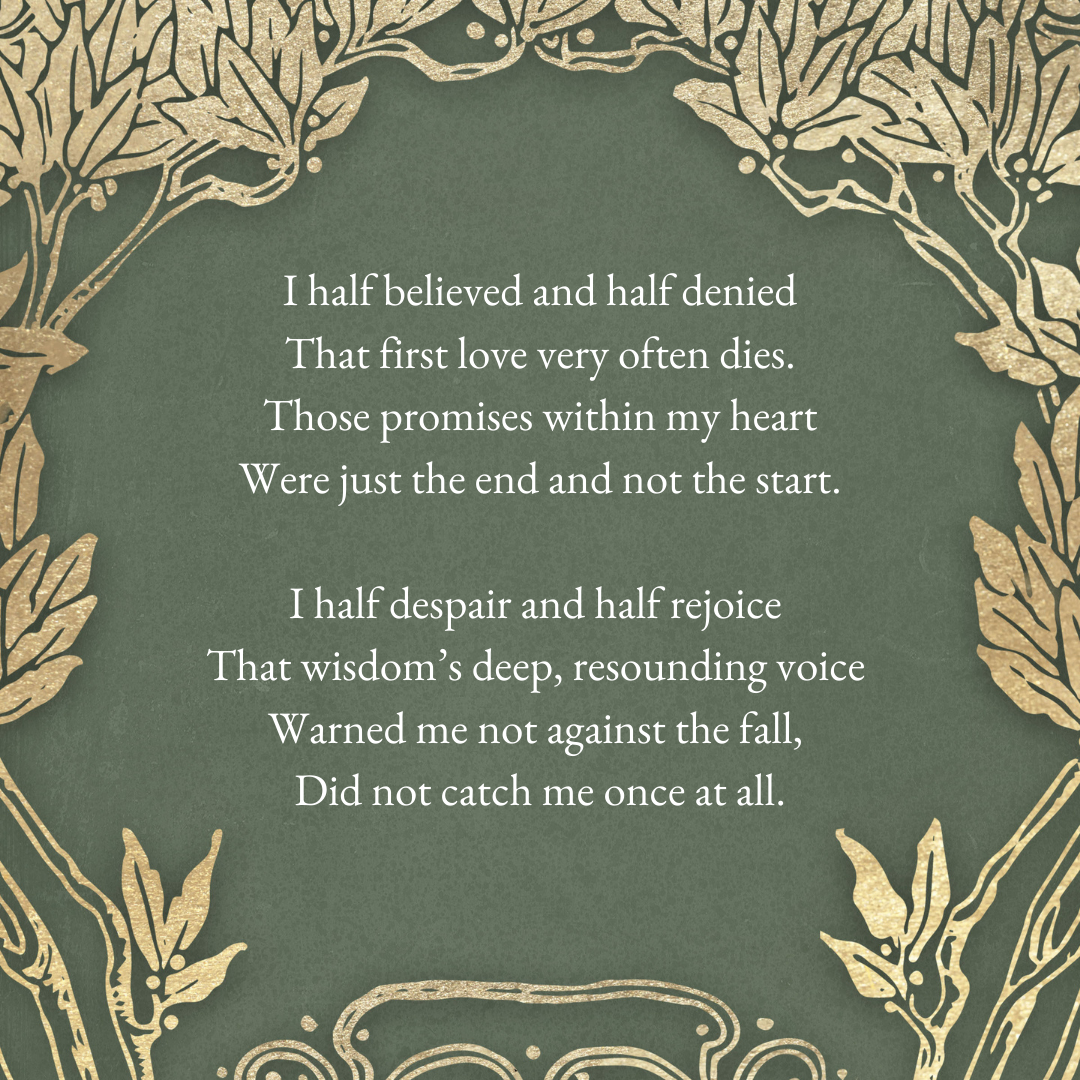
I’m delighted to share with you a beautiful new book I think you’ll want by your side this fall as you settle down for a cozy read by the fire! It’s called Bygone: Musings and Poems from a Regency Hearthside by Hannah Linder.

Not only is it beautiful to behold, but it is also beautiful to read. Read on for a fun interview with Hannah and some of my own thoughts on her book!

Book Description:

Modern, Regency-Esque Love Poems from a Regency Novelist. Enjoy this hardback collection of whimsical thoughts and poems, perfect for fans of Jane Austen. Grab a cup of tea and immerse yourself in this gift book release, just in time for fall.

I had the great honor of writing an endorsement for this book:

In Bygone: Musings and Poems from a Regency Hearthside, Hannah Linder offers elegant, heartfelt verses for the discerning Regency soul. As words dance delicately across the page, you’ll soon hear the gentle rustle of silk and the subtle murmur of voices as you step back through time to the beauty and romance of a bygone era.”

As you can see, I found myself in a very poetic mood after reading Hannah’s poems! Her words not only sweep you away to another time and place, but they are also food for the soul.

Interview with Hannah Linder

Hannah agreed to do an interview with me, and I enjoyed getting to know more about her and her writing and artistic background. She is an accomplished, creative, and talented person (I’m sure Austen would approve) with the same deep love for Austen and the Regency Era that all of us here at Jane Austen’s World share. I hope you enjoy our Q&A!

1. What is your background with poetry and what inspired you to write this book?

For years, I’ve enjoyed slipping off alone somewhere with an old poetry book, reading the stanzas out loud, or committing them to memory. I love the way poems play with words. The soothing sound. The cut of realization, throbbing at your chest, when you read something you always knew about life but never really pondered.

For years, I said I could not write poetry. I liked freedom best and writing in rhythms seemed too binding. Funny, isn’t it? Oftentimes the things we say we’ll never do are those we find ourselves doing. Now, writing poetry is an outlet. When emotions swell, I let them topple over and bleed into paper, each line a journal entry or a piece of what cries within me. Bygone is the collection of all my thoughts, dreams, and longings.

2. What are 2 of your favorite poems and what is the story behind each one?

Love You? is one that will always be special to me, because it reflects the heart of a wife who tries to explain to her husband all the ways she loves him. Love is not always flowers and moonlit dances and serenating music. Love, more often, is the simple things we do for each other. The life we live together.

Another favorite is Worth the While. This poem is a sweet reminder to slow down, be happy, and enjoy life as it comes.

3. When did you first discover Jane Austen and the Regency Era? 

My best friend, in my early teens, invited me over and introduced me to the 2005 Pride and Prejudice. From the moment Mr. Darcy walked through the foggy field with his coat billowing in the wind, I was hopelessly twitterpated. I have been in love with everything Jane Austen ever since.

4. Do you read Regency or Historical Fiction? If so, who are your favorite authors?

Absolutely! My all-time favorite Regency author is Michelle Griep. Her stories always keep me captivated.

5. What are your favorite 3 books you read in the last year?

This is such a hard question! I think Memory Lane by Becky Wade and Forgotten Secrets by Christy Barritt were among my favorite reads of the year.

6. Who do you picture reading the poems in this collection?

Anyone who loves the Regency Era, the sweetness of romance, the sing-song voice of poetry, or the sentimental things in life. Bygone would be a fun book to curl up with in a chair, near a hearth, with a steaming cup of tea.

7. What was your writing process for this collection? Where did you write these poems?

Anywhere, everywhere! Sometimes a thought or idea would strike me, and I would rush to write it down before I could forget. Other times, I’d just go wandering in a field, take a seat by the creek, and ponder on life until a poem came to me.

Bonus: Who is your favorite Jane Austen hero? Who is your favorite villain?

Absolutely, hands down, the wonderful Mr. Darcy. Though Mr. Knightly would be a close second. And villain, hmm…perhaps Mr. Wickham. He’s so charmingly deceitful and such a layered character. Jane Austen was so masterful.

About the Author

Hannah Linder resides in the beautiful mountains of central West Virginia. Represented by Books & Such, she writes Regency romantic suspense novels filled with passion, secrets, and danger. She is a four-time Selah Award winner, a 2023 Carol Award semi-finalist, and a member of American Christian Fiction Writers (ACFW). Also, Hannah is an international and multi-award-winning graphic designer who specializes in professional book cover design. She designs for both traditional publishing houses and individual authors, including New York TimesUSA Today, and international bestsellers. She is also a self-portrait photographer of historical fashion. When Hannah is not writing, she enjoys playing her instruments—piano, guitar, ukulele, and banjolele—songwriting, painting still life, walking in the rain, and sitting on the front porch of her 1800s farmhouse.

To follow her journey, visit hannahlinderbooks.com.

Hannah’s Links

If you’d like to follow along with Hannah’s other literary and artistic ventures, here are a few ways to find her online:

Purchase Bygone

You can purchase Bygone by Hannah Linder HERE!

I hope you enjoyed learning more about Hannah and her beautiful new book! Which Jane Austen character do you think would be most likely to read poetry? Which would be most likely to write poetry?


RACHEL DODGE teaches college English classes, gives talks at libraries, teas, and book clubs, and writes for Jane Austen’s World blog. She is the bestselling author of The Little Women DevotionalThe Anne of Green Gables Devotional and Praying with Jane: 31 Days Through the Prayers of Jane Austen. Now Available: The Secret Garden Devotional! You can visit Rachel online at www.RachelDodge.com.

Read Full Post »

During Jane Austen’s lifetime, conduct literature that advocated ideal conduct and character for young women was common. In the form of letters, pamphlets, and full-length novels, conduct literature covered an array of topics meant to instruct and inform.

Conduct manuals played a large part in forming Austen’s culture and the world of her novels. To better understand her world and her characters, let’s take a closer look at the world of conduct literature for young ladies.

Conduct Books

Whereas etiquette books of the last century, such as Emily Post’s Etiquette, stressed good manners and how to behave in specific social situations, the conduct manuals and letters written for young ladies in Jane Austen’s time focused mainly on propriety. The central purpose was to mold the character of a young woman and teach her how to think, act, and speak in a way that was both morally and socially proper.

Conduct manuals discussed a wide range of subjects, including household chores, religion, and what to look for in a husband. However, the underlying concern evident in most of the conduct pamphlets being written at this time was the cultivation of “virtue” in the female sex. As Mary Wollstonecraft Godwin states in Thoughts on the Education of Daughters (1787), “the main business of our lives is to learn to be virtuous.” And according to many eighteenth-century conduct books, a woman’s virtue was expressed in her attitudes, her carriage, her accomplishments, and her actions and speech. 

But what did these books, letters, and pamphlets actually say? Let’s take a closer look at three examples from the late 1700s to see what young ladies were taught during Austen’s youth and adolescence:

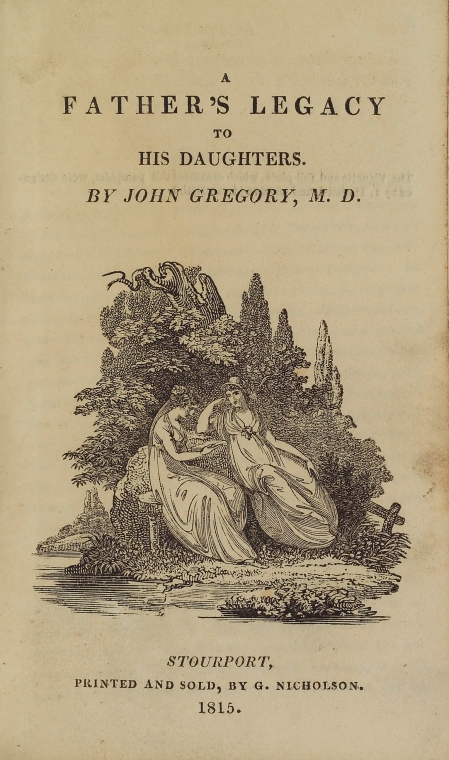
“A Father’s Legacy to His Daughters”

In John Gregory’s popular conduct book, A Father’s Legacy to his Daughters (first published in 1774), Gregory told his daughters that they should aspire to the kind of “virtue” their deceased mother possessed and put on “a certain gentleness of spirit and manners extremely engaging in [women].”


Carl H. Pforzheimer Collection of Shelley and His Circle, The New York Public Library. “A father’s legacy to his daughters.” The New York Public Library Digital Collections.

The topics for this particular conduct book are as follows:

  • Religion
  • Conduct and Behaviour
  • Amusements
  • Friendship, Love, Marriage

On the topic of Amusements, Gregory has this to say:

Some amusements are conducive to health, as various kinds of exercise: some are connected with qualities really useful, as different kinds of women’s work, and all the domestic concerns of a family: some are elegant accomplishments, as dress, dancing, music, and drawing. Such books as improve your understandings, enlarge your knowledge, and cultivate your taste, may be considered in a higher point of view than mere amusements. There are a variety of others, which are neither useful nor ornamental, such as play of different kinds.

John Gregory, A Father’s Legacy to his Daughters

On the topic of Friendship, Gregory makes these comments:

A happy choice of friends will be of the utmost consequence to you, as they may assist you by their advice and good offices. But the immediate gratification which friendship affords to a warm, open, and ingenuous heart, is of itself sufficient motive to court it. In the choice of your friends, have your principal regard to goodness of heart and fidelity. If they also possess taste and genius, that will still make them more agreeable and useful companions.

John Gregory, A Father’s Legacy to his Daughters

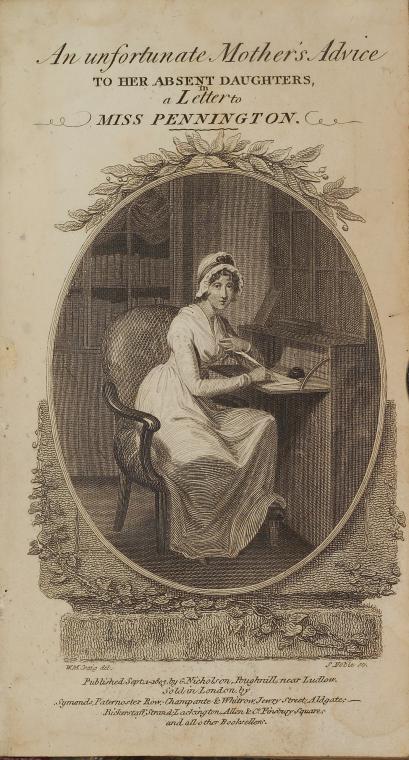
“An Unfortunate Mother’s Advice to Her Absent Daughters”

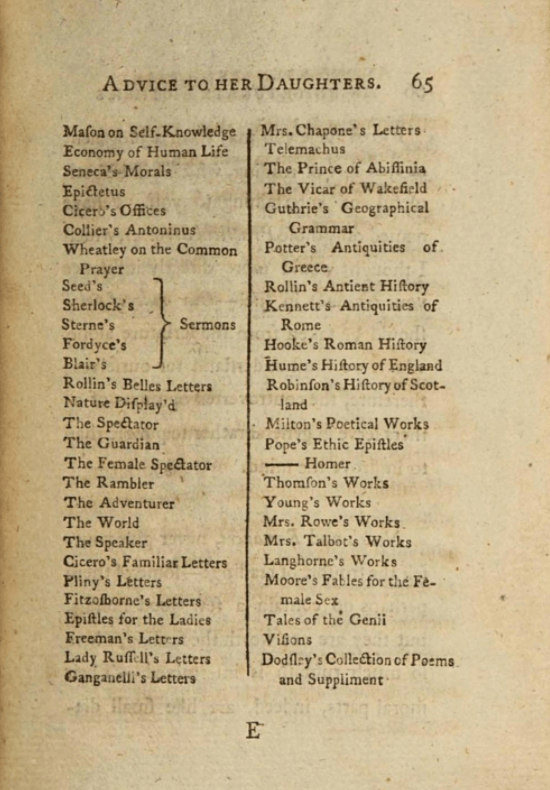
In Lady Pennington’s An Unfortunate Mother’s Advice to Her Absent Daughters (1761), she covers many topics for young ladies, complete with an index of books her daughters should read as part of her discussion on how her daughters should make “mental improvements” through reading, which gives us insight into other literature of the time period that was considered edifying for young ladies:

Along with Gregory, Pennington suggests that virtue should be a person’s highest goal: “Aim at perfection, or you will never reach to an attainable height of virtue.”

She goes into great detail on an expansive number of subjects, but one interesting highlight that seems to have been common for Jane Austen herself and for her leading ladies is in regard to one’s daily schedule. She explains that mornings should be spent in domestic duties and “improvement.” Afternoons “may then be allowed to diversions” (which includes “company, books of the amusing kind, and entertaining productions of the needle, as well as plays, balls”).

But, she says, the former part of the day should be “devoted to more useful employments”:

One half hour, or more, either before or immediately after breakfast, I would have you constantly give to the attentive perusal of some rationally pious author, or to some part of the New Testament, with which, and indeed with the whole Scripture, you ought to make yourself perfectly acquainted, as the basis on which your religion is founded. From this practice you will reap more real benefit than can be supposed by those who have never made the experiment.”

Lady Pennington, An Unfortunate Mother’s Advice to Her Absent Daughters
Carl H. Pforzheimer Collection of Shelley and His Circle, The New York Public Library. “An Unfortunate Mother’s Advice to Her Absent Daughters, in a letter to Miss Pennington,” The New York Public Library Digital Collections.

Further advice includes studying “your own language thoroughly, that you may speak correctly, and write grammatically.” She suggests being “well acquainted” with French and, if possible, Italian; the history of England other European nations; Geography, as this will “make history more entertaining to you;” Philosophy; and the “first four rules of Arithmetic.” Music and Drawing are humorously described as “accomplishments well worth the trouble of attaining, if your inclination and genius lead to either: if not, do not attempt them; for it will be only much time and labour unprofitably thrown away.”

Finally, a quote I found personally inspiring which I can imagine Austen might have agreed with:

Expect not many friends, but think yourself happy, if, through life, you meet with one or two who deserve that name, and have all the requisites for the valuable relation.

Lady Pennington, An Unfortunate Mother’s Advice to Her Absent Daughters

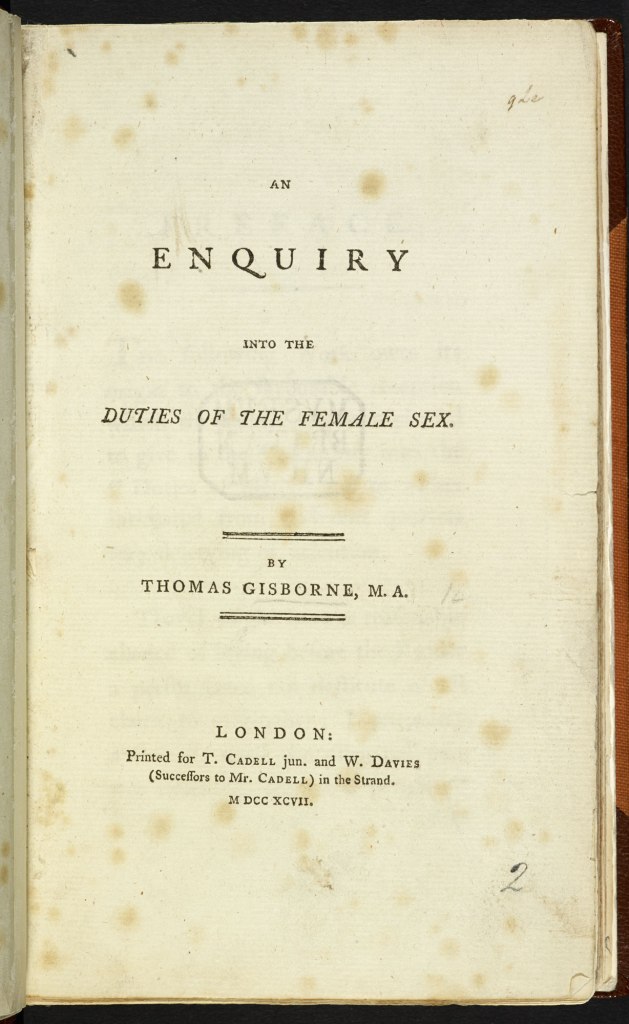
“An Enquiry into the Duties of the Female Sex

Austen herself read a conduct manual titled An Enquiry into the Duties of the Female Sex, written by Thomas Gisborne (1797), which followed his popular “Enquiries into the Duties of Men.” It covers topics such as the differences between men and women, female education, introducing young women into society, conversation and letter writing, dress, entertainment, the employment of time, choosing a husband, the duties of parents, and so forth.

I am glad you recommended “Gisborne”, for having begun, I am pleased with it, and I had quite determined not to read it.

Letter from Jane to Cassandra, 30 August 1805

To explain Austen’s possible reason for this common, the British Library has this to say:

“We don’t know why Austen had ‘determined not to read’ An Enquiry. Perhaps she expected it to be similar to the Mr Collins-endorsed Sermons to Young Women, referred to in Pride and Prejudice, which stresses the need for women to be submissive and modest. In fact, Gisborne praises woman’s capacity for ‘sprightliness and vivacity’, ‘quickness of perception’ and ‘fertility of invention’ – as well as the more traditional female virtues of offering comfort and cheer to those around them.

“Though Gisborne’s views seem conservative to modern readers, many of them are similar to those that Austen expresses in her novels. He urges women to spend time each day reading improving books, mentioning as particularly suitable the works of William Cowper, one of Austen’s favourite poets (p. 219). He warns against the ‘absurd and mischievous’ belief that a woman can reform a cruel and immoral man after marrying him (p. 238), and criticises mothers who prioritise wealth over happiness in choosing husbands for their daughters.” (British Library, Conduct Book for Women)

Forms of Conduct Literature

There were countless other conduct books, letters, and pamphlets written during Austen’s lifetime. These, along with sermons and religious writings, were the only kind of reading material that was thought proper for young ladies. Later, didactic novels that taught a moral lesson in story form, became more popular. Still within the genre of conduct literature, didactic novels were written to entertain and instruct. Stay tuned for more on that topic next month.

I encourage you to follow the links above and read some of these books for yourself. It’s quite interesting to find out what exactly young women were taught during Jane Austen’s time. And it’s easy to see where Austen may have found instruction, inspiration, and even, at times, amusement within their pages.


RACHEL DODGE teaches college English classes, gives talks at libraries, teas, and book clubs, and writes for Jane Austen’s World blog and Jane Austen’s Regency World magazine. She is the bestselling author of The Anne of Green Gables Devotional: A Chapter-By-Chapter Companion for Kindred Spirits and Praying with Jane: 31 Days Through the Prayers of Jane Austen. Her newest book The Little Women Devotional is now available. You can visit Rachel online at www.RachelDodge.com.

Read Full Post »

Last month, I wrote about Pin Money, or allowances, in Jane Austen’s life and novels. This time, I’m looking more closely at the importance of money in a genteel woman’s life and how it plays out in Austen’s novels.

Money is one obvious way parents could put limits on their children and keep them under control. This happened to both sexes for various reasons in Jane Austen’s time, but it carried even more weight for a woman because there were also financial consequences that came with marriage once she left her father’s home, even if she came from a wealthy family.

At that time in England, husbands had complete control over the finances of their wives. Without an adequate personal budget to spend as she liked, a wife had to go to her husband to ask for money to buy anything and everything she might need. Without a set allowance, wives could find themselves in a very difficult or unhappy position. This is one of many reasons why the marriage settlement (or prenuptial agreement) was so crucial because it was one way fathers could make sure their daughters (and grandchildren) were taken care of financially.

Gwyneth Paltrow in Emma, 1996.

Marriage Settlements

A young woman from a wealthy family would obviously qualify for better marriage terms than a young woman with very little. Her father could leverage what his daughter brought to the marriage for a highly favorable marriage settlement, allowing for her to have the pin money she needed, portions for her children, and a widow’s pension in the event that her husband died. Young women who did not bring as much to the marriage would have a smaller personal budget or, in some cases, no personal budget whatsoever.

In Daniel Pool’s What Jane Austen Ate and What Charles Dickens Knew, he writes, “Typically the bride’s family would have their lawyers negotiate with the husband’s lawyers, to get the husband to agree to grant her ‘pin money,’ which was a small personal annual allowance while he lived, a hefty chunk of property or money to support her after he died, and ‘portions’ of money for their children. All this would be written up in the ‘marriage settlement’ by the lawyers before anybody walked down any aisles.”

In JASNA’s Persuasions, you can read all about The Marriage Law of Jane Austen’s World. (For more on marriage settlements and marriage law in the Regency Era, please see the resources at the end of this article.)

Marriage Settlement, Mills College Library Heller Rare Book Room, Special Collections. Photo by Rachel Dodge, 2019.

Money Matters in Jane Austen’s Novels

In each of Austen’s novels, we find intriguing scenes that relate to women and personal money. Each of these examples shows us just how important it was for a woman to have her own money and the problems (and dangers) that could arise if she did not have any money or ran out of money, especially if she was away from home:

Fanny Price’s £10

In Fanny’s case in Mansfield Park, Sir Thomas supplies her with money before she leaves for her journey to visit her family in Portsmouth:

It had very early occurred to her that a small sum of money might, perhaps, restore peace for ever on the sore subject of the silver knife, canvassed as it now was continually, and the riches which she was in possession of herself, her uncle having given her £10 at parting, made her as able as she was willing to be generous.

Mansfield Park, Jane Austen

Harriet Smith’s Purse

In Emma, we see evidence of Harriet Smith’s allowance, which comes in handy when she meets the “trampers” on the road:

More and more frightened, she immediately promised them money, and taking out her purse, gave them a shilling, and begged them not to want more, or to use her ill.

Emma, Jane Austen
“The terror … was then their own portion.” Illustration by C.E. Brock.

Lydia and Kitty Bennet’s Mismanagement

In Pride and Prejudice, Lydia and Kitty spend their pin money money at the shops and must borrow money from Elizabeth and Jane when they surprise them for a meal at the inn in Hertfordshire:

“And we mean to treat you all,” added Lydia, “but you must lend us the money, for we have just spent ours at the shop out there.” Then, showing her purchases—“Look here, I have bought this bonnet. I do not think it is very pretty; but I thought I might as well buy it as not. I shall pull it to pieces as soon as I get home, and see if I can make it up any better.”

Lydia Bennet, Pride and Prejudice

Nancy Steele’s Fright

In Sense and Sensibility, we find this intriguing passage about the Steele sisters and personal money when Nancy Steele must go to Mrs. Jennings for money after Lucy borrows all of Nancy’s money and marries Robert Ferrars:

Not a soul suspected anything of the matter, not even Nancy, who, poor soul! came crying to me the day after, in a great fright for fear of Mrs. Ferrars, as well as not knowing how to get to Plymouth; for Lucy it seems borrowed all her money before she went off to be married, on purpose we suppose to make a show with, and poor Nancy had not seven shillings in the world…

Mrs. Jennings, Sense and Sensibility
Lucy Steele (Anna Madeley) and Anne, or “Nancy,” Steele (Daisy Haggardand), Sense and Sensibility, 2008.

Catherine Morland’s Borrowed Fare

In Northanger Abbey, money becomes quite important in a crucial moment. First, money is mentioned when Catherine Morland goes to Bath. Her parents send her with money for her personal expenses and ask her to keep account of her spending:

I beg, Catherine, you will always wrap yourself up very warm about the throat, when you come from the rooms at night; and I wish you would try to keep some account of the money you spend; I will give you this little book on purpose.”

Mrs. Morland, Northanger Abbey

Money is mentioned again when Catherine is suddenly and unexpectedly sent home from Northanger Abbey. While she is in Bath, she is under the care of her hosts, the Allens, who would, of course, pay for many of her expenses while she is under their roof and their protection. However, once she goes to Northanger, she is essentially under the care and protection of General Tilney. When he sends her home abruptly, he does not provide the funds necessary for her journey home, leaving her in a very precarious and even dangerous situation. This was a terrible oversight on his part. Thankfully, Eleanor is able to provide the funds, which we may assume is from her own personal allowance:

It had occurred to her that after so long an absence from home, Catherine might not be provided with money enough for the expenses of her journey, and, upon suggesting it to her with most affectionate offers of accommodation, it proved to be exactly the case.

Catherine had never thought on the subject till that moment, but, upon examining her purse, was convinced that but for this kindness of her friend, she might have been turned from the house without even the means of getting home; and the distress in which she must have been thereby involved filling the minds of both, scarcely another word was said by either during the time of their remaining together.

Northanger Abbey, Jane Austen

Catherine makes it home safely and repays the money to Eleanor by mail with only a short note: “The money therefore which Eleanor had advanced was enclosed with little more than grateful thanks, and the thousand good wishes of a most affectionate heart.”

The Morlands, a very practical bunch, decide after a bit that it all ended well in the end, but even they cannot understand such a “breach of conduct” on General Tilney’s part:

They were far from being an irritable race; far from any quickness in catching, or bitterness in resenting, affronts: but here, when the whole was unfolded, was an insult not to be overlooked, nor, for the first half hour, to be easily pardoned.

Mr. and Mrs. Morland could not but feel … that, in forcing her on such a measure, General Tilney had acted neither honourably nor feelingly—neither as a gentleman nor as a parent. Why he had done it, what could have provoked him to such a breach of hospitality . . . was a matter which they were at least as far from divining as Catherine herself…

Northanger Abbey, Jane Austen
Felicity Jones as Catherine Morland, Northanger Abbey, 2007.

Mrs. Smith’s Recovered Property

In Persuasion, we turn our attention to the widowed Mrs. Smith, whose husband had badly mismanaged their finances: “She was a widow and poor. Her husband had been extravagant; and at his death, about two years before, had left his affairs dreadfully involved.” In this situation, it is not just Mrs. Smith’s personal finances that are at stake, but her finances at large. Here, we see Captain Wentworth use his influence to work on her behalf and help improve her financial circumstances. At the end of the novel, we read this:

[Mrs. Smith] was their earliest visitor in their settled life; and Captain Wentworth, by putting her in the way of recovering her husband’s property in the West Indies, by writing for her, acting for her, and seeing her through all the petty difficulties of the case with the activity and exertion of a fearless man and a determined friend, fully requited the services which she had rendered, or ever meant to render, to his wife.

Persuasion, Jane Austen

When we look at the parents, guardians, husbands, and friends in the examples above, it’s clear that Austen uses money matters (just as she uses so many other clever devices) to point to character and propriety. We could go through each novel and study each of the male and female characters and surmise quite a bit about their personalities just from the way they each manage money.

It’s clear that the characters in Austen’s books who provide well for their wives, children, and friends–and those who are generous and charitable with their money–are the characters we should admire and respect. Conversely, those who handle their money poorly–and those who manipulate and use and abuse others for financial gain or for personal control–are the characters we should distrust and, in some cases, even despise. In Austen’s novels, money matters.


RACHEL DODGE teaches college English classes, gives talks at libraries, teas, and book clubs, and writes for Jane Austen’s World blog and Jane Austen’s Regency World magazine. She is the bestselling author of The Anne of Green Gables Devotional: A Chapter-By-Chapter Companion for Kindred Spirits and Praying with Jane: 31 Days Through the Prayers of Jane Austen. Her newest book The Little Women Devotional is now available for pre-order and releases December 2021. You can visit Rachel online at www.RachelDodge.com.

Links About Marriage and Marriage Settlements:

Read Full Post »

Older Posts »