Feeds:
Posts
Comments

Archive for the ‘Regency World’ Category

Jean Louis Bazalgette, the Prince Regent's tailor

Most of the known accounts published about George, Prince of Wales, and his profligate spending on clothes and luxury items say that his main tailor was John Weston. It is also said that under the influence of young Beau Brummel he patronized other London tailors such as Meyer, and Schweitzer and Davidson. Steven Parissien, in his very interesting book ‘George IV, Inspiration of the Regency’ has a whole chapter entitled ‘Clothing & Militaria’ which lists tailors, bootmakers etc. used by the Prince.

The name of the unknown man who was the Prince’s tailor for 32 years – Louis Bazalgette – shows up in none of these sources. He appears to have started quietly supplying the Prince with all manner of clothes in great quantities in about 1780, and carried on making most of his clothes until at least 1795.
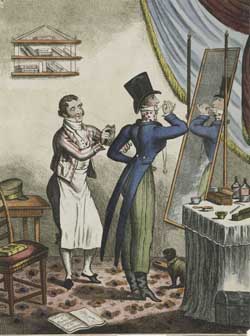
A dandy and his tailor

In 1794, the sixteen-year-old Brummel attracted the interest of the Prince, who under his influence began slowly to change his style of dress, so that by 1795 Bazalgette was making less of the gaudy outfits of which Prinny had been so fond. However, Louis continued to make most of the Prince’s uniforms, and the livery for his servants, until at least 1806.

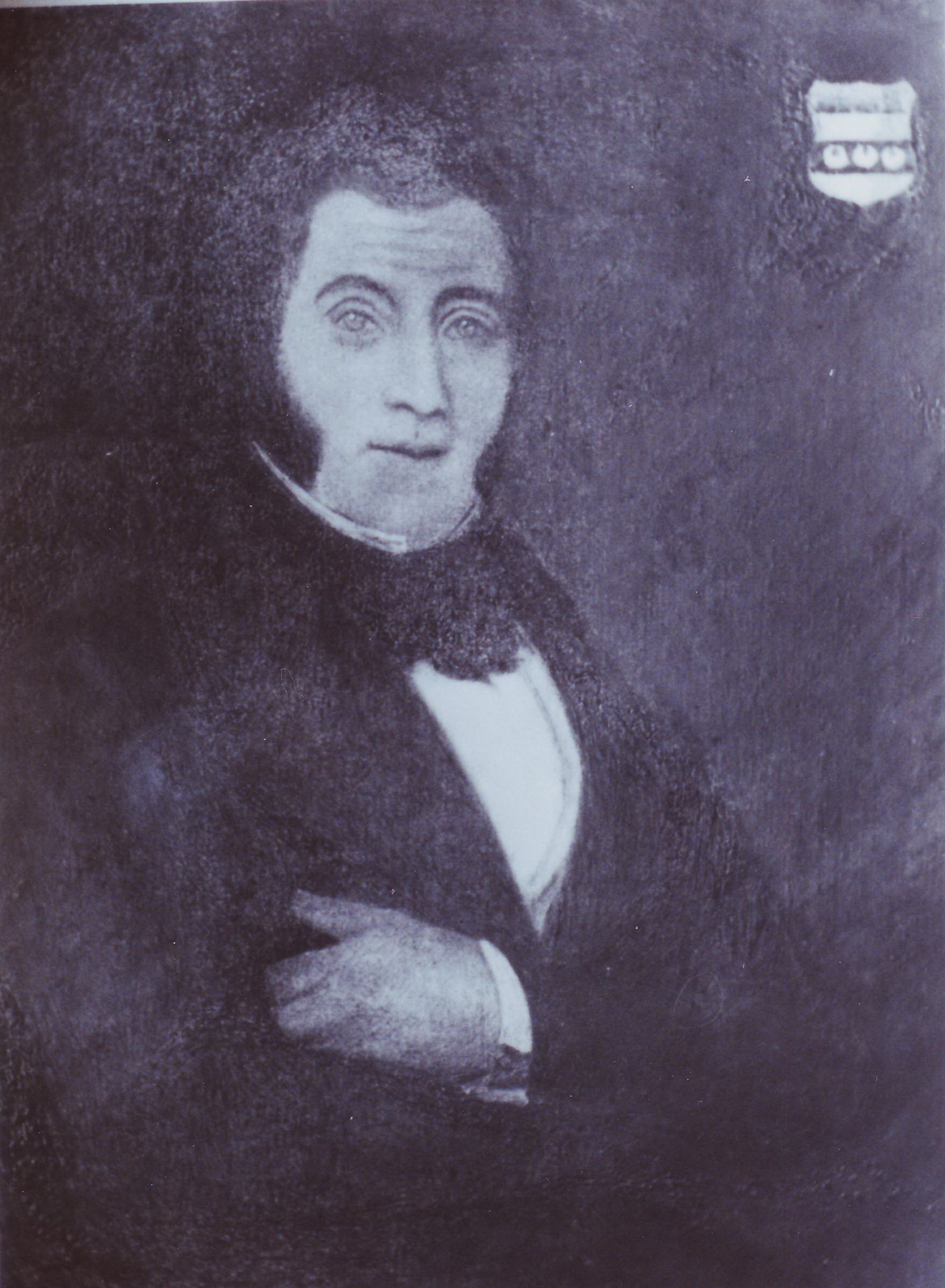
Louis was the great-great-great-great-grandfather of Charles Bazalgette (r), who is writing his life story. The book contains a great deal of new material; as a foretaste, Charles has started a blog which can be accessed at this blog http://chasbaz.posterous.com/

Read Full Post »

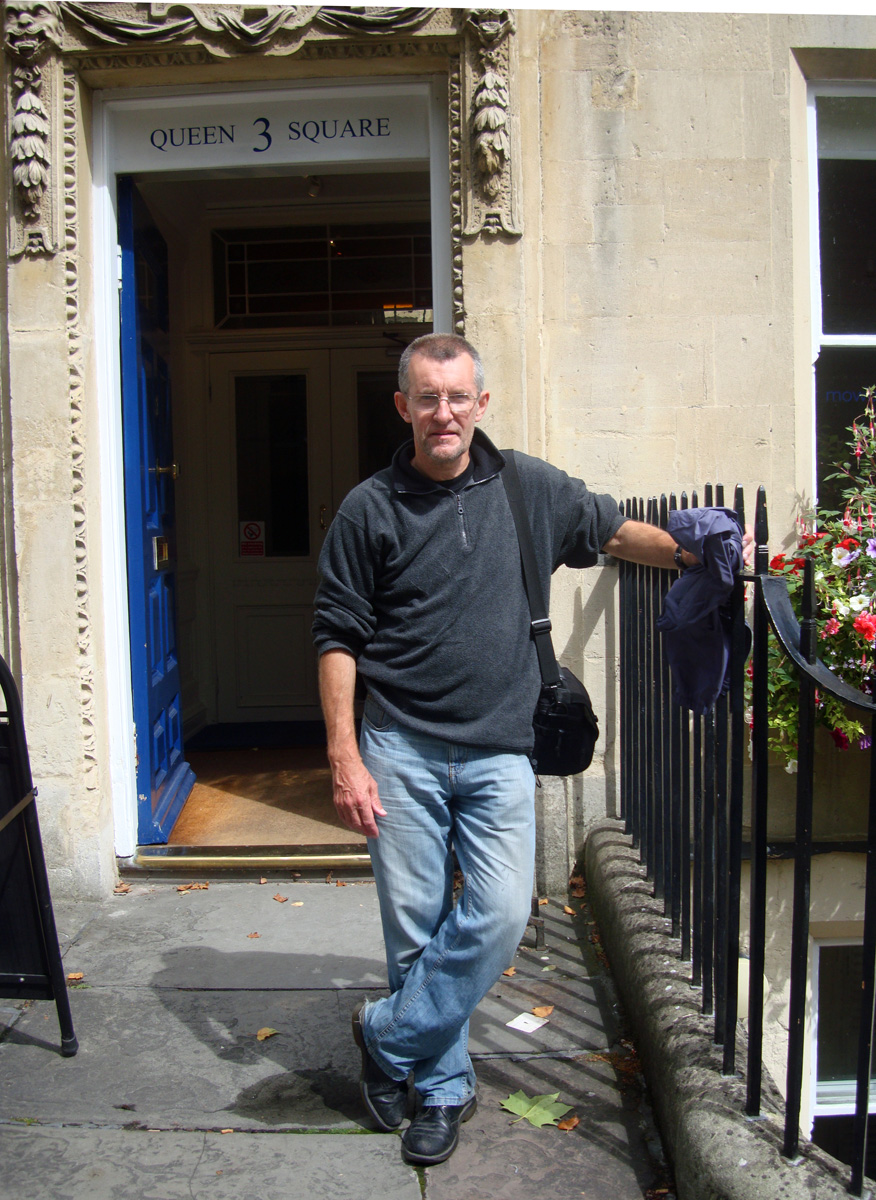
Tony Grant at 3 Queen Square, down the road from the Jane Austen Centre

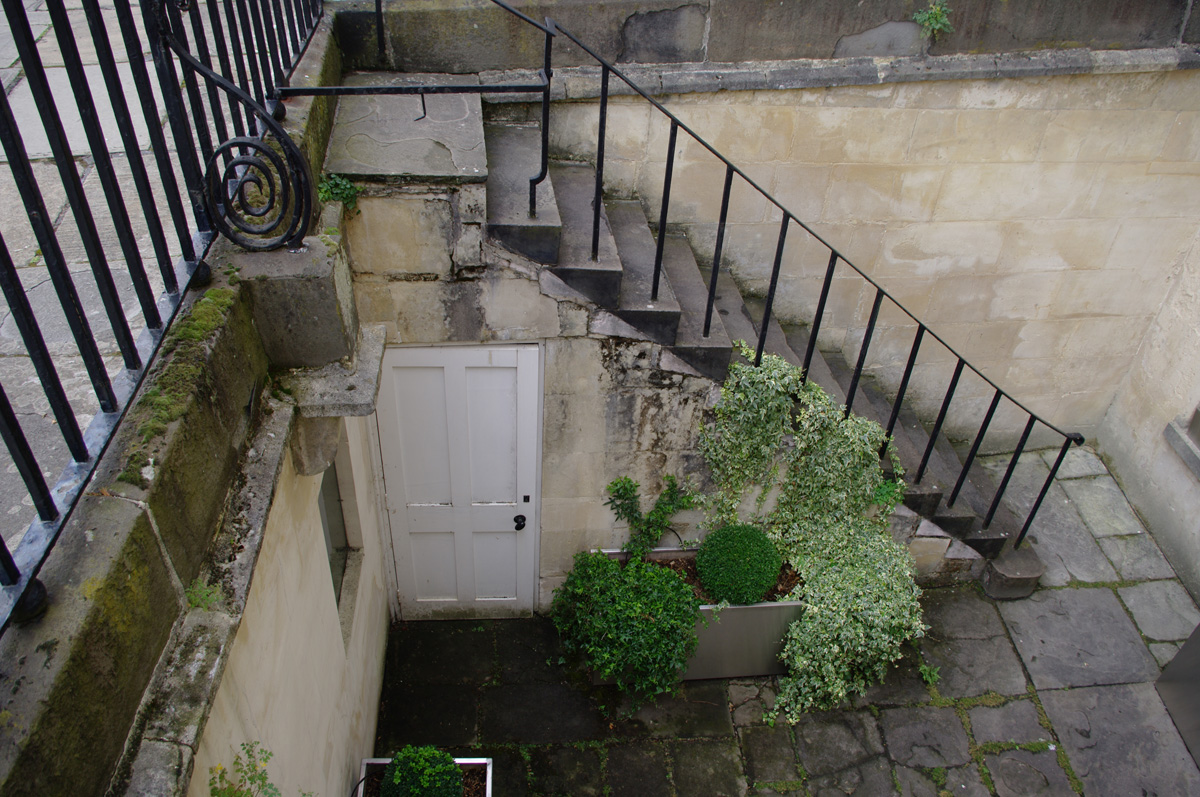
Tony Grant, who writes posts for Jane Austen Today and London Calling, stands above the “area”, the servants entrance that sits below ground and in front of town houses built during the Georgian and Regency eras. A wrough-iron fence separated the upper level from the lower basement level, which was sunk partly below the street. Windows in the work areas gave the servants a view of the people walking along the sidewalks.

Wherever these town houses were built, servants and delivery people used the lower entrance. The “area” also contained a coal vault used for storage.

The "area", or the way down to the servant's quarters

A collier unloaded coal from a cart directly into the coal vault. This practice prevented dirty coal sacks from being dragged through the house. Coal was dumped down a chute via a coal hole. The coal would then be used for fires or the kitchen stove. (Gaelen Foley)  The design of the coal hatch, which was locked from the inside, would vary from house to house. Coal holes were in use from the early 1800s to the middle 1900s, when the Clean Air Act made the burning of coal illegal. (Knowledge of London)

Coal hole, Bath, England

So much coal was burned in 19th century London (in 1800 over one million London residents were burning soft coal) that “winter fogs” became common.

An 1873 coal-smoke saturated fog, thicker and more persistent than natural fog, hovered over the city of days. As we now know from subsequent epidemiological findings, the fog caused 268 deaths from bronchitis. Another fog in 1879 lasted from November to March, four long months of sunshineless gloom. (London’s Historic “Pea Soupers”)

Read Full Post »

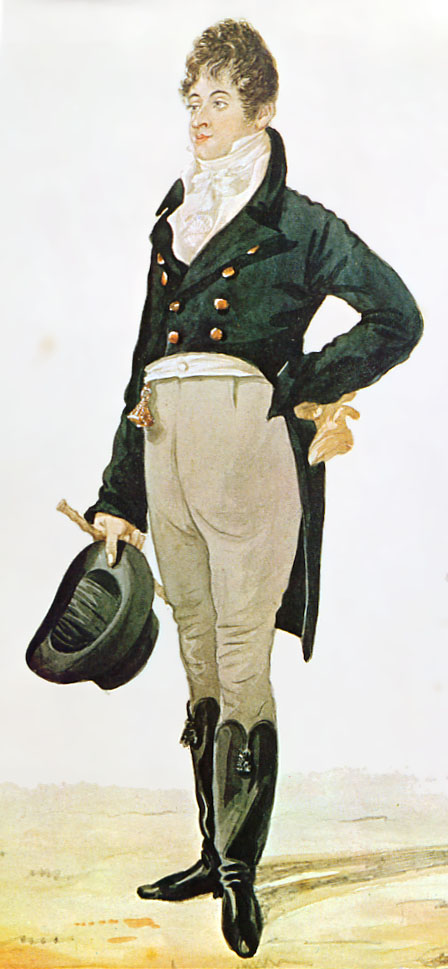
Brummel’s morning dress was similar to that of every other gentleman. Hessians and pantaloons, or top boots and buckskins, with a blue coat and a light or buff coloured waistcoat, of course, fitting to admiration on the best figure in England. His dress of an evening was a blue coat and white waistcoat, black pantaloons, which buttoned tight to the ankle, striped stockings and opera hat; in fact, he was always carefully dressed, but never the slave of fashion.

Brummel’s tailors were Schweitzer and Davidson in Cork Street, Weston, and a German of the name of Meyer who lived in Conduit Street. The trousers, which opened at the bottom of the leg, and were closed by buttons and loops, were invented either by Meyer or Brummel. The Beau, at any rate, was the first who wore them, and they immediately became quite the fashion ,and continued so for some years. – English Eccentrics: Beau Brummell, John Timbs, p 22-35,

Mr. Brummel in his morning dress

A good humoured baronet, and brother Etonian of [Brummel’s], who followed him at a humble distance in his dress, told me that he went to Schweitzer’s one morning to get properly rigged out, and that while his talented purveyor of habiliments was measuring him, he asked him what cloth he recommended? “Why, Sir,” said the artiste, “the Prince wears superfine, and Mr. Brummell the Bath coating; but it is immaterial which you choose, Sir John, you must be right; suppose, Sir, we say Bath coating, — I think Mr. Brummell has a trifle the preference.” – The Life of George Brummel, Esq, William Jesse

More on the topic: Between a Gentleman and His Tailor, Georgian Index

Read Full Post »

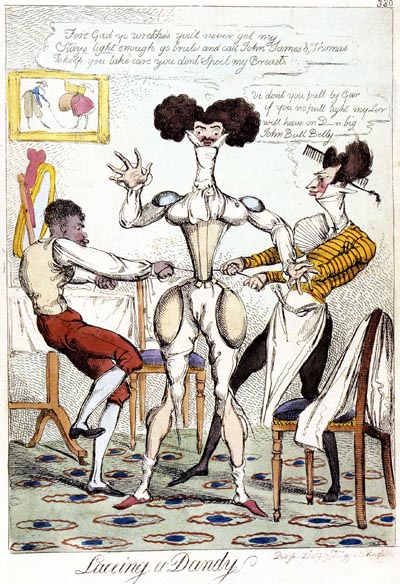
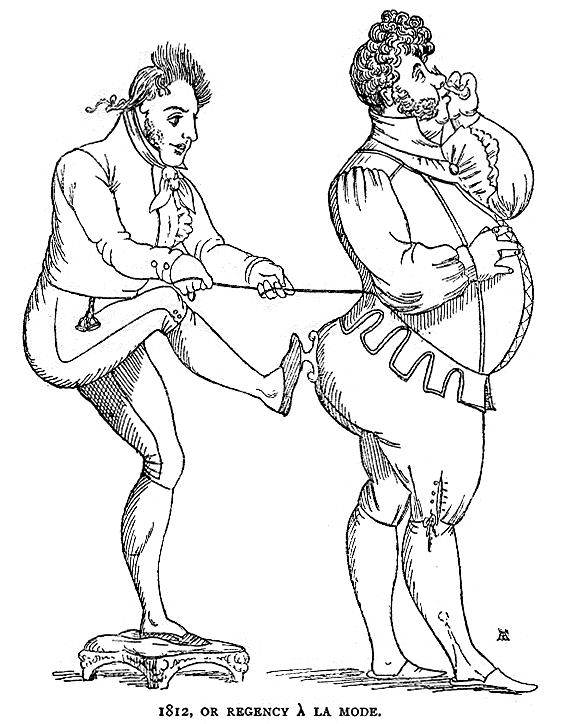
Even as women freed themselves for a short time from the confinement of corsets, the Regency dandy, following the Prince Regent’s fashion, began to constrict himself into a wasp-waisted and broad shouldered look. For men of a certain challenged physique, firm waists and tight stomachs were achieved through laced corsets. The sculpting of wide shoulders, bulging thighs, and fine calves was accomplished by well-placed pads, as the satiric image below shows.


Lacing a Dandy, 1819


There can be no doubt, indeed, that just as the large cravat resulted from defects in the royal neck, so the stays in later years became necessary to restrain the unwieldy proportions of the royal waist, and assumed by the dandies as an act of compliment to their patron. The caricatures of the day exhibit an Illustrious Personage lifted up and struggling to insert his legs into a pair of “leather”s of a size he was anxious to appear in –  which are securely lashed to the bed posts to give a sort of purchase in furtherance of his efforts – just as in 1784 stories were told of Monseigneur d’Artois, the brother of Louis XVI of France,  needing the aid of four tall lacqueys to put on and off, without creasing, his small clothes of a special make and kind. – Once a Week, Volume 10


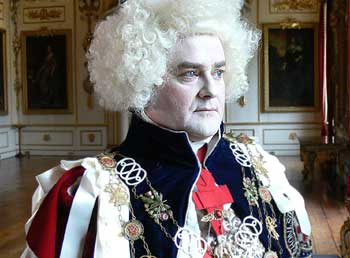
Prince Regent at his toilet, Hugh Bonneville, Beau Brummell, This Charming Man, 2008


Corsets continued to be relatively popular among the ruling and military classes for the rest of the 19th century, and retained a significant following during the first part of the 20th century.


1812 Regency a la mode


Read more on the topic:

Read Full Post »

Along with Austenprose, this blog is celebrating Georgette Heyer’s 108th birthday on August 16th. Look for Laurel Ann’s interview with me on her blog that day! Her questions were quite challenging.

The recent reviews featured on Laurel Ann’s blog echo some of the reviews that have been published in recent years on this blog. For your enjoyment and in celebration of the Austenprose event, we are reviving some of our favorite Georgette Heyer reviews.

Read more Georgette Heyer reviews by a wide variety of bloggers on Austenprose.

Read Full Post »

« Newer Posts - Older Posts »