Feeds:
Posts
Comments

Archive for the ‘Regency World’ Category

Making traditional black butter

Inquiring readers: Reader Cora Harrison recently placed this comment on my blog: “In one letter, Jane [Austen] spoke of serving ‘black butter’ with wigeon and that she thought the butter was bad … Poor Jane, I thought. However, in reading a book called The Feast of Christmas I discovered that black butter was not butter at all, but what I would call a fruit cheese, made from equal quantities of apples, blackcurrants or blackberries and less sugar, and then boiled until it sets – and of course, the colour would be black!”

Her comment so intrigued me, that I decided to look up the topic. Jane wrote to her sister on December 27, 1808:

The first pot [of black butter] was opened when Frank and Mary were here, and proved not at all what it ought to be; it was neither solid nor entirely sweet, and on seeing it Eliza remembered that Miss Austen had said she did not think it had been boiled enough. It was made, you know, when we were absent. Such being the event of the first pot, I would not save the second, and we therefore ate it in unpretending privacy; and though not what it ought to be, part of it was very good.”

The recipe for making black butter, or apple butter as it is commonly known today, harkens back to medieval times. After the winter crop was picked, the preserve was made in huge quantities. In the 18th century, twenty percent of Jersey’s arable land was made up of orchards, and the tradition of producing ‘black butter’ or ‘Le Niere Buerre’ became an annual social  and festive occasion.  Jersey black butter was made from cider apples that were slowly boiled over a fire. Women would peel hundreds of pounds of apples, while the men and children would gather enough wood to keep the fire going for almost two days. After the cider was ‘reduced’ by half, apples, sugar, lemon, liquorice and spices were added. The Jersey tradition of making black butter included singing, dancing, and storytelling all through the night and until early morning. Jersey Island black butter is characterized by the addition of liquorice, which made the preserve quite dark. – RecipeZaar & BBC Jersey Black Butter.

According to Food Legends, black butter “contains no butter, the butter in the name being like the cheese in lemon cheese, more a description of the consistency and application of the product than anything else; and second, it is not really black, indeed a great deal of effort goes into avoiding the burning that would change the dark brown mass to black.” The following is likely Jane Austen’s recipe for Black Butter. Traditionally, the preserve is spread on bread, or it can be eaten by itself:

    Take 4 pounds of full ripe apples, and peel and core them. Meanwhile put into a pan 2 pints of sweet cider, and boil until it reduces by half. Put the apples, chopped small, to the cider. Cook slowly stirring frequently, until the fruit is tender, as you can crush beneath the back of a spoon. Then work the apple through a sieve, and return to the pan adding 1lb beaten (granulated) sugar and spices as following, 1 teaspoon clove well ground, 2 teaspoons cinnamon well ground, 1 saltspoon allspice well ground. Cook over low fire for about ¾ hour, stirring until mixture thickens and turns a rich brown. Pour the butter into into small clean jars, and cover with clarified butter when cold. Seal and keep for three months before using. By this time the butter will have turned almost black, and have a most delicious flavour. – Copyright Maria Hubert von Staufer March 1995

Black butter on bread

This recipe, which Cora must have at first thought Jane Austen was referring to, is a black butter that is generally served with fish, such as skate or salmon:

Black Butter: Put into a frying pan the necessary amount of butter, and cook it until it has a brown color and begins to smoke. At this moment add a large pinch of concassed parsley leaves and spread it immediately over the object to be treated. – Chest of Books

More on the topic:

Read Full Post »

Inquiring readers: I have no doubt you shall enjoy this post by my good friend, Lady Anne, an expert when it comes to the subject of Georgette Heyer. Lady Anne has read Georgette Heyer’s novels for most of her years upon this earth. Smart, sassy, fabulous, well tressed and well dressed, she has read every GH book backwards and forwards. There is not one tiny detail of Georgette’s novels that escapes Lady Anne’s attention or opinion. As to her review of  These Old Shades- please enjoy.

Set in the Georgian period, about 20 years before the Regency, These Old Shades is considered to be the book that launched Heyer’s career. It features two of Heyer’s most memorable characters: Justin Alastair, the Duke of Avon, and Leonie, whom he rescues from a life of ignomy and comes to love and marry.

The title of the book, These Old Shades, is a subtle allusion to the fact that this book is a far superior reworking of Georgette Heyer’s first book, The Black Moth, a book she wrote for the amusement of her brother who was ill. The characters in The Black Moth are at best two dimensional, but like most of Heyer’s creations, have enough humor and idiosyncrasy to catch our interest. In her case, it was the character of the villain whom she wished to revisit, develop and deepen.

These Old Shades is the first of the Alistair trilogy – she really did like these characters – and is not Regency, nor does it take place primarily in England. Like many of her early books, it falls more accurately into the category of historical romance, and is cast in mid-18th century Paris, with a short idyll at the English county seat of our hero, Justin Alistair, the Duke of Avon. He is known by the soubriquet Satanas, for his cold exactitude and prescient understanding of what his opponent will do next, as well as a certain elasticity in his moral fiber. The Duke has restored his family’s fortune through gambling; he is, as one would expect of one of the first peers of the realm, an arrant snob, careful, although certainly flamboyant, in his dress, and punctilious in manner. The historical background is the court of Louis XV, complete with its intrigues and excesses. It is the perfect backdrop for this story, for which one must be willing to suspend disbelief for pages at a time. It is such fun, and so sparkling in its writing, that one is indeed willing.

We first meet the Duke, dissolute, languid, apparently unaware of his surroundings, when a gamin comes hurtling from a side street and provides Avon with the weapon he has been waiting for to bring about the destruction of the Comte de Saint-Vire, the man who famously insulted Avon beyond courtesy. Avon buys the youngster from his brother, and establishes him as a page dressed in sober black, who attends Avon at parties, assemblies, and the Court at Versailles. The youngster, called Leon, attracts considerable attention, not only for his utter adoration of his master, whom he calls Monseigneur, but also for his startling red hair and dark eyebrows. Such hair and eyebrow combination is evident in the Saint-Vire family. As le tout Paris buzzes, Avon begins laying his plans. Leon is revealed to readers as Leonie, and goes to England in the country to learn how to be a lady. The Duke adopts her and returns to Paris with his ward. His friend Hugh Davenant returns to Paris at the same time and Avon tells him, in a passage that makes clear both the character and performance of this Duke:

“I am becoming something of a patriarch, my dear.”
“Are you? Davenant said, and smiled to himself. “May I compliment
you on your ward?”
“Pray do! You find her to your taste?”
“Infinitely. Paris will be enchanted. She is an original.”
“Something of a rogue,” conceded his Grace.
“Justin, what does Saint-Vire to do with her?”
The thin brows rose.
“I seem to remember, my dear, that your curiosity was one of the
things I deplored in you.”
“I’ve not forgot the tale you told me – in this very room, Justin. Is
Leonie the tool with which you hope to crush Saint-Vire?”
His Grace yawned.
“You fatigue me, Hugh. Do you know, I have ever had a fancy to
play my game — alone.”
Davenant could make nothing of him and gave up the attempt.”

But it is not the plot that carries the reader along; it is the delightful characters. The Duke, the darkest of Heyer’s heroes, has real charm, albeit a little sinister. He is not one you would wish to cross, as we see. Leonie, the heroine, is an effervescent charmer with a ferocious temper and an inherent sense of her own worth that grows through the book. Her character is honest and instinctively noble. She also, like any adorable pet of a large circle, gets away with being outrageous – except when Monseigneur is displeased. The supporting characters have charm and individuality as well. It is no wonder that Heyer comes back to the family twice: once in The Devil’s Cub – to revisit the Duke and his family, with a focus on the Cub, definitely the son of both his parents, and then in what is generally considered her finest novel, in An Infamous Army, where the grandchildren of the second book’s couple play out their roles at Waterloo.

If the story that unfolds is outrageous and unbelievable, the characters develop beautifully, the dialog bubbles delightfully, and we love the rollicking ride.

These Old Shades/Black Moth comparison from Wikipedia

More on the topic:

Read Full Post »

Colin Firth wearing a reindeer jumper in Bridget Jones' Diary

The blog, Built on Facts, discusses Pride and Prejudice and Bridget Jones’s Diary in a post entitled: Metafiction and Self-Reference in Bridget Jones’ Diary

..not only is [Bridget Jones’ Diary] a retelling, it’s a retelling that’s very explicit about that fact. But that’s just the start; in fact Bridget meets him at a party wherein Mr. Darcy is standing around being standoffish, precisely as in Pride and Prejudice. And Bridget comments on this, pointing out to herself that if one is going to be named Darcy one shouldn’t be standing around standoffishly at parties.

More Intelligent Life dot Com features a long interview with Colin Firth about his movie, “A Single Man,” and his life and career. Quite insightful.

LOOK UP Firth’s name in a casting director’s address-book, and you’d find it under “a” for Archetypal Englishman. He has played the comedy version (the cuckolded, tongue-tied writer in “Love Actually”), the villainous version (a Blackadderish lord in “Shakespeare in Love”) and the subtle, smarter-than-he-first-appears version—decent Clifton, the young buffer who’s actually a spy, in “The English Patient”. Yet in reality Firth doesn’t have much time for England.

Both his major relationships have been with women from other countries—first the Canadian actress Meg Tilly, with whom he has a son, and now his wife Livia Guggioli, an Italian documentary producer and mother of his two younger children.

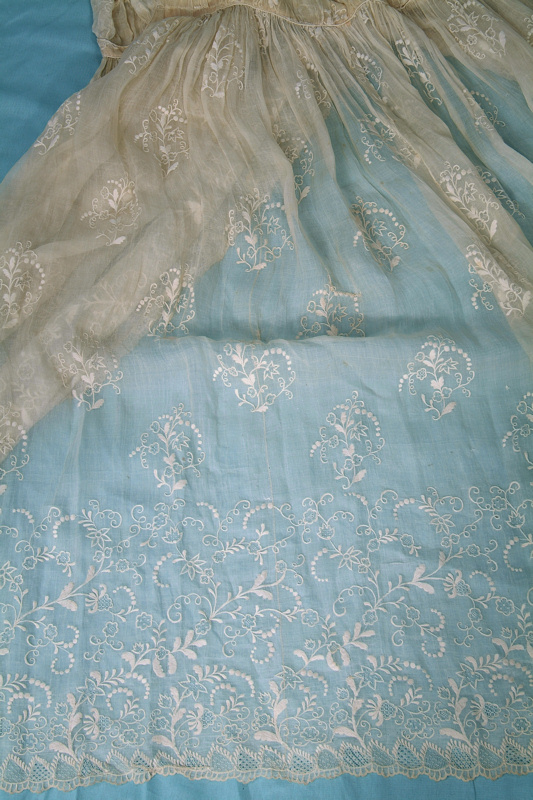
Trousseau features fashion from the 19th century through the early 20th century. This page shows gowns from 1801-1839. Clicking on a dress will lead you to a page; clicking on each image will lead you to an enlarged detail.

Detail of embroidered muslin dress, 1810-1814

Read Full Post »

Inquiring readers, Over a week ago, Chris wrote a post about her blog and her personal journey in pursuing a course of study about Jane Austen, her novels, and the time she lived in. This is her second post about her year-long project.

Over here at ‘Embarking on a Course of Study,‘ I’ve been hard at work on the project. Having finished Sense and Sensibility, I asked people to weigh in on who they felt they were most like, Marianne or Elinor, and who they would like to have as a friend. The results so far are overwhelmingly in Marianne’s favor. If you haven’t posted your comment/vote, please do! I’d love to hear from you.

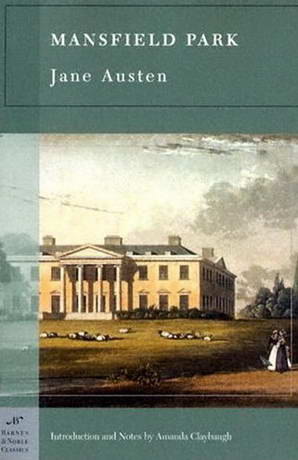
I’ve begun Mansfield Park again and have re-encountered, as I expected, another heroine I don’t much like (my other has always been Emma – I love her spunk, but she does too much damage). I forgot how dull Fanny is. Not that I think Mary Crawford is as fantastic as Lizzie Bennet, with whom I’ve read her compared. Mary is manipulative and racy. I enjoy how she pushes the limits, but not much more. The dynamics among the characters are the most fascinating for me, as are Austen’s insights and writing, of course.

I’ve been reading the Jane Austen Cookbook as well, to decide on something to contribute to my family’s Thanksgiving dinner, and have settled on Little Iced Cakes. As you’ll read in my blog, I had to choose something family would actually eat. I do want to make Things With Fun Names like ‘trifle’ and ‘syllabub’ at some point. I was tempted to go for something really foreign to us these days, like the ‘forcemeat balls,’ which would require the purchase (or capture?) of 2-3 pigeons, but just couldn’t wrap my brain around the concept of eating what struts around the streets of Baltimore on a daily basis. If you’d like to join me in the making of this dessert, the recipe is on my blog, along with a link to other recipes from the Jane Austen Cookbook.

If you’re in New York City any time before March 14th, there’s a wonderful new exhibit at The Morgan Library: A Woman’s Wit: Jane Austen’s Life and Legacy. Comprised of letters, drawings, films, and lectures, it promises to thrill the Austen lover. If you’d like to see the 15 minute documentary film entitled The Divine Jane, which “examines the influence of Austen’s fiction—and her enduring fame— through interviews with leading writers, scholars, and actors,” go to my blog.

Next week, I’ll post notes from my meeting with Professor Robin Bates at St. Mary’s College in St. Mary’s City, Maryland, who has been teaching a class on Austen for years, asking his students to read the books and poems mentioned in her novels, similar to my plan. I will also update you on my efforts to arrange an English Country Dancing class with an instructor from the Baltimore Folk Music Society. I have 8 ladies interested and am working on the venue. We’re all tremendously excited about learning some dances.

For those of you in the US, Happy Thanksgiving!

Chris Stewart

Read Full Post »

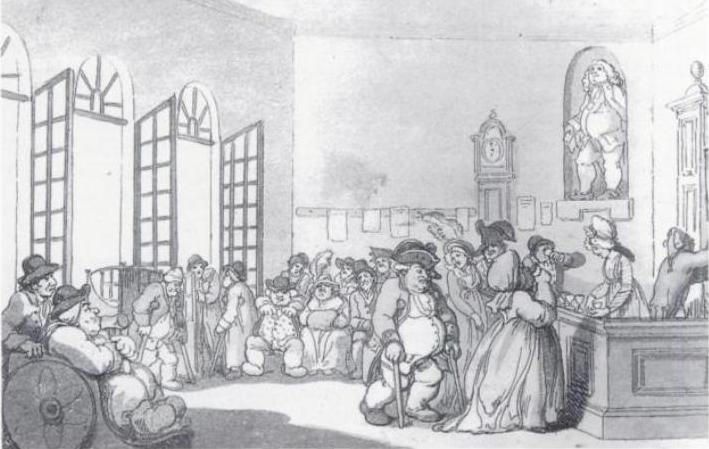
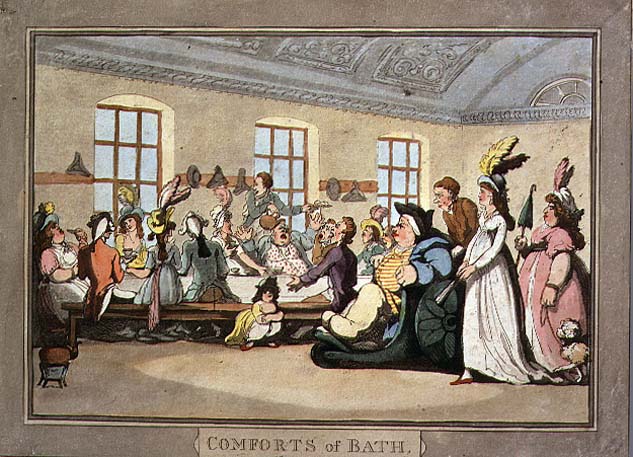
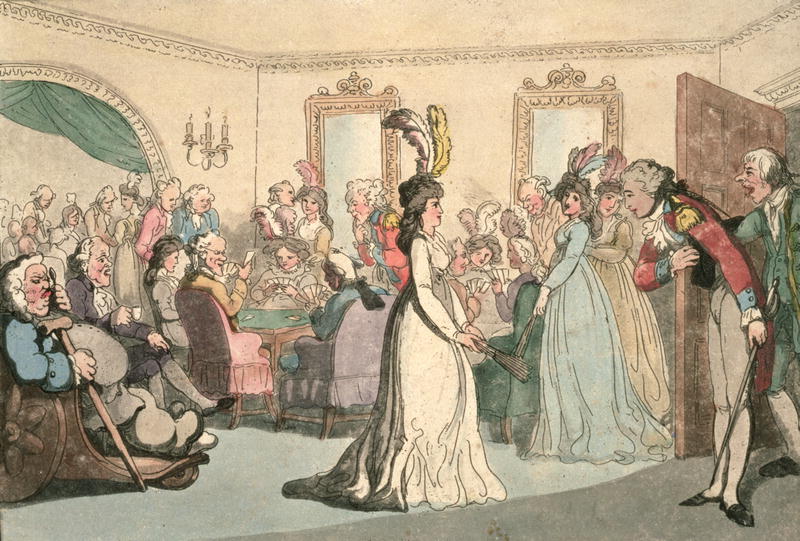
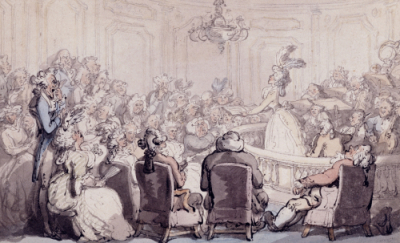
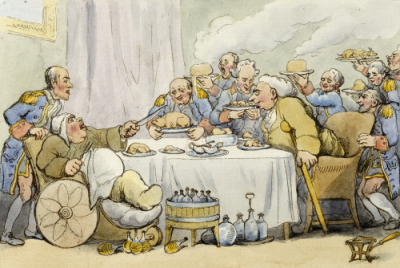
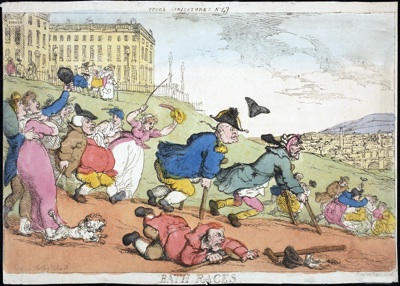
In 1798, the famous caricaturist Thomas Rowlandson drew The Comforts of Bath, a series of satiric drawings. The cartoons were used to illustrate the 1858 edition of the New Bath Guide, written by Christopher Anstey and first published in 1766.* Rowlandson depicted both the social and medical scene in Bath just before the period described by Jane Austen in Northanger Abbey and Persuasion, and by Georgette Heyer in her Regency romances.

The Portrait, Comforts of Bath, 1798, Thomas Rowlandson

In this post I combined Rowlandson’s images with excerpts from an 1811 guidebook, A new guide through Bath and its environs By Richard Warner. The scenes depict the use of mineral water therapy for the invalids who flocked to Bath, a city whose fashionable post-Nash reputation was already well past its prime and whose medical men were generally regarded as quacks or, worse, “potential murderers”. The rotund gentleman in front and center of all these scenes (who undoubtedly suffered from gout, a painful rich man’s disease), was conjectured to be based after Tobias Smollet’s Mr. Bramble. In the pictorial’s subtext, notice how “Mr. Bramble’s” young wife (companion or daughter) flirts with the young officer who boldly woos her (Image above). Even while satirizing them, Rowlandson gets the social details just right. Underneath each image sits a quote from the guidebook.

King Bladud's Bath, Comforts of Bath, Rowlandson

It is fit for the patient when he goeth into the bath to defend those parts which are apt to be offended by the bath, as to have his head well covered from the air and wind and from the vapours arising from the bath, also his kidneys if they be subject to the stone, anointed with some cooling unguents as rosatum comitiffs infrigidans Galeni Santo linum &c. Also, to begin gently with the bath till his body be inured to it, and to be quiet from swimming or much motion which may offend the head by sending up vapours thither at his coming forth, to have his body well dryed and to rest in his bed an hour and sweat, etc.” – A New Guide Through Bath, 1811

The Pump Room, The Comforts of Bath, 1798, Rowlandson

The new Pump Room supplied water from a covered pump. Before the room was built, the populace drank the waters in the open air. But the new rooms allowed them to

…  take the exercise prescribed to them sheltered from the inclemency of the weather. The work was accordingly begun in 1704, finished two years afterwards, and opened for the reception of the company under the auspices of Mr Nash, who had just then become the Arbiter Elegantiarum of Bath…A New Guide Through Bath, 1811

Black and White detail of above print

In the year 1751 [The Pump] Room was enlarged. Accommodated with a beautiful Portico stretching from it in a northern direction in 1786, and adorned with superb Western Frontispiece in 1791, The Corporation further beautified the city in 1796 by taking down the old Pump Room entirely and building on its site the much larger and more magnificent edifice known at present by that name…A New Guide Through Bath, 1811

Public Breakfast, The Comforts of Bath, 1798, Rowlandson

Pertaining to the construction of  the Harrison rooms and the Assembly Rooms:

Temporary booths had hitherto been the only places in which the company could drink their tea and divert themselves with cards, but Mr Harrison, a man of spirit and speculation, perceiving that a building of this nature was much wanted and would probably make him a very suitable return, undertook at the suggestion of Mr Nash to erect a large and commodious room for the purpose of receiving the company.  The succes of this attempt induced a similar one in the year 1728, when another large room was built by Mr Thayer.  A regular system of pleasurable amusements commenced from this period, and the gay routine of public breakfasts, morning concerts, noon card parties, evening promenades, and nocturnal balls rolled on in an endless and diversified succession. – A New Guide Through Bath, 1811

Company at Play, The Comforts of Bath, Rowlandson

Rules card games:

That no persons be permitted to play with cards left by another party;  That no hazard or unlawful game of any sort be allowed in these Rooms on any account whatever nor any cards on Sundays...A New Guide Through Bath, 1811

The Concert, Bath Chambers, Rowlandson

For music sweet music has charms to controul; And tune up each passion that ruffles the soul; What things have I read and what stories been told; Of feats that were done by musicians of old – The New Bath Guide, 1779

Dinner, Comforts of Bath, 1798

Bath has little trade and no manufactures; the higher clafles of people and their dependents conftitute the chief part of the population, and the number of the lower clafles being but fmall…A New Guide Through Bath, 1811

Bath Races, Rowlandson

More on the topic:

Read Full Post »

« Newer Posts - Older Posts »