Feeds:
Posts
Comments

Archive for the ‘Regency World’ Category

“Who you callin’ a silly bub, and what’s that you’re offering me?”– Mentioned on three occasions in Samuel Pepys’ diary — in 1662, 1663 and 1668

When we think of Christmases past, including the traditions and foods that Jane Austen and her kin would have enjoyed, we think of yule logs, kissing boughs, and festive drinks, such as apple toddy, milk punch, and syllabub, a less potent alcoholic and cream mixture than eggnog.

Over time, the precise recipes have changed. According to British Culture, British Customs, and British Traditions, “In the seventeenth century, a milkmaid would send a stream of new, warm milk directly from a cow into a bowl of spiced cider or ale. A light curd would form on top with a lovely whey underneath. This, according to Elizabeth David, was the original syllabub. Today’s syllabub is more solid (its origins can also be traced to the seventeenth century, albeit to the upper classes) and mixes sherry and/or brandy, sugar, lemon, nutmeg, and double cream into a custard-like dessert or an eggnog-like beverage, depending upon the cook.”

“In the hour or two that the syllabub was set aside, a curd formed over the ale. With the possible addition of a layer of cream on top, the syllabub was ready to drink. The solids that formed on top of a syllabub were eaten with a spoon, the wine at the bottom drunk.”* Historic Food offers another detailed account of the history and making of this fascinating drink. I’ve also found a stanza from a traditional song that includes drinking syllabub under a cow, which sits below.

You hawk, you hunt, you lie upon pallets,
You eat, you drink (the Lord knows how !);We sit upon hillocks, and pick up our sallets, And drink up a syllabub under a cow.

With a fading.

In The Universal Cook: And City and Country Housekeeper, John Francis Collingwood and John Woollams, the Principal Cooks at The Crown and Anchor Tavern in the Strand in the late 18th century, offer precisely such a recipe for syllabub. One supposes that these instructions might be difficult to follow today except for the most determined country person:

A Syllabub Under a Cow

Having put a bottle of red or white wine, ale or cyder, into a China bowl, sweeten it with sugar, and grate in some nutmeg. Then hold it under the cow, and milk into it until it has a fine froth on the top. Strew over it a handful of currants cleaned, washed, and picked, and plumbed before the fire.

Over half a century later, Mrs. Beeton includes this syllabub recipe in her historic and groundbreaking cookery and household management book:

To Make Syllabub

900ml (1½ pints) Milk
600ml (1 pint) Sherry or White Wine
½ Grated Nutmeg
Sugar, to taste

Put the wine into a bowl, with the grated nutmeg and plenty of caster sugar add the milk and whisk.
Clotted cream may be laid on the top, with ground cinnamon or nutmeg and sugar.
A little brandy may be added to the wine before the milk is put in.
In some counties, cider is substituted for the wine, when this is used, brandy must always be added.
Warm milk may be poured on from a spouted jug or teapot, but it must be held very high.

Sufficient for 5 or 6 persons.
Seasonable at any time.

Find more information about syllabub in these links:

Click here for my other holiday posts.

Image from Historic Foods
Technorati Tags: , ,

Read Full Post »

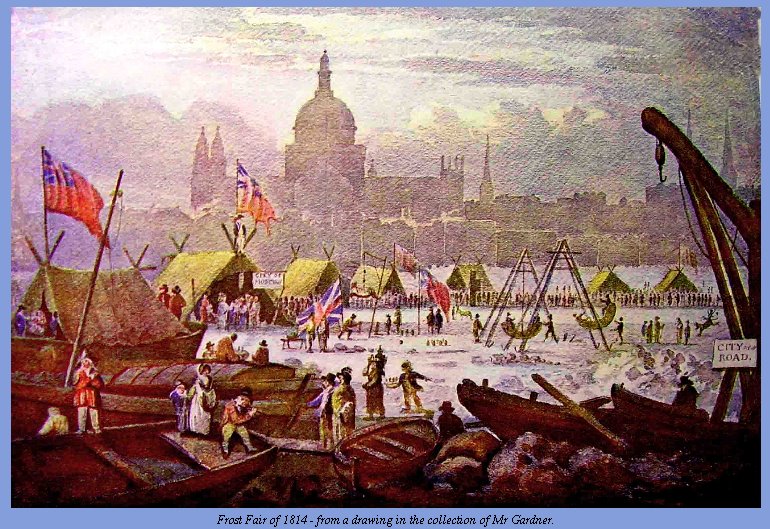
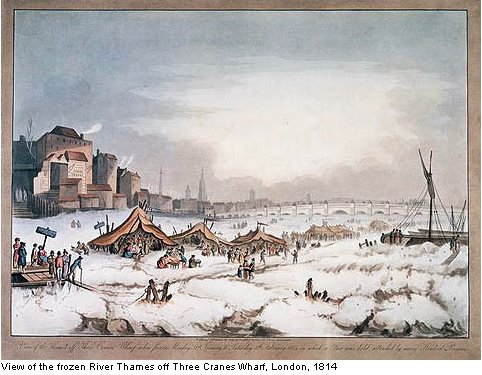
During a mini ice age two hundred years ago, the winters were so cold that the river Thames would freeze in solid sheets of ice. The old London Bridge was bulkier than the new London Bridge built in 1823, and it acted like a dam. After the new bridge was built and the old one was demolished, and after embankments were erected (which narrowed the channel), the river flowed too swiftly for the waters to freeze.

But in the days of yore, a Frost Fair was held whenever the river iced over. People ventured out on the ice, vendors set up stalls, and a variety of entertainments were offered. The last time such an event occurred in 1814, Jane Austen was still alive. She must also have felt the chill of that cold February in which London experienced the hardest frost it had known in centuries.

And this is what they did with the Great Frost. By February, as Lord William Pitt Lennox tells us in his Recollections, the Thames between London Bridge and Blackfriars became a thoroughly solid surface of ice. There were notices at the ends of all the local streets announcing that it was safe to cross the ice, and, as in times of Elizabeth 1, full advantage was taken of this new area and the public interest in it. As before, there now sprang up a Frost Fair. The people moved across the river by way of what was called Freezeland Street. On either side, crowded together, were booths for bakers, butchers, barbers and cooks. There were swings, bookstalls, skittle alleys, toyshops, almost everything that might be found in an ordinary fair. There were even gambling establishments and the ‘wheel of fortune, and pricking the garter; pedlars, hawkers of ballads, fruit, oysters, perambulating pie-men; and purveyers of the usual luxuries, gin beer, brandy-balls and gingerbread.’The Prince of Pleasure and His Regency, J.B. Priestley, p 113.

Read more on the topic at these links

This post was updated in this link.

Read Full Post »

…dirt accumulated faster than all measures to contain it: Cattle were still driven through the streets to and from Smithfield Market until the mid-nineteenth century and horse-drawn vehicles added to the labours of the sweepers stationed at street crossings. Smoke from brick kilns and thousands of sea coal fires polluted the air. In 1813 Henry Austen’s new home above his offices at No. 10 Henrietta Street appeared to Jane to be ‘all dirt & confusion.’ – Jane Austen in Context, Edited by Janet Todd, p 207-208

During Jane Austen’s time and into the earliest days of the twentieth century, crossing sweepers made a living sweeping pedestrian crossings, stoops, and sidewalks of horse manure and litter. Before motorized transport, London boasted over 100,000 horses traversing its streets daily, each one eating a fibrous diet. The crossing sweeper’s job was to shovel the muck, keeping the streets clean for ladies whose long dresses and delicate slippers might get soiled and for gentlemen in their fine raiments.


During “Boney’s” time of terror (Napoleonic Wars), the job of crossing sweeper was often strenuous, and it was said that crossing sweepers could build up a considerable fortune to dig a “channel of viscous mud, a foot deep, through which, so late as the time when George the Third was king, the carts and carriages had literally to plough their way.” In those days, the crossing sweeper had to dig trenches to allow carriages and pedestrians to pass through poorly maintained and muddy roads. As the roads improved, so did the lot of the crossing sweeper, who earned less and less for a job that was to become relatively easier. A good crossing sweeper in an excellent location could still earn a decent living, however. – Chambers, Edinburgh Journal, No. 437, Volume 17, New Series, May 15, 1852

Henry Mayhew described the advantages of this lowly occupation for the London poor:

  • 1st, the smallness of the capital required in order to commence the business;
  • 2ndly, the excuse the apparent occupation it affords for soliciting gratuities without being considered in the light of a street-beggar;
  • And 3rdly, the benefits arising from being constantly seen in the same place, and thus exciting the sympathy of the neighbouring householders, till small weekly allowances or “pensions” are obtained. – Henry Mayhew, London Labour and the London Poor: Volume 2, Crossing-Sweepers

According to the Leeds Industrial Museum, “Children often had more than one way to make money. When it was dry and the streets were not muddy the crossing sweepers, for instance, would do occasional work like catching and opening cabs for people. In the evening they would go outside theatres and operas and tumble for money. Girls mixed ballade singing or lace selling.”

At one time there were so many crossing sweepers that a pedestrian was accosted for money on every stoop and corner, and it would cost a pretty penny to walk from one end of town to another. In 1881, Richard Rowe wrote in London Streets:

IF anyone wants to realize, as the phrase goes, the little army of crossing-sweepers we have in London, let him take a walk – say for a mile or two – on a muddy day, and give a penny to every one who touches hat, makes a bob, as if shutting up like a spy-glass, or trots after him, trailing broom in one hand, and tugging at tangled forelock with the other. I remember when it would have cost anyone, disposed to give in this way, between a shilling and eighteen- pence to walk from the Archway Tavern, Highgate Hill, to Highbury Cock and back. For anyone of a squeezable temperament, therefore, it was decidedly cheaper to take the bus. It is simply as a statistical experiment, just for once in a way, that I recommend this penny-giving. It would be a great misfortune if all crossing-sweepers had pennies given them indiscriminately. I would not make a clean sweep of the sweepers, but I should like to see their ranks thinned considerably – viz., by the elimination of the adults who are able, and the young who might be trained to do something better than what, in the most favourable instances, is little better than a make-believe of work, as a pretext for begging, either directly or by suggestion.


Crossing sweepers worked diligently on both sides of the Atlantic Ocean. In 1882, a New York matron lamented in a letter to the editor of the New York Times about a new regulation that prevented crossing sweepers from working (double click on the image to read it) :

To read more about this fascinating topic, click on the following links:

Click here for an interesting backlink to this post.

Read Full Post »

The Historic Foods website offers a splendid Georgian recipe of gooseberries cut as hops and preserved in syrup.

The first printed version of this once popular recipe is found in Elizabeth Smith’s The Compleat Housewife (London: 1727). The instructions seem complex, but the results, as you can see, are visually delightful. In earlier times gooseberries were dried and candied, or made into a sauce served with fish or goose meat.

For a detailed history of the gooseberry, click on the link above.

Watercolour of Gooseberries by Pamela Sweda

Read Full Post »

March 15th – The seamstress came this morning to begin my wardrobe. We were with her for more than two hours and Mama ordered so many new gowns as that I am sure I shall never wear the half of them, but she insists that I must be properly dressed. – From The Journal of a Regency Lady 5

The above quote, though coming from a contemporary author, might well have been written during the regency era. Women’s clothes were made at home during this period by the ladies themselves, their servants, or a professional seamstress. A dressmaker (or mantua maker) would charge about 2 pounds per garment and come to the house for fittings, where she might be served tea. A successful mantua maker who had set up shop in the fashionable part of Town would also provide a pleasant environment in which a lady could relax, serving tea and refreshments to prolong the shopping experience.

In her letters, Jane Austen mentioned a Miss Burton, who made pelisses for her and Cassandra in 1811. The cost of cloth and labor were reasonable, she wrote, but the buttons seemed expensive. Fabrics, increasingly mass produced, became more affordable during the Industrial Revolution, and demand for clothes grew among the newly wealthy middle class women. Young girls who sought work in the cities became seamstresses in homes and sweat shops. A little over twenty years after Jane’s death, the poor working conditions described below were common for seamstresses.

1) EVIDENCE TAKEN BY Children’s Employment Commission, February 1841

Miss — has been for several years in the dress-making business…The common hours of business are from 8 a.m. til 11 P.M in the winters; in the summer from 6 or half-past 6 A.M. til 12 at night. During the fashionable season, that is from April til the latter end of July, it frequently happens that the ordinary hours are greatly exceeded; if there is a drawing-room or grand fete, or mourning to be made, it often happens that the work goes on for 20 hours out of the 24, occasionally all night….The general result of the long hours and sedentary occupation is to impair seriously and very frequently to destroy the health of the young women. The digestion especially suffers, and also the lungs: pain to the side is very common, and the hands and feet die away from want of circulation and exercise, “never seeing the outside of the door from Sunday to Sunday.” [One cause] is the short time which is allowed by ladies to have their dresses made. Miss is sure that there are some thousands of young women employed in the business in London and in the country. If one vacancy were to occur now there would be 20 applicants for it. The wages generally are very low…Thinks that no men could endure the work enforced from the dress-makers.

[Source: Hellerstein, Hume & Offen, Victorian Women: A Documentary Accounts of Women’s Lives in Nineteenth-Century England, France and the United States, Stanford University Press.]

For other sources on this topic, click on the links below.

Read Full Post »

« Newer Posts - Older Posts »