This Jane Austen blog brings Jane Austen, her novels, and the Regency Period alive through food, dress, social customs, and other 19th C. historical details related to this topic.
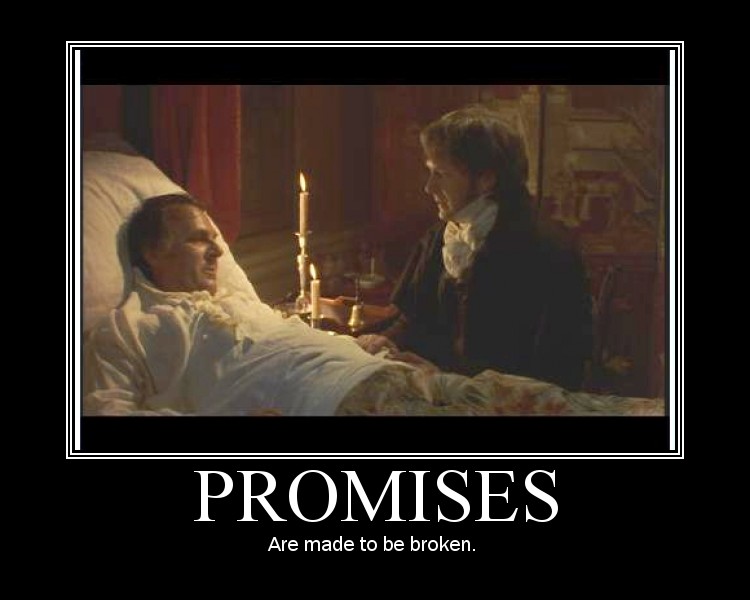
Book: Sense and Sensibility. Topic: John Dashwood’s promise to his father on his deathbed.
In this series of posts on ‘Jane’s Own Words’, I will simply let Jane speak for herself. The reasoning Fanny Dashwood uses to justify why John should not support his step mother and half sisters in the first Chapter of Sense and Sensibility, and how he comes to agree with her, is sheer genius, and is as harshly comic a passage as I have ever read. First, the death bed scene…
From Chapter One: Sense and Sensibility:
[Mr. Dashwood’s] son was sent for, as soon as his danger was known, and to him Mr. Dashwood recommended, with all the strength and urgency which illness could command, the interest of his mother-in-law and sisters.
Mr. John Dashwood had not the strong feelings of the rest of the family; but he was affected by a recommendation of such a nature at such a time, and he promised to do everything in his power to make them comfortable. His father was rendered easy by such an assurance, and Mr. John Dashwood had then leisure to consider how much there might prudently be in his power to do for them.
He was not an ill-disposed young man, unless to be rather cold hearted, and rather selfish, is to be ill-disposed: but he was, in general, well respected; for he conducted himself with propriety in the discharge of his ordinary duties. Had he married a more amiable woman, he might have been made still more respectable than he was; he might even have been made amiable himself; for he was very young when he married, and very fond of his wife. But Mrs. John Dashwood was a strong caricature of himself; more narrow-minded and selfish.
When he gave his promise to his father, he meditated within himself to increase the fortunes of his sisters by the present of a thousand pounds a-piece. He then really thought himself equal to it. The prospect of four thousand a-year, in addition to his present income, besides the remaining half of his own mother’s fortune, warmed his heart and made him feel capable of generosity. “Yes, he would give them three thousand pounds: it would be liberal and handsome! It would be enough to make them completely easy. Three thousand pounds! he could spare so considerable a sum with little inconvenience.” He thought of it all day long, and for many days successively, and he did not repent.
Click here to continue: Read Fanny’s self-serving justifications in convincing her weak-willed husband to relinquish his promise to his dying father to take care of Mrs. Dashwood and his half-sisters. To my way of thinking this is one of the funniest, most biting, and accomplished passages in any literary work.
One of the reasons I love the 1995 adaptation of Sense and Sensibility is the way it ended so romantically with the wedding of Marianne and Colonel Brandon. The scene began with children waving colorful ribbons on sticks following a man to church carrying a two- or three-tiered cake on a pole. How did this tradition start, I wondered? And why did the celebrants follow it? First, let’s address the tiered wedding cake, whose origin lies in a romantic, though unsubstantiated tale:
Thomas Rich “was a young man apprenticed to a baker near Ludgate. He fell in love with his master’s daughter and, at the end of his apprenticeship when he set up his own business, asked for her hand in marriage. The proposal was given her father’s approval. As a baker, Rich wished to create a spectacular cake for the wedding feast, but was unsure of how to create something completely new for his betrothed…until, one day, inspiration hit him. A cake in layers tiered, diminishing as it rose. And thus began, according to the story, the tradition of the tiered wedding cake, based on Wren’s steeple for St. Brides. – City of London Churches, by Mark McManus
The origin of the wedding procession is steeped in history, tradition, and superstition. The custom began in the days of the Romans as a morning offering to the gods and an evening filled with song. Symbolically the bride was transferred from her home to that of the groom, who now assumed guardianship of his wife. While symbolism remained – wheat stood for ‘plenty’, for example – singers and musicians began to accompany the procession, adding an especially festive touch.
In medieval times, the processional was especially colourful. Gaily dressed minstrels sang and piped at the head of the procession. Next came a young man bearing the bride-cup, which was a chalice or vase of silver or silver-gilt, decorated with gilt, rosemary and ribbons. Then the bride walked, attended by two bachelors, and a dozen or so knights and pages. Next came maidens carrying bride cake, followed by girls with garlands of wheat. The bridegroom then appeared, led by two maidens, and walked in the midst of his close friends, including his “best man.” The relatives walked after him, and these were followed by less intimate friends. Finally, at some distance and appearing to have no concern in the festivities, or ceremony, appeared the bride’s father! – The Origins of the Members of the Bridal Party
As time progressed, the whole affair could become so noisy and disorderly that complaints were made by the town council. Should the groom elect not to walk with the procession, he would meet his bride at the door of the church or at the altar.
Ancient superstitions were attached to the wedding procession, many having to do with the success of the marriage and the couple’s happiness. One English custom said that the guest who found a ring in their slice of wedding place would be assured of happiness during the coming year. The ring would have been placed deliberately inside the cake before it was baked. In Yorkshire, if a plate holding wedding cake broke when it was thrown out of the window as the bride returned to her parents home after the ceremony, then the couple’s future would be happy. (From Wedding Superstitions)
Bonus Question: What role did Edward Ferrars play on the day Marianne and Colonel Brandon were married?
The dramatic moments of Marianne’s illness in Ang Lee’s 1995 adaptation of Sense and Sensibility start when Marianne (Kate Winslet) walks in the pouring rain to view Willoughby’s estate, Combe Magna, from atop a hill. The musical strains swell as rivulets of water pour down her face and figure. Then Marianne quotes a Shakespearean Sonnet 116 that Willoughby had read to her in happier days, which she starts with the phrase, “Love is not love which alters when it alteration finds.” One is touched by Marianne’s emotional anguish, which is echoed by the roiling clouds overhead. Kate’s performance tugs at my heartstrings and tears still come to my eyes when I see this scene. Call me a hopeless romantic.
However, the scene is more reminiscent of Wuthering Heights than of a Jane Austen novel. Young Kate Winslet acts out Marianne’s torment so convincingly that one forgets that these are Emma Thompson’s words, not Jane Austen’s. Colonel Brandon (Alan Rickman) finds Marianne and carries her back in his manly arms. To his credit, he staggers under his load only just before he hands her over to Mr. Palmer and Elinor.
Much anxiety ensues, with the Colonel pacing the halls until he is given ‘employment’, and asked to fetch Mrs. Dashwood, who lives 80 miles away. Unspoken but implied is that he might be too late. Elinor/Emma weeps as she tends to Marianne, the doctor spends the night in a nearby chair, and we are all left in suspense: Will Marianne/Kate survive the night? All this Sturm und Drang is a bit overwrought, but these scenes provide the emotional turning point of this film adaptation.
I first saw the 1995 movie in the theatre just weeks after its premiere. When Marianne was clearly on the mend, I recall feeling as wrung out as Elinor. In case my words seem just a tad facetious (and they are), I adored this film. However, the script of this movie is to a Jane Austen novel what Tex-Mex cuisine is to real Mexican food – there is just enough authenticity to fool one into thinking that one has actually experienced the real thing.
Interestingly, in the most recent 2008 adaptation of Sense and Sensibility, written by Andrew Davies, Marianne (Charity Wakefield) also wanders around the gardens of Cleveland in a steady drizzle. She finds shelter under a gazebo, but then she deliberately stands under the rain, welcoming its healing effect. I suppose this ritual cleansing is meant to be symbolic. Weakened from lack of sleep and worry, Marianne succumbs to the chill and faints. She is gone for such a long time, that Colonel Brandon (David Morrissey) goes out to search for her. Riding his white steed (oh, don’t you just love these Jungian-Arthurian-Shakespearean symbols?), he finds her. Then, in a moment I find perplexing, for his trusty horse is standing at the ready, he carries her back to the house. Andrew Davies, please have mercy on the poor horse! While David Morrissey has the physical heft to pull off this scene (and he does deposit Marianne safely in her bed), you have deprived that lovely white steed of its employment. Ellen Moody gave a possible explanation for all this romantic drama in her post. Click here to read it.
Both films have mined Marianne’s illness for its full emotional depth. However, in Jane Austen’s words, the onset of Marianne’s illness is much less dramatic, and Colonel Brandon is nowhere to be seen:
Two delightful twilight walks on the third and fourth evenings of her being there, not merely on the dry gravel of the shrubbery, but all over the grounds, and especially in the most distant parts of them, where there was something more of wildness than in the rest, where the trees were the oldest, and the grass was the longest and wettest, had — assisted by the still greater imprudence of sitting in her wet shoes and stockings — given Marianne a cold so violent, as, though for a day or two trifled with or denied, would force itself by increasing ailments on the concern of everybody, and the notice of herself. Prescriptions poured in from all quarters, and as usual were all declined. Though heavy and feverish, with a pain in her limbs, a cough, and a sore throat, a good night’s rest was to cure her entirely; and it was with difficulty that Elinor prevailed on her, when she went to bed, to try one or two of the simplest of the remedies. Sense and Sensibility, Volume 3, Chapter 6.
Jane then goes on to describe a cold that settles in Marianne’s lungs, and that the doctor declares infectious. The Palmers leave, worried for their newborn baby. For two days Marianne’s situation does not change, and there is hope for a speedy recovery, but by the third day Marianne’s condition worsens and in a feverish delirium she starts calling for her mother. Enter the Colonel:
He, meanwhile, whatever he might feel, acted with all the firmness of a collected mind, made every necessary arrangement with the utmost dispatch, and calculated with exactness the time in which she might look for his return. Not a moment was lost in delay of any kind. The horses arrived, even before they were expected, and Colonel Brandon only pressing her hand with a look of solemnity, and a few words spoken too low to reach her ear, hurried into the carriage. It was then about twelve o’clock, and she returned to her sister’s apartment to wait for the arrival of the apothecary, and to watch by her the rest of the night.
Colonel Brandon leaves to procure Mrs. Dashwood, and Elinor is left alone (with Mrs. Jennings) to nurse Marianne and fret over her condition. Elinor’s suffering is real: “She was calm, except when she thought of her mother; but she was almost hopeless; and in this state she continued till noon, scarcely stirring from her sister’s bed, her thoughts wandering from one image of grief, one suffering friend to another, and her spirits
oppressed to the utmost by the conversation.”
Marianne’s situation is touch and go. The apothecary, Mr. Harris, attempts every remedy at his disposal, and promises to return in a three or four hour interval. In his second visit, he realizes his medicine has failed, and that Marianne’s fever remains unabated. He tries a fresh application of a medication in which he has almost as much confidence as the first, and then he leaves. Elinor spends a restless, sleepless night, worried about her mother, but she forces herself to remain calm.
About noon, however, she began–but with a caution—a dread of disappointment which for some time kept her silent, even to her friend–to fancy, to hope she could perceive a slight amendment in her sister’s pulse;–she waited, watched, and examined it again and again;–and at last, with an agitation more difficult to bury under exterior calmness, than all her foregoing distress, ventured to communicate her hopes.
During these scenes, both Elinor/Emma and Elinor/Hattie are true to Jane’s description of Elinor’s conduct through this long, anxious night. Waiting for the Colonel and her mother, Elinor hears: “The bustle in the vestibule, as she passed along an inner lobby, assured her that they were already in the house. She rushed to the drawing-room,–she entered it,–and saw only Willoughby.”
The Ang Lee film does not include this important scene. Instead, it shows a regretful Willoughby sitting at a distance on his horse, observing Marianne walking from the chapel with her new husband. The new 3-hour S&S adaptation takes the time to address Willoughby’s excuse for his bad behavior and his feelings for Marianne. “I mean to offer some kind of explanation,” he says to Elinor, “some kind of apology, for the past; to open my whole heart to you, and by convincing you, that though I have been always a blockhead, I have not been always a rascal, to obtain something like forgiveness from Ma–from your sister.”
Unlike the novel, the 2008 film shows Marianne eavesdropping. This ending sets the stage for her transformation. Her eyes are opened to Willoughby, allowing her to heal and open her heart to Colonel Brandon. Many find this section of the book implausible. How could someone with Marianne’s romantic nature do the sensible thing and marry the Colonel? Jane describes Marianne’s situation as thus:
Instead of falling a sacrifice to an irresistible passion, as once she had fondly flattered herself with expecting,–instead of remaining even for ever with her mother, and finding her only pleasures in retirement and study, as afterwards in her more calm and sober judgment she had determined on,– she found herself at nineteen, submitting to new attachments, entering on new duties, placed in a new home, a wife, the mistress of a family, and the patroness of a village.
My sensible self likes to think that a romantically minded 17-year-old can emerge wiser two years later. Marianne not only learned from adversity, but I imagine she will continue to mature and grow throughout her life.
Have you noticed how dark the new adaptation of Sense and Sensibility seems? Every time I took a screen shot, I needed to use photoshop to lighten the scene, as with these images of Barton Cottage before and after. It rained almost the entire time that the production crew filmed the movie. “We were filming in Devon for a fortnight and filming was plagued by constant rain storms,” recalls Charity [Wakefield.]“That’s fine for the days when we needed it to rain, but I learned that normal rain doesn’t show up on screen. So, even though it was raining, we still had to have these massive rain machines. We were drenched. By the end of the day, you’ve been out in the rain for so long you’re soaked through and exhausted.” The two photographs show the actresses wearing rain hats and thick coats in between scenes. Brrrr.
It also rained throughout the scene in which Dan Stevens as Edward chopped wood. I got chilled merely thinking about how cold Hattie Morahan must have felt wearing only a dress and holding a shawl over her head. At least Dan had the opportunity to warm himself up through the exertion of chopping wood. However, I found nothing romantic about these scenes, which made me shiver despite our own early warm spring weather.
Whoever said that film making was glamorous, evidently never shot a movie on location during a rainy spell in Devon!
“Marianne’s [letter] was finished in a very few minutes; in length it could be no more than a note; it was then folded up, sealed, and directed with eager rapidity. Elinor thought she could distinguish a large W in the direction; and no sooner was it complete than Marianne, ringing the bell, requested the footman who answered it to get that letter conveyed for her to the two-penny post. This decided the matter at once. – Jane Austen, Sense and Sensibility, Chapter 26
Footmen appear prominently in Sense and Sensiblity, 2008, and Emma 1996. They stand at attention in a row with the other servants when John and Fanny Dashwood arrive at Norland Park to take residence, and flank a seated Mrs. Ferrars when she banishes Edward and Lucy Steele from her sight. A footmen, as mentioned by Jane Austen, conveyed Marianne’s first letter to Willoughby when she arrives in London. In Emma 1997, the viewer is treated to the ridiculous sight of footmen moving kneeling cushions among the rows of strawberries as Mr. Knightley’s guests pick the fruit in his garden. By and large, footmen represented a status symbol. Chosen for their looks and height, they wore livery of a style that was popular a century earlier, with “knee breeches and braided coats with shoulder knots. At Clandon Park in Surrey in 1876, Lord Onslow provided his footmen with silk stockings, gloves and pumps, and one guinea per annum to pay for powder to dress their hair for state occasions.” (Household Management, p 18.*) According to Daniel Pool, footmen knew their status, and were generally known for their self-importance and lack of humor. The popular saying went that “calves came before character.” Taller footmen were paid higher wages, but the best status symbol of conspicuous wealth was a pair of footmen who were matched in height and looks. Although footmen were assigned duties both inside and outside the house, such as polishing the silver, or riding on the back of coaches, they spent an inordinate amount of time conspicuously waiting, either in an entrance hall, dining room, or wherever their services might be required at a moment’s notice. “Daily comfort is provided by servants who are almost always invisible in Austen’s novels. They are there to provide leisure and services for their superiors and to disappear—like Thomas, the footman in Sense and Sensibility: ‘Thomas and the tablecloth, now alike needless, were soon afterwards dismissed'”**
“Has no letter been left here for me since we went out?” said [Marianne] to the footman who then entered with the parcels. She was answered in the negative. “Are you quite sure of it?” she replied. “Are you certain that no servant, no porter has left any letter or note?” – Jane Austen, Sense & Sensibility, Chapter 26
When the man replied, “none,” Marianne turned her back to him dismissively and moved to the window.
Servants were regarded by the gentry much as a backdrop, like wallpaper or furniture. Such indifference did not go unnoticed. Eric Horne, author of What the Butler Winked At (1923) observed: “Do they ever ask themselves this question, ‘Where did I come from? And Why? Where am I going to, and when?'” (Below Stairs, p. 95.***) In most cases, apparently not.
Read more on the topic in these resources and links:
*Household Management, Margaret Willes, The National Trust, London, 1996.
What Jane Austen Ate and Charles Dickens Knew: From Fox Hunting to Whist–The Facts of Daily Life in 19t-Century England, Daniel Pool, Touchstone, New York, 1993
Fashionable Goodness: Christianity in Jane Austen's England is now available! By JAW contributor Brenda S. Cox. See Review. Available from Amazon and Jane Austen Books.
Available through December 31st, 2025. Click on image for details, and share this poster with other teachers and students!
The Obituary of Charlotte Collins by Andrew Capes
Click on image to read the story.
Comments
“My idea of good company…is the company of clever, well-informed people, who have a great deal of conversation.” – Jane Austen, Persuasion
Gentle readers: Please feel free to post your comments and continue the conversation! Due to SPAM, we will no longer accept comments on posts after 30 days of publication. In some instances, links will be removed from comments as well.
Administrators and Contributors
Vic Sanborn, founder of this blog, is supported by a team of talented and knowledgeable writers about Jane Austen and the Regency era. They are:
Tony Grant, who now contributes his photos from London and England
Click on their names to enter their own blogs.
In addition, we thank the many experts and authors who frequently contribute their posts and opinions, and who continue to do so freely or at our request.
Click here to enter the page. Topics include Regency fashion, historic foods, Jane Austen societies, British sites, related topics. Click on image.
May we suggest?
Hello, my name is Vic and I live in Maryland, USA. I have adored Jane Austen almost all of my life. I am a proud lifetime member of the Jane Austen Society of North America. This blog is a personal blog written and edited by me and my team. We do not accept any form of cash advertising, sponsorship, or paid topic insertions. However, we do accept and keep books and CDs to review.
If you would like to share a new site, or point out an error, please email us. (Yes, we are fallible. We'll own up to our mistakes and will make the corrections with a polite smile on our faces.) Write us at
Thank you for visiting this blog. Your comments and suggestions are most welcome.
Project Gutenberg: eBook of Stage-coach and Mail in Days of Yore, Volume 2 (of 2), by Charles G. Harper
STAGE-COACH AND MAIL IN DAYS OF YORE: A PICTURESQUE HISTORY
OF THE COACHING AGE, VOL. II, By CHARLES G. HARPER. 1903. Click on this link.


.jpg)
.jpg)


.jpg)


.jpg)


.jpg)


.jpg)
.jpg)







 Jane Austen's World