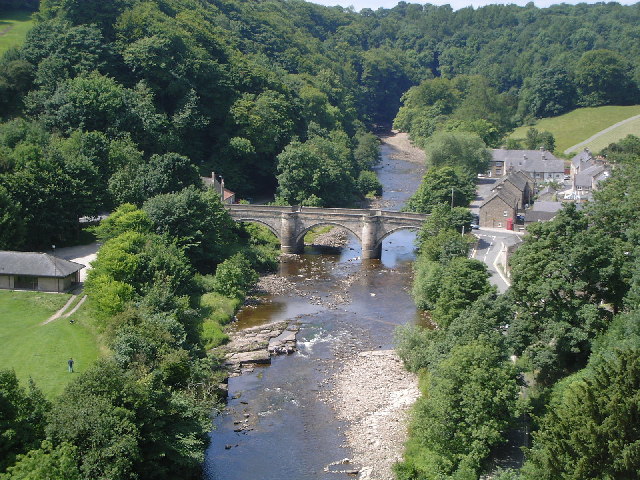
Richmond and the River Swale, North Yorkshire
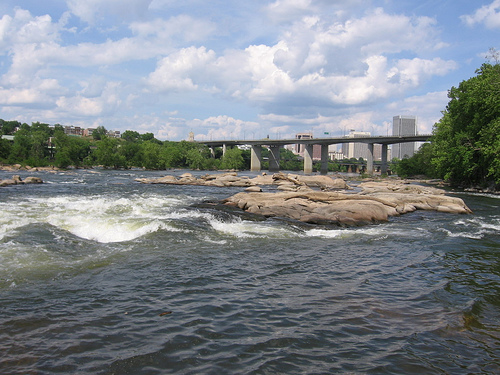
Richmond, Virginia, my home town
More on the topic:
Posted in Travel, tagged Richmond North Yorkshire, Richmond Virginia, Two Richmonds on July 17, 2010| 8 Comments »
Posted in jane austen, Jane Austen's World, Regency Life, Regency Transportation, Regency Travel, Regency World, Travel, tagged Regency, Regency carriages, Regency Travel on March 12, 2010| 3 Comments »
This carriage database discusses the history of the carriage and its uses over time. Included are links to specific makes of carriages, which lead to more detailed information or definition about that type, ie. landau, barouche, mail coach, phaeton, etc. In some instances, images accompany the pages. (Click on reference, then carriage). Update: Something seems to be wrong with the first link to the carriage database. I shall update this post as soon as I find the link again. This link to A Catalogue of Horse drawn vehicles 1896 catalogue of E. S. Annison, Coach Builder, of Hull, features drawings of his carriages and their latest design (late 19th century). Internet Archive provides a downloadable PDF book with images, Carriages and Coaches: their history and their evolution, fully illustrated with reproductions from old prints, contemporary drawings and photographs (1912). This entry in Carriages in Indopediais contemporary and provides links to definitions and information.
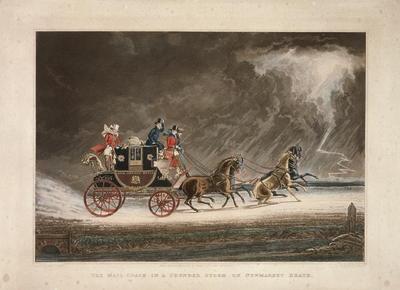
Mail Coach, 1827
The Georgian Index features an excellent page on Carriages and their Parts. Highways and Horses, Athol Maudslay, 1888 is an illustrated Google book that discusses carriages and transportation during the Victorian period in great detail. On the fronticepiece, Mr. Maudslay writes :
 // More about the topic on this blog:
Posted in jane austen, Regency Life, Regency World, Travel, tagged Earl of Abergavenny shipwreck, John Wordsworth, Sea rescue 18th century, Ship Wrecks off Dorset Coast, The Halsewell, William Wordsworth on August 22, 2009| 9 Comments »
Sea – Ship – drowned – Shipwreck – so it came,
The meek, the brave, the good, was gone:
He who had been our living John
Was nothing but a name. – William Wordsworth
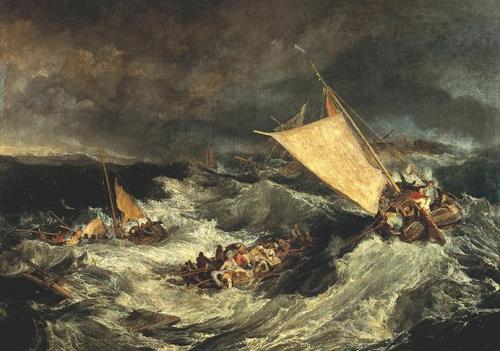
The Shipwreck, 1805, Turner
In 1805, John Wordsworth, a captain employed by the East India Company and younger brother of the poet William Wordsworth, died along with 2/3 of his crew on board the Earl of Abergavenny only 1 1/2 miles off the shoreline of Weymouth in shallow waters. John was anxious to sail from Portsmouth, for he had invested a large sum of his own money in this trip, intending to make a fortune for himself and his family, including his brother William.
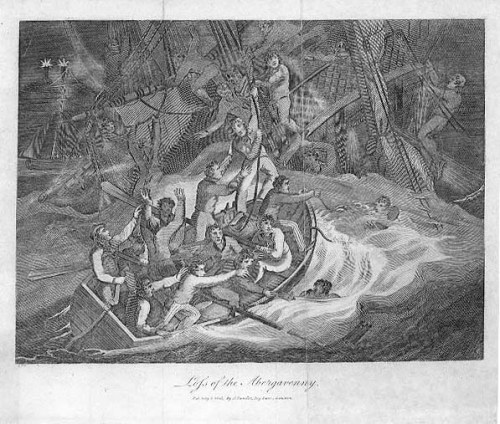
Loss of the Abergavenny
The ship, headed for India and China, carried valuable goods such as books, lace, perfume and silver for trade, and was worth an estimated £270,000. (John’s investment represented only a tiny portion of the whole.) The Earl of Abergavenny encountered bad weather and hit an underwater shingle bank off Portland, and was “badly holed.” Taking in water, the ship was unable to reach a safe haven. Most of those who died, did so from drowning or the cold. It was surmised that John Wordsworth did not try to save himself, but clung to the ropes and drowned with his ship.
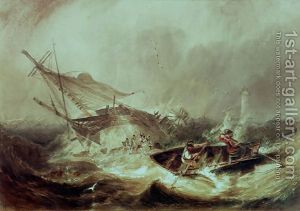
Rowing to the Rescue, Shipwrecked Sailors Off the Northumberland Coast
Rescuing those in distress was a perilous venture, for storm conditions made it extremely dangerous for rescuers to set out. While sea rescues were dangerous, there was a cost benefit for the local citizens, for many of the ships carried precious cargo. Once the crew had been saved, the locals could plunder the bounty after the storm had subsided, which many did. A breed of dog known as the Portland Newfoundland Sea Dog or Rescue Dog (which died out in the 19th century), was trained to rescue people in danger of drowning.
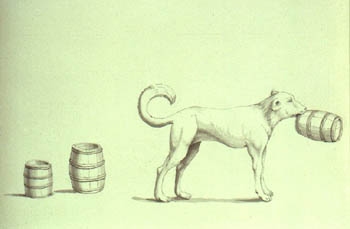
Portland Sea Dog: "portrait of a dog which brought 3 barrels of spirits out of the sea."
Jane Austen would most likely have heard of the loss of The Abergavenny, as well as the story of another famous tragedy, that of the Halsewell, which foundered in Weymouth Bay in 1786. This wreck was especially poignant, for the captain died along with his two daughters.
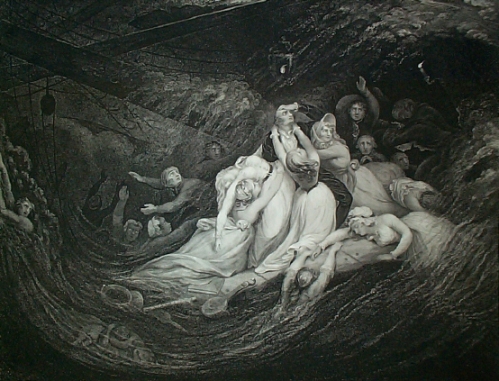
Loss of the Halsewell, Wilkinson
Over a hundred perished in the wreck, including the Captain, his two daughters and nieces, and the First Officer, his nephew. Another 60 seamen and soldiers, who managed to reach the cliffs, died of cold or were washed into the sea. About 70 were rescued from the cliffs. – The British Library
The tragedy, with the deaths of so many, including the women (who had joined the voyage probably in search of marriage), excited the keen interest of the public. Two ship’ officers wrote an account, which sits in the British Library. Read portions of the account in this link.
The waters off East Sussex were known for their treacherous conditions, and over 1,000 ships have wrecked in the area. Strong undertows and currents, shingle banks, and unexpected storms combine to make the area deadly.
As John Meade Faulkner wrote in his classic tale “Moonfleet” in 1898, “And once on the beach, the sea has little mercy, for the water is deep right in, and the waves curl over full on the pebbles with a weight no timbers can withstand. Then if the poor fellows try to save themselves, there is a deadly undertow or rush-back of the water, which sucks them off their legs, and carries them again under the thundering waves. It is that back-suck of the pebbles that you may hear for miles inland, even at Dorchester, on still nights long after the winds that caused it have sunk, and which makes people turn in their beds, and thank God they are not fighting with the sea on Moonfleet Beach”
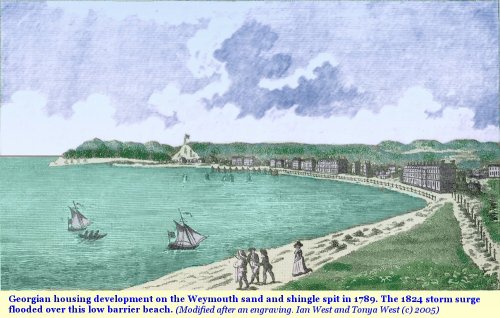
Hurricane and storm surges make the area dangerous for the citizenry as well. In 1824, a storm surge swept over the shingle spit on which a Georgian housing development (pictured above) sat, and swept away parts of villages. There was extensive damage as is indicated in the image below.*
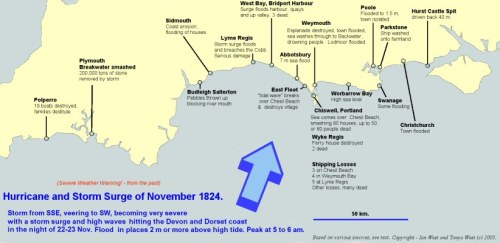
Hurricane Map, 1824
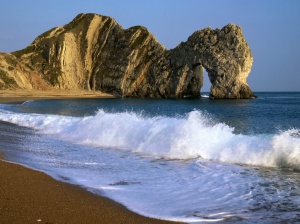
Luworth Cove, Dorset
More Information on the Topic
JMW Turner: The Shipwreck, 1805
East Devon and Dorset World Heritage Site
Grace Galleries: Images of Shipwrecks
Dove Cottage, The Wordsworth Museum
Posted in jane austen, Regency Life, Regency style, Regency World, Travel, tagged carriages, Coaches, Cost of a horse in London, Gower Mews, Regency Transportation, Regency Travel on June 18, 2009| 9 Comments »
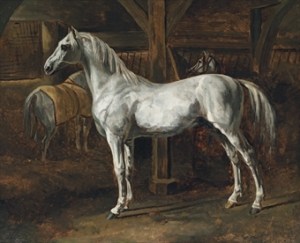
White Horse Standing in a Stable, Gericault
In today’s insulated world, we can only imagine the sights, sounds, and smells of the animals that inhabited Regency London alongside humans. Cows were confined inside small city dairies or allowed to graze in public parks ready to be milked at a moment’s notice. Tens of thousands of cattle and sheep were driven from the countryside through the streets to Smithfield market to feed the masses. Considering that a “horse will on average produce between 15 and 35 pounds of manure per day”, crossing sweepers were kept perpetually busy clearing the streets of dung, for by the end of the 19th century, over 300, 000 horses lived and worked in London. Despite the sweepers’ best efforts, the streets were covered in horse manure. This in turn attracted huge numbers of flies, and the dried and ground-up manure was blown everywhere.* Not a pretty image of a time that we tend to view with nostalgia.
Town planners had to take the lodging of horses and animals into account when designing new squares and terraces, which was no small effort, for stabling these animals and feeding them straw made an enormous demand on urban spaces.
The direct and indirect energy cost of urban horse-drawn transport–in terms of feeding, stabling, grooming, shoeing, harnessing, and driving the hourses and removing their wastes to periurban market gardens–were among the largest items on the energy balances of late-nineteenth-century cities. – Energy in World History, Vaclav Smil, p. 132
In terms of urban transportation, horses reached the peak of their importance in hauling goods and transporting people between 1820 and 1890. By the turn of the 20th century, horses were rapidly displaced by electric streetcars, automobiles, and buses. The cost of stabling and feeding horses was enormous and most Londoners walked. Those who could afford the luxury of stabling their animals and maintaining their carriages paid a steep price.

Parked carriages, Middlemarch
The difficulty and cost of horses and their stabling encouraged walking, which helped to keep the city small and dense. The limited travel span of the horse and cart further restricted urban expansion by constraining the outward movment of industry. An idea of the costs to households of private horse-based transport can be seen in the mews of the more expensive nineteenth-century West End neighbourhoods. Solely designed to house horses, carriages and livery servants, these back passageways behind the grand houses took up considerable space; whilts working horses ate prodigious amounts of feed, and livery men were often some of the best paid domestic staff. – An economic history of London, 1800-1914, by Michael Ball, David Sunderland, p. 229
Coaching houses and mews not only had to be located close enough to dwellings for convenience, but they needed to be tucked out of sight , especially in the tony West End (see image below). These photographs of Garrett Street Stables in Islington, London demonstrate how horses were traditionally kept. The site also tallies the numbers of horses that have been stabled at that location since 1750. While these animal were housed in a well maintained stable, one can only imagine the conditions for animals who were unlucky enough to be owned by those who could barely eek out a living. Costs for maintaining horses and a carriage in London were astronomical and reserved only for the rich if they could find a convenient space to house them. If one purchased a horse, one had to find stables, as Georgette Heyer reminds us in The Grand Sophy, when Sophy shows up in a new phaeton drawn by a pair of horses:
‘Don’t hesitate to tell me which of my mother’s or my horses you would like me to remove from the stables to make room for these!’ begged Mr. Rivenhall, with savage civility. ‘Unless, of course, you are setting up your own stables!’
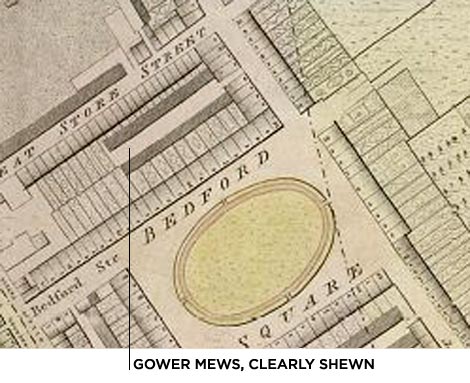
Gower Mews, since 1792
Relying on a carriage for transport, however, required significant wealth. They were expensive to buy and maintain, needing as they did stabling for the horses and liveries for the coachman and grooms. Even renting a carriage and pair (two horses) with a coachman cost £200–£300 a year (£10,000–£20,000 today). The two-wheeled carriages with one horse (the Ferraris of their day) were called ‘bankrupt carts’ by the Chief Justice ‘because they were, and are, frequently driven by those who could neither afford the Money to support them, nor the Time spent in using them, the want of which, in their Business, brought them to Bankruptcy’. Stabling your own horse, particularly in a city, was harder than finding a parking space today. Just feeding a horse cost £30 a year – more than feeding the groom, in fact – while the coachman’s liveries cost more than his annual salary.
On a practical level, coaches also took some time to prepare and had to be ordered several hours before they were needed. They were therefore more useful for displaying one’s wealth than for surveying one’s estate. They were necessary on long journeys, of course, or when carrying large loads, but otherwise riding a horse or a mule was much the quickest and cheapest option … – Regency House Party, Channel 4 History
The costs of keeping a horse in London are still enormous. Economist Brad DeLong estimates that with exercise, stabling, grooming, shoeing, and other facilities it costs £30,000 to maintain each horse per year, which is considerably more than driving and maintaining a car.
Posted in jane austen, Jane Austen's World, Regency Life, Regency style, Regency World, Travel, tagged coaching days, Regency Transportation, Regency Travel, treatment of horses in teh 19th century on June 9, 2009| 8 Comments »
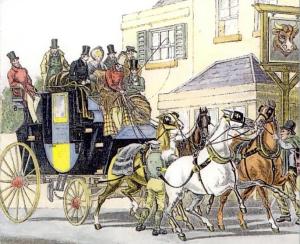
Stage coach travel. Notice the number of passengers laden on the coach and the number of horses.
At the height of 19th century coaching days Northallerton in North Yorkshire had four inns that catered to travellers – the Black Bull, the King’s Head, the Old Golden Lion and, the largest, the Golden Lion. Horses that pulled the public coaches suffered mightily for the sake of speed. In a previous post I had already discussed that if forced to run at breakneck speed, coach horses did not last longer than three years. Recently I ran across this description:
The Highflyer changed horses at the King’s Head but the horses belonged to Mr Frank Hirst. This coach was driven by a coachman called Scott, a very big fellow of the Old Weller type who had to be hauled into his seat and nearly broke the coach down. The Express also stopped at the King’s Head but the horses that worked this coach stood at the Waggon and Horses and belonged to Mr Hall of Northallerton. The Wellington London and Newcastle coach changed horses at the Golden Lion and was horsed by Mr Frank Hirst. At one time it was driven by Ralph Soulsby, who was a terror to drive, and it is on record that once during a period when the Wellington was running in opposition he succeeded in killing three out of his four horses on the short stage seven miles from Great Smeaton to Northallerton. Opposition coaches were terribly hard on horseflesh; they used to gallop every inch of the road up hill and down dale, and Soulsby’s third horse dropped dead just opposite the church, and he finished his journey to the Golden Lion with but a single horse. When the railway began to supersede the road and coach after coach began to fall away, the Wellington still held on until it at last stood alone. One of the oldest and first coaches on the road, it had withstood the tide of opposition through all time until it remained the absolute last regular coach running on this section of the Great North Road. The old coaching days in Yorkshire By Tom Bradley
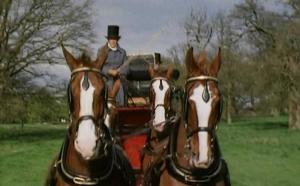
Coach and four
Horses were chattel and the general attitude towards beasts of burden during the Regency Era was one of exploitation. Fresh teams of horses were kept ready to replace an exhausted team that had just run the previous stage of a journey. These teams were contracted to stage lines or the Royal Mail. Other horses were available to be leased by individuals. Crack teams of hostlers prided themselves in changing mail coach teams in as little as three minutes. The combined refinements in coach design, and in road construction and maintenance allowed the heavy coach horses to be replaced by teams of faster half-bred or pure Thoroughbred horses. The luxurious coaches of the wealthy pulled by warmblooded horses or Thoroughbreds seemed to fly down the better roads at the unheard of speed of ten miles per hour. *
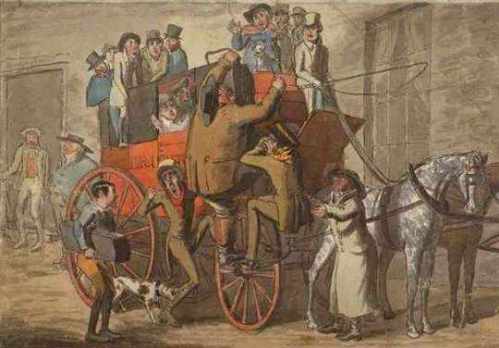
Coach leaving Brighton, 1840
It wasn’t until 1821, that Colonel Richard Martin, MP for Galway in Ireland, introduced the Treatment of Horses bill. This piece of legislature was greeted by laughter in the House of Commons. The first known prosecution for cruelty to animals was brought in 1822 against two men found beating horses in London’s Smithfield Market, where livestock had been sold since the 10th century. They were fined 20 shillings each. Colonel Martin’s “Ill Treatment of Horses and Cattle Bill,” or “Martin’s Act”, as it became known, was finally passed in 1822 and became the world’s first major piece of animal protection legislation. Not much changed for working horses, however. After a coaching horse’s usefulness ended, they were sold to labor for others**:
Mrs Mountain of the Saracen’s Head kept some 2,000 horses in her stables for the routes she served. Lord William Lennox sometime later estimated that it took some 2 pounds per week to keep coach horses. It is also estimated that the life of a coach horse was some three years. After that they were sold for they still had significant working life left. It was the nature of coaching with the strain of pulling a coach weighing more than 2 tons for an average of 10 miles at a speed of some 12 miles per hour 2 days out of 3. Farm work seemed easy by comparison. – Coaching Inns
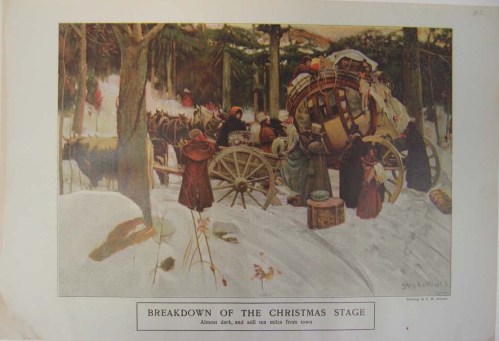
The Breakdown of the Christmas Stage shows how heavily laden the coaches were
A society that lacked adequate social service systems to take care of the poor did not place a high priority on the ethical treatment of animals. Cockfighting, bear baiting, and dog fights were common”betting” sports prevalent during the Regency Period. A retired coach horse would have an easier life plowing a farmer’s field than pulling a coach. Accidents were frequent, but horses were seldom given a break, forced to struggle through blizzards and quagmire after passengers alighted and luggage was taken off to lighten the load. Not every horse led a harsh life. The following excerpt describes a private, more benevolent owner, the Rev. George Bennet, Jane Austen’s father, whose horses pulled heavy carriages over poor roads:
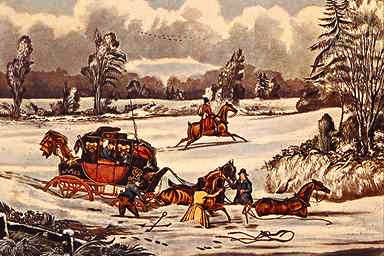
Coach stuck in snow
A carriage and a pair of horses were kept. This might imply a higher style of living in our days than it did in theirs. There were then no assessed taxes. The carriage, once bought, entailed little further expense; and the horses probably, like Mr. Bennet’s, were often employed on farm work. Moreover, it should be remembered that a pair of horses in those days were almost necessary, if ladies were to move about at all; for neither the condition of the roads nor the style of carriage-building admitted of any comfortable vehicle being drawn by a single horse. When one looks at the few specimens still remaining of coach-building in the last century, it strikes one that the chief object of the builders must have been to combine the greatest possible weight with the least possible amount of accommodation. – Memoir of Jane Austen by James Edward Austen-Leigh, Description of life at Steventon
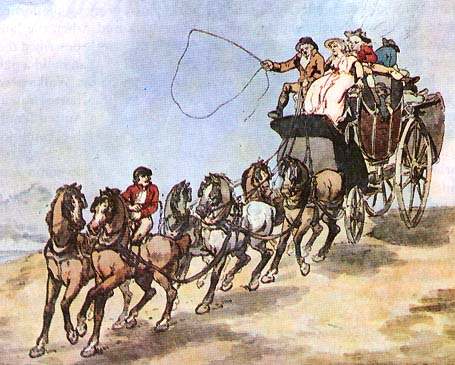
Rowlandson, Coach Travel
2025 AGM in Baltimore

RECOMMENDED BOOKS AND RESOURCES



Available through December 31st, 2025. Click on image for details, and share this poster with other teachers and students!


Click on image to read the story.

Gentle readers: Please feel free to post your comments and continue the conversation! Due to SPAM, we will no longer accept comments on posts after 30 days of publication. In some instances, links will be removed from comments as well.


If you would like to share a new site, or point out an error, please email us. (Yes, we are fallible. We'll own up to our mistakes and will make the corrections with a polite smile on our faces.) Write us at

Thank you for visiting this blog. Your comments and suggestions are most welcome.
STAGE-COACH AND MAIL IN DAYS OF YORE: A PICTURESQUE HISTORY
OF THE COACHING AGE, VOL. II, By CHARLES G. HARPER. 1903. Click on this link.

Disclaimer: Our team makes no profit from this blog. We may receive books (physical or digitized) for review purposes.
Copyright Statement: © Jane Austen's World blog, 2009-2024. Unauthorized use and/or duplication of this material without express and written permission from this blog’s author and/or owners is strictly prohibited. Excerpts and links may be used, provided that full and clear credit is given to Jane Austen's World with appropriate and specific direction to the original content.
 Jane Austen's World