This Jane Austen blog brings Jane Austen, her novels, and the Regency Period alive through food, dress, social customs, and other 19th C. historical details related to this topic.
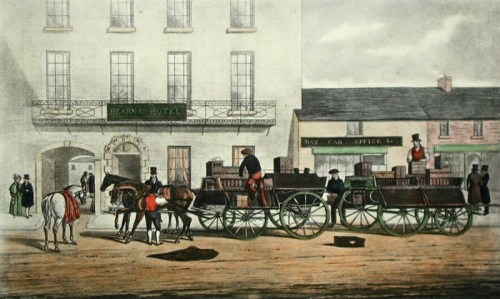
Have you ever heard of Charles Bianconi? The Irish probably have: Bianconi revolutionized public transport in Ireland in the early 19th century. An immigrant in 1802 from Costa Masnaga, Italy, he founded a network of coaching routes that covered Ireland from Belfast to Cork from a terminus that began at the Hearn Hotel in County Tipperary on July 6th in 1815. The first Bianconi carriage was a two-wheel horse drawn cart that carried three or four passengers. The new venture, known as the Bianconi Coach Service for private passengers, made the 30-year-old immigrant the ” King” of the Irish roads.
Charles Bianconi
Bianconi quickly expanded his fleet to 900 horses and 67 coaches.
Travel on one of these “Bians” as they were to become known, cost one-penny farthing a mile. Such demand was there for his transport that over the next 30 years a huge network of communications were established, with Clonmel, Co Tipperary as its hub. Huge employment was also now created from this growing transport business. The year 1833 saw the “long car” go into production from his coach building premises in Clonmel which enabled him to carry up to twenty passengers, plus cargo and mail deliveries for both British and Irish Post Offices. Here in Thurles, his depot was situated in O`Shea`s Hotel which today trades as McLoughneys, a ladies clothing boutique. The stables where he fed and changed his horses between journeys still exists, relatively unchanged, to this very day and are situated at the rear of Ryan’s Jewellers shop, Liberty Square, Thurles, Co. Tipperary.The advent of railway in 1834 brought home to Bianconi the realisation that his coaching business had now only a limited future. He immediately began to buy shares in the different rail lines as they were being built. He began to sell his coaches and long carts to his employees who had worked for him. – Thurles Information
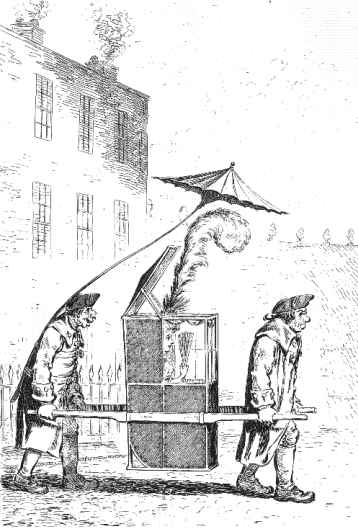
The 18th Century Sedan Chair; Image from Georgian Index
After the fire of London, in 1666, the streets were impassable, and so people of quality went on their business or pleasure in sedan chairs.They became in time such a nuisance as to obstruct the highways. – The History of Dress, The New York Times, 1884,
Young Georgian miss transported across town with her headdress feathers intact. Click on image for larger view.
Sedan chairs were a major mode of transportation through London’s narrow streets and along Bath’s steep lanes throughout the 17th and 18th centuries and early part of the 19th century. Strong chair carriers could transport passengers down winding passageways much faster than a carriage, which had to make frequent stops in congested traffic. The chair was named after the town of Sedan in France where it was first used. By 1634, they had been introduced to London as vehicles for hire, and their popularity quickly spread to France and Scotland, as well as the rest of Europe.
These portable covered chairs, used in one form or another in other cultures since ancient times, sported side windows and a hinged door at the front. Sedan carriers inserted long wood poles into metal brackets on either side of the chair. The poles were long and springy and provided a slightly bouncy ride. They were arranged in such a manner that the chair would remain in a horizontal position as the carriers climbed up steps or steep slopes. Passenger entered and exited between the poles if they remained in place.
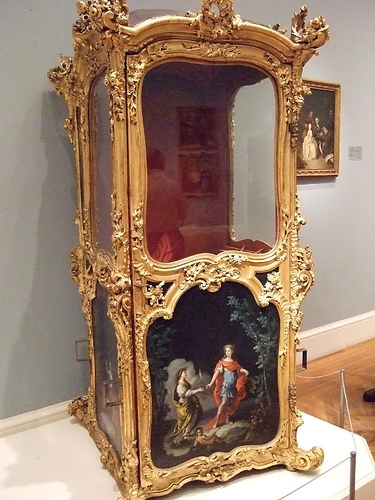
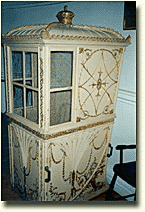
Early 18th c. gilt and wood Sedan chair; painted panels attributed to Charles Antoine Coypel
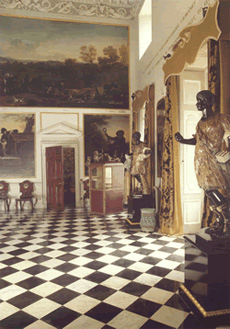
Sedan chair in entrance hall of Althorpe House, made for the Countess of Spencer in 1760.
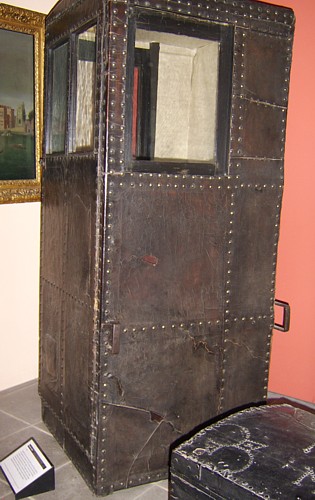
Chairs for the wealthy were richly carved and decorated, and stood inside the entrance hall to be used at the owner’s convenience. Footmen would summon hired carriers, who would take patrons to their destination. For the more ornate Sedan chairs, painters would create beautiful scenes on panels mounted on the sides, and many were extravagantly upholstered in silk on the inside. The less affluent hired plainer, leather covered chairs. (See 1700 image.)
Plain leather covered sedan chair, 1700. Notice the metal brackets.
Sedan chair in the Pump Room
Sedan chair houses were available throughout the city of Bath, as shown in the image lower down in this post, although they were also kept in hallways by those who owned them. A rather plain Sedan chair was on display underneath the stairs in the hall of No. 1 Royal Crescent when I visited Bath. One feature that made the chair so popular in Bath – a city in which invalids were transported for healing sessions to the hot mineral baths – is that the vehicle was narrow enough to be carried up the stairs and taken into the bedchamber. Once an invalid entered the chair, he or she would stay inside, unexposed to outside air. The chairs could be carried inside to the baths or to the Pump Room, as you can see in this illustration by Rowlandson, who shows a man on crutches emerging from a Sedan chair.
Rowlandson, Comforts of Bath, Pump Room
Because these portable chairs could be carried inside buildings, people could be transported around the city without being identified. This made it easier for people who were evading the law to go about their business, or for public personages to carry on trysts. Links-boys would light the road at night, and they waited until they were needed again to light the way back. As the painting below shows, accidents did happen!
Rowlandson, Sedan chair breaking down
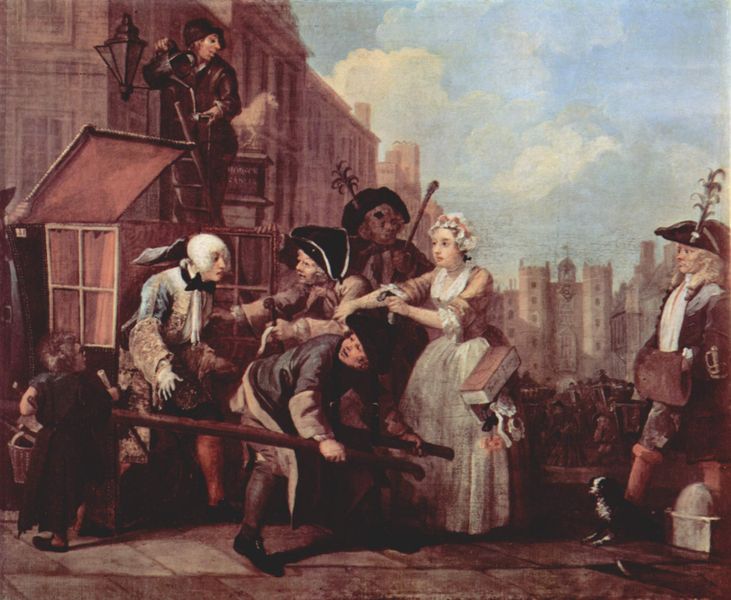
“At Bath, Tunbridge Wells, and other fashionable places, chairmen plied in the streets as cabs and hansoms now do. Occasionally they were used by spendthrifts, who were anxious to avoid the tipstaves, as they could enter them in their own houses and be deposited in that of a friend. However, it does not appear that the Sedan chair was always a safe refuge against arrest for debt, as in one of Hogarth’s prints the tipstaves are seen to be laying hold of one they were in search of, just as he was about to descend from his supposed place of security. One of the best caricatures of the day represented an Irishman being carried through the streets in a Sedan chair by two burly men, with his feet touching the ground, some wag having taken out the bottom of the Sedan, and the chairmen, aware of the practical joke, selecting the dirtiest part of the road.” NY Times, 1875, Old Coaches and Sedan Chairs
A Rake’s Progress, Hogarth, Sedan Chair
As previously stated, Sedan chairs for hire were common in London. Chairmen wore a uniform, were licensed to carry passengers, and had to display a number, like today’s taxi drivers. Three hundred chair permits were issued in London and Westminster in the early 1700’s. A similar system was later used in Scotland, where a fare system was established in 1738. A trip within a city cost six pence and a day’s rental was four shillings. It cost £1 1 shilling to hire a sedan chair for a week. The chairs were available around the clock, but after midnight the chairmen would be paid double the fare.
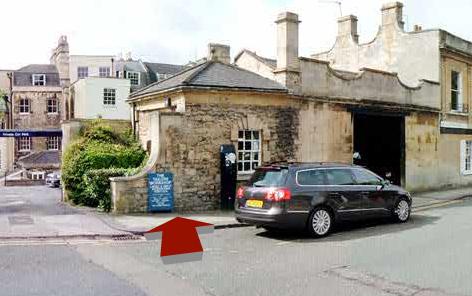
Sedan chair house in Bath, Queen’s Parade Place
Sedan chair houses, or stations, were common in cities were they were used. Only two examples of these houses remain today in Bath:
“Continue along Gay Street and turn first left into Queen’s Parade Place. On either side of an opening are the only examples of sedan chair houses in Britain. Here chairmen would rest before carrying passengers to their destinations. They were notoriously rude and unscrupulous often locking their passengers in the chair until they had paid the exorbitant fare! Beau Nash licensed them and set reasonable fares. Their demise came when a local man invented the “Bath chair,” a 3 wheeled vehicle.” From eu-journal, 011
1840, Wheeled Bath chairs outside of the Pump Room
The Sedan chair fell gradually into disuse. Horace Walpole bemoaned their waning popularity as early as 1774, and by the mid-19th century three-wheeled Bath chairs had taken their place.
“The chairmen were fine, robust men; they had little regard for foot passengers, and considered the pavement their own exclusive property. It was rather an amusing sight to witness how the men trotted off, when a chair was required, racing to be first for hire. After a time Sedan chairs got out of fashion, except at Bath, Cheltenham, and Leamington, where they wer in favor for many years after they ceased to exist in the metropolis. – Old Coaches and Sedan Chairs, NY Times, october 17, 1875”
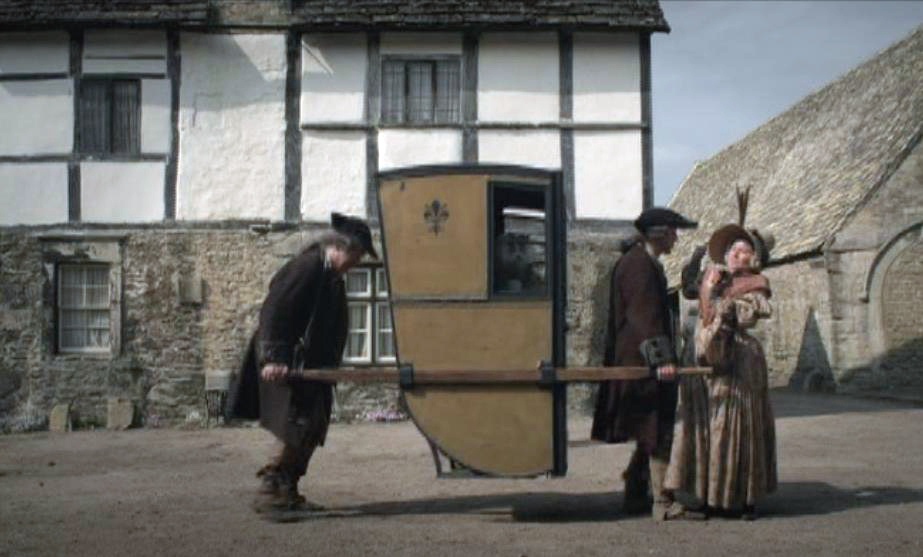
Chairmen huffing and puffing in Cranford
While the Sedan chair had gone out of fashion by the mid-19th Century, it played a crucial part in the recent mini-series, Cranford. One of the funniest and most memorable scenes in the movie showed two chairmen trying to keep apace with Miss Pole, a spinster, and Mrs. Forrester, whose cat had ingested lace, as they ran into the village seeking help. The men huffed and puffed as they carried their heavy load with Mrs. Jamieson inside, and staggered into Cranford.
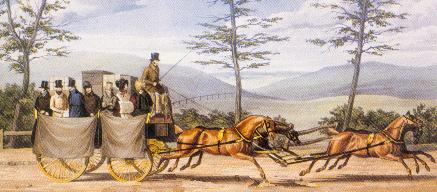
The life of a stage coach horse during the Regency era was not easy. Roads, though much improved over previous centuries, could be filled with mud and ruts that impeded progress. Generally one horse could pull a wheeled vehicle six times its own weight. Therefore, a carriage horse weighing from 1200 lbs to 2300 lbs is able to pull from 7200 lbs to 13,800 lbs. Multiply this number by four or six, and you have team that can pull a substantially sized vehicle. However, tired horses had to be replaced about every ten miles or so, and “the average life of a horse pulling a coach at about eight mile per hour was six years; at ten miles per hour or over, possible on good roads, a horse lasted three years.” (The Prince of Pleasure, J.B. Priestley, p 151-152)
Charles Dickens provides a vivid account of horses dragging a carriage out of mire and muck:
…there is another hole and beyond that another bank close before us. So he [the coachman] stops short, cries to the horses again, “Easy, Easy, den”, “Ease Steady, Hi”, “Jiddy”, “Pill”, “Ally”, “Loo”, but never Lee until we are reduced to the very last extremity and are in the midst of difficulties, extrication from which appears above all but impossible. And so we do the ten miles or thereabouts in two hours and a half, breaking no bones, though bruising a great many, and in short getting through the distance like a fiddle. (Charles Dickens’s works. Charles Dickens ed. [18 vols. of a 21 vol. set … By Charles Dickens, pages 78 & 79.)
One would hope that each time the horses struggled the passengers got out of the coach and removed the heavier belongings, so that the horses’ efforts were eased. This illustration of horses pulling a carriage through snow shows that the passengers have disembarked, but that the coach is still laden with cargo.
In a related post, read about the crossing sweepers, who in the early part of the century before macadamized roads became widespread, kept passages free and clear of ruts, as well as horse dung.
“Besides this excellent convenience of conveying letters, and men on horseback, there is of late such admirable commodiousness, both for men and women of better rank, to travel from London to almost any great town in England, and to almost all the villages near this great city, that the like hath not been known in the world, and that is by stage coaches, wherein one may be transported to any place, sheltered from foul weather, and foul ways, free from endamaging one’s health or body, by hard jogging or over violent motion, and this not only at a low price, as about a shilling for every five miles, but with such velocity and speed, as that the posts in some foreign countries, make not more than a mile a day; for the Stage Coaches called Flying Coaches, make forty or fifty miles in a day, as from London to Oxford, or Cambridge, and that in the space of 12 hours, not counting the time for dining; setting forth not too early, nor coming in too late.”
Text from The World in Miniature, a series of volumes created for the publisher Rudolf Ackermann, and written by W.H. Pyne. Illustrations by Thomas Rowlandson, Augustus Pugin, and W.H. Pyne.
Text, p 98-97, The World in Miniature: England, Scotland, and Ireland, edited by W.H. Pyne, containing a description of the character, manners, customs, dress, diversions, and other peculiarities of the inhabitants of Great Britain. In Four Volumes; illustrated with eighty-four coloured engravings, Volume 1, London, 1827, Printed for R. Ackermann, Repository of Arts, Strand.
Click below for more about this publication:
The World in Miniature: Click on the topics, such as stagecoach, the bishop, or the milk woman, to read about those topics.
A recent and personal account written by Lori Smith follows Jane Austen’s footsteps. Her A Walk With Jane Austen will be available in early October. Beautifully written, the book is worth the wait. You may pre-order the book at amazon.com.
Fashionable Goodness: Christianity in Jane Austen's England is now available! By JAW contributor Brenda S. Cox. See Review. Available from Amazon and Jane Austen Books.
Available through December 31st, 2025. Click on image for details, and share this poster with other teachers and students!
The Obituary of Charlotte Collins by Andrew Capes
Click on image to read the story.
Comments
“My idea of good company…is the company of clever, well-informed people, who have a great deal of conversation.” – Jane Austen, Persuasion
Gentle readers: Please feel free to post your comments and continue the conversation! Due to SPAM, we will no longer accept comments on posts after 30 days of publication. In some instances, links will be removed from comments as well.
Administrators and Contributors
Vic Sanborn, founder of this blog, is supported by a team of talented and knowledgeable writers about Jane Austen and the Regency era. They are:
Tony Grant, who now contributes his photos from London and England
Click on their names to enter their own blogs.
In addition, we thank the many experts and authors who frequently contribute their posts and opinions, and who continue to do so freely or at our request.
Click here to enter the page. Topics include Regency fashion, historic foods, Jane Austen societies, British sites, related topics. Click on image.
May we suggest?
Hello, my name is Vic and I live in Maryland, USA. I have adored Jane Austen almost all of my life. I am a proud lifetime member of the Jane Austen Society of North America. This blog is a personal blog written and edited by me and my team. We do not accept any form of cash advertising, sponsorship, or paid topic insertions. However, we do accept and keep books and CDs to review.
If you would like to share a new site, or point out an error, please email us. (Yes, we are fallible. We'll own up to our mistakes and will make the corrections with a polite smile on our faces.) Write us at
Thank you for visiting this blog. Your comments and suggestions are most welcome.
Project Gutenberg: eBook of Stage-coach and Mail in Days of Yore, Volume 2 (of 2), by Charles G. Harper
STAGE-COACH AND MAIL IN DAYS OF YORE: A PICTURESQUE HISTORY
OF THE COACHING AGE, VOL. II, By CHARLES G. HARPER. 1903. Click on this link.













 Jane Austen's World