Feeds:
Posts
Comments

Archive for the ‘Visited’ Category

“I had expected to find everything about the place very fine and all that, but I had no idea of its being so beautiful.” –Mrs. Cassandra Leigh Austen, Aug. 13, 1806, on a visit to Stoneleigh Abbey with her daughters Jane and Cassandra

Merry Christmas and Happy Holidays! As my gift to you, let’s take a trip to Stoneleigh Abbey together.

Jane Austen visited Stoneleigh Abbey in 1806. She and her mother and sister were visiting their cousin, Rev. Thomas Leigh, in Adlestrop when his distant cousin, the Honorable Mary Leigh, died. Rev. Thomas inherited the wealthy estate. He took his poorer relations, the Austens, with him to take possession, as a treat for them. They enjoyed it very much, as Mrs. Austen wrote in a letter.  She said the house was so large that they needed signposts to find their way, and that it was not only very “fine,” but more beautiful than she had imagined. Catherine Morland, similarly, when she saw Northanger Abbey, “was struck . . . beyond her expectation, by the grandeur of the abbey.”

Based on income, Stoneleigh Abbey was an even grander place than Pemberley or Sotherton (the Rushworth estate in Mansfield Park) would have been. Austen tells us that Darcy’s income was £10,000 a year and Mr. Rushworth’s was £12,000 a year. But the income of the Leighs of Stoneleigh Abbey, in Jane Austen’s time, was even higher, at £17,000 a year, which Victoria Huxley says was “perhaps the annual equivalent of a million pounds in today’s values” (p. 9). (We were told when touring Chatsworth that the income there in Austen’s time was about £30,000, three times Darcy’s income; I haven’t found confirmation of that number anywhere, though.)

Today, ideally you need a car or a tour bus to get you to Stoneleigh Abbey. It is about an hour’s drive north of Oxford or about 40 minutes southeast from Birmingham. If you want to take public transport, it looks like you’ll have a half-hour’s walk at the end of your journey.

I went with the JASNA Summer Tour. We saw the Adlestrop church the same day; it’s only about an hour’s drive away.

Stoneleigh Abbey, like Austen’s fictional Northanger Abbey, is a mix of older monastic buildings and newer buildings. (Newer in Austen’s time, at least.) Let’s take a trip through it, with some quotes from Austen’s novels.

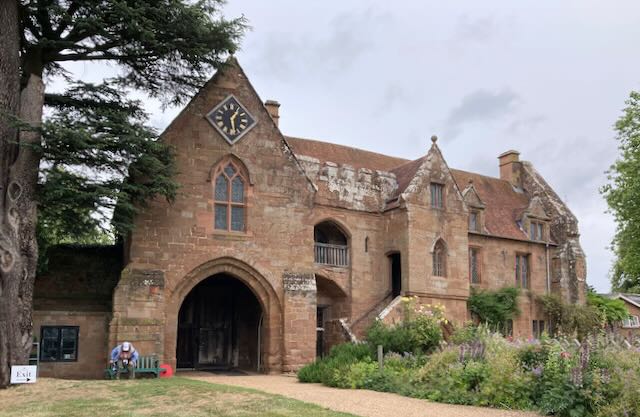
The red sandstone gatehouse, where you buy entry tickets, is from the 14th century, a remnant of the original Cistercian monastery. At this gatehouse, built in 1346 by Abbot Robert de Hoeckle, the poor received alms and travelers found hospitality.

So low did the building stand, that she found herself passing through the great gates of the lodge into the very grounds of Northanger, without having discerned even an antique chimney. . . . To pass between lodges of a modern appearance, to find herself with such ease in the very precincts of the abbey, and driven so rapidly along a smooth, level road of fine gravel, without obstacle, alarm, or solemnity of any kind, struck her as odd and inconsistent.–Catherine Morland, Northanger Abbey

Now we are coming to the lodge-gates; but we have nearly a mile through the park still.–Maria Bertram, Mansfield Park

The tour did not take us into this north wing. But you can still see arches on the walls, from the original monastery church. They are now bricked over. A cloister and medieval stained glass windows remain in the older buildings.
Another building from the old monastery. Stoneleigh Abbey was a small Cistercian monastery from 1155 until Henry VIII dissolved the monasteries in 1536. The Leigh family bought it in 1561. Catherine Morland was disappointed not to stay in such a building at Northanger Abbey.

[Catherine] was hardly more assured than before, of Northanger Abbey having been a richly endowed convent at the time of the Reformation, of its having fallen into the hands of an ancestor of the Tilneys on its dissolution–Northanger Abbey
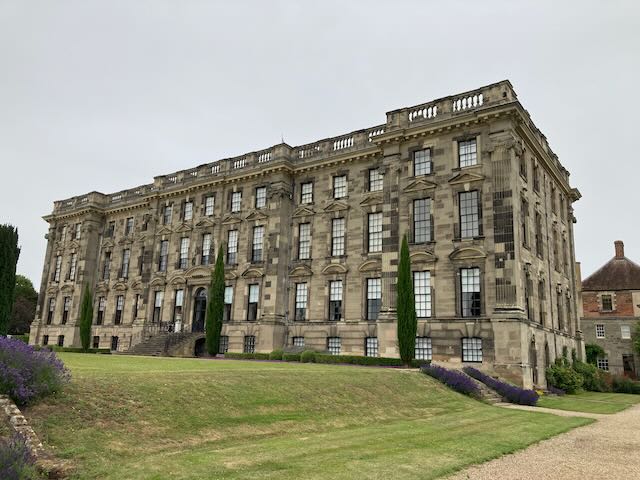
The baroque West Wing is the most impressive building, built in the 1720s by Edward, the third baron Leigh. He married a rich heiress. After his Grand Tour on the continent, he was inspired to create his own Italian-style palace. Mrs. Austen wrote that there are 45 windows in the front.

She was struck, however, beyond her expectation, by the grandeur of the abbey, as she saw it for the first time from the lawn.–Catherine Morland, Northanger Abbey

Even Fanny had something to say in admiration. . . . Her eye was eagerly taking in everything within her reach; . . . being at some pains to get a view of the house, and observing that “it was a sort of building which she could not look at but with respect”–Mansfield Park

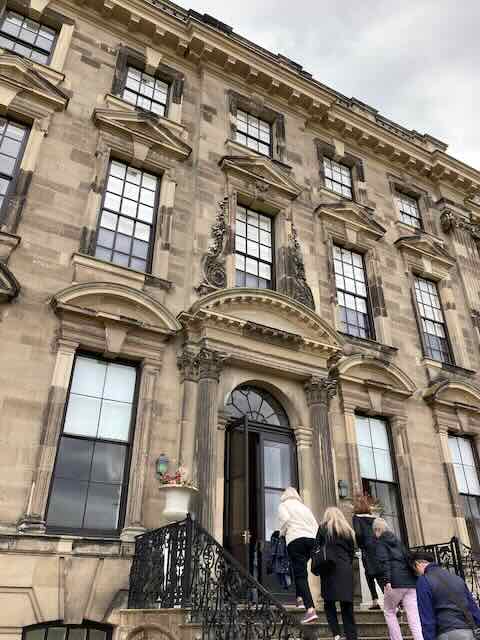
Architect Francis Smith designed the Stoneleigh Abbey West Wing, which cost £3,300. The older abbey buildings became servants’ quarters.
A flight of stairs leads up to the main entry to Stoneleigh Abbey, West wing

Miss Bertram could now speak with decided information of what she had known nothing about when Mr. Rushworth had asked her opinion; and her spirits were in as happy a flutter as vanity and pride could furnish, when they drove up to the spacious stone steps before the principal entrance.–Mansfield Park
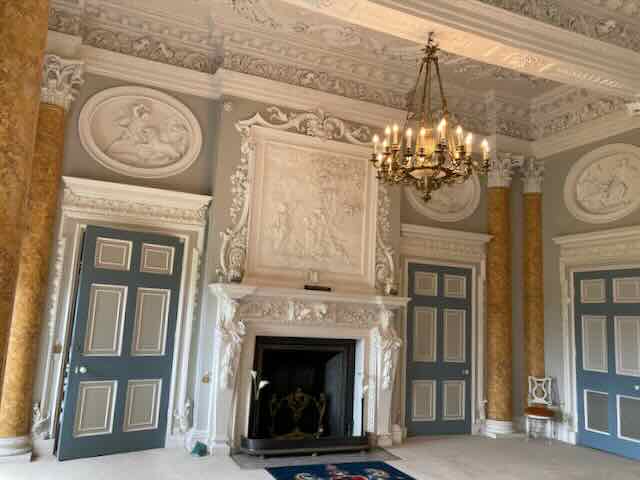
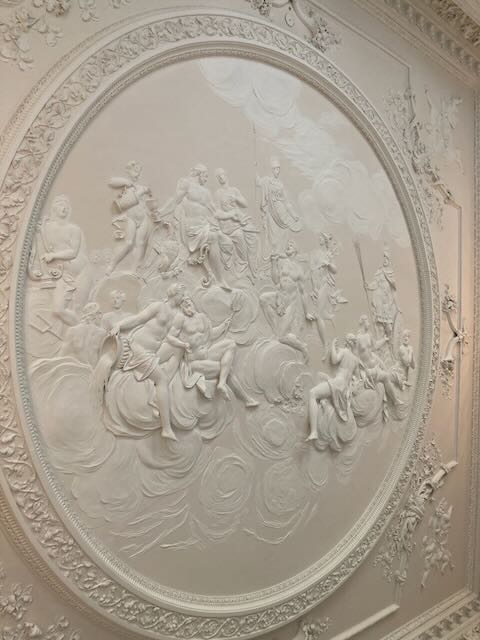
One end of the impressive “saloon” (salon, entry room) of Stoneleigh Abbey. Plaster decorations show myths of the Greek hero Hercules. Edward, the fifth Lord Leigh, decorated this room in the 1760s while doing vast “improvements” to his manor.
Ceiling plasterwork in the Stoneleigh Abbey saloon showing Hercules joining the gods. Ironically, Hercules suffered from bouts of madness, as did Edward Leigh himself.

An abbey! Yes, it was delightful to be really in an abbey! But she doubted, as she looked round the room, whether anything within her observation would have given her the consciousness. The furniture was in all the profusion and elegance of modern taste.–Catherine Morland, Northanger Abbey

The whole party rose accordingly, and under Mrs. Rushworth’s guidance were shewn through a number of rooms, all lofty, and many large, and amply furnished in the taste of fifty years back, with shining floors, solid mahogany, rich damask, marble, gilding, and carving, each handsome in its way.–Mansfield Park
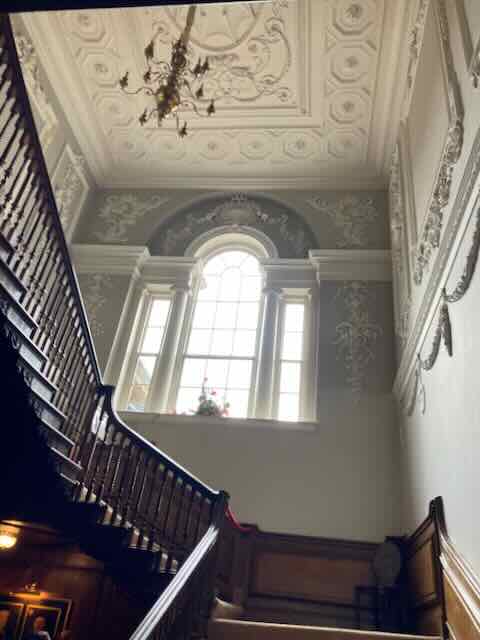
The main staircase of Stoneleigh Abbey, one of three staircases Jane Austen’s mother mentions.

They returned to the hall, that the chief staircase might be ascended, and the beauty of its wood, and ornaments of rich carving might be pointed out.–Northanger Abbey

The lower part of the house had been now entirely shewn, and Mrs. Rushworth, never weary in the cause, would have proceeded towards the principal staircase, and taken them through all the rooms above, if her son had not interposed with a doubt of there being time enough.–Mansfield Park
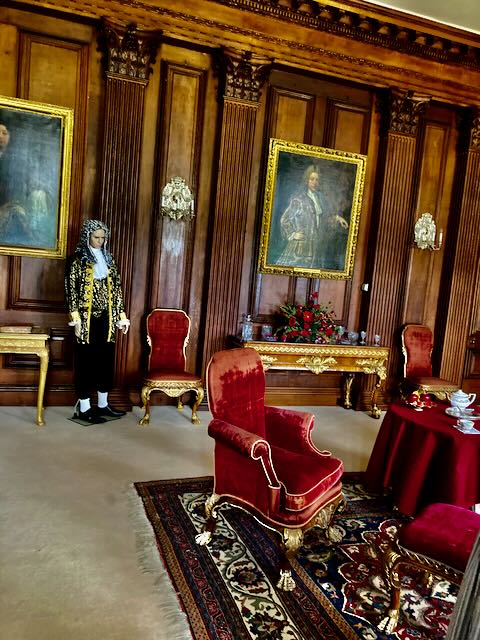
The drawing room of Stoneleigh Abbey. After dinner, the ladies would “withdraw” to the “withdrawing room,” later called the drawing room. The gentlemen would join them after a time.

The general leads Catherine “into a room magnificent both in size and furniture—the real drawing-room, used only with company of consequence. It was very noble—very grand—very charming!—was all that Catherine had to say, for her indiscriminating eye scarcely discerned the colour of the satin; and all minuteness of praise, all praise that had much meaning, was supplied by the general: the costliness or elegance of any room’s fitting-up could be nothing to her; she cared for no furniture of a more modern date than the fifteenth century.”–Northanger Abbey

The drawing room clock, from 1786, plays carillon music on the hour. Stoneleigh Abbey

“Till midnight, she supposed it would be in vain to watch; but then, when the clock had struck twelve, and all was quiet, she would, if not quite appalled by darkness, steal out and look once more. The clock struck twelve—and Catherine had been half an hour asleep.”–Northanger Abbey

Stoneleigh Abbey card room fireplace, with plates of “the prettiest English china,” hand painted by ladies of the family.

The fireplace, where she had expected the ample width and ponderous carving of former times, was contracted to a Rumford, with slabs of plain though handsome marble, and ornaments over it of the prettiest English china.–Northanger Abbey

A Rumford was an invention that made fireplaces more efficient. They are still used today.
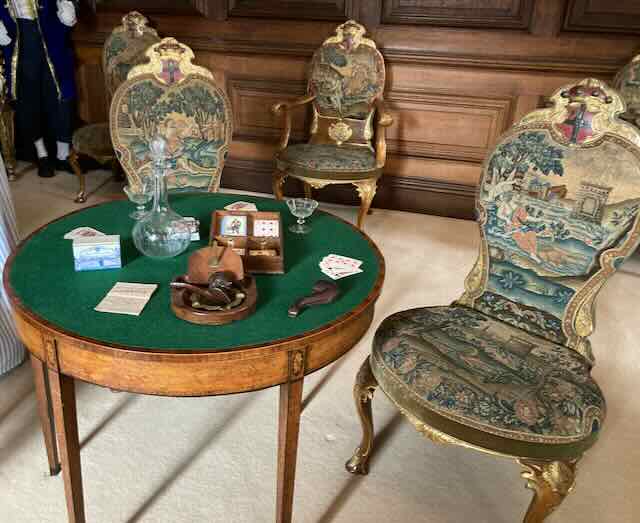
Stoneleigh Abbey card room, set up for a game of cards.

Mr. Elton had retreated into the card-room, looking (Emma trusted) very foolish.–Emma
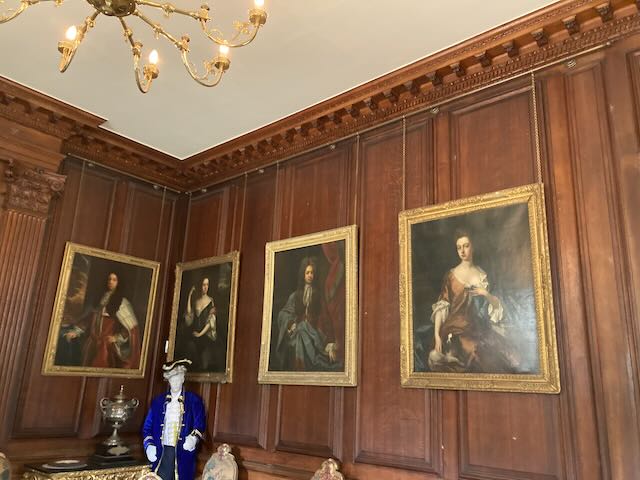
Portraits in the Card Room. All the rooms we saw were lined with family portraits.

Of pictures there were abundance, and some few good, but the larger part were family portraits, no longer anything to anybody but Mrs. Rushworth–Mansfield Park

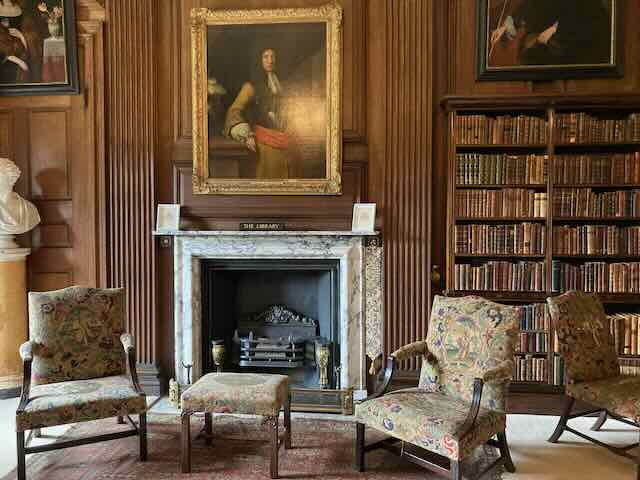
Edward, fifth Lord Leigh, bequeathed most of his extensive library to his alma mater, Oriel College at Oxford. These included “outstanding works on architecture and music, his scientific instruments, maps and prints.” (Jane Austen & Adlestrop, 22).
The library of Stoneleigh Abbey was replenished by later heirs.

Marianne, who had the knack of finding her way in every house to the library, however it might be avoided by the family in general, soon procured herself a book.–Sense and Sensibility

Ready to play chess in the library, Stoneleigh Abbey

“What a delightful library you have at Pemberley, Mr. Darcy!”

“It ought to be good,” he replied, “it has been the work of many generations.”

“And then you have added so much to it yourself, you are always buying books.”

“I cannot comprehend the neglect of a family library in such days as these.”–Miss Bingley and Mr. Darcy, Pride and Prejudice
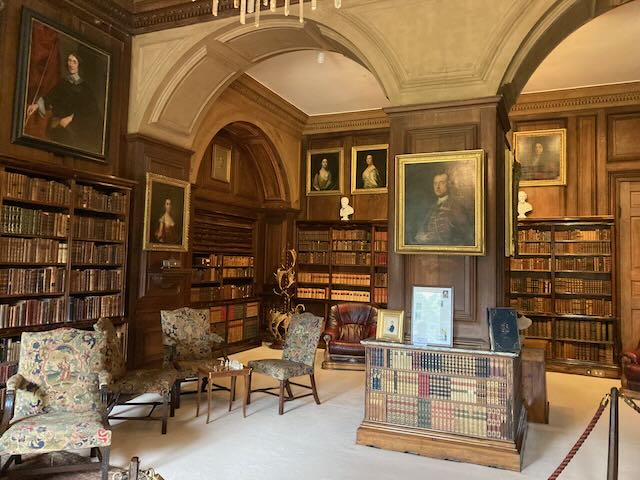
Stoneleigh Abbey library

After tea, Mr. Bennet retired to the library, as was his custom–Pride and Prejudice

Ladies’ dressing table, Stoneleigh Abbey

“My mother is tolerably well, I trust; though her spirits are greatly shaken. She is up stairs and will have great satisfaction in seeing you all. She does not yet leave her dressing-room.”–Jane Bennet, Pride and Prejudice
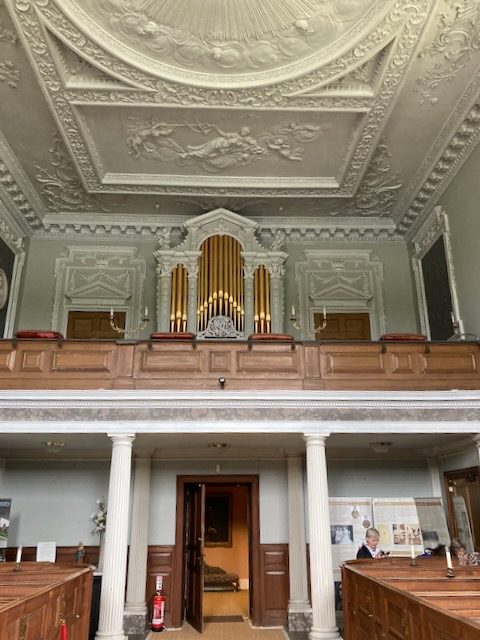
The chapel at Stoneleigh Abbey is considered to be the model for the chapel at Sotherton in Mansfield Park. Crimson cushions appear over the balcony ledge, as in Mansfield Park. Rev. Thomas Leigh read prayers (led a worship service) in the chapel twice a day, with morning prayers at 9 A.M.

Fanny’s imagination had prepared her for something grander than a mere spacious, oblong room, fitted up for the purpose of devotion: with nothing more striking or more solemn than the profusion of mahogany, and the crimson velvet cushions appearing over the ledge of the family gallery above. “I am disappointed,” said she, in a low voice, to Edmund. “This is not my idea of a chapel. There is nothing awful here, nothing melancholy, nothing grand.” . . .

Mrs. Rushworth began her relation. “This chapel was fitted up as you see it, in James the Second’s time. Before that period, as I understand, the pews were only wainscot; and there is some reason to think that the linings and cushions of the pulpit and family seat were only purple cloth; but this is not quite certain. It is a handsome chapel, and was formerly in constant use both morning and evening. Prayers were always read in it by the domestic chaplain, within the memory of many; but the late Mr. Rushworth left it off.” . . .

“It is a pity,” cried Fanny, “that the custom should have been discontinued. It was a valuable part of former times. There is something in a chapel and chaplain so much in character with a great house, with one’s ideas of what such a household should be! A whole family assembling regularly for the purpose of prayer is fine!”–Mansfield Park

See my post on The Stoneleigh Abbey Chapel and Mansfield Park for a visit to the chapel with further quotes from Mansfield Park.

Queen Victoria’s bedroom at Stoneleigh Abbey. In 1858, Queen Victoria stayed for two nights at the Abbey, in a suite of five rooms. The furniture was painted white and gold, according to the Queen’s preference.

In a house so furnished, and so guarded, she could have nothing to explore or to suffer, and might go to her bedroom as securely as if it had been her own chamber at Fullerton.–Catherine Morland, Northanger Abbey
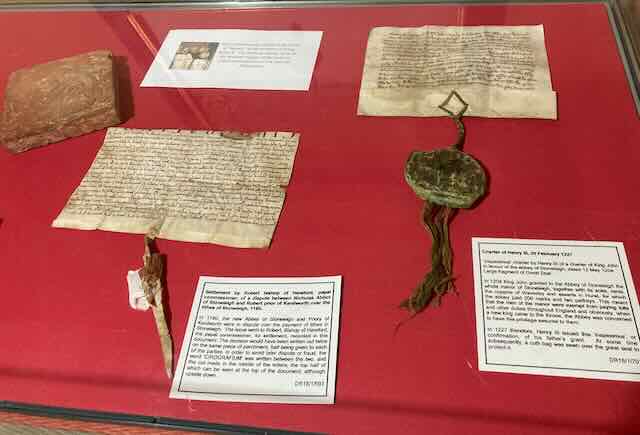
Further rooms at Stoneleigh Abbey display historical relics, such as the monks’ charters and seals.

Northanger turned up an abbey, and she was to be its inhabitant. Its long, damp passages, its narrow cells and ruined chapel, were to be within her daily reach, and she could not entirely subdue the hope of some traditional legends, some awful memorials of an injured and ill-fated nun.–Catherine Morland, Northanger Abbey

Humphry Repton was hired to improve Stoneleigh Abbey and its surroundings. His Red Book, showing before and after pictures, still exists.
Repton moved the river toward Stoneleigh Abbey so you could see the house reflected in the water.

“Smith’s place is the admiration of all the country; and it was a mere nothing before Repton took it in hand. I think I shall have Repton.”–Mr. Rushworth, Mansfield Park

A ha-ha (see below) at Stoneleigh Abbey gives an uninterrupted view across the fields.
From the other side of Stoneleigh Abbey’s hedge of lavender shown above, you can see the wall that kept animals from trespassing to the area around the house. A ha-ha is a walled ditch dug to act as a fence without disrupting the view.

A few steps farther brought them out at the bottom of the very walk they had been talking of; and standing back, well shaded and sheltered, and looking over a ha-ha into the park, was a comfortable-sized bench, on which they all sat down. . . .

“You will hurt yourself, Miss Bertram,” [Fanny Price] cried; “you will certainly hurt yourself against those spikes; you will tear your gown; you will be in danger of slipping into the ha-ha.”–Mansfield Park

In 1946, Stoneleigh Abbey became “one of the first stately homes to open its doors to the public” (Stoneleigh Abbey, 18). A fire destroyed much of it in 1960, though most of the furniture and paintings were rescued. In 1996, a trust was set up to restore it, at a cost of £12 million. They did an amazing job. Restoration was also done on the grounds and the lake. The restoration work sought to improve the habitats of bats, otters, kingfishers, and other species

Restorers also worked on conserving water management structures such as these locks.
We exit back through the Stoneleigh Abbey gatehouse, having enjoyed a beautiful day.

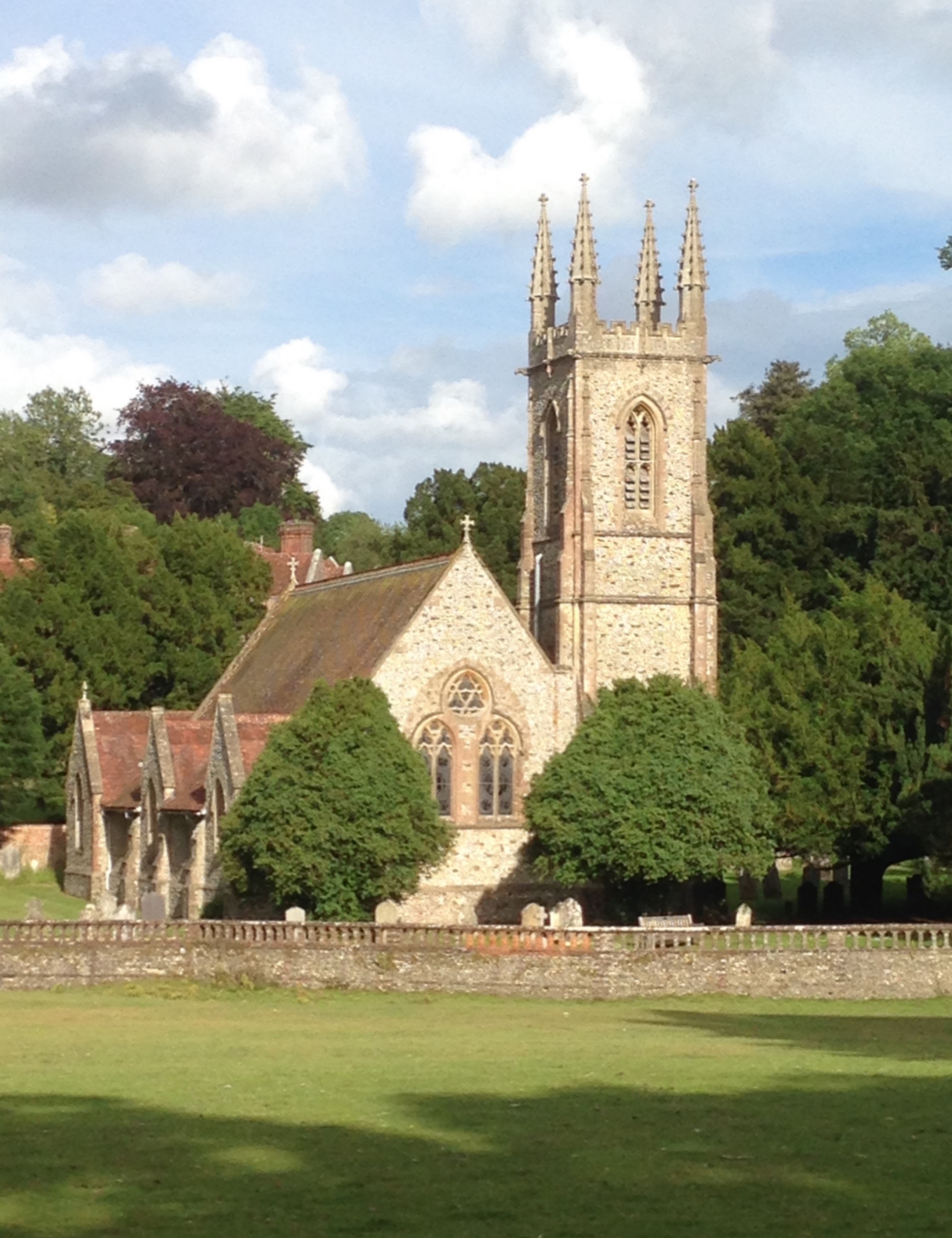
During their visit, the Austens enjoyed extensive walks through the grounds. Rachel Dodge has posted some of those lovely views. The Austens must have also attended the Stoneleigh Church, St. Mary the Virgin, though we didn’t get to visit it this trip. 

I hope you have enjoyed our visit to Stoneleigh Abbey with Jane Austen’s characters, and that you can see it in person some day! This year, the Abbey celebrated Christmas with a Christmas fair and a series of concerts, including carols in the chapel. If you have been to Stoneleigh Abbey, please tell us about your impressions!

Brenda S. Cox is the author of Fashionable Goodness: Christianity in Jane Austen’s England. She also blogs at Faith, Science, Joy, and Jane Austen.

All photos in this post, © Brenda S. Cox, 2023.

Sources and Further Reading

Jane Austen & Adlestrop: Her Other Family, by Victoria Huxley. US Amazon link

Stoneleigh Abbey by Paula Cornwell (obtained from Stoneleigh Abbey)

Jane Austen: A Family Record, 2nd ed., by Deirdre Le Faye

The Stoneleigh Abbey Chapel and Mansfield Park

Jane Austen’s Rich(er) Leigh Family Connections at Adlestrop and Stoneleigh Abbey 

Visiting Stoneleigh Abbey

Cassandra Leigh Austen’s Stay at Stoneleigh Abbey (letter)

Jane Austen’s Leigh Family: Stories Behind the Stories

Jane Austen’s Clergymen and Her Leigh Family

Jane Austen’s Mansfield Park and Stoneleigh Abbey

More pictures of Stoneleigh village, church, and abbey 

Stoneleigh Abbey website
Read Full Post »

By Brenda S. Cox

“Now we are come from church . . .” (Jane to Cassandra, London, March 5, 1814)

In Jane Austen’s letters and novels, she often mentions church. A quick search of my Complete Works of Jane Austen shows 119 uses of the word “church” plus 31 uses of “chapel.” The church was an important part of Jane’s life.

A number of different churches are associated with Austen and her family, and this past summer in England I had the privilege of visiting many of them. In the coming months, I will share photos with you of some of these special places.

St. Nicholas’s Church, Chawton, where Jane Austen worshiped from 1809 to 1817. You can see the chimneys of Chawton House in the background; Chawton Cottage is a few minutes’ walk away. Photo © Brenda S. Cox, 2023.

Country Churches in Austen’s England

Most of the Austen family churches are small country churches, like the churches the Bennets, Darcys, Tilneys, Dashwoods, Woodhouses, and others would have mostly attended.

Most country churches at that time were simple, whitewashed inside, with perhaps the Ten Commandments hung on the wall somewhere, along with monuments (usually plaques on the walls) commemorating people from the squire’s family or previous rectors. A simple Communion table at the front, with a railing in front of it, would have served as the altar. The part of the church around the altar is called the chancel.

Chancel of the Chawton church. This part of the church escaped the fire in the late 1870s, but was mostly redecorated later. The Communion railing, however, is from the 18th century; Jane Austen would have received Communion at that railing. Photo ©Brenda S. Cox, 2023.
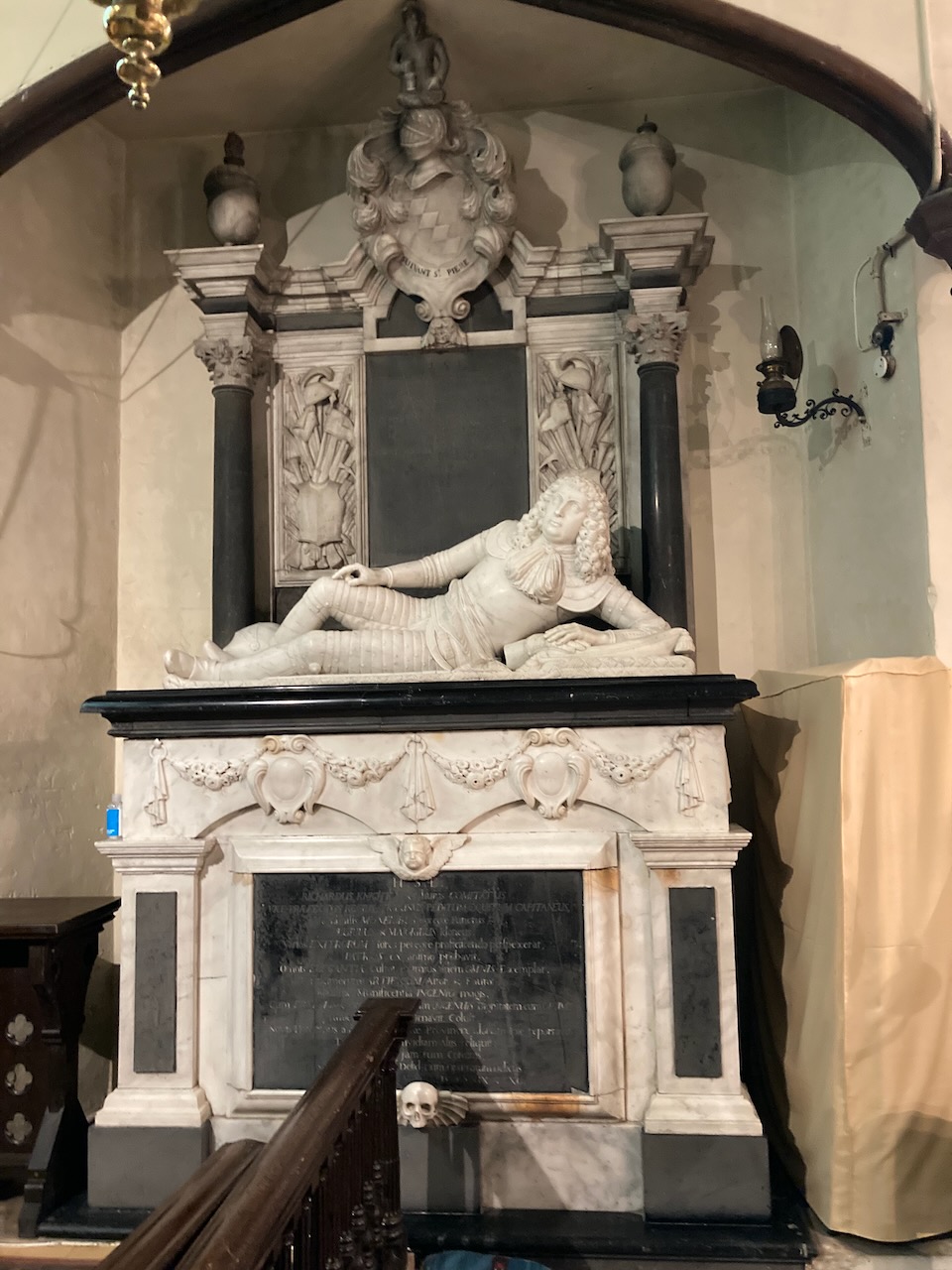
By far the most elaborate memorial in the Chawton Church, this one commemorates Sir Richard Knight, who lived from 1638-1679. Photos above and below © Brenda S. Cox, 2023.
Memorials to Jane’s mother and sister inside the church.

Preaching was an important part of each service, and the pulpit might have been one, two, or three levels high. Many churches had a gallery, a balcony where the choir, called the Singers, would sit, if they had music. From the top level of the pulpit, the clergyman could preach to those in the gallery, as well as see down into the box pews, pews surrounded by walls. These box pews were generally owned by the local gentry, who could listen in privacy and be protected from drafts of cold air. Others sat on benches.

Country families visiting Bath or London would have attended larger churches. I’ve speculated previously about where Jane herself (and Catherine Morland) might have worshiped in Bath.

Country Churches Today

The country churches we visited this summer now have small congregations for regular services; perhaps a dozen or so people on a Sunday morning. However, they occasionally host baptisms, weddings, and funerals, with much larger attendance. Those events also provide income to the churches. These small churches may gather one to two hundred people for holiday services such as Harvest, Christmas, or Easter. They sometimes also host local school events, concerts, and community events.

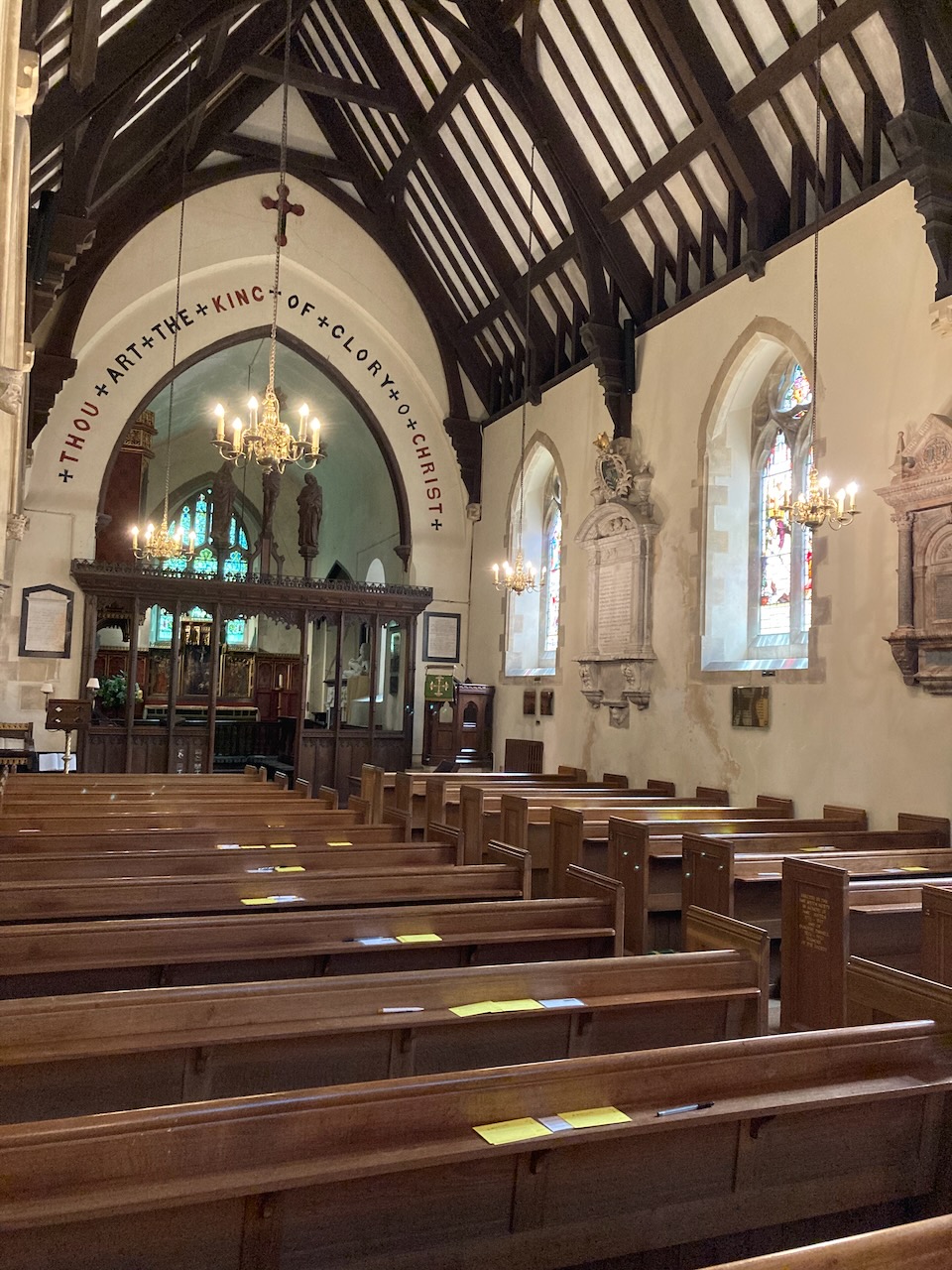
Interior of Chawton Church. The stained glass windows are all from Victorian times or later. Photo © Brenda S. Cox, 2023.

St. Nicholas’ Church, Chawton, Today

Let’s start with the Chawton church. This is the one Jane Austen fans can most easily visit, since it is next to Chawton House and a short walk from Jane Austen’s House. Jane Austen attended this church from 1809 to 1817, while she and her mother, sister, and friend were living in Chawton Cottage (now Jane Austen’s House, a museum). During that time, she wrote or rewrote all her novels, and four of them were published. (The other two were published shortly after her death.)

The church is named after St. Nicholas, like the church in Steventon where Austen grew up; that’s a little confusing.

This Victorian stained glass window in Chawton Church honors St. Nicholas, patron saint of children and others, to whom the church is dedicated, and St. Swithin, patron saint of Winchester Cathedral where Jane Austen is buried. The window is a memorial to Marianne Knight, daughter of Jane’s brother Edward Knight. Marianne died unmarried in 1896, and the window appears to have been commissioned by her great-nephews and great-nieces (if I am deciphering the Latin correctly).  Photo © Brenda S. Cox, 2023.

Nowadays a small team of clergy usually serve a group of country parishes. The Chawton church is now part of the Northanger Benefice, which includes eight small rural parishes, each with its own church.

While services are offered somewhere in the area every Sunday, most small churches do not have services every week. At the church in Chawton, three Sunday services are held per month.

One is led by a layperson (not an ordained clergyman or clergywoman). In the hour-long lay service I attended during Regency Week, a woman from the congregation led the service, reading from the Book of Common Prayer, while the congregation read the responses. The congregation sang hymns: “Lord of All Hopefulness,” a lovely traditional hymn, as well as “Kum Ba Yah” and “Morning Has Broken,” perhaps chosen because they were familiar and easy to sing. There was no sermon.

The leader read the banns for two couples who plan to get married in the church. I was told that, in order to be married there, a couple had to attend the church at least six times before the wedding, and they needed some connection with the parish or benefice.

The congregation was welcoming and kind to my friend and myself as visitors. We enjoyed the fellowship before and after the service.

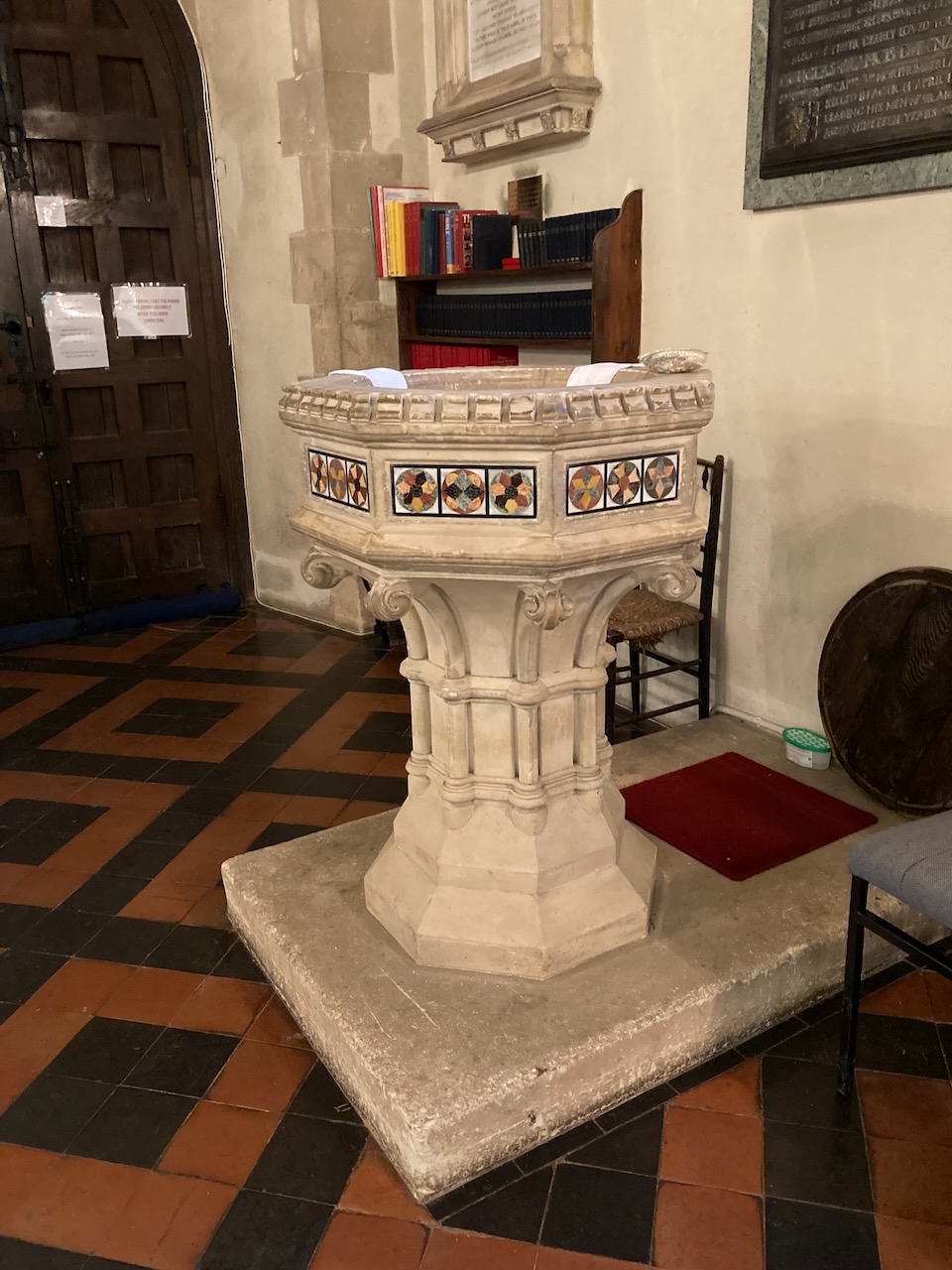
Baptisms (Christenings) are performed at this Victorian font near the door of the Chawton church. Photo © Brenda S. Cox, 2023.

The service I attended the following Sunday included the baptism of a nine-month-old boy. About forty or fifty people attended. (I was told anyone could be baptized in the church, with the payment of a small fee.) The rector in charge of the benefice, Rev. Carrie Walshaw, officiated. (The Church of England has ordained women since 1994.) The baby was dedicated with his parents, two godfathers, and one godmother (a baby girl would have two godmothers and one godfather), and baptized at the Victorian font at the back of the church. A candle was lit and given to the parents as a symbolic remembrance. Rev. Walshaw preached a sermon about baptism and salvation, and we sang hymns with organ music. Rev. Walshaw’s husband was the organist; the organ is an electronic one that sounds like a real pipe organ (to me, at least). It is hidden behind the pipes of the old organ which is now too expensive to maintain.

Victorian organ pipes at Chawton Church. A newer electronic organ is behind the panels. Photo © Brenda S. Cox, 2023.

History of St. Nicholas’ Church, Chawton

There has been a church at Chawton since at leat 1270 AD. The current church building, however, is not the same one Austen worshiped in. A fire in 1871 destroyed most of that church. The chancel (the area around the altar at the front of the church) remains, and most of the memorials were preserved, along with one original pew sitting against the back wall. So those are still as Jane Austen would have seen them, though the chancel has been extensively redecorated.

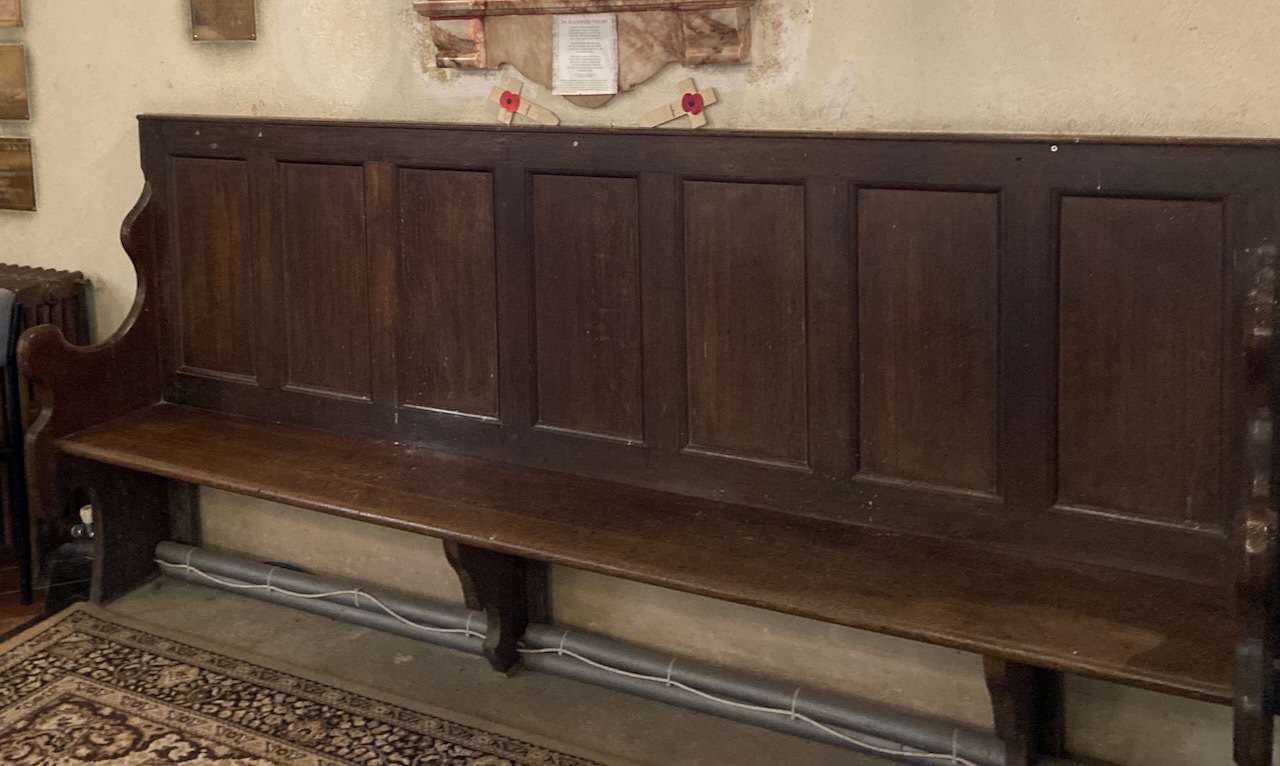
The only original pew, from 1733, to survive the fire; it is now attached to the back wall of the Chawton church. Photo © Brenda S. Cox, 2023.

The rest of the church, including the tower, was rebuilt in 1872 and 1873 in a Victorian style. Several of the pews are marked as memorials to various people, including one for Jane Austen, though these pews are all modern.

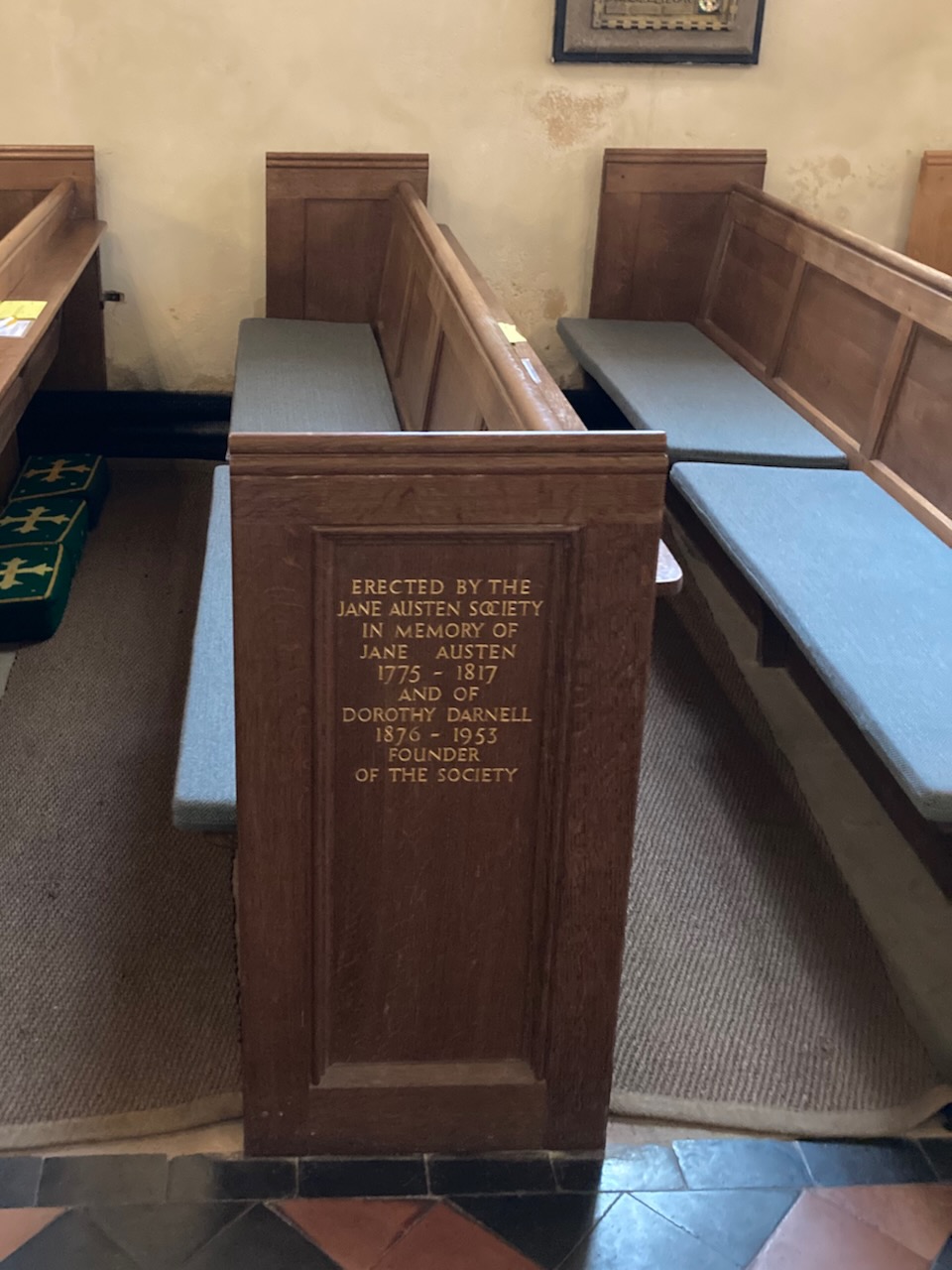
This modern pew in the Chawton Church is dedicated to Jane Austen and to Dorothy Darnell, founder of the Jane Austen Society. Photo © Brenda S. Cox, 2023.

Clergy

For each parish church in England, someone owns the advowson, the right to appoint the next clergyman. The Knight family (who adopted Jane’s brother Edward) owned the advowson for Chawton from 1578 until 1953. At that point, they gave it to the Bishop of Winchester, when Chawton became part of a benefice with nearby Farringdon.

During Austen’s time, the Knights chose Rev. John Papillon as rector of Chawton. In one of her letters, Jane refers to a family joke that she was supposed to marry Rev. Papillon, regardless of how either of them felt about it (Dec. 9, 1808).

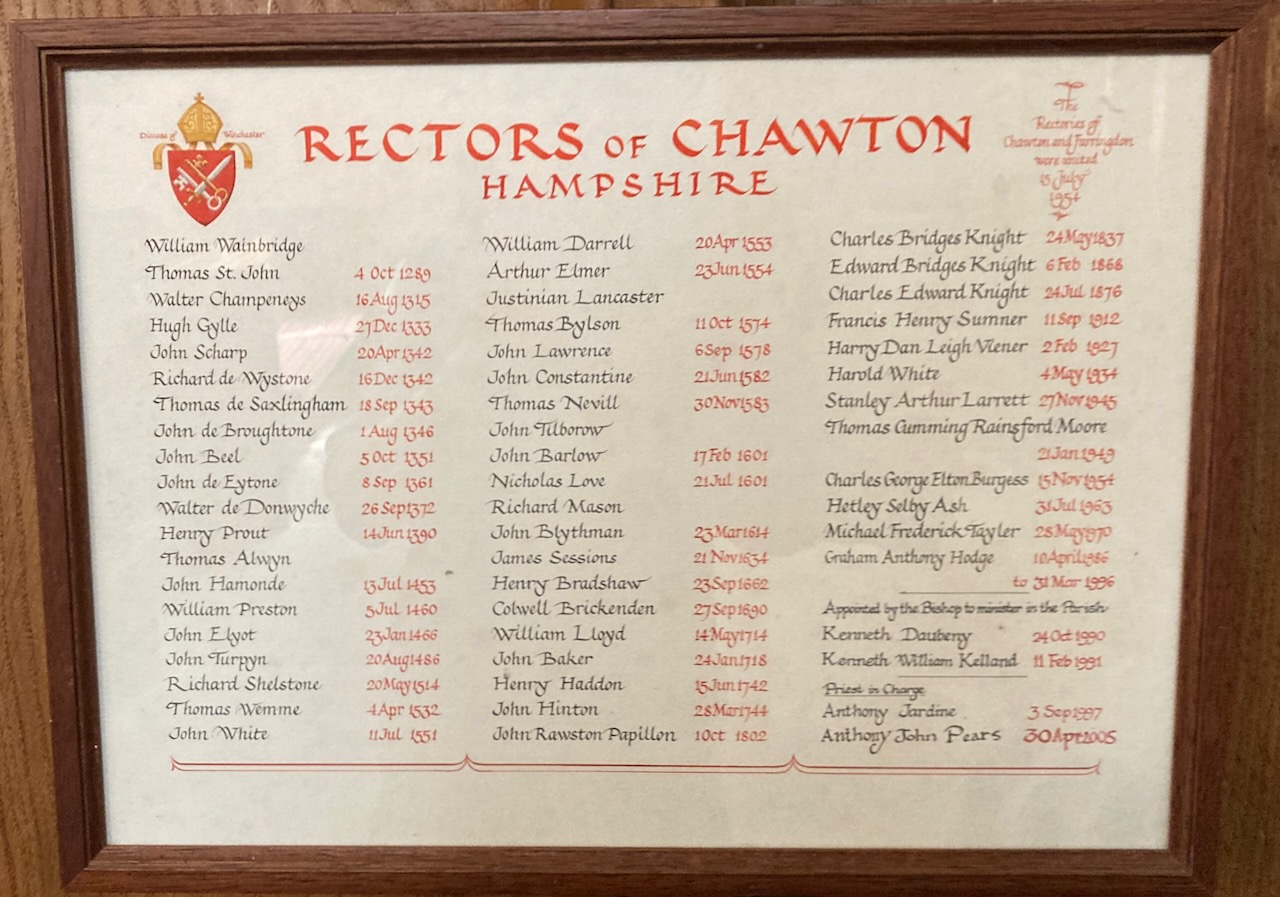
This list of Chawton rectors, posted on the wall of the church, includes Rev. Papillon, who was rector while Jane Austen lived there. He is mentioned in her letters. Two of her nephews and a great-nephew follow. Photo © Brenda S. Cox, 2023.

In 1817, Jane’s brother Henry Austen served briefly as curate at Chawton and at St. Lawrence the Martyr’s, parish church of the nearby market town of Alton. In 1837, Edward Knight installed his son, Charles Bridges Knight, as rector of Chawton. The rectory is the white house at the end of the lane leading to the church and Chawton house, just across the street. It is now a private home.

The former rectory of Chawton Church is now a private home, just across the road from the church and Chawton House. Photo © Brenda S. Cox, 2023.

Updating the Church

A guidebook to Chawton Church tells us, “The parish has increased little in population since the 19th century and still only has about 300 adults living in it so that the shortage of money which is the lot of most churches in tiny parishes is likely to continue in this, the 21st century.” The building is a grade 2 listed building in the UK, meaning it is “of special interest, warranting every effort to preserve it.” 

The church therefore has to get permission to make any changes. Recent changes are the addition of two restrooms and a small kitchen in the back of the church. The kitchen is made of oak matching the pews, with a cover to hide the sink. These amenities make the church more appealing as a site for weddings and other community events. Income from such events helps keep the church running. The Chawton church has hosted five weddings this year so far.

The church also has a children’s area toward the back, with toys. This helps keep children occupied, especially during the regular services geared for families.

A children’s area and basic kitchen facilities have been added to the back of the Chawton church. Photo © Brenda S. Cox, 2023.

Ring the Bells

The church has a peal of six bells, which were ringing during the baptism service I attended. Three of them would have been heard by Jane Austen; they are dated 1420, 1621, and 1748. Another original bell was re-cast and re-hung as one of the newer bells. During Austen’s time, the church had a West Gallery, a balcony which may have been used by a choir or musicians, but the rebuilt church has no gallery.

Bell tower of the Chawton church. Photo © Brenda S. Cox, 2023.
Chawton’s current six bells, three of which would have been heard by Austen, were dedicated/re-dedicated in 2009. Photo © Brenda S. Cox, 2023.

Lych Gates and Graveyard

Outside, the church can be approached from two traditional lych gates, one in front, one in the back. The word lych (pronounced litch) is from an Anglo-Saxon word for corpse. The lych gate was the entrance to the church yard, which was a cemetery. When a person died in the parish, their body might be set in the lych gate for a time, until the funeral was held.

The lych gates of the Chawton church date from about 1871. There is a similar one behind the church. Photo © Brenda S. Cox, 2023.

The Chawton churchyard includes many headstones for people buried there, some of which are so ancient they are illegible.

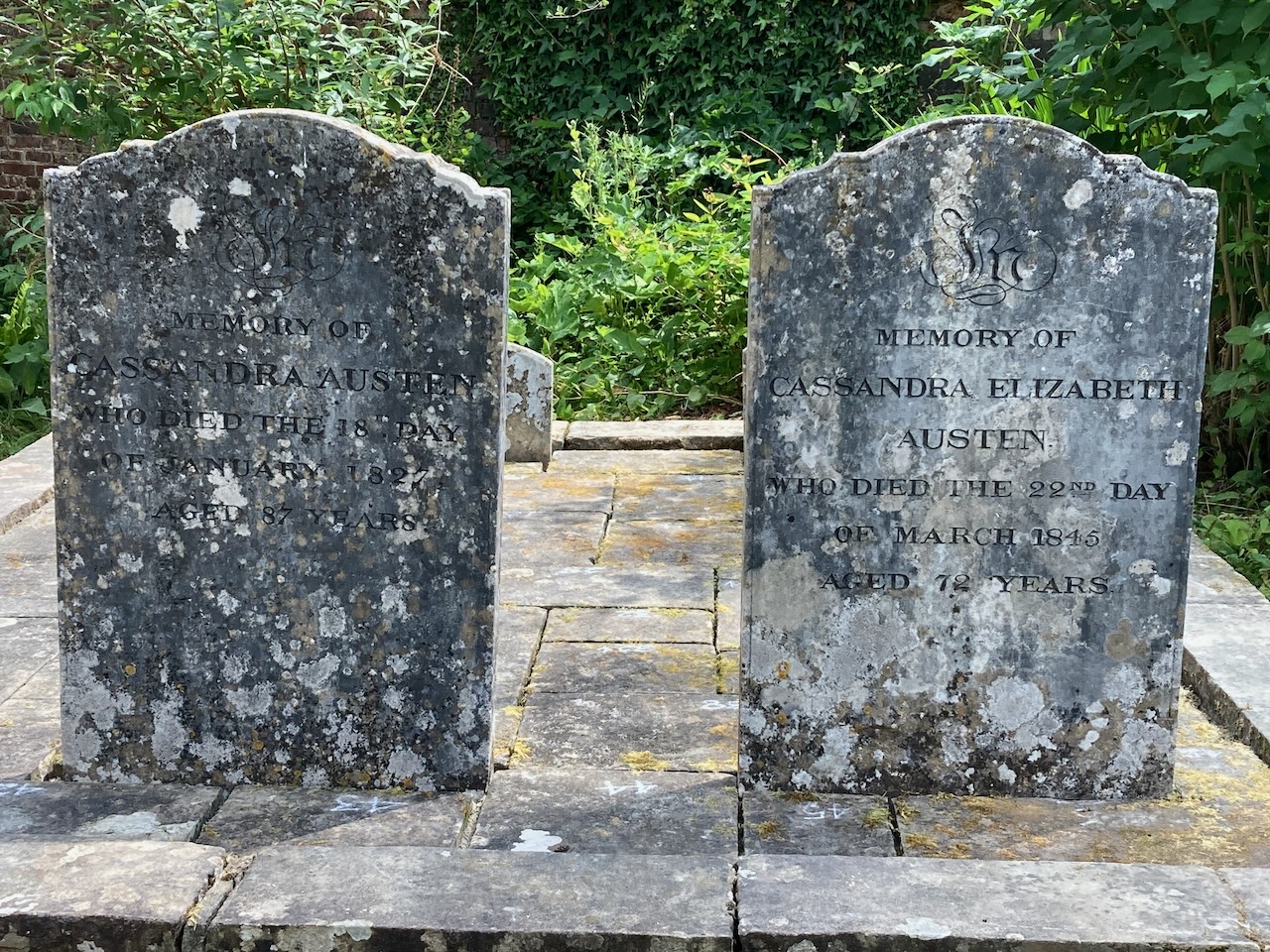
Jane Austen’s mother and sister are buried in the churchyard. Their graves were recently cleared of huge, deep weeds. But the lettering on the stones is still difficult to read.

Jane Austen’s mother and sister, both named Cassandra, are buried in the Chawton churchyard. Photo © Brenda S. Cox, 2023
The gravestones were easier to read in 2013, when I took this photo. Photo © Brenda S. Cox, 2013.

Honoring Jane

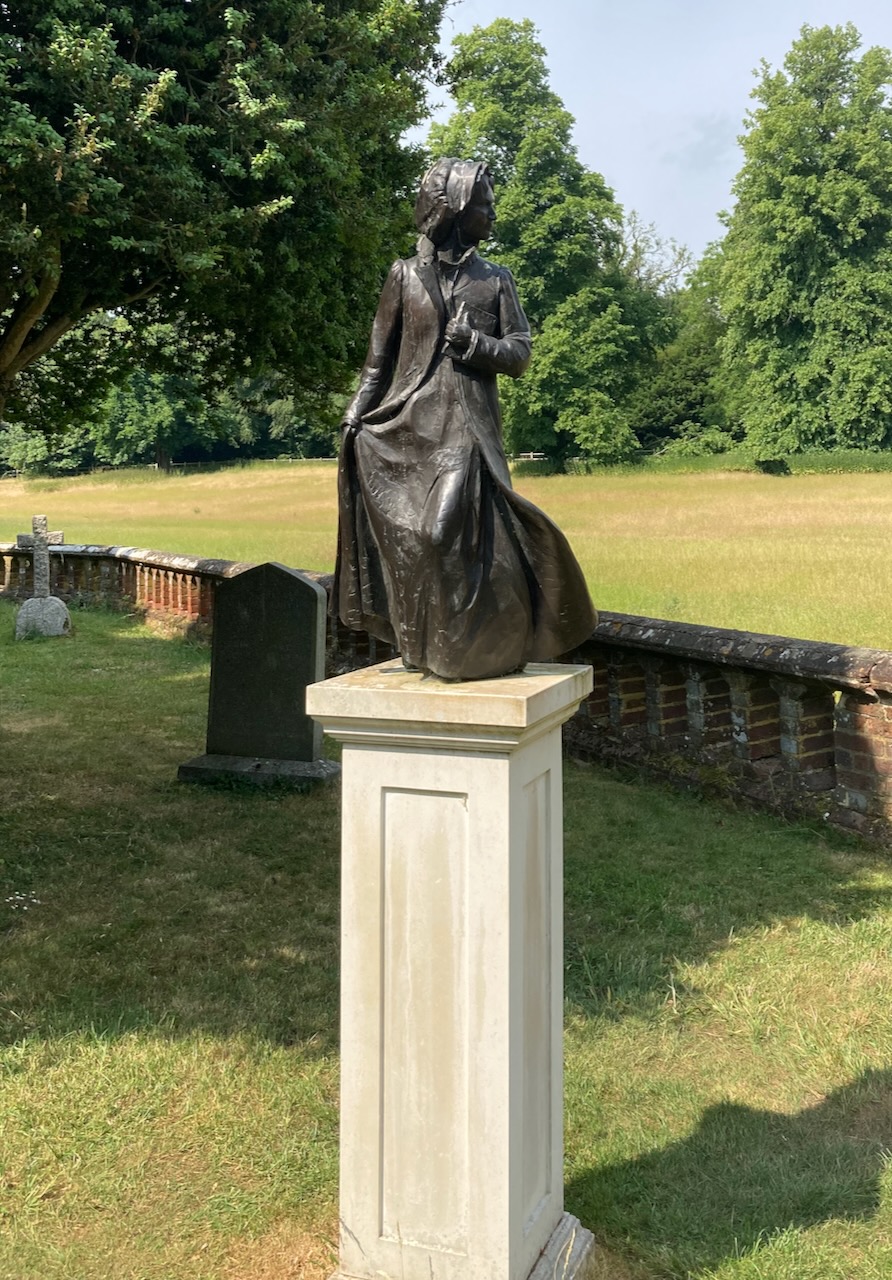
A small statue of Jane Austen now stands in front of the church, erected in 2018. The statue is the maquette, the prototype, for the life-size statue in Basingstoke. It shows Austen walking, carrying a book.

A statue of Jane Austen now greets visitors to the Chawton church. Photo © Brenda S. Cox, 2023.

I hope you can visit the Chawton church and enjoy its peace and beauty.

Resources

Guides to Chawton church and other Austen-related churches are available from Jane Austen Books, or you can buy them at the church if you visit it.

A Walk Through Chawton will give you a wider view of Austen-related places to visit in the area. 

Donations

The Chawton church is always open to visitors like yourself. According to a sign in the church, however, it costs over £75 a day to keep the church operating. If you should wish to make a donation directly to the church, churchwarden Sandra Martin has set up this site, which Rev. Lesley Leon of the Northanger Benefice shared with us: Chawton church donations.

JASNA provides support for special projects in some Austen family churches, including this one. If you are a JASNA member, donations to the churches fund for such projects are appreciated. (You can donate when renewing your membership, or sign in to your account and go under the drop-down menu to “Donate to JASNA or English Institutions.”)

Posts on other Jane Austen Family Churches

Steventon

Hamstall Ridware

Adlestrop and the Leigh Family

Stoneleigh Abbey Chapel

Great Bookham and Austen’s godfather, Rev. Samuel Cooke

Ashe and Jane’s Friend Mrs. Lefroy 

Deane

Brenda S. Cox is the author of Fashionable Goodness: Christianity in Jane Austen’s England. She also blogs at Faith, Science, Joy, and Jane Austen.

Read Full Post »

Gentle Readers, Chris Stewart from Embarking on a Course of Study, has often contributed posts to this blog. She will be visiting England soon. Lucky Chris! Before leaving, she asks you a question, a quite interesting one:

Next month I’m heading to England for a visit to London, which includes a too-brief pilgrimage to places associated with Jane Austen, including the Jane Austen House Museum, where I’ll be taking a writing class after I tour the house. The JAHM has a blog that you can follow and in catching up on the posts, I read one from April that talks about how much making a pilgrimage to Jane’s house means to most people who visit (myself included; I can’t wait!). One very special surprise, is that some visitors leave a gift or message for Jane that the staff finds later.

“It seems that for many people being in her home is part of an ongoing relationship that they develop with her as not only an author of their favourite books but also as a woman. Recently Isabel and I have found a few gifts and offerings to Jane and the house. I found a carefully made fan of hearts hung on a door handle in The Austen Family room. Each heart has a name of a character from Sense and Sensibility and they rotate to align with different people.”

Isn’t that wonderful? For pictures of the gifts and letters they’ve found, and to leave a comment about what you would leave in Jane’s house were you to visit (and find out what I’ll be leaving – you know I’m going to do it, it’s such a great idea!), go to my blog: Embarking on a Course of Study http://www.embarkingonacourseofstudy.com

Chris Stewart
Get to the Heart of Your Writing
Mentoring, Workshops, Editing, Critique: http://www.therealwriter.com
Facebook: http://www.facebook.com/ChrisStewartTheRealWriter
Poets & Writers Profile: http://www.pw.org/content/christine_stewart

Read Full Post »

I found the following tips in a 1919 book, Searchlight for Health. As far as I can tell, the etiquette of paying calls did not change significantly from Jane Austen’s time to the Edwardian era, or from having crossed an ocean. Here then, are the rules as outlined in this Project Gutenberg book:

Emma and Harriet visit Mrs. and Miss Bates

Emma and Harriet visit Mrs. and Miss Bates

In the matter of making calls it is the correct thing:

  • For the caller who arrived first to leave first.
  • To return a first call within a week and in person.
  • To call promptly and in person after a first invitation.
  • For the mother or chaperon to invite a gentleman to call.
  • To call within a week after any entertainment to which one has been invited.
  • You should call upon an acquaintance who has recently returned from a prolonged absence.
  • It as proper to make the first call upon people in a higher social position, if one is asked to do so.
  • It is proper to call, after an engagement has been announced, or a marriage has taken place, in the family.
  • For the older residents in the city or street to call upon the newcomers to their neighborhood is a long recognized custom.
  • It is proper, after a removal from one part of the city to another, to send out cards with one’s new address upon them.
  • To ascertain what are the prescribed hours for calling in the place where one is living, or making a visit, and to adhere to those hours is a duty that must not be overlooked.
  • A gentleman should ask for the lady of the house as well as the young ladies, and leave cards for her as well as for the head of the family.

Another book, Mrs. Astor’s New York by Eric Homberger (2004), gives a glimpse of what a call might look like for young ladies of quality in New York at the turn of the 20th century. (Edith Wharton does this so well.) The art of social climbing remained quite strict and, in fact, was probably stricter as a result of the Victorian era. Keep in mind that this book and the one above were written in the U. S. about Americans:

So simple a matter as paying a morning call was hedged around with complications. A male escort or female companion was not needed if a lady went in a carriage, but a gentleman was expected to accompany a lady walking on foot. It was permissible for two ladies walking together to make a call without male escort. When paying a call, female guests were expected to remain seated in chairs or benches lining the perimeter of the room, waiting for servants to pass refreshments in sequence. A hostess alone had the freedom to stand and cross the room. Larger social events, variously termed ‘routs,’ ‘conversaziones,’ and ‘squeezes,’ were less rigid in the assignation of gender roles, and the provisions of tables for chess and cards, or music for dancing, greatly increased the variety of entertainment.

For a truly comprehensive chapter on paying morning calls during the latter part of the 19th century, click on this link to read the chapter, Etiquette for the Caller, from The Ladies’ Book of Etiquette and Manual of Politeness, Florence Hartley, 1872. Again, this is an American etiquette book.

Click here to read my other post on etiquette:

    Read Full Post »

    During Jane Austen’s time, Brighton, a town along the south Sussex Coast and seen above in a John Constable painting, was the popular resort destination. Bath’s desirability had plummeted among the Ton, as it had gained the reputation of being a stodgy tourist attraction for the elderly and infirm. By the time the Prince Regent’s fashionable set frequented Brighton, it had grown from a sleepy seaside village of 3,000 in 1769 to a booming tourist town of 18,000 by 1817-1818.

    The lengthening of the formal season helped in establishing Brighton as a holiday destination. By 1804 the season started late July and lasted until after Christmas, and by 1818 it had been extended until March. Visitors of note were always mentioned in Brighton’s newspaper, and there were a host of them. (Illustration below is of Fashionables in Brighton, 1826)


    The first notables were both members of the Royal Family, the Duke of Gloucester in 1765, and then the Duke of York in 1766. From 1771 the Duke and Duchess of Cumberland were regular visitors and the town’s popularity with his uncles might have been one reason why the Prince of Wales came in 1783 and why he stayed for eleven days.

    The Prince of Wales, after he became Prince Regent, began to spend enormous sums of money refurbishing Brighton Pavillion to his own fanciful specifications, using John Nash’s designs. Click here for my post on this beautiful palace.

    In the early 18th century visitors were left to their own devices to find entertainments, but by 1810 guide books pointed out sites of interests in surrounding villages, amusements to be had, and picturesque walks. The sea was also used for entertainments such as yacht races and water parties which were watched from the shelter of the Steine. Military manoevres on the Steine and the Downs were popular.


    Read more about Brighton here:

    Quotes: Georgian Brighton, 1740-1820, Sue Farrant, University of Sussex Occasional Paper No. 13

    Read Full Post »

    Older Posts »