
Gentle Readers, My friend, Hillary Major, a fan of history and recent Georgette Heyer convert, graciously agreed to review Source Books’ latest release of My Lord John, which was published posthumously. You can purchase the book at this link.
Many Heyer readers may be surprised to learn that the Middle Ages, not the Regency era, was the historical period closest to Georgette’s heart. So asserts her husband, in his brief preface to My Lord John, Heyer’s last and unfinished work, which tackles the history of the royal House of Lancaster in the years leading up to the Wars of the Roses. Heyer first began the writing and researching of My Lord John in 1948, and when she died in 1974, she had completed less than half of her planned narrative. The copious research she left behind was proof of a passionate interest in the era; it included index cards noting the important events for every calendar day from 1393 to 1435.
In explaining why Georgette was never able to finish My Lord John (a title chosen after her death), Heyer’s husband G. R. Rougier writes, “The penal burden of British taxation, coupled with the with the clamour of her readers for a new book, made her break off to write another Regency story. … So a great historical novel was never finished.” Heyer fans will find it difficult to regret those “stories” to which Georgette turned her hand – novels ranging from Arabella and The Grand Sophy to Black Sheep.
My Lord John, however, shows a different and perhaps more complex side of Heyer. Romance is barely a flutter in the background of the dynastic tangle that faces readers at the novel’s opening: King Richard II’s reign is seeming more unstable by the day, and with no direct heirs, nearly every powerful noble family is jockeying to take over the throne. As events develop, family relationships will prove to be the driving force for Heyer’s protagonist; when ties of friendship and politics are tested, the family bond prevails. (In contrast, romance proper is banished to a minor subplot, and the parties in the unwise affair are granted no sympathy; Heyer’s 15th-century England has no patience with star-crossed lovers.)
The tale centers on four brothers: the future Henry V, his more dashing but less intelligent brother Thomas, the solid and reliable John, and Humphrey, the spoiled youngest. We first meet the future princes through the eyes (and gossip) of their nurses as they worry about lord Harry’s sickliness and retching and lord Humphrey’s unpredictable toddling. This is a technique Heyer uses again and again to bring the everyday details of medieval life to the fore: the reader is shown the perspective of minor characters, often servants, whose point-of-view broadens the medieval landscape while their observations help round out the characters of the main historical figures. We see Lord John, for example, through the eyes of a squire (who wonders why a nobleman would stop to patronize a street stall like a commoner) and the priest who follows in his retinue as Lord Confessor (who worries much more about the worldly concerns of lodging and meals than does his charge). Heyer takes every opportunity to revel in period dialogue (glossary provided) and even manages to write in cameo appearances by medieval celebrities such as Chaucer and Froissert.
As Heyer paints her portrait of Lord John, he emerges as an unusual hero: moderate, conscientious, loyal, but happy to fill a secondary role. While Heyer may relish the flash of Lord Harry (and the challenge of covering the events that inspired Shakespeare, who was rather less faithful to his sources), it is the slow-and-steady John whom she elevates to hero. My Lord John is in many ways a coming-of-age novel, and the story picks up pace about halfway through, when John travels to the Scottish Borderlands as Lord Warden, the representative of the throne in this rebellious and sometimes hostile region. As he meets with the nobles, clergy, and common folk, John consistently shows that is he more than he appears:
The Abbot himself received the Lord John … At first unhopeful of exchanging ideas with so young a princeling, he soon discovered that the King’s third son, besides having enjoyed the advantages of a careful education, had delved deeply into mundane matters. Sheep-farming was the chief worldly business of the Cistercians, and … [t]hey talked of ewe-flocks, of whethers and hoggets; of the perils of the lambing season; of fells; of the advantages and the disadvantages of a fixed Staple; of the guile of the Lombard merchants, and the wiles of the brokers; of the circumstances which had led great families to lease their farms to tenants; and – this was a homethrust delivered by the Lord John – of the sand-blind policy that induced sheep-farmers to sell their wool for many years ahead to crafty Flemish and Italian merchants.” (p. 210)
John shows himself similarly knowledgeable about falconry and coal-mining, among other pursuits. In passages like this, the reader sees in Lord John a love of the details and intricacies of daily life that is clearly shared by Heyer herself. While Harry has the fire and drives much of the action, it is John, the consummate planner and administrator, who earns the respect of author and readers. Can we see a parallel between the sparkling plots and vivid romances on which Heyer’s fame (and sales) relied and the meticulous research (on multiple historical periods) that she so valued and that infused her work?
It is impossible to know how Heyer would have completed her Lancastrian manuscript (or even how much of the present work would have survived her editing process), though further scenes of battle would have been inevitable and a passage toward the end of the book describing a heretic’s execution may be intended to foreshadow Lord John’s future encounters with Joan of Arc. As it is, the dedication to historical accuracy and the fact that Lord John is not personally involved in much of the action in the first half of the book, make My Lord John a slower and drier read than most Heyer novels. But the reader who takes a lesson from the unlikely hero, and relishes the richness and texture of Heyer’s medieval world, will find much to enjoy.
Other Heyer book reviews:
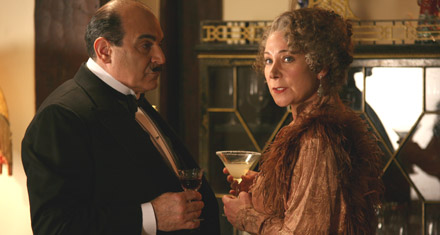 I’ve spent another pleasant Sunday evening with Hercule Poirot as he solves the murder of Mrs. McGinty in the small village of Broadhinney. The murderer has already been convicted and is sentenced to die by hanging, and detective Poirot has only two weeks in which to find the actual murderer. His gray matter working overtime, Poirot manages to accomplish the task. If you missed watching this splendid series the first time around, click here to watch both Poirot episodes online on the PBS website until July 5th. While I found this episode satisfying, the story line was a bit too complicated to follow without losing the thread, although I did identify the actual murderer early on.
 For my taste, I thought that last week’s The Cat Among the Pigeons was a bit more satisfying, though I did enjoy watching Amanda Root (Anne Elliot, Persuasion) again, regardless of her small part. And Siân Philips (right) is, as always, excellent. Mrs. Marple’s turn comes next week. I can’t wait.












 Jane Austen's World