Feeds:
Posts
Comments

Regency Riding Habits

glengarry habit miss mcdonaldThis description in The Grand Sophy by Georgette Heyer makes me wonder if Georgette Heyer was looking at this 1817 Ackermann fashion plate of The Glengary Habit when she wrote the passage:

When Miss Wraxton’s invitation was conveyed to Sophy she professed herself happy to accept it and at once desired Miss Jane Storridge to press out her riding dress. This garment, when she appeared in it on the following afternoon, filled Cecilia with envy but slightly staggered her brother, who could not feel that a habit made of pale blue cloth, with epaulettes and frogs, a la Hussar, and sleeves braided halfway up the arm, would win approval from Miss Wraxton. Blue kid gloves and half-boots, a high-standing collar trimmed with lace, a muslin cravat, narrow lace ruffles at the wrists, and a tall-crowned hat, like a shako, with a peak over the eyes, and a plume of curled ostrich feathers completed this dashing toilette. The tightly fitting habit set off Sophy’s magnificent figure to admiration; and from under the brim of her hat her brown locks curled quite charmingly; but Mr. Rivenhall, appealed to by his sister to subscribe to her conviction that Sophy looked beautiful, merely bowed, and said that he was no judge of such matters.

riding habit 1816
The mannish riding attire in the above image from 1816 is simpler than the first image, lacking the epaulettes, military-style piping and frogs, but it does emulate the masculine style and echoes a military overtone with the Shako hat.  It is interesting to note that until the mid-19th century tailors, not dress-makers, designed female riding habits.

Sean Bean as Richard Sharpe

Sean Bean as Richard Sharpe

The riding hat, or Shako Hat, was adapted from military headdress worn by the Infantry. By 1800, the cocked hat had been replaced by Shakos ornamented with a brass plate bearing the King’s crest. They sported  a tuft fixed in front rising from a black cockade. After each war it had been the habit of the British Army to adopt a head-cover belonging to its allies or the enemy.The cylindrical, flat-topped Shako adopted for the Infantry after the Napoleonic Wars was  in vogue among Britain’s Continental Allies.  Feminine versions of the Shako were often tied with sheer scarves which trailed behind and had feather plumes in front.

Learn more about the topic in these links:

British History Online

I would like to suggest British History Online for your perusal. This rich resource includes information about London throughout the ages, including the Regency Period,  geographical places, genealogy charts, and census records. The factual descriptions, even with their lack of detail, make the era come alive again. The following quotes provide a small sampling of the information that sits on this endlessly useful site:

Dictionary of Traded Goods and Commodities: 1550-1820

Borage, or Forget-Me-Not

Borage, or Forget-Me-Not

This dictionary includes descriptions and definitions of items that have historic signifance. Helpful to the historian, student, and author, each term is listed alphabetically and, like the OED, includes its history.

Borage water [burrage water]

Water made from BORAGE, and probably the same as AQUA LANGUE DE BOEUF. It was a pleasantly flavoured drink with limited medicinal uses. For example, the earliest reference in the OED online claimed it was ‘good agaynst madnes or vnwytyng [German ‘unsvnnigkeit’ (spelling as OED)] and melancolye’. Both John Gerard and Nicholas Culpeper confirmed the excellence of borage generally against these conditions, and Culpeper added that the water ‘helpeth the redness and inflammation of the eyes’ [Culpeper (1792)].

See also DISTILLED WATERS.
Sources: Inventories (early), Inventories (mid-period).
References: Culpeper (1792).

Survey of London

I refer to this section most often when researching London. This section describes St. James’s and Westminster in astonishing detail.

In 1720 St. James’s Market was described as ‘a large Place, with a commodious Market-house in the Midst, filled with Butchers Shambles; besides the Stalls in the Market-Place, for Country Butchers, Higglers, and the like; being a Market new grown to great Account, and much resorted unto, as being well served with good Provisions. On the South-west Corner is the Paved Alley, a good Through-fare into Charles-Street and so into St. James’s Square, and those Parts; but is of no great Account for Buildings for Inhabitants.’  Provisions were ‘usually a fourth Part dearer than in the Markets about the City of London, most of the Provisions being brought from thence, and bought up here by the Stewards of People of Quality, who spare no Price to furnish their Lords Houses with what is nice and delicate’.

St. James's Market, Haymarket, 1850

St. James's Market, Haymarket, 1850

By the early nineteenth century St. James’s Market was no longer of such good repute. Writing in 1856 the Reverend J. Richardson remembered it and the adjoining streets as being ‘very properly avoided by all persons who respected their characters or their garments, and were consequently only known to a “select few”, whose avocations obliged, or whose peculiar tastes induced them to penetrate the labyrinth of burrows which extended to Jermyn Street, and westward to St. James-square’.

Sackville Street

General John Fane, 11th Earl of Westmorland, born in Sackville St, 1784. Image by Sir Thomas Lawrence, 1815

General John Fane, 11th Earl of Westmorland, born in Sackville St, 1784. Image by Sir Thomas Lawrence, 1815

Though perhaps not in the first rank of fashion, the larger houses in Sackville Street, particularly those on the west side, attracted throughout the eighteenth century the minor nobility, the dowager, the member of Parliament, the senior army officer and the prosperous medical man. But the present commercial character of the street is not of recent origin. Even at the time of building there were three shops (two apothecaries’ and a cheesemonger’s), one tavern and a coffee house. By the beginning of the nineteenth century the tailoring trade, which is so prominent in the street today, had already established itself. Out of thirty-two tradesmen and professional men listed in Sackville Street in the Post Office directory for 1830 about 40 per cent (thirteen) were tailors; the next largest group consisted of four solicitors. This proportion has not changed considerably to-day (1962), for although many of the houses have been divided and there are fewer private occupants, about 34 per cent of the one hundred and fifteen listed tradesmen and professional men are tailors.

Other topics found on this site:

Layout 1Gentle Readers, This Georgette Heyer book is reviewed by Lady Anne, a paragon of friendship and nonpareil of GH reviewers. She is someone who, to my way of thinking, is “without an equal.”  In celebration of all things Georgette Heyer and Jane Austen, my regency-loving friends and I will partake of pâté, whole wheat triscuits, grapes, and French wine tonight. Here then, for your summer reading pleasure, is Lady Anne’s review of The Nonesuch, another incomparable offering by Sourcebooks.

A ‘nonesuch’ is something unrivalled, a paragon, or something like nothing else. The hero in Georgette Heyer’s romance entitled The Nonesuch is indeed all of the above. Sir Waldo Hawkridge has been nicknamed Nonesuch by those of the Corinthian set, because he could do it all: drive, ride, shoot, fish, box, dress elegantly in an unobtrusive fashion suiting his splendid physique. The book begins as Sir Waldo has been named the heir to an elderly and eccentric cousin; others in the Family had attended the reading of the Will in vain hope, where we meet also the two younger cousins who have looked up to and been assisted by Waldo – one well, and one poorly –as they have grown from grubby schoolboys to young men about Town. And we discover another attribute of Sir Waldo’s that truly makes him a paragon.

Many of the heroes in Heyer’s frothy Regency romances are jaded with society and its predictable lifestyles. Over-burdened with family members wanting something from them, or chased by match-making mamas more interested in the money and pedigree attached to their names, knowing that they must marry for the sake of the family, they are bored with life as only idle rich can afford to be. Sir Waldo, however, has followed his parents’ examples and precepts: “My father and my grandfather before him,” he tells a character in the book, “were considerable philanthropists, and my mother was used to be very friendly with Lady Spencer – the one that died a couple of years ago, and was mad after educating the poor. So you may say that I grew up amongst charities! This was the one that seemed to me more worth the doing than any other: collecting as many of the homeless waifs you may find in any city as I could, and rearing them to become respectable citizens….”

Here for once is a wealthy man who is interested not only in his own amusements, but also actively considers his responsibilities and pursues good works: the epitome of noblesse oblige.
Waldo plans to house some 50 orphans in his new legacy, but before he has made the renovations to the house and made the contacts with the people in Leeds, he doesn’t want it widely known.

The Nonesuch takes place in Jane Austen’s England, with the village society, country house parties, and gossip. There is a broader range of society here than in London where they would stay stratified within the ton; some of the families here are definitely below the salt. It is another example of the changing times. But like any Austen neighborhood when a new bachelor finds his way there, parties abound. And romance flourishes.

The Nonesuch also tends to his philanthropic business, first by seeking out the vicar to get his assistance in getting his business done in Leeds. The town appears in the book as a nearby shopping mecca for the young ladies, but its interest to our hero is that it was one of the fast-growing factory towns that thrust England into the forefront of the world as the Industrial Revolution changed the way all the classes interacted. The Enclosure Acts of the late 18th and early 19th Century took away the wherewithal of many of the poorest classes to earn their living from the land by assigning the use of previous open land to the local lord. The poor flocked to the cities and the factories to sustain themselves, not always to the best effect for their health. Illness, malnutrition, and drunkenness took their toll, and the Nonesuch found plenty of the ‘brats’ under the auspices of the parish, for whom he could do a great deal.

Which is not to say that we actually see Sir Waldo meeting with the good people of Leeds; his work is alluded to obliquely in several different situations throughout the book, moving the plot along.

More to our immediate interest, Sir Waldo also finds in the neighborhood one Ancilla Trent, a young lady of impeccable breeding, currently working as a companion to a beautiful and amazingly spoiled young minx. Like Sir Waldo, Ancilla is serious-minded person. Not one to become a financial drain on her family, she gives up her chance in the Marriage Mart to work first as a teacher and then to keep the lovely and headstrong Tiffany Weld from destroying her own chances at a good marriage; Tiffany is wealthy, but she is mercantile rather than gentry, barely seeing the point of basic courtesy, and much too sure of her position as most beautiful heiress in the area. With all the young men of the neighborhood, Sir Waldo’s two young cousins, the young ladies of the neighborhood, as well as Tiffany, we have all the ingredients for plenty of delightful parties and outings, an abundance of amusing chatter, and one of the very best last scenes any book could ask for.

The Nonesuch looks like a typical Regency romance, but as Georgette Heyer always provides, there is much more between the covers.

Georgian town houses in Bath

Georgian town houses in Bath

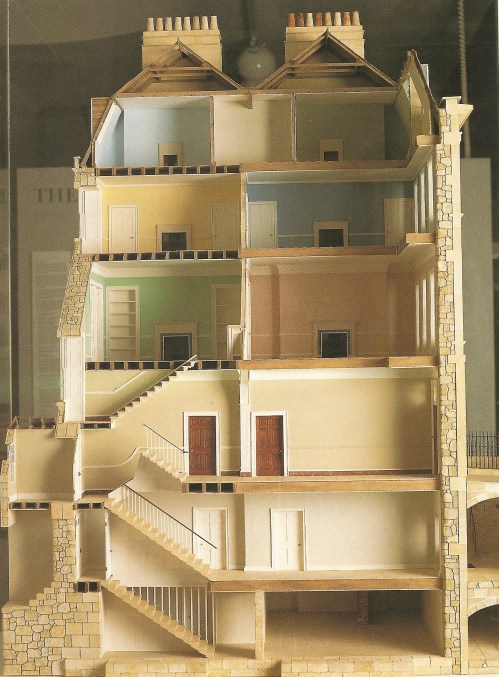
Cutaway of a Bath town house

Cutaway of a Bath town house

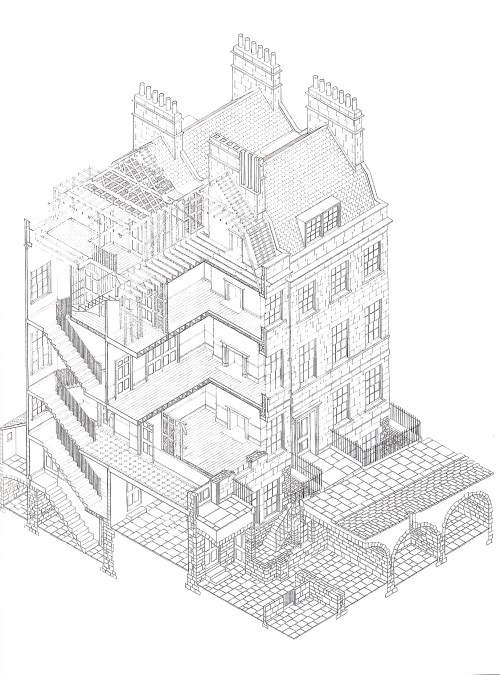
When we think of Regency architecture we think of the beautiful Georgian architecture so popular in Bath and Brighton. While there were subtle variations in design and detail, the basic plan for First Rate houses was similar to Fourth Rate houses*.

Bath Regency town house

Bath Regency town house

  1. The basement, or subterraneans section: All except the poorest houses had basements. They were occupied by the kitchens and other servant offices. The housekeeper and cook might be given rooms in this area away from the maids who slept in the attic.
  2. Ground floor: The drawing room was placed near the front door so that it was easily accessible. Drawing rooms were a place to greet visitors and where the women of the house could retreat. The humbler parlor was generally a private room where the family could retire. Furnishings in the drawing room were generally more feminine than those in the adjacent dining room. Double doors would lead to the dining room, which was more austere and masculine in nature. After dinner the men would remain there to enjoy conversation over port and cigars, while the women retreated to the drawing room. The closer the dining room was located to the kitchens, the warmer the food remained when it arrived at the table.
  3. The first floor: Featured a large room for entertaining on a grand scale, such as dancing, card playing, or other fashionable pastimes. This floor might also hold the principal bedrooms, which were generally placed in front of the house. The bedrooms would be decorated lavishly and in the latest style.
  4. The second floor: Featured bedrooms for children, or perhaps a lodger or guests.  Little expense went into decorating the nursery in comparison to the lower bedrooms. As the levels rose, the complexity of room decorations were simplified since fewer visitors bothered to climb the stairs to the upper levels. In general furnishings, mouldings, and decorations were modest on these floors.
  5. The attic: Reserved for the servants, whose beds were often like murphy beds and let down from the wall.  These rooms were cheaply painted and furnished.
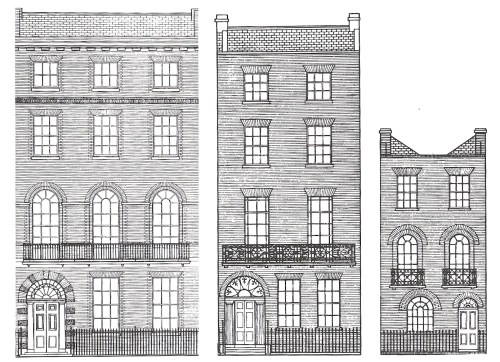
Georgian houses: first rate, second rate, and fourth rate

Georgian houses: first rate, second rate, and fourth rate

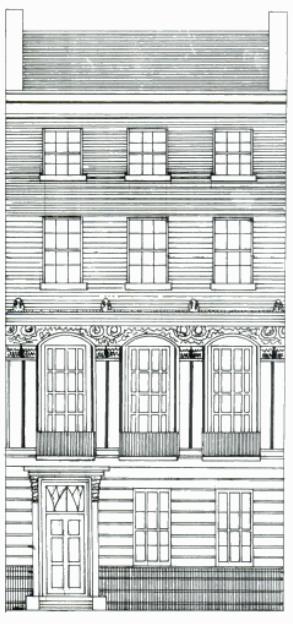
Throughout the 17th century, London houses had been susceptible to big fires that swept through narrow, twisting lanes in the city’s center and houses made of timber. A series of Rebuilding Acts specifying building construction followed the Great Fire of 1666 that destroyed over 14,000 houses. A rise in population generated demand for housing, encouraging land owner to develop large tracts of land. The Building Act of 1774 prescribed how houses were to be built. The act specified the use of stone or brick and determined the width of the street, the size of the houses, floor to ceiling heights, and the layout of the houses. It also defined the four types of houses that could be built in London. Each of these types were standardized and followed strict building guidelines:

First Rate House: Worth over £850 per year in ground rent and occupied over 900 square feet of space. These houses faced streets and lanes.

First rate house

First rate house

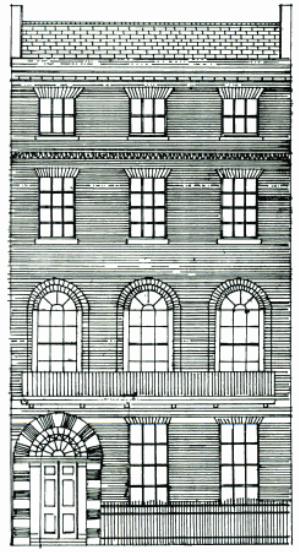
Second Rate Houses: Worth between £350 and £850 in ground rent and occupied 500-900 square feet of floor space. They faced streets, lanes of note, and the RiverThames.

Second rate house

Second rate house

Third Rate Houses: A smaller house worth around £150-£300 and occupied 350-500 square feet. They faced principal streets.

Fourth Rate House: Worth less than £150 per year in ground rent and occupied less then 350 square feet. These houses stood in their own ground.

About ground rent:
Land owners improved their land by laying out roads and services.  They then charged rent on this land. Housing developers (landlords) would build spec houses on the improved land and generate an income from leaseholders by collecting rent. Sometimes the land owner and the house landlord were the same person. These people were usually owners of great estates, which were better managed and the most sought after. Original leases were for as little as 33 years, but by the end of the Georgian era the length of time for many leases was increased to 99 years.

Curiously, the people who paid rent on large houses belonged to the nobility or gentry or prosperous merchants. While they did not own the houses they lived in, they received enormous incomes from their properties and businesses.

My blog, Jane Austen’s World, has a different look and feel depending on which browser you use. I am curious to know how my blog’s pages look on your computer. Does your view resemble image A, which is how Jane Austen’s World looks on Firefox and Google Chrome…

A. Firefox or Google Chrome header

A. Firefox or Google Chrome header

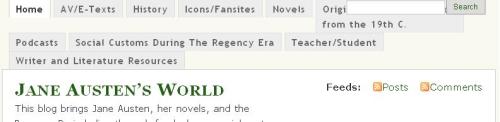
or does it resembles image B, which is how my blog looks on Internet Explorer. In image B the pages on top of the blog are messed up.

B. Internet Explorer header

B. Internet Explorer header

Thank you for taking this short poll.