This YouTube clip is pretty funny. It’s a parody of the end of a regency meal and a subsequent duel. For more about this British series, please click here to read my previous post.
Posted in jane austen, Popular culture, Regency World | Tagged The Supersizers Go |
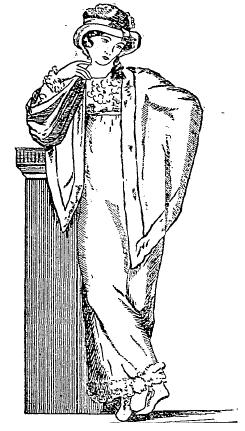
1811 Regency dress, New York Times illustration, 1913
How Today’s Styles Ran Their Course 100 Years Ago is a New York Times article (in PDF format) that ran in the paper on July 27, 1913. In it the author provides a comprehensive early 20th-century view of French fashions that were popular a century before. The author contrasts the racy French directoire styles with the more sedate British fashions of the period, and traces the evolution of the free flowing, transparent Grecian-inspired clothes to the tight, constricting crinolines that made their appearance in the second half of the century. The author worries that the fashions popular at the turn of the 20th century echoed “the scandalous gowns influenced by Paris directly after the revolution.”
This nearly century old article is definitely worth reading for its historic value and for its insights.
Read more on the topic:
- Les Incroyables et Merveilleuses: Fashion as Anti-Rebellion
- Les Merveilleuses
- Clothing of 18th Century England
- Fashion, Culture and Identity, Fred Davis, 1992, Google Book (Partial Book):
Posted in Fashions, jane austen, Regency Life, Regency style | Tagged How Today's Styles Ran Their Course 100 years Ago, Les Merveilleuses, New York Times 1913 | 1 Comment »
On her website, Diana Birchall discusses how she began writing Mrs. Elton in America, originally entitled In Defense of Mrs. Elton.
In Defense of Mrs. Elton had an interesting evolution. It began as an internet serial told on the Janeites online literary list. The group was discussing this obnoxious character from Jane Austen’s Emma, and I undertook to defend her. My defense took the form of a serial story, told in eleven parts over the period of about a month, and the response from the geographically far-flung, but intellectually close-knit Janeites community was startling…All three “Mrs. Elton” stories are collected in the volume, Mrs. Elton in America.
Vic: Diana, I am so pleased to learn that SourceBooks has published your book, Mrs. Elton in America, a comedic novel, in which, as the publisher says, Mrs. Elton crosses the Atlantic Ocean with her caro sposo and children and enjoys high comedic adventures in Boston and New York society. She also visits a Southern slave state, and dwells among the Comanche Indians. Goodness, but Mrs. Elton gets around!
Diana: Thank you! Well, if even a quarter of those things happened, Mrs. Elton would surely be the talk of Highbury, wouldn’t she? It’s not a place where there’s a tremendous amount of action going on. Yet Mrs. Elton is an energetic character. I felt she could use a greater scope for her activity, and it might even be beneficial for her, and improve her faults. (I know more travel would definitely improve mine…)
 Vic: I’ve already written about your delight with the book’s cover , which is very lovely AND lively, but I’m sure the readers of this blog are curious to learn more.
Diana: About the cover painting: I was browsing through an online gallery of the luminous, exquisite portraits by 18th century French woman artist Vigee LeBrun – a real pleasure – want to see the site? Here it is: http://www.batguano.com/vigee.html – and one face popped out at me. Remember when Jane Austen was in a gallery and “found” the portrait of Mrs. Bingley? In my less exalted case, I saw a face that said “Mrs. Elton” to me. Sort of a vulgar expression, and an over-gaudy costume. It turned out to be the Duchesse de Berry, but never mind! An earlier version of the book used a cowgirl picture, but that was never right. Now it’s right! (That is, if you think the Duchesse de Berry is Mrs. Elton. Oh well, if I’m deluded, don’t let me wake.)
Vic: Let’s face it, Mrs. Elton, though a memorable character, is not one of Jane Austen’s most beloved creations. Why concentrate on her? Why not write more about Jane Fairfax or Mary Crawford, for example?
Diana: In the first place, Mrs. Elton is funny! A character people love to hate, with a decided and distinct personality. I could never see writing about Jane Fairfax, she’s so…limp and repressed, I’ve never warmed to her. Mary Crawford, yes; a splendid wily witty Lady Susan-esque heroine. However, I identified with Mrs. Elton long ago, and there’s no help for it. She seems to have become my fate. (As Anne Elliot says in Persuasion, “It is not a very enviable one; you need not covet it.”) You know, the first time I read Emma, I couldn’t even see what was so awful about Mrs. Elton, why everyone in Highbury thought she was so dreadful. I grew up in New York and brash pushy behavior was what one saw every day, so Mrs. Elton only seemed normal! Gradually, of course, on successive re-readings, I learned to understand her social crimes, but I also found that her behavior was, in many ways, no more reprehensible than Emma’s own. The difference lies in Jane Austen’s editorial point of view, how she presents the two characters. At every opportunity she signals to us that Mrs. Elton is inappropriate, vulgar, striving for effect in her manipulations, while Emma is only young and mistaken in hers. When I wrote the first Mrs. Elton story, “In Defense of Mrs. Elton,” I came to see her side of things – that it was possible to sympathize with her, as a stranger, an outsider, so roundly and rapidly rejected by Emma, the Queen of Highbury society where she was going to live for the rest of her life.
Vic: Tell me about the impetus to write the book. Why did you decide to take the Elton family to America?
Diana: The impetus was that I’ve always been interested in transatlantic stories. Stories where an American character goes to England (as in some of Frances Hodgson Burnett’s books, for example – The Shuttle, or A Fair Barbarian), or where an English character goes to America. My main inspiration was Frances Trollope’s famous memoir, Domestic Manners of the Americans, which is jaw-droppingly brilliant journalism. Frances Trollope, Anthony Trollope’s mother, an excellent, spirited narrator and vigorous personality, went to America in the 1820s (just when Mrs. Elton would have) and wrote a vividly observed, yet extremely condescending and sarcastic description of the coarse Americans. Her viewpoint of the Americans influenced visiting authors’ attitudes ever since – I believe until this day. And I thought, what if Mrs. Elton traveled to America the way Mrs. Trollope did – what would she think of it, what would the Americans think of her, what sort of adventures would she have, how would she be changed? It just seemed like a funny idea.
Vic: You had researched Mrs. Darcy’s Dilemma extensively and worked hard on finding Jane Austen’s voice in your writing. Was the process easier with Mrs. Elton?
Diana: I’d read Jane Austen thousands of times, poring over each sentence and its beauty and balance and structure, by the time I wrote Mrs. Darcy’s Dilemma. I wanted it to be a beautiful book. I was less concerned with beauty when I started writing (or, let’s face it, “being”) Mrs. Elton. She is comedic and crass and not exquisite. Besides, by then I had developed some facility in writing in pseudo-early 19th century style. I found I could rather alarmingly snap myself into being her, and write *as* her. We are, regrettably, so very alike, after all…
Vic: Tell us a little about your writing process. Up at the crack of dawn, or writing late into the evening? Disciplined, or waiting for inspiration?
Diana: Waiting for inspiration, and when I get an inspiration, then I am driven and determined and disciplined, and just barrel away at a thing until it’s done, using every spare moment of free time. But I don’t get inspirations very often (grin).
Vic: I find your day job of reading scripts for a major movie studio fascinating. Care to share some of the details with the public?

Diana Birchall in Vancouver
Diana: It’s always been the ideal job for me and I know I was very lucky to have found what Dorothy L. Sayers calls my “proper job,” early in life. I’ve worked in the movie business since the 1970s, when I moved out to California after graduating from college. I had a B.A. in English, a small child to support, and was doing temp jobs. Then an aunt suggested I look up my grandmother’s old literary agent. My grandmother, Onoto Watanna, was the first Asian American novelist (she was half Chinese; I’m half Jewish; too difficult to explain), and she’d had a career as a Hollywood screenwriter in the 1920s. Her agent, a perky little man with a bow tie, was still alive, though elderly, and he gave me some scripts to read. That’s how I started, and I became what’s called a story analyst – a studio reader. I’ve been at Warner Bros since 1991, where I’m the “book person,” reading novels. Although I’m on staff I work from home, and that, of course, is ideal for a writer. Also, the work is excellent in itself, because I’m forced to work on deadline, be disciplined and professional, and turn out serviceable analytical prose every day. Very good training. As for the job itself, it’s something I have always loved doing – after thirty years I’ve never staled or got tired of it! I’m still excited each time I’m sent a new manuscript (they come via email now, which is fabulous; years ago I had to drive out to Burbank to pick up work). I love to read more than anything else in the world anyway, and even if a book isn’t one I might have chosen to read myself, I love to analyze and dissect them. And most of the books are popular novels of fairly high quality; I actually do enjoy most of them. When I don’t, I get through them quickly but professionally: you do develop the ability to read extremely fast after doing this for three decades. So It’s been a good career for me. Would I recommend it to people starting out? Not really. You see, the business is changing, with all the new technologies, and no one’s really sure which way things are going. I’m not sure it’s possible to make a career as a studio reader anymore; the system is dying out. There’ll be some new way of “covering” material, but it’s not clear yet what that will be.
Vic: Anything else you’d care to share with our readers?
Diana: Just that Jane Austen has been my teacher, my solace, my amuser, my inspiration, and my study. As Cassandra called her, “the sun of my life, the gilder of every pleasure.”
Vic: Thank you, Diana. As always your thoughts are so illuminating. You must be pleased with some of the reviews, like Ellen Moody’s, who called your book “a polished performance,” or Maggie Lane’s, who said, “It’s a delight to meet with old friends in new situations. America, where everything is bigger and better, is just the setting for the obnoxious but hugely entertaining Augusta Elton.”
Diana: Indeed, some most esteemed people have said lovely things, and I have been very pleased! Only one reviewer missed the point, that it was supposed to be, you know, funny – but then, what is fun for some, is not fun for every one. One half of the world, as Emma said, does not understand the pleasures of the other.
Vic: I can only add, good luck with the novel Diana. Two books published in one year! You must be proud.
- Please click here for my review of Mrs. Darcy’s Dilemma, Diana’s other book.
- Click here for the archives to Mrs. Elton’s current project, her weekly advice column on Jane Austen Today.
Posted in Book review, jane austen, Jane Austen Sequels | Tagged Diana Birchall interview, Mrs. Elton, Mrs. Elton in America, SourceBooks | 3 Comments »
Ah, London. If I were rich, I would visit this city every month. So I shall simply have to rely on interactive maps and panoramic views to satisfy my yearnings. Wikimapia is an online collaborative mapping system that combines google maps with a wiki system, allowing users to add information. Click here to see an interactive image of a portion of London that shows Hyde Park, Mayfair, and Green Park. The square grids provide detailed information about the mapped area when you move your cursor over them.

Static map of Green Park, The Mall, and Victoria Monument, London
The exciting part about this project is that if you have visited this part of the world (or better yet, live there) you can add your knowledge about a particular area. This interactive image depicts Green Park and Pall Mall. You can see Buckminster Palace at the lower left, the Victoria Memorial and the Mall leading from it, and St. James’s Palace in the upper right. To view greater details I keep clicking on the images until I see such details as people walking in the park and cars parked in the streets. Amazing.
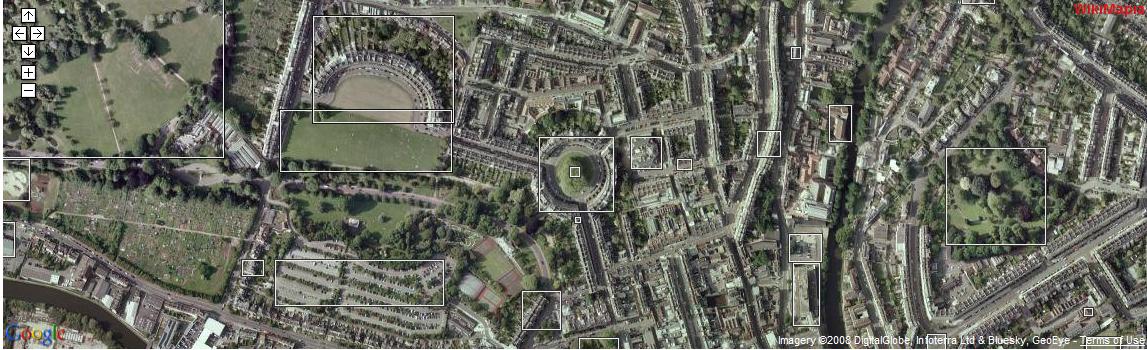
Static map of Bath, England
Let’s not forget Jane Austen and her world. This link leads to an interactive map of an arial view of Bath, England, and this link leads to an interactive close up of Pulteney Bridge (see static map below. The details are so fine that you can see cars parked on the streets. Spectacular.
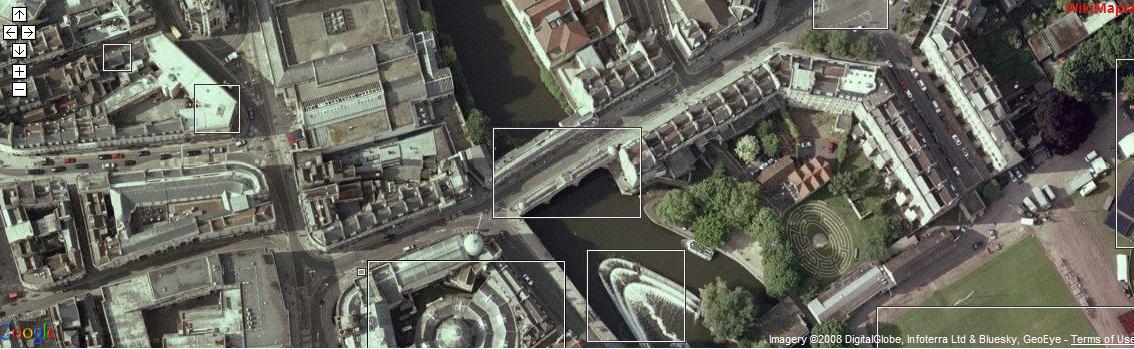
Pultney Bridge, static map
Posted in Bath, jane austen, Mayfair, Regency London, Regency World | Tagged Green Park, Interactive Maps, Pall mall, Wikimapia | 1 Comment »
John Clubbe, the author of ‘Bend it Like Byron: The Sartorial Sublime’, an 18-page PDF document published by Erudit, starts off with some interesting insights about Beau Brummell, Lord Byron, and Napoleon Bonaparte, linking them sartorially during their time and with later dandies, like David Beckham:
Byron
Byron liked being linked with Brummell and Napoleon. In fact, along with Hazlitt and Thackeray he made the association himself. He told Brummell he regarded him “as one of the great men of the nineteenth century.” Evaluating his contemporaries, he placed “himself third, Napoleon second, and Brummell first.” The ranking would have pleased Brummell, but so generous an estimate by Byron of Brummell’s greatness — what can he mean? I have come to think Byron astonishingly prescient. He and Napoleon play leading roles in the Romantic Sublime, but if we ponder what I delight in calling the Sartorial Sublime we discover that Byron gauged well the contemporary fame — and even presaged the future significance — of George Bryan (“Beau”) Brummell.
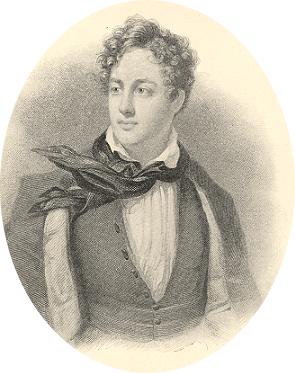
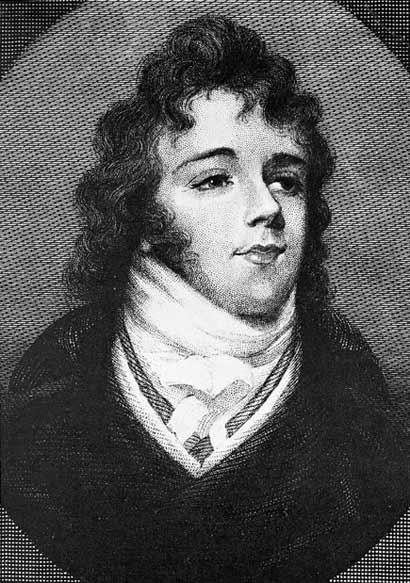
Beau Brummell
While Brummell’s fame as a dandy is still widely known, many have forgotten Lord Byron’s obsession with dress and with the dandy’s attitude of studied boredom, indifference and disdain. His calculated approach to language and style placed him squarely in the pantheon of dandies. J. B. Priestey wrote about dandyism, saying: “In its indifference to serious matters and its intense focus upon trivia, Regency dandyism was a half-defiant, half humorous way of life. There was in it a good deal of poker-faced impudence.” (The Prince of Pleasure and the Regency.) As Mr. Clubbe writes, “Brummell did not concern himself with vulgar politics or economic matters.” This attitude, along with his fastidiousness and obsession with detail in dress, set him apart from other men and drew the Prince Regent’s admiration.
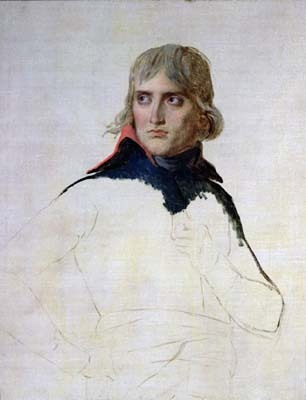
Bonaparte, unfinished portrait by Jacques Louis David
According to Clubbe, Napoleon Bonaparte shrewdly used clothes and dress to stage his ambitions. His private secretary wrote that the general was always impeccably dressed, even when marching. While Bonaparte was instantly recognizable by the simplicity of his attire, his use of clothes in ceremonial state of affairs was another matter. Bonaparte’s garments of robes and ermine could “rival in opulent grandeur those of the Sun King himself.”
Dandyism in its varying forms survives intact today. Clubbe links David Beckham’s modern forays into fashion with Brummell’s, but that he has yet to achieve that seemingly effortless style and attitude towards fashion. This article is well worth reading for its insights and information. (See link below.) In addition I added more links about Beau Brummell and dandies of his age, and highly recommend a visit to Dandyism.net, which I regard the premier dandy web site.
More links about dandies:
- Beau Brummell: Don’t let the title of this blog (On Kayaks) fool you. This is a comprehensive post about the Beau.
- Beau Brummell: King of Fashion: Dandyism.net: More about Beau Brummell on this premier dandy site.
- The Parks of London: Dandyism.net: This post includes an interesting verbal portrait of Beau Brummell.
- Dutch exhibit of The Life of a Dandy: 1800 till the present: This exhibit makes similar points as John Clubbe’s article, only visually. You do not need to read Dutch to understand the gist of this exhibit.
Posted in Dandy, Fashions, jane austen, Regency Customs, Regency Life, Regency style, Regency World | Tagged Add new tag, Beau Brumell, Lord Byron, Napoleon, Regency Dandies | 1 Comment »
-
Join 7,219 other subscribers
-
2025 AGM in Baltimore
-

-
Items of Interest
Blog Stats
- 18,543,818 hits
- Follow Jane Austen's World on WordPress.com
-
RECOMMENDED BOOKS AND RESOURCES
-
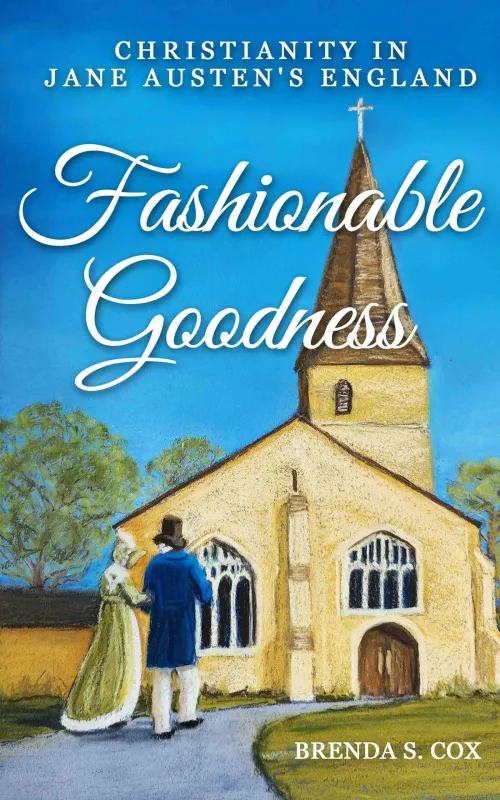
Fashionable Goodness: Christianity in Jane Austen's England is now available! By JAW contributor Brenda S. Cox. See Review. Available from Amazon and Jane Austen Books. 
We also recommend JAW contributor Rachel Dodge's devotionals based on Jane Austen's prayers and classic literature. Reviews:
Praying With Jane: 31 Days Through the Prayers of Jane Austen
The Anne of Green Gables DevotionalThe Little Women Devotional
The Secret Garden Devotional
The Tour of Doctor Syntax. Edited by Ben Wiebracht. Read the review of the book at this link. Click to order the book on Amazon US or Amazon UK or Jane Austen Books FREE Student Membership to JASNA
Available through December 31st, 2025. Click on image for details, and share this poster with other teachers and students!

The Obituary of Charlotte Collins by Andrew Capes

Click on image to read the story.
Comments
“My idea of good company…is the company of clever, well-informed people, who have a great deal of conversation.” – Jane Austen, Persuasion

Gentle readers: Please feel free to post your comments and continue the conversation! Due to SPAM, we will no longer accept comments on posts after 30 days of publication. In some instances, links will be removed from comments as well.
Administrators and Contributors
Pin It!

Top Posts
-
Recent Posts
Links to Jane Austen Blogs
May we suggest?
Hello, my name is Vic and I live in Maryland, USA. I have adored Jane Austen almost all of my life. I am a proud lifetime member of the Jane Austen Society of North America. This blog is a personal blog written and edited by me and my team. We do not accept any form of cash advertising, sponsorship, or paid topic insertions. However, we do accept and keep books and CDs to review.
If you would like to share a new site, or point out an error, please email us. (Yes, we are fallible. We'll own up to our mistakes and will make the corrections with a polite smile on our faces.) Write us at

Thank you for visiting this blog. Your comments and suggestions are most welcome.
Project Gutenberg: eBook of Stage-coach and Mail in Days of Yore, Volume 2 (of 2), by Charles G. Harper
STAGE-COACH AND MAIL IN DAYS OF YORE: A PICTURESQUE HISTORY
OF THE COACHING AGE, VOL. II, By CHARLES G. HARPER. 1903. Click on this link.
Top Posts & Pages
- Regency Fashion: Men's Breeches, Pantaloons, and Trousers
- Men's hair styles at the turn of the 19th century
- Pictorial History of Regency Hairstyles
- Regency Hygiene: The Bourdaloue
- Highclere Castle Floor Plan: The Real Downton Abbey
- The heaving Regency bosom, or was it? Some facts laid bare.
- Social Customs During the Regency
- Cheapside, The Gardiners, and Pride and Prejudice
- Cassandra Writes About Jane Austen's Death, July 18, 1817
- Dancing at the Netherfield Ball: Pride and Prejudice
Tour Chawton Cottage on YouTube
-
Disclaimer: Our team makes no profit from this blog. We may receive books (physical or digitized) for review purposes.
-
Copyright Statement: © Jane Austen's World blog, 2009-2024. Unauthorized use and/or duplication of this material without express and written permission from this blog’s author and/or owners is strictly prohibited. Excerpts and links may be used, provided that full and clear credit is given to Jane Austen's World with appropriate and specific direction to the original content.




 Jane Austen's World