In Sense and Sensibility, a conversation between Marianne and Elinor during Edward Ferrars’ visit to Barton Cottage reveals how much income Marianne considers suitable for setting up house. The Dashwoods had been reduced to living on £500 per year, or around 17,000 pounds in today’s terms. Marianne mentions a sum of £1,800 – 2,000 pounds a year as being adequate in an age when male servants earned from £20 to £60 a year and a female servant from £5 to £15 pounds per year. While these incomes seem desperately low, room and board were usually included. Coal cost 50 pounds per year, and the rent of a medium sized house in London ranged from £12 to £25 per year.* If a family’s income was less than £100 for a single person or £200 for a couple, then the head of the house would probably have to work for a living.
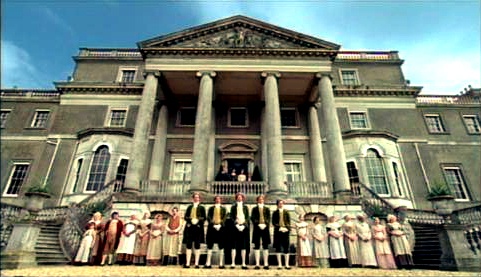
“An income of two thousand pounds was considered quite comfortable, allowing people to maintain a large house, keep horses and a carriage, and employ eleven servants.” (Life in Regency England: More Than Games). Such an income would not have been enough to maintain Norland Park (below), but it would have been quite enough for Willoughby, who married an heiress with £50,000. The interest on that sum would have been £2,000 per year.
Edward: “As moderate as those of the rest of the world, I believe. I wish as well as every body else to be perfectly happy; but, like every body else it must be in my own way. Greatness will not make me so.”
“Strange that it would!” cried Marianne. “What have wealth or grandeur to do with happiness?”
“Grandeur has but little,” said Elinor, “but wealth has much to do with it.”
“Elinor, for shame!” said Marianne, “money can only give happiness where there is nothing else to give it. Beyond a competence, it can afford no real satisfaction, as far as mere self is concerned.”
“Perhaps,” said Elinor, smiling, “we may come to the same point. Your competence and my wealth are very much alike, I dare say; and without them, as the world goes now, we shall both agree that every kind of external comfort must be wanting. Your ideas are only more noble than mine. Come, what is your competence?”
“About eighteen hundred or two thousand a-year; not more than that.”
Elinor laughed. “Two thousand a-year! One is my wealth! I guessed how it would end.”
“And yet two thousand a-year is a very moderate income,” said Marianne.“A family cannot well be maintained on a smaller. I am sure I am not extravagant in my demands. A proper establishment of servants, a carriage, perhaps two, and hunters, cannot be supported on less.”
Elinor smiled again, to hear her sister describing so accurately their future expenses at Combe Magna.
“Hunters!” repeated Edward—“But why must you have hunters? Every body does not hunt.”
Marianne coloured as she replied, “But most people do.”
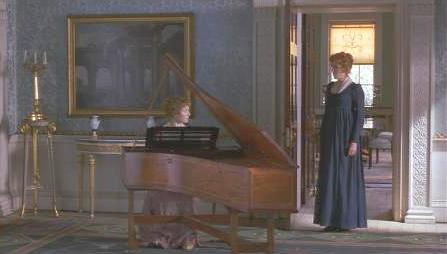
Knowing her situation and prospects, we see how far fetched Marianne’s statements must sound to Elinor and Edward. A woman without fortune needed luck on her side to snag a husband with such an income: she could not depend on looks alone, although great beauty, such as Lady Emma Hamilton possessed, helped a great deal. If a woman had only beauty, then an extravagant man like Willoughby, who could not live without his hunters, must look else where for a bride. As Stephanie Edelman writes in a JASNA Essay contest:
Austen demonstrates throughout Sense and Sensibility just how much inheritance influences the marriage market. Willoughby, who “had always been expensive,” intended to “re‑establish [his] circumstances by marrying a woman of fortune”–Miss Grey, with her “fifty thousand pounds” ‑‑despite his attraction to Marianne. His actions are not surprising, for even Mrs. Jennings explains that “when there is plenty of money on one side, and next to none on the other” romance can take a back seat to economics. Beauty sometimes compensates for a lack of fortune, as Mrs. Jennings hopes when she claims that Marianne would be perfect for Colonel Brandon, “for he was rich and she was handsome”, but a loss of beauty lowers one in the marriage market. Because Marianne worries herself sick over Willoughby and, in John Dashwood’s opinion, “destroys the bloom forever”, he “question[s] whether Marianne now, will marry a man worth more than five or six hundred a‑year, at the utmost”. Thus we see families being formed, not on the basis of love and respect, but on inheritances, yearly incomes, and how much one is willing to pay for beauty. – The Family of Dashwood by Stephanie Edelman
For a fuller explanation of incomes during the Regency era and their relative value today, click on my other post, Pride and Prejudice Economics.
More links on the topic:
*The Period House: Style, Detail, and Decoration: 1774 – 1914, Richard Russell Lawrence and Teresa Chris, Phoenix Illustrated, 1996, 192 pages
Images: 1st – Sense and Sensibility 2007; 2nd – Sense and Sensibility 1996.
 Jane Austen’s incomparable novels have inspired praise, sequels, movie adaptations, artwork, and poetry. Find a few samples of the latter below:








 Jane Austen's World
