Feeds:
Posts
Comments

Miss Annis Wychwood, at twenty-nine, has long been on the shelf, but this bothers her not at all. She is rich and still beautiful and she enjoys living independently in Bath, except for the tiresome female cousin, who her very proper brother insists must live with her.

When Annis offers sanctuary to the very young runaway heiress Miss Lucilla Carleton, no one at all thinks this is a good idea. With the exception of Miss Carleton’s overbearing guardian, Mr. Oliver Carleton, whose reputation as the rudest man in London precedes him. Outrageous as he is, the charming Annis ends up finding him absolutely irresistible. – Sourcebooks blurb

I discovered Georgette Heyer just after I graduated from college. Having run out of new Jane Austen novels to read, I began to search for other regency stories set in similar settings. One day at the library, I stumbled across Charity Girl and Arabella, and my love affair with all things Georgette began.

In those days I was barely older than the youngest of Heyer’s heroines, and could identify closely with The Grand Sophy. I reveled in Georgette’s world filled with bored aristocratic gentlemen who, usually as they traveled by coach or horse to a country inn or walked the streets in London in the middle of the night, stumbled across an innocent and disarming chit who needed rescuing. This plot device was a popular one with the author. Another one of Georgette’s plots was that of the “older” beautiful, rich, and independent spinster (almost on the shelf, but not quite) who is determined to live her life as she likes it and skirt convention when she can. Because she has independent means, she rules her roost and will brook no interference from any man. Invariably, these strong willed women meet their match in an even richer, stronger-willed man, usually a Duke or Earl, but not always as in a Lady of Quality.

I learned about Bath through Georgette Heyer’s eyes, not Jane Austen’s. Oh, Jane mentioned Molland’s on Milsom Street, and her characters take the waters in the Pump Room and attend assembly balls in the Upper and Lower Rooms. But Jane is spare in her descriptions, and could barely be bothered to describe dresses, fripperies, and interiors, or how well a man’s broad shoulders fit into his tailored coat, or that his valet polishes his tasseled Wellington boots with champagne. Georgette revels in these descriptions, and takes them to the extreme. Her characters are rather shallow and predictable, and she uses the same “type” over and over again. However, one doesn’t read a Georgette Heyer novel to learn something new and wondrous about the human character – one reads her stories to learn about Regency manners and mores, and how bored the aristocrats are with their privileged lifestyles, and about carriage rides in Hyde Park, and intrigues in Bath, and elopements to Gretna Green, and for descriptions of satin ball gowns and sprigged muslin day dresses. Georgette’s world is filled with high perch phaetons, and visits to Gentleman Jackson’s salon and Astley’s Amphitheatre, and a night at the opera. When I think of Georgette’s descriptions of matrons, I think of formidable ladies dressed in puce and ostrich feathers, bosoms heaving, and faces pinched with displeasure. Or I think of an older, fluffier, high maintenance woman dressed too young for her age, wearing too many ruffles, always fainting or expostulating about something inconsequential, and driving everyone but our heroine to distraction.

Jane Austen’s novels are meaty and take a long time to digest; Georgette’s frothy, sparkling, and often funny romances are as light and sugary as a meringue, and just as filling, which is to say that one becomes hungry to read more after having just finished the previous book. I have read all of Georgette’s regency romances, but I can barely recall one plot from the other, whereas Jane’s six novels are different and distinct. There is no confusing Persuasion with Pride and Prejudice!


To give Georgette her due, she KNOWS her stuff. Not only was her own “breeding” impeccable, but she married well. She and her husband rented rooms in a grand house in Mayfair, and they knew London inside and out. Georgette visited museums, and filled her notebooks (right) with drawings of costumes, uniforms, carriages, and the like. One of the characteristic that sets Georgette’s books apart from all other romance novels is her use of language and aristocratic cant. She made up many of her phrases, including “A Banbury Tale,” but they sound so authentic that other authors began to copy her, much to her dismay. A frustrated historian, who yearned to be recognized for her serious historical novels, she lived long enough to see her regency romances take off in popularity, and printed in many languages all over the world. Her artist of choice for her hard cover book jackets was Barbosa, (illustration of second book cover) whose talent for portraying the regency world was incomparable.

Georgette and her husband rented space in Albany House in Mayfair, London for 24 years. Turned into bachelor chambers in the early 19th century, its famous renters included Lord Byron and Lord Macaulay.

Georgette is a sweet romance writer, which means that she writes no X-rated sex scenes. In fact, she writes no sex scenes at all. Her characters might kiss and hug, but that is towards the end of the story to seal the deal. Unfortunately, Georgette’s light-hearted books have inspired other, lesser writers, like Barbara Cartland, whose awful repetitive romances about barely post-pubescent heroines with heart-shaped faces and huge liquid eyes are barely digestible. Writers like Cartland have given the entire genre a bad name. As with all genre writers, there are good ones and bad ones. Georgette’s works stand out as among the best. Having said that, her plots about 18-year-old misses catching the interest of 38-year-old dukes attract me the least. When I was young I could barely stomach the age difference, and now that I am longer in the tooth and a tad world weary, I refuse to read them. However, her novels about the older feisty heroine of independent means verbally sparring with her hero still strike my fancy.

Which brings me to the real topic of this post: a review. If you haven’t read a Georgette Heyer book, and you are of a certain age, I would like to recommend that you first read a Lady of Quality, which combines both of Georgette’s two basic plots. The book starts predictably, with our older, stubborn heroine, Miss Annis Wychwood, who has set up her own house in Bath (in a fashionable part of town, of course), returning from a visit with her brother and sister-in-law.  Her chaperone is a meek mannered spinster cousin, who doesn’t dare to cross her rich patroness, which is exactly how Annis had planned it. The hero of the story is Oliver Carleton, the uncle and legal guardian of a silly chit, (Lucilla) who has run away. Annis becomes her protector, which sets up frequent opportunities for Annis and Oliver to verbally spar with one another.

He came forward to shake hands with Miss Wychwood, paying no immediate heed to Lucilla, following her into the parlour. “You can’t think of how relieved I am to see that you haven’t brought your cousin with you,” he said, by way of greeting. “I have been cursing myself these three hours for not having made it plain to her that I was not including her in my invitation to you! I couldn’t have endured an evening spent in the company of such an unconscionable gabble-monger!”

“Oh, but you did!” she told him. “She took you in the greatest dislike, and can’t be blamed for having done so, or for having uttered some pretty sever strictures on your total want of conduct. You must own, if there is any truth in you, that you were shockingly uncivil to her!”

“I can’t tolerate chattering bores,” he said. “If she took me in such dislike, I’m amazed that she permitted you to come here without her chaperonage.”

“She would certainly have stopped me if she could have done it, for she does not think you are a proper person for me to know!”

“Good God! Does she suspect me of trying to seduce you? She may be easy on that head: I never seduce ladies of quality!” He turned from her as he spoke, and put up his glass to cast a critical look over Lucilla. “Well, niece?” he said. “What a troublesome chit you are! But I’m glad to see that your appearance at least is much improved since I last saw you. I thought that you were bidding fair to grow into a Homely Joan, but I was wrong: your are no longer pudding-faced, and you’ve lost your freckles. Accept my felicitations!”

“I was not pudding-faced!”

“Oh, believe me, you were! You hadn’t lost your puppy-fat.”

Her bosom heaved with indignation, but Miss Wychwood intervened, recommending her not to rise to that, or any other fly of her uncle’s casting. She added severely: “And as for you, sir, I beg you will refrain from making any more remarks expressly designed to put Lucilla all on end, and to render me acutely uncomfortable!”

“I wouldn’t do that for the world,” he assured her.

“Then don’t be so rag-mannered!” she retorted.

An experienced reader of romance novels can divine the plot from this short scene, in which Lucilla is induced to speak to her uncle after having run away from him. One thing leads to another, with many plot twists and misunderstandings and heaving of bosoms, until Georgette neatly ties up her various threads, and her hero and heroine live happily ever after. The author was nearly seventy years old when she sent this note to her publisher about the book’s progress:

“I’ve left [Carleton] making himself thoroughly obnoxious to Lord Beckenham in the Pump Room, and must go back to him, and think of a few more poisonously rude things for him to say…I have only to add that Mr. Carleton is not merely the rudest man in London, but has also the reputation of being a Sad Rake, to convince you that he has all the right ingredients of a Heyer-Hero.” (Hodge, p 196*)

SourceBooks is issuing a select number of Georgette Heyer novels in Trade Paper for the first time. Click here to enter the site and see the selections. If you find my description of the book intriguing, then you will not be disappointed reading it. Georgette’s breezy romances are a perfect accompaniment for a summer’s day at the beach or a relaxed afternoon in your lawn chair.

For additional information about Georgette Heyer, click on the links below:

  • *The Private World of Georgette Heyer, Jane Aiken Hodge, The Bodley Head, London, 1984. Quote and illustration of Heyer’s notebook and house are from this book.

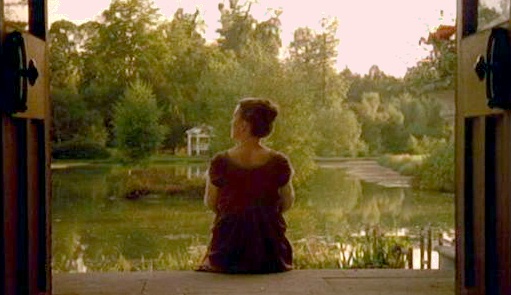
It is ironic that a novel filled with clues similar to those found in a good mystery tale can spin off a film whose clues stand out like a red cape in front of a bull. Jane Austen deftly sprinkled hints about Jane Fairfax’s relationship with Frank Churchill throughout Emma. One has to read the novel twice to find her subtle inferences, and even then one might miss a few. The 1996 film version of Emma, written by Andrew Davies, leaves no stone unturned and drops its clues with such a heavy hand that midway through the film you want to shout – “enough!” Jane and Frank exchange frequent glances, are seen at the piano together in Mrs. and Miss Bates’ apartment, and argue on the terrace at Donwell Abbey. We even see Jane crying after their tiff as she walks through a field hatless. Tsk. Tsk. At least Mr. Davies did not sex up this particular film adaptation.

While I like this film overall, and gave it a favorable review when it was shown during PBS’s presentation of The Complete Jane Austen earlier this year, it did have a cringe worthy moment. Mr. Knightley, forcefully played by Mark Strong, proposes to Emma and says afterwards: “I held you in my arms when you were three weeks old”. Kate Beckinsale as Emma replies before they kiss: “Do you like me now as well as you did then?” Eww! The unfortunate image these words evoke are not at all what Jane intended. Here is how her Mr. Knightley proposes, which is just as it ought to be:

“My dearest Emma,” said he, “for dearest you will always be, whatever the event of this hour’s conversation, my dearest, most beloved Emma—tell me at once. Say ‘No,’ if it is to be said.”—She could really say nothing.—”You are silent,” he cried, with great animation; “absolutely silent! at present I ask no more.”

Emma was almost ready to sink under the agitation of this moment. The dread of being awakened from the happiest dream, was perhaps the most prominent feeling.

“I cannot make speeches, Emma:”—he soon resumed; and in a tone of such sincere, decided, intelligible tenderness as was tolerably convincing.—”If I loved you less, I might be able to talk about it more. But you know what I am.—You hear nothing but truth from me.—I have blamed you, and lectured you, and you have borne it as no other woman in England would have borne it.—Bear with the truths I would tell you now, dearest Emma, as well as you have borne with them. The manner, perhaps, may have as little to recommend them. God knows, I have been a very indifferent lover.—But you understand me.—Yes, you see, you understand my feelings—and will return them if you can. At present, I ask only to hear, once to hear your voice.”

Jane DID bring up the differences in ages, but earlier in her novel, when 21-year-old Emma and 37-year-old Mr. Knightley attended a family gathering soon after Mr. & Mrs. John Knightley arrive for a visit. The conversation occurs some time after Mr. Knightley had chastised Emma for influencing Harriet in declining Mr. Martin’s marriage proposal. In this scene, Emma and Mr. Knightley speak as long-standing friends and as relations through marriage:

Emma: “What a comfort it is, that we think alike about our nephews and nieces. As to men and women, our opinions are sometimes very different; but with regard to these children, I observe we never disagree.”

Mr. Knightley: “If you were as much guided by nature in your estimate of men and women, and as little under the power of fancy and whim in your dealings with them, as you are where these children are concerned, we might always think alike.”

Emma: “To be sure—our discordancies must always arise from my being in the wrong.”

Mr. Knightley: “Yes,” said he, smiling—”and reason good. I was sixteen years old when you were born.”

Emma: “A material difference then,” she replied—”and no doubt you were much my superior in judgment at that period of our lives; but does not the lapse of one-and-twenty years bring our understandings a good deal nearer?”

Mr. Knightley: “Yes—a good deal nearer.”

Emma: “But still, not near enough to give me a chance of being right, if we think differently.”

Mr. Knightley: “I have still the advantage of you by sixteen years’ experience, and by not being a pretty young woman and a spoiled child. Come, my dear Emma, let us be friends and say no more about it. Tell your aunt, little Emma, that she ought to set you a better example than to be renewing old grievances, and that if she were not wrong before, she is now.” – Emma, Chapter 7, Volume One

Since watching this film adaptation, I have often wondered why Mr. Davies inserted those words about Emma as a baby into the script at what should have been a supremely romantic moment. Thankfully the Harvest Ball almost made up for his faux pas, almost, but not quite. Although the scene ends the movie on a perfect note, Jane never wrote it for her novel.
Score: Jane Austen, 100; Andrew Davies, Good try.

For more posts about Emma, 1996, click on the links below:

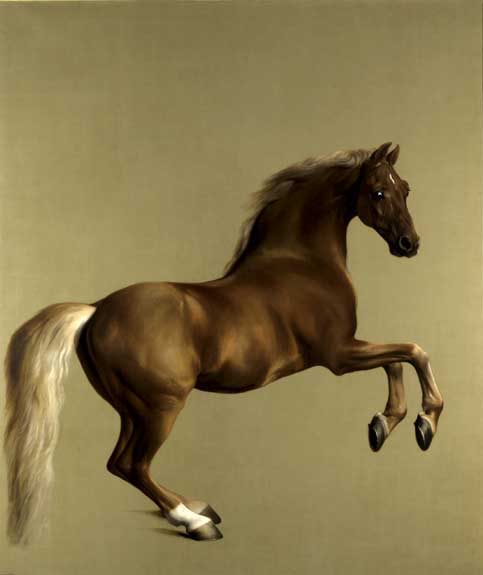
What could be more magnificent to a Georgian gentleman than a fine stallion with fiery eyes and beautiful confirmation (musculature), a thoroughbred horse known to have won an important race and who could sire other champions? George Stubbs, a painter who specialized in horse and dog portraiture, painted Whistlejacket on commission for the Marquess of Rockingham in 1762. When it isn’t on loan to another museum (this oil painting is on exhibit in York through August) this arresting, iconic, and almost life-sized image hangs in the National Gallery in London.

Whistlejacket was foaled in 1749, and his most famous victory was in a race over four miles for 2000 guineas at York in August 1759. Stubbs’s huge picture was painted in about 1762 for the 2nd Marquess of Rockingham, Whistlejacket’s owner and a great patron of Stubbs. According to some writers of the period the original intention was to commission an equestrian portrait of George III, but it is more likely that Stubbs always intended to show the horse alone rearing up against a neutral background. (Description of the painting on the National Gallery website, image from Wikimedia Commons)

George Stubbs was born in 1724 in Liverpool. Largely a self-taught painter, his fame among aristocratic horseman and sportsmen as a painter of animals was at his height when Jane Austen began to write First Impressions. The artist’s interest in horse and human anatomy equalled his interest in painting, and he studied the subject to such an extent that he was commissioned to illustrate a book on midwifery in 1751 by Dr. John Burton. His ground-breaking book, the Anatomy of a Horse, was published in 1766. Stubbs, whose paintings hung in the private collections of the great houses of his aristocratic patrons, and who was highly regarded in these circles, as well as among the naturalists of his day, did not find general fame until he was rediscovered in the 20th century. To this day, most of Stubbs’s painting remain in private collections.

The origin of the name, Whistlejacket, is interesting. In Yorkshire, the local name for the treacle/gin drink was ‘whistle-jacket’. When made with brandy instead of gin, the color of the drink would have resembled the color of this palomino stallion’s coat.

The painting is more like a candid photograph, capturing the essence of the horse’s beauty and energy in a split-second shot. The horse is sensuous with its chestnut gleam and rounded, muscular form. Whistlejacket’s eye does not meet the viewer’s; instead, it seems to look inward, contemplating. (Art Straight From the Horse’s Mouth)

To read more about George Stubbs (1724-1806), click on the links below:

An 1825 Homespun Gown

This plain dress made in Vermont circa 1825 is a rarity: a homespun dress that survived being cut into pieces for rags. The rough plain weave wool fabric was hand dyed and hand sewn. Most of us save our prettiest gowns for posterity, but we rarely save our every day dresses. Beautiful examples of ball gowns and richly decorated party dresses survive, but this gown, just sold on Vintage Textiles, is worth more than its weight in gold for the mere fact that it survived in such good condition. Hurry over to the site to view the many images of this dress before the link is discontinued. Oh, dear, the link has already been taken down.

Vintage Textiles, as you know, is one of my favorite sites. The visual displays of the clothes for sale are unparalleled, and each item comes with a provenance and rich description. I would suggest that you visit this site often if you are interested in the fashions of the era. Many of the pieces are surprisingly affordable, especially the accessories. I was devastated to read that one bride had purchased a vintage lace gown from Vintage Textiles and had it redesigned into a modern wedding dress. While the dress was pretty, she had ruined a one-of-a-kind, historical gown.

Inquiring Readers,

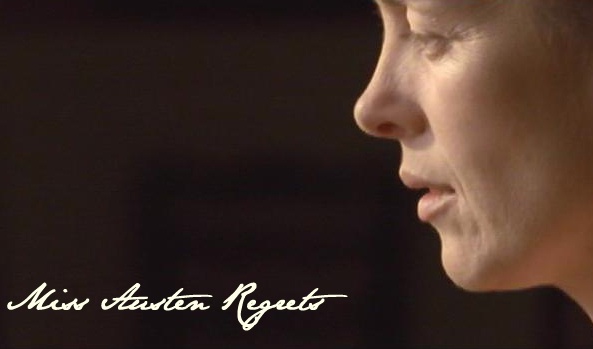
When I read Professor Ellen Moody’s comments regarding Jane Austen Regrets 2007, I realized we were in complete agreement about the movie. She includes historical and literary details that set her essays apart from most movie reviews. Ellen has graciously allowed me to publish her thoughts on this blog.

Dear all,

It’s been asked how accurate is this film as a biography. That’s a hard question to answer because it depends on how you read Austen’s letters; and the letters themselves represent a minority of the letters she wrote and they are censored (clipped, abridged, cut — and we all know how one word left out can make a very great change in tone, not to omit literal meaning).

I rewatched it last night (thanks to my good friend, Judy, who sent me a video of the movie as it played on British TV). Alas, it too seems to be 84 minutes. It’s reported on IMDb that the movie is 90 minutes altogether; since scenes are so short (sometimes lasting 11seconds nowadays) and the camera cuts to and fro from scene to scene, 6 minutes is not nothing to lose (if 6 are indeed lost — bringing up the question which 6 and why were these cut?)

I think the real question is how unhappy was Austen’s life. The film presented her as very unhappy basically, even though she had freedom to write. Olivia Williams did the part with great tact and intuition and irony and made the state much more believable than the shallow imbecility (and glamorized victimhood complete with the crew adoring our heroine at the end) of ‘Becoming Jane’. We should recall first that (as Mary Lefkowitz among others in her lives of the classic poets says), it’s common for popular biography to present the life of a genius in any area as miserable; she suggests this comes out of envy, a desire for compensation (that is, most or many people’s lives are thwarted and unhappy and it makes them feel better to see the genius suffer too, a sense of alienation from someone different) and her classic case is the myths surrounding Euripides and she has a number of modern ones too.

A perceptive article on the recent spate of biopic movies shows that to a movie they all attribute the genius’s insight to loss of love. It must be a love affair that motivates the writing; nothing else will do, and in the case of a woman, she must be helped, inspired by the man she loved. Shakespeare in Love. Moliere. Dear Jane led to write by Tom Lefroy.

This one did show these paradigms in spades. Jane is different and thus alone so must be unhappy. Jane must have been in love and lost and thus we see where she got her stories.

Still I think it better than that; smarter. It seemed to suggest she was unhappy beyond this simply because she was dissatisfied with the choices offered her, whatever these were. She urges Fanny to marry, but she herself won’t take what’s on offer because she doesn’t want it.

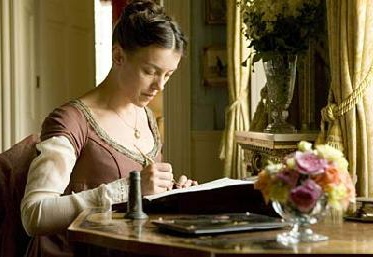
It would have been more believable as a real depiction of a real life if there had been less physical beauty all around her, but that’s too much to ask in a heritage film I suppose. And we did get the new poverty: Austen used to be presented as richer than she was; the recent spate of films about her characters show them as much poorer than Austen imagined, and now she has come down to live in a farm-like cottage (below) with Cassandra in barely clean clothes too.

But we do see that her relations with her relatives are less than comforting — too bad they had only the mother; what about the aunt? What about the uncle? And we got only two brothers. Was there some salary limit so the pathology of family life had only minimal representation? (The 07 films have all been very minimalist in budget.) It is true there is strain in the letters from the mother, and from the mother’s leftover writing we see that she was very materialistic.

I’ve thought Austen was not happy in the way that’s common in lives. She had to live on a small allowance; she couldn’t travel about without a man or post (beneath her); the little evidence we have about her family, the manuscript of her leftover chapters of Persuasion and her letters show she was under some pressure to write conventionally (she had thought she was safe over the moral about the mother’s advice in Persuasion but not so, her mother resented the book somehow or other). She had to write for 3 decades before she could get anything in print, and then she wasn’t exactly getting huge sums (but then that was rare). The man who wrote back about Northanger Abbey was very nasty over it: she must give him the 10 pounds before he returns the NA manuscript and if she publishes, he’ll sue. I guess he wasn’t impressed by her connections, wasn’t afraid at all of offending her. Her close woman friend may have betrayed her (by sending the young man she was attracted to away) and then she died early (from a carriage accident); another was a governess in her brother’s house; her sister-in-law and cousin, Eliza, died before her. Her father died leaving her mother and sisters and her without an adequate income. Most of all she died young and in great pain and the sickness was a while coming on.

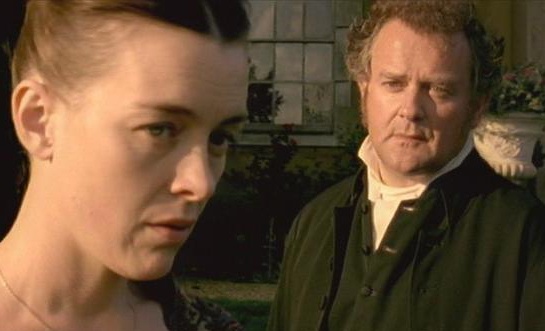
As to the specifics the film made it’s claim for — as I read the letters with common sense — there is no iota of evidence that Austen ever had a deep feeling love affair with any specific man, none whatsoever, and certainly not with Bridges (Hugh Bonneville, left) nor he for her; he did marry and had a passel of children and as far as we know did not go after Austen with his grief from the loss of her. Family members, such as Cassandra, told of a romance around 1802-4 in the west country where the man said he would meet Austen again next year but died. He is strangely omitted from the film — too vague? It does seem Austen had a crush or liking for Tom LeFroy and he for her, but this was easily quashed: he was sent away to make sure he didn’t get any further involved with a girl with no dowry, a fringe person who needed better connections, couldn’t offer them.

James Macavoy as Tom LeFroy and Anne Hathaway as Jane Austen in Becoming Jane

The story of Harris Bigg-Wither was told by someone else, and it does have the ring of truth. None of these three is a deep romance; the two last are anything but. Reading supercarefully I have noticed that in a couple of instances when older Austen was attracted to an amusing or congenial man, like the apothecary. She jokes about the clergyman. But if there was anything serious in it, Cassandra destroyed the evidence, and the tone of the letters is such that lots of people haven’t seen anything in the couple of instances I’ve noticed. One was an apothecary, and to be sure, this writer picked that up.

But to say Austen was deeply regretful at the end of her life that she hadn’t married. Nonsense. Her letters are filled to to the brim with dislike of endless pregnancies. Absolutely typical:

Anna has not a chance of escape; her husband called here the other day, & said she was pretty well but not equal to “so long a walk; she must come in her “Donkey Carriage.”–Poor Animal, she will be worn out before she is thirty.—I am very sorry for her.–Mrs Clement too is in that way again. I am quite tired of so many Children.–Mrs Benn has a 13th… (Jane Austen’s Letters, ed. Le Faye 336, Letter dated Sunday 23- Tuesday 25 March 1817

She preferred to write and to read and had she married it would have been all over for her. She had 3 sisters-in-laws constantly pregnant all of whom died young in childbirth. She writhed under the control of her brothers because she couldn’t travel. The story to be told is of a woman who decided not to marry because in her circumstances, it would have been a slavery forever she couldn’t stand. She regretted not being able to make more money.
She writhed at dying young. She grieved over not being able to finish Persuasion properly.

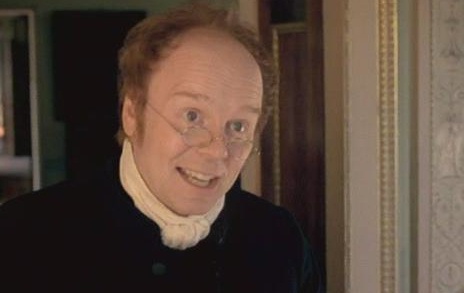
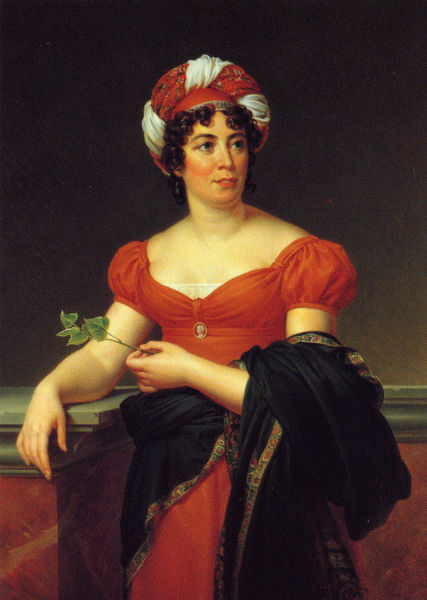
The movie does include the incident with the Regents’ librarian (Jason Watkins as Rev. Clarke at left). We see from her letters she was “taken” up by the Regents’ librarian and show the library. He was a rare literary person she met (if third rate) and he treated her seriously and it was to him she wrote a letter where she expressed some worry that Emma showed she was running out of material in a more sophisticated way than she usually discusses her work. She also makes a striking comment on how court life is a form of slavery she wouldn’t be able to stand. She did make fun of him, but she makes fun of lots of people and sometimes (frequently if we are candid) maliciously. She hardly ever has a good word for a fellow novelist. She was afraid to meet famous novelists in public arenas; she wasn’t used to it and knew she had little to make them respect her in the ordinary wordly way. So she refused an invitation to a party where she would have met Madame de Stael (Wikipedia image at right) even though (a rare instance) she praised Corinne highly (better than Milton she said).

I did like how her friendship for Madame Bigeon was presented, and there was an allusion to Isabelle de Montolieu — the woman who is said to have written Raison et Sentiments. Since I have Montolieu’s text of Caroline de Lichtfield on my site, a biography and her preface to Persuasion the translation, I liked that. But why not Miss Sharpe? Where was Martha who lived with them and married Frank? Where Frank? Who I think Austen did love very much (if only as a sister probably) — at least deeply enough to make the name Frank a repeating one and have Janes fall in love with Frank clandestinely, and have sailors central to her books. Why did we not get Anna? who wrote too. Nor her nephew?

Again why were so many people left out? Maybe to make the interpretation of love as central stick.

I thought as a movie it held together movingly though and was intelligently done. If you know little about Austen’s life, it at least is not complacent like the old 3 part BBC “life and works” type thing, and may just lead the viewer to go back to her letters or find a decent biography.

Ellen

Click here for Ellen’s other posts on this blog:

Click here for Ellen’s blog, Ellen and Jim Have a Blog Too and her main website.

Click here for my review of Miss Austen Regrets