Feeds:
Posts
Comments
profile-Cassidy-Percoco

Cassidy Percoco

Inquiring Readers: guest author, Cassidy Percoco, submitted this informative article about duels during the Regency era. Enjoy!

The duel is a staple of Regency fiction, whether classic (Colonel Brandon and Willoughby’s duel in Sense and Sensibility) or contemporary (Bridgerton, of course). It’s tempting to think of it as a literary device, but in fact duels were an accepted aspect of upper-class and upper-middle-class life, though the vast majority of gentlemen never fought or even witnessed one.

The duel had been introduced to England from Italy in the sixteenth century, and quickly spread along with other Italian notions of courtesy and civility. These new ideas, which were coming to replace the older traditions of chivalry and courtly love, would become entrenched and end up becoming the standard for gentlemanly behavior for centuries. Where chivalry had been focused on aristocratic men proving their honor through their behavior toward women (or at least high-born ladies), these new standards included a great deal of focus on men proving their honor in relation to other men – and in theory, all gentlemen, whether nobly born or of the gentry, were equal in this.

The major proof of one’s own honor was being seen to behave civilly toward other men acknowledged as honorable, and having them behave civilly toward oneself. A gentleman’s reputation was of paramount importance, and any action taken by someone else to threaten that reputation – a direct insult made to his face, or a slander made behind his back – was a problem. Being hit by another gentleman or being accused of lying were two insults that were frequently seen as so intense that they required a duel to settle. However, not all provocation was so clearly endangering to the reputation: any argument could theoretically lead to a duel if one or both participants became incensed enough, although most of the time gentlemen made allowances for each other to avoid actually coming to the field over simple mistakes like being jostled in the street, as being too eager to duel could also be a strike against one’s reputation.

If the insult came from a servant, pauper, or tradesman, there was no shame in responding immediately with one-sided violence, but when it came from another man of honor, the most appropriate way to repair the hurt was for both parties to meet in a duel at a later time, and to fight (generally with swords, until the 1780s) to wounding or even death. This required “seconds,” gentlemen who assisted the combatants by acting as go-betweens and arranging the time and place of the duel. But on another level, the second’s assistance was in being a gentleman who provided assurance that a duelist was also a gentleman himself, since engaging in a duel with someone who technically was not eligible would have been shameful. The duel was so associated with the nobility and gentry that the idea of tradesmen engaging in one was seen as very humorous. The London Times printed numerous stories (almost certainly fictional) relating duels held by florists, tailors, and the like, always showing some cowardice or intemperance to prove that dueling was really the province of gentlemen.
Aristocrat_man_Final1_sm-Cassidy-Percoco

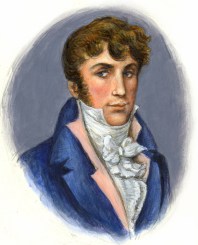
Portrait of an aristocratic man. Copyrighted image courtesy of Cassidy Percoco, illustrated by Joanne Renaud.

The British government opposed the practice strenuously, imposing penalties on those who were caught dueling or who intended to duel. Killing a man in the heat of passion (which did apply to some earlier duels) could lead to the reduced charge of manslaughter, but the decision to defer immediate violence in favor of a fight at an appointed time and place later meant that deaths from dueling were considered cold-blooded murder. However, the sovereigns tended to pardon convicted duelists, and there was overall a widespread tolerance for violent behavior on the part of gentlemen, whether aimed at each other or their social inferiors. As long as a duel was considered a fair and honorable attempt to satisfy honor, a duelist who killed his opponent could generally avoid consequences. On the other hand, a duel seen as a malicious attempt to kill someone was not given the same tolerance. For instance, a duel between a Major Campbell and a Captain Boyd in Scotland in 1808 was fought in a closed room with no seconds, and resulted in Captain Boyd being fatally wounded; on his deathbed, Boyd accused Campbell of having rushed him into such an unorthodox duel against his wishes, and as a result, Campbell was actually executed.
512px-thumbnail-Dueling pistols

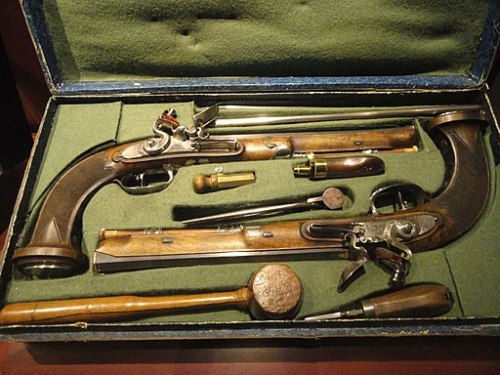
French cased duelling pistols, Nicolas Noel Boutet, single shot, flintlock, rifled, .58 caliber, blued steel, Versailles, 1794-1797 – Royal Ontario Museum – Public domain image by Daderot, Wikimedia Commons.

By the time of the Regency, pistols were the preferred weapon in British duels. They were seen as more equitable, as they required less training to wield than the sword – while some might be expert marksmen, there was less likelihood of a pistol duel being decided by one participant having greater skill. Pistols could also be fitted with hair triggers to fire before a duelist was necessarily ready, and the terms of a duel often required both duelists to simultaneously bring the firearm to bear and fire in one movement to force the shooters not to aim. While some gentlemen were known to purchase dueling pistols with rifling in the barrel to increase their accuracy, and to practice target shooting to improve their own ability, this was strongly deplored.

What was important for the restoration of honor was going through the formula of the challenge, the seconds’ deliberations, and the shooting: it was not important to actually hit, let alone kill, one’s opponent by the time of the Regency. A gentleman who had been insulted needed to be willing to stand up with a pistol to prove his honor or he might be thought weak, and a gentleman who had given insult needed to allow himself to be shot at (rather than apologize) so as not to be thought a coward. While duels sometimes ran to multiple volleys of fire, an initial exchange of bullets without harm could often satisfy the needs of honor.

Dueling had always been particularly associated with military officers, as men born into the gentry and aristocracy were both familiar with weapons and put a high price on honor, and as a result, there was an increase in reported duels during the time of the Napoleonic Wars, particularly in London and in port cities where troops might be quartered. In the following decades, however, the practice died out in Britain. Tolerance for aristocratic violence decreased, and at the same time, the barriers between rich and poor increased such that there was less need to show “honor” as a conspicuous sign of class. Modern mid-nineteenth-century men were restrained workaholics, not impulsive and dissolute rakes, and they had a respect for official hierarchy and the rules. The duel would be left behind as a relic of a chaotic and romantic past.

Further reading:

Stephen Banks, A Polite Exchange of Bullets: The Duel and the English Gentleman, 1750–1850 (The Boydell Press, 2010)

Markku Peltonen, The Duel in Early Modern England: Civility, Politeness, and Honour (Cambridge University press, 2003)

Victor Kiernan, The Duel in European History: Honour and the Reign of Aristocracy (Oxford University Press, 1988)

About the Author:

Cassidy Percoco has been focused on history from the time she was a child. After graduating with an MA in Fashion and Textiles: History, Theory, and Museum Practice from the Fashion Institute of Technology, she embarked on a career in museum collections management, and today she works at the Fenimore Art Museum and The Farmers’ Museum in Cooperstown, NY. She has previously published Regency Women’s Dress: Techniques and Patterns, 1800-1830, and runs Mimic of Modes Historic Patterns.
all portraits-Cassidy-Percoco

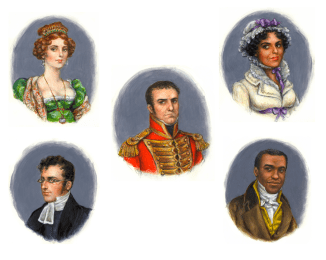
Portraits of roles in Dandies & Dandyzettes. Copyright image courtesy of Cassidy Percoco, illustrated by Joanne Renaud.

A Regency tabletop role-playing game

The topic of dueling is discussed in Dandies & Dandyzettes, a new tabletop role-playing game for one to many players now being funded on Kickstarter. In Dandies & Dandyzettes, players can step into the past and become anyone they can imagine, from a duel-hungry officer to a lady-in-waiting to the queen to a Cheapside lawyer and his family. The book also works as a detailed guide to the world of Regency Britain, from honor ideologies to the specifics of how to send a letter. 

I own quite a few copies of each of Jane Austen’s novels. Many are annotated, some are old editions or designed for children. Others are illustrated with different artists, many of whom are well known. Most recently I purchased Sense and Sensibility (hardcover), and Pride and Prejudice and Emma (kindle.) All three are illustrated by one of my favorite wildlife artists, Marjolein Bastin, who is known worldwide for her delicate watercolors and gorgeous depictions of flowers, birds, and animals from the field. Click on images below to view some of the beautiful illustrations up close.

photo of Marjolijn Bastin

Illustrator Marjolein Bastin

While Ms Bastin’s painting subjects do not at first seem aligned with Austen’s stories, they are as romantically gorgeous as the author’s prose. They are, in fact, perfect gifts for introducing family members and friends to your favorite author. Considering Austen’s upbringing in Steventon and the countryside and her final years in Chawton Cottage, these images in  Ms Bastin’s portfolio are suited to evoking the countryside in soft, beautiful strokes.

Certainly purchasing a hardback is the best choice, for such a book is tactile, allowing us to finger the pages, and flip back and forth to reread a passage. Hardback books last a long time and remain in good condition much longer than a paperback. In Sense and Sensibility’s edition, gifts of inserts appeared at random throughout the chapters – note the postcard in figure four above!

Online books also have their good features, however. They are portable. I can read them on several devices any time and any place where I have connectivity. My iPad and smart phone allow me to read at night without light, and to change the font size to suit my eyes. While one can find particular passages, the tactile joy of reading a book is gone. When purchasing these books, one does not own them. You are only renting them.

Plus, digital volumes are hidden inside a tablet or computer, while my hardbacks are given logical designations inside my bookcases. I can feast my eyes on them at will and run my fingertips lovingly along their spines. Below are the covers and inserts from my digital books.

More information about illustrated books & illustrators:

About Marjolein Bastin:

Marjolein’s work is enjoyed the world over. In addition to her partnership with Hallmark, she provides ongoing contributions to Libelle, as well as a variety of product partners in Europe and North America. She and her husband Gaston divide their time between country homes in Holland, Switzerland and in Missouri, near Hallmark’s headquarters, as well a tropical retreat in the Cayman Islands. Each setting provides a unique glimpse of what nature has to offer throughout the world.

My personal story: My mother (Moeder) filled a Bastin Dutch birthday calendar of her friends and relatives. This is how I got to know the artist. (My first cousin’s name is Marjolijn.) See the calendar front page below in Dutch.

By Brenda S. Cox

Church livings play an important part in most of Jane Austen’s novels.

For example:

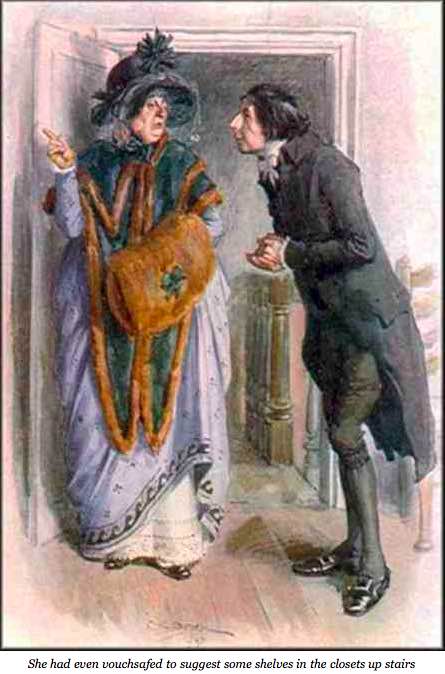
A fortunate chance had recommended him [Mr. Collins] to Lady Catherine de Bourgh when the living of Hunsford was vacant; and the respect which he felt for her high rank, and his veneration for her as his patroness, mingling with a very good opinion of himself, of his authority as a clergyman, and his right as a rector, made him altogether a mixture of pride and obsequiousness, self-importance and humility.—Pride and Prejudice chapter 15

Mr. Collins “venerates” his patron Lady Catherine, who gave him a living as a rector. (C.E. Brock)

A church living was a permanent job as rector or vicar of a parish, and the income, house, and farmland that went along with that.

In a country parish, most of the income came from tithes. People in the parish were legally required to pay the clergyman 10% of their income, which was usually from farming. It might be paid in crops, animals, and eggs, or in cash. During Austen’s time the system was changing over to cash, but many still paid in produce.

The clergyman also sometimes got income from glebe, the farmland that was part of the living. (Austen usually calls this land “meadow.”) And he might get a few pounds a year from the fees people paid for weddings, funerals, etc.

Some parishes in England traditionally had (and still have) a rector. Others traditionally had (and still have) a vicar. Mr. Collins was a rector, like most of Austen’s clergymen. Edward Ferrars is also offered a position as a rector:

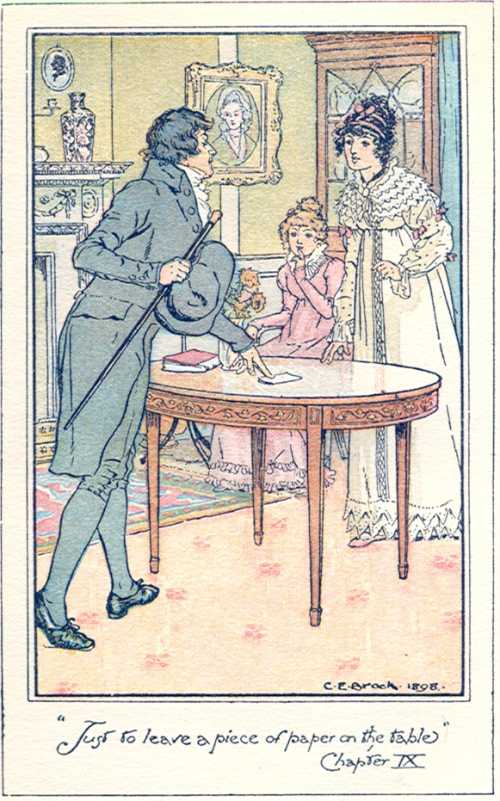
“It is a rectory, but a small one”—Col. Brandon on the church living he is offering Edward Ferrars, Sense and Sensibility chapter 39

Colonel Brandon with Elinor; he gave a living to Edward Ferrars as a parish rector. (C.E. Brock)

The word rectory could mean either a job as a rector, or the rector’s home (also called a parsonage) that was provided with the living. Here it means his position. The word rector, by the way, is related to the words right and rectify. The rector was supposed to lead his parish in the right direction, and he had certain rights, which Mr. Collins is proud of.

Mr. Elton, though, is not a rector. He’s a vicar.

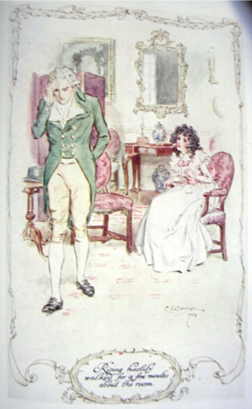
“He [Mr. Elton] had a comfortable home for her [Harriet], and Emma imagined a very sufficient income; for though the vicarage of Highbury was not large, he was known to have some independent property”—Emma chapter 4

Emma does not recognize Mr. Elton’s need for money, thinking he will marry Harriet. (C. E. Brock)

The word vicarage, like the word rectory, could refer to his position or his home; here it means his position. Vicar is related to vicarious, it means standing in the place of someone else.

A rector or a vicar had the same duties. They led church services, preached, officiated at ceremonies like baptisms, met with the vestry to deal with parish issues, helped the poor, and so forth. However, they did not receive the same level of pay.

There were two kinds of tithes. Parishes had their own agreements and definitions about what was included in each. But most commonly:

Greater tithes included everything that came from the ground, like wheat, oats, and barley.

Lesser tithes were usually fruit, eggs, and the young of animals.

If a clergyman was the rector of a parish, he got all the tithes.

If a clergyman was the vicar of a parish, he only got the lesser tithes, usually about a quarter of the total tithes. Someone else, probably the patron, was actually the rector and took the greater tithes.

Farmers brought their tithes of grain and animals to the parish clergyman. From A Clerical Alphabet, Richard Newton, Courtesy of The Lewis Walpole Library, Yale University

So, I think Austen is very intentional when she makes Mr. Elton a vicar. Emma knows that he doesn’t make a lot of money as vicar (“the vicarage . . . was not large”). Austen also gives us another clue:

“Mrs. Bates, the widow of a former vicar of Highbury, was a very old lady . . . She lived with her single daughter in a very small way . . . her [daughter’s] middle of life was devoted to the care of a failing mother, and the endeavour to make a small income go as far as possible.” —Emma chapter 3

Mrs. and Miss Bates, the widow and daughter of the former vicar of Highbury, live in poverty. (C.E. Brock)

Mrs. Bates’s husband, the former vicar, had not made enough money to leave much for his wife and daughter. So the income of this parish, at least for the vicar, is certainly low.

Emma, as usual, is clueless. She doesn’t realize that Mr. Elton, a vicar, is going to need to marry for money (though her readers would have known). So, the fun begins!

The third major type of clergyman was a curate. You can read more about curates in my post Nothing But a Country Curate

Brenda S. Cox blogs on Faith, Science, Joy, and Jane Austen at brendascox.wordpress.com . She is working on a book entitled Fashionable Goodness: Christianity in Jane Austen’s England.

In 2021, on the heels of Bridgerton’s success, Netflix announced a new adaptation of Persuasion starring Dakota Johnson as 27-year-old Anne Elliot and Cosmo Jarvis as Captain Wentworth. Henry Golding, given the choice to play either the captain or William Elliot, interestingly chose the latter. Also on board are Richard E. Grant and Suki Waterhouse as, I suppose, Sir Walter Elliot and Elizabeth Elliot, for their roles have not been announced. The other cast members are described at IMBD Persuasion 2022.

Persuasion pulbicity-Netflixfilm

Let these exquisite photos of Dakota Johnson, Cosmo Jarvis (t), and Henry Golding (b) tide you over until PERSUASION, a most excitable new film adaptation of Jane Austen’s novel arrives on Netflix in 2022.- NetflixFilm twitter @NetflixFilm

Netflix is betting on a sure thing. In addition to Bridgerton, now in its second season, the powers that be at Netflix must also have noticed Emma 2020’s draw. Before theaters closed during the pandemic, this film drew huge audiences in its opening weeks and enjoyed a steady stream of online viewers during lock down.

Jane Austen’s final novel was published posthumously in 1818, and by many it is considered her finest. This new adaptation is described as a “modern, witty approach.” We’ll see how well this approach matches Austen’s nuanced novel. Carrie Cracknell, a theater director, directs this film. Like Autumn de Wilde (Emma. 2020), she is a first-time film director. The script was written by Ron Bass (Rain Man) and Alice Victoria Winslow (Hot Spot). 

Filming began in 2021, and a release date is anticipated this year. The film is now in post production. I’m curious to see how this Persuasion stacks up against two previous adaptations, one in 1995 starring Amanda Root, and in 2007 starring Sally Hawkins. Stay tuned for more news as it comes.

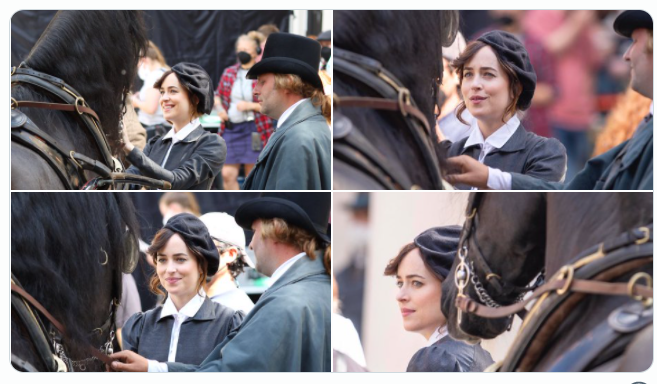
Behind the scenes photos-PhotoWorld Twitter

Behind the scenes photos from Twitter, Period Drama World @WorldPeriod

Review of Persuasion by Tony Grant of the theater production, 2022

“PERSUASION (an adaptation of Jane Austen’s novel by Jeff James and James Yeatman) at The Rose Theatre Kingston upon Thames.”

Marilyn and I went to see Persuasion performed at The Rose on Tuesday 8th March. It may be strange but  for somebody who professes to know a little bit about Jane Austen it is a long time since I had actually read the novel. I have delved deep into Austen’s novels over the years for quotes and to reference her possible thoughts  and ideas about life and love,  but I have failed to read the whole of the novels since I first read them all  years ago.  I have lost sight. I think of what Jane actually wrote. So I read Persuasion again and it wowed me. It is a novel that explores the shifting of society  in the early 19th century when much was changing, not just relationships, but class and the industrial world was taking off. It seems apposite that at the moment when the world order is actually changing that The Rose Theatre chose Persuasion to dramatize. 

I know that novels, good novels, that is, as you read them again over time and  as your own experience of life develops,  reveal  different levels of understanding. So what did I get from reading Austen’s Persuasion this time round before seeing the performance?  The word ,persuasion, is used at times during the novel, but not often. The actual consequences of being persuaded however are felt throughout and drive the novel itself. Anne Elliot was persuaded by not just her father to refuse a  marriage proposal to somebody she really loved  but Lady Russell, the family friend and Anne’s particular friend, was always the deciding factor in the process of persuading  Anne in her youth. Ann seems to have been persuaded into a lot of things in her early life up to the moment of the novel’s action including turning down that offer of marriage from Captain Wentworth eight years previously.   Ann is  annoyingly hyper neurotic. Is that because she has always been pressured by others? Does she feel  she has no control over her life?  

Things happen to Anne. She doesn’t make things happen for herself. She analyses every situation, almost every word and look to an intense degree. She  always comes out worst. In this novel and in the play she eventually learns to decide for herself. So a major theme has to be how we use people’s advice and how much we should be persuaded when making life decisions for ourselves.

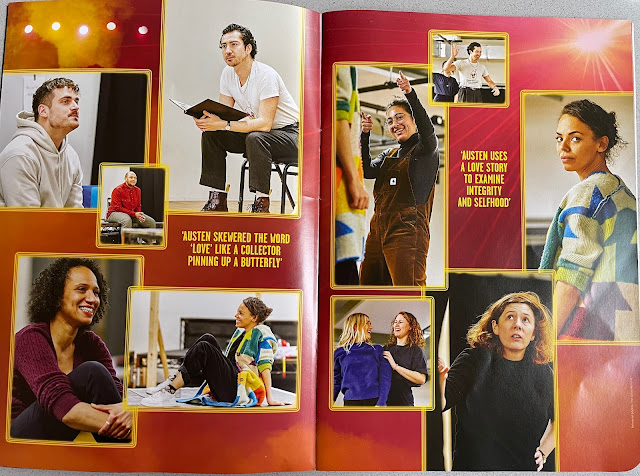
Persuasion-program-Image@TonyGrant

Persuasion program. Image taken by Tony Grant. See more of his images in the link at the bottom of this post.

A novel written in the early 19th century  translated into  a play set in the 21st century, surely, it can’t be done. They are two worlds so far apart. How can they possibly come together and meet? There are the wise among us that say Austen is universal in her treatment of relationships. This is true when you drill down to what happens in a  relationship  but all those 18th century rules get in the way to a  translation across centuries, surely? Class status, wealth,  attitudes to money and  the patriarchy  and what seems to us blatant misogyny but wasn’t understood as such in the 18th century, how does it all get transferred to the 21st century? When I read Persuasion again finishing the day before we saw the stage adaptation, I couldn’t see any way that it was possible to achieve that transfer from the 18th century to the 21st century.

To finish the review, continue to read how this production achieved its 21st century point of view and how the comedy was resolved on London Calling, Tony’s blog. Note: Tony Grant is a frequent contributor to this blog. His site covers all things England, past and present.

When the world is topsy-turvy and my heart is heavy, many of us find comfort in the beauty of Austen’s novels, in the richness of the movie adaptations, and even in the thought of the lovely Hampshire countryside, secluded and beautiful, tucked away and secure.

The world inside Austen’s novels never changes. The familiar scenes and characters are always there and waiting. Elizabeth and Darcy never fail to spar and flirt in the drawing room in Pride and Prejudice. Mr. Woodhouse continues to eat his porridge and worry comfortably over the weather in Emma. And at the end of Persuasion, Captain Wentworth always sits down to write his letter to Anne Elliot.

Perhaps that’s why many of us (and why so many others throughout history) have found solace and comfort within the pages of Austen’s novels, especially during times of turmoil. And why her novels have been reprinted and translated and enjoyed around the world by so many people for over 200 years.

Familiar Faces

I find similar comfort in the film adaptations. When I sit down to watch a Jane Austen movie (or even have one playing in the background as I do chores), I love knowing just what to expect. I can’t wait to hear the music I love, listen to the accents and voices of characters and actors I adore, and watch the ever-amusing (and always touching) storylines unfold.

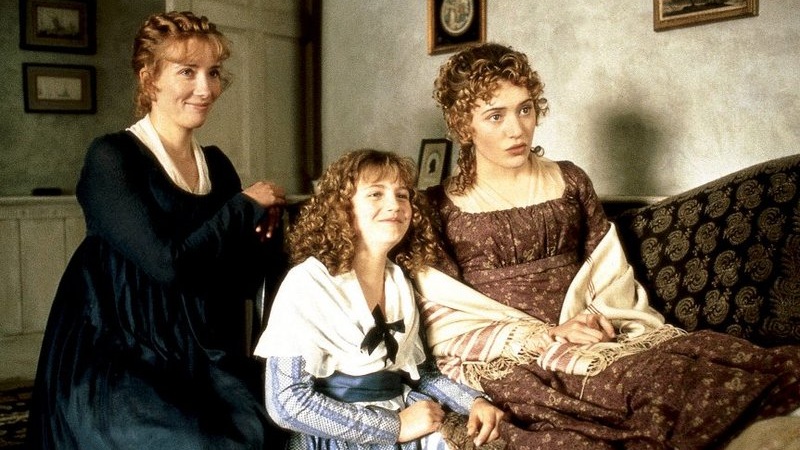
Sense and Sensibility, 1995.
Pride and Prejudice, 1995.
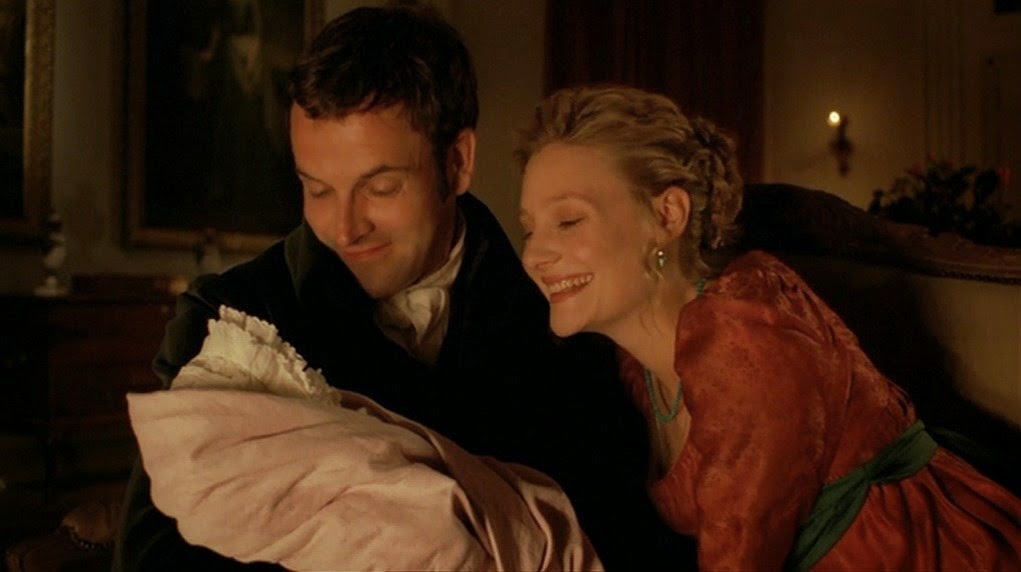
Emma, 2009.

The comfort and familiarity of Austen movies keeps us coming back for more, year after year. There are always new adaptations to enjoy and critique (because there’s nothing better than debating this Emma over that Emma with Austen friends).

Familiar Sights

And then there’s the comfort of Jane Austen’s actual world. Although I know Hampshire is a real place with its own fair share of regular, everyday life activities and stormy days, both figurative and literal (such as when Storm Eunice brought down many trees on the Chawton estate and in Mingledown Woods just last month), the England described in Austen’s novels never fades.

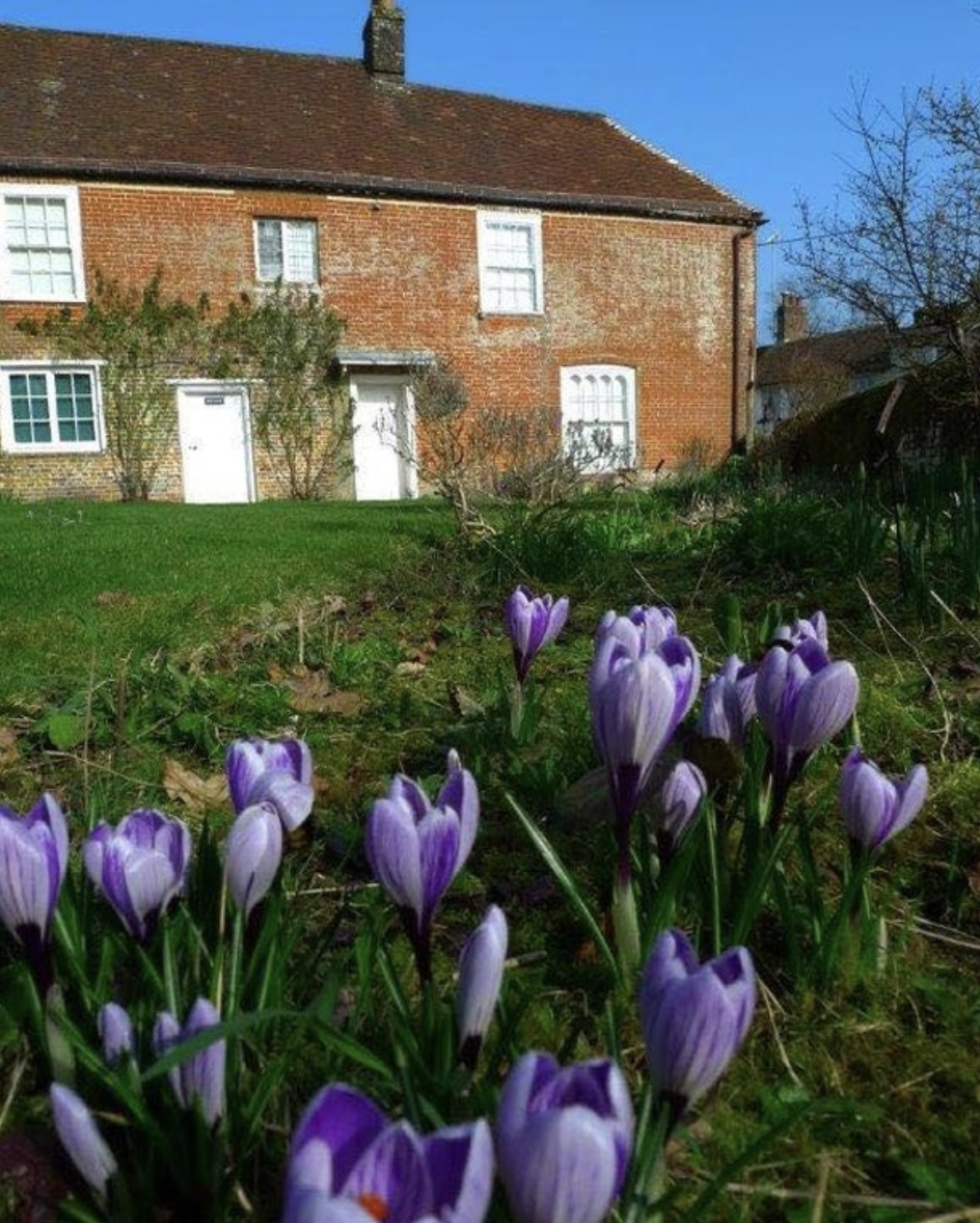
Jane Austen’s House Museum, 2022.

I think the charm of the setting in her books is another reason so many of us as lifelong students and fans of Austen love to learn about her life, her family, and the places where she lived and wrote. During the height of the pandemic, we all did what we could to support the historic sites in England and watched for updates whenever possible. We dreamed of the day when we might get to visit those precious sites again or for the first time. Many of us even took virtual tours so we could “be” there.

Benches Along the Way

That’s probably why I was so overjoyed when I saw the good news a few weeks ago that the bench my local JASNA regional group sponsored had been installed in the Chawton House Gardens. In fact, the entire bench project fundraising is now complete! (I know many of you have contributed in various ways to the care and keeping of the historic sites as well.) Here is a snippet of the announcement:

“This month, we are pleased to announce that thanks to the wonderful support of the North American Friends of Chawton House (NAFCH), we have received the final 17 benches donated through the ‘Share a Bench with Jane’ scheme, just in time for our Spring Flowers season.

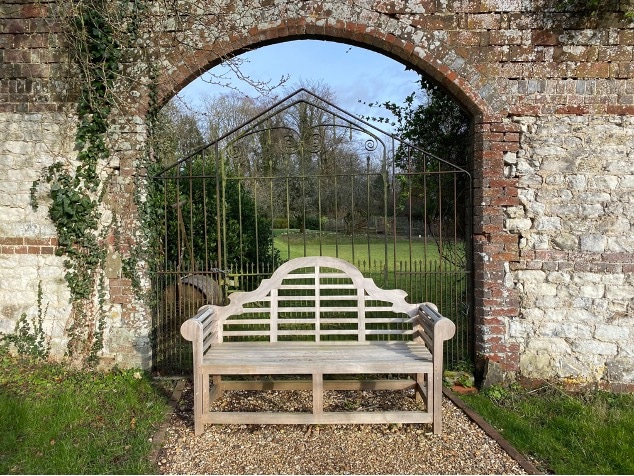
Photo: Chawton House. Bench, 2022.
Location 22: at the head of the Pride and Prejudice Rose Walk.

If you’d like to see all of the bench locations, you can find them HERE.

As I read through the announcement and looked through the photos, I was comforted. I thought about how peaceful it would be to sit on a bench and enjoy the garden around me. I even thought about how I should install a bench in my own small garden area.

And then I came to this lovely quote that was included in the announcement from Chawton House:

Although the recent storms have caused significant damage to parts of the estate, these latest additions mean that visitors to Chawton House will still be able to rest among the spectacular displays of snowdrops and daffodils as we move into a warmer season.”

Isn’t that an encouraging thought? I made me think. Though storms come in this life, there are benches along the way where we can rest. When the journey is long, it’s important to stop and sit. And though some winter seasons are particularly difficult, spring always comes and bright new flowers always bloom.

Signs of Spring

I’ll leave you with that lovely thought and a few photos of the “snowdrops and daffodils” mentioned above. I hope that each of you is finding comfort in the glimpses of beauty around you, in friends and family, in faith and home, in lending a helping hand to others when you can, and in the enjoyment of Jane Austen.

Photo: Chawton House. Snowdrops, 2022.
Photo: Chawton House. Daffodils, 2022.
Photo: Chawton House. Daffodils and Snowdrops, 2022.

Your turn: What is it about Jane Austen’s novels and life that brings you comfort? Why do you think people continue to turn to her work in life’s difficult seasons?


RACHEL DODGE teaches college English classes, gives talks at libraries, teas, and book clubs, and writes for Jane Austen’s World blog and Jane Austen’s Regency World magazine. She is the bestselling author of The Anne of Green Gables Devotional: A Chapter-By-Chapter Companion for Kindred Spirits and Praying with Jane: 31 Days Through the Prayers of Jane Austen. Her newest book The Little Women Devotional just released and is available now! You can visit Rachel online at www.RachelDodge.com.