Feeds:
Posts
Comments

This frontispiece from L’Art de bien faire les glaces d’office,  a book by M. Emy, an 18th century French confectioner, about whom very little is known, depicts how ices and ice cream were made at the time.

M. Emy Fronticepiece2

Click on image for larger view.

Buckets filled with ice and salt held covered metal freezing pots that contained the ice cream mixtures. As the mixture froze, the pots were taken out occasionally to be shaken. The ice cream was scraped from the sides of the pots and stirred. When the mixture was ready, it was placed in decorative molds and served almost immediately. You can see the all the steps of ice cream making in the above image, with ice being delivered from ice houses in the background, and cherubs tending to the freezing mixture, while another hastens to the main house to serve the ices before they melt.

Confectioners tools

Confectioners tools from Gunter’s modern confectioner by William Jeanes. Figure 18 represents a copper funnel. Figure 24 is an oval tub surrounded with ice and salt and containing tow freezing pewter pots. At the bottom is a plug to let out water. Figure 25 represents a Bomba ice mould, which has the impression of fruit and holds from four to six pints each. Figure 26 shows how the hands are positioned whilst modelling flowers.

The process was expensive, for hauling and storing great blocks of ice was a laborious process that began in winter. The ice was stored in ice houses that were dug deep into the ground to keep the blocks from melting even in summer.

The Eglinton Ice House being filled with ice. Eglinton Castle, Kilwinning, Scotland. Image @ Wikipedia

The Eglinton Ice House being filled with ice. Eglinton Castle, Kilwinning, Scotland. Image @ Wikipedia

Only the rich were able to afford this luxury food to any extent until the mid-19th century, when Carlo Gatti began importing  ice in large quantities to London from Norway.

domenico-negri915-correction

Negri’s trade card of the Pot and Pineapple with his description of his shop’s offerings.

The first references to making ice cream harken back to ancient Rome and China. By the mid 18th century, French, Italian, and British chefs had published cookbooks with recipes for ices and ice creams. Specialty confectioner’s shops that offered ices and ice cream began to pop up in London: the most famous of these became to be known as Gunter’s Tea Shop, which survived in one form or another until quite recently.

pot and pineapple detail negri

Detail of the pineapple in Negri’s trade card

In 1757 an Italian pastry cook named Domenico Negri opened a confectionery shop at 7-8 Berkeley Square under the sign of “The Pot and Pineapple”. At that time, the pineapple was a symbol of luxury and used extensively as a logo for confectioners. Negri’s impressive trade card not only featured a pineapple, but it advertised that he was in the business of making English, French, and Italian wet and dry sweetmeats. The confectioner’s art required as much precision and craft as a sculptor or silversmith. Equipment for refining sugar resembled those of a foundry, including specialized pans for melting, devices that calibrated heating and cooling, and a variety of molds to create shapes for chilled custards and ice cream, frozen mousses, jellied fruit, and candies and caramels. Negri’s shop sold

Cedrati and Bergamot Chips, Naples … Syrup of Capilaire, orgeate and Marsh mallow … All sorts of Ice, Fruits and Creams in the best Italian manner’. It also sold diavolini, or little icing-sugar drops scented with violet, barberry, peppermint, chocolate and neroli made from the blossom of bitter orange. For those who could not stretch to the luxury of shop-bought produce but who could afford a book of recipes, a long struggle with the complexities of sugar science ensued.” – Taste, Kate Culquohon

Detail of a James Gillray cartoon of soldiers eating  in a confectioner's shops, 1797. Image @Library of Congress

No Regency image of The Pot and Pineapple or Gunter’s exists. This is a detail of a James Gillray cartoon of soldiers eating in a confectioner’s shops, 1797. Image @Library of Congress

As the chefs of the era attest in their recipes, the taste in ice cream seemed to change with each generation. M. Emy made a glace de creme aux fromages that was flavored with grated parmesan and Gruyere cheeses. Joseph Gillier made an artichoke ice cream and a fromage de parmesan with grated Parmesan, coriander, cinnamon, and cloves frozen in a mold shaped like a wedge of parmesan cheese.

Ivan Day image of ice groups. One can see the recreation of the incredible detail that confectioners were able to create for their wealthy clients.

Ivan Day image of ice groups. One can see his recreation of the incredible detail that confectioners were able to create for their wealthy clients. Ivan Day, Ices and Frozen Desserts

Flower flavors were also common – violets, orange flowers, jasmine roses, and elder flowers – were used in ices. The vanilla bean, although appreciated for its agreeable flavor, did not rise in popularity until Victorian times. Negri must have done a booming business selling syrups, candied fruits, cakes, biscuits, ices, delicate sugar spun fantasies, and elaborate table decorations that showcased his deserts, for his shop survived many decades.

Illustration of ice cream goblets from Emy's cookbook

Illustration of ice cream goblets from Emy’s cookbook

Twenty  years after starting his Berkeley Square establishment (1777),  Negri took in a business partner named James Gunter. The Gunter family, which had both Catholic and Protestant members, had lived in Abergaveny in Wales for generations. (Read a fascinating history about the family at this site, Last Welsh Martyr.)

Exterior of a confectioner's shop in Persuasion, 1995.

Exterior of a confectioner’s shop in Persuasion, 1995.

The shop employed famous apprentices like Frederic Nutt, William Jarrin, and William Jeanes, who would go on to write their own cookbooks. All proudly noted their association with the shop. Interestingly, William Gunter, who was James’s son, wrote the most frivolous cookbook, Gunter’s Confectioner’s Oracle (published in 1830), in which he gossiped, name-dropped, and included some illogical details.

William Gunter in 1830

William Gunter in 1830

One section of the book was supposed to be a dictionary of raw materials in use by confectioners. It started with A for apple, and skipped B because it ‘is to us an empty letter.’ C was a fourteen-page treatise on coffee, in French … Gunter did not name its source…The dictionary skipped D and E. The letter F was for flour. Then Gunter wrote, ‘I now skip a number of useless letters until I arrive at P.” – ‘Of Sugars and Snow: A history of ice-cream making’, Jeri Quinzio, University of California Press, 2009, p. 65.

Tea Room in Bath, as depicted in Persuasion 1995

Tea Room in Bath, as depicted in Persuasion 1995

With two men at the helm, The Pot and Pineapple flourished and by 1799 Gunter had become its sole proprietor, changing the name to Gunter’s Tea Shop.  (I tried to find Negri’s birth and death dates, and can only surmise that he must have retired or died when Gunter took over.)

Berkeley Square, Greenwood's Map

Berkeley Square, Greenwood’s Map

Berkeley Square was uniquely situated to appeal to the upper crust.  Many notable people lived there – Beau Brummell at #42 in 1792;  Lord Clive the founder of the British Empire in India, lived at #45 until he killed himself in 1774; and Horace Walpole, whose letters give the record of fashionable society of his day, lived at #11 until he died in 1797. (Nooks and Corners of Old England.) The square was described as a

frontier land between West-end trade and West-end nobility. The east side is half shops, on the northern there is an hotel. Confectioners and stationers here confront peers and baronets.” – Every Saturday: A Journal of Choice Reading, Ticknor and Fields, 1867.

Berkeley Square in 1813

Berkeley Square in 1813

By the early 19th century, Gunter’s ices had become so fashionable that the Beau Monde, many of whom already resided in tony Mayfair, made it a custom to stop by the shop for a cool ice during carriage rides.

A custom grew up that the ices were eaten, not in the shop, but in the Square itself; ladies would remain in their carriages under the trees, their escorts leaning against the railings near them, while the waiters dodged across the road with their orders. For many years, when it was considered not done for a lady to be seen alone with a gentleman at a place of refreshment in the afternoon, it was perfectly respectable for them to be seen at Gunter’s Tea Shop.- Encyclopedia of London

View from the shop at #7 to Berkeley Square. Note that the plane trees are among the oldest in central London, planted in 1789 by

View from the shop today at #7 to the green space of Berkeley Square. The plane trees are among the oldest in central London, planted in 1789 by Edward Bouverie. One can imagine the carriages parked in this area, with waiters scurrying back and forth. (Few of the original buildings still stand today.)

It seemed that a rendezvous at Gunter’s in an open carriage would not harm a gently bred lady’s reputation! One can also imagine waiters running at a full clip across the street on hot days when ices began to melt as soon as they were released from their molds!

7 berkeley square today

How #7 Berkeley Square looks today

Gunter’s was also known for its catering business and beautifully decorated cakes. In 1811, the Duchess of Bedford’s and Mrs. Calvert’s ball suppers featured the shop’s confectionery, a tradition followed by many a society lady, I am sure.

plate X Gunters

Illustration of an elaborate Gunter’s cake

James Gunter’s success allowed him to purchase land in Earl’s Court, which was largely farmland in the 18th century.

Normand House, built in Earl's Court in the 17th century, is now demolished.

Normand House, built in Earl’s Court in the 17th century, is now demolished. Image @MyEarlsCourt.com

Gunter bought the tracts of land so he could run a market gardening business. The produce  – fruits, vegetables and flowers – was taken daily by horse-drawn wagons to Covent Garden to be sold. Gunter also

bought Earls Court Lodge (near the present Barkston Gardens) which was to be the Gunters’ family home for the next 60 years. This was one of the few substantial houses in the area. (The aristocratic neighbours at nearby Earls Court House, who weren’t keen on having a cake shop owner next door, called it “Currant-Jelly Hall”).” – The Gunter Estate

Gunter died in 1819 and his son Robert (1783-1852), who studied confectionery in Paris, took over the business. Robert hired his cousin John as a partner in 1837, ensuring that the business would stay in the family for several generations. Gunter’sTea Shop moved to Curzon Street when the east side of Berkeley Square was rebuilt in 1936-37. The shop closed in its new location in 1956, although the catering business continued for another 20 years in Bryanston Square. More on the topic:

Please Note: None of the advertisements that sit below this post are mine. They are from WordPress. I make no money from this blog.
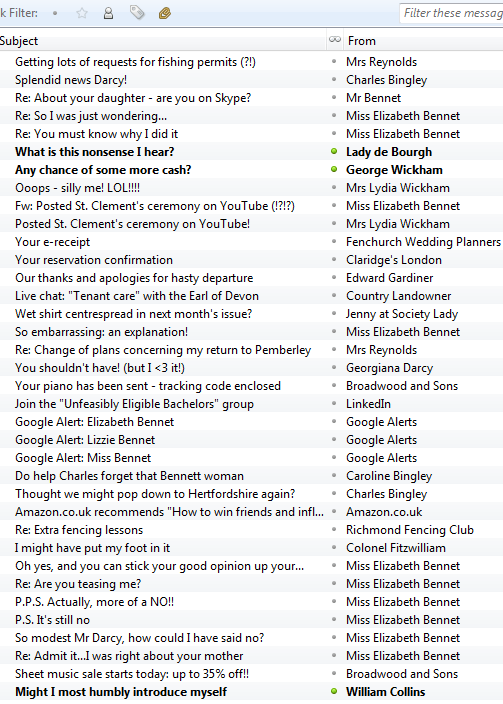
If Jane Austen’s characters were transported to our age, how would they take to twitter and email? Mark Brownlow explores how several characters’  inboxes might look. The concept is pure genius and reading these creations is such fun! Enjoy Mr. Darcy’s inbox. (Here’s Elizabeth Bennet’s)

Mr. Darcy's inbox by Mark Brownlow, Click on image for the full version.

Mr. Darcy’s inbox by Mark Brownlow, Click on image for larger version.

More Jane Austen inboxes here!

Click here to read the inboxes from Catherine Morland, Anne Elliot, Elinor Dashwood, and Elizabeth Bennet.


Please note: the ads at the bottom of this post are by WordPress. I do not receive money for this blog.

In 1838, John Tallis, mapmaker, created a series of street views of central London that are breathtaking. His images showed detailed views of the streets using the facades of the buildings. These street views are much like we use Google street view today, giving us a sense of what the city looked like in the early Victorian era.

TALLIS, JOHN. TALLIS'S LONDON STREET VIEWS, EXHIBITING UPWARDS OF ONE HUNDRED BUILDINGS IN EACH NUMBER, ELEGANTLY ENGRAVED ON STEEL, WITH A COMMERCIAL DIRECTORY CORRECTED EVERY MONTH, THE WHOLE FORMING A COMPLETE STRANGER'S GUIDE THROUGH LONDON... THE PUBLIC BUILDINGS, PLACES OF AMUSEMENT, TRADESMEN'S SHOPS, NAME AND TRADE OF EVERY OCCUPANT. LONDON, N.D. [CA. 1840].

John Tallis’s view of Fleet Street, ca. 1840 Image @Christie’s.

This detail of a Tallis street view comes from the informative London Street Views blog.

This detailed view of a Tannis street view is the header of the of London Street Views blog.

This street view is the header of the of London Street Views blog.

This YouTube video clip of “London Low Life: (published by the Adam Matthew Group) uses a variety of maps to bring early Victorian London back to life. It includes a series of Tallis Street Views, which have been computer enhanced. The website, which is not free, is designed for students and scholars to explore 19th century London in great detail. The video was produced by Axis Maps (www.axismaps.com)

The blog, The Consecrated Eminence, gives you an idea of the size of Tallis’s  street views, which were modest when compared to the Grand architectural panorama of London: Regent Street to Westminster Abbey: from original drawings made expressly for the work by R. Sandeman, architect, and executed on wood by G.C. Leighton. Published by I. Whitelaw in 1849, which reached up to 22 feet in length. See the image at right and click here for more views.

grand2

Image of a street view based on Tallis’s maps at The Consecrated Eminence

More on the topic:

Image of John Tallis

Image of John Tallis

Nobody could catch cold by the sea; nobody wanted appetite by the sea; nobody wanted spirits; nobody wanted strength. Sea air was healing, softening, relaxing — fortifying and bracing — seemingly just as was wanted — sometimes one, sometimes the other. If the sea breeze failed, the seabath was the certain corrective; and where bathing disagreed, the sea air alone was evidently designed by nature for the cure.” ― Jane Austen, Sanditon

Inquiring readers, I have spent this week at the seaside with my extended family, an unusual occurrence for us, but one that a Regency traveler would have easily understood. The great grandparents are resting in a cool spot, while grandparents and parents have taken the grandchildren and great grandchildren to the beach. A lady’s companion and an auntie (me) are also in attendance, doing what is required to maintain family unity, feed the masses, and provide comfort and mobility for the elders.

A Calm, 1810, Gillray

A Calm, James Gillray, 1810

Life near the sea shore today is different than depicted in this 19th century image by James Gillray. Or is it really?  We still come to the beach to relax and holiday with friends and family, and to enjoy the bracing sea air and the entertainments that are available for the entire family. While modern sea-goers are more scantily dressed, we still enjoy sitting on the beach, swimming in the sea, walking along the seashore, watching ships or dolphins pass by, eating fresh seafood, reading the latest best sellers, and ogling others.

While we no longer swim behind bathing machines that have been pulled into the waters by sturdy horses, we use other equipment to make our swims more enjoyable – floats and surf boards or paddle boards. Like the women in the image, many of us wear hats for protection from the sun and sit under beach umbrellas. We comb the sands for shells and the waters for clams and crabs.

My family frequently vacations at Bethany Beach in Delaware, where my brother owns a vacation house. Each year, new vacation resorts seem to spring up on what once were cornfields and farmlands. If it weren’t for my GPS system, I would get lost, for so many of the landmarks I once knew are disappearing. It was much the same in Jane Austen’s day, when fashionable sea resorts also sprang up to satisfy the masses.  London became a convenient day’s ride from the coast as roads improved, and the benefits of fresh air and sea water were appreciated for invalids and healthy alike. In this passage from Sanditon, Mr. Parker’s and Mr. Heywood’s topic of discussion is similar to the one I had with my family as we lamented the increasingly crowded conditions and traffic jams, even as we confessed our addiction to the sea:

“Yes, I have heard of Sanditon,” replied Mr. Heywood. “Every five years, one hears of some new place or other starting up by the sea and growing the fashion. How they can half of them be filled is the wonder! Where people can be found with money and time to go to them! Bad things for a country, sure to raise the price of provisions and make the poor good for nothing, as I daresay you find, Sir.”

“Not at all, Sir, not at all,” cried Mr. Parker eagerly. “Quite the contrary, I assure you. A common idea, but a mistaken one. It may apply to your large, overgrown places like Brighton or Worthing or Eastbourne, but not to a small village like Sanditon, precluded by its size from experiencing any of the veils of civilization; while the growth of the place, the buildings, the nursery grounds, the demand for everything, and the sure resort of the very best company, those regular, steady, private families of thorough gentility and character who are a blessing everywhere, excite the industry of the poor and diffuse comfort and improvement among them of every sort. No, Sir, I assure you, Sanditon is not a place …”

“I do not mean to take exception to any place in particular,” answered Mr. Heywood. “I only think our coast is too full of them altogether. But we had not better try to get you …”

“Our coast is abundant enough. It demands no more. Everybody’s taste and everybody’s finances may be suited. And those good people who are trying to add to the number are, in my opinion, excessively absurd and must soon find themselves the dupes of their own fallacious calculations. Such a place as Sanditon, Sir, I may say, was wanted, was called for. Nature had marked it out , had spoken in most intelligible characters. The finest, purest sea breeze on the coast, acknowledged to be so, excellent bathing, fine hard sand, deep water ten yards from the shore, no mud, no weeds, no slimy rocks. Never was there a place more palpably designed by nature for the resort of the invalid, the very spot that thousands seemed in need of! The most desirable distance from London! One complete, measured mile nearer than Eastbourne, Only conceive, Sir, the advantage of saving a whole mile in a long journey. But Brinshore , Sir, which I daresay you have in your eye, the attempts of two or three speculating people about Brinshore this last year to raise that paltry hamlet, lying as it does between a stagnant march, a bleak moor, and the constant effluvia of a ridge of putrefying seaweed, can end in nothing but their own disappointment. “

Alas, our sojourn at the beach has ended. We must pack up our belongings and return to our daily routines. Would that vacation had lasted a week longer!

Part One of this four-part series left me salivating to meet Darcy’s aunt, for up to now we have experienced her only through Mr. Collins’s observations, which, the astute reader has come to surmise, MUST be suspect. After Lady Catherine de Bourgh’s daughter Anne stops by to visit Hunsford in her carriage, Charlotte announces to the group that they are invited to dine at Rosings. Even if Mrs. Collins hadn’t opened her mouth, Lizzy would have realized that something was up, what with an ecstatic Mr. Collins performing cartwheels and Irish jigs in the background and his chest puffed up with so much consequence and triumph that he nearly topples over from imbalance.

He cannot stop gloating about Lady CdeBs graciousness and affability, and pops up here and there like a Regency era whack-a-mole as the ladies and Sir William Lucas prepare for their walk to Rosings, constantly admonishing them with  – “Lady CdeB wants this” – ” Lady CdeB expects that” – ” Lady CdeB says” — until he has Sir William and his daughter Maria quaking in their boots and practically passed out from fear.

Only Lizzy remains unperturbed. Mere stateliness of money or rank do not overly impress her, and this is one of the many reasons why this heroine, conceived in the late 18th century, retains her appeal over two hundred years after her conception. Her attitude is so modern that we readily understand the motives of this educated, independent-minded woman, who, despite having some serious socio-economic cards stacked against her (she has no legal rights under British law and her dowry is but a mere pittance), refuses to buckle under pressure or kowtow to Society’s dictates. Unlike many fictional heroines of her day, she will chance fate and wait for a man she can respect AND love. You go girl!

Much to our chagrin, Jane Austen continues to delay that first meeting between Lizzy and Mr. Collins’s benefactress. Jane first takes us over hill and dale to enjoy the beautiful vistas and prospects and forces us to listen to more of Mr. Collins’s blathering until we readers begin to skim-read with impatience. Then Rosings comes into view and Jane swiftly takes us inside the manse’s impressive entrance hall and to the room where Lady CdeB receives her visitors (the Hunsford party and us). Our hostess rises to greet us with great condescension and for a second we wonder if she might not be all that Mr. Collins promised. Much to our delight, the lady is MORE than was advertised. (Thank you, thank you, Ms. Austen.). Lizzy calmly  takes in the scene and inspects Lady CdeB.

Lady Catherine was a tall, large woman, with strongly-marked features, which might once have been handsome. Her air was not conciliating, nor was her manner of receiving them such as  to make her visitors forget their inferior rank.”

Lady CdeB much as I envision her in her younger years. Painting by Gainsborough.

Lady CdeB much as I envision her in her younger years: Haughty and Handsome. Painting by Gainsborough.

In fact, the lady’s demeanor brought everything Mr. Wickham had said about her to Lizzy’s mind. Undaunted, Lizzy turns her inquisitive gaze upon the daughter, in whose pale, sickly, Gollum-like features and timid presence she finds nothing remarkable. Her inner bad-girl is immensely satisfied that such a mousy specimen is destined to become Mr. Darcy’s bride.

While Lizzy scarcely bats an eye at the sight of Lady CdeB, Sir William  is unable to speak, his tongue cleaving  to the dry roof of his mouth, while Maria is seriously considering rolling over and playing dead. Lady CdeB is more than happy to show off her silver and fine plate and chef’s talents to this humble group, for “the dinner was exceedingly handsome. ” This is about as detailed a description of outer appearances as Jane Austen ever gives. We have no idea of what the guests wore, what dishes were served, and how many servants were in attendance. Such details are unimportant in the grand scheme of Jane’s masterful study of the human character.

Mr. Collins is completely in his element, scraping and bowing and prattling while carving the meat, an honor he finds so great that  it has eliminated any vestige of restraint. As he babbles nonstop, Sir William, having recovered his severe case of nerves, echoes the unfiltered stream of utterances. Lady CdeB laps up their compliments without a sense of irony.  No Mr. Bennet she!

Lizzy, meanwhile, sits unnoticed on the side and twiddles her thumbs, waiting for an opening in the conversation. This fails to come, for Lady CdeB is too busy relating the opinions of “Me, Myself, and I”, an overpowering and determined trio intent on delivering their viewpoint on every subject.

In the drawing room Lady CdeB continues her one-sided discussions, giving Charlotte advice on all matters pertaining to  household management, including the care of her poultry and cows, of all things. Then, just before poor Lizzy falls asleep from boredom, the Lady zeroes in on our heroine, firing off a series of questions.

  • How many sisters do you have?
  • Are they younger or older?
  • Are they handsome?
  • Any chance of them marrying soon?
  • Are they educated as a young lady ought to be?
  • What is your mother’s maiden name?
  • What year and make is your father’s carriage?

Lizzy hides her outrage but feels all the impertinence of this inquiry. Lady CdeB attempts to rattle her again. “Your father’s estate is entailed on Mr. Collins,” she drops, before abruptly switching the topic. Seasoned interrogators use this technique to catch their subjects off guard, but our Lizzy remains unflappable:

“Do you play and sing, Miss Bennet?”

“A little.”

“Do your sisters play and sing?”

“One of them does.” (Mary. Hah!)

Undeterred, Lady CdeB keeps  the chandeliers spotlighted over Lizzy’s head and continues her inquisition:

You ought all to have learned, the Miss Webbs all play.”

Still trying to rattle Lizzy’s chain, she resorts to insulting Mrs. Bennet’s mothering skills. The reader guffaws from the irony of it all.

“What, you don’t draw? Strange, but your mother should have taken you to town for the benefit of masters.”

“No Governess! How is that possible. You must have been neglected.”

And on and on she goes. Elizabeth plasters a polite smile on her face and refuses to cower. I recall reading this passage with the speed of a Ferrari on an open road  racing to the finish. I so enjoyed the heady ride Jane Austen was taking us on that I had to read how it ended as swiftly as possible! (In fact, I finished my first reading of P&P in one sitting, then reread it a short time later, slowly savoring each word.)

Lady CdeB asks one more question —

Are any of your younger sisters OUT, Miss Bennet?”

“Yes, ma’am, ALL.”

“ALL?!!” You could have thrown the feathers on top of Lady CdeB’s aristocratic head for a loop when Lizzy calmly explains the fairness of her mother’s decision.  “You give your opinion decidedly for so young a person, ” she sniffs, but the reader already knows the score:

Miss Elizabeth Bennet of Longbourn, One

Lady Catherine de Bourgh of Rosings, Zilch

GO TEAM LIZZY!”

After this scene one can only conclude that Lost in Austen got it right when the series transported Elizabeth Bennet to the future and had her land on her feet,  embracing smart phones, automated teller machines, and iPads as if to the Internet born. In this time travel fantasy series the viewer can readily imagine Jane’s prototype of a modern heroine wanting to free herself from the restraints of her era. In my estimation, Lost in Austen lost its way when it followed the story line of boring Amanda Price discovering life in the past in favor of Lizzy’s more interesting journey into the future.

As for Lady CdeB, I will next examine her as a Proficient. Read Part One of the Lady CdeB series here.