This Jane Austen blog brings Jane Austen, her novels, and the Regency Period alive through food, dress, social customs, and other 19th C. historical details related to this topic.
It’s “Heart Day,” and those of us here at JAW are dreaming of what it might be like to celebrate Valentine’s Day in the Regency Era with Jane and her best and silliest characters.
Valentine’s Day has a long history, and it dates back far beyond Jane Austen’s lifetime. For those interested in learning more about the history of Valentine’s Day or what Valentine’s Day looked like during the Regency era, here are several articles to peruse, most by our Vic:
History of Valentine’s Day: Initially, Valentines were usually handmade and given anonymously. During the 1800s much larger hand-painted copperplates molded in the shape of hearts replaced paper e-cards. You can read more HERE.
Ophelia’s Valentine’s Song: Jane Austen would certainly have known Ophelia’s Song, written by William Shakespeare in the 16th century. You can read it HERE.
Valentine’s Day in Jane Austen’s Day: By the middle of the eighteenth century, it was common for friends and lovers in all social classes to exchange small tokens of affection or handwritten notes. You can read about it HERE.
Valentine puzzle purse, February 14, 1816. Image by Nancy Rosin.
Be Mine, Austen Edition
And now for a reprise of a set of Austen-Themed Valentine’s created for your enjoyment! Perhaps you’ll send a few to a friend and have a good laugh together over Austen’s sense of humor:
True Romantics
And finally, a few beautiful quotes from Austen’s best literary moments for the true romantics among us. These are absolutely swoon-worthy and worth sending to a special someone:
A very Happy Valentine’s Day to you, from all of us here at Jane Austen’s World! May your day be filled with love, laughter, and good books!
“Hot! He [John Thorpe’s horse] had not turned a hair till we came to Walcot Church; but look at his forehand; look at his loins; only see how he moves; that horse cannot go less than ten miles an hour: tie his legs and he will get on.”–John Thorpe, Northanger Abbey, chapter 7
“Walcot Church” in Bath is one of several real churches that Jane Austen mentions in her novels. This particular church is closely connected to Jane Austen’s family. Austen made several visits to Bath and lived there for some years, so she knew Bath and its churches and chapels well.
As we’re celebrating Jane Austen’s life this year, we remember that church was an important part of her life. We’ve already looked at some of the churches she attended: St. Nicholas’ at Steventon, where she went as a child, St. Nicholas’ at Chawton, which she attended during the years she was writing most of her novels, and others (see links at the end of those posts).
St. Swithin’s Walcot in Bath. Completed in 1790, externally it is still much as it was when Jane Austen saw it.
“Walcot Church”
Walcot Church is the parish church of Walcot, right on the London Road coming into Bath. So it would have marked Thorpe’s arrival at the town. Wealthy and influential people worshipped there during the nineteenth century, so this may also be an indirect boast, as Thorpe tries to connect himself with a prestigious place.
A parish church can be called by the name of the parish or by the name of its patron saint. The patron saint of this church is St. Swithin, so the church is St. Swithin’s Walcot. St. Swithin (also spelled Swithun) was an Anglo-Saxon bishop. The patron saint of Winchester Cathedral, where Jane Austen is buried, is also St. Swithin.
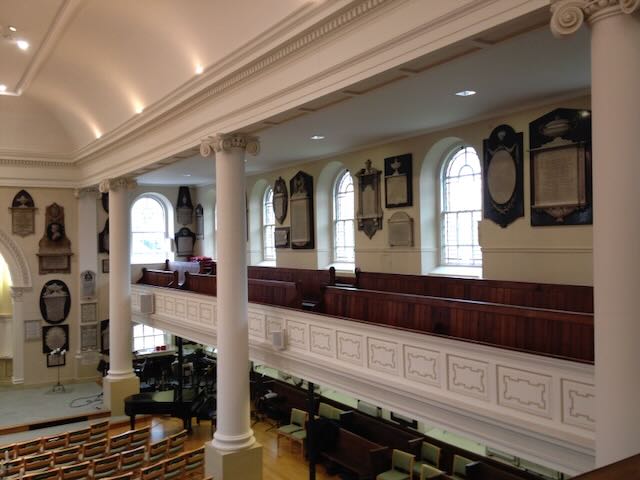
Many “monuments”–the plaques on the walls–commemorate wealthy and influential people who have worshipped at St. Swithin’s Walcot through the years. In Northanger Abbey, Catherine contemplates a similar monument to General Tilney’s wife at the fictional Northanger parish church.
St. Swithin
St. Swithin was associated with various miracles. He came to be connected mostly with the weather. July 15 is St. Swithin’s Day (each saint has a day associated with him or her in the church calendar, usually the day of their death). According to tradition, if it rains on St. Swithun’s day, it will rain for the next forty days, but if it’s clear that day, it will be clear for forty days.
Just before she died, Jane Austen wrote a humorous poem in which St. Swithin threatens Winchester race-goers with rain because they have forgotten him.
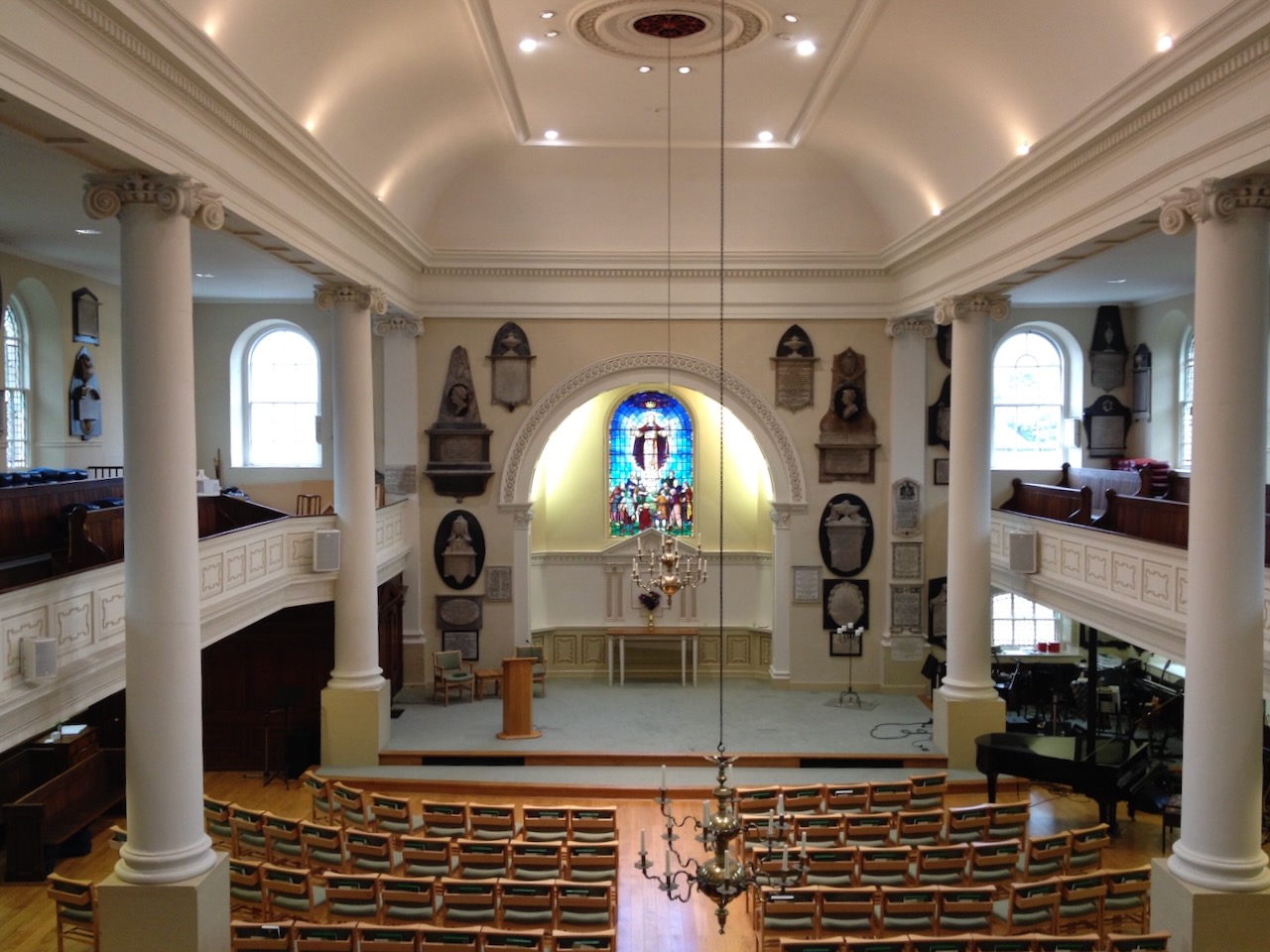
Interior of St. Swithin’s Walcot Church today. The stained glass window was first added in 1841 and replaced in 1958 after it was shattered in World War II. It portrays Christ ascending into heaven, surrounded by his disciples. Modern seating on the main floor, rather than pews, allows the church to host a variety of events.
Austen’s Parents’ Wedding
How was the Austen family connected with St. Swithin’s?
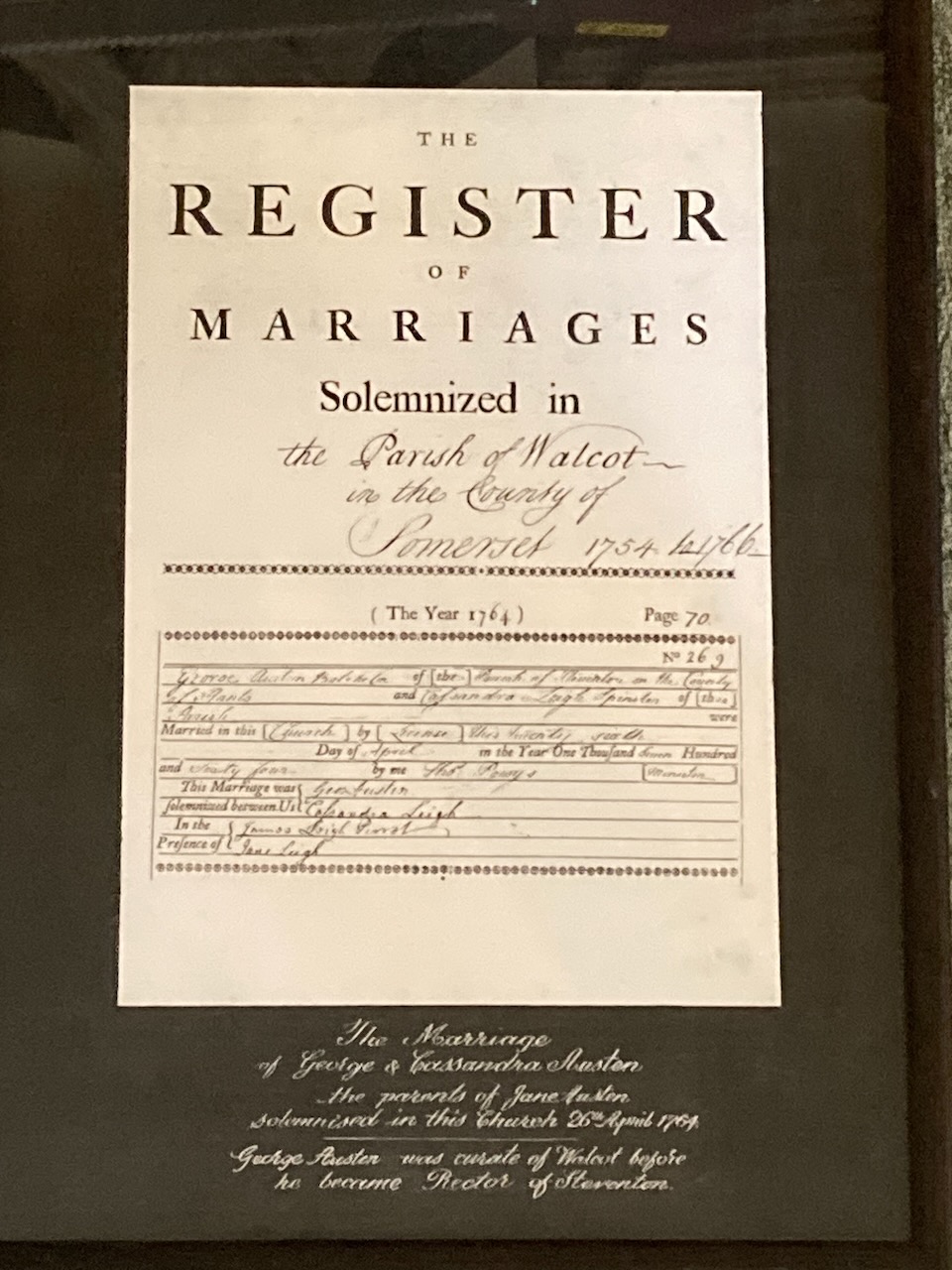
Jane’s father, George Austen, studied at Oxford University. He eventually became an assistant chaplain, then a proctor (in charge of student discipline), called “the Handsome Proctor.” At some point he met Cassandra Leigh, niece of the Master of Balliol College at Oxford. Cassandra was the daughter of a clergyman. Her father eventually retired and moved with his family to Bath. After he died, Cassandra Leigh agreed to marry George Austen, and they were married on April 2, 1764, at St. Swithin’s Church. The register states that Cassandra was living in Walcot parish, while George was in the parish of Steventon in Hampshire. Cassandra’s mother came to the wedding, and her brother, James Leigh-Perrot, and her sister, Jane Leigh, signed as witnesses. George was 32 and Cassandra was 24. They were married by license, presumably a common license, not by banns.
By then George Austen had been ordained and gained the living of Steventon, through his relatives. The young couple went straight to Hampshire, where they rented the parsonage at Deane while the Steventon parsonage was prepared. Of course, Jane Austen was born in 1775 in that Steventon parsonage.
Copy of the entry in the marriage register for George and Cassandra Austen, married at St. Swithin’s Walcot on April 26, 1764.
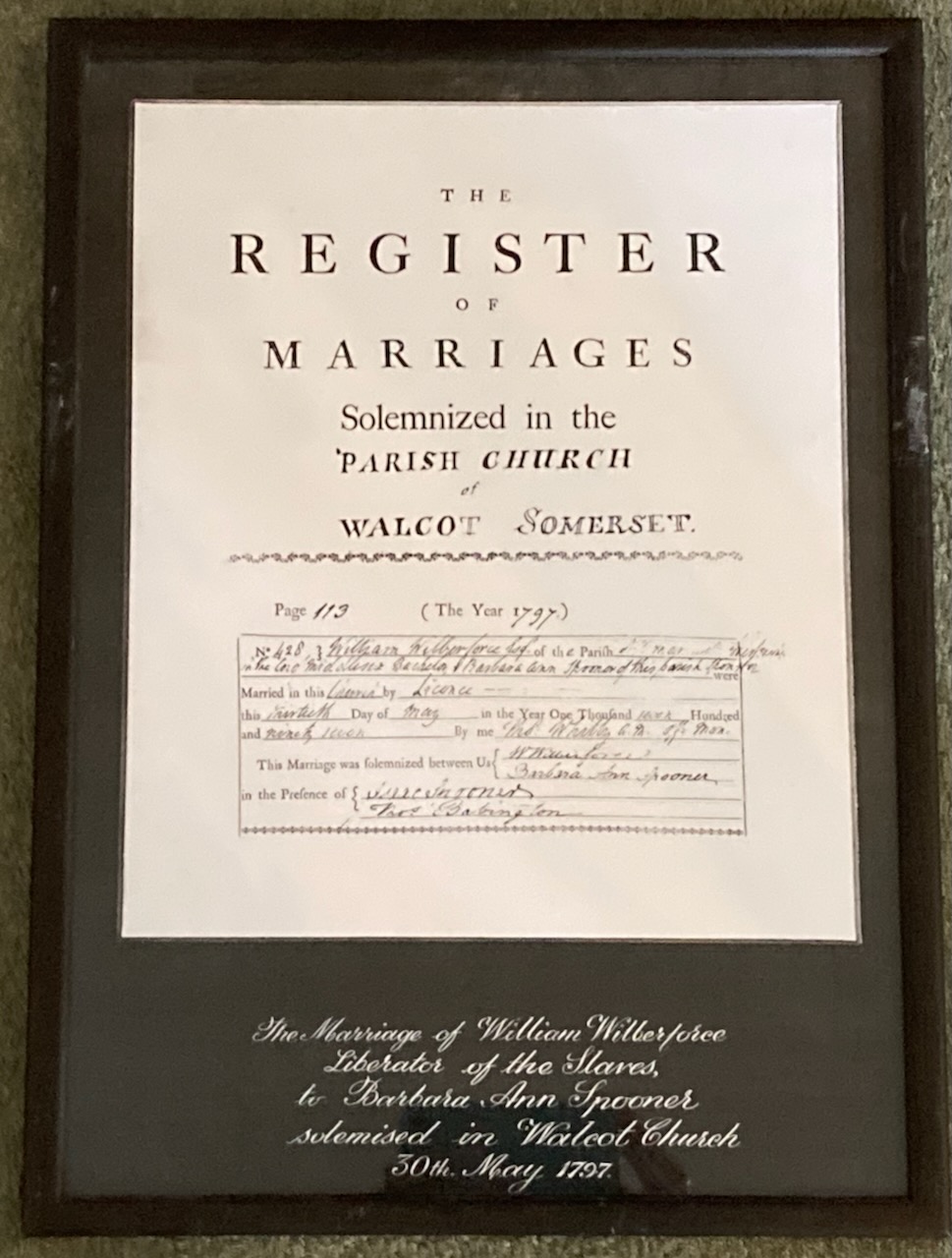
Another famous wedding at St. Swithin’s Walcot: William and Barbara Wilberforce were married there on May 30, 1797, after a six-week whirlwind courtship in Bath. Wilberforce led the fight against the trade in enslaved people and slavery.
George Austen’s Death
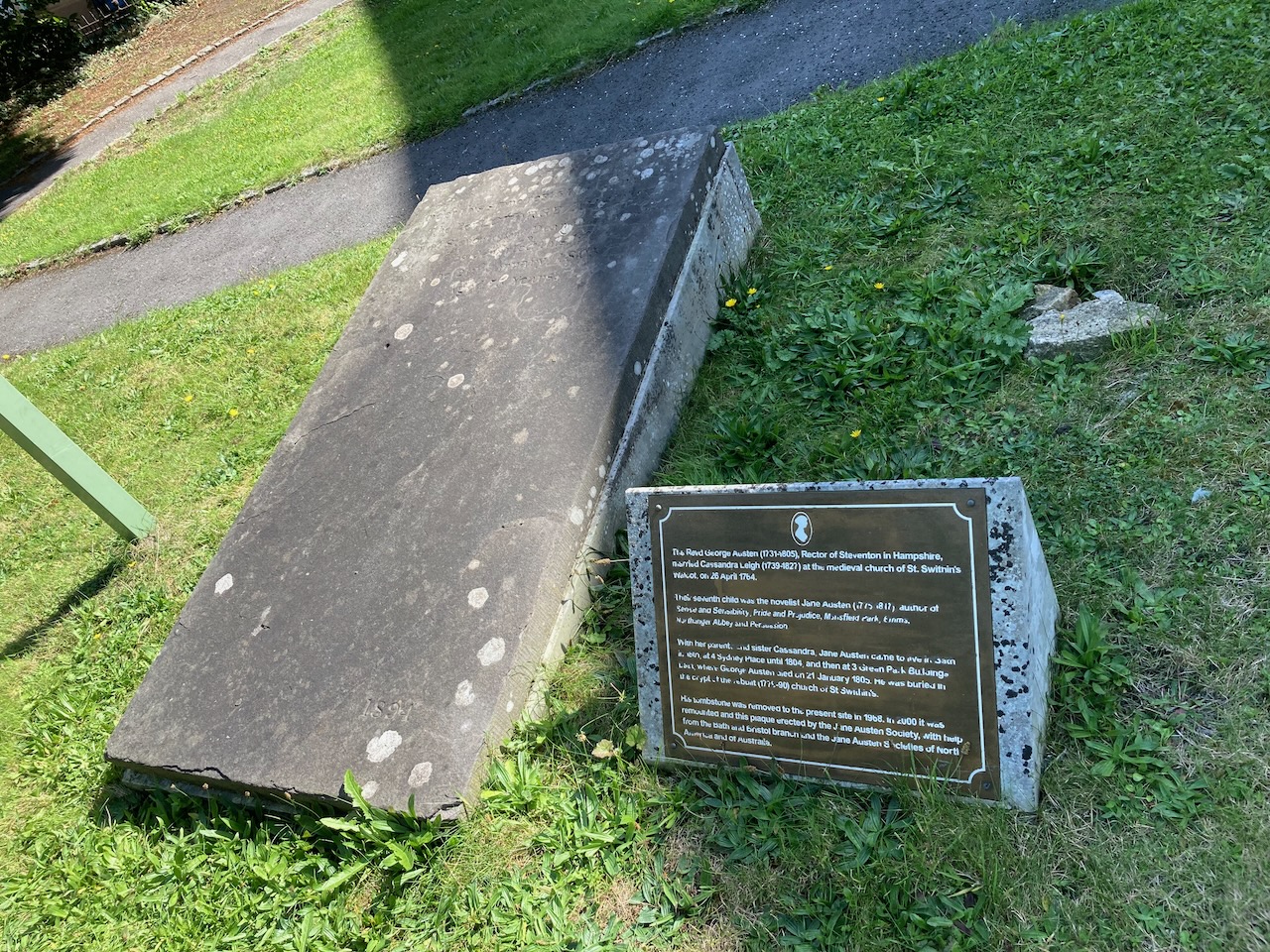
In 1801, George Austen left his Steventon parish to his son’s care and moved to Bath with his wife and two daughters, as his wife’s father had done much earlier. In 1805, George Austen died there. He was buried at St. Swithin’s, where you can still see his grave. Jane Austen wrote to her brother Frank, on Jan. 21 and 22, 1805:
“Our dear Father has closed his virtuous & happy life, in a death almost as free from suffering as his Children could have wished. . . . We have lost an Excellent Father. . . .The funeral is to be on Saturday, at Walcot Church. . . . [his body] preserves the sweet, benevolent smile which always distinguished him.”
Jane did not have a suitor waiting in the wings (as her father had been waiting for her mother in a similar situation). She and her mother and sisters had to depend on her brothers for financial help after her father died.
George Austen’s grave at St. Swithin’s Walcot. He died Jan. 21, 1805. The inscription on the gravestone is worn and hard to read. It identifies him as the rector of Steventon and Deane, who died age 75 (meaning, in his 75th year). The newer brown plaque, added in 2000, adds information about his daughter Jane Austen and her residence in Bath.
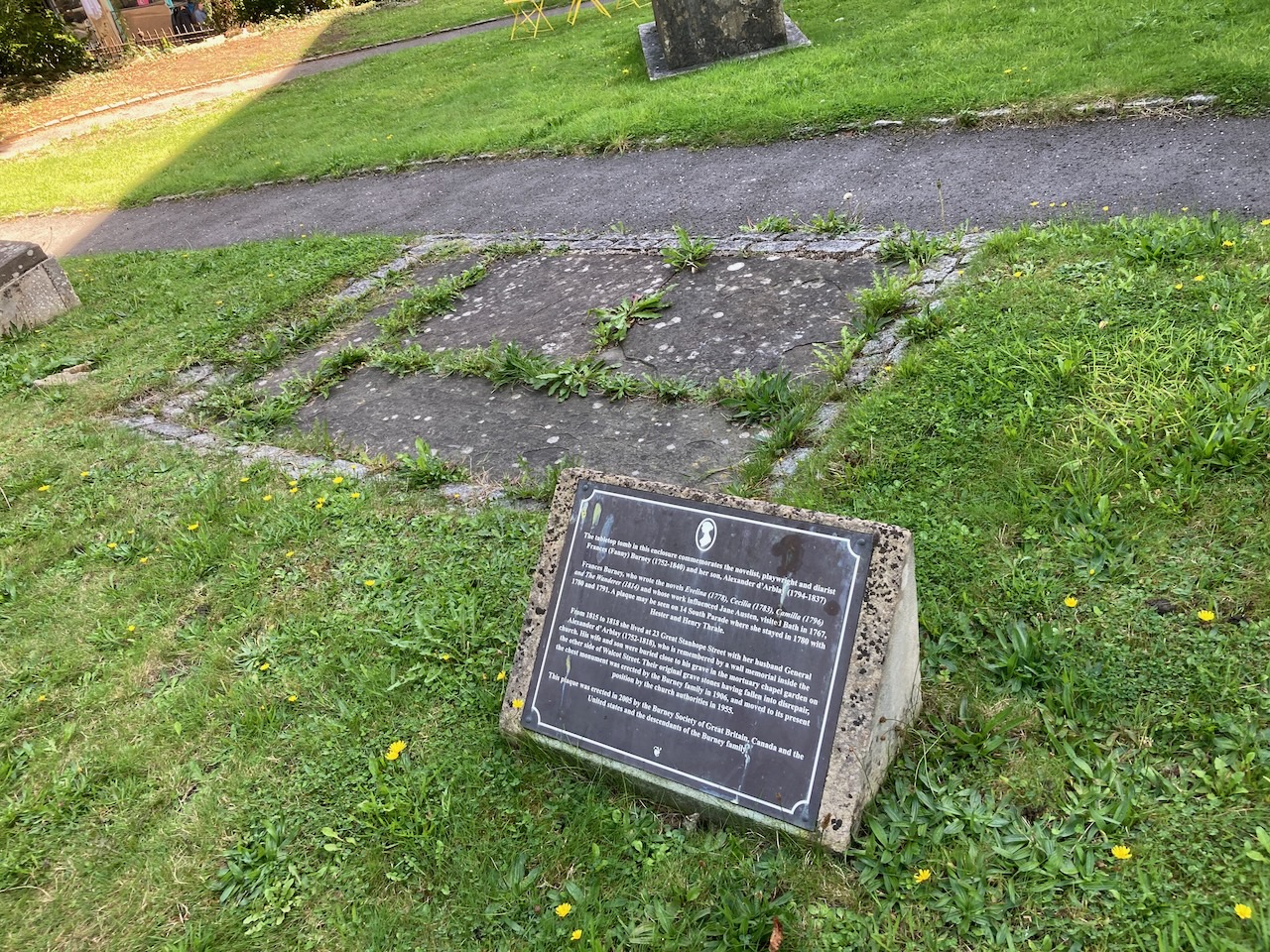
The author Fanny Burney, Jane Austen’s contemporary, is buried and commemorated nearby.
Did Austen ever attend church at St. Swithin’s? I’ve written another post exploring where she may have gone to church and chapel in Bath. It’s likely that she went to St. Swithin’s when she was visiting her aunt and uncle Leigh-Perrot who lived on the Paragon in Bath. That’s the edge of Walcot parish. The church is a steep walk uphill from their home. Later on, when Jane lived in Bath, she more likely went to chapels closer to her family’s various lodgings.
St. Swithin’s is a busy, thriving church today, with many activities going on. Some events of the Jane Austen Festival last fall took place there. The Charles Simeon Trust, started in 1836 by Evangelical clergyman Charles Simeon, is a patron of St. Swithin’s, as well as of Bath Abbey.
Other Churches Mentioned in Northanger Abbey
Northanger Abbey refers to four other real churches or chapels, more obliquely.
Thorpe says he bought his gig from a “Christchurch man.” He is referring to one of the colleges at Oxford University. Oxford and Cambridge are made up of semiautonomous colleges, and a student’s studies were mostly at his own college. Christ Church is a college at Oxford, and its college chapel is also Christ Church Cathedral for the diocese of Oxford. Thorpe shows a cavalier attitude toward “Christchurch” as well as toward everything else.
(A cathedral is the seat of a bishop, who leads a diocese made up of a number of parishes. A parish is a geographical area which was generally served by one main church, like the parishes that Edward Ferrars and Mr. Collins serve.)
Catherine and Isabella expect to worship together in a chapel in Bath; Austen doesn’t tell us which one. It may have been the Octagon Chapel, which would have been convenient to both of them.
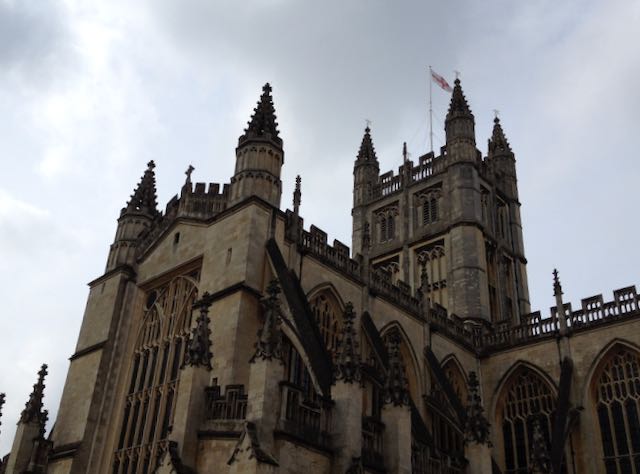
Northanger Abbey also indirectly refers to Bath Abbey. Twice the “church-yard” in the center of Bath comes up. The two young men Catherine and Isabella are following go “towards the church-yard,” and later Catherine trips “lightly through the church-yard” to go make her apologies to the Tilneys. This would be the church-yard of Bath Abbey, in the center of Bath. Roger E. Moore, in Jane Austen and the Reformation, argues that Austen purposely did not name the abbey, which was historically the spiritual center of the town. She may have wanted to critique the fact that Bath in her time was a place of pursuing shallow entertainment rather than deeper spirituality.
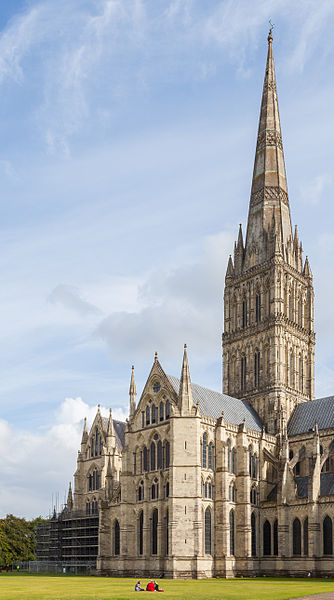
Near the end of the novel, Catherine is headed home. She looks out for the “well-known spire” of Salisbury. This is ancient Salisbury Cathedral, which has the tallest cathedral spire in England. Her father’s parish is in Salisbury diocese.
While Jane Austen invents country parishes for her characters, she also connects them with spiritual places in the real world.
Bath Abbey towers above the city of Bath. It is not mentioned by name in Northanger Abbey, though its church-yard is mentioned.
Austen includes real-life churches in her novels, such as Salisbury Cathedral, with the highest spire in England. This is Catherine Morland’s landmark as she heads home. Photo by Diego Delso, CC-BY-SA license.
Romney’s new book provides Janeites with a brand-new perspective on the female authors Jane Austen would have read during her lifetime. The very fact that Romney is a rare book specialist caught my eye! While many of the authors she highlights are known to us, this book takes a deeper look at their works and the reasons why their novels are unknown to the general public.
From rare book dealer and guest star of the hit show Pawn Stars Rebecca Romney comes a page-turning literary adventure that introduces readers to the women writers who inspired Jane Austen—and investigates why their books have disappeared from our shelves.
Long before she was a rare book dealer, Rebecca Romney was a devoted reader of Jane Austen. She loved that Austen’s books took the lives of women seriously, explored relationships with wit and confidence, and always, allowed for the possibility of a happy ending. She read and reread them, often wishing Austen wrote just one more.
But Austen wasn’t a lone genius. She wrote at a time of great experimentation for women writers—and clues about those women, and the exceptional books they wrote, are sprinkled like breadcrumbs throughout Austen’s work. Every character in Northanger Abbey who isn’t a boor sings the praises of Ann Radcliffe. The play that causes such a stir in Mansfield Park is a real one by the playwright Elizabeth Inchbald. In fact, the phrase “pride and prejudice” came from Frances Burney’s second novel Cecilia. The women that populated Jane Austen’s bookshelf profoundly influenced her work; Austen looked up to them, passionately discussed their books with her friends, and used an appreciation of their books as a litmus test for whether someone had good taste. So where had these women gone? Why hadn’t Romney—despite her training—ever read them? Or, in some cases, even heard of them? And why were they no longer embraced as part of the wider literary canon?
Jane Austen’s Bookshelf investigates the disappearance of Austen’s heroes—women writers who were erased from the Western canon—to reveal who they were, what they meant to Austen, and how they were forgotten. Each chapter profiles a different writer including Frances Burney, Ann Radcliffe, Charlotte Lennox, Charlotte Smith, Hannah More, Elizabeth Inchbald, Hester Lynch Thrale Piozzi, and Maria Edgeworth—and recounts Romney’s experience reading them, finding rare copies of their works, and drawing on connections between their words and Austen’s. Romney collects the once-famed works of these forgotten writers, physically recreating Austen’s bookshelf and making a convincing case for why these books should be placed back on the to-be-read pile of all book lovers today. Jane Austen’s Bookshelf will encourage you to look beyond assigned reading lists, question who decides what belongs there, and build your very own collection of favorite novels.
About the Author
Rebecca Romney is a rare book dealer and the cofounder of Type Punch Matrix, a rare book company based in Washington, DC. She is the rare books specialist on the HISTORY Channel’s show Pawn Stars, and the cofounder of the Honey & Wax Book Collecting Prize. She is a generalist rare book dealer, handling works in all fields, from first editions of Jane Austen to science fiction paperbacks. Romney is the author of Printer’s Error: Irreverent Stories from Book History (with JP Romney)and The Romance Novel in English: A Survey in Rare Books, 1769–1999. Her work as a bookseller or writer has been featured in The New York Times, The Atlantic, Forbes, Variety, The Paris Review, and more. In 2019, she was featured in the documentary on the rare book trade, The Booksellers. She is on the Board of the Antiquarian Booksellers’ Association of America (ABAA) and the faculty of the Antiquarian Book Seminar (CABS-Minnesota).
Expertise In Rare Books
Rebecca Romney has been in the rare book trade since 2007, when she was hired by Bauman Rare Books for their new location in Las Vegas. In 2010, she became manager of that gallery. She eventually moved to Philadelphia to manage the central operations of the firm, where she also handled the acquisition of libraries and oversaw catalogue production. After a stint at the Brooklyn-based Honey & Wax Booksellers (where she co-founded a book collecting prize), she founded her own rare book firm, Type Punch Matrix.
Rebecca is on the board of the Antiquarian Booksellers Association of America (ABAA), the Council of the Bibliographical Society of America (BSA), and on the board and faculty of the Antiquarian Book Seminars. She is a member of the Grolier Club, the Association Internationale de Bibliophilie (AIB), the American Antiquarian Society (AAS), and the Baker Street Irregulars (BSI).
January New Release
While you’re waiting for Rebecca’s new book to arrive, if you’re looking for something brand-new for January, look no further!
Canterbury Classics released a refreshed Word Cloud Classics edition of Pride and Prejudice just last week. Featuring colorful sprayed edges and a heat-burnished cover with foil stamping, this edition of Pride and Prejudice is a stylish addition to your bookshelves!
Jane Austen Must-Reads for 2025
This is just the start of a wonderful journey. Many authors and publishers are coming out with new projects this year to celebrate Jane Austen’s 250th year. I am excited to explore all the options, learn a lot more about Austen, and expand my library this year. If I could attend some of the events in England this year, I would, but until then, I’ll live vicariously through online events and new books! What are you looking forward to most during this year-long celebration?
Throughout 2025, our team – Vic Sanborn, Rachel Dodge, and Brenda Cox – will celebrate events and historical details during Jane Austen’s life (including the years just before and after).This year marks the 250th anniversary of Jane Austen’s birth on December 16th, 1775. She lived her short life during King George III’s reign. (Austen died in 1817, aged 41; the king died in 1820, aged 81.) Jane Austen Society organizations around the world will, in the next twelve months, mark this important year with their own celebrations and acknowledgments of her life and the events that influenced her talents.
Most of us who have read about dining during the Georgian era learned about 18th C. dining etiquette largely through novels, films, and television shows that featured fabulous Aristocratic settings in high-ceilinged dining rooms, liveried servants at the ready to serve or take away plates, and tables laden with food in fine silver or porcelain dishes.
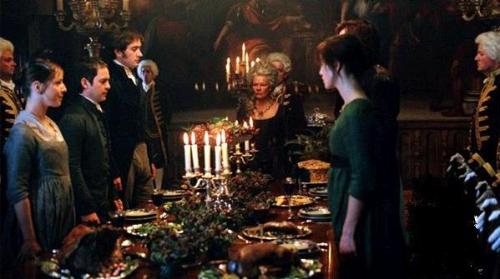
Lady Catherine de Bourgh’s dinner for Elisabeth Bennet and Mr Collins and Charlotte. Screen shot taken by Vic Sanborn
But how was British food celebrated among the other classes? How did British empire building affect what it meant to be British in terms of food tastes? Both of these topics will be addressed in this post by 1) renowned British food historian, Ivan day, and 2) Dr Sarah Fox, senior lecturer and researcher at Edge Hill University.
1) Dining and Hospitality in Eighteenth Century English Provincial Towns and Cities
In this YouTube video, Mr Day discusses the influences that changed dining and hospitality in 18th century Britain. French foods at court in the 1690s began to spread from British aristocrats to the provinces throughout the 1700s and into the 1780’s and 90’s, when Austen was a child.
English food preferences changed in remarkable ways, which Mr Day discusses in detail. This 36 minute video offers both closed captioning and a transcript.
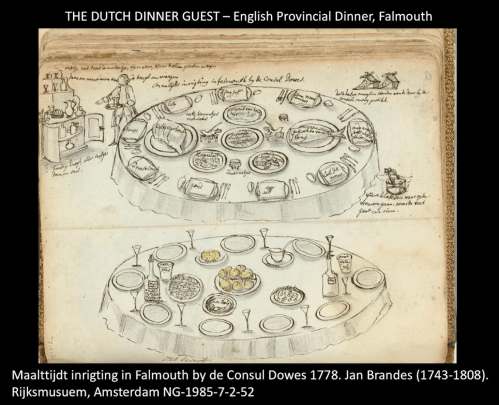
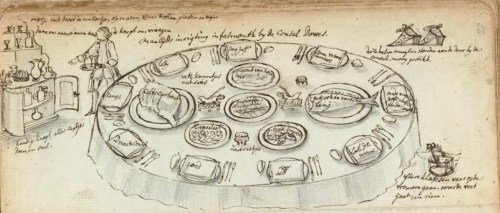
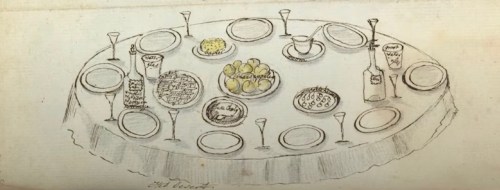
A few highlights of the talk that struck me include these drawings of a provincial English meal in Cornwall that were made in the 1770s by a visiting Dutch artist. He provided a marvelous snapshot of 18th C. dining.
Provincial meal, two courses
Mr Day notes the details of these drawings, The details are remarkable. The pattens at the upper right were once worn to protect ladies’ shoes from mud. Only some vegetables were presented, with the emphasis still on eating meat. Notice the unique placement of a knife, fork and spoon to the right of the plates. A waiter holds a tray with wine glasses and points to a sideboard filled with more glasses, as well as decanters.
Dinner table
The second drawing shows a table laden with assorted sweets: cookies, almond biscuits, oranges, butter cream, and preserved cherries.
Dessert table
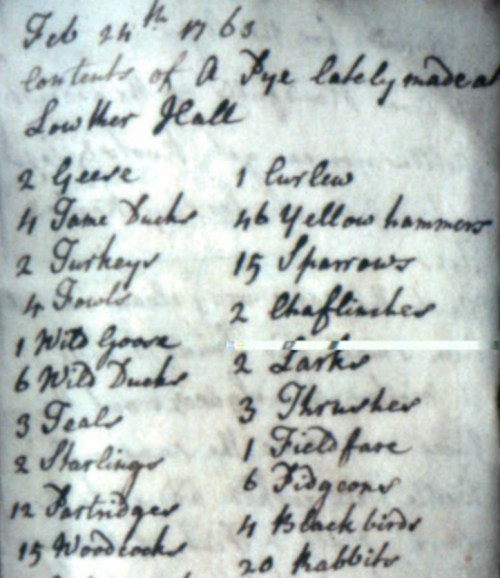
Another one of his observations intrigued me – that of an enormous English pie, labeled the Northern Country Great Pie in the video. James Lowther, the First Earl of Lonsdale House in Cumbria offered such a pie in 1763. It was the English aristocratic Christmas tradition to create this pie, meant to be eaten after dancing. Just imagine! The ball supper was served at 2 or 3 in the morning. Its size and weight of 22 stone (308 lbs.) must have been staggering, considering the list of baked animals that went into its making. This is a screenshot of half the list.
Half the list of the animals in a ball supper pie
To view the entire list, click on this link entitled Eat the Entire Creation if You Dare, which sits on Mr Day’s blog, Food History Jottings. One can only read in awe at the amount of protein those animals contributed. These ball supper pies were not only large, but expensive, and most likely made from game hunted on the aristocrat’s land.
At the end of his video, Mr Day showed pie molds that resulted in exquisite creations. This link to raised pie molds at MichaelFinlay.com shows a pie made by Mr Day from the Harewood mould.
Smaller, often hand-held pies were consumed by all classes, especially the working classes and travelers. By 1775, the year of Jane Austen’s birth, these portable foods had become ubiquitous. Pies were made for long distance travel. They encased meat and fruits in a variety of pastries that helped food to last longer, an important feature in an age without refrigeration. In 17th and 18th century Britain…
“…pies were devices in many senses of the word. They were used to preserve food,…and to prevent rot. Perhaps in part because of their preservative functions, pies were well-traveled, sent to friends and family members across long distances. Pies were embedded within global foodways, filled with ingredients sourced from around the planet.” – Hearse Pies and Pastry Coffins: Material Cultures of Food, Preservation, and Death in the Early Modern British World, Amanda E. Herbert &Michael Walkden, 07 Sep 2023
These portable foods had a long and varied history, starting centuries ago with the Egyptians, Greeks, and Romans. Recipes differed in each country, which did not diminish their popularity. Imagine being able to take food safely on long voyages, whether over land or sea, in an age when so many foods were consumed fresh.
The years between 1688 and 1815 were an important and exciting time for the British in terms of trade. Great Britain oversaw a sprawling empire during the Georgian era:
“Domestic industry [in England] flourished, with many workers pursuing dual occupations on a seasonal basis in industry and agriculture. English society contained a flourishing and more extensive middling sector than any other western country, including the Dutch Republic. This provided a strong platform for commerce with, and settlement in, far-flung territories.” – Symbiosis: Trade and the British Empire, Professor Kenneth Morgan, History, BBC.
Dr Sarah Fox, from Edge Hill University, examined the following topic:
2) Britishness revisited: food and the formation of British identities in the late eighteenth century.
Trade routes and the enormous reach of the British empire over the world began to change British attitudes towards food. Dr Fox discusses this topic in detail in the YouTube video below. This presentation also has closed captioning and a transcript. In this instance, I found both features useful, since, while Dr Fox’s research is fascinating, her rapid and soft-spoken speech is hard to follow. Still, this video is a worthwhile investment of time.
During what is now regarded as the long 18th century, which spans the Georgian era that either ended in 1815 after the Napoleonic Wars, or in 1830, which marks the death of King George IV (these dates are still under discussion), the British empire oversaw a dominant position among the major European trading empires.
At the end of this period, traders and merchant ships enabled the British to successfully expand beyond the boundaries of their island nation. They imported goods and foods from North America and the West Indies, Africa, the Carribean, and the East Indies. Closer to home they traded with Ireland, Germany, and Russia. Maps from The Guardian show the routes taken overseas in the 18th C. with densely criss crossed lines of travel.
King George III (‘Farmer George’)
As mentioned earlier, during her lifetime, Austen knew only one king. Her distaste of George III’s eldest son, the Prince Regent, is well known, and has been documented on this blog.
“George [III] was particularly interested and adept at farming. He felt strongly that he should use his lands to better feed the nation, and used Windsor and Kew to develop improvements in agriculture. He published his thoughts on more than one occasion, using the pseudonym ‘Ralph Robinson’.
George enlisted Sir Joseph Banks to smuggle merino sheep from Spain to breed them with British sheep. This flock of experimental sheep grazed under the Great Pagoda at Kew.
George would walk his fields and till the soil himself, often being mistaken for an ordinary gentleman. His nickname of ‘Farmer George’ endeared him to the public”. – Quote from George III, The Complex King, Historic Royal Palaces.
As it turned out, Farmer George had a simple, old-fashioned (but knowledgable) taste in cuisine. An article from the University College London (UCL) entitled “Chicken broth & lobster among 3,000 dishes served to King George III, 3 November 2023”, in which a research group, including Dr Fox, lists the top ten foods generally consumed by King George III. It is obvious his food tastes were quite conservative. They were:
It’s fascinating to hear Dr Fox list the enormous amount of research regarding foods eaten during the Long 18th through datasets accumulated from meticulous records that were kept regarding household food consumption. Records that survived are available all over the UK. Ivan Day also benefited from such record keeping, which he shared in his video.
The typical British fare of the 18th century was not the only food ‘Farmer George’ and his family consumed. The king and queen occasionally dined on more exotic dishes during state occasions, including recipes based on French cuisine and foods brought in from the empire, such as those from the West and East Indies.
Like British pies, turtles also offered a portable solution for travelers. British sailors used turtles for fresh food. They could be transported alive in sea water and eaten when they were needed. The meat of a six pound turtle could feed quite a few men. Soon, turtles, once a preferred food for sailors, were prepared as an exotic food for aristocrats.
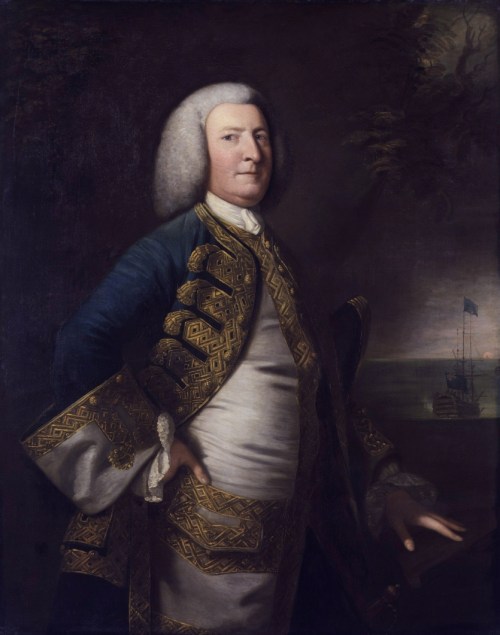
In 1744, Admiral of the Fleet, George Anson, brought two 300 lb turtles as gifts, one of which was given to the Royal Society’s Dining Club. From this time on, chefs created delicious dishes and soups from imported turtle meat. In fact, famed chef Marie-Antoine Careme, who created sumptuous banquets for the Prince Regent, thought turtle soup to be quite competitive with British roast beef! Fifty years after their introduction to British cuisine, turtles became a food mainstay for the British.
Captain George Anson, 1755, portrait by Joshua Reynolds. Wikimedia Commons/National Portrait Gallery, London. Looking Through Art: Turtle Cuisine
Interestingly, George III, whose food tastes were traditional, ate only mock turtle soup made from a calf’s head, and had it served a mere fourteen times between 1788 and 1801. A JSTOR Daily article, Turtle Soup: From Class to Mass to Aghast, describes how turtle soup and mock turtle soup became accessible to the British middle classes. These tastes soon spread to the Continent and North America.
Meanwhile, the Prince Regent, who was more adventurous in his culinary explorations than his father, ate turtle meat at Carlton House at least once per week. He also embraced Eastern culture and built the Brighton Pavilion using Eastern motifs influenced by Eastern trade.
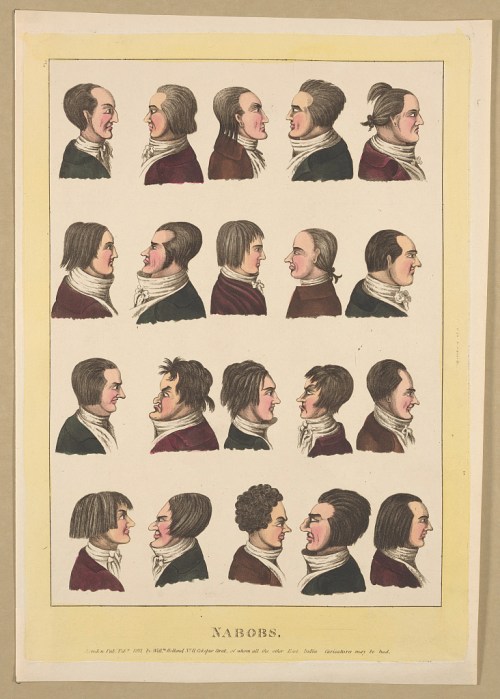
According to Dr Fox, the British adapted to the unfamiliar flavors and spices from the Far East more slowly than the foods from the West Indies. In addition, these spices were expensive. Nabobs, or British men who were employed in the East India Company, returned to Great Britain with their families, along with the fortunes they made in India’. They also brought with them their love of Indian spiced food. To many, these dishes were too hot and strong in flavor for British tastes — at first.
Print shows profile portraits of 20 men, called nabobs, who are representatives of the East India Company that have returned home with newly acquired wealth, generally through dubious or corrupt means. Names: Holland, William, active 1782-1817, publisher. Library of Congress
In 1747, Hannah Glasse, cookbook author, published the first recipe for curry in her cookbook, The Art of Cookery Made Plain and Easy.As Dr Fox relates, Glasse included rabbit plus onions, pepper, corn, rice, coriander seeds and butter in this edition. By 1751, she had replaced the rabbit with chicken. Then added new spices that included ginger, turmeric, lemon, and cream. Both the rice and coriander were removed. Due to the turmeric, this dish resulted in a bright yellow color. The recipe, adapted for British taste, was reproduced in a variety of cookbooks practically unchanged for years afterwards. As I understand, rice was added as a side dish to the changed cuisine. Glasse’s curry recipe was mild enough to satisfy British tastes.
While George III did not eat curry at all, in 1816, the Prince Regent was served a curry dish. From this period on, the British had, through trade and royal influences, adapted their taste towards foreign foods and spices. Today, over 12,000 curry houses are spread across Britain.
As a writer, Austen used food descriptions to characterize the people in her novels – Mr Woodhouse’s penchant for gruel; Mr Bingley’s lavish ball and a sumptuous supper meal afterwards, and Mrs Bennet’s two courses served for Mr Bingley and Mr Darcy. Her two courses most likely consisted of anywhere from 10 -25 dishes.
One can imagine how much Elizabeth must have cringed when her mother assured Mr Collins that they were able to keep a good cook, and that her daughters had nothing to do in the kitchen, (Pride and Prejudice, Chapter 13.) Austen’s use of food in her novels was sheer genius as she introduced her readers to absurdity and reality at the table!
Additional Resources:
Ivan Day
Spotify: The British Food History Podcast: 18th Century Dining, Ivan Day, January 2023
Ivan Day is a social historian of food culture and a professional chef and confectioner.
Green sea turtles, whose popularity as a food slowly declined over the centuries, had been caught in such prolific numbers that in 1973 they were classified as endangered.
A short history of turtles as food, starting with seafarers in the early 18th century and culminating 50 years later, as turtle soup began to be closely associated with the British empire and British Identity. Turtle Soup: From Class to Mass to Aghast – JSTOR Daily
“Immediately surrounding Mrs. Musgrove were the little Harvilles, whom she was sedulously guarding from the tyranny of the two children from the Cottage, expressly arrived to amuse them. On one side was a table, occupied by some chattering girls, cutting up silk and gold paper; and on the other were tressels and trays, bending under the weight of brawn and cold pies, where riotous boys were holding high revel; the whole completed by a roaring Christmas fire, which seemed determined to be heard, in spite of all the noise of the others. . . .
Mrs. Musgrove . . . observ[ed] with a happy glance round the room, that after all she had gone through, nothing was so likely to do her good as a little quiet cheerfulness at home. . . .
” ‘I hope I shall remember, in future,’ said Lady Russell, as soon as they were reseated in the carriage, ‘not to call at Uppercross in the Christmas holidays.’ Every body has their taste in noises as well as in other matters . . .”—Persuasion, Vol. 2, chapter 2
The Musgrove family at Christmas
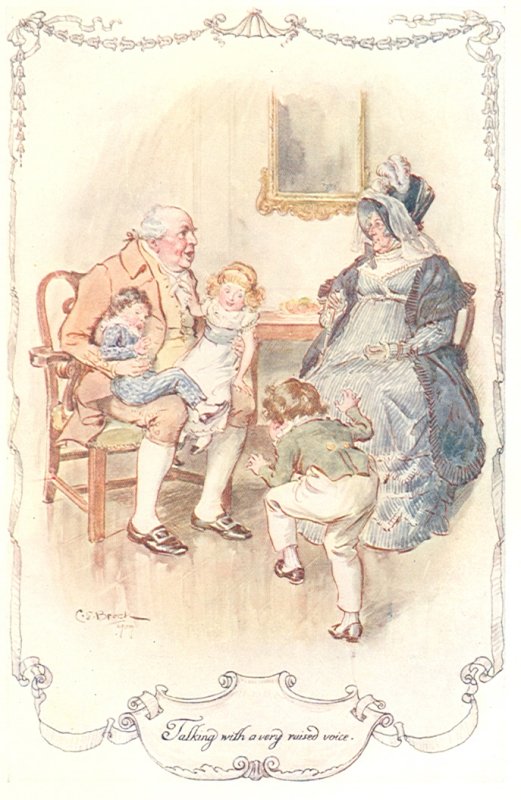
Jane Austen gives us only brief glimpses of Christmas in her world. Here Mrs. Musgrove and Lady Russell think very differently about what makes a pleasant Christmas. The Musgrove family are enjoying crafts, food, a Christmas fire, and children having fun and making noise.
Family and Friends
At Christmas, people gathered with friends and family, as we still do today. In Northanger Abbey, Catherine’s brother James met Isabella Thorpe when he went to spend the Christmas holidays with Isabella’s brother. In Pride and Prejudice, Elizabeth invites the Gardiners to join her and Darcy at Pemberley for Christmas. In Sense and Sensibility, Charlotte Palmer asks the Dashwood sisters to join her at Cleveland for Christmas.
In Emma, Emma’s sister and her husband come to visit for the holidays with their children. They are busy with friends during the mornings, and Mr. Weston insists that they dine with him one eventful evening.
Mr. Elton, at least, enjoys the occasion, saying:
“This is quite the season indeed for friendly meetings. At Christmas every body invites their friends about them, and people think little of even the worst weather. I was snowed up at a friend’s house once for a week. Nothing could be pleasanter. I went for only one night, and could not get away till that very day se’nnight.”—Emma, chapter 13
Mr. Elton drinks too much and proposes to Emma, who rejects him. She is therefore very glad on Christmas day to see
“a very great deal of snow on the ground. . . .The weather was most favourable for her; though Christmas Day, she could not go to church.”—Emma, chapter 16
The clear implication, though, is that Emma would naturally have gone to church on Christmas day. Churches generally had a good turn-out on Christmas. Communion was generally offered that day (one of only three or four times a year when country churches would offer Communion, also called the Lord’s Supper). Henry Crawford in Mansfield Park assumes that Edmund Bertram will only need to preach on the major holidays when many people attended church:
“A sermon at Christmas and Easter, I suppose, will be the sum total of sacrifice.”— Mansfield Park, chapter 23
Edmund, of course, plans to live in his parish and lead services and preach there every Sunday, not just on holidays.
For each church holiday, the Book of Common Prayer, handbook of the Church of England, prescribed specific prayers and Bible readings that would be the same every year. The “collect” prayer from the 1790 Book of Common Prayer for “the Nativity of our Lord, or the birth day of CHRIST, commonly called Christmas-day” is:
“Almighty God, who hast given us thy only begotten Son to take our nature upon him, and as at this time to be born of a pure Virgin; grant that we being regenerate, and made thy children by adoption and grace, may daily be renewed by thy Holy Spirit, through the same our Lord Jesus Christ, who liveth and reigneth with thee and the same Spirit, ever one God, world without end. Amen.”
Bible readings for the day were from the first chapter of the book of Hebrews and the first chapter of the book of John, both about the coming of Christ.
In a recent talk by Rachel and Andrew Knowles on “A Regency Christmas,” they pointed out that Christmas day, and the whole Christmas season, was a popular time for weddings in the churches. So perhaps that was Austen’s little joke, having Mr. Elton propose right before Christmas! Babies were also christened on that day, and Christmas was a time for ordaining new clergymen. Edmund Bertram goes to Peterborough for ordination during Christmas week. When he delays his return, Mary Crawford thinks he may be staying for “Christmas gaieties.”
Christmas Gaieties
Miss Bingley uses the same term when she writes to Jane Bennet:
“I sincerely hope your Christmas in Hertfordshire may abound in the gaieties which that season generally brings, and that your beaux will be so numerous as to prevent your feeling the loss of the three of whom we shall deprive you.”—Pride and Prejudice, chapter 21
What did those gaieties involve?
Customs that were consistent across the country were gathering with family and friends, eating a special meal, and giving gifts and money to the poor. Austen mentions a few additional traditions.
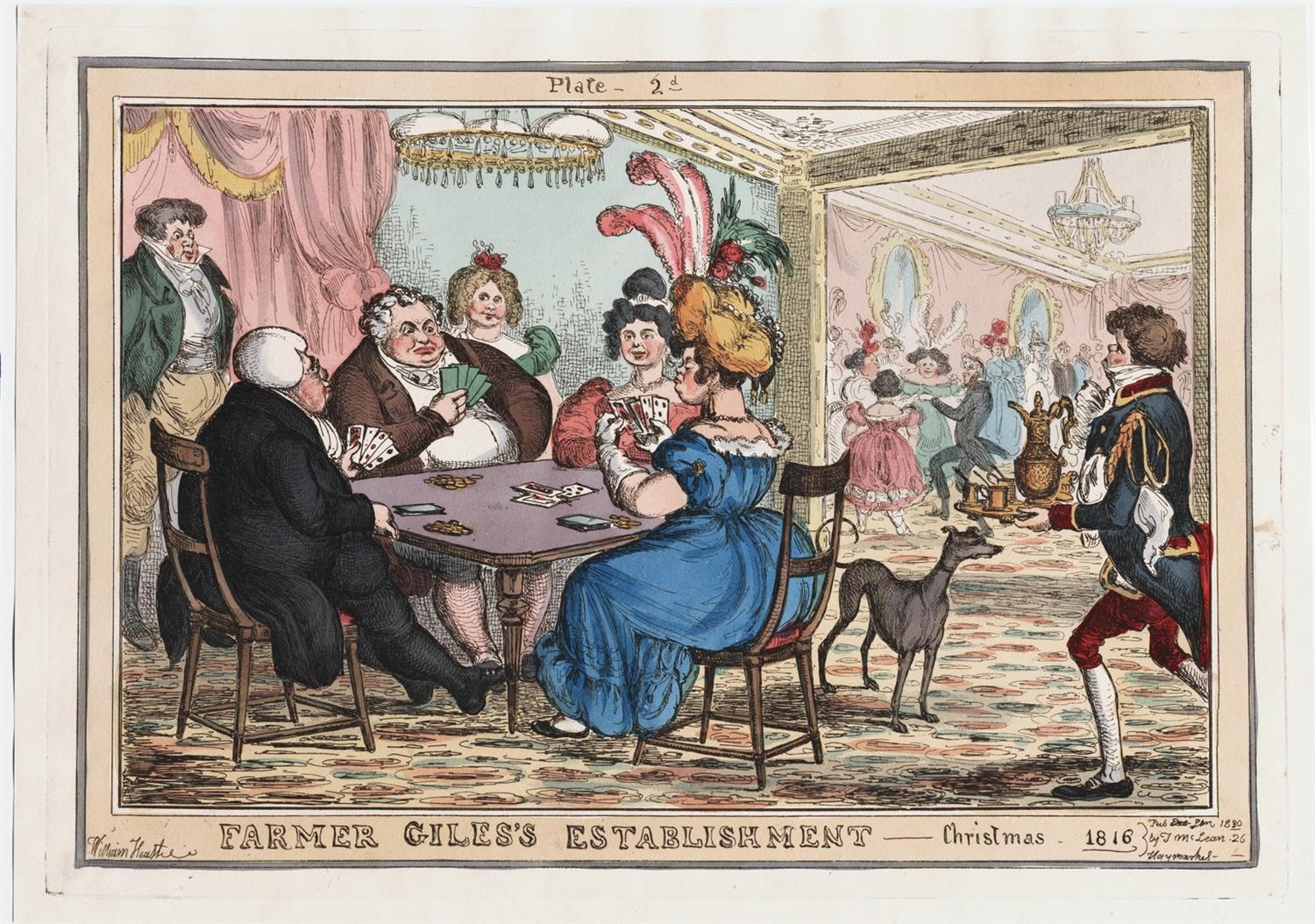
Regency Christmas celebrations usually involved a special meal with family and friends. Farmer Giles’s Establishment, Christmas day, 1800, by William Heath, 1830. Courtesy of The Lewis Walpole Library, Yale University
Gifts
Christmas was a time for charity, for giving gifts to the poor and to those in service occupations, like the local butcher. These gifts of money were called “Christmas boxes.” According to the Knowles’s research, newspapers even published lists of what certain wealthy people were giving to the poor at Christmas.
In families, it appears that gifts were given mainly to children. I found only one mention in Austen:
“On the following Monday, Mrs. Bennet had the pleasure of receiving her brother and his wife, who came as usual to spend the Christmas at Longbourn. . . . The first part of Mrs. Gardiner’s business on her arrival was to distribute her presents and describe the newest fashions. . . . The Gardiners stayed a week at Longbourn; and what with the Phillipses, the Lucases, and the officers, there was not a day without its engagement. Mrs. Bennet had so carefully provided for the entertainment of her brother and sister, that they did not once sit down to a family dinner.”—Pride and Prejudice, chapter 25
It’s not clear if Mrs. Gardiner brought gifts for everyone because it was Christmas, or if she was just bringing gifts because she was coming from London to the country on a visit.
Games
Many played games at Christmastime. Jane Austen wrote in a letter to Cassandra from Portsmouth, on Jan. 17, 1809 about a change in the fashions for Christmas games:
“I have just received some verses in an unknown hand, and am desired to forward them to my nephew Edward at Godmersham:
Alas! poor Brag, thou boastful game! What now avails thine empty name?
Where now thy more distinguished fame? My day is o’er, and thine the same,
For thou, like me, art thrown aside At Godmersham, this Christmas tide;
And now across the table wide Each game save brag or spec. is tried.
Such is the mild ejaculation Of tender-hearted speculation.”
Card games and dancing were popular Christmas activities. Farmer Giles’s Establishment Christmas 1816 by William Heath, 1830. Courtesy of The Lewis Walpole Library, Yale University
Dancing
Austen’s characters dance at Christmastime. Sir Thomas Bertram holds a ball for Fanny Price during the Christmas holidays. Sir John Middleton hosts a Christmas dance, followed by a hunt the next morning:
“‘He [Willoughby] is as good a sort of fellow, I believe, as ever lived,’ repeated Sir John. ‘I remember last Christmas at a little hop at the park, he danced from eight o’clock till four, without once sitting down.’
“‘Did he indeed?’ cried Marianne with sparkling eyes, ‘and with elegance, with spirit?’
“‘Yes; and he was up again at eight to ride to covert.’”—Sense and Sensibility, chapter 9
Other Christmas Traditions
According to the Knowles, Christmas customs were different between city and country, and between various areas of the country. In some areas old customs like the Yule log and decorating with greenery were dying out, in other areas they were still going strong.
Whatever traditions your family keeps during this holiday season, may you experience much joy and deep peace.
If you want to find out more about specific Christmas customs in Austen’s England, check out any of these posts:
Fashionable Goodness: Christianity in Jane Austen's England is now available! By JAW contributor Brenda S. Cox. See Review. Available from Amazon and Jane Austen Books.
Available through December 31st, 2025. Click on image for details, and share this poster with other teachers and students!
The Obituary of Charlotte Collins by Andrew Capes
Click on image to read the story.
Comments
“My idea of good company…is the company of clever, well-informed people, who have a great deal of conversation.” – Jane Austen, Persuasion
Gentle readers: Please feel free to post your comments and continue the conversation! Due to SPAM, we will no longer accept comments on posts after 30 days of publication. In some instances, links will be removed from comments as well.
Administrators and Contributors
Vic Sanborn, founder of this blog, is supported by a team of talented and knowledgeable writers about Jane Austen and the Regency era. They are:
Tony Grant, who now contributes his photos from London and England
Click on their names to enter their own blogs.
In addition, we thank the many experts and authors who frequently contribute their posts and opinions, and who continue to do so freely or at our request.
Click here to enter the page. Topics include Regency fashion, historic foods, Jane Austen societies, British sites, related topics. Click on image.
May we suggest?
Hello, my name is Vic and I live in Maryland, USA. I have adored Jane Austen almost all of my life. I am a proud lifetime member of the Jane Austen Society of North America. This blog is a personal blog written and edited by me and my team. We do not accept any form of cash advertising, sponsorship, or paid topic insertions. However, we do accept and keep books and CDs to review.
If you would like to share a new site, or point out an error, please email us. (Yes, we are fallible. We'll own up to our mistakes and will make the corrections with a polite smile on our faces.) Write us at
Thank you for visiting this blog. Your comments and suggestions are most welcome.
Project Gutenberg: eBook of Stage-coach and Mail in Days of Yore, Volume 2 (of 2), by Charles G. Harper
STAGE-COACH AND MAIL IN DAYS OF YORE: A PICTURESQUE HISTORY
OF THE COACHING AGE, VOL. II, By CHARLES G. HARPER. 1903. Click on this link.




















 Jane Austen's World