Feeds:
Posts
Comments

Posts Tagged ‘London’

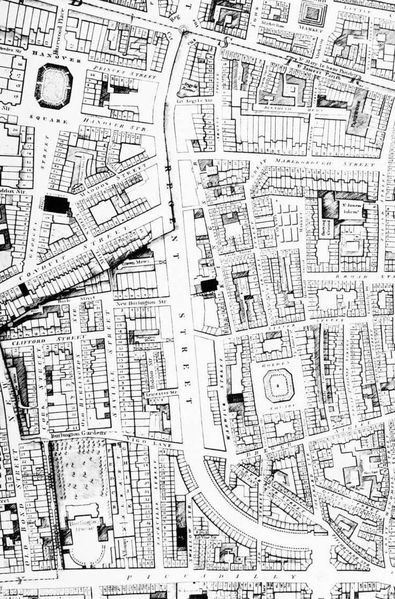
Greenwood’s Map of London

Published in 1827 after surveying every square mile of London, Greenwood offered his detailed map to subscribers. You can observe in this small detail a corner of Hyde Park, Park Lane, Grosvenor Square and a part of Berkeley Square, Green Street, Upper Brook Street, and other familiar Mayfair landmarks

This online map, hosted by Bath Spa University, is interactive. Click here to find it and other information about the development of this wonderful tool.

Click here to find an interactive map of London during Charles Dickens time.

Read Full Post »

View the updated version of this post here.

John Nash’s buildings exemplified the neoclassical style of early 19th Century Architecture. His sweeping changes transformed London, from the graceful curve of Regent Street to the majestic terraces and vistas in Regent’s Park.

View some of his edifices below:

1. Regent’s Park
2. Regent Street
3. Buckingham Palace

We will devote an entire section to Brighton Palace later.

Read Full Post »

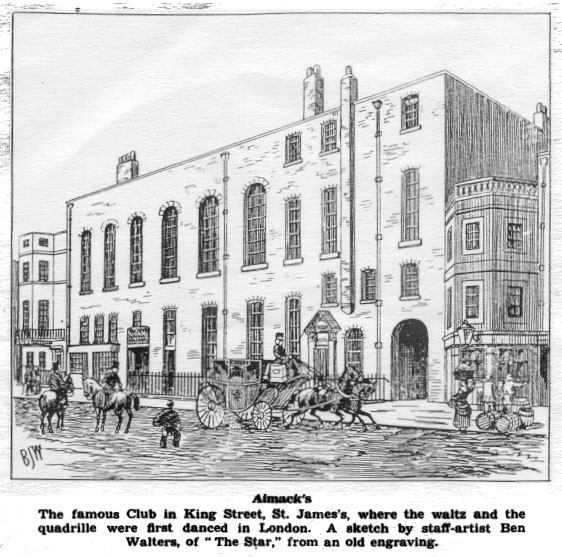
Almack’s Assembly Rooms


The patronesses of Almack’s Assembly Rooms on King Street near St. James’s Park could make or break one socially, although the food they served left something to be desired.

The Great Metropolis was written in 1837 by James Grant, a member of Almack’s. In a chapter in his book, he discusses Almack’s origin and impact on Society.

Find another description of Almack’s here.

And more information on Wikipedia.

Find a detailed, if dry, description of Almack’s on King Street on this British History Online site.

Finally, want to have some fun? Find a detailed, erudite description of the history of Almack’s on Almack’s Online Gaming Club. You can even join the club and play bridge or backgammon! There are privileged rates for hereditary peers. (You must live in an area where gaming is allowed.)

Read Full Post »


From 1809 to 1811, Louis Simond, a French emigre who lived in America, spent 21 months in England. He chronicled his trip in journals, which he published as The Journal of a Tour and Residence in Great Britain.

I have in my possession a copy of his book, which has been retitled “An American in Regency England.” Occasionally, I will post Simond’s observations, as they seem as fresh now as the day he recorded them.

“January 11.–We arrived yesterday at Richmond. This morning I set out by myself for town, as London is called par excellence, in the stage-coach, crammed inside, and herisse outside with passengers, of all sexes, ages, and conditions. We stopped more than twenty times on the road–the debates about the fare of way-passengers–the settling themselves–the getting up, and the getting down, and damsels shewing their legs in the operation, and tearing and muddying their petticoats–complaining and swearing–took an immense time. I never saw any thing so ill managed. In about two hours we reached Hyde Park corner; I liked the appearance of it; but we were soon lost in a maze of busy, smoky, dirty streets, more and more so as we advanced.”

Click here to find the Royal Parks, including Hyde Park and Richmond Park.

Read Full Post »

« Newer Posts