This Jane Austen blog brings Jane Austen, her novels, and the Regency Period alive through food, dress, social customs, and other 19th C. historical details related to this topic.
Several years ago I wrote a post on Regency Hairstyles and their Accessories. This series of images starts much earlier than the Regency. Jane Austen, who was born in 1775, would have been familiar with the hairstyles depicted here up to 1817, the year of her death. Her mother and aunts would have worn longer curls and powdered hair in her childhood. As teenagers and young women just coming on the marriage mart, she and Cassandra would have worn their hair much like the women in the 1790s.
1780s, 1781, 1790
As can be seen from the paintings, hairdos were elaborate in the 1780s and 1790s. Wigs made from real human hair were often used to build up elaborate hair structures. These confections took so many hours to create that a woman would wear them for days on end, protecting the hairdo at night.
Wigs and hair were covered with hair powder made of starch (potato or rice flour, not wheat flour). Oily pomades applied to the hair allowed the powder to stick and fragrant oils masked odors.
1790, 1792, 1795
1795, 1796, 1797
Hairdos became increasingly less elaborate and by the end of the 18th century women began to look to antiquity for role models. (Regency Hairstyles and their Accessories.) A woman’s natural hair color was allowed to shine. More often than not, women tied back their hair in chignons that exposed the neck. In some instances, hairdos were cut boyishly short. Lady Caroline Lamb cut her hair short, as did the two girls shown in 1810.
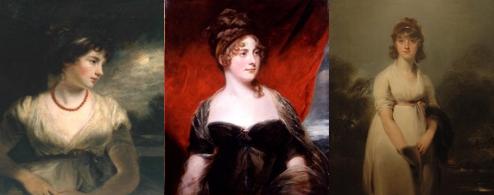
1797, 1800, 1800 1801, 1801, 1802
I cannot anyhow continue to find people agreeable; I respect Mrs. Chamberlayne for doing her hair well, but cannot feel a more tender sentiment – Jane Austen, 1801
1802, 1802-1804, 1804
1804, 1804, 1804
1804, 1805, 1804-1806
1806, 1906, 1807
1807, 1807, 1808
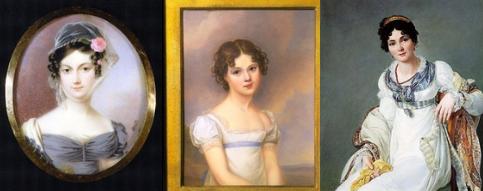
Even when wearing hats, curls were coaxed out to frame the face. The woman below right with straight hair pulled back into a severe chignon wears curls in front of her ears. Curling tongs were very much in use during this era, as were paper and cloth curlers worn at night.
1809, 1809, 1809
1810, 1810, 1810
1810, 1810, 1810
1810, 1810, 1810
1810, 1811, 1812
She looks very well, and her hair is done up with an elegance to do credit to any education.” – Jane Austen, 1813
1813, 1813, 1816
1816, 1816, 1816
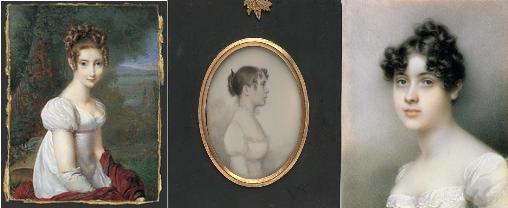
Jane Austen wore caps over her light brown hair, but allowed curls to peep out from under them. I imagine that her nieces at a ball looked much like the young miss at top left in 1813. Hairdos became slowly more elaborate as dresses as dresses were embellished with frills, lace, and other furbelows. Jane would not have recognized the more elaborately decorated dresses and stylized hairstyles of the mid-1820s and 1830s, in which natural flowing lines were taken over by elaborately ruffled collars and skirt hems. Had she lived, she might even have made a joke at the expense of ladies who wore the popular but elaborately built-up hairstyles at the crown, with ringlets cascading down the sides, and flowers and feathers arranged artfully into the curls. (Modes des Paris image.)
1818, 1819, 1820
1824, 1825, 1825
1828, 1828-1833, 1830
1831, 1834, 1835
Modes des Paris image, 1832
More on the topic
To see a Regency timeline of headresses and hairstyles for Regency evenings and their descriptions, click here.
Lisa Brown. Image @Edward Voytovich. Click on image for a larger view.
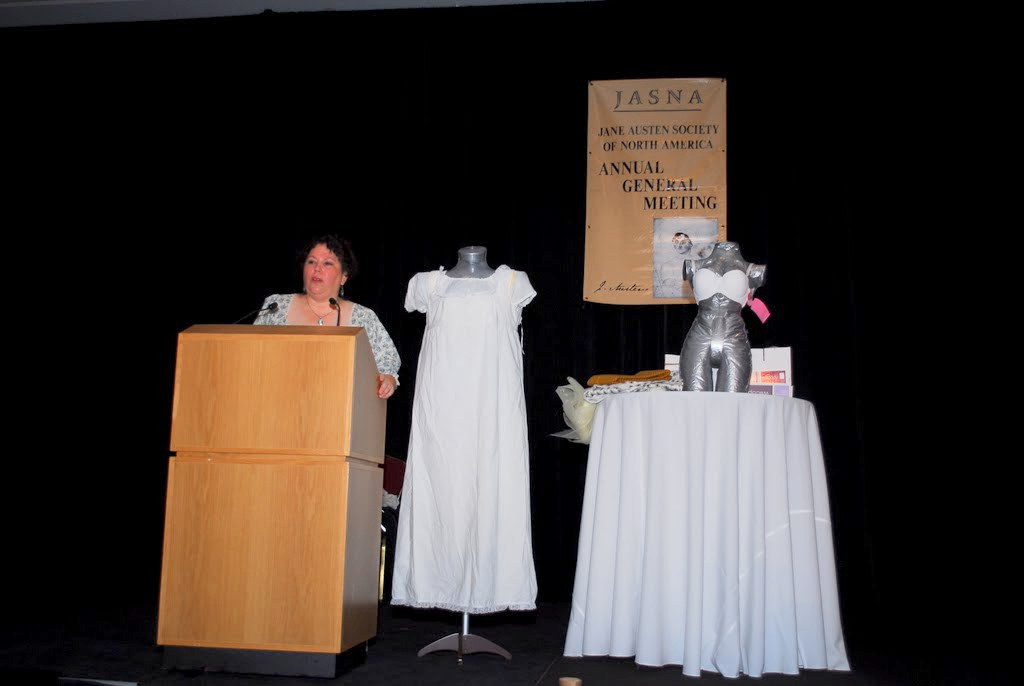
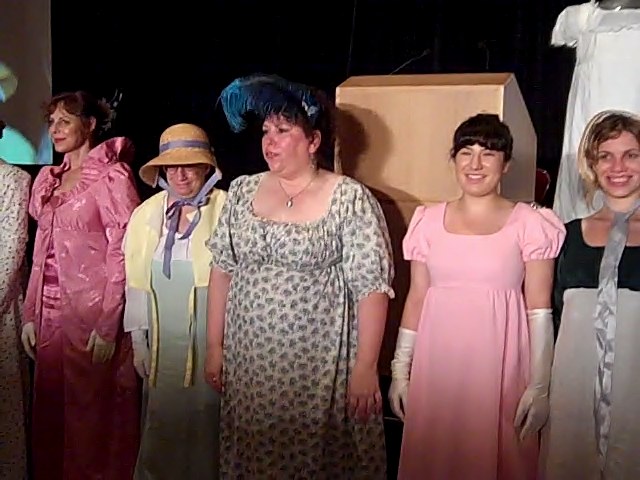
Inquiring readers. My first JASNA AGM in Brooklyn started out with a bang. Not only did I room with the wonderful Deb Barnum (Jane Austen in Vermont), but the first workshop I attended was given by Lisa Brown, co-coordinator of the Rochester and Syracuse Regions of JASNA (and the official photographer at the AGM, it seems). She presented a fashion show and workshop demonstration of Regency fashions, including detailed instructions on how to rework 1970s and 1980s gowns into very creditable Regency costumes. A similar custom was studiously followed by Regency ladies, such as the Miss Bennets and Miss Austens, whose income precluded them from custom ordering as many handmade gowns as they liked. Two hundred years ago, cloth and trim were quite expensive, although changes wrought by the Industrial Revolution in weaving, dying cloth, and creating off the rack gowns would make clothes more affordable as the 19th century progressed. Jane Austen wrote frequently of refurbishing a new bonnet or reworking a gown to suit an occasion.
Lisa Brown stands in the center of her models
Lisa graciously gave me permission to use the videos I took of her fashion show and from my notes. The personal impressions are mine.
The back of Lisa’s gown with the drawstring details. Note the floral print.
The Layers of a Regency gown
In Regency fashion, it’s all about lift and undergarments. The distinctive Regency “shelf” was created with straps tied from the side (not center) and short stays with busks and wires. The stays were drawn from the bottom to the top, and as the stays tightened the bosom (shelf) rose. During the extended Regency era (1795-1820) women wore fewer clothes than their mothers and aunts. Sheer fabrics, exposed bosoms, and bare arms in the evening were the hallmarks of the Regency style.
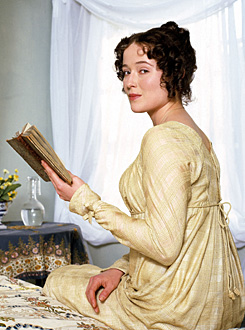
This image of Jennifer Ehle as Elizabeth Bennet shows her wearing a day gown with long sleeves. Note the gathering in the back and the silhouette of her Regency shelf bosom
The typical dress layers included (from skin side out): a simple shift made of sturdy cotton or linen that could withstand repeated laundering; short stays; a petticoat; and a gown. While women wore stocking and garters, under drawers were not generally worn until later in the 19th century. If a woman opted to wear them, they would be crotchless (mostly for convenience.)
Regency gown fashion show
In this video Sarah wears a 1970s dress found in a vintage shop and a period bonnet. The sleeves look modern, but the overall effect is very charming. Sarah is the author of the delightful post: I was a Model in a Regency Jane Austen Fashion Show.
Nadia wears a modern reworked holiday dress that converted nicely into a Regency style costume. I felt that the skirt lacked authenticity in that there was no gathering of the fabric in the back.
Julie wears a simple gray gown. To me the accessories turned this vintage dress into a Regency look, for the dress details were too sleek to be authentic.
Joyce in a green silk tafetta that could have used some trim or a shawl or something to turn this dress into a show stopper.
Jaclyn’s brown tafetta dress is one of my favorites. The gloves, bonnet, puffy sleeves, low scooped neck, and slight gathering in the back added realistic touches.
Jane wears a cotton dress with spencer jacket and long ties. I imagine Mrs. Austen might have looked much like her.
Meg looks like she is going to market. On stage she showed her reversible cape, which she took off for the runway. Her outfit is typical of a married lady who, after her marriage, begins to wear a cap. After turning 27, unmarried women don caps as well, much like Jane Austen and her sister Cassandra. Meg also wears a delicate fichu, an item typically worn during the day. It can be tucked in or worn out. The fichu indicated casual day dress. If a lady with a limited wardrobe wished to dress up for the evening, she would take off her fichu and add dressier accessories to spruce up her look.
Aniela is also off to market. On stage she wore a spencer, a spinster’s cap, and a tucked-in fichu, a garment appropriate for all ages. Walking down the runway, you can see her fan on a little chain. Angela is a resourceful young woman, who found her short, form-fitting “spencer” at Forever 21. All she needed to do to turn this day gown into evening wear was to take off her cap and fichu, change from short gloves to long gloves, and change her jewelry. Voila! She is ready to visit neighbors for dinner and join in a dance! Notice the Van Dyke points on her sleeve.
Lynn Marie wears a spencer and parasol. Lisa cautioned that only umbrellas made in the 40s, 50s, or 60s would do as Regency parasols. Umbrellas from that time period were still made pagoda style, with the fabric coming up to the top of the frame. Notice how Lynn Marie’s dress has the gathered pleats in the back. If you choose to make a dress with a print pattern make sure that the prints are small and set far apart. Modern prints are often too large and set too closely together. In choosing cloth to make Regency gowns and for the sake of authenticity, Lisa also warned us to stay away from fabrics that are reminiscent of the two Lauras – Laura Ingalls Wilder and Laura Ashley. Hah!
Joyce wears a dark sleeveless pelisse with a long train. An elegant look that flows beautifully when she walks.
Nadia wears long sleeves during day and gloves. Dark fabric was chosen for daywear, since the color was easier to keep clean. Lighter colors, such as whites and pastels, were worn at night. White was a symbol of wealth since laundering took a great deal of time and effort. A white gown easily became soiled and required enormous maintenance to keep pristine (imagine how dirty those trains must have become even if the woman was confined to walking indoors.) Jane Austen’s audience knew exactly how pampered Eleanor Tilney was when her character was described as wearing only white.
In her second costume, Sarah wears a long sleeved dress and a quaint Amish straw bonnet with lining, flowers, and a ribbon. Trims were expensive and transferred from dress to dress, on the neck or sleeves, or at the bottom of a dress. Between 1805-1815, embellishments at the hem increased from 1″ of trim to 2″, to 3″ or more in 1817, the year Jane Austen died.
Jaclyn’s polyester pink 1970s gown turns into a pretty Regency ball gown. Today’s enterprising seamstress can order Indian muslin in specialty stores and find sheer netting overlays at curtain shops.
Julie’s pink gown is based on Empress Josephine’s coronation gown. The elaborate satin overdress is worn over a simpler dress underneath.
Aniela wears a pretty pale dress, very simple in design. Her day look includes short gloves and a basket. This dress can easily be converted for a night time look by adding the right accessories.
Lynn Marie wears a dramatic ball dress from David’s Bridal. It was an age when showing one’s ankles was deemed scandalous, but showcasing one’s bosom was not. In fact, the Regency shelf was a display area on which a possible suitor could feast his eyes and the lady in question could show off her pretty necklace as well as her womanly assets.
Proper jewelry for that era consisted of small round shapes, such as seed pearls, small crosses, and delicate stones. To resemble a proper Regency miss, one should not wear posts or hoop earrings, long chains of pearls, or chokers, which were a Victorian affectation. Choose flat-heeled ballet style shoes or slippers, and half-boots with outer wear.
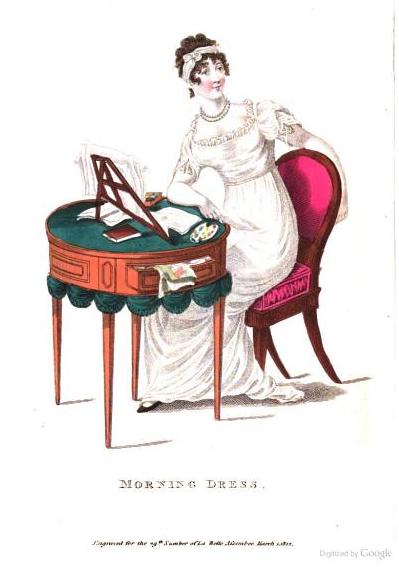
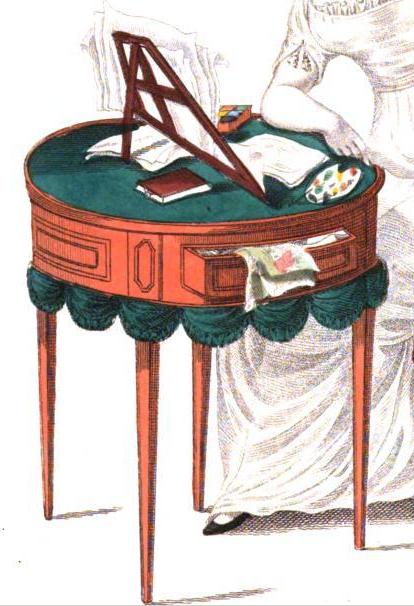
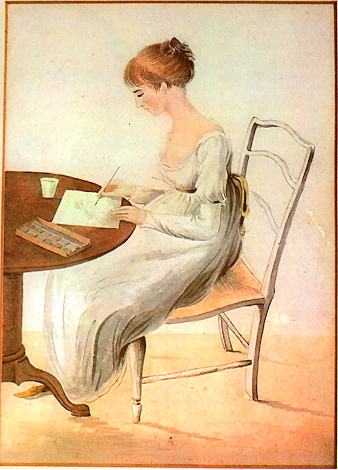
What did ladies do in the morning 200 years ago? Why, write letters and draw and paint, of course. A genteel lady knew all three arts and achieved them with varying skills. This delightful La Belle Assemblee print details how a well-dressed woman would look at her work table. This young Regency miss works like me, btw: with everything out and cluttering surfaces.
MORNING or HOME COSTUME: A white cambric frock with a demi train, short sleeves fastened up in front with cordon and tassels, a necklace formed of two rows of opal; the hair dressed in full curls, and confined by a demi turban of very fine muslin tied on the right side with a small bow; silk stockings with lace clocks richly brocaded; and plain black kid slippers.”
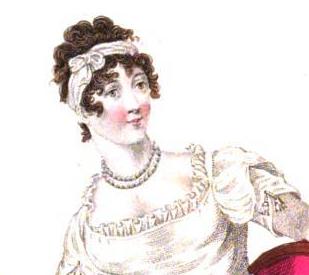
Detail of hair and bodice, La Belle Assemblee, March 1812. Note the lovely bandeau, the ringlets framing the face, and the relatively high neckline with ruff.
The magazine goes on to say that embroidery on all gowns, whether for domestic parties or home attire, seems very prevalent. Embroidery on evening gowns made of costly materials is frequently of gold and silver. India muslins are again coming much into wear and were very decently priced:
for the information of our Fashionable Readers, we have observed, at the house of Millard, in the City, some of the choicest production of the East Indies from the Company’s recent Sale of Bengal Muslins, &c. Their beauty is exquisite…”
Detail of ladies round worktable with drawer. La Belle Assemblee, March 1812. This one most likely had a top and decorative swaths made of green baize, which prevented sliding.
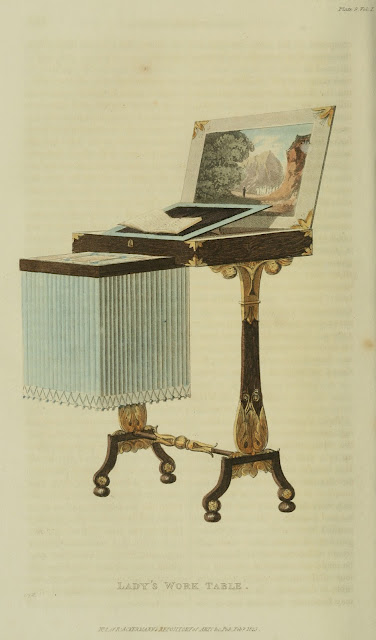
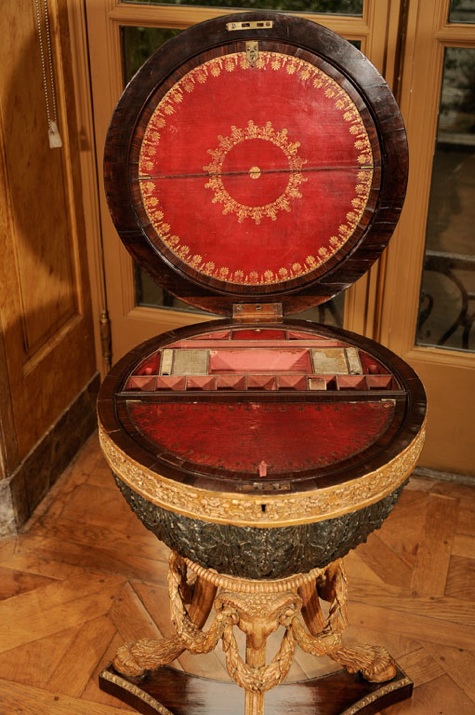
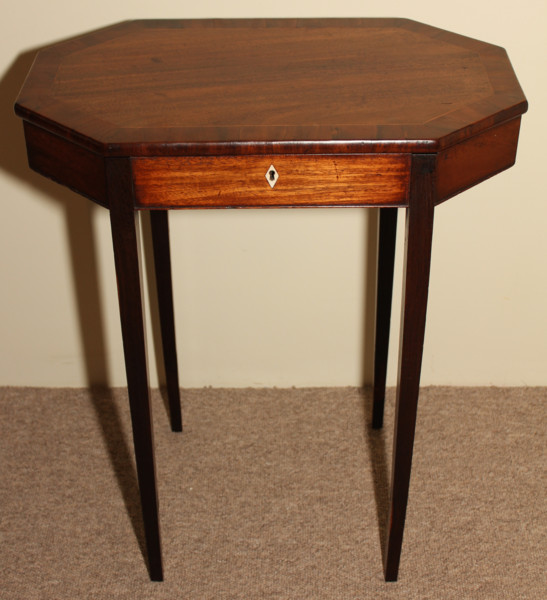
These small and elegant worktables were portable and could be easily carried near a light source or fireplace, or stashed against a wall when company came. They varied, some coming with a variety of compartments – some hidden – that contained writing and painting supplies. Many had book stands for reading, others had drawers that contained paper or embroidery threads and sewing supplies.
This work table was “equally adapted to the boudoir and drawing-room, and answers the purpose of a drawing-table as well as a work-table, and a desk for writing and reading.”
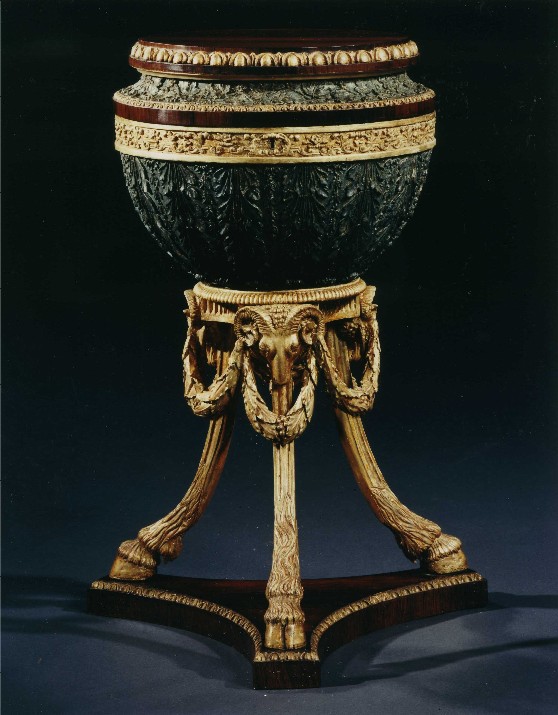
This was a very elegant and expensive work table for a rich lady.
This English work table, circa 1815, is a curious fusion of the refined neoclassicism of Robert Adam and the exotic eclecticism which emerged during the Regency period. The finely carved tri-form giltwood stand, based on a Roman form, is typical of Adam’s adaptation of the antique. – Carlton Hobbs Work Table
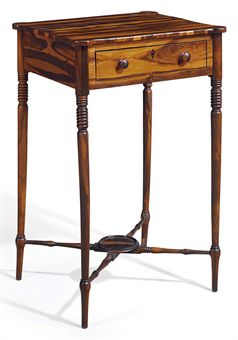
As you can see, work tables varied in design and construction. This simpler and smaller cocuswood work table suited a lady’s purpose as well as a fancier one, but it has fewer compartments.
Early 19th century regency cocuswood work table with a rectangular top and single drawer.The turned legs are joined by a turned stretcher with circular platform, with paper label to underside inscribed purchased by ABM.
A few months ago I featured a short video of an 18th century French mechanical worktable, which showed how the hidden mechanisms worked and how easily the table could be moved from place to place. Click on this link to view it.
Note: The blue links are mine: the green links are ads placed here by WordPress. I make no money from this blog.
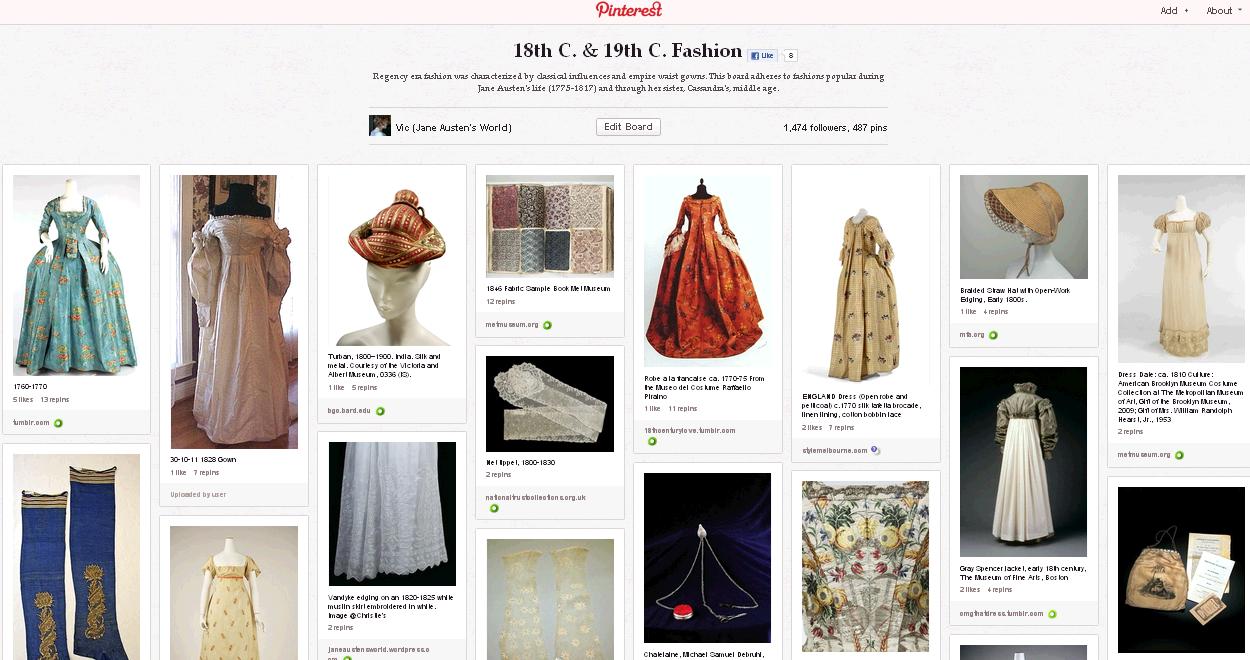
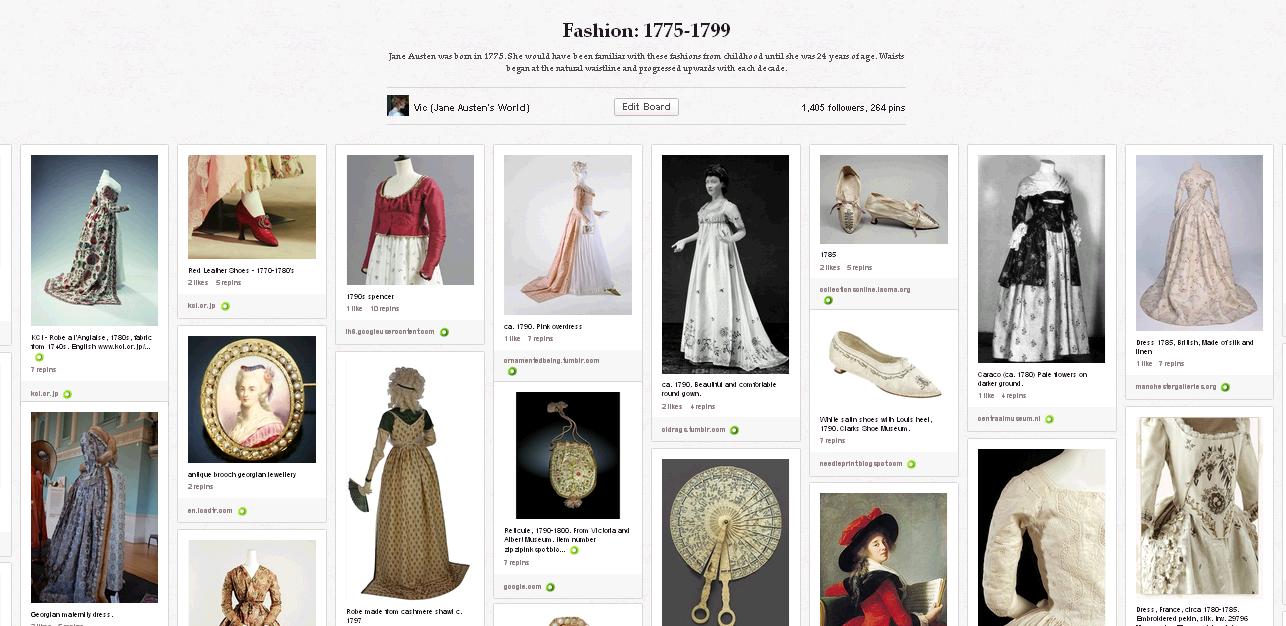
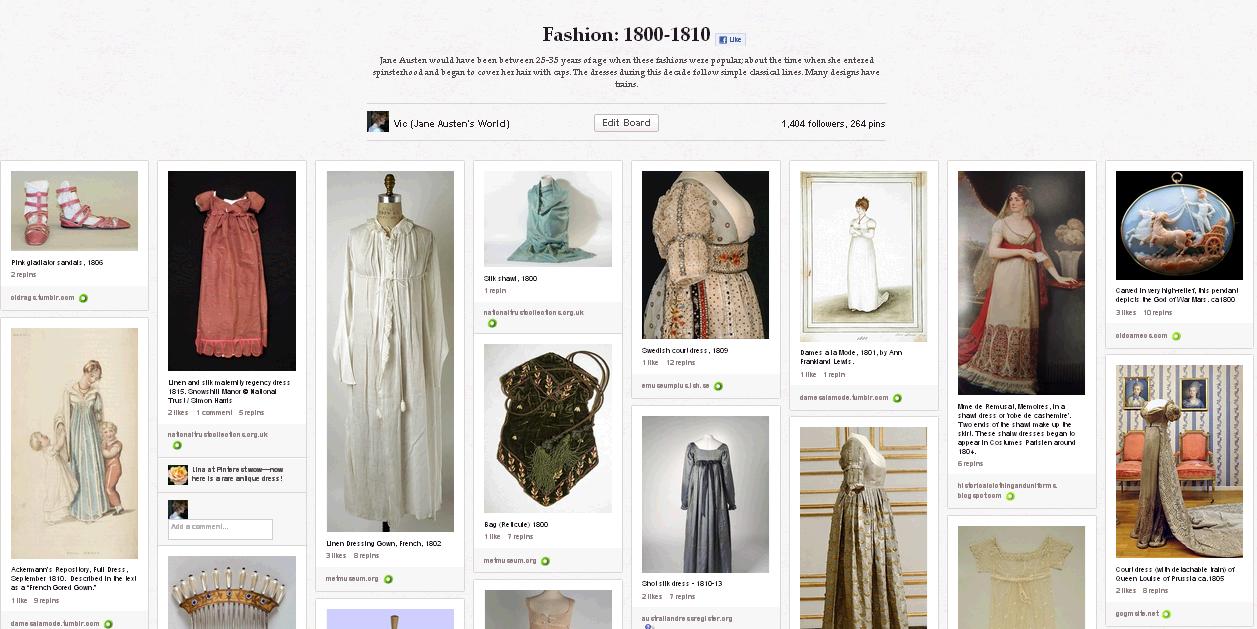
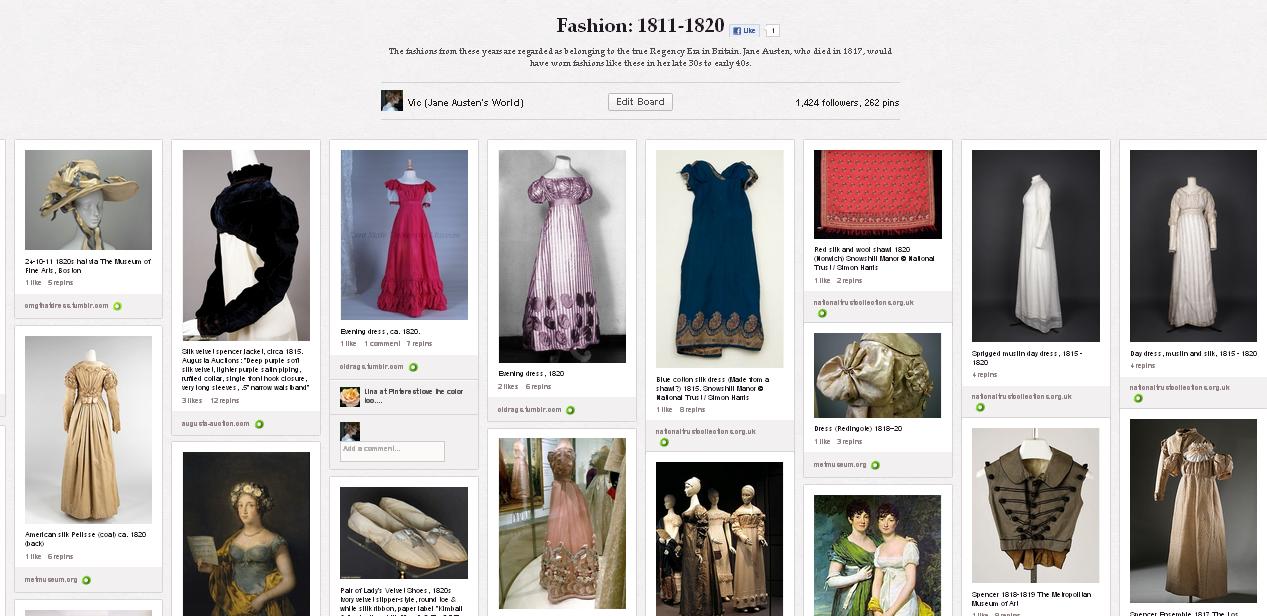
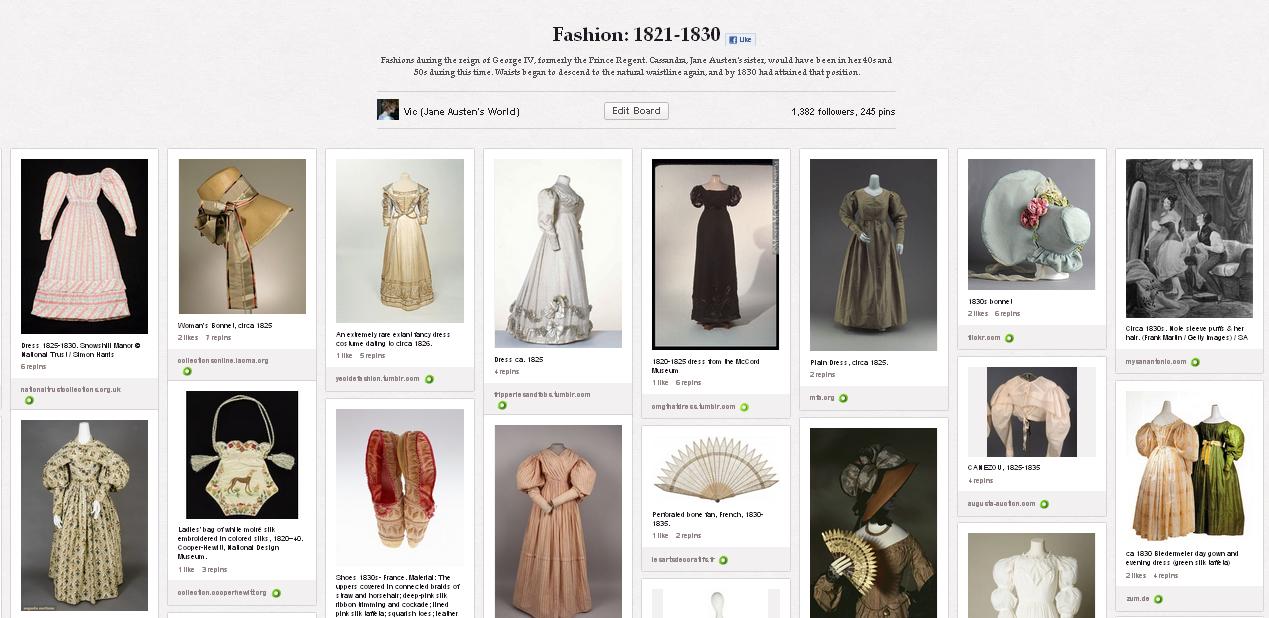
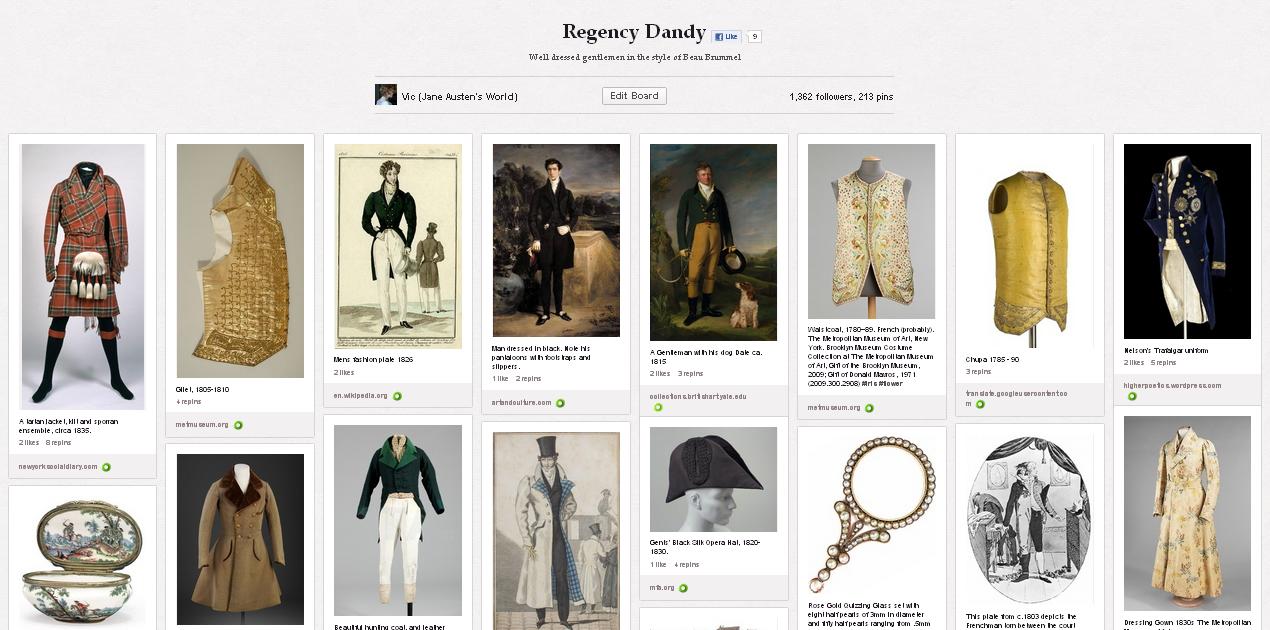
I’ve become a Pinterest addict. I can’t help it. I have always collected images for my blogs from a variety of sources, including museums, other bloggers, and historical websites. When I can, I provide attribution. Pinterest allows me to share interesting images in an easy and public forum. Just look at my fashion Pins. I have divided them into the following categories: 18th and 19th century fashions. Click here to see the full 18th and 19th century fashion board.
I love how I can file my images in logical Pinterest Boards, such as the ones you see above. I’d been collecting images for my private files, but now I can easily share them. Other bloggers have discovered this social media as well, sharing their unique pins (images) with others. I am thinking in particular of Two Nerdy History Girls, Austen Only, Evangeline Holland from Edwardian Promenade, and Heather Carroll from Marie Antoinette’s Gossip Guide
Pinterest is supposed to represent one’s personal interests. My fashion boards, especially, represent my POV. I like to mix up portraits, accessories, costumes, and fashion plates, so that the viewer gains a sense of what a lady’s (or dandy’s) wardrobe might look like in a particular time frame. I often think hard about the combination, making sure to provide a mix. In a few months, I plan to subdivide my boards, to provide a story about fashion or architecture, from which a student of Jane Austen’s World can take away a unique story.
I do have one major beef. While most people repin my images here and there, there are individuals who will repin hundreds of my images in one sitting. Mind you, it has taken me months to assemble the boards that represent my interests. To see one pinner simply appropriate more than 20 images in one sitting burns me up.
If you decide to join Pinterest, enjoy yourself! I do encourage you to follow Pinterest etiquette, however. In all things ask yourself: What would Jane Austen do? Join Vic’s Pinterest account at this link: http://pinterest.com/janeaustenworld/
Please note: Green links in this post are WordPress Ads.
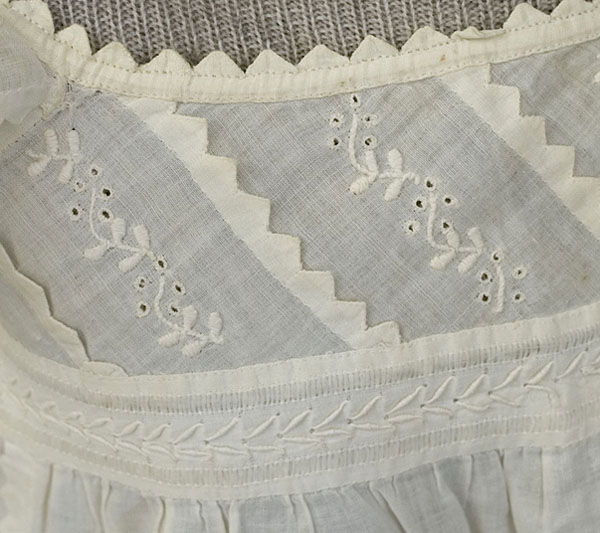
Infant’s hand-embroidered dress, c. 1815-1820. Image @Vintage Textiles.
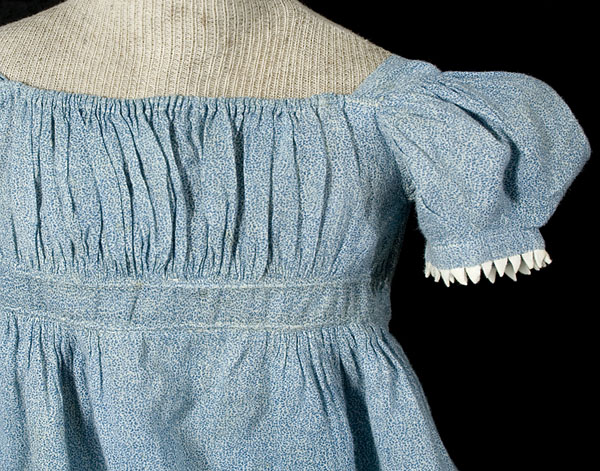
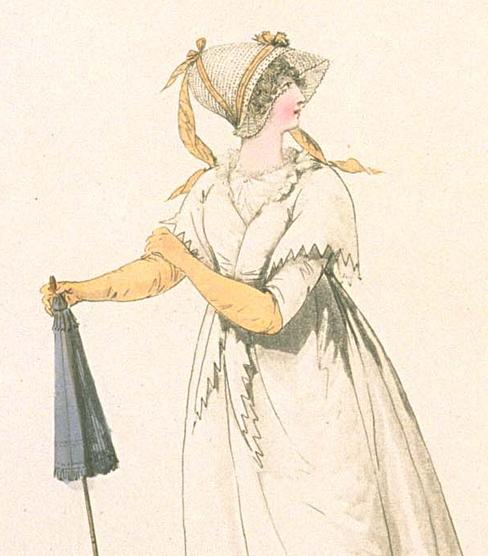
Whenever I view fashion plates and clothes from 200 years ago with Vandyke points, my gaze always lingers. I love these deeply indented trims and decorations, whether they are made of lace or cloth. These are sewn by hand! Imagine the work that went into them.
Vandyke points on the sleeves of a girl’s dress, 1815-1820. Image @Vintage Textile
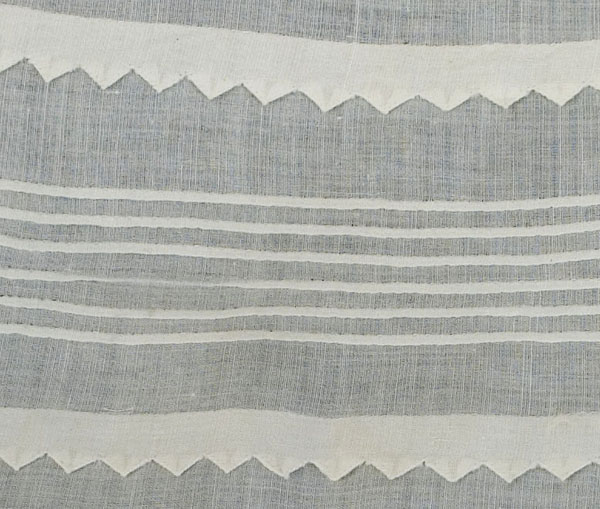
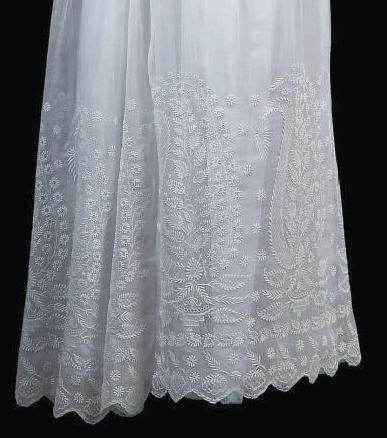
Delicate muslin border. Image @Vintage Textile
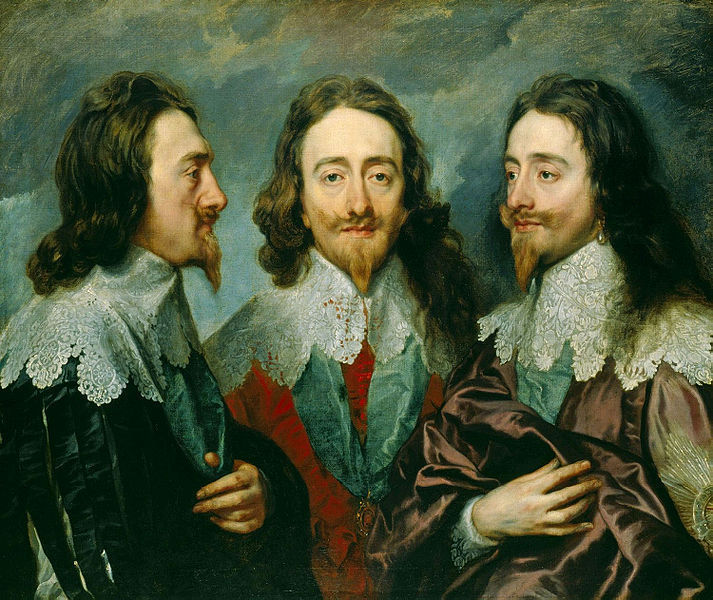
These trims were named after Sir Anthony Van Dyck, a 17th-century Flemish painter (and popular portraitist for British royalty and the upper crust), who was known for painting elaborate V-shaped lace collars and scalloped edges on both his male and female sitters. The pointed vandyke beard was named after him. You can see an example of both in the portrait of Charles I below.
Anthony Van Dyck’s triple portrait of Charles I. Notice the scalloped edge lace collars and pointed vandyke beard.
Vandyke points are labor intensive. The edges you see in the sample of a child’s dress are sewn by hand, as are the tucks. One can only imagine how much time it took, but the results are striking.
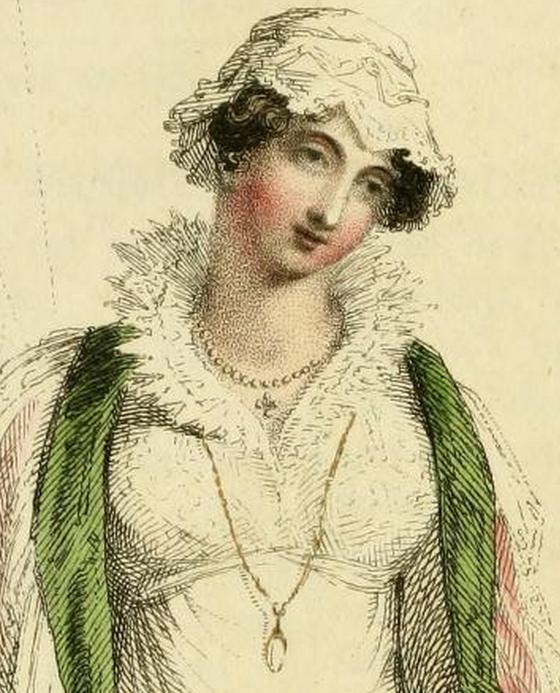
Notice the Vandyke points. Love this Heideloff fashion image, 1794-98.
All of the lade edges were once hand-tatted; they are now machine made, but no less spectacular.
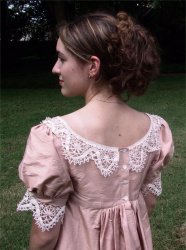
Modern reproduction of a regency gown using lace with vandyke points
Vandyke points edged skirts:
Muslin dress with vandyke edging, 1820-1825. Image @Christie’s
They embellished lace caps and collars:
Vandyke points on lace cap and on collar, detail of an Ackermann plate, morning gown, April 1812.
And edged necklines:
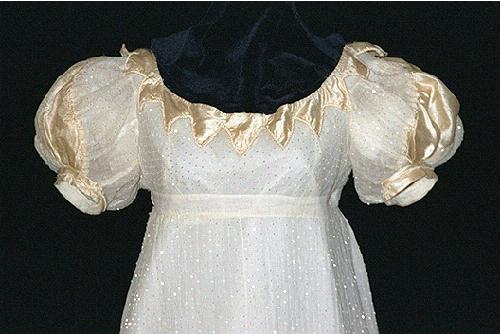
1818 ballgown with satin vandyke points edging
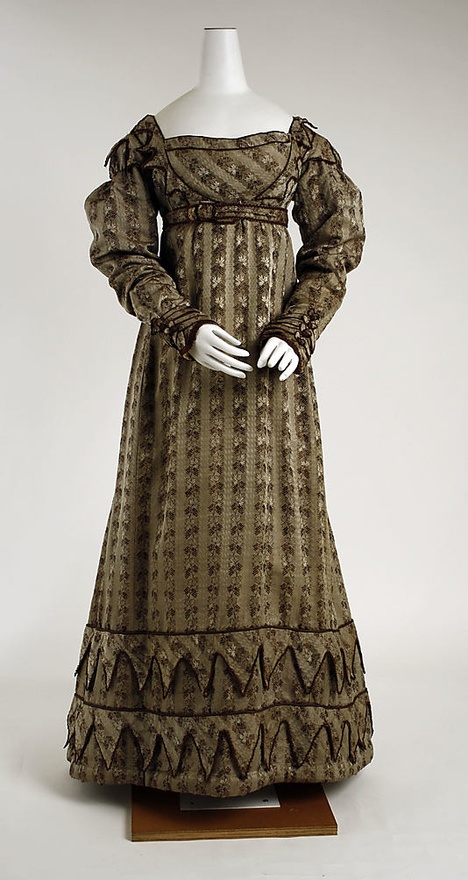
They were used to decorate hems:
Silk European dress, ca. 1819-22. Image @MetMuseum
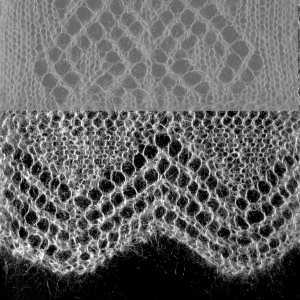
And are still made for modern edgings:
Modern lacy knit with vandyke points
17th century antique clothes looked rich and splendid with these added lace embellishments:
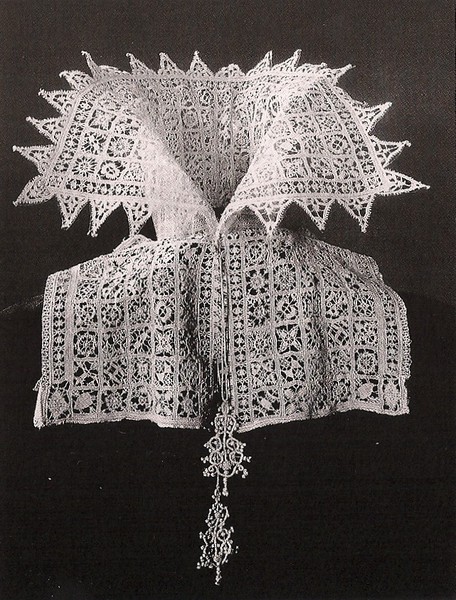
Italian collar with sharp lace points, 1610
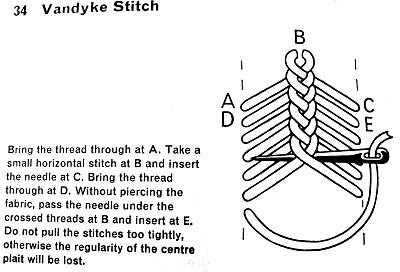
For embroidery stitches and lace tatting, click on the following link: Van Dyke online tatting:This article demonstrates how to tat your own Vandyke point lace. Warning. Time consuming. And the link in the caption to the image below:
Vandyke embroidery stitch – a nice way to fill in leaves and flowers. Image @Windy River embroidery stitch tutorial
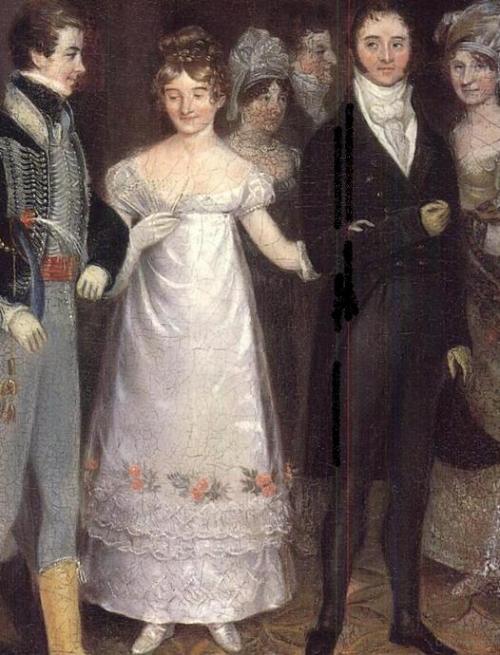
Rolinda Sharple’s painting of the Cloakroom at Clifton shows a number of dresses with vandyke points. This one demonstrates several rows of lace with scalloped edges, and sharp-edged embroidery patterns.
Fashionable Goodness: Christianity in Jane Austen's England is now available! By JAW contributor Brenda S. Cox. See Review. Available from Amazon and Jane Austen Books.
Available through December 31st, 2025. Click on image for details, and share this poster with other teachers and students!
The Obituary of Charlotte Collins by Andrew Capes
Click on image to read the story.
Comments
“My idea of good company…is the company of clever, well-informed people, who have a great deal of conversation.” – Jane Austen, Persuasion
Gentle readers: Please feel free to post your comments and continue the conversation! Due to SPAM, we will no longer accept comments on posts after 30 days of publication. In some instances, links will be removed from comments as well.
Administrators and Contributors
Vic Sanborn, founder of this blog, is supported by a team of talented and knowledgeable writers about Jane Austen and the Regency era. They are:
Tony Grant, who now contributes his photos from London and England
Click on their names to enter their own blogs.
In addition, we thank the many experts and authors who frequently contribute their posts and opinions, and who continue to do so freely or at our request.
Click here to enter the page. Topics include Regency fashion, historic foods, Jane Austen societies, British sites, related topics. Click on image.
May we suggest?
Hello, my name is Vic and I live in Maryland, USA. I have adored Jane Austen almost all of my life. I am a proud lifetime member of the Jane Austen Society of North America. This blog is a personal blog written and edited by me and my team. We do not accept any form of cash advertising, sponsorship, or paid topic insertions. However, we do accept and keep books and CDs to review.
If you would like to share a new site, or point out an error, please email us. (Yes, we are fallible. We'll own up to our mistakes and will make the corrections with a polite smile on our faces.) Write us at
Thank you for visiting this blog. Your comments and suggestions are most welcome.
Project Gutenberg: eBook of Stage-coach and Mail in Days of Yore, Volume 2 (of 2), by Charles G. Harper
STAGE-COACH AND MAIL IN DAYS OF YORE: A PICTURESQUE HISTORY
OF THE COACHING AGE, VOL. II, By CHARLES G. HARPER. 1903. Click on this link.


 1801, 1801, 1802













 Jane Austen's World