Feeds:
Posts
Comments

Posts Tagged ‘Stoneleigh Abbey’

“I had expected to find everything about the place very fine and all that, but I had no idea of its being so beautiful.” –Mrs. Cassandra Leigh Austen, Aug. 13, 1806, on a visit to Stoneleigh Abbey with her daughters Jane and Cassandra

Merry Christmas and Happy Holidays! As my gift to you, let’s take a trip to Stoneleigh Abbey together.

Jane Austen visited Stoneleigh Abbey in 1806. She and her mother and sister were visiting their cousin, Rev. Thomas Leigh, in Adlestrop when his distant cousin, the Honorable Mary Leigh, died. Rev. Thomas inherited the wealthy estate. He took his poorer relations, the Austens, with him to take possession, as a treat for them. They enjoyed it very much, as Mrs. Austen wrote in a letter.  She said the house was so large that they needed signposts to find their way, and that it was not only very “fine,” but more beautiful than she had imagined. Catherine Morland, similarly, when she saw Northanger Abbey, “was struck . . . beyond her expectation, by the grandeur of the abbey.”

Based on income, Stoneleigh Abbey was an even grander place than Pemberley or Sotherton (the Rushworth estate in Mansfield Park) would have been. Austen tells us that Darcy’s income was £10,000 a year and Mr. Rushworth’s was £12,000 a year. But the income of the Leighs of Stoneleigh Abbey, in Jane Austen’s time, was even higher, at £17,000 a year, which Victoria Huxley says was “perhaps the annual equivalent of a million pounds in today’s values” (p. 9). (We were told when touring Chatsworth that the income there in Austen’s time was about £30,000, three times Darcy’s income; I haven’t found confirmation of that number anywhere, though.)

Today, ideally you need a car or a tour bus to get you to Stoneleigh Abbey. It is about an hour’s drive north of Oxford or about 40 minutes southeast from Birmingham. If you want to take public transport, it looks like you’ll have a half-hour’s walk at the end of your journey.

I went with the JASNA Summer Tour. We saw the Adlestrop church the same day; it’s only about an hour’s drive away.

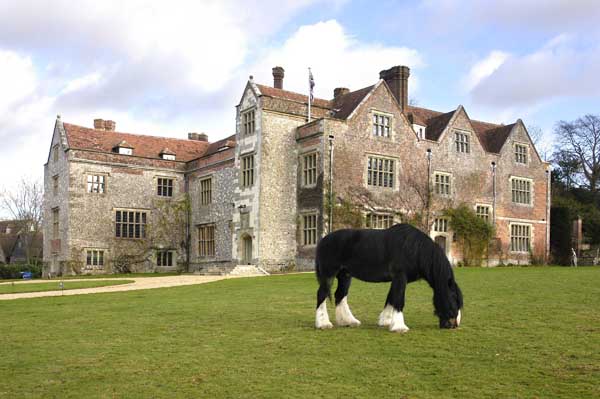
Stoneleigh Abbey, like Austen’s fictional Northanger Abbey, is a mix of older monastic buildings and newer buildings. (Newer in Austen’s time, at least.) Let’s take a trip through it, with some quotes from Austen’s novels.

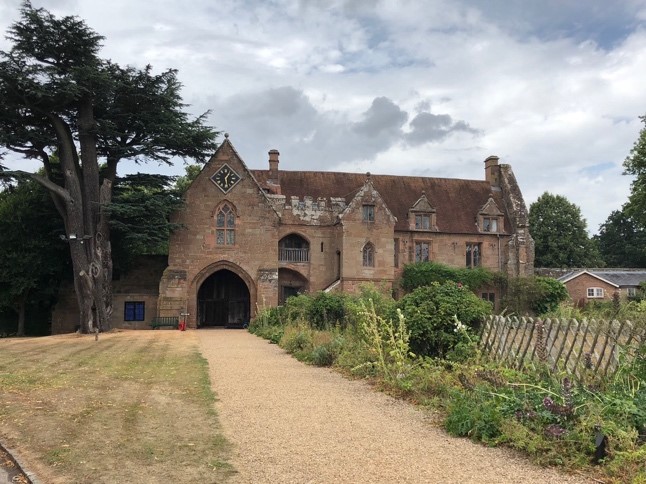
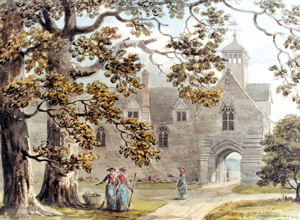
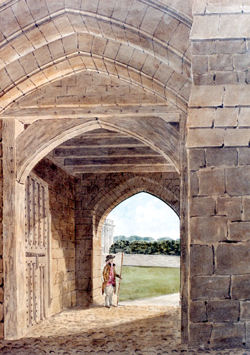
The red sandstone gatehouse, where you buy entry tickets, is from the 14th century, a remnant of the original Cistercian monastery. At this gatehouse, built in 1346 by Abbot Robert de Hoeckle, the poor received alms and travelers found hospitality.

So low did the building stand, that she found herself passing through the great gates of the lodge into the very grounds of Northanger, without having discerned even an antique chimney. . . . To pass between lodges of a modern appearance, to find herself with such ease in the very precincts of the abbey, and driven so rapidly along a smooth, level road of fine gravel, without obstacle, alarm, or solemnity of any kind, struck her as odd and inconsistent.–Catherine Morland, Northanger Abbey

Now we are coming to the lodge-gates; but we have nearly a mile through the park still.–Maria Bertram, Mansfield Park

The tour did not take us into this north wing. But you can still see arches on the walls, from the original monastery church. They are now bricked over. A cloister and medieval stained glass windows remain in the older buildings.
Another building from the old monastery. Stoneleigh Abbey was a small Cistercian monastery from 1155 until Henry VIII dissolved the monasteries in 1536. The Leigh family bought it in 1561. Catherine Morland was disappointed not to stay in such a building at Northanger Abbey.

[Catherine] was hardly more assured than before, of Northanger Abbey having been a richly endowed convent at the time of the Reformation, of its having fallen into the hands of an ancestor of the Tilneys on its dissolution–Northanger Abbey
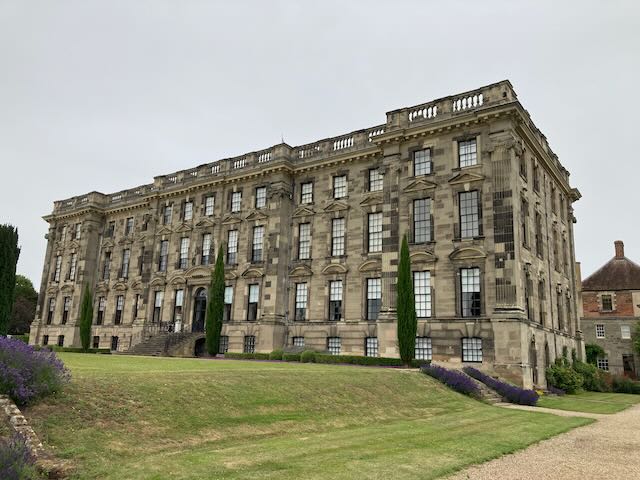
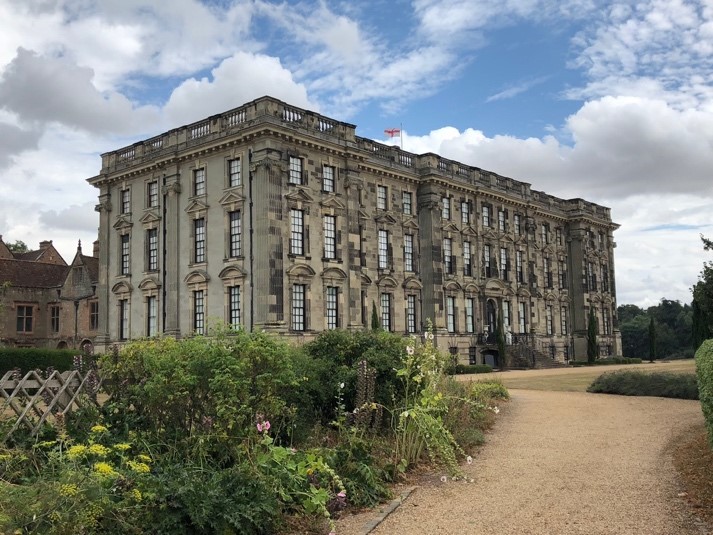
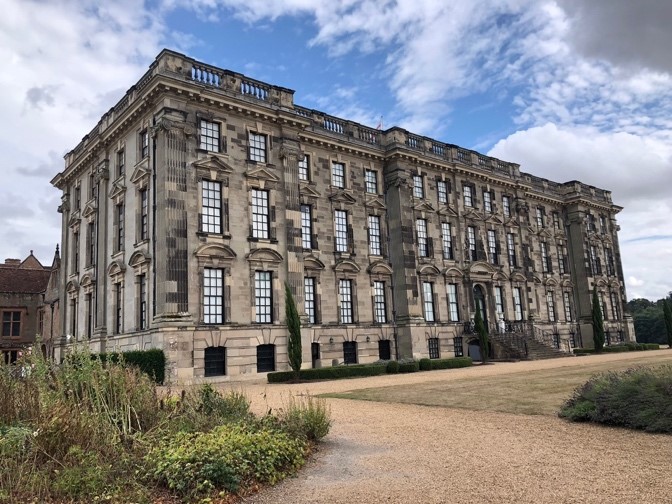
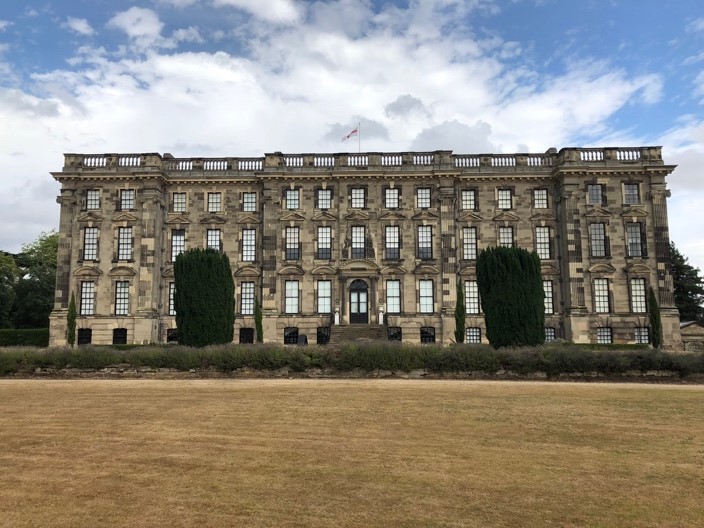
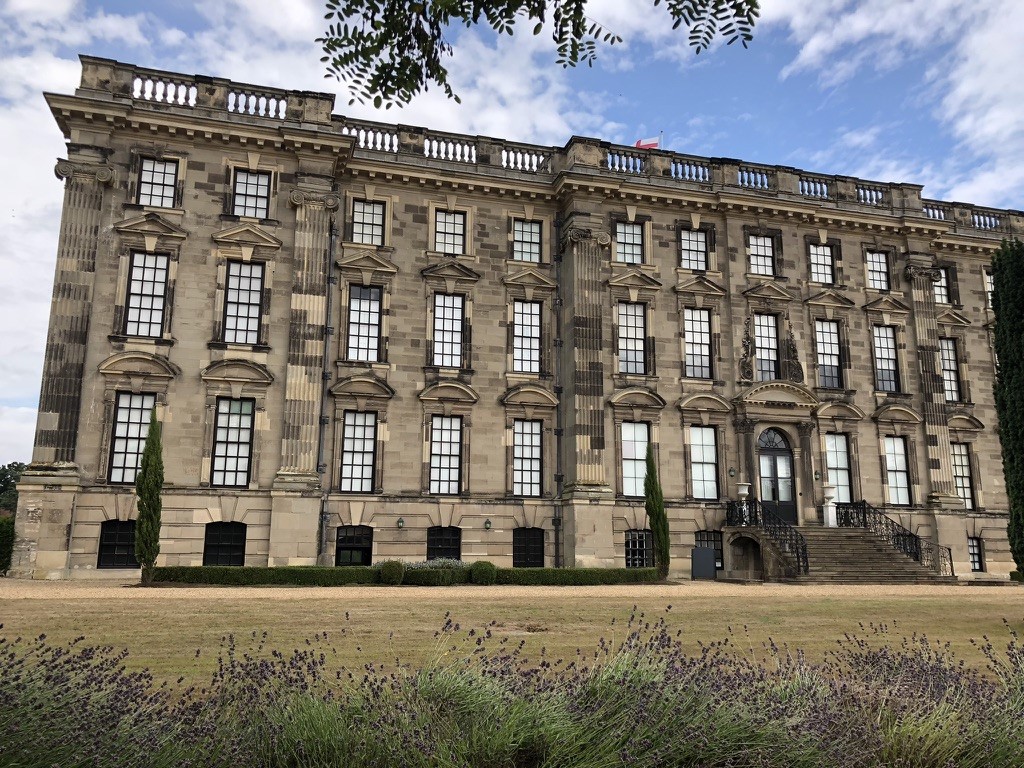
The baroque West Wing is the most impressive building, built in the 1720s by Edward, the third baron Leigh. He married a rich heiress. After his Grand Tour on the continent, he was inspired to create his own Italian-style palace. Mrs. Austen wrote that there are 45 windows in the front.

She was struck, however, beyond her expectation, by the grandeur of the abbey, as she saw it for the first time from the lawn.–Catherine Morland, Northanger Abbey

Even Fanny had something to say in admiration. . . . Her eye was eagerly taking in everything within her reach; . . . being at some pains to get a view of the house, and observing that “it was a sort of building which she could not look at but with respect”–Mansfield Park

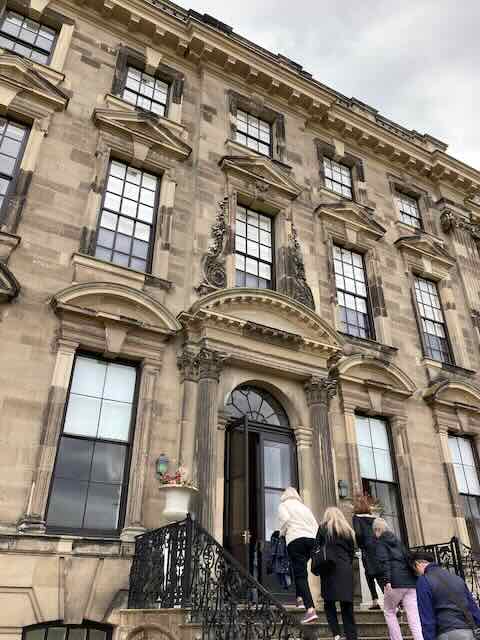
Architect Francis Smith designed the Stoneleigh Abbey West Wing, which cost £3,300. The older abbey buildings became servants’ quarters.
A flight of stairs leads up to the main entry to Stoneleigh Abbey, West wing

Miss Bertram could now speak with decided information of what she had known nothing about when Mr. Rushworth had asked her opinion; and her spirits were in as happy a flutter as vanity and pride could furnish, when they drove up to the spacious stone steps before the principal entrance.–Mansfield Park
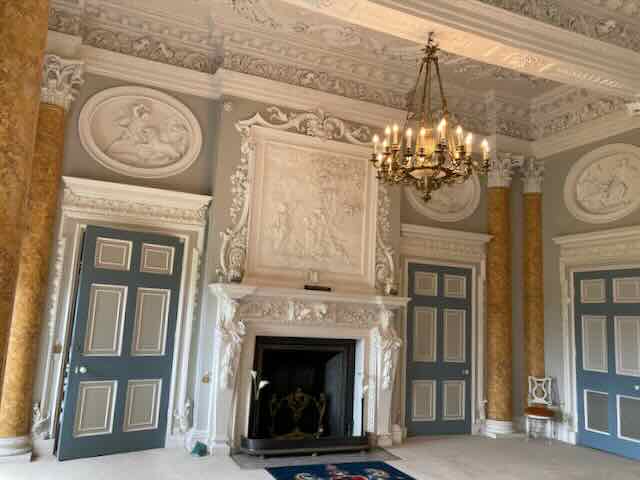
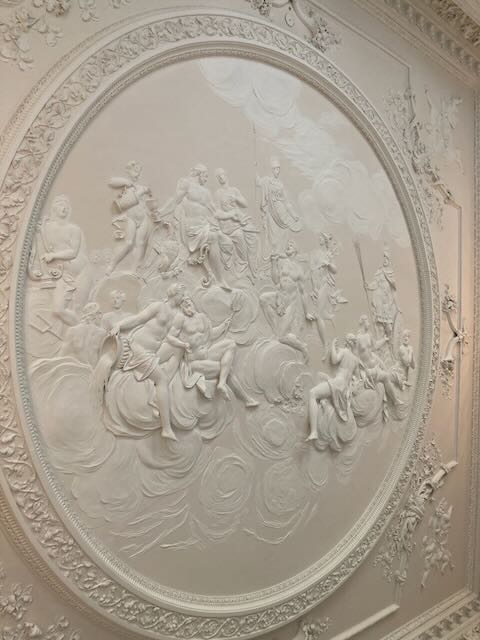
One end of the impressive “saloon” (salon, entry room) of Stoneleigh Abbey. Plaster decorations show myths of the Greek hero Hercules. Edward, the fifth Lord Leigh, decorated this room in the 1760s while doing vast “improvements” to his manor.
Ceiling plasterwork in the Stoneleigh Abbey saloon showing Hercules joining the gods. Ironically, Hercules suffered from bouts of madness, as did Edward Leigh himself.

An abbey! Yes, it was delightful to be really in an abbey! But she doubted, as she looked round the room, whether anything within her observation would have given her the consciousness. The furniture was in all the profusion and elegance of modern taste.–Catherine Morland, Northanger Abbey

The whole party rose accordingly, and under Mrs. Rushworth’s guidance were shewn through a number of rooms, all lofty, and many large, and amply furnished in the taste of fifty years back, with shining floors, solid mahogany, rich damask, marble, gilding, and carving, each handsome in its way.–Mansfield Park
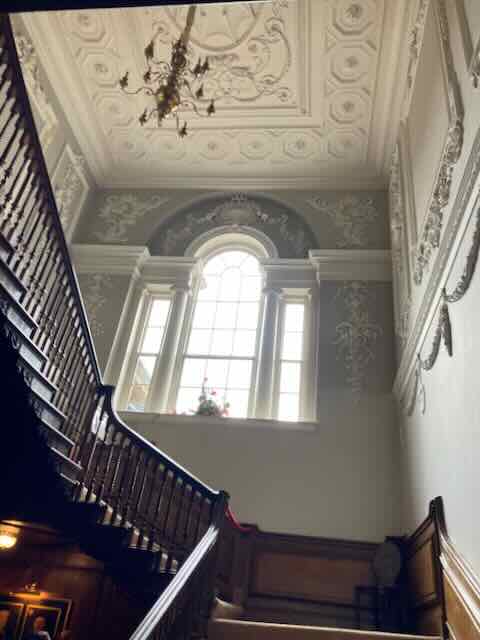
The main staircase of Stoneleigh Abbey, one of three staircases Jane Austen’s mother mentions.

They returned to the hall, that the chief staircase might be ascended, and the beauty of its wood, and ornaments of rich carving might be pointed out.–Northanger Abbey

The lower part of the house had been now entirely shewn, and Mrs. Rushworth, never weary in the cause, would have proceeded towards the principal staircase, and taken them through all the rooms above, if her son had not interposed with a doubt of there being time enough.–Mansfield Park
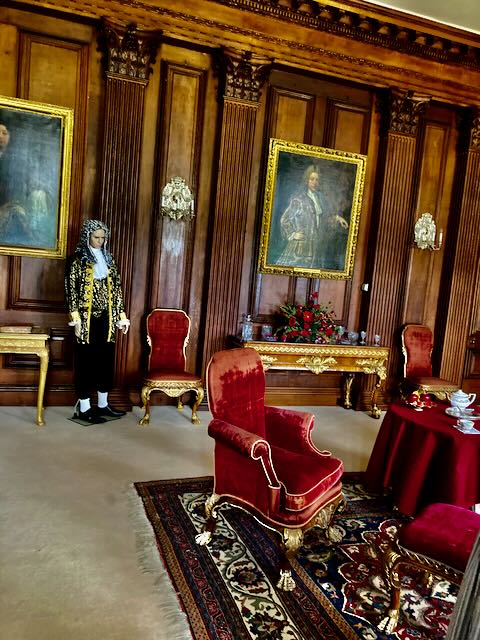
The drawing room of Stoneleigh Abbey. After dinner, the ladies would “withdraw” to the “withdrawing room,” later called the drawing room. The gentlemen would join them after a time.

The general leads Catherine “into a room magnificent both in size and furniture—the real drawing-room, used only with company of consequence. It was very noble—very grand—very charming!—was all that Catherine had to say, for her indiscriminating eye scarcely discerned the colour of the satin; and all minuteness of praise, all praise that had much meaning, was supplied by the general: the costliness or elegance of any room’s fitting-up could be nothing to her; she cared for no furniture of a more modern date than the fifteenth century.”–Northanger Abbey

The drawing room clock, from 1786, plays carillon music on the hour. Stoneleigh Abbey

“Till midnight, she supposed it would be in vain to watch; but then, when the clock had struck twelve, and all was quiet, she would, if not quite appalled by darkness, steal out and look once more. The clock struck twelve—and Catherine had been half an hour asleep.”–Northanger Abbey

Stoneleigh Abbey card room fireplace, with plates of “the prettiest English china,” hand painted by ladies of the family.

The fireplace, where she had expected the ample width and ponderous carving of former times, was contracted to a Rumford, with slabs of plain though handsome marble, and ornaments over it of the prettiest English china.–Northanger Abbey

A Rumford was an invention that made fireplaces more efficient. They are still used today.
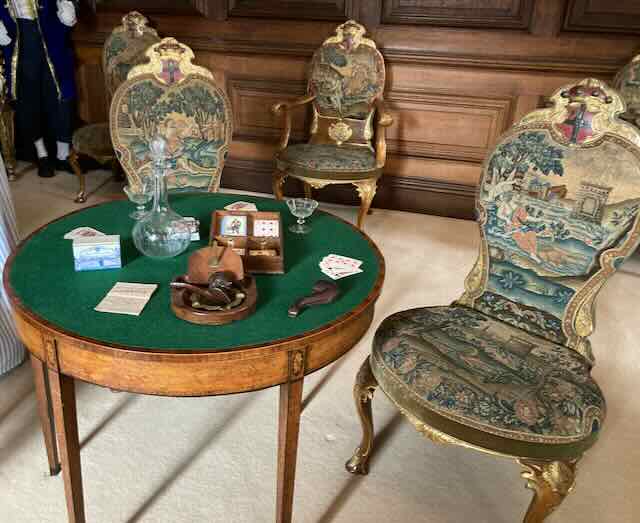
Stoneleigh Abbey card room, set up for a game of cards.

Mr. Elton had retreated into the card-room, looking (Emma trusted) very foolish.–Emma
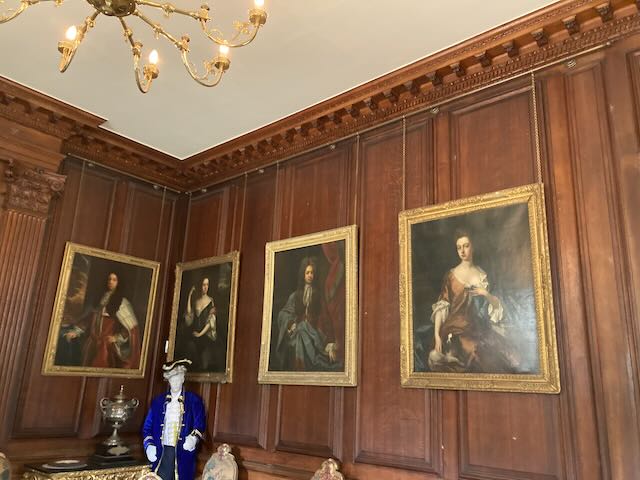
Portraits in the Card Room. All the rooms we saw were lined with family portraits.

Of pictures there were abundance, and some few good, but the larger part were family portraits, no longer anything to anybody but Mrs. Rushworth–Mansfield Park

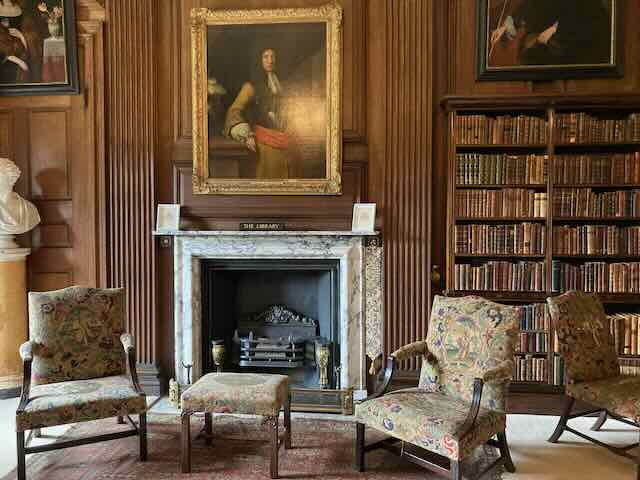
Edward, fifth Lord Leigh, bequeathed most of his extensive library to his alma mater, Oriel College at Oxford. These included “outstanding works on architecture and music, his scientific instruments, maps and prints.” (Jane Austen & Adlestrop, 22).
The library of Stoneleigh Abbey was replenished by later heirs.

Marianne, who had the knack of finding her way in every house to the library, however it might be avoided by the family in general, soon procured herself a book.–Sense and Sensibility

Ready to play chess in the library, Stoneleigh Abbey

“What a delightful library you have at Pemberley, Mr. Darcy!”

“It ought to be good,” he replied, “it has been the work of many generations.”

“And then you have added so much to it yourself, you are always buying books.”

“I cannot comprehend the neglect of a family library in such days as these.”–Miss Bingley and Mr. Darcy, Pride and Prejudice
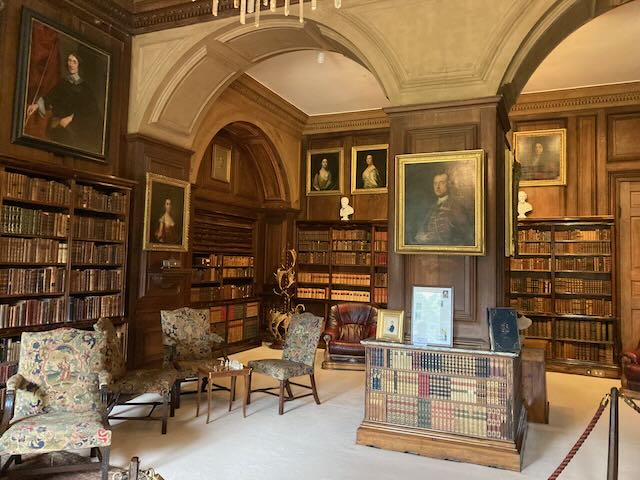
Stoneleigh Abbey library

After tea, Mr. Bennet retired to the library, as was his custom–Pride and Prejudice

Ladies’ dressing table, Stoneleigh Abbey

“My mother is tolerably well, I trust; though her spirits are greatly shaken. She is up stairs and will have great satisfaction in seeing you all. She does not yet leave her dressing-room.”–Jane Bennet, Pride and Prejudice
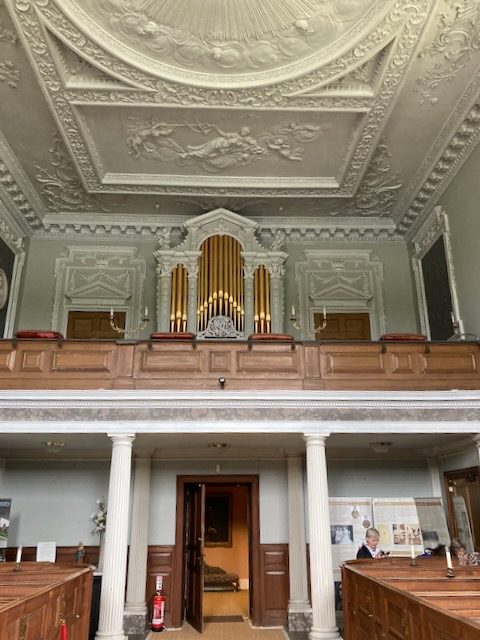
The chapel at Stoneleigh Abbey is considered to be the model for the chapel at Sotherton in Mansfield Park. Crimson cushions appear over the balcony ledge, as in Mansfield Park. Rev. Thomas Leigh read prayers (led a worship service) in the chapel twice a day, with morning prayers at 9 A.M.

Fanny’s imagination had prepared her for something grander than a mere spacious, oblong room, fitted up for the purpose of devotion: with nothing more striking or more solemn than the profusion of mahogany, and the crimson velvet cushions appearing over the ledge of the family gallery above. “I am disappointed,” said she, in a low voice, to Edmund. “This is not my idea of a chapel. There is nothing awful here, nothing melancholy, nothing grand.” . . .

Mrs. Rushworth began her relation. “This chapel was fitted up as you see it, in James the Second’s time. Before that period, as I understand, the pews were only wainscot; and there is some reason to think that the linings and cushions of the pulpit and family seat were only purple cloth; but this is not quite certain. It is a handsome chapel, and was formerly in constant use both morning and evening. Prayers were always read in it by the domestic chaplain, within the memory of many; but the late Mr. Rushworth left it off.” . . .

“It is a pity,” cried Fanny, “that the custom should have been discontinued. It was a valuable part of former times. There is something in a chapel and chaplain so much in character with a great house, with one’s ideas of what such a household should be! A whole family assembling regularly for the purpose of prayer is fine!”–Mansfield Park

See my post on The Stoneleigh Abbey Chapel and Mansfield Park for a visit to the chapel with further quotes from Mansfield Park.

Queen Victoria’s bedroom at Stoneleigh Abbey. In 1858, Queen Victoria stayed for two nights at the Abbey, in a suite of five rooms. The furniture was painted white and gold, according to the Queen’s preference.

In a house so furnished, and so guarded, she could have nothing to explore or to suffer, and might go to her bedroom as securely as if it had been her own chamber at Fullerton.–Catherine Morland, Northanger Abbey
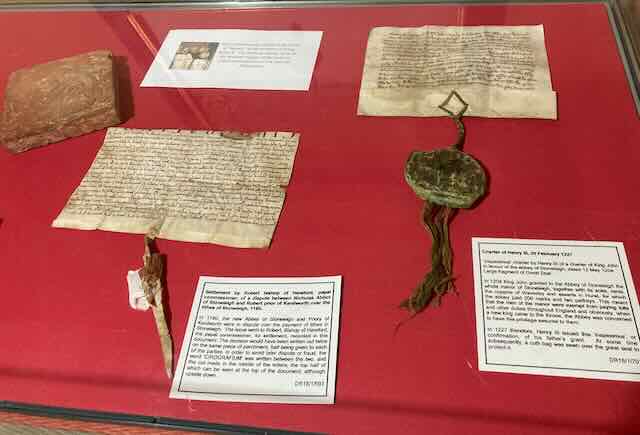
Further rooms at Stoneleigh Abbey display historical relics, such as the monks’ charters and seals.

Northanger turned up an abbey, and she was to be its inhabitant. Its long, damp passages, its narrow cells and ruined chapel, were to be within her daily reach, and she could not entirely subdue the hope of some traditional legends, some awful memorials of an injured and ill-fated nun.–Catherine Morland, Northanger Abbey

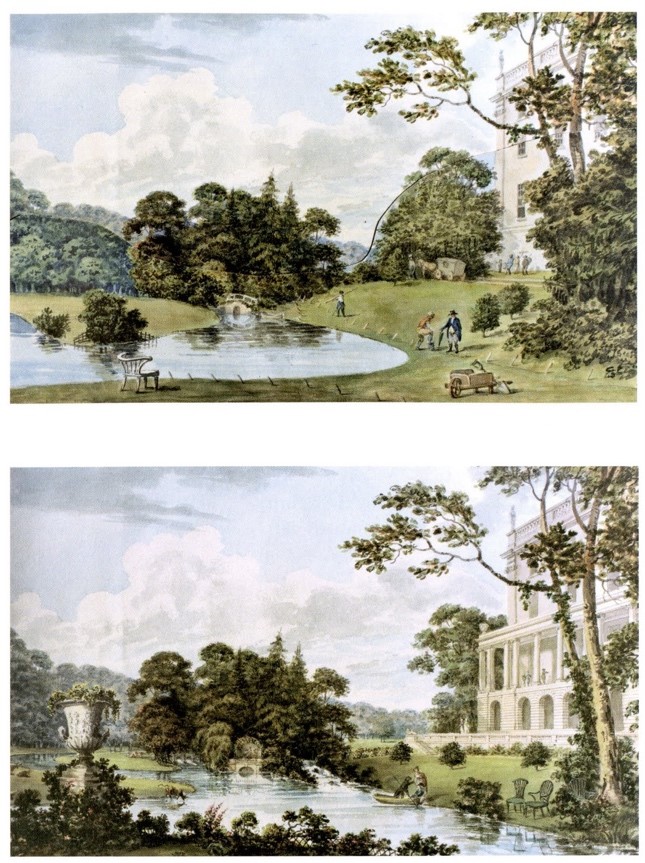
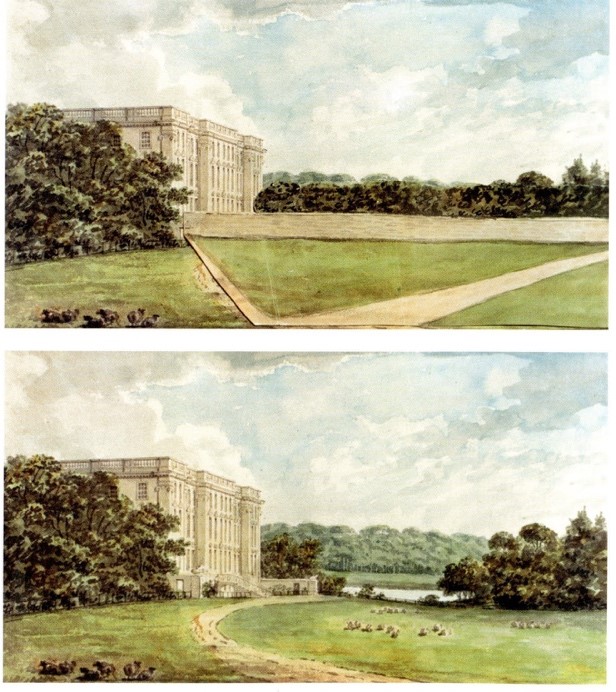
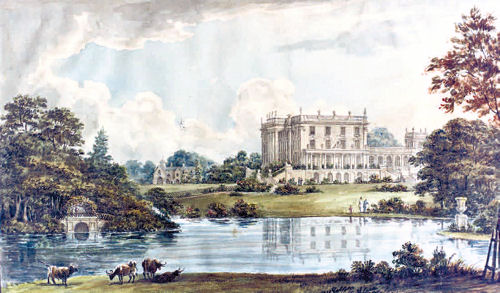
Humphry Repton was hired to improve Stoneleigh Abbey and its surroundings. His Red Book, showing before and after pictures, still exists.
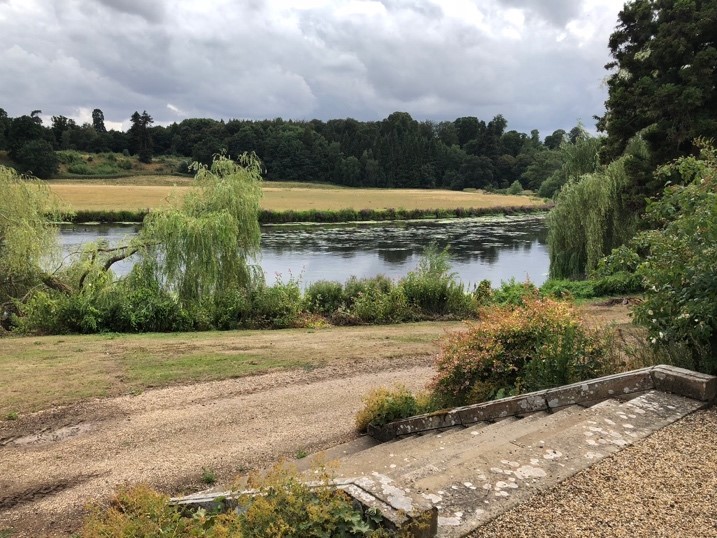
Repton moved the river toward Stoneleigh Abbey so you could see the house reflected in the water.

“Smith’s place is the admiration of all the country; and it was a mere nothing before Repton took it in hand. I think I shall have Repton.”–Mr. Rushworth, Mansfield Park

A ha-ha (see below) at Stoneleigh Abbey gives an uninterrupted view across the fields.
From the other side of Stoneleigh Abbey’s hedge of lavender shown above, you can see the wall that kept animals from trespassing to the area around the house. A ha-ha is a walled ditch dug to act as a fence without disrupting the view.

A few steps farther brought them out at the bottom of the very walk they had been talking of; and standing back, well shaded and sheltered, and looking over a ha-ha into the park, was a comfortable-sized bench, on which they all sat down. . . .

“You will hurt yourself, Miss Bertram,” [Fanny Price] cried; “you will certainly hurt yourself against those spikes; you will tear your gown; you will be in danger of slipping into the ha-ha.”–Mansfield Park

In 1946, Stoneleigh Abbey became “one of the first stately homes to open its doors to the public” (Stoneleigh Abbey, 18). A fire destroyed much of it in 1960, though most of the furniture and paintings were rescued. In 1996, a trust was set up to restore it, at a cost of £12 million. They did an amazing job. Restoration was also done on the grounds and the lake. The restoration work sought to improve the habitats of bats, otters, kingfishers, and other species

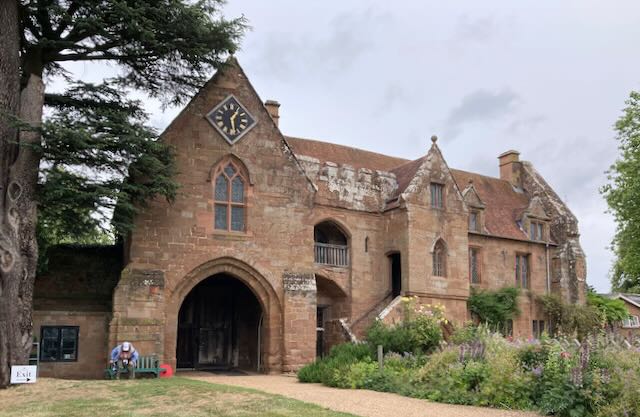
Restorers also worked on conserving water management structures such as these locks.
We exit back through the Stoneleigh Abbey gatehouse, having enjoyed a beautiful day.

During their visit, the Austens enjoyed extensive walks through the grounds. Rachel Dodge has posted some of those lovely views. The Austens must have also attended the Stoneleigh Church, St. Mary the Virgin, though we didn’t get to visit it this trip. 

I hope you have enjoyed our visit to Stoneleigh Abbey with Jane Austen’s characters, and that you can see it in person some day! This year, the Abbey celebrated Christmas with a Christmas fair and a series of concerts, including carols in the chapel. If you have been to Stoneleigh Abbey, please tell us about your impressions!

Brenda S. Cox is the author of Fashionable Goodness: Christianity in Jane Austen’s England. She also blogs at Faith, Science, Joy, and Jane Austen.

All photos in this post, © Brenda S. Cox, 2023.

Sources and Further Reading

Jane Austen & Adlestrop: Her Other Family, by Victoria Huxley. US Amazon link

Stoneleigh Abbey by Paula Cornwell (obtained from Stoneleigh Abbey)

Jane Austen: A Family Record, 2nd ed., by Deirdre Le Faye

The Stoneleigh Abbey Chapel and Mansfield Park

Jane Austen’s Rich(er) Leigh Family Connections at Adlestrop and Stoneleigh Abbey 

Visiting Stoneleigh Abbey

Cassandra Leigh Austen’s Stay at Stoneleigh Abbey (letter)

Jane Austen’s Leigh Family: Stories Behind the Stories

Jane Austen’s Clergymen and Her Leigh Family

Jane Austen’s Mansfield Park and Stoneleigh Abbey

More pictures of Stoneleigh village, church, and abbey 

Stoneleigh Abbey website

Read Full Post »

By Brenda S. Cox

“Your letter to Adlestrop may perhaps bring you information from the spot . . .”–Jane Austen writing to her sister Cassandra about a relative in Adlestrop they loved, Elizabeth Leigh, who was very ill. Jan. 10, 1809

I’ve just finished a fascinating little book, Jane Austen & Adlestrop: Her Other Family, by Victoria Huxley. Huxley tells the stories of Austen’s Leigh relatives alongside frequent quotes from Austen’s works as well as other contemporary sources. I highly recommend this book, but I’ll share some highlights.

Members of the JASNA Summer Tour were entertained by church members at Adlestrop. Author Victoria Huxley sells her book to me, Brenda Cox. Photo © Brenda S. Cox, 2023

We know Jane Austen didn’t take her characters or situations directly from life. And yet, for every author, the experiences we have and hear about, and the people we know and know of, are all grist for the mill. They come together in new shapes and forms as we write. Jane Austen was close to her Leigh relatives, so it’s not surprising their lives fed into her novels in various ways.

The Leigh Family

Jane’s mother Cassandra Leigh Austen was from an old family descended from a Lord Mayor of London, Sir Thomas Leigh (1498-1571). During Sir Thomas’s lifetime, King Henry VIII dissolved the monasteries, making much land available for purchase. Sir Thomas invested widely. When he died, he owned extensive lands in four counties plus London.

His eldest son, Rowland, inherited Adlestrop and the lands around it in Gloucestershire (north of Oxford). His second son, Thomas, inherited Stoneleigh, Hamstall Ridware, and other estates in Staffordshire (north of Gloucestershire). The Adlestrop line remained country squires, while the Stoneleigh line gained a peerage by supporting Charles I in the English Civil War. They became far wealthier than the Adlestrop Leighs. By Jane Austen’s time, the Stoneleigh estate was worth around £17,000 a year, more than the income of wealthy Mr. Rushworth (£13,000) or Mr. Darcy (£10,000)!

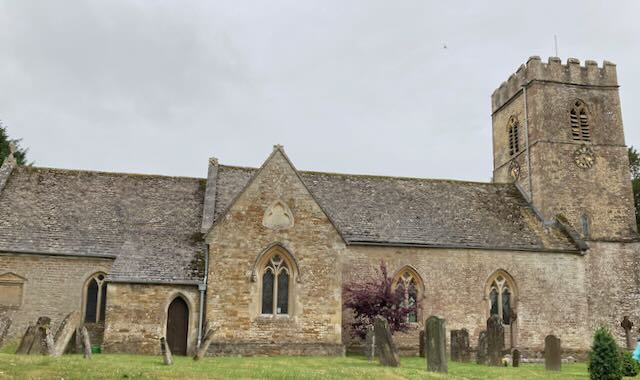
Jane Austen must have attended the lovely old church at Adlestrop on her three visits to her mother’s cousin, Rev. Thomas Leigh, who was rector there. Photo © Brenda S. Cox, 2023

I won’t inflict the whole family tree on you, as they repeated the same names over and over. Some of their favorite names were Thomas, Theophilus, James, Cassandra, and Mary. Cassandra Leigh Austen’s father was Rev. Thomas Leigh (1696-1764), and her mother’s maiden name was Jane Walker. Cassandra Leigh also had a sister named Jane, a sister-in-law named Jane, and, our favorite, a daughter named Jane (plus a daughter named Cassandra, and two first cousins named Cassandra). Jane Walker brought the Perrot family’s wealth into the family. [In the following, whenever I say “Cassandra Leigh” or “Cassandra Leigh Austen,” I mean our Jane Austen’s mother, not her sister.]

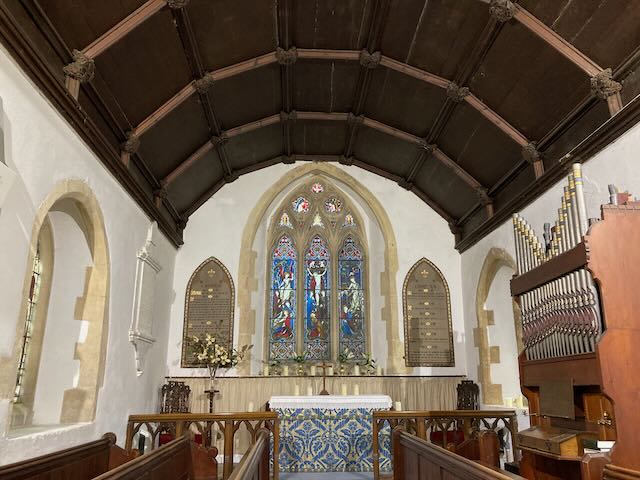
The chancel of the Adlestrop church (area around the altar). Photo © Brenda S. Cox, 2023

Adlestrop, Jane Austen, and the Clergy

Adlestrop is now best known for a poem written in 1914 by Edward Thomas, who died three years later in World War I. His train stopped there briefly, and the poem describes the natural beauties of the area, the “willows, willow-herb, and grass” and a blackbird singing. Adlestrop is still a small, rural town, as it was in Austen’s time.

The squire of the manor, Adlestrop Park, during Jane’s lifetime was James Henry Leigh, who inherited in 1774, when he was only nine years old. His uncle, Rev. Thomas Leigh, was his guardian and the rector of Adlestrop at that time. He was Cassandra Leigh’s first cousin. Rev. Thomas lived with his wife Mary and his unmarried sister Elizabeth, who was the godmother of Jane’s sister Cassandra.

Memorial to James Henry Leigh, squire of Adlestrop when Austen visited there. Photo © Brenda S. Cox, 2023

Apparently Cassandra Leigh was closer to Rev. Thomas than to James Henry. On their visits, the Austens always stayed in the rectory, not in the great house. They would certainly have attended the Adlestrop church, where Rev. Thomas preached. Jane Austen first visited Adlestrop in 1794, when she was 19. She visited again five years later, in 1799, and then in 1806, when she was 31. Throughout the years, the Austen and Leigh families kept in touch through letters.

The nave of the Adlestrop church, where the congregation sits. Perhaps Jane Austen sat on one of these pews, or an earlier version of them. Photo © Brenda S. Cox, 2023

Many of Cassandra Leigh’s relatives were clergymen*, including her father, an uncle, two cousins, a brother-in-law, and a nephew. Leigh family members were patrons of various church livings connected with their extensive properties, and bestowed those livings on relatives, as was customary. In Austen’s novels, for example, both Henry Tilney and Edmund Bertram receive livings from their fathers. Livings might also be given by more distant relations. The Honorable Mary Leigh, for example, gave Edward Cooper (Jane Austen’s cousin) his living at Hamstall Ridware in Staffordshire. 

A living green cross welcomes visitors to the Adlestrop church. Photo © Brenda S. Cox, 2023

Stoneleigh Abbey and Inheritance

In 1806, the last member of the Stoneleigh branch of the Leigh family, the Honorable Mary Leigh, died, and Rev. Thomas Leigh, inherited. Mrs. Austen [Cassandra Leigh, who was Rev. Thomas’s first cousin], with her daughters Jane and Cassandra, were visiting Rev. Thomas at the time, and they traveled with him to take possession of Stoneleigh. The Abbey made a strong impression on Jane and her family. Mrs. Austen wrote letters describing its wonders.

When Rev. Leigh inherited Stoneleigh Abbey, he gave a settlement to another claimant*, Jane’s uncle, James Leigh-Perrot (Cassandra Leigh’s brother). The understanding was that rich Mr. Leigh-Perrot would share this settlement with the needy Austens and Coopers. However, he did not. Jane attributed this lack of generosity to Mrs. Leigh-Perrot; perhaps she was caricatured as selfish Fanny Dashwood of Sense and Sensibility. You can find more details in “Jane Austen’s Leigh Family: Stories behind the Stories.”

When James Leigh-Perrot died, he left almost everything to his wife. Eventually, when Mrs. Leigh-Perrot died in 1836, some of her estate went to Jane’s nephew, James’s son James Edward. He had to take the name Leigh, becoming James Edward Austen-Leigh. 

Next month I’ll post more pictures of Stoneleigh Abbey and talk about its possible parallels with Sotherton and Northanger Abbey in Austen’s novels.

The Leighs who inherited Stoneleigh Abbey and the surrounding lands eventually became much wealthier than the Leighs who inherited Adlestrop. But when that branch died out, some of the Adlestrop Leighs inherited the Abbey. Photo © Brenda S. Cox, 2023

Improvements—Mansfield Park

“Improvements” of land and property often meant providing more “picturesque,” more “natural” views, according to the ideas promoted by Gilpin at the time. In Mansfield Park, Mr. Rushworth wants to get the well-known expert, Humphry Repton, to improve his estate. Henry Crawford has already improved his own estate, and he advises Edmund Bertram on improving his parsonage. In Sense and Sensibility, Mrs. Dashwood talks often of making improvements to Barton Cottage, but she never has the funds for it. John and Fanny Dashwood do spend their money making improvements to Norland, which Elinor and Marianne don’t think much of. Mr. Collins makes improvements to his parsonage. Elizabeth is impressed that the Darcys have shown good taste in improving Pemberley, inside and out.

Austen more strongly commends personal “improvement,” though, improvement in mind, in manners, in education.

Austen would have known first-hand about Repton and his improvements from her cousins in Adlestrop and Stoneleigh. Rev. Thomas Leigh and his nephew employed Repton to make improvements to the manor, rectory, and surrounding lands of Adlestrop. Records show payments to Repton between 1798 and 1812.

Adlestrop House, the former rectory, where Jane Austen and her family stayed. The bow on the left side was added later, and the entrance returned to its original position. Photo © Brenda S. Cox, 2023

Rev. Leigh “improved” his parsonage at Adlestrop by moving his front door to another side of the house, so the principal rooms would face the pretty valley. He also destroyed “a dirty farmyard and house which came within a few yards of the Windows.” Similarly, in Mansfield Park, Henry Crawford tells Edmund Bertram that he must improve his parsonage: “The farmyard must be cleared away entirely, and planted up to shut out the blacksmith’s shop. The house must be turned to front the east instead of the north—the entrance and principal rooms, I mean, must be on that side, where the view is really very pretty.” He also recommends combining gardens, changing a stream, and moving a road.

Rev. Thomas Leigh enclosed neighbouring land (with permission), adding it to his church living, and created a small lake from some flooded ground. As Huxley says, “Now he had a ‘Pleasure Ground’ to rival his brother’s” (at the Adlestrop estate). He moved roads and paths, as Mr. Knightley is planning to do in Emma. Jane Austen would have seen these improvements first hand during her visits. Sometimes she might have felt, like Mary Crawford, that all was “dirt and confusion, without a gravel walk to step on, or a bench fit for use” because of all the changes in process. However, as Mr. Collins did for his visitors, no doubt Rev. Leigh proudly took the Austen family on a thorough tour of his parsonage and its gardens, pointing out with pride all the improvements he was making.

In 1799, some land was exchanged between the church and the manor. In return, James Henry paid to build and fence a better church road and enclose the churchyard with a stone wall. In 1800, Repton was hired to unite the gardens of the rectory and Adlestrop Park, to improve the views. Dr. Grant in Mansfield Park also extends a wall and makes a plantation “to shut out the churchyard,” improving the view from the parsonage.

Rev. Thomas Leigh expanded the park area between the rectory and Adlestrop Park, adding an unused part of the church graveyard to the Park. Photo © Brenda S. Cox, 2023

Austen would have heard about Repton’s later “improvements” in Stoneleigh Abbey’s grounds, which Thomas Leigh set about once he moved in. Repton’s “Red Book,” showing the suggested improvements, is still in existence. You can see a video of it here. Not all of Repton’s recommendations were followed, but some were.

The Leighs and Persuasion

Two other stories from the Leigh family are echoed in Persuasion. At one point, the Adlestrop family was deep in debt and needed to “retrench” in order not to lose the estate. They rented out the manor and moved to Holland for some years, until their finances were in order. Sir Walter and his family, of course, only moved to Bath; we wonder if they will ever make it back to Kellynch!

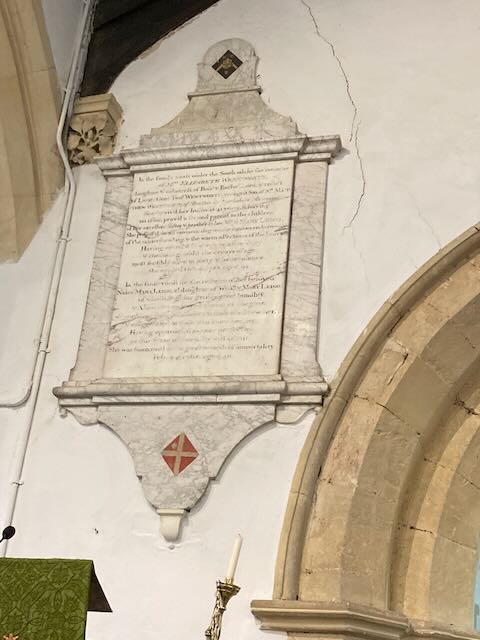
The Leighs also had an aunt who fell in love with an army officer. The family disapproved because of his lack of money. She married him secretly before he went off to war. When he returned as–guess who? Captain Wentworth!– she finally got her family’s approval. Elizabeth Wentworth and her Captain became wealthy and were benefactors to their Leigh relatives. The largest marble tablet in the Adlestrop church, just behind the pulpit, memorializes Elizabeth Wentworth.

For more of these stories, see my post on the Stories Behind the Stories

Memorial in the Adlestrop church to Elizabeth Wentworth, whose story is similar to Anne Elliot’s in Persuasion. Photo © Brenda S. Cox, 2023

Adlestrop Today

The church, St. Mary Magdalene, at Adlestrop is well worth a visit. The church dates from the thirteenth century, though much of it was rebuilt in the 1750s. In the Victorian period, the window traceries were replaced, and stained glass windows and a clock added. The church is one of seven in the Evenlode Vale Benefice. Services are usually held at St. Mary Magdalene twice a month. Like other country churches, a handful of the faithful attend regular services, while larger crowds come to special services at Harvest and Christmas. We don’t know about attendance numbers in Austen’s time. Supposedly, by 1851, “‘all parishioners without exception‘ attended church at least once a week” (Huxley, 201). 

St. Mary Magdalene’s Church, Adlestrop. The interior includes many memorials to the Leigh family, and many of the family are buried in the churchyard.Photo © Brenda S. Cox, 2023

The rectory where Jane and her family stayed is now called Adlestrop House, and, along with Adlestrop Park, still belongs to the Leigh family. Both are very close to the church, but are not open to the public. The lands were originally monastic lands owned by Evesham Abbey.

The Old Schoolhouse opposite the church was built after Austen’s time. However, Austen probably saw the earlier charity school, supported by donations from the Leigh family and other local gentry. In 1803, sixteen children learned reading, knitting, and other marketable skills at that “school of industry.” By 1818 there was a day school for boys and another for girls. A Sunday school attended by 52 children was supported by a bequest from Rev. Thomas Leigh (Huxley, 203). (Sunday schools taught reading and other basic skills to working-class children, who were only free on Sundays.)

The last chapter of Jane Austen & Adlestrop takes readers on a tour of Adlestrop today, still a sleepy country village, but with history around every corner.

Adlestrop Park, the manor, etching in 1818, from Historic England.
Across from the church in Adlestrop is the “Coachman’s Cottage,” in a building dated 1722. The “Old Schoolhouse” next door was probably built in the mid-1800s. Photo © Brenda S. Cox, 2023

Notes

* Claimants for the Stoneleigh Abbey estate (this is complicated, sorry! You can find a chart of these relationships in Jane Austen & Adlestrop, by Victoria Huxley, or in Jane Austen and the Clergy, by Irene Collins):

Theophilus Leigh (died 1724), of the Adlestrop Leighs (great-great grandson of the Lord Mayor), had 14 children.

Theophilus’s oldest son, William, had a son named James (who died in 1774). James had one son (Theophilus’s grandson), James Henry (1765-1823). William’s second son was Rev. Thomas Leigh (1734-1813), rector of Adlestrop, who had no children.

Theophilus’s next surviving son, Dr. Theophilus Leigh (died 1785), was a clergyman and Master of Balliol at Oxford. He had no sons who survived childhood. One of his daughters married Rev. Thomas Leigh of Adlestrop, and another married Rev. Samuel Cooke, Jane Austen’s godfather.

Theophilus’s next son, also Rev. Thomas Leigh (died 1764), was Cassandra Leigh Austen’s father. He had a son, James Leigh-Perrot (1735-1817), just a year younger than Rev. Thomas Leigh of Adlestrop. James had added “Perrot” to his last name to get an inheritance from his wife’s family.

So in 1806, the closest living male heirs were Rev. Thomas Leigh of Adlestrop, who inherited the estate, then he passed it to his nephew James Henry Leigh. They gave money to James Leigh-Perrot, the third claimant, to pay off his claim.

For more stories of the Leigh family and their connections with Jane Austen’s novels, see “Jane Austen’s Leigh Family: Stories behind the Stories.”

Brenda S. Cox is the author of Fashionable Goodness: Christianity in Jane Austen’s England. She also blogs at Faith, Science, Joy, and Jane Austen.

Further Reading

“Jane Austen’s Leigh Family: Stories Behind the Stories”

“Jane Austen’s Clergymen and Her Leigh Family”

“Edward Cooper: Jane Austen’s Evangelical Cousin”

“Jane Austen’s Family Churches: St. Michael and All Angels, Hamstall Ridware”

Sources

Jane Austen & Adlestrop: Her Other Family, by Victoria Huxley. Highly recommended. US Amazon link

The Story of Elizabeth Wentworth or “Aunt Betty”—Jane Austen’s Anne Elliot? By Sheila Woolf (obtained from Stoneleigh Abbey)

Stoneleigh Abbey by Paula Cornwell (obtained from Stoneleigh Abbey)

Jane Austen: A Family Record, 2nd ed., by Deirdre Le Faye 

Adlestrop Park and House

St. Mary Magdalene, Adlestrop 

Jane Austen’s Mansfield Park and Stoneleigh Abbey

Posts on other Jane Austen Family Churches

Steventon

Chawton

Hamstall Ridware

Stoneleigh Abbey Chapel

Great Bookham and Austen’s godfather, Rev. Samuel Cooke

Ashe and Jane’s Friend Mrs. Lefroy 

Deane

Read Full Post »

On a visit to see my relatives in Warwick, England, last month, I stopped at Stoneleigh Abbey. It was late in the day and the house tours had concluded, so I purchased a garden ticket and stepped through the wide, low door from the Gatehouse into the garden. Once inside, I followed a small path, lined on one side with tall flowers and a wooden fence. As the imposing front face of Stoneleigh came into view, I stopped and stared. In person, Stoneleigh Abbey is absolutely stunning.

1 Stoneleigh Abbey-View from lane

Stoneleigh Abbey: View from lane

[Photo: Rachel Dodge]


Jane Austen went to Stoneleigh Abbey in 1806 with her mother and Cassandra during a visit to Mrs. Austen’s first cousin, Reverend Thomas Leigh. The Austen women stayed at Leigh’s Adlestrop estate. During their visit, they also went with him to Stoneleigh Abbey, which he had just inherited. It’s believed that Austen drew inspiration from that trip for the Sotherton outing in Mansfield Park.

During the Regency period, the trend in landscape gardening aimed to make the gardens and surrounding land of grand estates look more natural and inviting. Enclosure walls were taken down, streams were redirected, long avenues of trees were chopped down, and new trees were planted in natural clumps. The orderly borders and rows of previous generations gave way to open spaces, grazing sheep or cattle, Grecian urns, and playful fountains.

2 Stoneleigh Abbey-River Avon views

3 Stoneleigh Abbey-River Avon views

Stoneleigh Abbey: River Avon views

[Photos: Rachel Dodge]


In Jane Austen and the English Landscape, Mavis Batey closely chronicles the landscape changes made to Adlestrop and Stoneleigh during Thomas Leigh’s day as well as the Red Book design plans proposed by Humphrey Repton. Austen was familiar with Repton’s Red Books, in which Repton presented clients with detailed drawings and paintings of his proposed changes.

During her visit to Adlestrop, Austen had access to Repton’s book, Observations on the Theory and Practice of Landscape Gardening, which features examples of his “before and after” overlays, including his design plans for Adlestrop: “Jane Austen’s first real acquaintance with Repton’s work was at Adlestrop in Gloucestershire, where her cousin the Revd Thomas Leigh had consulted him in 1799” (Batey 81). By the time Austen visited Adlestrop in 1806, the improvements were complete.


When Austen saw Stoneleigh, no alterations had been made. Her brother, James, visited Stoneleigh in 1809, just after Repton had completed the Red Book for Stoneleigh (89). It’s likely that James provided the Austen women with updates on the progress there.

4 Stoneleigh Abbey-Front Approach (close-up)

Stoneleigh Abbey: Front Approach (close-up)

[Photo: Rachel Dodge]

5 Stoneleigh Abbey- Front

Stoneleigh Abbey: Front

[Photo: Rachel Dodge]


Often, Repton’s improvements included redirecting nearby bodies of water, as Repton’s Red Book shows in this “before and after” of the flow of the River Avon next to Stoneleigh Abbey:

6 Stoneleigh Abbey-Repton_s Red Book “Before and After” (River Avo)

Stoneleigh Abbey: Repton’s Red Book “Before and After” (River Avon)

[Pith+Vigor, May 8, 2013]


Austen was evidently inspired by Repton’s Red Books and the changes made to Adlestrop, as well as those proposed at Stoneleigh. During the group outing to Sotherton in Mansfield Park, Repton’s name is mentioned in reference to the changes Mr. Rushworth is considering:

Now, at Sotherton we have a good seven hundred [acres], without reckoning the water meadows; so that I think, if so much could be done at Compton, we need not despair. There have been two or three fine old trees cut down, that grew too near the house, and it opens the prospect amazingly, which makes me think that Repton, or anybody of that sort, would certainly have the avenue at Sotherton down: the avenue that leads from the west front to the top of the hill . . . (Mansfield Park)


There are also similarities between the Stoneleigh improvements and those Austen describes in Mansfield Park, such as the removal of a walled enclosure:

Stoneleigh had a walled entrance forecourt on the imposing west front, which had been added by Smith of Warwick in 1726. A walled enclosure was the first object for “fault-finding” when Jane Austen’s improver, Henry Crawford, led the party out to ‘examine the capabilities of that end of the house.’ Anticipating Repton he exclaimed, “I see walls of great promise.” Repton’s before and after illustrations show how essential the removal of these walls were. (Batey 90)

7 Stoneleigh Abbey-Repton_s Red Book “Before and After” (stone wall) (2)

Stoneleigh Abbey: Repton’s Red Book “Before and After” (stone wall)

[Pith+Vigor, May 8, 2013]


In The World of Jane Austen, Nigel Nicolson also provides a history of the Stoneleigh architecture: “It had been a Cistercian Abbey . . . founded in 1143” (141). When it came into the Leigh family after the Dissolution, an Elizabethan mansion was built. “The gatehouse was built by the sixteenth Abbot of Stoneleigh in 1346, and is the only substantial structure of the medieval abbey to survive” (146). The gatehouse still stands today (pictured below). The “entrance front” to the Great House was built in 1714.

8 Stoneleigh Abbey-Gatehouse

Stoneleigh Abbey: Gatehouse

[Photo: Rachel Dodge]


Behind the gray-stoned front face of Stoneleigh Abbey stands an older, Elizabethan house (142). The internal courtyard in the latter “was once the cloister of the medieval Abbey . . . remodeled to form the sixteenth-century house” (145). During their visit, Mrs. Austen commented on the interior of Stoneleigh, describing “the state bedchamber with a dark crimson Velvet Bed: an alarming apartment just fit for a heroine” (Batey 88).

9 Stoneleigh Abbey-Red brick Elizabethan portion of house

Stoneleigh Abbey: Red brick Elizabethan portion of house
[Photo: Rachel Dodge]

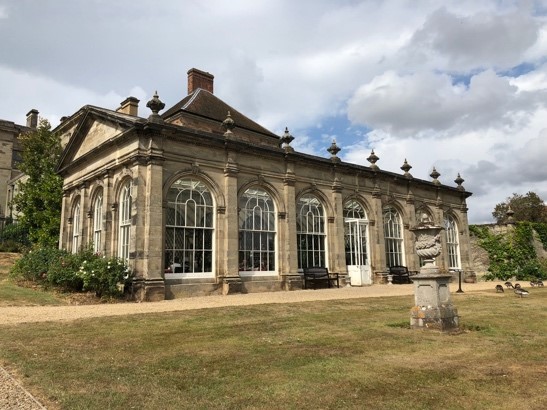
Today, visitors to Stoneleigh may enjoy an afternoon Cream Tea (tea and scone with clotted cream and jam) or a more elaborate Jane Austen Tea (http://www.stoneleighabbey.org/afternoon-tea) in the outdoor Orangery Tea Room. For those who want to spend more time on the grounds, there is a Jane Austen-themed tour of the house and a Repton Walk landscape tour available on certain days and times (reservations are encouraged for each).

10 Stoneleigh Abbey-Side view (from River Avon walk)

Stoneleigh Abbey: Side view (from River Avon walk)
[Photo: Rachel Dodge]

11 Stoneleigh Abbey-Orangery Tea Room

Stoneleigh Abbey: Orangery Tea Room
[Photo: Rachel Dodge]

One of the many delights of the Stoneleigh gardens is the lavender that grows alongside the walks. I visited on a stormy, breezy summer afternoon, and the smell of lavender filled the air. The Gatehouse has a small gift shop, and I bought dried lavender and Stoneleigh Abbey honey there, which I took as a hostess gift to my cousin that evening.

12 Stoneleigh Abbey-Lavender plants

Stoneleigh Abbey: Lavender plants

[Photo: Rachel Dodge]

Landscape architects still refer to Repton’s Red Books today. On Pith + Vigor, you can view an entire gallery of Repton’s Red Book images in Rochelle Greayer’s article, “Before & After: Humphry Repton.” [http://www.pithandvigor.com/garden/before-after/before-after-humphry-repton]

To view all of the original images from Humphrey Repton’s Red Book for Stoneleigh Abbey, please visit: http://www.stoneleighabbey.org/red-book.


Rachel Dodge is an author, college English instructor, and Jane Austen speaker. A true Janeite at heart, she loves books, bonnets, and ball gowns. For more of Rachel’s literary ramblings, you can follow her at www.racheldodge.com or on Facebook or Instagram (https://www.instagram.com/kindredspiritbooks/). Her book, Praying with Jane: 31 Days Through the Prayers of Jane Austen releases October 2, 2018 (Bethany House Publishers).

Works Cited:

Batey, Mavis. Jane Austen and the English Landscape. Chicago: Chicago Review Press, 1996.

Greayer, Rochelle. “Before & After: Humphry Repton.” Pith + Vigor, 8 May 2013, http://www.pithandvigor.com/garden/before-after/before-after-humphry-repton.

Nicholson, Nigel. The World of Jane Austen. London: Orion Publishing Group, 1991.


Read Full Post »

This weekend as we celebrate Mother’s Day, my thoughts turn to Cassandra Austen,  wife of Rev. George Austen and mother of Jane Austen. Cassandra was related to the Leighs of Stoneleigh Abbey.  In 1806, the recently widowed Mrs. Austen visited Adlestrop Rectory in Gloucestershire with her two daughters, where they stayed with her cousins Rev. Thomas Leigh and his sister Elizabeth.  During their visit,  Rev. Thomas Leigh learned that the Hon. Mary Leigh of Stoneleigh Abbey had died and that he would inherit the great house, whose origins go back to 1154. The Austen women traveled with Rev. Leigh to Warwickshire. In the following letter, Mrs. Austen writes glowingly about their stay at the mansion:
“STONELEIGH ABBEY,
“August 13, 1806.

“MY DEAR MARY, – The very day after I wrote you my last letter, Mr. Hill wrote his intention of being at Adlestrop with Mrs. Hill on Monday, the 4th, and his wish that Mr. Leigh and family should return with him to Stoneleigh the following day, as there was much business for the executors awaiting them at the Abbey, and he was hurried for time. All this accordingly took place, and here we found ourselves on Tuesday (that is yesterday se’nnight) eating fish, venison, and all manner of good things, in a large and noble parlour, hung round with family portraits. The house is larger than I could have supposed. We cannot find our way about it – I mean the best part; as to the offices, which were the Abbey, Mr. Leigh almost despairs of ever finding his way about them. I have proposed his setting up direction posts at the angles. I had expected to find everything about the place very fine and all that, but I had no idea of its being so beautiful. I had pictured to myself long avenues, dark rookeries, and dismal yew trees, but here are no such dismal things. The Avon runs near the house, amidst green meadows, bounded by large and beautiful woods, full of delightful walks.

Stoneleigh Abbey, 1808, Humphrey Repton

“At nine in the morning we say our prayers in a handsome chapel, of which the pulpit, &c. &c., is now hung with black. Then follows breakfast, consisting of chocolate, coffee, and tea, plum cake, pound cake, hot rolls, cold rolls, bread and butter, and dry toast for me. The house steward, a fine, large, respectable-looking man, orders all these matters. Mr. Leigh and Mr. Hill are busy a great part of the morning. We walk a good deal, for the woods are impenetrable to the sun, even in the middle of an August day. I do not fail to spend some part of every day in the kitchen garden, where the quantity of small fruit exceeds anything you can form an idea of. This large family, with the assistance of a great many blackbirds and thrushes, cannot prevent it from rotting on the trees. The gardens contain four acres and a half. The ponds supply excellent fish, the park excellent venison; there is great quantity of rabbits, pigeons, and all sorts of poultry. There is a delightful dairy, where is made butter, good Warwickshire cheese and cream ditto. One manservant is called the baker, and does nothing but brew and bake. The number of casks in the strong-beer cellar is beyond imagination; those in the small-beer cellar bear no proportion, though, by the bye, the small beer might be called ale without misnomer. This is an odd sort of letter. I write just as things come into my head, a bit now and a bit then.

Stoneleigh Abbey, Gatehouse. 1807

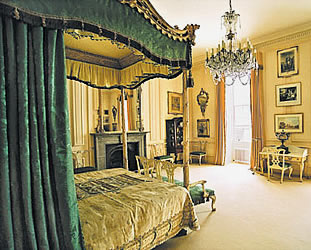
“Now I wish to give you some idea of the inside of this vast house – first premising that there are forty-five windows in front, which is quite straight, with a flat roof, fifteen in a row. You go up a considerable flight of steps to the door, for some of the offices are underground, and enter a large hall. On the right hand is the dining-room and within that the breakfast-room, where we generally sit; and reason good, ’tis the only room besides the chapel, which looks towards the view. On the left hand of the hall is the best drawing-room and within a smaller one. These rooms are rather gloomy with brown wainscot and dark crimson furniture, so we never use them except to walk through to the old picture gallery. Behind the smaller drawing-room is the state-bedchamber – an alarming apartment, with its high, dark crimson velvet bed, just fit for an heroine. The old gallery opens into it. Behind the hall and parlours there is a passage all across the house, three staircases and two small sitting-rooms. There are twenty-six bedchambers in the new part of the house and a great many, some very good ones, in the old.

Bedroom, Stoneleigh Abbey

There is also another gallery, fitted up with modern prints on a buff paper, and a large billiard-room. Every part of the house and offices is kept so clean, that were you to cut your finger I do not think you could find a cobweb to wrap it up in. I need not have written this long letter, for I have a presentiment that if these good people live until next year you will see it all with your own eyes.

Arch, Stoneleigh Manor, Repton, 1807

“Our visit has been a most pleasant one. We all seem in good humour, disposed to be pleased and endeavouring to be agreeable, and I hope we succeed. Poor Lady Saye and Sele, to be sure, is rather tormenting, though sometimes amusing, and affords Jane many a good laugh, but she fatigues me sadly on the whole. To-morrow we depart. We have seen the remains of Kenilworth, which afforded us much entertainment, and I expect still more from the sight of Warwick Castle, which we are going to see to-day. The Hills are gone, and my cousin, George Cook, is come. A Mr. Holt Leigh was here yesterday and gave us all franks. He is member for, and lives at, Wigan in Lancashire, and is a great friend of young Mr. Leigh’s, and I believe a distant cousin. He is a single man on the wrong side of forty, chatty and well-bred and has a large estate. There are so many legacies to pay and so many demands that I do not think Mr. Leigh will find that he has more money than he knows what to do with this year, whatever he may do next. The funeral expenses, proving the will, and putting the servants in both houses in mourning must come to a considerable sum; there were eighteen men servants.” – Letter, Hill, Jane Austen: Her Homes and Her Friends

More on the topic:

Images: Plants info

Bedroom image: UK Student Life

Add to DeliciousAdd to DiggAdd to FaceBookAdd to Google BookmarkAdd to RedditAdd to StumbleUponAdd to TechnoratiAdd to Twitter

Read Full Post »

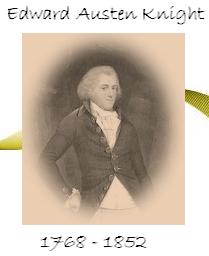
Edward Austen Knight

[Marianne] “’What have wealth or grandeur to do with happiness?’
‘Grandeur has but little,’ said Elinor, ‘but wealth has much to do with it.’‘Elinor, for shame!’ said Marianne; ‘money can only give happiness where there is nothing else to give it. Beyond a competence, it can afford no real satisfaction as far as mere self is concerned.’

‘Perhaps,’ said Elinor, smiling, ‘we may come to the same point. Your competence and my wealth are very much alike, I dare say; and without them, as the world goes now, we shall both agree that every kind of external comfort must be wanting. Your ideas are only more noble than mine. Come, what is your competence?’

‘About eighteen hundred or two thousand a year; not more than that.’

Elinor laughed. ‘Two thousand a year! One is my wealth! I guessed how it would end.’” – Jane Austen, Sense & Sensibility, volume 1, chapter 17

“To be above vulgar economy” … was one of Jane Austen’s express wishes, yet on the surface it would seem that her rich brother Edward contributed very little to Jane’s and her mother’s and sister’s notions of security. How was it that Edward’s fortunes were so very much above that of his family, and why did he not do more for his sisters and mother than provide them with a roof over their heads and a small annual sum?

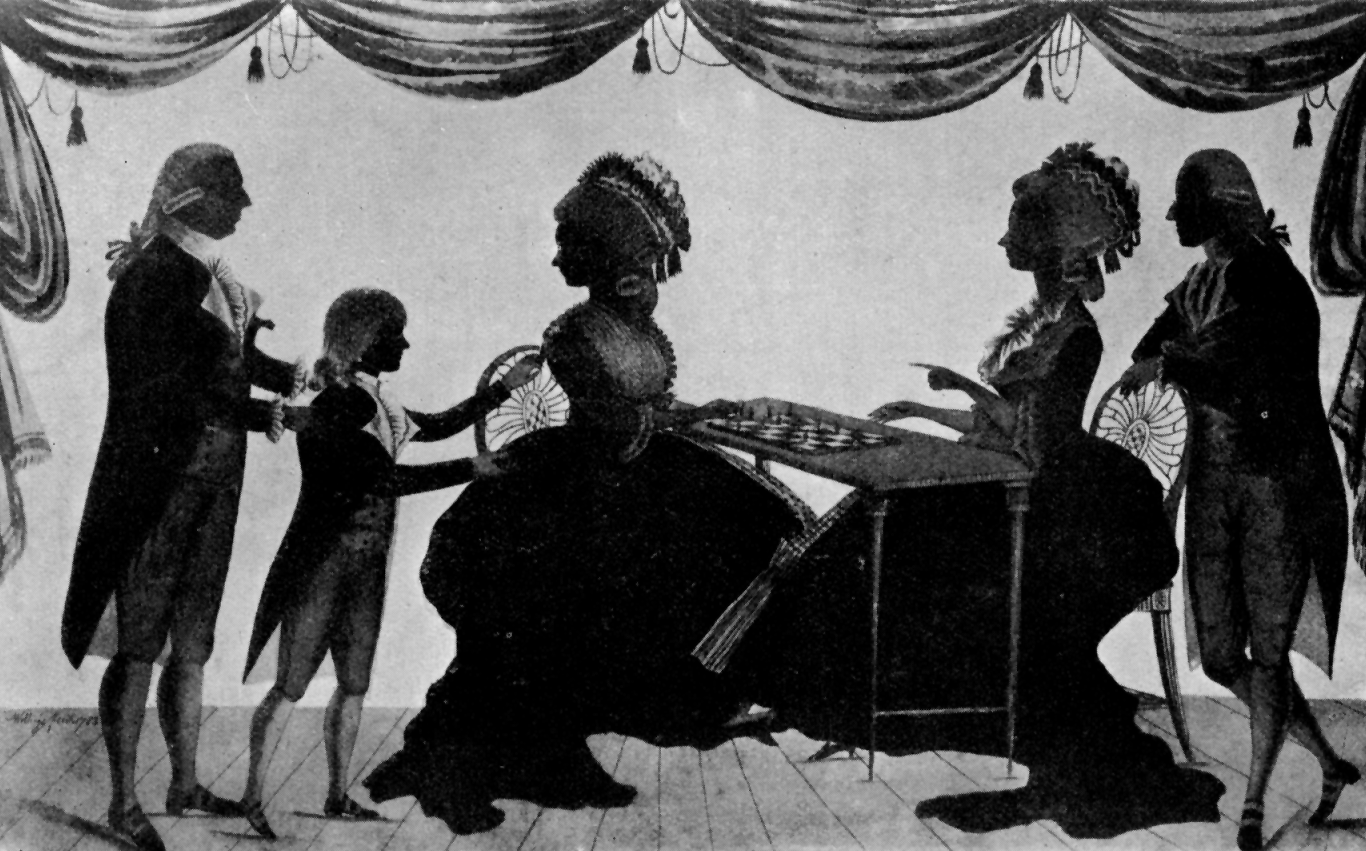
Rev. George Austen presents his son, Edward, to Thomas Knight and family

Rev. George Austen presents his son, Edward, to Thomas Knight and family

Edward, third son of the family … became the favourite of some wealthy childless relatives of his father, the Thomas Knights. They met him as a 12-year-old when they visited the rectory at Steventon on their wedding journey. When they left, Edward accompanied them for the rest of the trip and subsequently went frequently for holidays at their estate. Eventually, when Edward was 16, they adopted him as their heir. – Janet Todd, Jane Austen in Context

The Austens must have been thrilled beyond belief when Thomas Knight, George’s rich, childless cousin, took an interest in Edward, his third son. The practice of childless couples in adopting an heir from a less fortunate branch of the family was not an uncommon one for wealthy relatives to take at the time. When Edward inherited his estates from his adopted father, he became richer than Mr. Darcy, earning £15,000 per year from his investments against Mr. Darcy’s £10,000 per year. Multiply this number by 50 and you have an approximate amount of how much income Edward enjoyed in today’s terms.

Godmersham Park

Godmersham Park

And yet, with such a rich brother, Jane and her sister and mother worried a great deal about money after the sudden death of Rev. George Austen in Bath in 1805. Three of the brothers rallied behind them. Edward’s initial pledge of £100 a year almost doubled his mother’s income of  £122 from a small South Seas fortune, and both Henry and Frank pledged £50 apiece per year to support their mother and sisters. Cassandra received a small income from Tom Fowle’s £1000, which he had bequeathed to her in his will.  Even so, the three women were forced to move in March to more affordable rented living quarters on Gay Street, and then to Southampton in 1806, where they, along with their friend Martha Lloyd, shared a house with Frank Austen and his new bride.

The move to the house in Castle Square, Southampton in 1807 brought much cheer to Jane. The house, she noted, was not in good repair but it had a large garden. Her accounts for 1807 show that from her allowance of £50 she spent £2.13.6 to hire a pianoforte.”- Soft and Loud, JASA

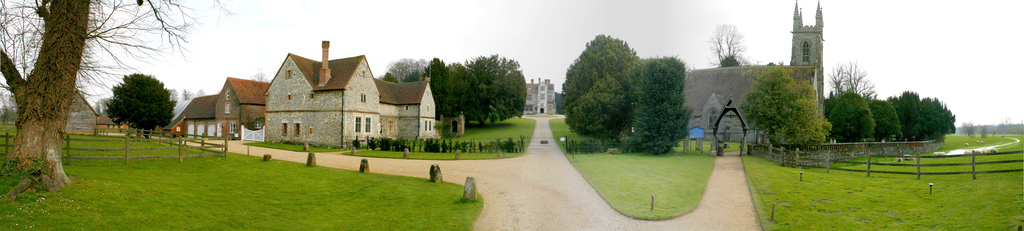
Panorama of Chawton

Panorama of Chawton

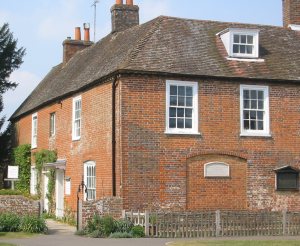
Edward finally came through for his mother and sisters. Four years after his father’s death, he refurbished Chawton Cottage and invited them to move in. It was in this cottage that Jane was at her most prolific, polishing off earlier versions of Pride and Prejudice and Sense and Sensibility and famously writing Mansfield Park, Emma, and Persuasion. In skimming through a variety of biographies, many authors treat Edward’s seeming parsimony with a hint of contempt. The Knights had a history of generosity towards their poorer Austen relatives. Thomas Knight, second cousin to Rev. George Austen, gave him two livings that were valued at £210 the year that Jane was born. At Steventon, the Austens also had land to farm, which was an important factor in their diet and maintaining their self-sufficiency. The Austens also took in boarding pupils, and by the time Rev. Austen retired , he was earning almost  £600 per year, the same amount that his eldest son, James, made towards the end of his life.

Jane, her sister and mother had fallen on hard times. Financially dependend on their families, they are forced to move in March to rented living quarters on Gay Street, and then to Southampton in 1806, where they, along with their friend martha Lloyd shared a house with Frank Austen and his new bride.
“The move to the house in Castle Square, Southampton in 1807 brought much cheer to Jane. The house, she noted, was not in good repair but it had a large garden. Her accounts for 1807 show that from her allowance of £50 she spent £2.13.6 to hire a pianoforte.” JASA Soft and Loud,
Finally, four years after his father’s death, Edward Austen Knight refurbished Chawton Cottage for his mother and sisters, and had them move in. The walled garden, designed by Edward Austen Knight on the advice of his sisters Jane and Cassandra, is being recreated to provide not only flowers but organically grown fruit, vegetables and herbs, some of which will be used in contemporary recipes to be prepared in the kitchens. The church where Jane’s mother and sister are buried sits halfway up the drive.(from Chawton site)There had always been generostiy from the Knights towards the Austens. .

Jane’s mother, Cassandra, who was related to the Leighs of Stoneleigh Abbey, placed a great hope that her rich childless brother, James Leigh-Perrot, would leave money to her eldest son James. While James Leigh-Perrot provided James with a clerical living and some supplementary cash, his property eventually went  not to James, but to his son, James Edward, who was Jane Austen’s biographer. James Leigh-Perrot left nothing to his sister Cassandra, even knowing that she lived on a small income. He might have supposed that her uber rich son, Edward, would take care of his mother, which, in a fashion he did. Why did Edward not contribute more to his mother and siblings?

This is mere conjecture on my part, but Edward did the best he could under the circumstances. Yes, he was rich beyond imagining, but his responsibilities were many and heavy. He inherited two large estates, which were the physical embodiment of his inheritance. The laws of primogentirue demanded that as the heir, he should keep everything intact, from the land, which provided the income, to the house and all the family heirlooms within it. The heir was merely a “keeper” of the estate and the family name, and his actions were proscribed. Edward was more a tenant than an owner, and he was duty bound to turn over his entire estate to his male heir. – The Country House, JASA.

Chawton Cottage

Chawton Cottage

Running these estates, with their attendant servants and necessary improvements, took an enormous, some would say crippling, amount of resources. In addition, Edward’s family was large. His first wife, Elizabeth, died after giving birth to their eleventh child. Add his seven brothers and sisters, his biological mother and adopted mother and her family, the Knight family, and the ever widening circle of nieces and nephews, and the even larger circle of aunts, uncles and cousins on both the biological and adopted sides, and you can imagine the pressures Edward must have felt all around.  Had he doled out what we would deem as adequate support to all the needy individuals in his extended family, Edward’s estate would soon have been frittered away.

Chawton House

Chawton House

One cannot fault Edward too much for moving prudently and cautiously, for he was obliged first to his immediate family and the need to provide for adequate dowries for his daughters and support for his younger sons. I do fault him for not helping Jane to repurchase her manuscript, Susan (renamed Northanger Abbey), for the measly sum of £10, so that she could pursue its publication, but for all we know she might have never applied to him for help.

I sometimes wonder if the Austen women were as destitute as people today conjecture. Unlike 90% of their countrymen, who rarely traveled outside of their immediate area, the Austens traveled frequently, visiting friends and relatives. They were able to keep two servants and supplement their diet with vegetables from their kitchen garden, and received an endless supply of milk from Edward’s cows. Jane secured a modest but extra income from her writing, and the three women lived off a yearly income of  £500 pounds, which was only  £100 less than Rev. George Austen earned, who had a family of eight to feed, in addition to his boarders. Jane’s eldest brother,  Rev. Frank Austen, managed to keep a carriage for his second wife on an income of  £600 per year. I am not saying that the three women were rich, by any means, for, like Elinor Dashwood, they lived frugally and prudently, but they did dine frequently with Edward and visited him over extensive periods of time at Godmersham Park, which must have been as luxurious an experience as any visit to a high end resort.

After Thomas Knight died, his widow, instead of waiting until her own death, handed over the family estates to Edward, who from 1798 lived the life of a country gentleman at Godmersham in Kent. When Mrs Knight herself died in 1812, Edward and his family, as stipulated in her will, took the name of ‘Knight’, prompting his eldest daughter Fanny (a favourite niece of Jane Austen’s) to write in her diary that now ‘we are therefore all Knights instead of dear old Austens How I hate it!!!!!’. Fanny’s aunt Jane wrote more calmly to her friend Martha Lloyd that ‘I must learn to make a better K.” – Janet Todd, Jane Austen in Context

Edward was the Austen's third oldest child

Edward was the Austen's third oldest child

More on the topic:

Gentle reader: In honor of JASNA’s annual meeting in Philadelphia this week, this blog, Austenprose, and Jane Austen Today will be devoting posts to Jane Austen and her siblings. Look for new links each day.

Read Full Post »

Older Posts »