Inquiring readers: Here’s another delightful contribution from the ever creative Tony Grant. If you can’t get enough of his work and photographs, visit his blog, London Calling, where he shares his images from his many trips all over Great Britain. A little over 200 hundred years ago (December, 2015), Emma was first published. This is the first of a number of articles related to that novel on this blog this year.
Emma, written by Jane Austen between 21st January 1814 and the 29th March 1815, is unique amongst her six published novels because it’s entire setting is one small country town, the fictitious Highbury and Hartfield, located in one county, Surrey. Other places, real and fictitious are mentioned and have roles in the story too but most of those, apart from London, are located in Surrey as well. All Austen’s other novels move between at least two major locations, Bath, London, Lyme Regis and so on. Her two unfinished novels, Sanditon and The Watsons also have one major location each, Sanditon, a fictitious seaside resort of the sort that were being developed in the Georgian period on the south coast and at other coastal places. In the case of The Watsons, it is another novel that starts in Surrey and specifically in and around, a real town this time, Dorking. The Turnpike Road and The White Hart Inn are real locations in and around Dorking. The Watsons was not developed beyond this setting.


The places mentioned in Emma that are real include Box Hill, the River Mole, Richmond, Kingston, Weymouth, Cobham and London of course. The fictitious places are Highbury and Hartfield, Donwell Abbey, Rosings and Maple Grove. Randalls, might refer to an actual house called Randalls near Leatherhead not far from Box Hill.


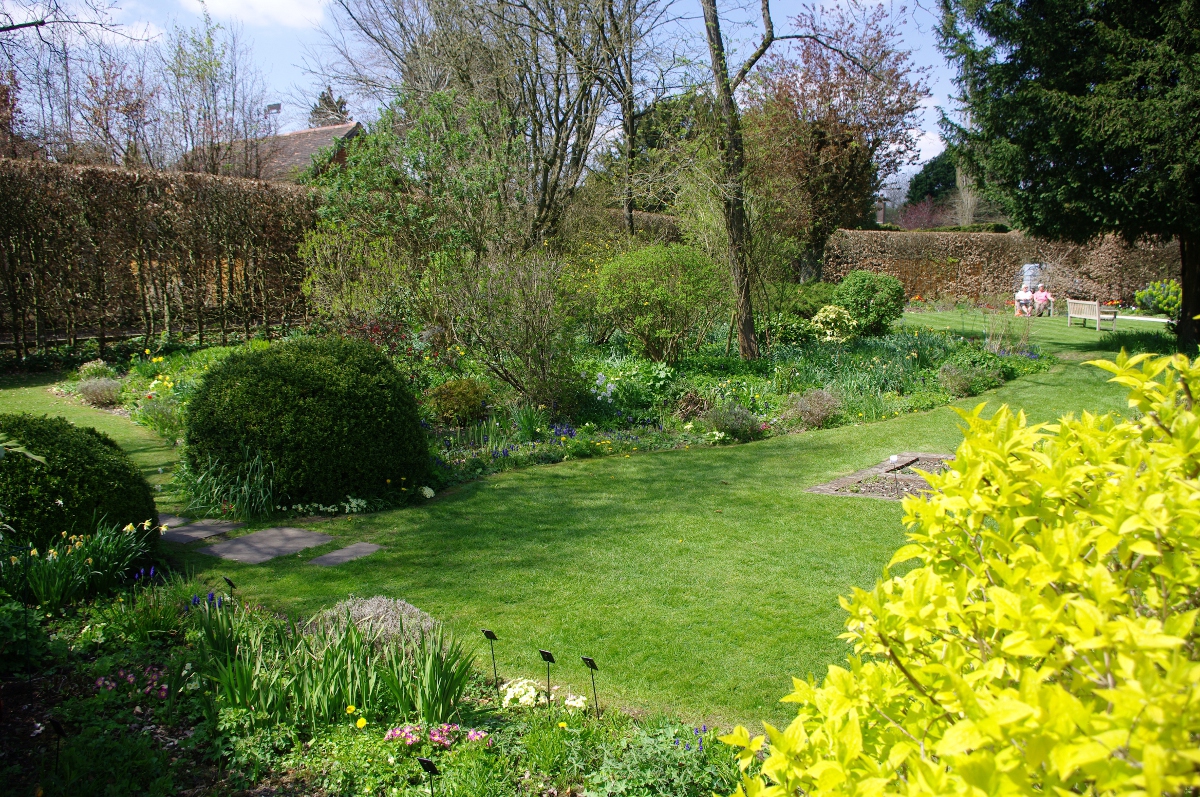
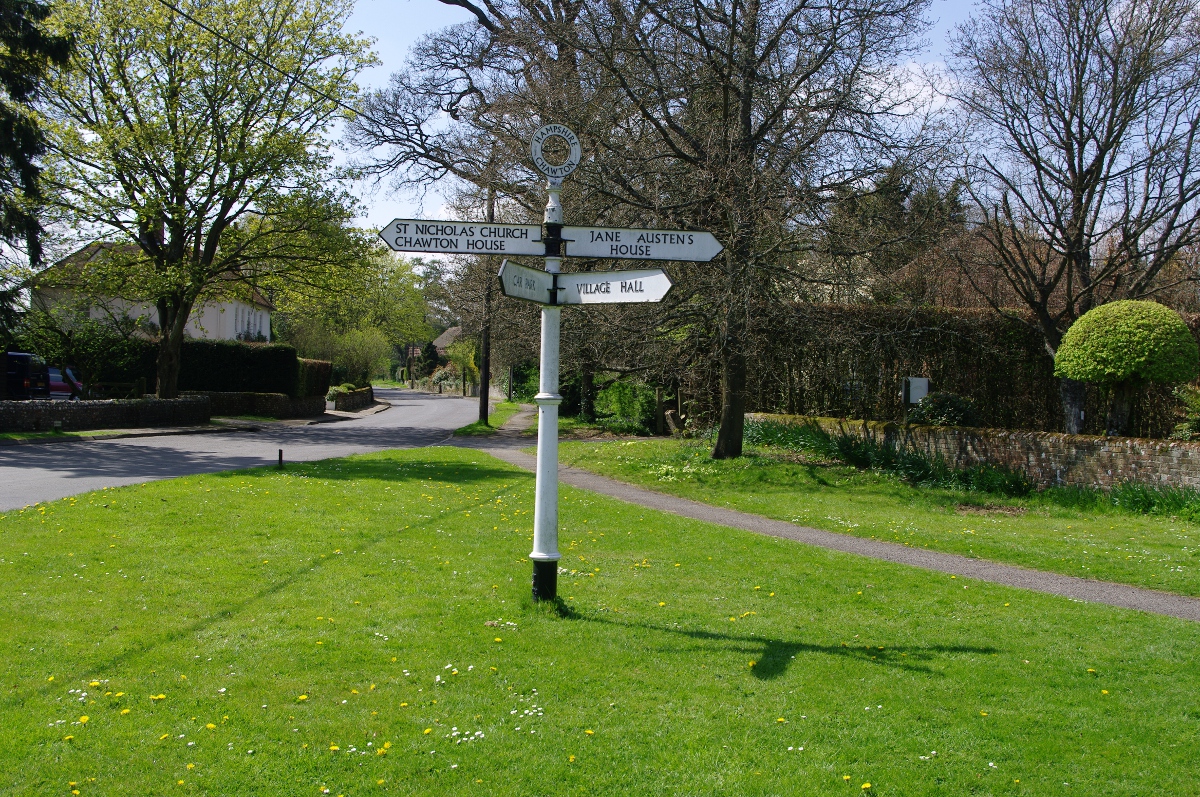
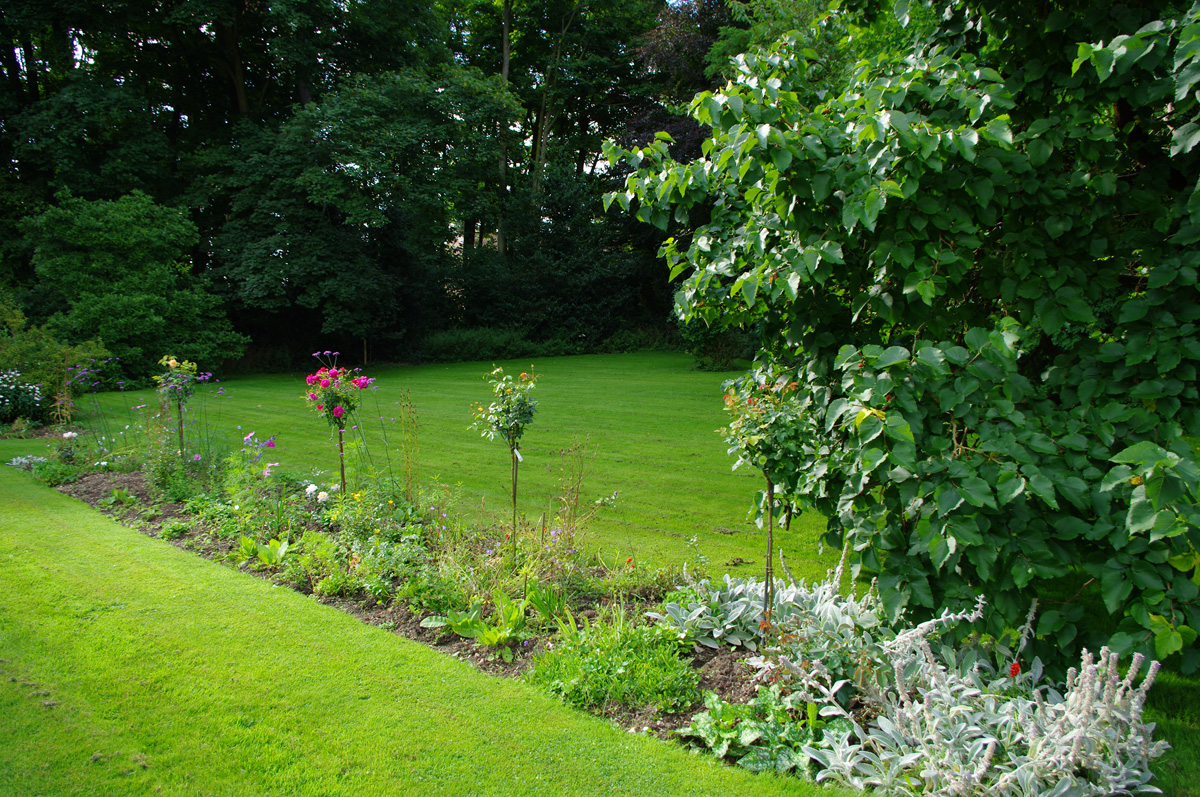
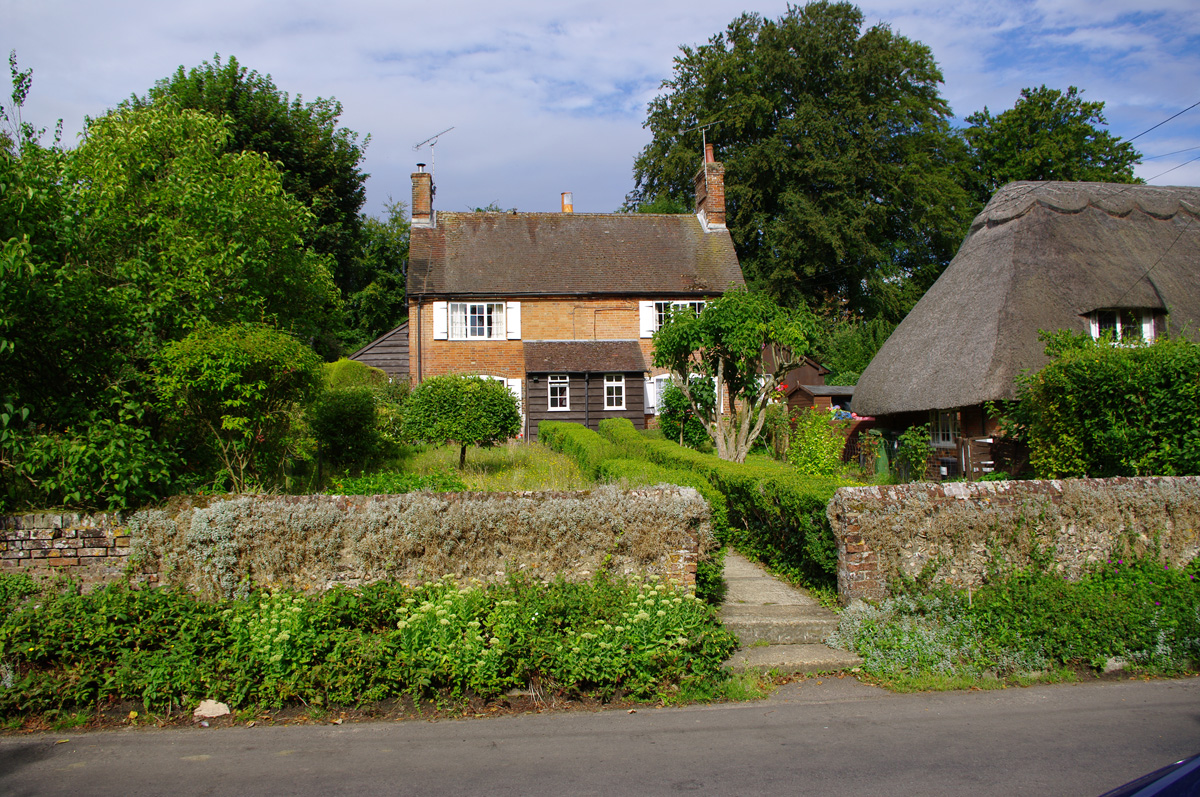
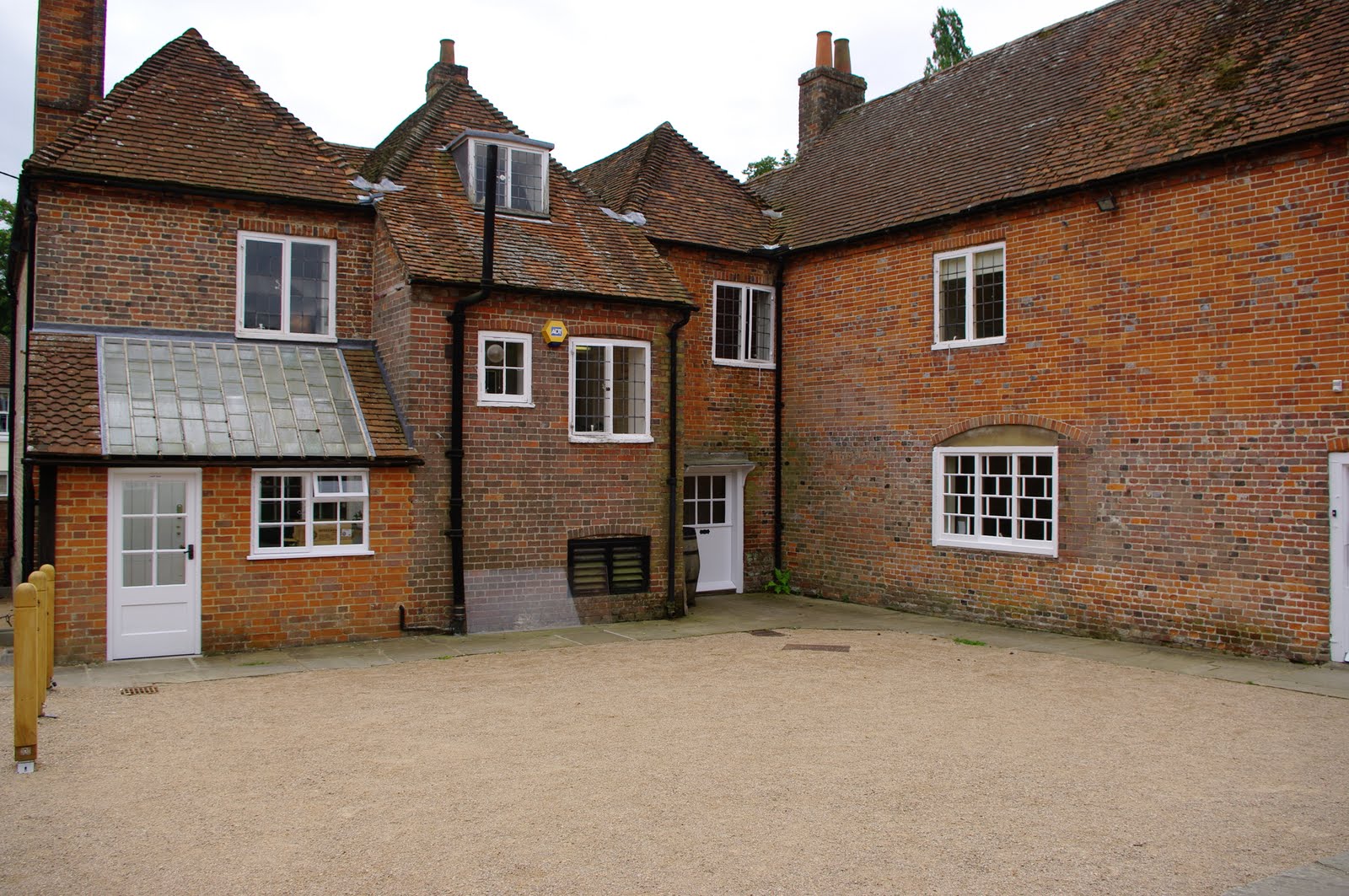
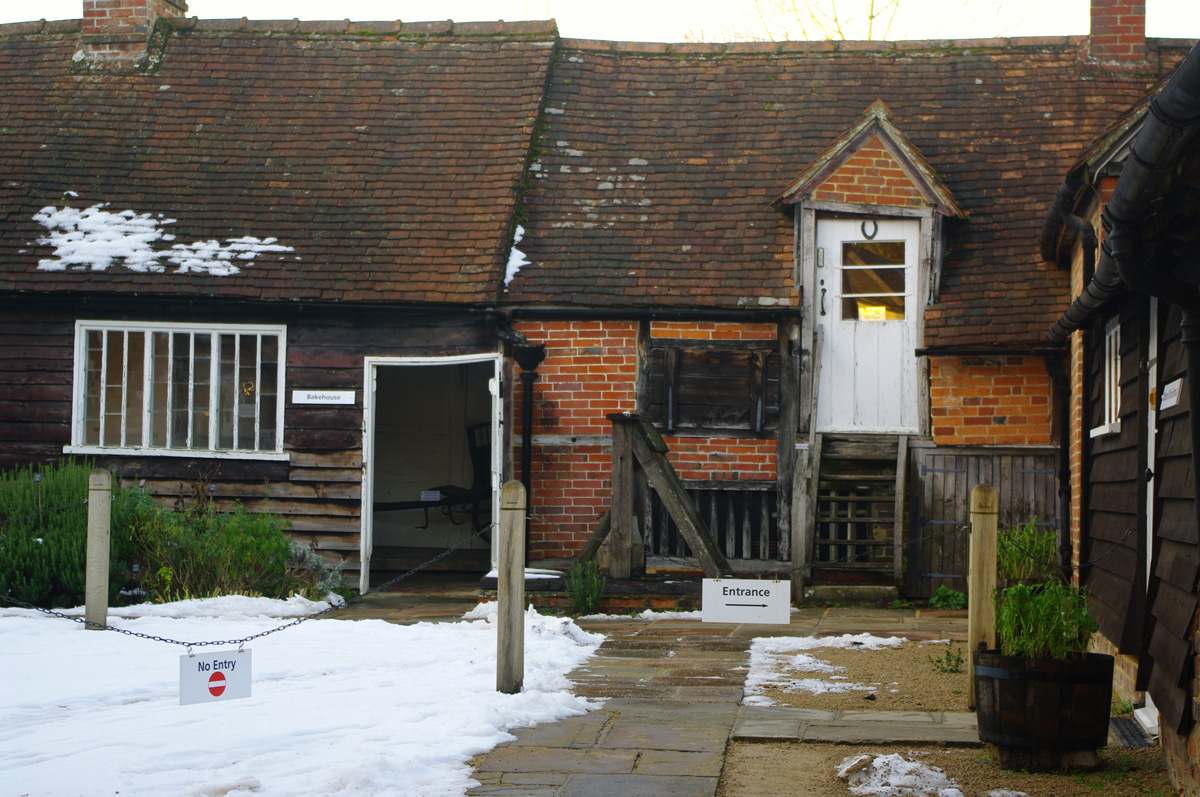
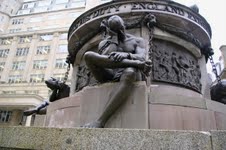
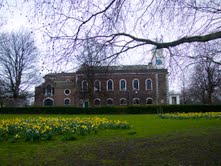
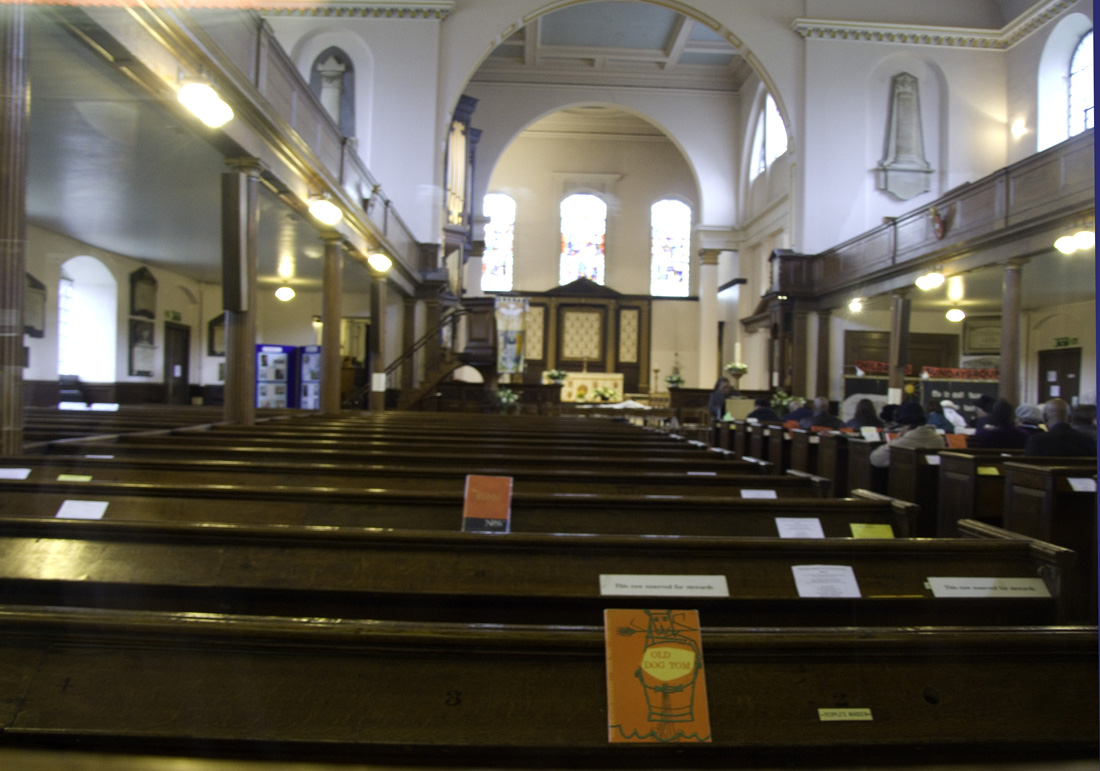
Many people think Leatherhead (images above) is the template for Highbury and Hartfield. However, if you ever have the time to travel around Surrey villages and towns, there are similarities between them all. A grand house and estate is often located outside the town. There are a variety of still existing Georgian town houses ranging from those that would have housed well to do middle class businessmen to cottages for the working man and his family. All towns have an ancient church, probably first built in the middle ages, along with a rectory.Many of the rectories, interestingly look Georgian in design, however many of them are much older, probably Tudor in construction, constructed with great oak beams, with Georgian fronts added. All towns have old inns and what were once assembly rooms.


For instance, Cobham is mentioned in Emma. In one scene with Mr Knightly, Emma extolls the virtues of Mr Weston,
“ … ever since his particular kindness last September twelve month in writing that note, at twelve o’clock at night, on purpose to assure me that there was no scarlet fever at Cobham, I have been convinced that there could not be a more feeling heart nor a better man in existence.-“
Cobham is located not far from Leatherhead and Box Hill. I have walked around it often and the little bits of information about Highbury and Hartfield that Austen puts into the novel fit Cobham just as well as Leatherhead or a number of other towns and villages in Surrey. I think Highbury and Hartfield therefore is a sort of generic Surrey county town. It is after all the relationships between the characters that matter in the novel.
Jane Austen gives details describing the miles from Highbury and Hartfield to various places. It is 16 miles from London, 9 miles from Richmond and 7 miles from Box Hill. How more detailed could you be? These coordinates actually give you a spot on the Leatherhead to Kingston Road at a crossroads called, Malden Rushett. There are a couple of Victorian cottages there and nowadays a garden centre. It is mostly still surrounded by fields as it would have been in the early 19th century. The road comes from Dorking just south of Box Hill and passes through Leatherhead on its way to Kingston. It would, without doubt, have been the road that Mr Knightley and Mr Martin travelled along to get to the markets in Kingston. Also Frank Churchill / Weston, would have travelled this way to go to Richmond, which is further north of Kingston on the banks of the River Thames.
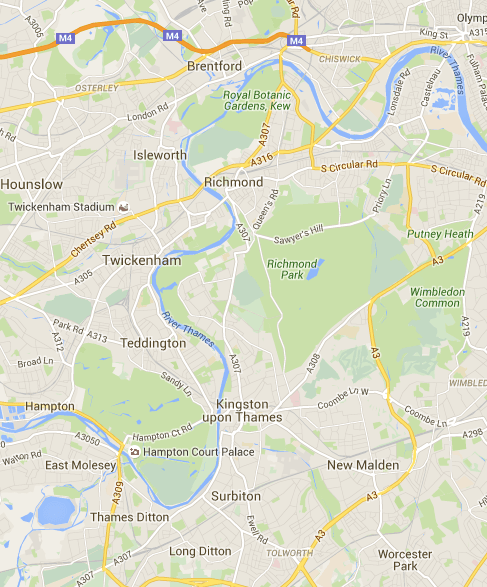
One can see the relation between Kingston Upon Thames and Richmond in this Google map image
Perhaps the mileage Austen gives us for the location of Highbury and Hartbury is all part of her play on words and riddles that permeate Emma. The mileage gives us the impression that this must be a real place that actually exists, although it doesn’t actually exist. Her choice of names real and fictional play games with us too. However, we can start to interpret the words and names she uses. For instance the derivation of, bury, used as a suffix to the name of a town comes from Old English. It means ,burh, or fortified place. A fortified place can be interpreted as defensive and insular. Then we have a “High,” protected place and,” Hart,” which could refer to the,” heart,” but also a hart is a sort of deer. Is Jane referring to the heart of Englishness, the heart of what it means to be a community? Although Emma might be seen as an insular novel, just centered on the people of a generic Surrey town, it also refers to all towns and all communities. We can think about our own social groups and work colleagues and neighbours. I would not be surprised if our immediate associations number a similar number as the community described within the scope of Emma. Jane Austen not only plays with the names of places but also her characters. George Knightly, for instance, might refer to George IV the monarch and the name Knightly to a chivalrous connection. King, country and nobility of the true Englishman was an important concept, especially at the time Jane was writing Emma. It was published in the year that Waterloo was fought and won. It is also interesting to note Franck Churchill asking how much it would take for him to become a “citizen,” of Highbury and Hartfield. This is an oblique reference to France and the enemy the French. He is subtly made into the enemy. There are enough real places referred to in the novel for any visitor to Surrey today to explore and walk the streets and fields Jane Austen herself walked. We know that in 1814, Jane Austen visited her relatives, the Cookes, at Great Bookham and probably visited Box Hill with them. Maybe she decided to place one her major scenes on the hill at that time.


Richmond (above) in the 18th and 19th century was a place for the well off and the aristocracy as it was in previous centuries and still is today. Nearby was located Kew Palace, where “mad” King George III lived with his family, and set amongst beautiful grounds planted with trees and shrubs brought from various corners of the British Empire. Richmond Green in the centre of Richmond is to this day surrounded by grand houses and a beautiful theatre that originates from Georgian times. Along the Thames near Richmond the river is lined by grand houses and the estates of the aristocracy going back to Stuart times. Frank Churchill and his adopted family are wealthy and this is the place for them.
When Frank Churchill at last arrives in Highbury he meets Emma for the first time.
“Their subjects in general were such as belong to an opening acquaintance. On his side were the enquiries, – “Was she a horse woman? -Pleasant rides? -Pleasant walks? -Had they a large neighbourhood? – Highbury perhaps afforded society enough?-There were several pretty houses in and about it-Balls-had they balls?-Was it a musical society?”
A person who knows Richmond well is aware of the almost cynical comparisons Frank Churchill is making. He appears to be polite but every reader would know then that Highbury could not compare with Richmond.


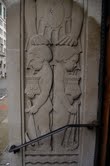
Kingston upon Thames (above) , further down river from Richmond and about two miles closer to the fictional Highbury than Richmond, was a very different sort of place. It had three markets, a large important cattle market, a central general market selling vegetables, meat, fish and selling general merchandise. There was also a small apple market. Kingston was important as a coaching inn stop. The Castle Inn was the largest and most prestigious inn overlooking the main market area. The inn itself no longer exists but the building occupying its site contains the original Castle Inn staircase constructed in 1537.
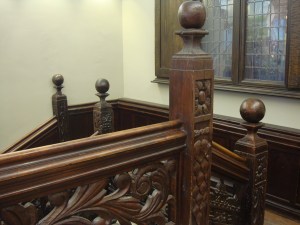
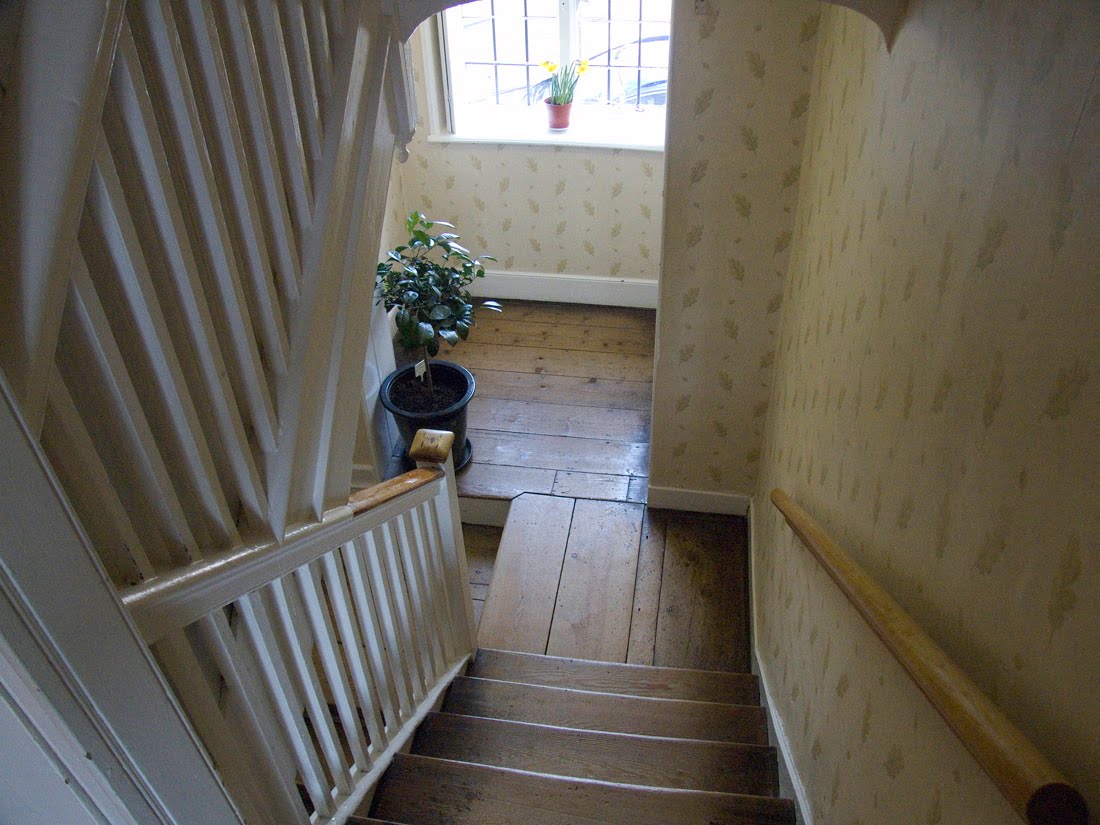
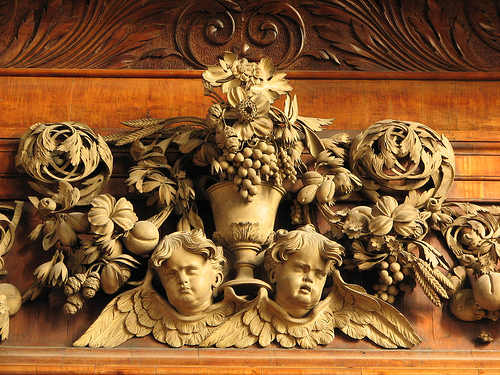
Original Castle Inn staircase. Image @Tony Grant
It is a massive carved dark oak construction. Jane probably walked up its creaky steps and in her imagination, Mr Knightley and Mr Martin too. Kingston was the sort of place that Mr Martin and indeed Mr Knightly would visit regularly. The main central market still exists and there are buildings around it which originate from Georgian and much earlier times. The Druids Head pub is the only original 18th century coaching inn still in the market place. The shape and layout of the central market today would be recognized by both Jane Austen, who stopped in Kingston on her way to London often, and also her characters, Mr Martin and Mr Knightley. Austen writes an amusing scene in Emma, when Jane Fairfax is given the opportunity to play the pianoforte that was just delivered and Frank Churchill, Jane Fairfax, and Emma were crammed into Miss Bates’s living room. This crammed indecorous scene creates a comical picture, when Mr Knightley rides past and Miss Bates rushes outside to also invite him in too. He is about to comply with the request, but when he learns about all the others already inside he says in a loud voice, so that everybody can hear
“…….No, not now, I thank you. I could not stay two minutes. I must get on to Kingston as fast as I can.”
It might be the thought of adding to the already crowded interior that put him off, or it might have been the desire to avoid certain people at that time.
Kingston was a frequent place Jane Austen travelled through or stopped at on her way to London from Chawton to stay with her brother Henry. She experienced its atmosphere, its sights and its sounds. In a letter to Cassandra from Henrietta Street, dated Wednesday 15-Thursday 16 September 1813, Jane Austen writes.
“ had a very good journey-Weather and roads excellent- the three first stages for 1s-6d and our only misadventure the being delayed about a quarter of an hour at Kingston for Horses, and being obliged to put up with a p belonging to a Hackney Coach and their coachman which left no room on the barouche box for Lizzy who was to have gone her last stage as she did the first:- consequently we were all 4 within, which was a little crowd;- We arrived at quarter past 4-…”
Leatherhead,is supposed, by some people, to be the template for Highbury and Hartbury. It certainly has some of the features mentioned in Emma but I think also other towns and villages in Surrey have similarities with Highbury and Hartbury too. Its proximity to Box Hill and also the Kingston Road from Dorking does lend it some credence. The part of Surrey in Emma is the Vale of Mickleham, the area between Leatherhead and Dorking, including Box Hill.
Jane Austen describes the view:
“The considerable slope, at nearly the foot of which the Abbey stood, gradually acquired a steeper form beyond its grounds; and at half a mile distant was a bank of considerable abruptness and grandeur, well clothed with wood; and at the bottom of this bank, favourably placed and sheltered, rose the Abbey-Mill Farm, with meadows in front, and the river making a close and handsome curve around it.
It was a sweet view – sweet to the eye and the mind. English verdure, English culture, English comfort, seen under a sun bright, without being oppressive.”
I have a theory, though. Cobham is mentioned in Emma in a rather unusual way. It is mentioned by Emma when praising,
“that excellent Mr Weston.”
Mr Weston had shown Emma his, “particular kindness last September twelvemonth in writing that note , at twelve o’clock at night, on purpose to assure me that there was no scarlett fever at Cobham.”
There are some strange things about this. Why would he write the note so late at night? Was the note sent during the night? Why was it so important for Emma to know?
A few things occur to me. First, Emma is informed by Mr Weston that there is no scarlett fever at Cobham which means it is alright to go there. Is it alright for my flight of fancy to go there too? I am sure scarlet fever was not a good thing to catch in the 18th century. Jane’s first experience of Southampton, for example, when she was eight years of age attending Mrs Cawley’s school with Cassandra and her cousin Jane Cooper. The children caught an illness from troops landing in the town and Southampton had to be quarantined, so it must be a relief to the surrounding communities that Cobham is free of it but there is no other reference to anybody in the novel going to Cobham or wanting to go there. Its only addition to the story is that it shows Mr Martin’s rather obscure way of being marvellous. Why mention Cobham in this random way? Is this an aside, a joke with the reader, suggesting that Jane Austen used Cobham as the real template for Highbury and Hartfield? If you go to Cobham, which, incidentally, is only about two or three miles north west of Leatherhead and so not far from Boxhill, Kingston, and all the other places mentioned, it has many of the features of Highbury and Hatfield, including a grand manor and estate at Painshill, about one mile from the centre. The River Mole also runs nearby. It is a small village and much more compact than Leatherhead and would suit the closer community that Highbury and Hartfield seems to suggest rather than the larger town of Leatherhead. But that is just my surmise. Again, I must mention my previous observation that Highbury and Hartfield are really a sort of generic English town with features that you could find in most towns and villages in the 18th century. Quite often the same features are recognisable in many such places nowadays too.
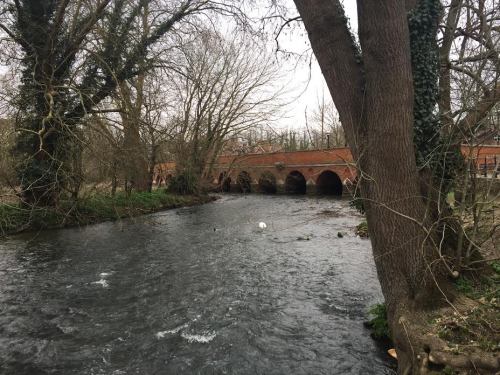
The River Mole at Leatherhead. Image @Tony Grant
Jane Austen’s knowledge and experience of Surrey is extensive. She would have known may places in Surrey well. Jane Austen visited Great Bookham in 1799 and 1814. Great Bookham is about a mile south west of Leatherhead and not far from Box Hill. She went there to visit her mother’s relatives, the Reverend Samuel Cooke and his family. He was rector of Cotsford in Oxfordshire and vicar of Great Bookham. He was married to Cassandra Leigh, Mrs George Austen’s cousin. The Reverend Cooke was Jane Austen’s godfather. It has been suggested that while she stayed at Great Bookham she visted Box Hill and thus got the idea for that important location in Emma.
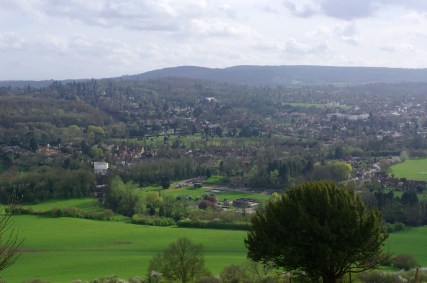
Town of Dorking from Box Hill. Image @Tony Grant
In her letters to Cassandra, Jane relates many trips she takes from Steventon and later Chawton to London to visit Henry. The journeys she makes are invariably along roads and through places in Surrey. Some other places in Surrey that Jane mentions are Painshill, Epsom, Claremont Park, Dorking, Guildford, Farnham, and the Hogs Back Hill. Dorking is very interesting from the point of view of Janes writing. Her unfinished novel, The Watsons, takes place almost entirely in Dorking. As it does not really feature in Emma I will not elaborate on it.
Jane Austen almost creates an intellectual game in Emma. The names of places suggest other meanings. Donwell, for instance. Does it suggest that Mr Knightley, who has a very patriotic name and suggests a chivalrous and ”knightly” character, has “DONE WELL,”? A very corny joke. Even her first readers in the early 19th century would have groaned at that, I am sure. She mixes real and imaginary places in her setting making all places sound convincing. She gives concrete directions to a place that does not exist, namely Highbury and Hartbury. She apparently relates the story of a small close community in a way that seems specific to them but is really universal in its descriptions of types of people and their interactions. Jane Austen sets up all these dichotomies. She really is playing with our minds in many ways and on different levels.
Sources:
- Jane Austen Was a Surrey Girl: http://www.surreyhills.org/jane-austen-was-a-surrey-girl/
- Jane Austen, A New Revelation, by Nicholas Ennos, Jane Austen Historical Society: http://www.leatherheadlocalhistory.org.uk/2015.htm#Friday%2016%20October
- Box Hill in Jane Austen’s Emma, by Tony Grant, Jane Austen in Vermont: https://janeausteninvermont.wordpress.com/2014/11/02/box-hill-in-jane-austens-emma-guest-post-by-tony-grant/
- High field and Hatfield, Perhaps, by Tony Grant, London Calling: http://general-southerner.blogspot.co.uk/2010/01/highfield-and-hartfield-perhaps.html
- EMMA by Jane Austen Penguin Classics (reissue 2003)
- Jane Austen’s Letters Collected and edited by Deirdre Le Faye (third edition)



















 Jane Austen's World