Inquiring readers, I can’t gush enough about this website, which started out as a research project by Matthew Sangster “to explore the life and culture in London in the late 18th and early 19th centuries.” I discovered the site when I wanted to trace Jane Austen’s trip from her brother Henry’s house on Henrietta Street to Carlton House, the home of the Prince Regent, after the Prince’s librarian, James Stanier Clarke, invited her to visit in 1815, just as she was completing the final touches on Emma. I found the route in Horwood’s Plan of the Cities of London and Westminster in the Borough of Southwark, and Parts Adjoining Shewing every House (1792-99).
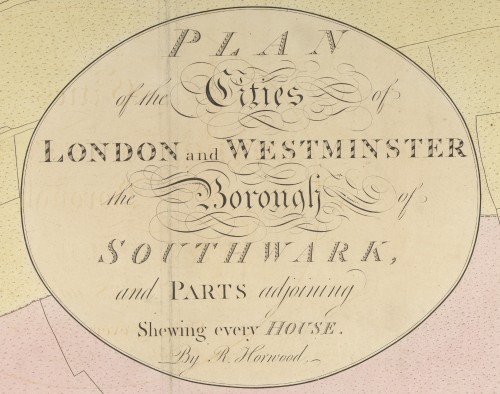
Horwood’s Plan of the Cities of London and Westminster in the Borough of Southwark, and Parts Adjoining Shewing every House (1792-99).
Romantic London, the website, is divided into a number of topics of vast interest to historians, lovers of Jane Austen and the Regency era, authors, researchers, and teachers and students. In addition to Horwood’s Plan, Sangster offers tabs entitled Harrris’s List (1788), Antiquities (1791), Picturesque Tour (1792-1801), Modern London (1804), Microcosm (1804–10), Life in London (1821), and Wordsworth’s Prelude (1850). He includes a blog and provides an email address for those with questions.
It is worth your while to read the introduction to each section, starting with Introducing Romantic London. I’ll describe a few of the wonderful features on this site, and will leave the rest for you to discover on your own.
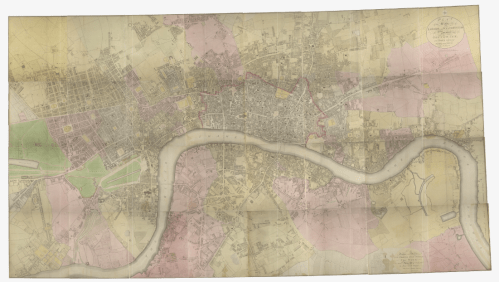
Notice the 32 pages that comprise Horwood’s Map. Image from Sangster’s website.
The entire map, as drawn, is composed of grids or 32 sheets. All one needs to do with this digital map is to place a cursor over an area. I chose one near Mayfair, and pressed “+” until I honed in on Carlton House. Click anywhere on this map and explore to your heart’s content.
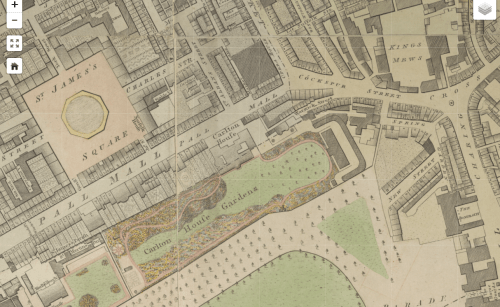
Detail of Carlton House, Carlton House Gardens, St. James’s Square, and Kings Mews.
The level of detail in this close up image is simply amazing. We see Carlton House and Carlton House Gardens in a bird’s eye view. All houses, with their back yards, stables or mews, common areas and gardens are delineated. Pale colors mark squares, grassy areas, and trees.
Included in this tab is a history and texts that show how Sangster uses Horwood’s Map for his and our benefit. As an example, let’s study the tab, Modern London, which is an 1804 guide to the city, published by Richard Phillips.
While the guide was written by Richard Phillips, the 22 views of key buildings and landscapes were engraved from designs by Edward Pugh and images of street traders and seller by William Marshall Craig. Many of us are already familiar with these images, but where were they exactly located? This tab answers that question in detail.
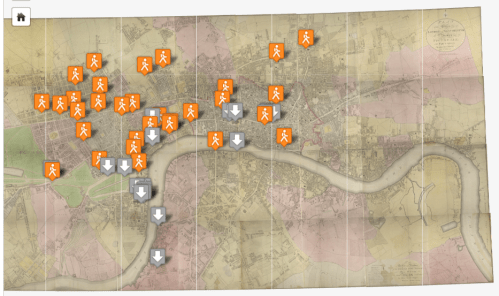
Markers showing the locations described in Modern London
Superimposed on Horwood’s entire map are orange hiker tabs and gray arrow tabs. Hover your cursor over one, and the location is identified with a title of the images created by Pugh or Craig.
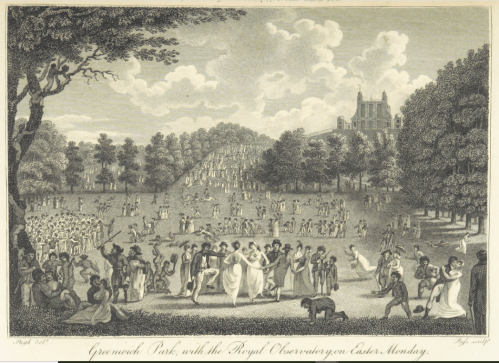
Greenwich Park with the Royal Observatory on Easter Monday, Modern London, Edward Pugh
A street trader image:
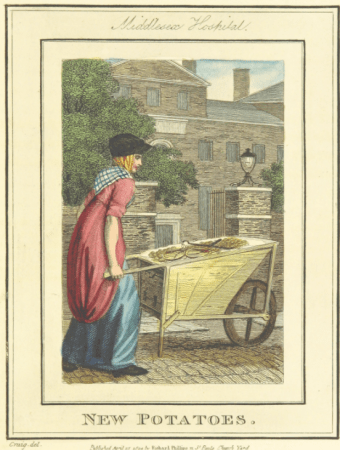
New Potatoes, Middlesex Hospital, by William Marshall Craig
Other tabs of note:
All the tabs lead to information for those of us interested in Austen’s era. In this section, I will detail only a few—those with images of and information about London created during Austen’s life. Each tab is designed like the one described in Modern London. You will first see Horwood’s Map with corresponding tabs, and then the engravings or lithographs and their descriptions (if they exist).
- Antiquities (1791-1800) by John Thomas Smith shows plates of buildings, architectural details, and objects found in London.
- Malton’s Picturesque Tour (1792-1801) consists of black and white engravings of major buildings and thoroughfares.
- Microcosm of London features images of Rudolph Ackermann’s famous Microcosm of London (1808-10).
- Select Views, or Select Views of London; with Historical and Descriptive Sketches of Some of the Most Interesting of its Public Buildings (1816) compiled by John B. Papworth and published by Rudolph Ackermann.


In conclusion:
One reason this site excites me is that with Horwood’s map I can trace Austen’s visits to the places she and her family mentioned while staying with Henry in London, such as the Wedgwood Shop in Regent’s street. In the accompanying images that sit at the bottom of the various tabs, I can view how London looked in her day, and read contemporary accounts about these locations.
I am struck by how quickly London turns from city streets to rural surroundings; how closely houses are stacked together in the city’s center, each with their own chimneys and need for refuse removal. I can imagine how, on dry windy days, the dust from unpaved streets must have settled everywhere, and the smell of urine and feces from horses and cattle driven by drovers to Smithfield Market must have permeated through every nook and cranny, and windows and door cracks on hot summer days.
This map and the accompanying images, along with current accounts and subsequent histories, provide us (as readers and authors), with a way to follow the movements of historical and fictional people who resided in the largest city in Europe. It will also allow me to map my next visit to London, and choose specific locations to visit as I learn more about the time in which Jane Austen and her contemporaries lived.
Resources
British Library: Online Gallery: Plan of the Cities of LONDON and WESTMINSTER, Richard Horwood, 1795, includes a zoomable image, full size printable image, and a short history.
Layers of London: London Maps: Choose historical maps of London, and overlay them with information about a range of topics and themes.







 Jane Austen's World
Hi Vic. I love old maps too. This is very interesting. I know the site of Carlton House well. It was located in Pall Mall where many of the private London Clubs are now situated. The part of the map you show has St James Square on it. St James square has a lot of interesting history but I must tell you something. When I was 20 a friend of mine was a student at one of the London colleges. He was having such a brilliant life in London I decided to get a job for a company in St James Square, Aluminium Foils Limited as a sales assistant.The company was located in the building to the south east of the map. More interstingly that very building was SHAEF headquarters up to a month before D_Day. A lot of the planning was carried on there. Leading up to D_Day SHAEF Headquarters changed its location many times so it could never be pinned down by Nazi spies. In the top north east of the square is The London Library that Virginia Woolf was a member of and frequented often, writing about it in her diaries. And I have hardly scratched the surface Vic. ha! Ha!
Tony, this sounds like the perfect post for your blog! I would be fascinated to read the full account. V
I have had a good look at that Horwood Map, Vic. It actually shows the Ironmongers Almshouses in the Kingsland Road, Shoreditch, that I am writing about for my next article for you. You suggest i write a blog post about St James Square. Horwoods map has potential for so many blog posts. I couldn’t do it in one post. I have planned a Shakespeare walk around St Pauls, Shoreditch, The Barbican and the South Bank. I could write a post about that. Shakespeare isn’t a topic for Jane Austen’s World though. There are so many topics and possibilities that map brings up. A lifetimes work. Ha! Ha!
*Smiles to herself.* I thought you might like this resource! It’s addictive.
A huge thank you for this post – already had a fascinating time looking through the Horwoods map, and will no doubt be delving into other tabs and pages from now on. Great share!
Gail
On Wed, 17 Mar 2021 at 19:27, Jane Austen’s World wrote:
> Vic posted: “Inquiring readers, I can’t gush enough about this website, > which started out as a research project by Matthew Sangster “to explore the > life and culture in London in the late 18th and early 19th centuries.” I > discovered the site when I wanted to trace Jane” >
I’m glad to be of service, Gail. This is a site that should be shared across the web! Thanks for your feedback.
This looks like an amazing resource, Vic; thanks so much for sharing it!
Hi Brenda, I thought you might like this site. It’s so easy to use with a pc or laptop. I don’t find it as friendly with my iPad or phone, unless one has a stylus, which I don’t. Another digital map, Layers of London, provides a variety of maps of London over the ages. (I placed a link at the bottom of the post.) I then chose a layer: Coffee Shops in Georgian England, and 3 images of shops, with information, popped up. I have not fully explored this site yet.
this is so fascinating.
denise
Thanks, Denise. Enjoy your stroll through Mayfair! I often use Google street view to visit my favorite countries, including London! It adds perspective to Horwood’s Map.
what a fantastic resource!
Thanks, Linda. I’m amazed at Mr. Sangter’s energy and creativity in organizing this site, which I’ve found so useful for my personal use.
This looks like such a great resource! I had fun playing around with the different maps, discovering new (old) sights as I explored. Thanks so much for posting about this!
I’m glad you like it. I keep returning to it and finding nooks and crannies I’ve read about, but now I know where they’re located!
Wow! What an in depth site. I also love old maps, so this is right up my alley (pardon the pun). The detail and depth of information is incredible!
It is amazing, isn’t it Kevin? Even the house numbers and the names of the inns and pubs are written down, which give us the ability to find structures that were razed or burned down long ago. Glad you like this resource.
Great resource! Thank you!
Vic, this is an amazing resource! I’ve done a number of talks on London in Austen’s letters and fiction and have heavily relied on the Horwood map to follow her travels in Town – this website is such a gift! Kudos to Matthew Sangster for making this available to all and to you for sharing it with everyone. Time to time-travel to London [since we cannot really go right now]!
Hello, Deb. I’ve known of Horwood’s map for many years, but Matthew Sangster has added new dimensions by adding tags to those locations. I’m still looking for the architectural 2-dimensional pen and ink drawings of London’s buildings along streets and squares which I found in the early 2000’s, but can no longer locate online. Those building/street frontages and Sangster’s site would provide us with an 18th/early 19th century Google satellite map of old London. I am still searching for those pen and ink renditions!