By Brenda S. Cox
“What are young men to rocks and mountains?”—Pride and Prejudice
Rocks and mountains recur in the story of Lady Hester Stanhope, though the mountains she climbed were much farther away than Derbyshire. We all know that women of Jane Austen’s England faced many restrictions. Austen herself published her books as “a lady” rather than under her own name, to avoid any stigma for stepping outside of the box that society prescribed for her.
Yet some women did step out of that box, some of them very far outside the box! Those in the upper classes with enough money could afford to be “eccentric” and go their own ways. (Some in the middle and lower classes did the same, especially if they were widows, but that’s another story.)
Lady Hester Stanhope
One of the most famous, or infamous, of these trailblazing women was Lady Hester Stanhope, Middle Eastern traveler and pioneer archaeologist. Chawton House hosted a talk entitled “Lady Hester Stanhope: Trowelblazer or Iconoclast?” on Feb. 16.
Lady Hester was born only a few months after Jane Austen, in March of 1776. She was the oldest child of an earl. In 1803 she moved into the home of her uncle, William Pitt the Younger, prime minister of England. She acted as his hostess and private secretary. When he died in 1806, the British government granted Hester a pension of £1200 a year, at Pitt’s request. After several romantic disappointments, she became disillusioned with England. She went overseas in 1810 and never returned to England. She was almost 34.
Shipwrecked on Rhodes
Starting out on a Grand Tour of Europe, she was shipwrecked on the island of Rhodes, losing all her possessions and money. She wrote,
Unable to make the land, I got ashore, not on an island, but a bare rock which stuck up in the sea, and remained thirty hours without food or water. It becoming calmer the second night, I once more put to sea, and fortunately landed upon the island of Rhodes, but above three days’ journey from the town, travelling at the rate of eight hours a day over mountains and dreadful rocks. Could the fashionables I once associated with believe that I could have sufficient composure of mind to have given my orders as distinctly and as positively as if I had been sitting in the midst of them, and that I slept for many hours very sound on the bare rock, covered with a pelisse, and was in a sweet sleep the second night, when I was awoke by the men, who seemed to dread that, as it was becoming calmer, and the wind changing (which would bring the sea in another direction), that we might be washed off the rock before morning. So away I went, putting my faith in that God who has never quite forsaken me in all my various misfortunes. The next place I slept in was a mill, upon sacks of corn; after that, in a hut, where I turned out a poor ass to make more room, and congratulated myself on having a bed of straw. When I arrived (after a day of tremendous fatigue) at a tolerable village, I found myself too ill to proceed the next day, and was fortunate enough to make the acquaintance of a kind-hearted, hospitable Greek gentleman, whom misfortune had sent into obscurity, and he insisted upon keeping me in his house till I was recovered.
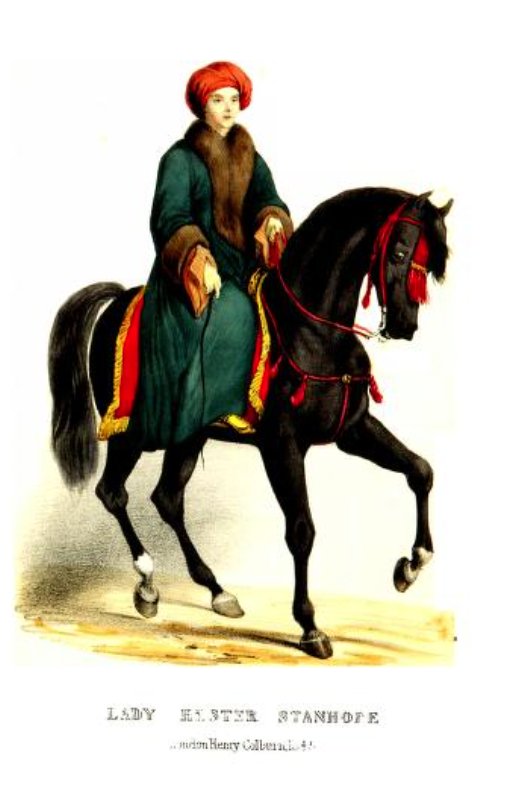
At this point she adopted the Turkish dress of the Ottoman Empire. She explains why she chose men’s clothing:
. . . Everything I possessed I have lost; had I attempted to have saved anything, others would have done the same, and the boat would have been sunk. To collect clothes in this part of the world to dress as an Englishwoman would be next to impossible; at least, it would cost me two years’ income. To dress as a Turkish woman would not do, because I must not be seen to speak to a man; therefore I have nothing left for it but to dress as a Turk — not like the Turks you are in the habit of seeing in England, but as an Asiatic Turk in a travelling dress — just a sort of silk and cotton shirt; next a striped silk and cotton waistcoat; over that another with sleeves, and over that a cloth short jacket without sleeves or half-sleeves, beautifully worked in coloured twist, a large pair of breeches, and Turkish boots, a sash into which goes a brace of pistols, a knife, and a sort of short sword, a belt for powder and shot made of variegated leather, which goes over the shoulder, the pouches the same, and a turban of several colours, put on in a particular way with a large bunch of natural flowers on one side. This is the dress of the common Asiatic; the great men are covered with gold and embroidery, and nothing can be more splendid and becoming than their dress. (Life and Letters of Lady Hester Stanhope, 116-117)
The clothes sound quite sumptuous, and she seems to have enjoyed them! As a foreign woman, and a woman in men’s clothing, Lady Hester occupied an unusual place in Ottoman society. She could be treated as more or less an “honorary man,” relating to local men in ways that local women could not.
Egypt to Palmyra
Lady Hester traveled deeper into the Middle East. She wasn’t much impressed with the wonders of Egypt. She refused to enter the Great Pyramid and complained of “an inconceivable number of fleas.” Many English tourists visited Egypt, and she wanted to do something more impressive.
Because of her background with Pitt in politics, and her connections, she was able to get permission from the Ottoman Pasha to go to Palmyra, an ancient city in the Syrian desert. When she reached it with her Beduin caravan after six days of travel, they “crowned” her “Queen of the Desert,” after the ancient Queen Zenobia.
During her travels, Lady Hester constantly racked up debts, and wrote back to the English government asking for money. They sometimes ended up paying because of her high connections.
Archaeologist; Searching for Treasure
Emma Yandle, curator of the Chawton House exhibition on “Trailblazers: Women Travel Writers,” went on to discuss Lady Hester Stanhope’s somewhat questionable contributions to archaeology. Lady Hester was arguably the first Westerner given official permission to excavate an ancient site; certainly she was the first woman to do so.
Lady Hester somehow obtained a manuscript, purportedly written by a monk, describing the location of immense hoards of buried treasure (three million gold coins!) in the ancient cities of Ashkelon, Awgy (near Jaffa), and Sidon. She got permission and safe conduct letters from the Ottoman government to excavate at Ashkelon. She promised the Ottoman government all the treasure she would find. She asked the British government to pay for the excavations, simply for the honor it would bring to England and to herself.
Excavations began in April of 1815. Lady Hester was the visionary, nominally in charge. Actually, though, her personal physician, Dr. Charles Meryon, directed the excavations and kept the records. They found no gold coins.
They did, however, find one archaeological treasure. It appeared to be a Roman statue, somewhat mutilated. According to a later biography, this made Lady Hester Stanhope “the first person who ever intentionally excavated an ancient artifact in the ‘Holy Land.’”
However, Lady Hester feared that if the Ottoman ruler heard about this, he would believe that she was excavating treasures to send back to her native England. She had promised she would not do that. (Many others of the time were plundering the various countries they colonized.) So—she destroyed the statue! She had it smashed and thrown into the sea. A very strange decision.
We still have drawings and a description of the statue, but that’s all. A much later archaeological expedition, in 1921, found what were apparently the missing pieces of that statue.
The records of the expedition, however, gave a lot of historical information. The layers of history that were uncovered were recorded: a Roman temple at the lowest layer, above it a church, and over that a mosque. (This was confirmed by the later expedition.) They also recorded the locations of any artifacts found. This was a new procedure. Other diggings at the time simply took whatever they could find and shipped it off to museums or private collections, with no details of location or depth. So Lady Hester’s excavation did blaze new trails for archaeology.
End of Life
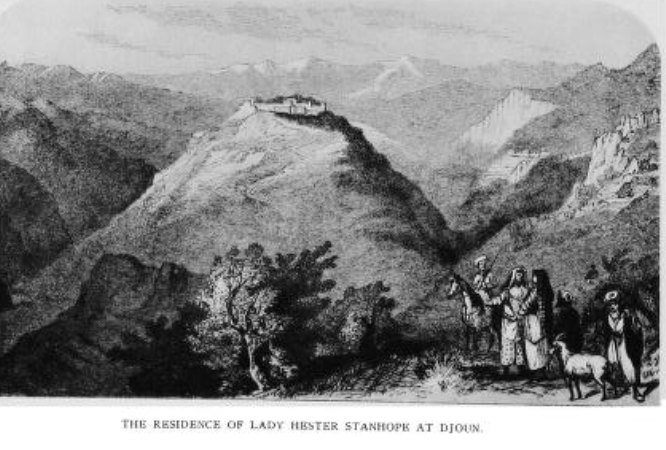
Lady Hester Stanhope later settled on a mountaintop among the Druze people of Lebanon, near Sidon. She became disastrously involved in Middle Eastern conflicts, and went deeper and deeper into debt. She died, penniless and alone, in 1839.
Dr. Meryon, who had accompanied her on many of her travels, wrote her memoirs in 1845-6, romanticizing her story.
Paul Pattison, at English Heritage, summarizes Lady Hester Stanhope’s life:
She was always a wilful aristocrat, who wanted to govern her life and the lives of others – indeed believed it was her position in life to do so – and on occasions she was overbearing and unkind. But she was also vivacious, daring, sharp-witted, charismatic, benevolent, and brave to the point of recklessness.
Above all, she rejected society conventions and the restrictions of life for a woman in Europe, embracing the unexpected opportunity to be her own mistress within an Eastern culture that excluded women from public life. That alone sets her apart as a pioneer and an extraordinary human being.
As far as I’ve been able to discover, Jane Austen never mentioned Hester Stanhope in her letters. She may have known of some of her exploits, however. Both were trailblazers: Jane, quietly, from her home; and Hester, flamboyantly, in exotic places.
Resources about Lady Hester Stanhope
Memoirs of the Lady Hester Stanhope; the sequel, Travels of Lady Hester Stanhope; and Life and Letters of Lady Hester Stanhope, are available on archive.org.
Lady Hester, Queen of the East, by Lorna Gibb
Star of the Morning: The Extraordinary Life of Lady Hester Stanhope, by Kirsten Ellis
Brenda S. Cox is the author of Fashionable Goodness: Christianity in Jane Austen’s England. She also writes for Faith, Science, Joy, and Jane Austen.







 Jane Austen's World
Lady Hester Stanhope is encountered in Kinglake’s ‘Eothen’ They were an important cluster of families and associates including the Pitts.
Fascinating. She was an amazing woman! I first became aware of her through references in Mary Stewart’s novel “The Gabriel Hounds” set in Lebanon. A fun read.
What a fascinating woman.
denise
Hello, I have always enjoyed reading about characters with the name ‘Hester’ and I happened to be reading this wonderful thriller titled: The Tenant by Katrine Engberg and the focal character is named Hester…it is a story that takes place in Copenhagen and I find that I am liking it very much despite some of the gores. I know my contribution is trite but I try. Thank you for sharing.